Fitbit AI Coach will read your medical records next month as Google pushes deeper into healthcare


5 Sources
5 Sources
[1]
Fitbit lets you upload medical records and ask its AI for advice now - but is that safe?
Its AI health coach reviews these records to generate responses. The era of the AI-powered health coach is in full swing, and now, it's moving into medical territory. Google is one of the latest tech companies leading this AI-powered charge. On Tuesday, it announced updates to Fitbit's personal health coach that will further integrate medical data with AI. Fitbit users will soon be able to connect their medical records to the Fitbit app for the personal health coach's review. The AI-powered health coach can contextualize and use this data in response to health questions. The data includes lab results, medications, and visit history, according to a press release from Google, Fitbit's owner. Other smaller wearable health technology companies have offered similar features through their own apps. This includes the fitness band company Whoop, which lets you upload records to the app and then use the Whoop AI to ask it questions. "When your coach understands your medical history, its guidance becomes safer, more relevant and more personalized," Google said in a press release. The feature comes at a time when more people are turning to AI for guidance on everything from task management to health regimens. Eight in 10 US adults go online to look up health information, and over two-thirds of Americans find the information reliable. Meanwhile, some medical professionals worry that this over-reliance on AI for health information could lead patients to self-diagnosis or incorrect treatment. Also: Asking AI for medical advice? There's a right and wrong way, one doctor explains Google said that by connecting medical data to Fitbit, the personal health coach's responses and advice are more personalized to the user. If a user is curious about the implications of a recent lab test, they can now query the AI for help. And when a Fitbit user asks the personal health coach how to improve their cholesterol, the AI can use the medical data and lifestyle patterns (such as sleep, diet, and activity) recorded on Fitbit for helpful responses and advice. When a conversation goes too far into medical territory, Google said that the AI coach will remind users to consult with a healthcare professional for medical needs. In other words, it's not going to give medical advice, diagnose, or offer a treatment plan. The feature will arrive next month. Perhaps you're reading this news and scratching your head, worrying about the privacy implications of connecting your health records to a consumer wearable device owned by Google. Google said that medical records are securely stored within Fitbit, and users will have control over their use. Google didn't specify whether that data will be stored on-device or within Fitbit's servers. Also: OpenAI, Anthropic, and Google all have new AI healthcare tools - here's how they work Florence Thng, Google's Health Intelligence product management director, said in the press release that users' medical records, like other health data in Fitbit, are not used for ads. Chatbots have a tendency to hallucinate or make up information, and this could pose a risk to Fitbit users asking the coach for questions or advice about their health. Google acknowledged large language models' limitations in an email with ZDNET. It said it is committed to improvement and evaluation. "We acknowledge that Large Language Models can have limitations, including potential inaccuracies and hallucination. To address this, we invest heavily in a validation process to enhance the quality of our models. This involves ongoing evaluations and the use of advanced architectures that rely on tools and self-critique to improve reliability and reduce the chance of inaccurate responses," a Google spokesperson said in an email. Google is bringing another health device to its ecosystem for Fitbit users to try out. Starting next month in public preview, users will be able to connect a continuous glucose monitor to Fitbit and query the health AI for insights into their blood sugar trends after a meal or workout. Also: Are AI health coach subscriptions a scam? My verdict after testing Fitbit's for a month The company also announced an increase in its sleep staging accuracy, which will soon roll out to public preview users. These sleep staging models can better predict differences between naps, interruptions, and sleep stage transitions. The new sleep stage feature will roll out in public preview over the next few days.
[2]
Fitbit's AI Coach Improves Sleep Tracking, Can Soon Read Your Medical Records
With over a decade of experience reporting on consumer technology, James covers mobile phones, apps, operating systems, wearables, AI, and more. Fitbit's AI-powered Personal Health Coach is designed to give you more personalized guidance, and various new upgrades are coming to help improve sleep and better understand your medical history. Fitbit's AI Personal Health Coach is in a public preview on both Android and iOS. These two new features join the series of upgrades available through the AI-powered feature, but you'll need to sign up for the early version of the software to access the suite of tools. The brand says it's now better at detecting when you're asleep rather than when you're tossing and turning in bed. The new datasets for training the feature are designed to better understand interruptions in your sleep pattern, transitions between sleep stages, or whether you're just napping. That then feeds into your overall Sleep Score, a feature Fitbit has had for a long time, which now better evaluates your rest by measuring how long it took you to fall asleep. Fitbit says that it can then inform its coaching features to help you build a better sleep routine. The tracking is rolling out to devices now, and its influence on Sleep Score will appear in the "coming weeks," as it needs time to monitor your data before it can implement advice. Additionally, Fitbit will soon let those on the Public Preview software share their medical records to better understand their overall health. It says it'll let you share lab results, medications, and visit history with Personal Health Coach. Google is partnering with b. well and CLEAR platforms to help you connect directly to your healthcare provider, requiring a selfie and a valid ID to access your records. It also says it believes "data privacy is key," confirming there will be options to control how your data is shared, alongside a confirmation that your health information won't be used to inform ads. Why would you want to share such private information with Fitbit's AI coach? The brand says it helps give "safer, more relevant and more personalized" guidance if you share the full picture of your health. Fitbit's marketing materials give the example of someone asking about their cholesterol levels. It says, "The coach can then summarize your cholesterol labs, highlighting notable values and trends, and provide personalized wellness information based on your medical history and wearable data." Medical record support is set to launch in the "coming months," with no clear timeline from Fitbit.
[3]
Google's AI plans for Fitbit include your medical records
The Fitbit app, owned by Google, seen here running on a Pixel watch. Credit: PATRICK T. FALLON/AFP via Getty Images It's fair to say Fitbit has been through a few changes in the eight years since I wrote about breaking up with the then-dominant wearable. Spoiler alert: I ran away with the Apple Watch and never looked back. Now here comes the ex with a new announcement, and, uh ... I guess you'd say they've had some work done? Fitbit was bought by Google for $2.1 billion back in 2019. The Fitbit co-founders left the tech giant in 2024, a few months before Google discontinued the Fitbit wearable altogether. The Google Pixel has become the default Fitbit smartwatch, and the Fitbit Charge 6 its sturdy old-school fitness tracker. Meanwhile, the Fitbit app -- where Google sells Premium subscriptions at $8 a month -- has been loaded with new features. Now, whether you like it or not, those features include feedback from Google's AI, Gemini -- or as it's called in its Fitbit flavor, Coach. The company has trialed Coach via the Android version of the Fitbit app. The test expanded last month to iOS users -- right around the same time Fitbit owners were required to have Google accounts, and the Fitbit accounts were discontinued. That deadline for switching to Google has been extended until May 19, 2026 -- doing little more than perpetuating the agony for old-school Fitbit users. All of which, apparently, makes this the perfect time for Google to invite Fitbit users to trust the company with their medical data. "When your coach understands your medical history, its guidance becomes safer, more relevant and more personalized," the company wrote in its latest Fitbit announcement. The company added: "you have control of your data and how it's used, shared or deleted. Your medical records, like other health data in Fitbit, is not used for ads." (emphasis in the original.) And if you're wondering whether to trust that claim, note that the AI features in question aren't from Google alone. Requests for health records go to b.well Connected Health, an AI platform that aggregates health data from various providers. Clear, the security platform you may know from the empty line next to the TSA queue at many airports, is another partner, allowing you to search for medical records using a valid form of ID and a selfie. So, Fitbit, you're looking well, and I see you have some new friends. We must catch up sometime. Bring my medical records? Yeah, let me think about that. I'll let you know!
[4]
Fitbit improves sleep tracking and adds an AI coach that uses your medical history
A major update lets you link lab results and medications for smarter, safer health guidance. Fitbit is pushing its app closer to a full health companion. Starting next month, you'll be able to connect your medical records, giving its AI coach access to lab results, prescriptions, and past visits. The same update also improves sleep tracking, with a reported 15 percent boost in detecting sleep stages. The changes, announced at Google's Check Up event, show how Fitbit is moving beyond basic activity tracking. By combining clinical records with wearable data, its Gemini-powered assistant aims to deliver guidance that reflects your actual health data. Instead of generic suggestions, you can ask about cholesterol and get answers tied to your real numbers. What happens when you sleep Before clinical data integration arrives, users are getting a meaningful upgrade to sleep tracking. Fitbit is rolling out a refined sleep staging model that better separates time spent trying to fall asleep from time actually asleep. Clinical validation shows a 15 percent improvement over the previous version across Pixel and Fitbit devices. There is also a redesigned Sleep Score that goes deeper into how you rest. It now looks at details like how long it takes you to fall asleep, rather than focusing only on total sleep time. The goal is to help you spot specific habits to improve your routine without guesswork. The updated tracking is available now, while the new scoring experience is expected in the coming weeks for Public Preview users. Your health data meets AI guidance The bigger shift arrives next month for Public Preview users in the US. You'll be able to connect your health records directly inside the app, bringing together information from different providers in one place. Fitbit is working with partners like b. well and CLEAR to support verification, either by searching for your provider or confirming your identity with an ID. Once connected, the AI coach can interpret that data. Ask about cholesterol, and it can summarize trends, highlight changes, and offer guidance based on both your records and wearable insights. You'll also be able to share those summaries with a doctor or family member using a QR code or Smart Health Link. Fitbit says this data is stored securely and not used for ads. Glucose tracking and what's next Additional health data is on the way. Around the same time, Public Preview users will be able to connect a continuous glucose monitor through Health Connect. That means you can ask how specific meals or workouts affect your glucose levels, based on your own data. Recommended Videos These updates build on broader research Fitbit is pursuing. A recent study published in Nature explored predicting insulin resistance using wearable signals, and the company is working with Included Health to test how conversational AI can support virtual care. The direction is clear, Fitbit is building a system that understands more about you so its guidance becomes more relevant in daily decisions.
[5]

Get a fuller picture with Fitbit's personal health coach
New updates from Fitbit across sleep, advanced research and securely linking your medical records. Improving sleep accuracy and insights We're launching our most significant update yet, delivering an additional 15% increase in sleep staging accuracy for Public Preview users. Trained on diverse, inclusive datasets, our models now better distinguish between when you are aiming to sleep and when you are asleep. These improvements more accurately capture interruptions, naps and transitions between stages, aligning with clinical gold-standard measurements. This rigorous foundation powers a reimagined, transparent Sleep Score designed to make your data more actionable. The new score evaluates specific aspects of your rest -- not only how much sound sleep you got, but how long it took you to get there. This level of detail provides targeted coaching, helping you understand exactly where to focus your routine for better recovery. This enhanced tracking rolls out over the next few days, with the new Score experience following in the coming weeks for Public Preview users. Advancing health through research A great health coach supports you holistically across your health and wellness. That's why we're investing deeply in advanced health research to expand the insights and experiences the coach can support. This week, our pioneering study on predicting insulin resistance using wearable data was published in Nature. This foundational work, alongside our ongoing Fitbit hypertension study, lets us invest in AI that better understands your cardiometabolic health and potentially enables early awareness -- allowing you to take proactive actions and the coach to help you make lifestyle adjustments. We also want to make these insights even more actionable. In the next couple of weeks, we're launching a new "Get care now" Fitbit Lab research study in partnership with Included Health, a leading U.S. healthcare provider to assess how conversational AI can help you navigate your health during virtual visits. Separately, starting next month in Public Preview, you'll be able to connect a continuous glucose monitor (CGM) through Health Connect and ask your coach how a specific workout or even that slice of pizza actually impacts your glucose levels. Getting a fuller picture of your health
Share
Share
Copy Link
Google announced that Fitbit users can soon connect medical records to its AI-powered health coach for personalized guidance. The update includes lab results, medications, and visit history integration, alongside a 15% improvement in sleep tracking accuracy. While Google promises data privacy and says health information won't be used for ads, concerns remain about AI hallucinations and over-reliance on chatbots for medical advice.
Fitbit Integrates Medical Records with AI Coach
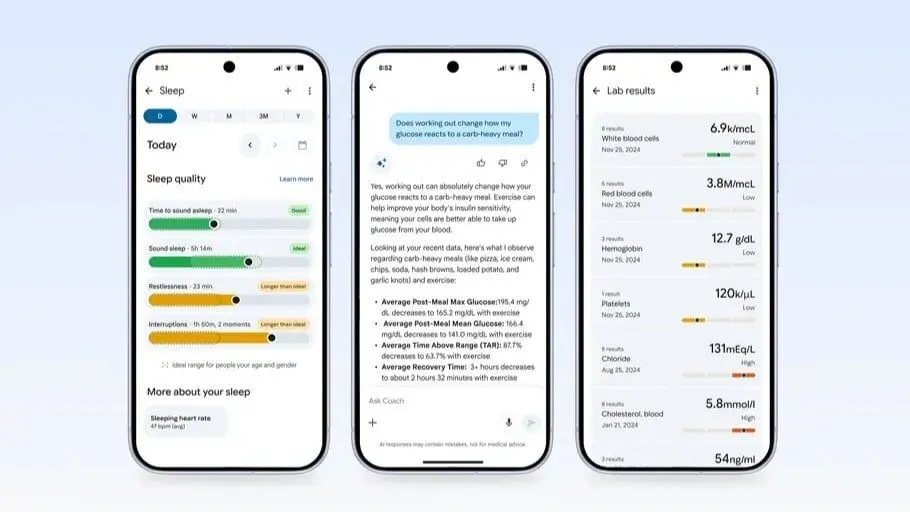
Google is expanding the capabilities of Fitbit's AI-powered health coach by allowing users to connect their medical records directly to the app starting next month
1
. The AI Coach will access lab results and medications, visit history, and other clinical data to provide personalized health guidance that considers both medical history and wearable data collected from Fitbit devices2
. This feature, powered by Google's Gemini AI, aims to contextualize health questions with actual medical information rather than offering generic suggestions4
.
Source: PC Magazine
The health data integration represents a significant shift in how consumer wearables interact with clinical information. Google is partnering with b.well Connected Health and Clear platforms to facilitate secure connections to healthcare providers
2
. Users will need to verify their identity using a selfie and valid ID to access their records through these partner platforms3
. When users ask about specific health concerns like cholesterol levels, the AI Coach can summarize lab trends, highlight notable values, and provide wellness information based on both medical records and lifestyle patterns tracked by the device1
.Google's AI Plans Include Improved Sleep Tracking
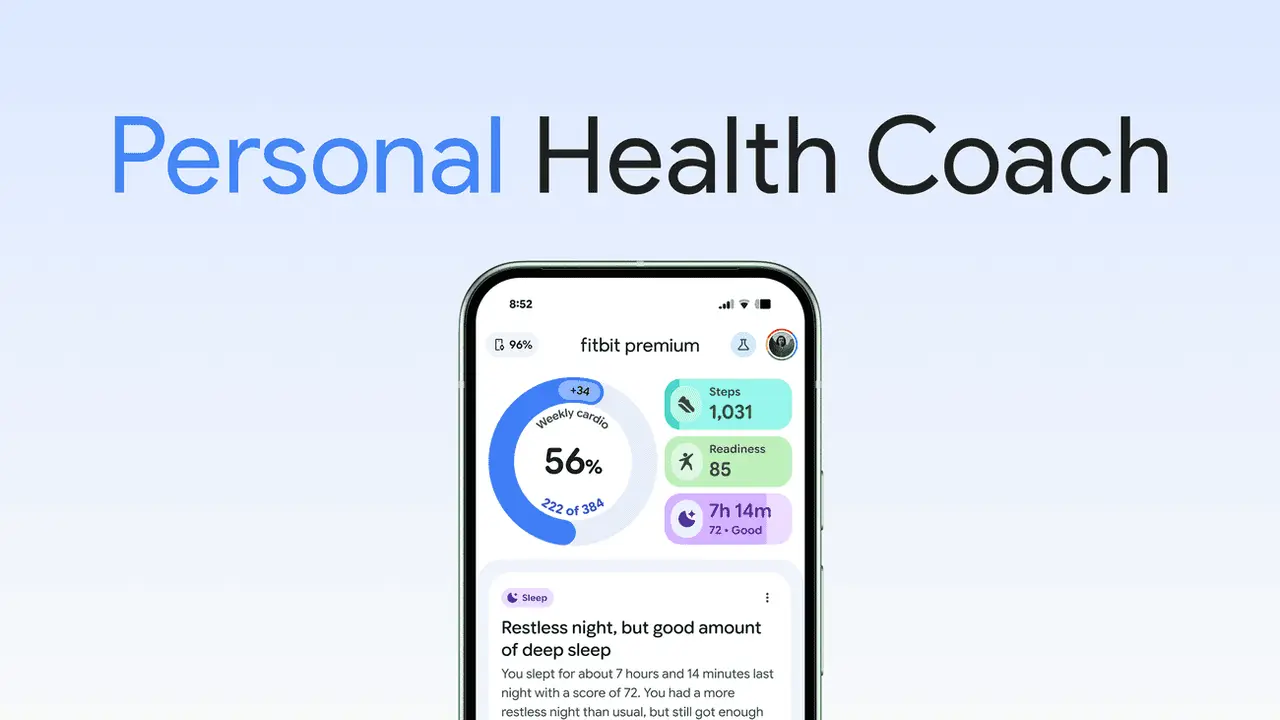
Before the medical records feature arrives, Fitbit is rolling out significant improvements to sleep tracking with a reported 15% increase in sleep staging accuracy for Public Preview users
4
. The improved sleep tracking uses refined models trained on diverse datasets to better distinguish between attempting to sleep and actually sleeping5
.
Source: Google
These models more accurately capture interruptions, naps, and transitions between sleep stages, aligning with clinical gold-standard measurements
5
.The redesigned Sleep Score now evaluates specific aspects of rest, including how long it takes to fall asleep rather than focusing solely on total sleep time
4
. This level of detail enables the AI Coach to provide targeted coaching, helping users understand exactly where to focus their routine for better recovery5
. The enhanced tracking is rolling out now to Pixel Watch and Fitbit devices, with the new Sleep Score experience expected in the coming weeks2
.Data Privacy Concerns and AI Limitations
The announcement raises questions about data privacy, particularly given Google's ownership of Fitbit since 2019
3
. Google states that medical records are securely stored within Fitbit and users maintain control over how their data is used, shared, or deleted1
. The company emphasizes that medical records, like other health data in Fitbit, are not used for ads2
. However, Google did not specify whether this data will be stored on-device or within Fitbit's servers1
.The integration of large language models with medical information presents risks, as chatbots have a tendency to hallucinate or generate inaccurate information
1
. Google acknowledges these limitations and says it invests heavily in validation processes to enhance model quality through ongoing evaluations and advanced architectures that rely on tools and self-critique to improve reliability1
. When conversations venture too far into medical territory, the AI Coach will remind users to consult with healthcare professionals for medical needs, indicating it won't provide medical advice, diagnoses, or treatment plans1
.Related Stories
Continuous Glucose Monitor and Virtual Care Integration
Google is expanding health data integration beyond medical records. Starting next month in Public Preview, users will be able to connect a continuous glucose monitor through Health Connect and ask the AI Coach how specific meals or workouts impact glucose levels
1
. This feature allows users to query their wearable data alongside real-time glucose monitoring for more comprehensive health insights4
.Fitbit is also launching a "Get care now" research study in partnership with Included Health to assess how conversational AI can help users navigate virtual care during healthcare visits
5
. This research builds on Fitbit's pioneering study on predicting insulin resistance using wearable data, recently published in Nature, which explores how AI can better understand cardiometabolic health and enable early awareness5
. The direction is clear: Fitbit is building a system that combines clinical data with wearable data to deliver more relevant personalized health guidance in daily decisions4
.References
Summarized by

Navi
[4]
Related Stories
Google Unveils AI-Powered Personal Health Coach for Fitbit, Revolutionizing Fitness Tracking
21 Aug 2025•Technology

Fitbit AI health coach expands to iOS users globally as Apple scales back health plans
10 Feb 2026•Technology

Fitbit Labs Introduces AI-Powered Health Features to Enhance User Experience
13 May 2025•Technology

Recent Highlights


Recent Highlights
Today's Top Stories





Your Daily Dose of Curated AI News
Don’t drown in AI news. We cut through the noise - filtering, ranking and summarizing the most important AI news, breakthroughs and research daily. Spend less time searching for the latest in AI and get straight to action.

