Google accidentally leaks Aluminium OS, showing Gemini AI at the center of its new desktop vision


2 Sources
2 Sources
[1]
Leak shows Google's new Aluminium OS in action for the first time
The leaked interface showcases Gemini AI as a central feature and includes Google Play Store access, promising an AI-centric cross-platform experience. Google is planning to replace ChromeOS -- the operating system that currently powers Chromebooks -- with a new one called Aluminium OS. It promises to combine the strengths of ChromeOS and Android into a single, cross-platform operating system... and though it's far from an official release, we just caught a first glimpse of it thanks to a leak. 9to5Google was able to see official images of Aluminium OS in a Google bug report. These show the first real pictures of the OS's interface and other elements, such as the status bar. The images were taken on an HP Elite Dragonfly 13.5-inch Chromebook with a split screen. Google reacted quickly and removed the images from the report, but not before the editor shared a video with the public. Here's what Aluminium OS looks like Unsurprisingly, Aluminium OS looks like a mixture of Android 16 and the current ChromeOS. Although you can't see much in the relatively short clip, this first glance is still pretty interesting. The taskbar and start screen, which are reminiscent of Android 16's desktop mode, are particularly striking. For a brief moment, the Google Play Store also opens, providing a glimpse of available apps. Right at the top of the list of pre-installed applications is Google's AI assistant Gemini, which will also play a central role in Aluminium OS. While Chromebooks are optimized for AI use, Aluminium OS is designed to run on more devices than merely Chromebooks, including tablets and smartwatches made by Google and other companies. The video also shows the process of updating apps in Aluminium OS, in this case Chrome. The update runs quickly and apparently without closing or restarting the application in the meantime, which is a significant improvement over how ChromeOS handles things. When will Aluminium OS be released? Aluminium OS is set to be a long-term replacement for ChromeOS. As of this writing, there's no known launch date for the new operating system, nor a timetable for the phase-out of its predecessor. Nevertheless, Google promises to continue supporting ChromeOS for a while to come -- even after Aluminium OS is released.
[2]
Google accidentally leaks first look at Android PC OS online: What to expect
In November last year, reports of Google working to bring ChromeOS and Android together were in full swing. A job posting spotted by a couple of tech portals further added fuel to the fire. And now, Google seems to have accidentally given away some more information. A new leak from the tech giant has revealed the first real look at Aluminium OS in action, offering early clues about how Google intends to merge Android and ChromeOS into a single, unified platform. While the company has not acknowledged the software publicly, a leaked video paints a convincing picture of Android evolving into a true desktop class operating system. Read on to know more. Also read: Google Aluminium OS explained: What it is and everything we know so far Leaked video of Aluminium OS shows Android and ChromeOS in a desktop-first design The images and short screen recordings appeared briefly in a Google Issue Tracker bug report before Google quickly removed them. However, till then, 9to5Google had already captured and shared the material. According to 9to5Google, the footage was recorded on an HP Elite Dragonfly Chromebook, suggesting Google is already testing Aluminium OS on existing Chromebook hardware rather than specialised prototypes. That detail alone hints at how serious the company is about making this transition as seamless as possible. In addition to this, the leak also not only confirms the existence of Aluminium OS, but also that it is already functional enough to be used in real world testing scenarios. The recordings reference Android 16 builds internally labelled ALOS, a name previously linked to Google's long term ChromeOS replacement strategy. At first glance, Aluminium OS looks like exactly what many expected. A hybrid that borrows the flexibility of Android while retaining the productivity focused layout of ChromeOS. The interface shown in the leaked video features a desktop style taskbar, split screen multitasking, and windowed apps running side by side. Chrome appears to behave more like a native desktop application rather than a browser constrained by mobile style limitations. One subtle but important change is the positioning of the start button, which now sits at the centre of the taskbar rather than the corner. A taller status bar stretches across the top of the screen, displaying connectivity, battery information, time down to the second, and indicators for background processes such as screen recording. These may sound like small tweaks, but together they signal a clear shift towards a more PC like experience. The Google Play Store is also visible in the clip, reinforcing that Android apps will remain a core part of the experience. More importantly, Gemini appears to be deeply integrated, positioned not as an add on but as a central system level feature. About Aluminium OS According to earlier reports, Aluminium OS is Google's codename for its new Android-based desktop operating system. A Google job listing, spotted by Android Authority and later referenced by Mashable and The Verge last year, mentioned a senior product manager role focused on a new Aluminium platform built for laptops, detachables, tablets, and PC-like devices. It also used the acronym ALOS, which likely stands for Aluminium Operating System. The naming choice itself is a fun detail. The Verge pointed out at the time that the British spelling seems to be a nod to Chromium, the open source base of ChromeOS, while also highlighting Android as the foundation. WeAreTenet added more context, explaining that Aluminium OS is designed to make big screen devices feel more intuitive, more connected, and more scalable than what ChromeOS can do today. It is expected to offer deeper system wide AI features powered by Gemini, smarter multitasking, and better integration across phones, tablets, and laptops. What devices will run Aluminium OS? Beyond laptops, Aluminium OS is reportedly being designed to run across multiple device categories, including tablets and even smartwatches. That opens the door to a genuinely unified Google platform, where apps, updates, and AI features behave consistently regardless of screen size or form factor. For now, Google remains silent on timelines. There is no confirmed launch window, nor any indication of when ChromeOS might begin its gradual phase out. What is clear, however, is that Aluminium OS is no longer just a concept. It is running, being tested, and quietly evolving behind the scenes. With Google I O expected later this year and Android leadership already teasing major updates ahead, it may not be long before Aluminium OS steps out of the shadows. If this leak is any indication, Google's vision for Android on PCs is far more ambitious than a simple ChromeOS refresh.
Share
Share
Copy Link
Google's upcoming Aluminium OS appeared in a leaked bug report, offering the first real glimpse of how the company plans to merge Android and ChromeOS. The footage reveals a desktop-style interface with Gemini AI positioned as a central feature, Google Play Store access, and improved app updates—all tested on existing Chromebook hardware.
Google's Accidental Leak Reveals Aluminium OS in Action
Google Aluminium OS has surfaced in an unexpected leak, providing the first confirmed look at the new Google operating system designed to replace ChromeOS. The leaked first look at Aluminium OS appeared briefly in a Google bug report before being swiftly removed, but not before
9to5Google
captured images and video footage that reveal significant details about the platform's direction1
. The footage was recorded on an HP Elite Dragonfly 13.5-inch Chromebook, indicating Google is already testing the system on existing Chromebook hardware rather than specialized prototypes2
. This bug report leak confirms that Aluminium OS is functional enough for real-world testing scenarios, marking a significant milestone in Google's platform strategy.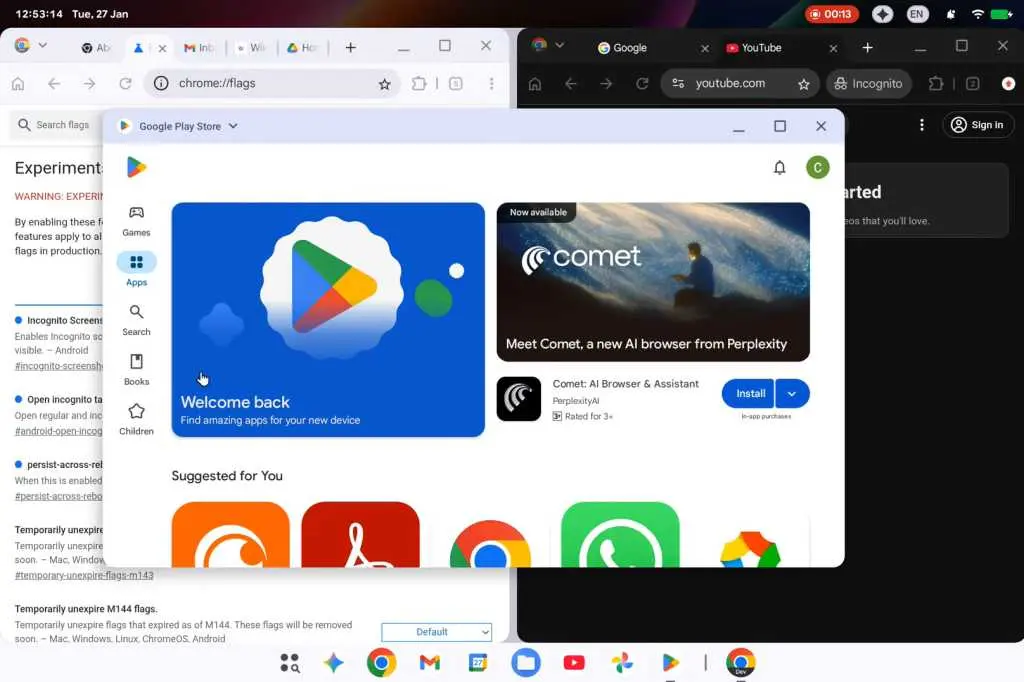
Source: PCWorld
How Aluminium OS Merges Android and ChromeOS
The leaked footage demonstrates how Google Aluminium OS combines elements from both Android 16 and ChromeOS into a unified desktop platform. The user interface showcases a desktop-style interface with a taskbar and start screen reminiscent of Android 16's desktop mode, but with clear productivity enhancements
1
. One notable change positions the start button at the center of the taskbar rather than the corner, while a taller status bar displays connectivity, battery information, time down to the second, and indicators for background processes such as screen recording2
. The video also reveals windowed apps running side by side with split-screen multitasking capabilities, signaling a clear shift toward a PC-like experience. The Google Play Store appears prominently in the clip, confirming that Android apps will remain integral to the experience as this Android PC OS evolves.Gemini AI Integration Takes Center Stage
Gemini AI sits at the top of the list of pre-installed applications in the leaked footage, positioned not as an add-on but as a central system-level AI feature
1
. This Gemini AI integration reflects Google's ambition to deliver AI capabilities that extend beyond current Chromebooks optimization. The positioning suggests that Aluminium OS will offer deeper system-wide AI features powered by Gemini, enabling smarter multitasking and better integration across multiple device types2
. While Chromebooks have been optimized for AI use, Aluminium OS is designed to run on tablets, smartwatches, and other devices made by Google and partner companies, creating a genuinely unified experience where AI features behave consistently regardless of screen size or form factor.Related Stories


Improved Performance and Device Compatibility
The leaked video showcases a significant improvement in how the ChromeOS replacement handles app updates. When Chrome updates in the footage, the process runs quickly without closing or restarting the application—a notable enhancement over how ChromeOS currently manages updates
1
. This attention to seamless performance suggests Google is addressing long-standing pain points in its current operating system. The recordings reference Android 16 builds internally labeled ALOS, a name previously linked to Google's long-term strategy for replacing ChromeOS2
. Device compatibility extends beyond traditional laptops to include tablets and smartwatches, opening the door to a truly unified Google platform where apps, updates, and AI features work consistently across all hardware.What This Means for the Future of Google's Platform Strategy
While Google has not announced a launch date for Aluminium OS or a timeline for phasing out ChromeOS, the company promises to continue supporting ChromeOS even after the new operating system releases
1
. The fact that Aluminium OS is already running on existing Chromebook hardware suggests the transition may be more seamless than anticipated. With Google I/O expected later this year and Android leadership teasing major updates, Aluminium OS may step out of the shadows sooner rather than later2
. For users invested in Google's ecosystem, this development signals a future where phones, tablets, laptops, and wearables operate within a cohesive environment powered by advanced AI capabilities. The leak indicates that Google's vision for Android on PCs extends far beyond a simple refresh—it represents an ambitious reimagining of how desktop computing should work in an AI-first era.References
Summarized by

Navi
Related Stories
Recent Highlights



Recent Highlights
Today's Top Stories







Your Daily Dose of Curated AI News
Don’t drown in AI news. We cut through the noise - filtering, ranking and summarizing the most important AI news, breakthroughs and research daily. Spend less time searching for the latest in AI and get straight to action.

