Intel launches Panther Lake vPro platform with AI capabilities to reclaim commercial PC market


2 Sources
2 Sources
[1]
Intel officially releases Xeon 600 chips, announces new vPro Panther Lake CPUs -- 'all-new' vPro platform goes all-in on AI
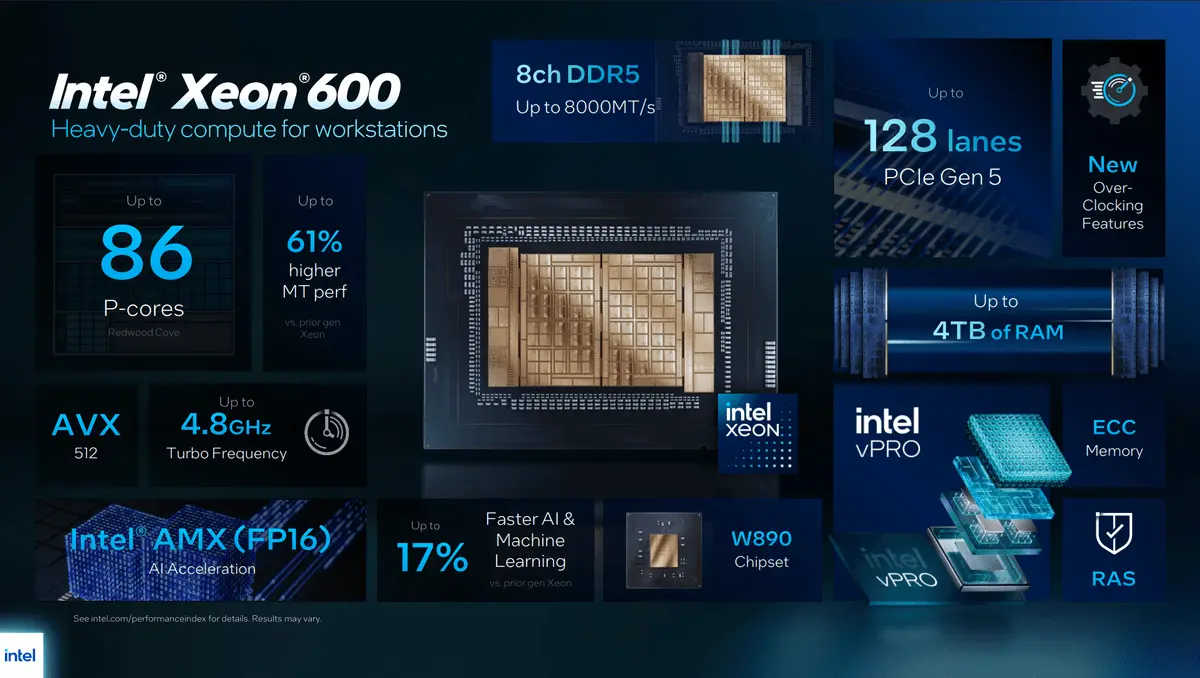
OEM and retail units are now available, plus new W890-chipset motherboards. After revealing them last month, Intel has officially launched its Xeon 600 range of workstation CPUs. Previously known as Granite Rapids-WS, the range includes 11 SKUs, five of which will be available in boxed retail units. The chips support Intel's updated vPro platform, alongside a range of Panther Lake chips that are now certified for business use with vPro. Intel hasn't shared new benchmarks for its Xeon 600 CPUs, still leaning on a claim of up to 61% faster multithreaded performance and up to 9% better single-threaded performance compared to last-gen Sapphire Rapids-WS chips. The news is that Xeon 600 CPUs are now available, starting at $499 and going up to $7,699. That includes OEM systems, boxed retail units, and motherboards with the new W890 chipset; though, Intel says you need to check with individual retailers on specific SKU availability. As a recap, Xeon 600 are supported on the new W890 chipset, supporting up to 4TB of ECC memory in eight channels at up to 8000MT/s. The platform also supports up to 128 PCIe 5 lanes. For the chips themselves, they scale up to 86 scores using the Redwood Cove microarchitecture. Xeon 600 chips exclusively use the P-core design, with support for Hyper-Threading. They also come with Intel AMX in each core, with support for FP16 instructions to accelerate AI workloads, along with AVX-512 support. As a recap, Xeon 600 are supported on the new W890 chipset, supporting up to 4TB of ECC memory in eight channels at up to 8000MT/s. The platform also supports up to 128 PCIe 5 lanes. For the chips themselves, they scale up to 86 scores using the Redwood Cove microarchitecture. Xeon 600 chips exclusively use the P-core design, with support for Hyper-Threading. They also come with Intel AMX in each core, with support for FP16 instructions to accelerate AI workloads, along with AVX-512 support. Alongside Xeon 600, Intel is launching Core Ultra Series 3 (formerly known as Panther Lake) chips for businesses with vPro certification. The lineup is slimmer compared to the client Core Ultra Series 3 stack, but the specs are identical. The difference, of course, is Intel vPro support. Like the client stack, Core Ultra Series 3 processors with vPro support up to 96GB of LPDDR5 memory and up to 12 PCIe 5 lanes. The SoC is the first to use Intel's 18A node on the compute tile, which combines Cougar Cove P-cores with Darkmont E-cores. The chips also come with Intel's latest NPU 5 AI accelerator and an Xe3 iGPU with up to 12 cores. As we've seen with devices like the Asus Zenbook Duo, the iGPU is where Core Ultra Series 3 processors really earn their stripes, particularly the X-series models with the full 12 Xe3 cores. You can see that from Intel's internal benchmarks, as well. The Core Ultra X7 358H holds some victories over AMD's competing Ryzen AI 9 HX PRO 375 in general productivity workloads, but it runs away with graphics performance. Intel also claims significantly higher AI performance in Geekbench AI 1.6. Keep in mind, however, that Geekbench is a pure benchmark; it isn't a real-world workload. Intel details 'all-new' vPro platform Both Xeon 600 and Core Ultra Series 3 chips for business support Intel's updated vPro platform, which includes a handful of new features. For starters, Intel is expanding what vPro covers with the vPro Certified Apps and Accessories Program. As the name suggests, Intel is working with ISVs and OEMs to validate applications and accessories for vPro use. On the application side, Intel says vPro certification means apps are "optimized for battery life and performance," while for accessories, they're "certified for seamless connectivity." Through early engagements with ISVs, Intel says it's seen up to a 59% reduction in CPU utilization in FlexxAgent (an endpoint application for centralized IT management) with vPro optimizations, a 56% improvement in power efficiency in Riverbed Aternity (an employee management platform), and a 74% reduction in background activity in Absolute Secure Endpoint. Alongside these applications, Intel says it has partnerships with ESET, Citrix, and Crowdstrike, among others, along with Dell, HP, Jabra, Lenovo, and Logitech on the accessories front. Also new is Intel Device IQ, which is enabled through Lakeside, Riverbed, Control Up, and Flexxible software. Intel says Device IQ "collects PC telemetry, [and] uniquely applies local AI to trigger remediation directly on the device." On the security front, Intel has added its Total Storage Encryption (TSE) feature to vPro, alongside Intel Threat Detection Technology. The latter can detect malware in real-time using AI, says Intel. On the NPU, Intel announced support for CrowdStrike Falcon Data Protection, using the onboard AI capabilities to protect sensitive data during agentic AI workloads (we've certainly seen those workloads go wrong in the past). Finally, Intel is extending the servicing window for Core Ultra Series 3 machines with vPro to 10 years. Intel says it has over 125 designs for Panther Lake machines that support vPro, including the usual names like Acer, Asus, Dell, and HP, alongside more commercial-focused OEMs like Fujitsu, Panasonic Connect, and Dynabook. Designs start rolling out on March 31. Follow Tom's Hardware on Google News, or add us as a preferred source, to get our latest news, analysis, & reviews in your feeds.
[2]
Intel Exec: 'Panther Lake' Commercial PC Push Will Help Us Regain Market Share
Another Intel executive says the company's confidence in the Core Ultra Series 3 processors for the commercial PC market also stems from success it has seen with the integration of Intel's vPro Fleet Services with Microsoft's cloud-based Intune endpoint management solution. Intel's push to sell its new Core Ultra Series 3 "Panther Lake" chips for commercial PCs will help it regain share in the broader market segment, a company executive told CRN. The remarks by Intel executive David Feng were made ahead of the company's Wednesday launch of the Core Ultra Series 3 processors with Intel vPro, the umbrella of silicon-based management, security and optimization technologies it provides for commercial PCs. [Related: Intel Global Channel Chief On CPU Shortage: 'Everyone Is Impacted'] Commercial PCs powered by the Core Ultra Series 3 with vPro are expected to become available from OEMs starting at the end of this month. With Intel CEO Lip-Bu Tan pushing the company's latest comeback plan, the chipmaker continues to face competitive pressure from AMD. The rival grew its x86 market share in the PC segment by 4.6 points year over year to 29.2 percent against Intel's 70.8 percent in the fourth quarter of last year, according to CPU-tracking firm Mercury Research. The semiconductor giant is claiming that the Panther Lake chips can outperform AMD's Ryzen AI 300 series, in some cases by double or triple digits, while taking the crown for battery life in an x86-based laptop, reaching up to 27 hours for video streaming, 17 hours for office productivity and nine hours for a nine-pane Microsoft Teams video call. Feng, a leader within Intel's Client Computing Group, said the combination of Panther Lake's 18A manufacturing process and architectural improvements led "one important partner" to say the lineup achieved the "impossible combination, which is high-performance CPU, GPU and AI -- all with long, better battery life and power efficiency." "We're pretty happy with the product. Our OEMs are very excited about the products they're launching, so yes, we believe we're well positioned," said Feng, whose title is vice president and general manager of PC segments, in a Monday interview. Another Intel executive, Jen Larson, said the company's confidence in the Core Ultra Series 3 processors for the commercial PC market also stems from success it has seen with the integration of Intel's vPro Fleet Services with Microsoft's cloud-based Intune endpoint management solution over the past several months. Since the integration was announced last September, Intel has seen over 1,400 global customers activate vPro Fleet Services, a hosted software-as-a-service solution the company introduced last year to simplify what was previously a "cumbersome" process for enabling fleet management with vPro-based PCs, according to the executive. "If you think about the scale of fleets within those 1,400 customers, those aren't 1,400 devices. Those are 1,400 customers with massive fleets in a lot of cases," said Larson, who is general manager of commercial client segments within the Client Computing Group. With this new generation of Core Ultra processors, Intel is announcing new vPro capabilities, including a certification program for third-party applications and accessories that is meant to reduce CPU utilization, improve power efficiency and minimize the impact of background processes. Called vPro Certified, the program includes 17 vendors, including Dell Technologies, HP Inc., Logitech, Crowdstrike, Lenovo and Citrix. Larson said the new certification program will coincide with joint go-to-market efforts between Intel and such vendors through the Intel Partner Alliance program. "Channel partners can really take advantage of this combination of system devices software applications and accessory hardware [as a] complete package to offer to end customers to make it easier for them to adopt," Feng added. Other new vPro features includes Intel Device IQ, which analyzes PC telemetry data and then uses the processor's GPU or NPU to remediate device issues; Intel Total Storage Encryption, which brings hardware-level protection to Microsoft's BitLocker for the first time; and DTECT, which allows security ISVs to detect a wide range of cyber threats using an Intel-developed AI model that analyzes x86 machine code. The last feature, which is an acronym for Deep Learning Trace-Based Execution Tracker Technology, is an extension of Intel's Threat Detection Technology software development kit that allows ISVs to move security workloads to the GPU or NPU for acceleration. For the first time, Intel is also promising to provide 10 years of security updates for Core Ultra Series 3 processors with vPro as part of its security assurance program, which includes its bug bounty programs, red teams for testing vulnerabilities and security development lifecycle approach. While Larson declined to say how many years of updates Intel previously offered, she said the new move is "definitely an extension." "Where that's important are desktops that tend to have a longer lifecycle or potentially repurposed devices for some of our customers," she said. "I don't think all of our customers will leverage that, but it's nice to have an added value for certain folks."
Share
Share
Copy Link
Intel officially released its Core Ultra Series 3 Panther Lake processors with vPro certification, targeting the commercial PC market where AMD has gained ground. The chipmaker also launched Xeon 600 workstation CPUs and introduced new vPro features including a certification program for apps and accessories, promising improved power efficiency and AI-driven security capabilities.
Intel Pushes Panther Lake and vPro to Counter AMD's Market Gains
Intel has officially launched its Core Ultra Series 3 processors with vPro certification, marking a strategic push to regain market share in the commercial PC segment where AMD has made significant inroads. According to Mercury Research, AMD grew its x86 market share in the PC segment by 4.6 points year over year to 29.2 percent against Intel's 70.8 percent in the fourth quarter of last year
2
. Intel executive David Feng told CRN that the company's Panther Lake push "will help us regain share in the broader market segment," with commercial PC units expected to become available from OEMs starting at the end of this month2
.
Source: CRN
The chipmaker claims Panther Lake can outperform AMD's Ryzen AI 300 series, in some cases by double or triple digits, while achieving up to 27 hours of battery life for video streaming, 17 hours for office productivity, and nine hours for a nine-pane Microsoft Teams video call
2
. Feng noted that the combination of Panther Lake's 18A manufacturing process and architectural improvements led "one important partner" to say the lineup achieved the "impossible combination, which is high-performance CPU, GPU and AI -- all with long, better battery life and power efficiency"2
.Core Ultra Series 3 Architecture Delivers Enhanced AI Capabilities
The Core Ultra Series 3 processors for business with vPro support feature Intel's latest NPU 5 AI accelerator and an Xe3 iGPU with up to 12 cores
1
. The SoC is the first to use Intel's 18A node on the compute tile, combining Cougar Cove P-cores with Darkmont E-cores1
. The chips support up to 96GB of LPDDR5 memory and up to 12 PCIe 5 lanes1
.Intel's internal benchmarks show the Core Ultra X7 358H holds victories over AMD's competing Ryzen AI 9 HX PRO 375 in general productivity workloads while delivering significantly higher graphics performance and AI performance in Geekbench AI 1.6
1
. The iGPU represents a particular strength for Core Ultra Series 3 processors, especially the X-series models with the full 12 Xe3 cores1
.vPro Certified Program Promises Optimized Power Efficiency
Intel is expanding what vPro covers with the vPro Certified Apps and Accessories Program, working with ISVs and OEMs to validate applications and accessories for vPro use
1
. Intel says vPro certification means apps are "optimized for battery life and performance," while accessories are "certified for seamless connectivity"1
.Through early engagements with ISVs, Intel reports seeing up to a 59% reduction in CPU utilization in FlexxAgent, a 56% improvement in power efficiency in Riverbed Aternity, and a 74% reduction in background activity in Absolute Secure Endpoint
1
. The program includes 17 vendors, including Dell Technologies, HP Inc., Logitech, CrowdStrike, Lenovo, and Citrix2
.Related Stories

Device IQ and AI-Driven Security Features Target Enterprise Needs
Intel introduced Device IQ, enabled through Lakeside, Riverbed, Control Up, and Flexxible software, which "collects PC telemetry, [and] uniquely applies local AI to trigger remediation directly on the device"
1
. The feature analyzes PC telemetry data and uses the processor's GPU or NPU to remediate device issues2
.On the security front, Intel added its Total Storage Encryption (TSE) feature to vPro, bringing hardware-level protection to Microsoft's BitLocker for the first time
2
. Intel Threat Detection Technology can detect malware in real-time using AI, while on the NPU, Intel announced support for CrowdStrike Falcon Data Protection, using onboard AI capabilities to protect sensitive data during agentic AI workloads1
. DTECT (Deep Learning Trace-Based Execution Tracker Technology) allows security ISVs to detect a wide range of cyber threats using an Intel-developed AI model that analyzes x86 machine code2
. Intel is also promising to provide 10 years of security updates for Core Ultra Series 3 processors with vPro2
.Xeon 600 Workstation CPUs Now Available for AI Workloads
Alongside the Panther Lake launch, Intel officially released its Xeon 600 range of workstation CPUs, previously known as Granite Rapids-WS
1
.
Source: Tom's Hardware
The range includes 11 SKUs, five of which will be available in boxed retail units, with pricing starting at $499 and going up to $7,699
1
. Intel claims up to 61% faster multithreaded performance and up to 9% better single-threaded performance compared to last-gen Sapphire Rapids-WS chips.Xeon 600 chips are supported on the new W890 chipset, supporting up to 4TB of ECC memory in eight channels at up to 8000MT/s, with up to 128 PCIe 5 lanes
1
. The chips scale up to 86 cores using the Redwood Cove microarchitecture and exclusively use the P-core design with Hyper-Threading support1
. They come with Intel AMX in each core, with support for FP16 instructions to accelerate AI workloads, along with AVX-512 support1
.References
Summarized by

Navi
[1]
Related Stories
Intel Unveils New AI-Powered Core Ultra Series 2 Processors with vPro for Enterprise PCs
06 Mar 2025•Technology

Intel Unveils Core Ultra 2 "Lunar Lake" Processors: A Leap in AI and Mobile Computing
04 Sept 2024

Intel Panther Lake debuts as first AI chip built on 2nm 18A process at CES 2026
05 Jan 2026•Technology
Recent Highlights
1
OpenAI shuts down Sora video app after six months, ending Disney's $1 billion investment deal
Technology

2
AI-Generated Val Kilmer to Posthumously Appear in As Deep as the Grave After His Death
Entertainment and Society

3
Supermicro Co-Founder Indicted in $2.5 Billion Nvidia AI Chip Smuggling Scheme to China
Policy and Regulation

Recent Highlights
Today's Top Stories




Your Daily Dose of Curated AI News
Don’t drown in AI news. We cut through the noise - filtering, ranking and summarizing the most important AI news, breakthroughs and research daily. Spend less time searching for the latest in AI and get straight to action.

