Intel brings XeSS 3.0 frame generation to older Arc GPUs, but keeps code proprietary


3 Sources
3 Sources
[1]
Intel shares XeSS 3.0 SDK for game devs with 3x and 4x MFG modes -- but it still hasn't followed through on its open-source promise
Intel has just published the SDK for XeSS 3.0 -- the latest iteration of the company's in-house AI upscaler. XeSS 3's highlight feature is support for 3x and 4x multi-frame gen (XeMFG), similar to Nvidia's DLSS MFG available on RTX 50-series GPUs. But community developers hoping to use Intel's upscaling innovations in downstream projects will continue to be disappointed. The SDK is now available as Windows binaries on GitHub despite Intel's promise to make XeSS open-source four years ago. Any game that already supported XeSS 2.0 will benefit from a simple upgrade process. According to Intel, devs just need to swap the old .dll files for the new ones. The in-game settings UI also needs to be updated to reflect 3x and 4x MFG options instead of just an on/off toggle like before. Intel has continued to keep its upscaling suite closed source with version 3.0, providing no source code for streamlined injection. To be fair, this practice extends across cutting-edge upscaling tech from all vendors. While AMD has generally made FSR versions prior to 4.x available as open-source, the company has held FSR 4 much closer to the chest, including holding back an official INT8 fallback for older hardware that only exists due to inadvertently leaked source code. Often, developers don't follow through with even a drop-in upgrade, in which case, access to the source code might make the community's modding efforts easier. Still, you can manually override a game's built-in XeSS framegen to support 3x and 4x modes from Intel's driver suite on Arc GPUs. But frame generation, specifically, only works in DirectX titles on Windows, not on Linux or in games using the Vulkan API. The base upscaler -- XeSS-SR (super resolution) -- hasn't been majorly overhauled in XeSS 3.0, since Intel's focus with this release is multi-frame gen. Because of XeMFG being limited to only DirectX 12 Windows titles, gamers on other platforms or APIs will not benefit from XeSS 3.0 nearly as much. Regardless of its limitations, XeSS 3.0 is a major update for Intel and brings an impressive performance bump when implemented correctly. Given the challenges that Intel has faced in driving adoption of the most recent XeSS versions with game devs, the release of this SDK is an important one for devs that might be persuaded to consider including upscaling and frame-gen tech for GPUs of all vendors. While Intel's desktop gaming ambitions have been quiet since the launch of Battlemage products in late 2024, the latest Panther Lake mobile platform and its Arc B390 high-end iGPU are likely to reach a large number of gamers in time. Those users will rightfully expect feature support for their GPUs given the prevalence of Intel's iGPUs in laptops. We can only hope that the XeSS 3.0 SDK release spurs greater adoption of Intel's performance-boosting tech going forward. Follow Tom's Hardware on Google News, or add us as a preferred source, to get our latest news, analysis, & reviews in your feeds.
[2]
Intel did something for old Arc GPU owners that Nvidia has refused to do for RTX 30 owners
Abhinav pivoted from a career in banking to pursue his first love in writing. Even while working full-time, he continued contributing as an editor-at-large, a role he has held for more than 7 years. A lifelong tech enthusiast who has built three gaming and productivity powerhouse PCs since 2018, his passion for technology keeps him closely following the semiconductor industry, from NVIDIA and AMD to ARM. His MSc dissertation explored how artificial intelligence will reshape the future of work, reflecting his curiosity about the wider social impact of emerging technologies. It is a great time to own an Intel GPU. At a time when the PC hardware market is increasingly being defined by forced obsolescence, Team Blue seems to be flipping the script by democratizing its most advanced software features and bringing them to existing owners. With the rollout of XeSS 3 and Multi-Frame generation, Intel has proudly proclaimed that no GPU will be left behind when it comes to getting the latest features. This move serves as a sharp response to Nvidia's history of gatekeeping AI advancements such as Dynamic Multi-Frame Generation behind the latest hardware, effectively leaving the owners of RTX 40-series, 30-series and 20-series GPUs in the rearview mirror. If you're running Intel graphics, here's why your GPU is about to get a lot better, and serve you for longer. Intel's Multi-Frame Generation comes to almost all discrete and iGPUs Will Nvidia take a page out of Team Blue's book? Intel rolled out the support for their proprietary AI upscaling tech, XeSS 3, as a part of their February 13 WHQL driver update. This update brought with it Multi-Frame Generation (MFG) capabilities to the first-gen Alchemist (A-series) to the Battlemage (B-series) GPUs, including Core Ultra integrated graphics like Lunar Lake, Arrow Lake and Meteor Lake as well. This is a historic first from a large consumer GPU manufacturer, and is likely to extend the life of budget-friendly GPUs for existing owners. Team Blue's uniquely inclusive approach has placed Nvidia in an awkward spotlight, especially after the latter's move to exclude all but the latest Blackwell architecture SKUs from receiving the hotly anticipated 6X Dynamic Multi-Frame Generation capabilities announced at CES 2026. Intel has shown steadfast progress in the development of software and deployment of AI in supporting its existing SKUs for a while now. Utilizing the XMX (Xe Matrix Extension) units already present in their first-gen SKUs, Intel continues to ship features for the generations preceding the Battlemage lineup and providing consistent value, showing strong determination to claw back market share in an increasingly competitive consumer graphics segment. So far, their strategy seems to be working. While AMD commands a bigger share of the discrete desktop graphics card market, Team Red is yet to come up with an answer to Intel and Nvidia's native MFG capabilities, and as the newest entrant in the space, Intel seems to be doing all the right things at the right time. Intel takes swings at AMD and Nvidia with XeSS 3 and Multi-Frame Generation Intel's XeSS 3 technology offers up to 4x multi-frame generation, and is hardware agnostic. Posts 1 By Madeline Ricchiuto XeSS 3 is a generational upgrade for Intel graphics A triple-threat power-up to future-proof Intel platforms Delving into the XeSS 3 stack will immediately reveal that it's far more than a routine update. Intel has packed fundamental advancements with its new upscaling stack, rolling out the new version as a two-part package. XeSS Super Resolution (XeSS-SR) already introduced notable improvements to image reconstruction, and reviewers noted that Arc GPUs can now deliver sharper, higher-fidelity visuals efficiently, which means without the overhead that's associated with this technology. This is especially important considering the VRAM constraint in the Arc Alchemist and Battlemage SKUs. The highlight, of course, is the new update, which brings XeSS 3 Multi-Frame Generation. With support for MFG, XeSS-FG can synthesize frames through interpolation, which does what any frame generation technology does. Intel has also paired XeSS Frame Generation with Xe Low Latency (XeLL) which works in tandem with the former to maintain responsiveness and reduce latency as the engine inserts additional AI-generated frames at up to 4x FG rates. The entire XeSS feature suite is available on Alchemist, Battlemage and Core Ultra platforms. Is a new standard for longevity on the horizon? Team Blue's challenge won't go unanswered. Or will it? The question that beckons itself through Intel's move is now whether this shift towards longevity in GPUs is to gain more momentum. It does remain unclear whether Nvidia will abandon its habit of excluding older hardware from receiving newer features. AMD may be the first candidate to follow Intel's lead. Reports from CES 2026 have suggested that Team Red is considering making FSR 4 fully open-source, a move that could allow the community to leverage AI-driven advancements across a wide range of hardware. If realized, it would echo the inclusive philosophy that Intel is currently pursuing. The open-source community has already demonstrated how far this idea can go by successfully modding proprietary features like multi-frame generation onto older GPUs. It is worth noting that Intel also benefits from a newcomer advantage. Its entire discrete lineup is modern and equipped with XMX units designed for the benefit of AI workloads. Older Nvidia architectures, however, lack the native FP8 processing required for newer AI models, which makes meaningful back ports more compute-intensive and expensive to emulate on older hardware. Intel has an ambitious roadmap ahead, and they have exceeded expectations on the fundamentals. Intel is doing everything right, so far Team Blue has an ambitious roadmap ahead, and they have exceeded expectations on the fundamentals. The hardware foundation is solid, the pricing has revived genuinely affordable and otherwise overlooked budget segments of GPUs, and the company's software continues to support the hardware. This combination has already led to a rise in their market share. Nvidia may still remain the default choice for many buyers, although Intel's strategy has succeeded in positioning the upcoming "Celestial" lineup to be a potential, much-needed disruptor. If the new lineup can hold the momentum, Team Blue can emerge as a far more serious contender this year.
[3]
Intel rolls out XeSS 3.0 with multi-frame generation, but it's still locked to Windows
Serving tech enthusiasts for over 25 years. TechSpot means tech analysis and advice you can trust. What just happened? Intel's latest XeSS 3.0 launch brings major advances in AI-assisted upscaling - but not the open-source transparency many developers were expecting. Team Blue released the software development kit this week, offering game developers the tools to integrate the updated version of its Xe Super Sampling technology into modern engines and titles. The SDK introduces a substantial technical leap in multi-frame generation (MFG). By inserting up to three AI-generated frames, MFG can boost performance by up to 4x, rivaling Nvidia's DLSS frame generation. The new model uses data from surrounding frames to predict smoother motion and reduce blur or ghosting, making fast-moving scenes look more natural. It improves frame stability without adding noticeable lag. This improves both performance and image quality. Intel's new SDK also improves memory handling through support for external memory heaps. The change allows XeSS to draw directly from GPU memory allocated by the game engine rather than carving out separate space, minimizing fragmentation and redundant buffers. With more control over memory use, developers are able to improve performance and make integration easier. Despite these engineering accomplishments, the release carries a familiar limitation. Intel has once again opted to deliver XeSS 3.0 as a proprietary, precompiled binary rather than fulfilling its long-standing promise of an open-source model. Developers have awaited access to XeSS source code for four years, but each release, including this one, has arrived under Intel's closed license and remains restricted to Windows systems. The binaries, distributed through GitHub, appear as dynamic-link library files, leaving Linux developers dependent on compatibility layers for any attempt at integration. For gamers running Windows, installation remains straightforward - updating to XeSS 3.0 involves replacing a few existing library files from earlier versions. But on Linux, support remains problematic. Some games have forced users to rely on workarounds to bypass issues with Intel graphics stacks, a lingering frustration for users who favor open ecosystems. XeSS 3.0 represents a meaningful technical step forward for Intel's upscaling ambitions, tightening the competition with both Nvidia and AMD. Yet by maintaining a binary-only licensing model, Intel risks alienating developers who increasingly expect transparency and cross-platform flexibility in rendering tools tied to AI. For now, XeSS remains a Windows-centric technology - powerful, but not yet open.
Share
Share
Copy Link
Intel released its XeSS 3.0 SDK with up to 4x multi-frame generation, extending advanced AI-powered upscaling technology to first-gen Alchemist and Battlemage GPUs. The move contrasts sharply with Nvidia's hardware-gating approach, but Intel still hasn't delivered on its four-year-old open-source promise, leaving the SDK locked to Windows as proprietary binaries.
Intel Delivers XeSS 3.0 SDK With Multi-Frame Generation for Game Developers
Intel has published the XeSS 3.0 SDK, introducing up to 4x multi-frame generation capabilities that rival performance-enhancing tech from competitors
1
. The latest iteration of the company's AI-powered upscaling technology brings substantial technical advances, with XeMFG inserting up to three AI-generated frames to boost performance by up to 4x, similar to Nvidia's DLSS frame generation available on RTX 50-series GPUs3
. Game developers can now integrate these capabilities through binaries available on GitHub, though the release comes with notable limitations that have frustrated the developer community.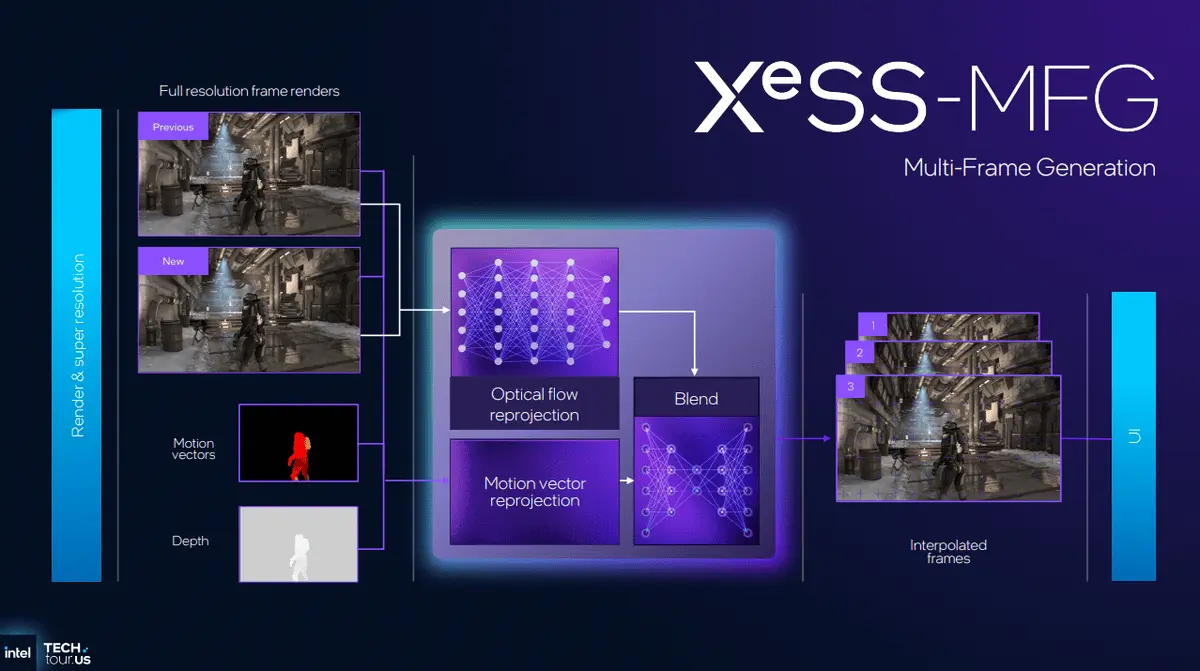
Source: Tom's Hardware
The XeSS 3.0 SDK simplifies integration for existing titles. According to Intel, any game that already supported XeSS 2.0 will benefit from a straightforward upgrade process where developers simply swap old .dll files for new ones and update in-game settings UI to reflect 3x and 4x MFG options
1
. The new model uses data from surrounding frames to predict smoother motion and reduce blur or ghosting, improving both image quality and frame stability without adding noticeable lag3
.Support for Older GPUs Sets Intel Apart From Nvidia
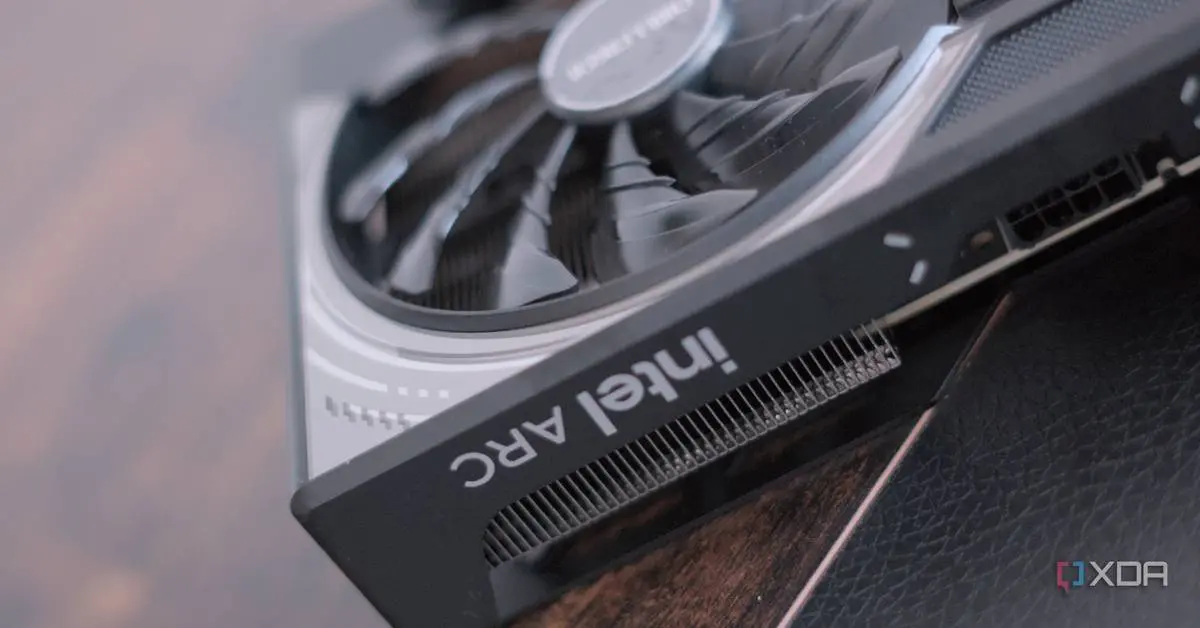
Intel rolled out support for XeSS 3 as part of their February 13 WHQL driver update, bringing multi-frame generation capabilities to first-gen Alchemist (A-series) through Battlemage (B-series) GPUs, including Core Ultra integrated graphics like Lunar Lake, Arrow Lake and Meteor Lake
2
. This inclusive approach marks a historic first from a large consumer GPU manufacturer and directly contrasts with Nvidia's strategy of gatekeeping AI advancements such as Dynamic Multi-Frame Generation behind the latest hardware, effectively excluding RTX 40-series, 30-series and 20-series GPU owners2
.
Source: XDA-Developers
Utilizing the XMX (Xe Matrix Extension) units already present in first-gen SKUs, Intel continues to ship features for generations preceding the Battlemage lineup, providing consistent value and showing determination to claw back market share in an increasingly competitive consumer graphics segment
2
. Arc GPU users can manually override a game's built-in XeSS framegen to support 3x and 4x modes from Intel's driver suite, though frame generation specifically only works in DirectX 12 titles on Windows1
.Open-Source Promise Remains Unfulfilled After Four Years
Despite these technical accomplishments, Intel has continued to keep its upscaling suite closed source with version 3.0, providing no source code despite the company's open-source promise made four years ago
1
. Community developers hoping to use Intel's upscaling innovations in downstream projects will continue to be disappointed as the SDK arrives as Windows binaries on GitHub rather than accessible source code1
.The proprietary approach extends across cutting-edge upscaling tech from all vendors. While AMD has generally made FSR versions prior to 4.x available as open-source, the company has held FSR 4 much closer to the chest
1
. By maintaining a binary-only licensing model locked to Windows, Intel risks alienating developers who increasingly expect transparency and cross-platform compatibility in rendering tools tied to AI3
.Related Stories

Platform Limitations Restrict Broader Adoption
Because XeMFG is limited to only DirectX 12 Windows titles, gamers on other platforms or APIs will not benefit from XeSS 3.0 nearly as much
1
. The base upscaler, XeSS-SR (super resolution), hasn't been majorly overhauled in XeSS 3.0, since Intel's focus with this release is multi-frame generation1
. On Linux, support remains problematic, with the binaries distributed as dynamic-link library files, leaving Linux developers dependent on compatibility layers for any attempt at integration3
.The SDK does introduce improved memory handling through support for external memory heaps, allowing XeSS to draw directly from GPU memory allocated by the game engine rather than carving out separate space, minimizing fragmentation and redundant buffers
3
. XeSS Frame Generation is paired with Xe Low Latency (XeLL) which works in tandem to maintain responsiveness and reduce latency as the engine inserts additional AI-generated frames at up to 4x FG rates2
.Given the challenges that Intel has faced in driving adoption of the most recent XeSS versions with game developers, the release of this SDK is important for devs that might be persuaded to consider including upscaling and frame-gen tech for GPUs of all vendors
1
. While Intel's desktop gaming ambitions have been quiet since the launch of Battlemage products in late 2024, the latest Panther Lake mobile platform and its Arc B390 high-end iGPU are likely to reach a large number of gamers in time, who will rightfully expect feature support for their GPUs1
.
Source: TechSpot
References
Summarized by

Navi
[1]
[2]
Related Stories
Intel Unveils XeSS 3 with Multi-Frame Generation: A Game-Changer in AI-Powered Graphics
09 Oct 2025•Technology

Intel Unveils XeSS 2: A Major Leap in AI-Driven Gaming Performance
04 Dec 2024•Technology

Intel's XeSS 2 AI-Powered Graphics Technology Expands to More Games, Boosting Performance and Reducing Latency
07 May 2025•Technology

Recent Highlights
1
AI chatbots validate you too much, making you less kind to others, Stanford study reveals
Science and Research

2
Anthropic's Claude Code Source Leak Reveals Hidden AI Agent Plans and Extensive System Access
Technology

3
Judge blocks Pentagon from branding Anthropic a security risk over AI safety guardrails dispute
Policy and Regulation

Recent Highlights
Today's Top Stories










Your Daily Dose of Curated AI News
Don’t drown in AI news. We cut through the noise - filtering, ranking and summarizing the most important AI news, breakthroughs and research daily. Spend less time searching for the latest in AI and get straight to action.

