Intel Unveils XeSS 3 with Multi-Frame Generation: A Game-Changer in AI-Powered Graphics


4 Sources
[1]
Intel Claims You Won't Need an Nvidia GPU to Push Gaming Frame Rates Through the Roof
Nvidia previously claimed you needed its GPUs to achieve multi-frame generation. Intel says "nuh uh." Intel is trying to get into the good graces of gamers with its big Panther Lake chipset reveal. In that vein, Intel took more time to explain an update to its two-year-old AI upscaler, XeSS 2. No,
[2]
Intel reveals XeSS 3 with Multi-Frame Generation - and unlike Nvidia's MFG, it works on older GPUs
This is a big advantage over Nvidia's MFG, and with Panther Lake chips due as 2026 arrives, there are exciting possibilities on the horizon Intel has taken the wraps off its next-gen XeSS tech to boost frame rates with its Arc (and Xe) GPUs, and Team Blue is following in Nvidia's footsteps with
[3]
Intel announces XeSS 3 with multi-frame generation, putting it ahead of AMD in the AI-powered graphics performance race
Though Intel would probably prefer its GPU sales to be ahead instead. At this year's Technology Tour event in Arizona, Intel not only launched its Panther Lake CPU architecture but it also announced an update to its AI-powered performance scaling package, and it now brings XeSS on par with
[4]
Intel XeSS 3 MFG "Multi-Frame Gen" With Up To 4x Mode Unveiled, Coming To All Arc GPUs With XMX Cores, XeSS 2 Games Supported & Further Perf/Efficiency Optimizations For Arc
Intel is bringing MFG "Multi-Frame Generation" support to XeSS 3 across all Arc GPUs with XMX alongside various software updates. Intel's XeSS software has seen tremendous improvements since launch. Even at launch, the upscaling technology was comparable to NVIDIA's DLSS and vastly ahead of AMD's
Share
Copy Link
Intel announces XeSS 3 with Multi-Frame Generation (MFG) technology, challenging Nvidia's dominance in AI-enhanced gaming performance. The new feature promises significant frame rate boosts and will be available on a wide range of Intel GPUs.
Intel Challenges Nvidia with XeSS 3 Multi-Frame Generation
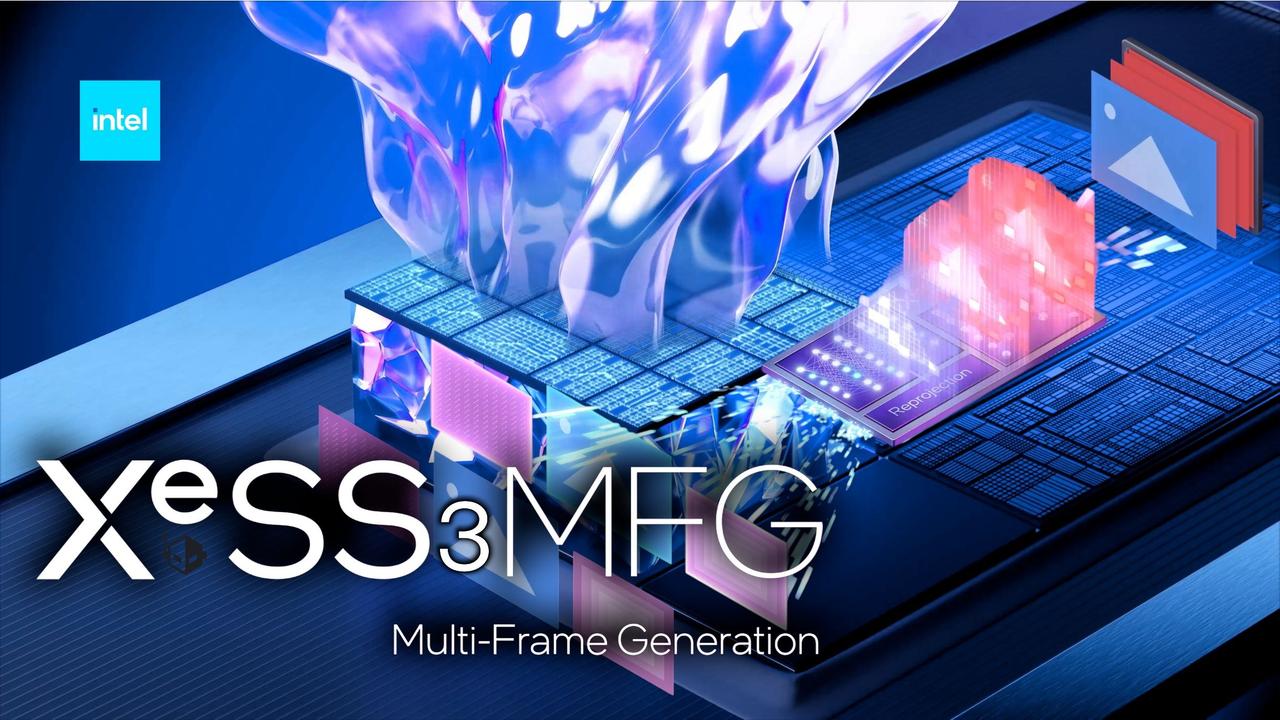
Intel has unveiled its latest AI-powered upscaling technology, XeSS 3, featuring Multi-Frame Generation (MFG) capabilities. This announcement puts Intel in direct competition with Nvidia's DLSS technology and ahead of AMD in the AI-enhanced graphics performance race
1
2
3
.
Source: Wccftech
How XeSS 3 MFG Works
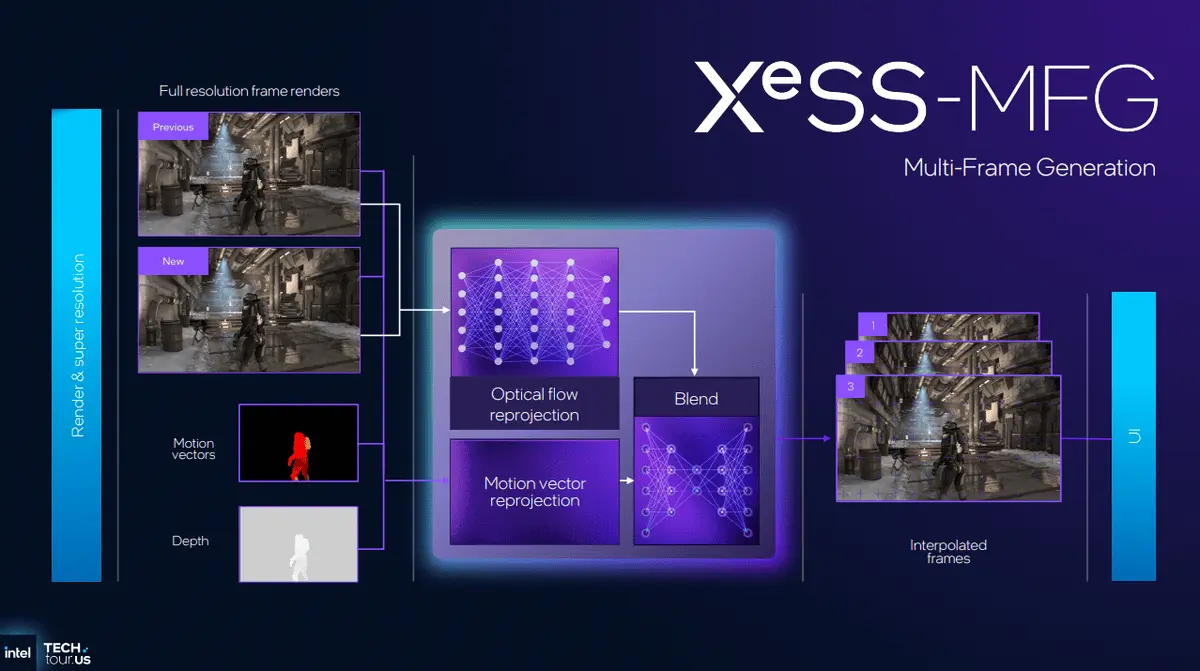
XeSS 3 MFG operates by inserting multiple AI-generated frames between two rendered frames, significantly boosting frame rates. The technology can generate up to three additional frames for every rendered frame, potentially quadrupling the frame rate
2
3
4
.
Source: PC Gamer
Performance and Compatibility
Intel demonstrated XeSS 3 MFG's capabilities using an early version of the Painkiller reboot on a Panther Lake laptop. The game ran at 45-50 fps at 1080p native, which increased to around 200 fps with 4x multi-frame generation enabled
1
3
.
Source: Gizmodo
Broad Compatibility Across Intel GPUs
Unlike Nvidia's MFG, which is limited to its latest RTX 50-series GPUs, Intel's XeSS 3 MFG will be compatible with a wide range of Intel GPUs, including:
- Upcoming Panther Lake integrated GPUs
- Core Ultra 200V 'Xe2' and Arc B-Series dGPUs
- Older Xe1 GPUs, including Core Ultra 200H and Arc A-series dGPUs
2
4
User Control and Configuration
Intel's Graphics Software Application will offer new options for users to configure XeSS 3 MFG:
- XeSS Frame Generation Override: Allows users to set MFG mode between 2x, 3x, and 4x
- Shared GPU/NPU Memory Override: Enables allocation of system RAM to the GPU/NPU for improved performance
4
Related Stories


Game Support and Future Prospects
XeSS 3 MFG will be compatible with all games that currently support XeSS 2, which amounts to nearly 50 titles. The technology is expected to debut alongside Intel's Panther Lake processors, with 'broad market availability starting January 2026'
2
4
.Industry Impact and Competition
Intel's introduction of XeSS 3 MFG positions the company as a serious contender in the AI-powered graphics performance market. While Nvidia currently leads with its DLSS 4 technology, Intel's broader compatibility and potential for future improvements could shake up the competitive landscape
1
2
3
.As the AI-enhanced graphics race intensifies, AMD remains the only major GPU vendor without a multi-frame generation technology. However, AMD has announced its upcoming FSR Redstone, which promises to bring another leap in upscaling and frame generation quality through machine learning
3
.Conclusion
Intel's XeSS 3 with Multi-Frame Generation represents a significant step forward in AI-powered graphics technology. With its broad compatibility and impressive performance gains, it has the potential to redefine gaming experiences across a wide range of devices, from high-end gaming rigs to budget-friendly laptops and handhelds.
References
Summarized by

Navi
[2]
Related Stories
Recent Highlights



Recent Highlights
Today's Top Stories













Don’t drown in AI news. We cut through the noise - filtering, ranking and summarizing the most important AI news, breakthroughs and research daily. Follow topics that matter to you and stay ahead.


