Intel Arc Pro B70 and B65 GPUs Target AI Workloads with 32GB Memory at Half NVIDIA's Price


5 Sources
5 Sources
[1]
Intel Arc Pro B70 and Arc Pro B65 GPUs bring 32GB of RAM to AI and pro apps -- bigger Battlemage finally arrives, but it's not for gaming
Intel brings 32GB of VRAM and plenty of bandwidth to the local AI inference party Along with new Xeons and vPro platforms, Intel is launching a larger configuration of its Battlemage GPU for the first time, but it's not targeted at gaming. Instead, the new Arc Pro B70 and B65 cards bring options for more compute horsepower and larger memory capacities to users of pro apps and local AI inference workloads on Intel's hardware-software stack. The first big Battlemage product, the Arc Pro B70, features 32 Xe Cores running at a rated 2800 MHz for a theoretical 22.9 TFLOPS of FP32 compute performance. Intel hooks it up to 32GB of 19 Gbps GDDR6 memory on a 256-bit bus to enable 608 GB/s of bandwidth. Both the relatively large VRAM capacity and higher memory bandwidth of this card are important for LLM inference workloads, where being able to fit both models and context in GPU-local memory is critical to achieving the best performance. The Arc Pro B70 can be targeted at a wide power envelope of 160W to 290W to support a wide range of cooling designs and system form factors. Intel says this card will start at $949 for its own reference design, and partner cards will be available from brands including ARKN, ASRock, Gunnir, Maxsun, and Sparkle. The Arc Pro B65 keeps the 32GB of memory and 608 GB/s memory bandwidth of its stablemate, but drops down to just 20 Xe Cores of compute capacity -- identical at a high level to the existing Arc Pro B60. That large gulf in raw compute compared to the B70 is likely meant to appeal to users of professional and creative applications that can benefit from more memory than lesser Arc Pro cards, but not the extra horsepower. It could also appeal to local LLM enthusiasts chasing memory capacity and bandwidth on the cheap. Intel isn't announcing a price for the B65 today, but it says the card will be available in mid-April. Intel positions the B70 against Nvidia's $1,800 RTX Pro 4000 24GB, the second-cheapest Blackwell workstation card so far, and highlights the B70's advantages against that product for larger context windows and time-to-first-token latency for large numbers of concurrent users. Intel mostly charts its wins against the RTX Pro 4000 using models with BF16 quantizations, whose higher potential accuracy might be desirable in some use cases but also obscures the Blackwell card's potential performance advantages with increasingly popular lower-precision data types like Nvidia's own NVFP4. The XMX matrix acceleration of Battlemage only extends down to FP16 and INT8 data types, while Blackwell supports a much wider range of reduced-precision formats. Intel also highlights the multi-GPU support of its software stack, which lets interested parties scale up LLM serving across multiple Arc Pro cards to increase memory capacity for larger context windows, larger models, or both. Intel further emphasizes the advantages of its platform for cost-per-token across a range of models, and indeed, at $949 apiece, any number of Arc Pro B70s would ring in for less than the $1,800 RTX Pro 4000. Any tokens you get out of a B70 will naturally be cheaper by that math. The Arc Pro B70 also undercuts AMD's $,1299 Radeon AI Pro R9700, which until now has been another relatively cheap way to get to 32GB on a local AI card. But it's worth noting that Nvidia has several other RTX Pro cards above the RTX Pro 4000 in its lineup that allow AI systems architects to precisely tailor memory and compute requirements to given workloads, so it might not always be necessary for those folks to spread workloads across multiple cards this way. And that same breadth of offerings means that those working with Nvidia server GPUs can scale up the capabilities of those systems further than Intel's product stack currently allows. Nvidia and its partners have also long been in the business of selling eight-GPU servers, while Intel didn't highlight configurations extending beyond four GPUs in its presentation. It's also worth remembering that hardware alone does not an AI system make, as our own local AI experiments have demonstrated. Nvidia's CUDA moat remains wide, and buyers considering an Arc Pro-powered solution would need to account for the potential time and costs involved in handling issues of application support and stability on Intel's platform. For intrepid AI explorers undeterred by potentially choppy software seas, the relatively low cost of entry on Intel's platform for organizations just trying to spin up an experimental on-premise AI server for local usage might be appealing. But more seasoned AI developers working with an eye toward scaling up their applications both locally and in the cloud will likely want to stick with systems built around Nvidia's offerings for reasons of compatibility, scalability, and TCO. It remains to be seen whether Intel will ever deploy big Battlemage for gaming, but given the current silicon and memory supply crunch and the midrange performance ballpark where this GPU might land for gaming, it seems unlikely that Intel could sell a gaming-first version of this card profitably. The AI and professional markets allow for higher prices and better margins, and given CEO Lip-Bu Tan's stated goals for the company, we expect that's where bigger Battlemage will stay. But anything could happen in today's crazy tech landscape. Follow Tom's Hardware on Google News, or add us as a preferred source, to get our latest news, analysis, & reviews in your feeds.
[2]
Intel Targets AI Workstations With Memory-Stuffed Arc Pro B70 and B65 GPUs
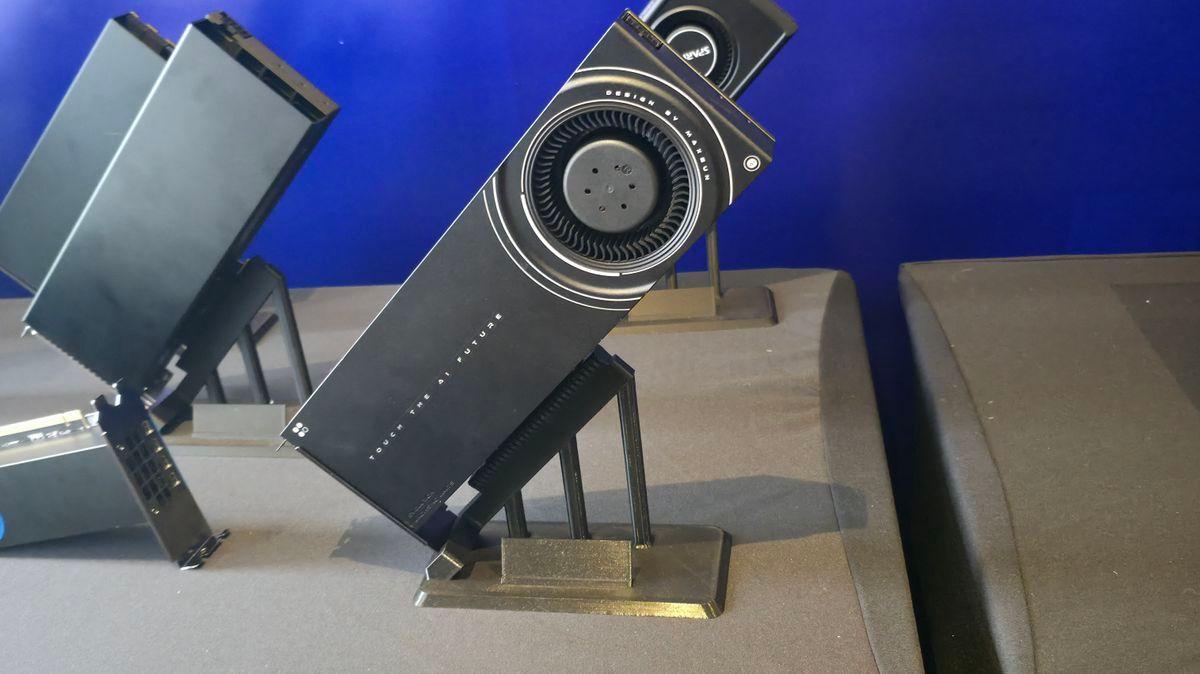
The tech industry is undergoing rapid change as everyone focuses on AI. Intel is among the companies revving up new silicon and hardware to drive AI workloads, and it is now pushing its AI hardware to the next level with new Arc Pro B70 and B65 graphics cards. At heart, these are traditional workstation graphics cards engineered to handle compute-intensive workloads. But they are augmented with powerful AI engines and a large 32GB pool of RAM at an aggressive price. That makes them not just powerful but ideally suited for handling complex AI tasks and the biggest possible AI models. Arc Pro B70 and B65 Details: The Battlemage Champion and Its Acolyte The Intel Arc Pro B70 features an entirely new graphics core we haven't seen before, and it looks to be Intel's fastest graphics processor to date. The B70 is still based on Intel's "Battlemage" microarchitecture, which powers all Intel Arc B-series and Intel Arc Pro B-series graphics cards, but it ships with 60% more Xe cores than the second-fastest chip in the series. This gives it a total of 32 Xe2-HPG cores and a grand total of 4,096 pixel shaders. Alongside these shaders are 32 ray-tracing units and 256 XMX engines, the latter of which drive AI performance. Intel said the card is capable of 367 TOPS when running INT8 workloads. The Arc Pro B70 also has an upgraded 256-bit memory controller and expanded memory support. Each Arc Pro B70 will have 32GB of GDDR6 RAM and a rated bandwidth of 608GBps. Intel also announced a new Intel Arc Pro B65, which is somewhat less new than the B70 at heart. It uses the same graphics core as the Intel Arc B580 consumer/gaming graphics card, and this chip is already used in Intel's existing Arc Pro B60 workstation card. The major feature enhancement the B65 offers is an expanded 32GB memory pool, up from a maximum of 24GB on the Arc Pro B60. The increase in memory capacity may seem questionable at this time, given the ongoing memory shortage, but the large memory capacity is one of the most alluring features of these GPUs. While virtually everything in your computer can benefit from more and faster memory, AI workloads are particularly greedy on that front, and the local RAM allocation limits the size of models you can host in memory. The more complex the AI workload is, the more RAM is required to host and run the AI model, which makes memory capacity of paramount importance. Intel vs. Nvidia Pro Cards: Battlemage Boss vs. Green Cloud Spec numbers are always a delight, but at the end of the day, what really matters is how well Intel's new workstation cards perform against what is currently on the market. Here, Intel is pushing the Arc Pro B70 as a superior option to Nvidia's "Blackwell"-based RTX Pro 4000 for AI workloads. The RTX Pro 4000 is not Nvidia's top workstation graphics card, but by Intel's numbers, the Arc Pro B70 appears to be the better-value option. Intel's internal testing showed that the Arc Pro B70 achieved significantly higher token throughput while handling AI workload requests from multiple users. At the same time, Intel also showed that the Arc Pro B70 would be a superior option for running large AI models due to its higher memory capacity. This latter point is not surprising, as the RTX Pro 4000 is limited to 24GB of RAM, compared with the Arc Pro B70's 32GB, and the entire point of a higher memory capacity is to run larger AI models. Also, Intel notes that these cards can be set up in arrays of two, four, or eight cards in a workstation or server rack module, to enable multiple AI models queued up in one workstation as needed, or to pool memory allowances for AI models that are too big for one card's memory allocation. The Arc Pro B70 also has a major price advantage over the RTX Pro 4000. While the Arc Pro B70 costs $949, the Nvidia RTX Pro 4000 costs $1,899. This suggests that Intel deliberately set the Arc Pro B70 to cost half as much as the RTX Pro 4000, but Intel didn't say this directly. The Big B70: Coming March 31 for $949 Intel is set to launch its new Arc Pro B70 and Arc Pro B65 workstation cards on March 31, the same day the company plans to release its new Intel Core Ultra 7 270K Plus and Intel Core Ultra 5 250K Plus CPUs. There isn't a fixed price for the Intel Arc Pro B65 at this time, as Intel is leaving the production and sale of these graphics cards entirely in the hands of its OEM board partners. An Intel-branded Arc Pro B70, however, will be sold directly by Intel for $949. You will also see versions of the Arc Pro B70 from a host of Intel board partners, including ARKN, ASRock, Gunnir, Maxsun, and Sparkle. The prices on these models will likely vary due to different thermal solutions and other design changes. Intel had several models of the Arc Pro B70 on display during its press announcement in New York City. One of the more interesting models on show was a fanless model from Maxsun. These cards use more power than earlier Arc Pros and are likely to get too hot to run fanless without some performance penalty, but this card's thermal design allows air to pass straight through its enclosure and out the back of the case. This can be particularly useful in systems that are tightly packed with graphics cards and have excellent airflow from case fans. Power and display connections on these cards are fully at the discretion of Intel's board partners, and we observed models with the traditional 8-pin PCI Express power connectors alongside others with the newer Nvidia-style 12VHPWR connection. We've also heard that one board partner is developing a dual-GPU version of the Arc Pro B70, but it remains unclear whether that card will actually make it into production.
[3]
Intel's new Arc Pro B70 and B65 GPUs are built for AI work
Intel's new Arc Pro cards are here to run AI workloads on your workstation. Intel has launched two new graphics cards aimed at professionals: the Arc Pro B70 and Arc Pro B65. These are not gaming cards. They are built for local AI inferencing, software development, and running multiple GPUs together in rack-scale AI setups. Is the Arc Pro B70 the card AI fans have been waiting for? For anyone who has been following Intel's GPU journey, the Arc Pro B70 is a big deal. The Arc Pro B70 is the answer to anyone asking Intel to create an ultra-powerful GPU to power their workstation. It comes with 32 Xe cores, a 256-bit memory interface, 32 GB of GDDR6 memory with 608 GB/s of bandwidth, and 32 ray tracing units. For AI work, it delivers up to 367 TOPS, which is a solid number for local AI inferencing tasks. The card connects via PCI Express 5.0 x16 and supports all the major compute APIs, including Intel's own oneAPI, OpenCL 3.0, and OpenVINO. Power draw sits between 160 W and 290 W, depending on the partner card, with the Intel reference model rated at 230 W. What about the Arc Pro B65? The Arc Pro B65 is the more affordable card, but it still brings good performance. It packs 24 Xe cores, 32 GB of GDDR6 RAM with the same 608 GB/s memory bandwidth, and 20 ray tracing units. It uses the full PCIe 5.0 x16 interface and is rated for a typical board power of 200 W. Both the Arc Pro B65 and B70 cards support Windows 10, Windows 11, and Linux with certified drivers, and share the same display outputs: four HDMI 2.1 ports. They both support up to 8K display output at 120Hz. Recommended Videos If your work involves running AI models locally or professional visualization, Intel's new Arc Pro lineup is worth a serious look.
[4]
Intel Arc Pro B70 Outclasses NVIDIA's RTX Pro 4000 In AI At Half The Cost, 50% More Memory
Intel's Arc Pro B70 is designed to offer accessible local inference for AI users, delivering more memory at half the price of the competition. So we talked about the unveiling of the Intel Arc Pro B70 graphics card in our other post, where we highlighted the specifications, availability, and prices of the product. The B70 is going to be the flagship Pro & AI product from Intel within its Arc Pro stack, and they have some interesting figures to showcase for this product. On a high-level, Intel states the following benefits for its Arc Pro B70 graphics cards: First of all, the Intel Arc Pro B70 looks very impressive given its specifications at this price point. Intel has positioned the Arc Pro B70 against the NVIDIA RTX PRO 4000 Blackwell. That GPU generally costs around $1800 US, which is almost twice the price of the Arc Pro B70, which starts at $949 US. One of the main advantages is very clear, and that's memory. The RTX Pro features 24 GB of memory, but the Arc Pro B70 has 32 GB of memory, a 50% higher capacity. This 32 GB memory is crucial for AI, as more memory means more AI context. In the first benchmark test, Intel showcases the Token Throughput vs Context Length of these cards. The model being used is Llama 3.1 8b, and BF16 is being leveraged. The RTX PRO 4000 supports a context length of 42K before it goes out of memory. Meanwhile, the Arc Pro B70 supports a context length of up to 93K before its memory is exhausted. That's up to a 2.2x larger context window. Next up, Intel offers a look at multi-agent flows in parallel. Here, the model being used is Ministral Instruct 2410 8B (BF16), and you can see that the B70 offers up to a 85% higher token throughput for multiple users/requests versus the NVIDIA RTX PRO 4000 in the Linux OS. Arc Pro delivers much higher throughput than NVIDIA's Blackwell offering at half the cost. Intel Arc Pro B60 also delivers much quicker answers for multiple users with a faster time to first token versus the competition. Here, the leading is extended up to 6.2x, which is impressive. Do note that all of this isn't just the hardware working; it's also Intel's own oneAPI and AI software stack that is working to deliver faster throughput. This capability further shows in the scalable multi-GPU software stack, which enables support for multiple GPUs, opening up the space for larger models and contexts in multi-GPU setups. The Intel Arc Pro B70 enables up to 183K context window in DS-R1-Distill-Qwen 3 32B (Int4) versus 80K for RTX PRO 4000, a 304K context window in Qwen3 32B (FP8) versus 199K for RTX PRO 4000, and 408K context window in Mistral-Small 24B (BF16) versus 243K for the RTX PRO 4000. These tests were run on a 4-GPU solution for both Intel and NVIDIA. Moving forward, Intel showcases up to 2x tokens per dollar for its Arc Pro B70 GPUs in single, dual, and quad GPU systems. So the performance is very scalable and is perfect for users running a single entry-level workstation or a high-end multi-GPU stack. So overall, a very positive showcase of Intel's brand new AI powerhouse, and that too at a cost that will be very attractive for AI & Pro users. It looks like the next few months will be very interesting as the Arc Pro B70 & the cost-effective B65 roll out on retail shelves. The question remains, though, whether we will see a gaming-oriented variant of Big Battlemage, maybe something like the Radeon VII, which housed a GPU that was built for Pro users but landed as a gaming-oriented graphics card as a niche enthusiast product.
[5]
Big Battlemage Is Here - Intel Unveils Arc Pro B70 & B65 GPUs, Up To 32 GB Memory & 367 TOPS For AI
Intel has finally unveiled its "Big Battlemage" GPUs, the Arc Pro B70 & Arc Pro B65, with up to 32 GB of memory for AI & Pro workloads. Intel Expands Its AI & Pro Fleet With Big Battlemage-Powered Arc Pro B70 & Arc Pro B65 GPUs At its Pro Day 2026, Intel finally unveiled the one GPU that we have all been waiting for. The GPU is the one and only "Big Battlemage", and while we would've loved to see a gaming-oriented variant, Intel's first outing with this GPU is for the rapidly rising AI & Pro segment. These GPUs are designed as a balance for everyday professionals and heavy-duty Pros and are part of the same Arc Pro B-Series, which has seen the likes of the Arc Pro B60 & Arc Pro B50. The previous entries in the Arc Pro B-series family were based on the Battlemage BMG-G21 GPU with up to 24 GB of memory. The new cards utilize the brand new BMG-G31 GPU, which is a larger chip, based on the same TSMC N5 process technology, and offering an increased number of cores and memory. Both GPUs are designed for the Pro Workstation segment, a market that is expected to reach $17B by 2029 with a 60% share in mobile and 40% share in desktops. While a small chunk compared to the Local AI inference market, which is expected to reach $250B by 2030, Intel is still catering to its Pro and Workstation markets. So there are two graphics cards that are based on the Intel Big Battlemage GPU that are launching today. These are the Intel Arc Pro B70 and the Arc Pro B65. Let's start with the specifications of these cards. Intel Arc Pro B70 - 32 Xe Cores, 32 GB Memory, Up To 367 AI TOPS The Intel Arc Pro B70 graphics card is the flagship Arc B-Series offering. It features the full BMG-G31 GPU, which packs 32 Xe2-HPG cores, 256 XMX Engines, 32 RT units, and provides 367 INT8 TOPS for AI workloads. The graphics card will feature 32 GB of GDDR6 memory across a 256-bit bus interface. The memory is clocked at 19 Gbps, delivering 608 GB/s of total bandwidth. The GPU itself is clocked at 2800 MHz. The graphics card will be offered in both AIC and Intel-branded variants. The power rating for the Intel-branded variant is 230W, while the AIC models can scale from 160W up to 290W. Power will be provided through a single 16-pin connector interface for the Intel-branded variant, while AICs have the choice to select the number of connectors based on their designs. Another important thing to remember is that a few AICs made multi-GPU models of the Arc Pro B60 with two BMG-G21 GPUs and up to 48 GB of VRAM. So we can expect some partners to be given the green light to produce such variants with two BMG-G31 GPUs and up to 64 GB of memory. Some highlights of the graphics card include: * 32 GB memory runs large AI models with higher precision & accuracy * 256 XMX AI Engines (Intel Xe Matrix eXtensions) * Xe2 architecture for fast content creation & AI applications * Scalable multiple-GPU LLM Linux support * XMX AI Engines for AI-enhanced gaming, content creation & media * Ray tracing hardware acceleration for fast, photo-realistic renders * Pro drivers with ISV software certifications * Windows & Linux OS support * Xe Media Engine - Comprehensive content creation toolkit In terms of display, the Arc Pro B70 will feature four DP2.1 outputs by default, and supports all the latest API and hardware acceleration engines such as DX12 Ultimate, oneAPI, OpenCL 3.0, OpenGL 4.6, Vulkan 1.3, OpenVINO, XMX AI Engines, RT support, AV1/HEVC/H.264/VP9 encode/decode support. The Arc Pro B70 is designed for powerful local inferencing, scalable multi-GPU deployments, and advanced software development. Intel Arc Pro B65 - 20 Xe Cores, 32 GB Memory, Up To 197 AI TOPS Moving over to the second GPU, the Intel Arc Pro B65 is the second graphics card to feature a cut-down BMG-G31 GPU. This is a cost-optimized solution for AI inferencing, which features 20 Xe2-HPG cores, 160 XMX Engines, 20 RT units, and up to 197 INT8 TOPS for AI computing. The GPU is clocked at 2400 MHz. The graphics card features the same 32 GB of GDDR6 memory running across a 192-bit bus interface, and pumping out 608 GB/s bandwidth. The card is pretty much the same in terms of display and acceleration support. The main difference is that the power consumption is rated at 200W (TBP) and varies by partner. Some highlights of the graphics card include: * 32 GB Memory runs large AI models with higher precision & accuracy * 160 XMX AI Engines (Intel Xe Matrix eXtensions) * Xe2 architecture for fast content creation & AI applications * Scalable multiple-GPU LLM Linux support * XMX AI Engines for AI-enhanced gaming, content creation & media * Ray tracing hardware acceleration for fast, photo-realistic renders * Pro drivers with ISV software certifications * Windows & Linux OS support * Xe Media Engine - Comprehensive content creation toolkit The Arc Pro B65 is designed for high-precision local inferencing, scalable multi-GPU deployments, and advanced software development. Both the Intel Arc Pro B70 and Arc Pro B65 are supported in Windows 11, Windows 10, and Linux Ubuntu OS. Pricing & Availability The Intel Arc Pro B70 graphics card will be available starting 25th March, 2026, from Intel and its AIC partners such as ARKN, ASRock, Gunnir, Maxsun, and Sparkle. The graphics card has a starting price of $949 US, while AIB models will vary in pricing and designs. The Intel Arc Pro B65 will be available starting in mid of April 2026, and will come in AIC models with pricing lower than the Arc Pro B70. Intel Arc Pro B-Series GPUs Specs: Follow Wccftech on Google to get more of our news coverage in your feeds.
Share
Share
Copy Link
Intel unveiled its Arc Pro B70 and Arc Pro B65 workstation graphics cards featuring 32GB of memory for AI inference workloads and professional applications. Priced at $949, the Arc Pro B70 undercuts NVIDIA's RTX Pro 4000 by nearly half while offering more memory capacity. The cards mark Intel's first deployment of its larger Battlemage GPU architecture, though aimed at AI and pro markets rather than gaming.
Intel GPUs Enter AI Arena with Battlemage Architecture
Intel has launched two new workstation graphics cards designed specifically for AI inference workloads and professional applications: the Arc Pro B70 and Arc Pro B65. Both cards feature 32GB of memory and represent the first deployment of Intel's larger Battlemage GPU architecture, specifically the BMG-G31 chip
1
. The Arc Pro B70 packs 32 Xe Cores running at 2800 MHz, delivering 22.9 TFLOPS of FP32 compute performance and up to 367 TOPS for AI tasks2
. This represents a 60% increase in cores compared to Intel's second-fastest graphics processor to date2
.
Source: Wccftech
Arc Pro B70 Challenges NVIDIA with Aggressive Pricing
The Arc Pro B70 is priced at $949 for Intel's reference design, positioning it directly against NVIDIA's RTX Pro 4000, which costs $1,800
1
. The card features 32GB of 19 Gbps GDDR6 RAM on a 256-bit bus, enabling 608 GB/s of bandwidth1
. This memory capacity advantage—50% more than the RTX Pro 4000's 24GB—proves critical for LLM applications where fitting models and context in GPU-local memory directly impacts performance4
. Intel's internal testing showed the Arc Pro B70 supports context windows up to 93K with Llama 3.1 8b models, compared to 42K for the NVIDIA RTX Pro 4000 before running out of VRAM—a 2.2x larger context window4
.
Source: Wccftech
Memory-Rich Arc Pro B65 Offers Cost-Optimized Alternative
The Arc Pro B65 maintains the same 32GB of memory and 608 GB/s bandwidth as its flagship sibling but features a cut-down BMG-G31 GPU with 20 Xe Cores and 160 XMX Engines, delivering up to 197 TOPS
5
. This configuration mirrors the existing Arc Pro B60 in compute capacity but doubles down on memory for users of professional applications who need capacity over raw horsepower1
. The card operates at 200W TBP and will be available in mid-April, though Intel has not announced pricing3
.Related Stories

Multi-GPU Setups Enable Scalable Local AI Inference
Both cards support multi-GPU setups for scalable AI deployments, allowing users to pool memory capacity for larger models or extended context windows
2
. In quad-GPU configurations, the Arc Pro B70 enables up to 408K context window with Mistral-Small 24B models versus 243K for comparable NVIDIA RTX Pro 4000 setups4
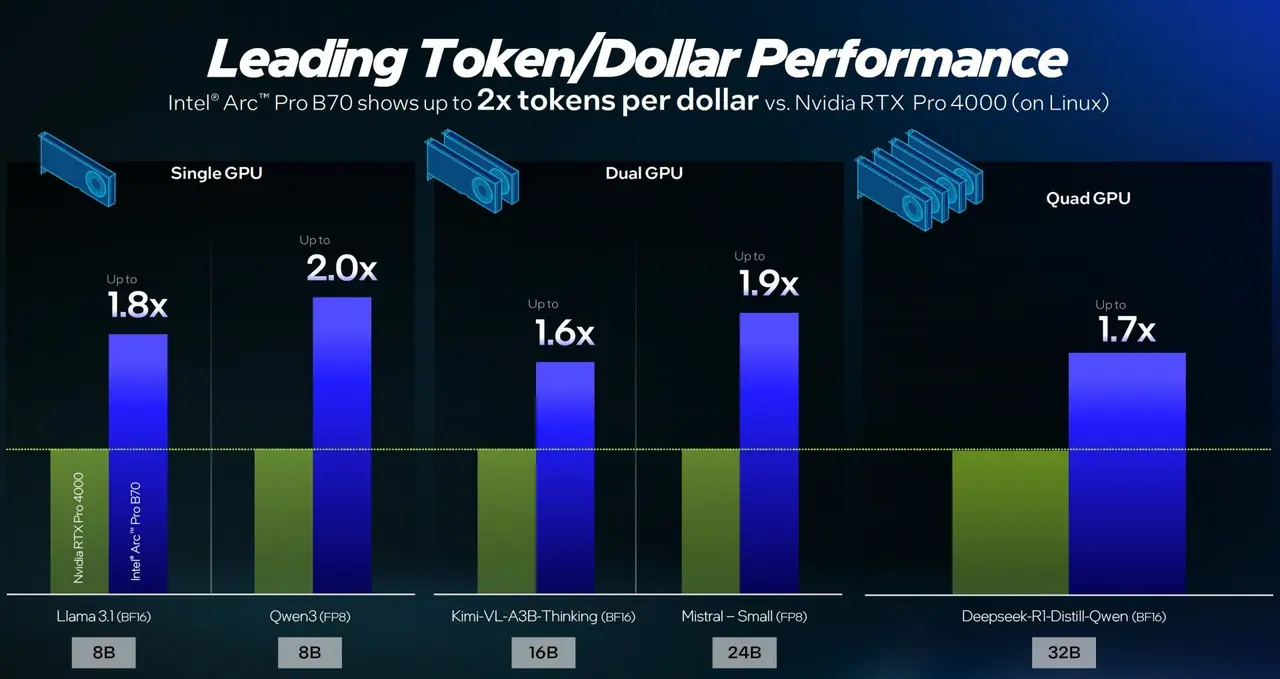
. Intel demonstrated up to 2x tokens per dollar across single, dual, and quad GPU systems, emphasizing cost-effectiveness for organizations building local AI inference infrastructure4
. The cards support Intel's oneAPI and OpenVINO software stack, along with OpenCL 3.0, enabling development across multiple frameworks3
.Software Compatibility Remains Key Consideration
While the hardware specifications appear competitive, potential buyers must weigh software maturity against NVIDIA's established CUDA ecosystem
1
. Intel's XMX matrix acceleration supports FP16 and INT8 data types, while NVIDIA's Blackwell architecture extends to additional reduced-precision formats including NVFP41
. Organizations building experimental on-premise AI servers may find Intel's platform appealing for its low entry cost, but developers focused on scalability and cloud compatibility will likely prefer NVIDIA's broader ecosystem1
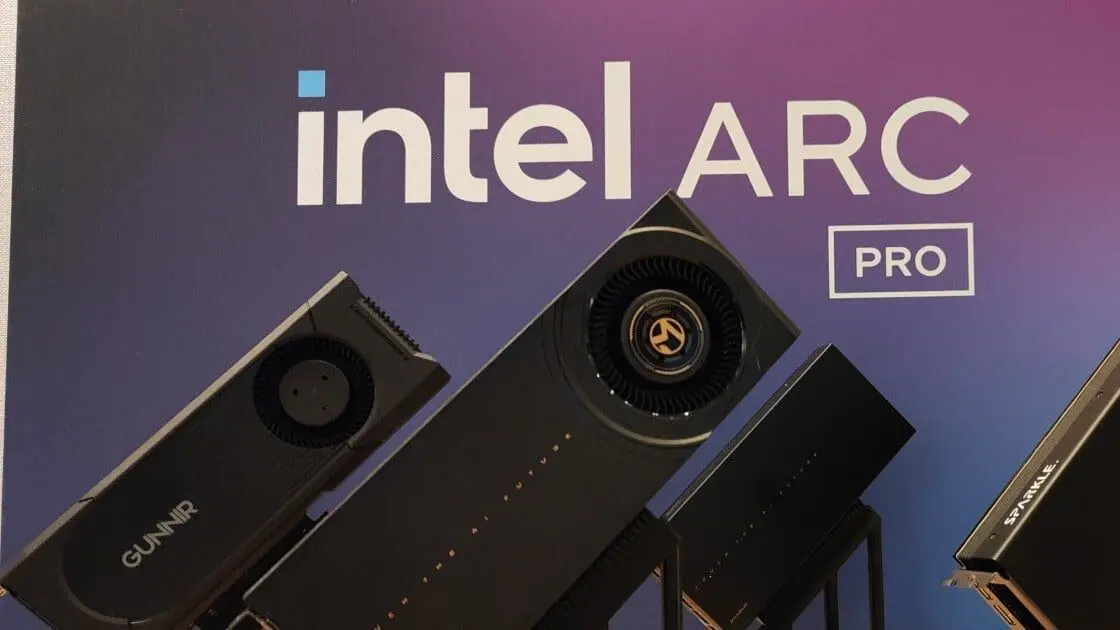
. Board partners including ARKN, ASRock, Gunnir, Maxsun, and Sparkle will offer custom designs, with the Arc Pro B70 launching March 312
.
Source: PC Magazine
References
Summarized by

Navi
[1]
[3]
[4]
Related Stories
Intel Launches Arc Pro B50 GPU: A Compact Powerhouse for AI and Professional Workloads
04 Sept 2025•Technology
Intel Unveils Arc Pro B-Series GPUs and 'Project Battlematrix' for AI Workstations
19 May 2025•Technology
Intel Challenges GPU Market with New Arc B580 and B570 Graphics Cards
04 Dec 2024•Technology

Recent Highlights
1
Anthropic's Claude AI can now control your computer to complete tasks autonomously
Technology

2
Nvidia's Jensen Huang calls OpenClaw the next ChatGPT, sending Chinese AI stocks soaring
Technology

3
Elon Musk unveils $20 billion Terafab chip manufacturing project to produce terawatt of computing
Technology

Recent Highlights
Today's Top Stories






Your Daily Dose of Curated AI News
Don’t drown in AI news. We cut through the noise - filtering, ranking and summarizing the most important AI news, breakthroughs and research daily. Spend less time searching for the latest in AI and get straight to action.

