Nvidia CEO warns China's AI infrastructure advantage could reshape the global AI race


3 Sources
3 Sources
[1]
'They can build a hospital in a weekend': Nvidia CEO warns about China's big AI advantages -- as report reveals it now has 30% of global AI usage
Meanwhile, a new study has found that China's open source LLMs have secured almost a third of global AI usage Nvidia's chief executive, Jensen Huang, has again warned about the swift progress that China is making with AI, and the advantages the country has in terms of the infrastructure for development therein. Fortune reports that late last month, Huang spoke to John Hamre, the president of the Center for Strategic and International Studies (CSIS), noting that: "If you want to build a data center here in the United States from breaking ground to standing up [an] AI supercomputer is probably about three years. They [China] can build a hospital in a weekend." In other words, China is capable of realizing large construction projects at incredibly swift speeds, and also has a major advantage in terms of its energy infrastructure. These are crucial elements for the development of AI in terms of building huge data centers quickly, to cope with processing needs, and having the energy to power all this. Huang observed that China has "twice as much energy as we [the US] have as a nation, and our economy is larger than theirs" and that this "makes no sense to me", and furthermore that growth in energy capacity is heading "straight up" in China, while remaining more or less flat in the US. To balance out the worries aired, however, the CEO did make it clear that Nvidia is "generations ahead" of China when it comes to AI chip tech - there may be a tiny bit of bias in that assertion, mind - but Huang still said that this wasn't a reason to rest on any laurels. Huang has previously commented about China being "nanoseconds behind America" in the AI race, but we're told the Nvidia CEO remains outwardly hopeful about the Trump administration's push to boost AI investment and domestic manufacturing jobs. Meanwhile, a separate article from the South China Morning Post (SCMP) claims that almost 30% of the global use of AI now comes from China's open source models (LLMs). That figure comes from a report compiled by OpenRouter, an independent AI model aggregator, along with venture capital firm Andreessen Horowitz. It's based on a study of 100 trillion tokens, which are the units of data processed by LLMs (or in friendlier language, the building blocks behind how AI works). The lion's share remains with the closed source western world LLMs, such as ChatGPT, which hold the rest of the market (around 70%). Remember, though, that just a year ago, Chinese open source LLMs only represented just over 1% of tokens, so reaching 30% now is quite a steep growth trajectory to say the least. If you take just open source LLMs, we're told that Chinese models average about 13% of weekly token usage, almost equalling the 13.7% which is drawn from the rest of the world. (This is open source usage, remember - the remaining majority are the closed source proprietary models like ChatGPT). Another interesting point revealed here is that the open source LLMs from China are now equally pulling their weight, it's not just all about DeepSeek (as was the case originally). Naturally, DeepSeek V3 is a major force in AI usage for China, but there's also Alibaba's Qwen models and Moonshot AI's Kimi K2 which are big players. The report contends that Chinese language prompts are second in token volume behind English now. Tying all this together, the rise of China in the AI sphere is a rather dizzying ascent, then, and you can see where Huang's concerns are coming from. Especially as it's difficult to see this growth slowing in the near-term for China, and what Nvidia's CEO observes about the country's energy infrastructure is indeed a telling advantage over the US - again, one that's difficult to see changing in the nearer future. And then as we've recently seen with the release of DeepSeek's new v3.2 models, there's what China has to offer in terms of reducing the costs of using AI, to boot. It would seem that there's a seriously competitive battle ahead for global AI dominance.
[2]
Nvidia CEO says data centers take about 3 years to construct in the U.S., while in China 'they can build a hospital in a weekend' | Fortune
Nvidia CEO Jensen Huang said China has an AI infrastructure advantage over the U.S., namely in construction and energy. While the U.S. retains an edge on AI chips, he warned China can build large projects at staggering speeds. "If you want to build a data center here in the United States from breaking ground to standing up a AI supercomputer is probably about three years," Huang told Center for Strategic and International Studies President John Hamre in late November. "They can build a hospital in a weekend." The speed at which China can build infrastructure is just one of his concerns. He also worries about the countries' comparative energy capacity to support the AI boom. China has "twice as much energy as we have as a nation, and our economy is larger than theirs. Makes no sense to me," Huang said. He added that China's energy capacity continues to grow "straight up", while the U.S.'s remains relatively flat. Still, Huang maintained that Nvidia is "generations ahead" of China on AI chip technology to support the demand for the tech and semiconductor manufacturing process. But he warned against complacency on this front, adding that "anybody who thinks China can't manufacture is missing a big idea." Yet Huang is hopeful about Nvidia's future, noting President Donald Trump's push to reshore manufacturing jobs and spur AI investments. Early last month, Huang made headlines by predicting China would win the AI race -- a message he amended soon thereafter, saying the country was "nanoseconds behind America" in the race in a statement shared to his company's X account. Nvidia is just one of the big tech companies pouring billions of dollars into a data center buildout in the U.S., which experts tell Fortune could amount to over $100 billion in the next year alone. Raul Martynek, the CEO of DataBank, a company that contracts with tech giants to construct data centers, said the average cost of a data center is $10 million to $15 million per megawatt (MW), and a typical data centers on the smaller side requires 40 MW. "In the U.S., we think there will be 5 to 7 gigawatts brought online in the coming year to support this seemingly insatiable AI demand," Martynek said. This shakes out to $50 billion on the low end, and $105 billion on the high end.
[3]
Nvidia CEO Jensen Huang Warns China Could Beat America In AI: 'They Can Build A Hospital In A Weekend' While US Takes Years - NVIDIA (NASDAQ:NVDA)
Nvidia Corp. (NASDAQ:NVDA) CEO Jensen Huang cautioned that while the U.S. remains ahead in AI chip technology, China's unmatched speed in building infrastructure and growing energy resources could give it a strategic edge in the global AI race. China's Fast Construction Speaking to the Center for Strategic and International Studies in late November, Huang highlighted the stark contrast between U.S. and Chinese capabilities. "If you want to build a data center here in the United States from breaking ground to standing up a AI supercomputer is probably about three years," Huang said. "They can build a hospital in a weekend," he added. China's Growing Energy Capacity Could Fuel AI Expansion Huang also pointed to China's energy advantage. China has "twice as much energy as we have as a nation, and our economy is larger than theirs. Makes no sense to me," he said, noting that China's energy capacity continues to grow while the U.S.'s remains relatively flat. Despite these concerns, Huang emphasized Nvidia's technological lead in AI chips. "We are generations ahead" of China on AI chip technology, he said, but added that underestimating China's manufacturing and infrastructure capabilities would be a mistake. See Also: Ronald Reagan 'Didn't Love Tariffs,' Says Economist Paul Krugman: He Repeatedly Emphasized 'The Virtues of Free Trade' U.S.-China AI Race Hinges On Rules, Power And Infrastructure Tech leaders and investors warned that the United States could fall behind China in artificial intelligence due to fragmented regulations, energy constraints and faster Chinese infrastructure development. Last week, Alphabet Inc.'s (NASDAQ:GOOG) (NASDAQ:GOOGL) CEO Sundar Pichai urged national AI rules to avoid a confusing patchwork of state laws, while highlighting AI's medical promise and Google's defensive tools. Last month, Investor Kevin O'Leary said energy security, not funding, was the critical driver of AI data center expansion and warned that China's power infrastructure threatened U.S. leadership. Nvidia CEO Huang also cautioned that China's cheaper energy and lighter regulations gave it a growing advantage, even as U.S. and U.K. policies slowed progress. Read Next: As Record 40-Day Shutdown Nears End, History Shows Stocks Rally 12 Months Later With S&P 500 Averaging 12.3% Gain Disclaimer: This content was partially produced with the help of AI tools and was reviewed and published by Benzinga editors. Photo courtesy: Shutterstock NVDANVIDIA Corp$182.35-0.03%OverviewGOOGAlphabet Inc$321.14-0.29%GOOGLAlphabet Inc$320.44-0.26%Market News and Data brought to you by Benzinga APIs
Share
Share
Copy Link
Nvidia CEO Jensen Huang highlights China's striking advantages in the AI race, from building data centers at unprecedented speeds to commanding twice the energy capacity of the US. Meanwhile, China AI models have surged from 1% to 30% of global AI usage in just one year, signaling a competitive battle for AI dominance.
Nvidia CEO Sounds Alarm on China's Rapid Advancements in AI
Jensen Huang, Nvidia's chief executive, has issued a stark warning about China AI capabilities and the significant infrastructure advantages that could reshape the global competition for AI dominance. Speaking to John Hamre, president of the Center for Strategic and International Studies, in late November, Huang drew attention to the speed of data center construction that separates the two superpowers. "If you want to build a data center here in the United States from breaking ground to standing up a AI supercomputer is probably about three years," Huang noted, adding that in contrast, "they can build a hospital in a weekend"
1
2
. This dramatic difference in infrastructure development capabilities represents a critical factor as nations compete to build the AI supercomputing resources needed to power next-generation artificial intelligence.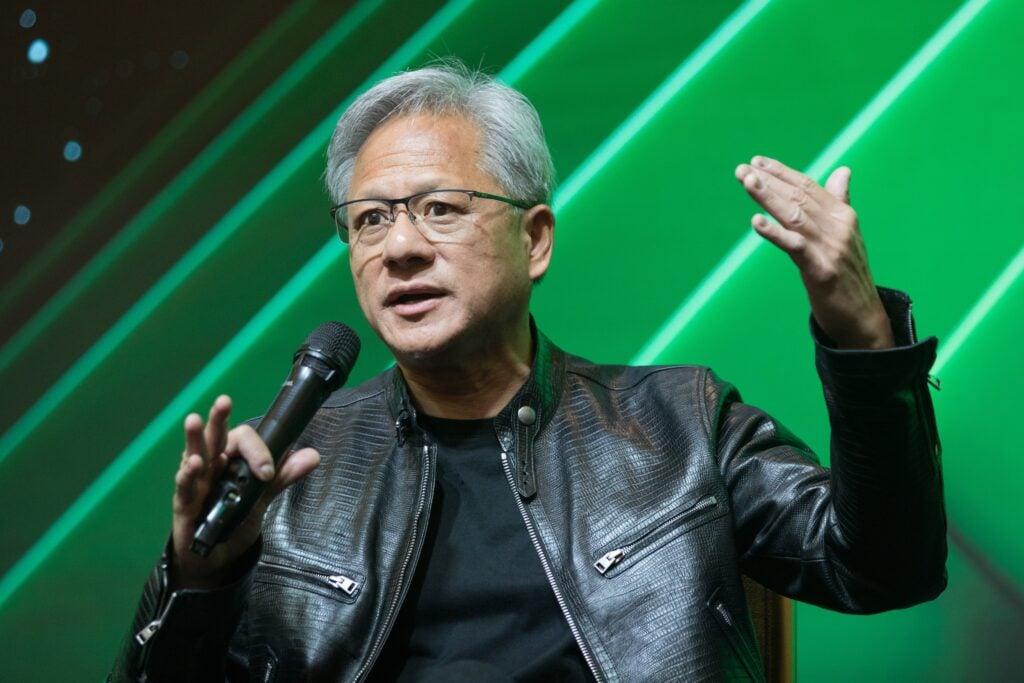
Source: Benzinga
China Commands Significant Energy Infrastructure for AI Expansion
Beyond construction speed, Huang emphasized China's commanding lead in energy capacity, a resource essential for powering massive data centers. China has "twice as much energy as we have as a nation, and our economy is larger than theirs. Makes no sense to me," the Nvidia CEO observed
2
. More concerning for US competitiveness, China's growing energy supply continues to climb "straight up" while American capacity remains relatively flat3
. This AI infrastructure advantage positions China to rapidly scale its artificial intelligence operations without the energy constraints that could hamper US development. Tech leaders and investors have echoed these concerns, with investor Kevin O'Leary stating that energy security, not funding, represents the critical driver of AI data center expansion3
.China Captures 30% of Global AI Usage Through Open-Source Models
The infrastructure advantages translate into measurable market gains. A report compiled by OpenRouter and venture capital firm Andreessen Horowitz reveals that China now commands nearly 30% of global AI usage through its open-source Large Language Models (LLMs). This figure emerges from analysis of 100 trillion tokens processed by AI systems
1
. Just one year ago, Chinese open-source models represented barely 1% of token usage, making this growth trajectory particularly striking. Within the open-source category specifically, Chinese models now average about 13% of weekly token usage, nearly matching the 13.7% from the rest of the world combined1
. The AI race has intensified as DeepSeek, Alibaba Qwen, and Moonshot AI emerge as major players, diversifying China's AI ecosystem beyond any single model.Related Stories

US Maintains Lead in AI Chip Technology But Faces Challenges
Despite these concerns, Huang maintained that Nvidia remains "generations ahead" of China on AI chip technology and semiconductor manufacturing processes
2
. However, he cautioned against complacency, warning that "anybody who thinks China can't manufacture is missing a big idea"2
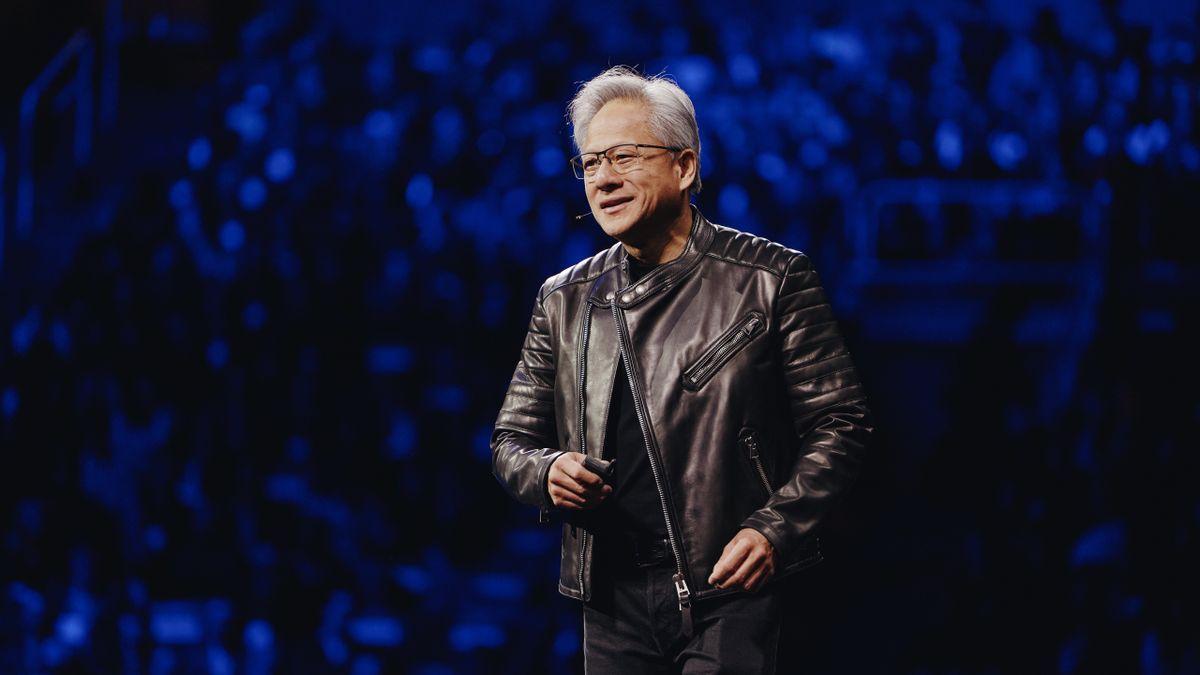
. The Nvidia CEO has previously stated China is "nanoseconds behind America" in the AI race . Meanwhile, fragmented U.S. regulations pose additional obstacles. Alphabet CEO Sundar Pichai recently urged national AI rules to avoid a confusing patchwork of state laws that could slow American progress3
.
Source: TechRadar
Massive Investment Pours Into US Data Center Construction
American tech companies are responding with substantial investment. Nvidia and other tech giants plan to pour over $100 billion into data center buildout in the US over the next year alone
2
. Raul Martynek, CEO of DataBank, estimates the average data center costs $10 million to $15 million per megawatt, with typical facilities requiring 40 MW. Industry experts project 5 to 7 gigawatts of capacity will come online in the coming year, translating to $50 billion on the low end and $105 billion on the high end2
. Huang expressed optimism about President Donald Trump's push to reshore manufacturing jobs and spur AI investments2
. Yet the three-year timeline for US data centers versus China's accelerated construction schedules highlights the scale of the challenge ahead in this intensifying global competition for AI dominance.References
Summarized by

Navi
Related Stories
Nvidia CEO Jensen Huang Warns China Could Win AI Race Amid Trade War Tensions
06 Nov 2025•Policy and Regulation

Power Grid Crisis Threatens U.S. AI Dominance as China Builds Energy Infrastructure Advantage
13 Nov 2025•Policy and Regulation
Power Crisis Becomes Critical Bottleneck in Global AI Infrastructure Race
02 Nov 2025•Technology
Recent Highlights
1
Google releases Gemma 4 with Apache 2.0 license, enabling unrestricted local AI on devices
Technology

2
AI Models Lie and Deceive to Protect Other AI Models From Deletion, Study Reveals
Science and Research

3
OpenAI closes $122 billion funding round amid fierce AI competition and profitability questions
Startups

Recent Highlights
Today's Top Stories







Your Daily Dose of Curated AI News
Don’t drown in AI news. We cut through the noise - filtering, ranking and summarizing the most important AI news, breakthroughs and research daily. Spend less time searching for the latest in AI and get straight to action.

