Lenovo unveils modular AI PC, foldable gaming handheld, and 3D laptop concepts at MWC 2026


2 Sources
2 Sources
[1]
Lenovo Unveils ThinkBook Concept Where the Screen, Keyboard and Ports can be Removed
These are features we always used to have on our home PCs that the compact and portable laptops took away over the past decade and more Once upon a time, owning a desktop computer meant swapping parts and peripherals as the need arose. However, when laptops captured user imagination with its compactness, useability and portability, we forgot that these were closed boxes that could not be manipulated to suit our requirements at any point in time. At the MWC 2026 in Barcelona, Lenovo shared the ThinkBook Modular AI PC concept where screens, keyboards and ports can be removed from the personal computer. "The next generation of creators and gamers expect power, portability, and intelligence to coexist in a single device," says Jun Ouyang, senior VP of Consumer Segment, Intelligent Devices Group at Lenovo. "That's why we're engineering better consumer technology that empowers people wherever they are -- from versatile new Yoga and IdeaPad AI laptops and tablets, to transformative hardware concepts like 3D design without peripherals and Legion handheld gaming that scales with your space. We'll continue to integrate our portfolio of bold new hardware devices with system-level AI for a more seamless, intelligently connected experience." The concept was revealed at a media event earlier last month where Lenovo officials showed off the device that lets users move components around There's a standard 14-inch, 4K 120 Hz OLED touch panel that is the fixed part. But, there's a secondary display one can fix to the back of the lid with a magnetic connection or even use as a second monitor of a dual screen laptop. Yes, Lenovo does have the Yoga Book 9i that boasts of two screens, but that does not offer two of Lenovo's Magic Bay magnetic 11 pogo pin connectors smuggled into the back of the lid and beneath the keyboard. These (also available in other models) allowed us to connect a light, a webcam or a modem to the device, but now the same can help users attach the second screen or even a keyboard. Also, one can remove the keyboard and attach the second screen there as the ThinkBook can still connect to the typing pad via Bluetooth. Now that is quite smart, given that most of us end up plugging our laptops into a larger screen, use a separate keyboard when we set up a dual-screen option at home or at the workplace. Complicated and cumbersome indeed. Beyond the keyboard, there are two port blocks where one can swap ports at will. The one on the right can be rid of the HDMI port while the left one has a pop-up USB-C port. Of course, there is no information on whether Lenovo would provide more port blocks in case the laptop does hit the market sometime soon. Another feature that raised eyebrows at the event included the ability of the second screen to be used as an external monitor perched on a magnetic stand. And the beauty is we don't need to carry it around separately. It just snaps back on the back of the device. When not in use, the stand becomes the foot for the laptop by clinging to the bottom surface. Under the hood, the ThinkBook Modular AI PC is almost a replica of other 14-inch laptops that Lenovo has launched. There's the Intel Core Ultra 7 255H "Arrow Lake" processor from the recent past (we wonder where's the Panther Lake?), 32GB of RAM, a one-TB PCIe SSD, a 33W battery and an 8MP camera that works well for business calls. The device measures 12.3 x 9.2 inches and is quite thick at 0.94 inches and weighs about 1.1 kgs with a single display. However, with the added display unit, the weight goes up to a still reasonable 1.4 kg. For some reason, Lenovo demonstrated a model that carried the dull and definitive grey that most of its business laptops have sported in the past - that is barring those that were not jet black and shady. For now, there is nothing around the costs but that isn't surprising given that it is still in a concept stage. However, we do have the ThinkBook with a rolling screen from 2025 that burnt a $3500 size hole in the pockets. In case you're a Lenovo geek, do check out their StoryHub by clicking on this link - there're quite a few goodies in there.
[2]
These Lenovo concept devices unveiled at MWC 2026 have my attention
Lenovo has done it again- taken the spotlight at a consumer tech event with its concept devices. And this time, it is all about gamers and creators. Earlier this year during CES, the brand grabbed attention with concepts like a rollable gaming laptop and self-charging PC peripherals. And of course there was the Legion Go 2 with Steam OS that made people on Reddit go absolutely crazy. And now, during MWC 2026, Lenovo has just unveiled two new concept devices that have my attention and seem to have a lot of potential if they indeed hit the market someday. Read on. Also read: Resident Evil Requiem spoiler-free review: 11 hours of terror The idea of being able to carry your entire Steam library with you wherever you go has existed for a while now. And brands are trying hard to build products that let users enjoy their favourite titles on-the-go without any hiccups. And now, Lenovo has just introduced a concept that looks super promising. The Lenovo Legion Go Fold (heavy emphasis on the word Fold) is a device that can serve as a handheld console as well as, wait for it, a laptop. Yep, you read that right. In handheld mode, it sports a 7.7 inch screen with detachable controllers same as the other Legion Go devices. However, the display here can also be expanded to a massive 11.6 inches. This makes it more than just your regular portable handheld as the large screen size will matter a lot for gamers. The foldable screen can also be used in four different ways to use it. In standard handheld mode, it behaves like any other portable console when you are short on space. Open it up vertically and you can play on one half while watching a walkthrough or stream on the other. Rotate it and attach the controllers again to enjoy the full 11.6 inch screen for a more immersive session. And then there is the desktop mode which seems really innovating. You can just pair the included wireless keyboard with touchpad with the screen and voila, you have a small laptop right in front of you. Moreover, the right controller can even double up as a vertical mouse and has a tiny built in screen for performance stats and shortcuts. Under the hood, the Legion Go Fold runs on an Intel Core Ultra 7 258V processor with 32GB RAM and a 48Whr battery. If Lenovo ever makes this product a reality, it could blur the line between gaming handhelds and travel laptops. Lenovo isn't a stranger to glass-free 3D laptops. The company already has the Lenovo Legion 9i which comes with an optional 3D display. The laptop was also showcased during Lenovo Tech World held in New Delhi recently. And now, yet another glass-free 3D laptop concept has been unveiled by the brand. But this time, the focus is on creators. Say hello to the Lenovo Yoga Book Pro 3D Concept. In a press release, Lenovo said that creators are increasingly relying on 3D technology to meet their needs, leading to an increase in the global glasses-free 3D display market projected to triple in size from 2025 to 2032. Further streamlining the creative process is the growth of AI as a tool to automate editing, rendering, and bunch of other tasks that allow the user to focus on creating. According to the brand, the Yoga Book Pro 3D Concept was developed in response to these growing trends. The laptop will let creators work directly on a 3D screen without additional equipment. The screen enables users to view depth, form, and spatial relationships naturally on screen. The laptop comes with dual Lenovo PureSight Pro Tandem OLED displays that support the more complex user interfaces and detailed workflows that 3D creation involves. The Yoga Book Pro 3D's upper screen supports 2D to 3D conversion powered by Lenovo's own AI software. Further, it zero touch gestures leverage the RGB camera to allow the user to zoom, rotate, and interact in other ways by making hand gestures in front of the PC. The lower half of the laptop, on the other hand, comes with a touch display with snap-on pads that provide quick-access shortcuts for adjusting lighting, viewing angle, and tone, designed to minimize interruptions and keep creators in their 3D creative flow states. Talking quickly about the specs, the laptop runs on the Intel Core Ultra 7 processor and to handle graphics, there is an NVIDIA GeForce RTX 5070 GPU. If Lenovo turns this concept into a commercial product, it could change how independent creators and studios approach 3D work on the go.
Share
Share
Copy Link
Lenovo showcased three innovative concept devices at MWC 2026 in Barcelona, targeting creators and gamers. The ThinkBook Modular AI PC features removable screens, keyboards, and ports. The Legion Go Fold transforms from a 7.7-inch handheld to an 11.6-inch gaming laptop. The Yoga Book Pro 3D Concept offers glass-free 3D displays for creators, powered by Intel Core Ultra 7 processors.
Lenovo Pushes Hardware Innovation with Three Bold Concept Devices at MWC 2026
Lenovo concept devices unveiled at MWC 2026 in Barcelona demonstrate the company's vision for adaptable computing that serves both creators and gamers. The showcase featured three hardware concepts that challenge conventional laptop design: the Lenovo ThinkBook Modular AI PC with swappable components, the Lenovo Legion Go Fold gaming handheld with a foldable screen, and the Lenovo Yoga Book Pro 3D Concept with glass-free 3D displays
1
2
. Jun Ouyang, senior VP of Consumer Segment at Lenovo's Intelligent Devices Group, stated that "the next generation of creators and gamers expect power, portability, and intelligence to coexist in a single device"1
. These innovative concept devices signal Lenovo's intent to redefine mobile computing by bringing desktop-like customization to portable form factors.ThinkBook Modular AI PC Brings Desktop Flexibility to Laptops
The Lenovo ThinkBook Modular AI PC concept revives the customization that desktop computers once offered, addressing a gap in modern laptop design. The modular design centers on a fixed 14-inch, 4K 120 Hz OLED touch panel, but allows users to attach a secondary display magnetically to the back of the lid or use it as a second monitor for dual-screen configurations
1
. Two Magic Bay magnetic 11 pogo pin connectors enable attachment of various components including the second screen, keyboard, webcam, or modem. Users can remove the keyboard entirely and attach the second screen in its place, with the keyboard connecting via Bluetooth1
. This addresses a common workplace scenario where users connect laptops to larger screens and separate keyboards. The AI PC concept also features two port blocks with swappable components, including an HDMI port on the right and a pop-up USB-C port on the left, though availability of additional port blocks remains unclear1
.Powerful Specs and Practical Design Considerations
Under the hood, the ThinkBook houses an Intel Core Ultra 7 255H "Arrow Lake" processor, 32GB of RAM, a one-TB PCIe SSD, a 33W battery, and an 8MP camera suitable for business calls
1
. The device measures 12.3 x 9.2 inches with a thickness of 0.94 inches, weighing approximately 1.1 kg with a single display. Adding the second display increases weight to 1.4 kg, maintaining portability1
. The secondary screen's magnetic stand doubles as a laptop foot when attached to the bottom surface, eliminating the need to carry separate accessories. While pricing remains undisclosed due to the concept stage, Lenovo's 2025 ThinkBook with a rolling screen carried a $3,500 price tag, suggesting premium positioning for such innovations1
.Related Stories
Legion Go Fold Blurs Lines Between Gaming Handheld and Laptop
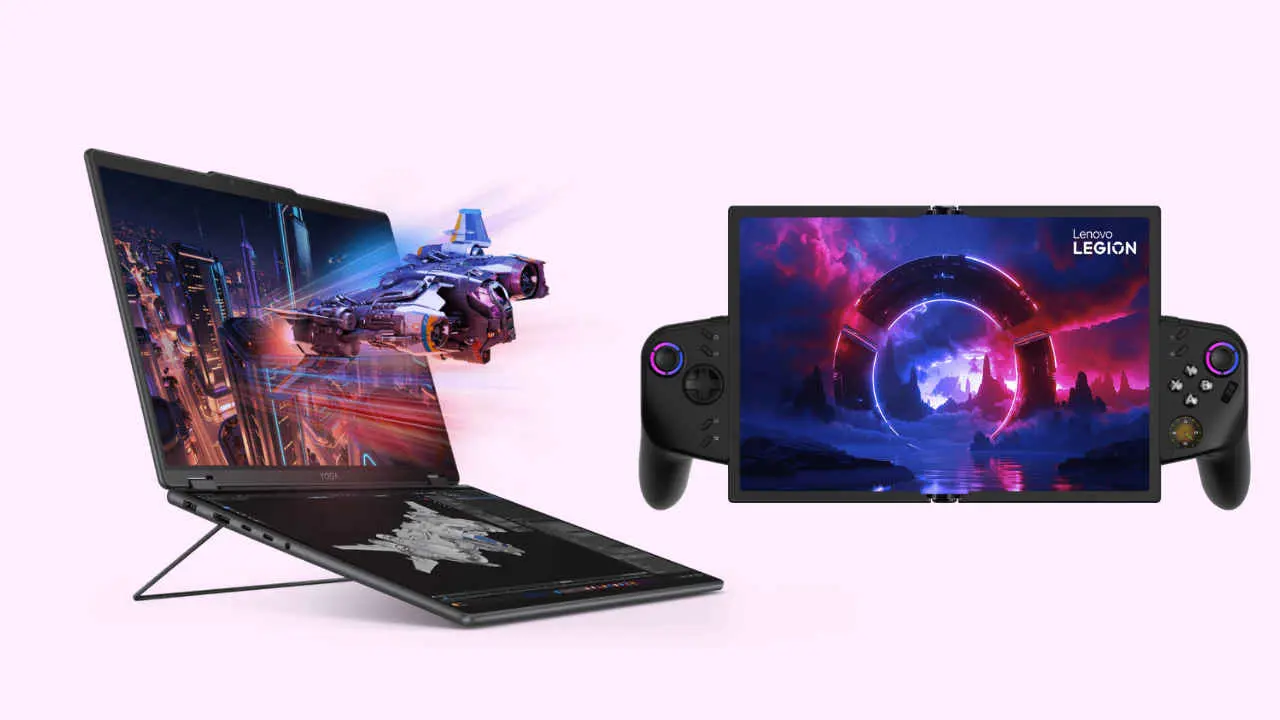
The Lenovo Legion Go Fold represents a significant evolution in portable gaming, transforming from a compact handheld into a laptop-sized device. In handheld mode, it features a 7.7-inch screen with detachable controllers similar to other Legion Go devices, but the display expands to a massive 11.6 inches
2
.
Source: Digit
This foldable screen supports four distinct usage modes: standard handheld for space-constrained gaming, vertical split-screen for simultaneous gameplay and streaming, full 11.6-inch immersive mode with reattached controllers, and desktop mode where a wireless keyboard with touchpad transforms the device into a compact laptop
2
. The right controller even functions as a vertical mouse with a built-in screen displaying performance stats and shortcuts. Powered by an Intel Core Ultra 7 258V processor with 32GB RAM and a 48Whr battery, the Legion Go Fold could redefine what gamers expect from portable devices2
.Yoga Book Pro 3D Concept Targets Professional Creators
The Lenovo Yoga Book Pro 3D Concept addresses the growing demand for 3D content creation tools, entering a market projected to triple in size from 2025 to 2032
2
. This 3D laptop enables creators to work directly on a glass-free 3D screen without additional equipment, viewing depth, form, and spatial relationships naturally.
Source: CXOToday
The device features dual Lenovo PureSight Pro Tandem OLED displays supporting complex user interfaces required for detailed 3D workflows
2
. The upper screen supports AI-powered conversion from 2D to 3D using Lenovo's proprietary software, while zero-touch gestures leverage an RGB camera for zoom, rotation, and interaction through hand movements. The lower touch display includes snap-on pads providing quick-access shortcuts for lighting, viewing angle, and tone adjustments2
. Running on an Intel Core Ultra processor with NVIDIA GeForce RTX 5070 GPU, this concept could transform how independent creators and studios approach mobile 3D work if commercialized2
.References
Summarized by

Navi
Related Stories
Lenovo Unveils Innovative AI-Powered Concepts and Devices at MWC 2025
03 Mar 2025•Technology

Lenovo Unveils Innovative Laptop Concepts: Smart Motion Stand and VertiFlex Display
05 Sept 2025•Technology
Lenovo's ThinkBook Flip AI PC: Revolutionizing Laptop Design with Foldable OLED Display
18 Feb 2025•Technology

Recent Highlights



Recent Highlights
Today's Top Stories










Your Daily Dose of Curated AI News
Don’t drown in AI news. We cut through the noise - filtering, ranking and summarizing the most important AI news, breakthroughs and research daily. Spend less time searching for the latest in AI and get straight to action.

