Living human neurons from Cortical Labs are now playing Doom on a $35,000 biological computer


2 Sources
2 Sources
[1]
This $35,000 computer made of living human neurons can run Doom
Serving tech enthusiasts for over 25 years. TechSpot means tech analysis and advice you can trust. First look: Australian biotech startup Cortical Labs has crossed another boundary in biological computing. Its latest hardware platform, the CL1, uses living human neurons as the core of a fully functioning computer - and it's now capable of running Doom. The company demonstrated the feat through its Cortical Cloud, posting it on YouTube and the open-source code to GitHub. The CL1 is the first commercial system from the same researchers who wowed the tech world in 2022 by teaching a cluster of 800,000 neurons to play Pong. The new CL1 pushes the idea into engineered hardware, built around 59 electrodes positioned on a planar array of metal and glass. The denser contact grid and upgraded signal processing cut latency from milliseconds to sub-millisecond speeds, allowing the living network to respond almost as fluidly as a conventional processor. Unlike simulated neural networks, these are genuine neurons - cultured from skin or blood cells taken from adult donors, reprogrammed into induced pluripotent stem cells, and then differentiated into cortical brain cells. Within the CL1 module, the living tissue sits inside a sealed chamber linked to an internal life-support system that controls gas composition, temperature, and waste filtration. Under ideal lab conditions, the neurons remain active and viable for up to six months. To manage this biological substrate, Cortical Labs designed an operating system, called biOS, that sends and receives electrical stimuli through the electrode array. Developers can deploy code directly to the neuron layer, where feedback signals shape adaptive pathways much like synapses in a biological brain. When trained on games like Pong or Doom, the networks react to stimuli - reward signals when a goal is achieved, corrective signals when it fails - forming self-organized response patterns. Cortical Labs calls this computational model "Synthetic Biological Intelligence," a term meant to distinguish living computation from traditional artificial intelligence. Technically, the CL1 ships as a self-contained desktop unit but also integrates into 30-unit server racks targeted at research institutions. Each module sells for around $35,000, with volume pricing dropping to $20,000 per unit in rack configurations. A full rack consumes roughly 850 to 1,000 watts - power levels on par with a single midrange GPU server. The company began shipping the first 115 commercial systems in 2025 and maintains cloud connectivity for live monitoring and remote code deployment. The decision to run Doom was partly practical and partly symbolic. Since the 1993 game has become a universal benchmark for testing hardware - a rite of passage for everything from graphing calculators to hacked-together pregnancy tests.
[2]
A Dish of Neurons Playing DOOM Is the Wildest Thing I've Seen in Ages
A couple of years ago, a company called Cortical Labs released a video that showed a simplified version of Pong being played by a culture of human neurons in a Petri dish. The idea that a bunch of neurons in a dish can do anything is impressive enough, but it turns out that things have gotten significantly crazier since then, because the company has now managed to get a similar culture of neurons to play Doom. In a very slick marketing video, the company demonstrates “real neuron gameplayâ€: Doom running on its CL-1 neural computing system, a microchip upon which 200,000 human neurons are mounted in something called a “multi-electrode array.†(For comparison, while the exact number of neurons in an average human brain remains the subject of some debate, it’s in the order of tens of billionsâ€"which really just reinforces how astonishingly powerful and complex our own brains are.) Anyway, this video is wildâ€"and it just gets wilder as various company representatives explain exactly what’s going on. First, the chip isn’t running Doom; it’s playing Doom. Or, to be more accurate, various elements of the on-screen data are being mapped to patterns of electric stimuli, which are then transmitted to the neurons. The neurons respond to these stimuli with signals of their own, which control the on-screen character’s actions: “If the neurons fire in a specific pattern, Doomguy shoots. If they fire in another pattern, he moves to the right. And so on.†At one point, a researcher shows some microscope images of the chip, and we see how intricate and very clearly organic webs of neurons wind around the crisp, straight lines of circuitry. It looks like something straight out of a sci-fi film. I mean, look at this: The other thing is that the neurons are learning. At present, they’re not particularly good at Doom: “The cells play like a beginner who’s never seen a computer. And in all fairness, they haven’t.†But give them a couple of years, and who knows? The plasticity of the networks that neurons form is a big part of what makes our own brains so powerful and adaptable. If these networks adapt in the same manner, we might just find that they end up being very, very good at Doom. (With that said, save for a couple of short exceptions, the footage doesn’t actually depict Doom. The neurons are playing Freedoom, which runs on the Doom engineâ€"which has been open-sourced for decadesâ€"but uses none of Doom’s iconic demons or weapons, which remain under copyright. We have nothing against Freedoom per se, but come onâ€"can we not at least furnish our future brain-in-a-vat overlords with a proper copy DOOM.WAD?) There are obviously many fascinating and potentially troubling questions raised by this sort of technology. One that springs to mind immediately is, “Whose cells are these?†They must contain somebody's DNA. Are we going to end up with another Henrietta Lacks situation two decades down the line, where every one of the neurocomputers thrashing everyone online at Call of Duty 17 contains neurons that originate with the same person? The company has launched something it’s calling the “Cortical Cloud,†which promises to allow developers the world over to experiment with the CL-1 via a Python-based API. This collegiate spirit is admirable, but the idea of human neurons ending up being used to generate AI porn or something feelsâ€| unpleasant. Who knows, though? Maybe in a couple of generations’ time, it’ll feel just as commonplace as today’s insanely complicated processors being used for the same purpose.
Share
Share
Copy Link
Australian biotech startup Cortical Labs has achieved a milestone in biological computing by demonstrating its CL1 system running Doom using 200,000 living human neurons. The $35,000 commercial platform represents a leap from the company's 2022 Pong experiment, offering developers access through Cortical Cloud to explore what they call Synthetic Biological Intelligence.
Cortical Labs Pushes Biological Computing Into Commercial Reality
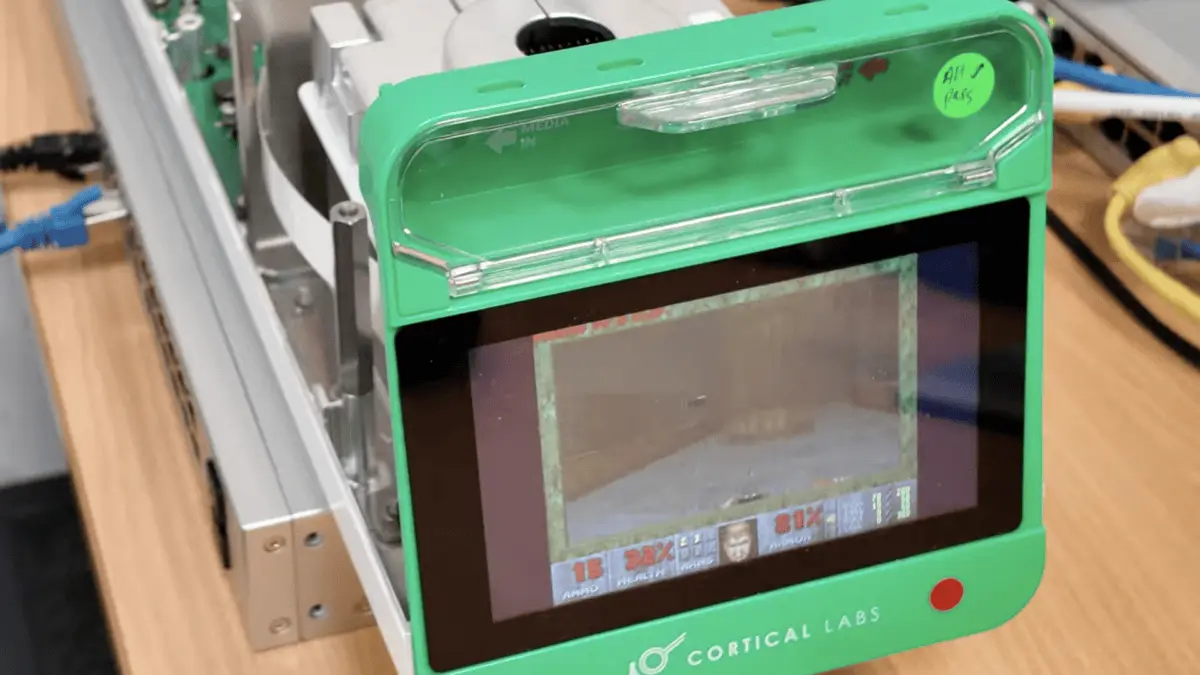
Australian biotech startup Cortical Labs has demonstrated a striking advancement in biological computing: a system where human neurons are playing Doom
1
. The company's CL1 platform, priced at $35,000 per unit, represents the first commercial computer made of living human neurons capable of running complex software1
. This achievement builds on Cortical Labs' 2022 breakthrough when researchers taught 800,000 neurons to play Pong, but the new hardware pushes biological computation into engineered, commercially available systems1
.
Source: Gizmodo
The decision to run Doom wasn't arbitrary. Since 1993, the game has served as a universal benchmark for testing unconventional hardware, from graphing calculators to pregnancy tests
1
. But unlike those hacks, the CL1 isn't simply running the game—the neurons are actually playing it2
. On-screen data gets mapped to patterns of electrical stimuli transmitted to the neurons, which respond with signals that control the character's actions2
. When neurons fire in specific patterns, the in-game character shoots or moves, creating a genuine feedback loop between biological tissue and digital environment.How the CL1 System Works With Cultured Human Cortical Cells
The CL1 microchip contains approximately 200,000 cultured human cortical cells mounted on a multi-electrode array
2
. These aren't simulated neural networks but genuine neurons derived from skin or blood cells taken from adult donors1
. Through a process involving induced pluripotent stem cells, these samples are reprogrammed and differentiated into cortical brain cells1
.
Source: TechSpot
The living tissue sits inside a sealed chamber connected to an internal life-support system that regulates gas composition, temperature, and waste filtration
1
. Under optimal lab conditions, the neurons remain active and viable for up to six months1
. The hardware features 59 electrodes positioned on a planar array of metal and glass, with the denser contact grid and upgraded signal processing reducing latency from milliseconds to sub-millisecond speeds1
. This allows the living network to respond almost as fluidly as conventional processors.Synthetic Biological Intelligence and the biOS Operating System
To manage this biological substrate, Cortical Labs developed biOS, an operating system that sends and receives electrical stimuli through the electrode array
1
. Developers can deploy code directly to the neuron layer, where feedback signals shape adaptive pathways similar to synapses in a biological brain1
. When trained on games like Pong or Doom, the networks react to stimuli—receiving reward signals when achieving goals and corrective signals upon failure—forming self-organized response patterns1
.Cortical Labs terms this computational model Synthetic Biological Intelligence, distinguishing living computation from traditional artificial intelligence
1
. The company emphasizes that these neurocomputers leverage the plasticity inherent in neural networks—the same adaptability that makes human brains powerful2
. Currently, the cells "play like a beginner who's never seen a computer," but researchers note the potential for dramatic improvement as the networks adapt2
.Related Stories

Commercial Availability Through Cortical Cloud and Research Institutions
The CL1 ships as a self-contained desktop unit but also integrates into 30-unit server rack configurations targeted at research institutions
1
. Volume pricing drops to $20,000 per unit in rack configurations, with a full rack consuming roughly 850 to 1,000 watts—power levels comparable to a single midrange GPU server1
. Cortical Labs began shipping the first 115 commercial systems in 2025 and maintains cloud connectivity for live monitoring and remote code deployment1
.The company launched Cortical Cloud, allowing developers worldwide to experiment with the CL1 via a Python API
2
. This open approach mirrors the company's decision to post demonstration footage on YouTube and release open-source code to GitHub1
. The platform enables researchers to explore biological computing applications beyond gaming, though the practical uses remain largely speculative at this stage.Questions About Ethics and Future Implications
The technology raises immediate questions about sourcing and consent. The neurons contain someone's DNA, prompting concerns about whether this could lead to situations similar to the Henrietta Lacks case, where biological material was used extensively without proper consent or compensation
2
. The prospect of human neurons being deployed for various applications—some potentially problematic—adds another layer of complexity to the ethical considerations surrounding biotechnology2
.For AI researchers and developers, the CL1 represents a fundamentally different approach to computation. Instead of silicon-based processors mimicking biological processes, this system uses actual biological tissue to perform computational tasks. The short-term implications center on research applications, where the six-month viability window and $20,000-to-$35,000 price point make it accessible to well-funded institutions. Long-term speculation focuses on whether these systems can scale beyond simple games to handle more complex tasks, and whether the plasticity of neural networks will enable performance improvements that rival or exceed conventional systems in specific applications.
References
Summarized by

Navi
Related Stories
Cortical Labs Unveils CL1: World's First Commercial Biological Computer Using Human Brain Cells
06 Mar 2025•Technology

Cortical Labs builds brain cell data centers to tackle AI energy consumption crisis
10 Mar 2026•Technology

Digital fruit fly brain walks while human neurons play Doom in biological computer experiments
16 Mar 2026•Science and Research

Recent Highlights


Recent Highlights
Today's Top Stories






Your Daily Dose of Curated AI News
Don’t drown in AI news. We cut through the noise - filtering, ranking and summarizing the most important AI news, breakthroughs and research daily. Spend less time searching for the latest in AI and get straight to action.

