Cortical Labs builds brain cell data centers to tackle AI energy consumption crisis


6 Sources
[1]
Startup is building the first data centre to use human brain cells
Cortical Labs is building two data centres that will house its neuron-filled chips. The technology is still in the very early stages of development Data centres use huge amounts of energy and chips are in high-demand - could brain cells be the answer? Australia-based startup Cortical Labs has
[2]
Human brain cells set to power two new data centers, thanks to 'body-in-the-box' CL1 -- Cortical Labs targets the AI energy crisis with biological computer that reportedly uses less energy than a calculator
Cortical Labs, the Australian tech startup behind the CL1 biological computer, has just announced a new partnership to establish data centers using its experimental product, Bloomberg reports. The biotech company has partnered with data center company DayOne to establish the two data centers,
[3]
Human Brain Cells Run New Data Centers in Singapore, Melbourne
Cortical Labs has made progress, including teaching its brain cells to play computer games like Pong and Doom, and is building facilities in Melbourne and Singapore to house its CL1 units, with the Singapore location set to deploy up to 1,000 units in phases. Biotech startup Cortical Labs is
[4]
That Doom-running, human brain cell-powered computer is headed for data centers
Serving tech enthusiasts for over 25 years. TechSpot means tech analysis and advice you can trust. What just happened? Following news that its human brain cell-powered computer can run Doom, Australian biotech startup Cortical Labs has announced it is working on two small data centers running on
[5]

The Company That Made a Dish of Neurons Play DOOM Is Getting Into Brain Cell-Powered Data Centers
A computer platform that runs on human neurons (and recently showed off said neurons' ability to play DOOM) now wants in on the data center boom. Australia-based Cortical Labs announced today that it is working on two of what it calls “biological data centers,†one in Melbourne and another in
[6]

New Data Centers Will Be Powered by Human Brain Cells
Can't-miss innovations from the bleeding edge of science and tech Last year, researchers at Australian biotech startup Cortical Labs showed off its CL1, the "world's first code deployable biological computer" that's made up of 200,000 living human neurons. In February, the company showed off its
Share
Copy Link
Australian biotech startup Cortical Labs is constructing two biological data centres powered by human brain cells in Melbourne and Singapore. The facilities will house neuron-filled chips that use a fraction of the energy required by conventional AI processors. While the technology remains in early development stages, it represents a novel approach to addressing the mounting power demands of AI infrastructure.
Cortical Labs Launches Brain Cell-Powered Infrastructure
Australian biotech startup Cortical Labs is building two biological data centres that mark a significant shift in how computing infrastructure could be designed. The company announced a partnership with DayOne Data Centers to establish facilities in Melbourne and Singapore, both powered by its CL1 biological computer units
3
. The Melbourne facility will house 120 CL1 units, while the Singapore location is set to deploy as many as 1,000 units in phases2
. Each CL1 unit consists of a silicon chip with approximately 200,000 lab-grown human neurons grown on top, converted initially from human blood cells2
. These human brain cells respond to electrical stimuli, forming networks similar to neural arrays in our own brains.
Source: Gizmodo
Energy-Efficient AI Alternative Addresses Power Crisis
The timing of this development comes as AI energy consumption has become a critical concern for tech companies and governments alike. Traditional AI data centers consume thousands of watts per chip and require substantial cooling infrastructure, but Cortical Labs argues that each CL1 requires around 30W
1
. Founder and CEO Hon Weng Chong stated that each unit uses less power than a handheld calculator3
. Paul Roach at Loughborough University noted that when scaled up to whole rooms, there could be huge power savings compared to conventional data servers1
. The swift buildout of AI data centers across the planet has led to environmental concerns over their power needs and water consumption as well as shortages in silicon3
.
Source: Bloomberg
Brain Computing Services Expand Through Cloud Access
Cortical Labs has revealed that these biological data centres will allow the company to expand their cloud-based brain computing services
1
. Michael Barros at the University of Essex, who already uses Cortical Labs' cloud services as part of his research, explained that biological computers like the CL1 are often hard to build and not easy for others to use1
. The company is essentially allowing its biocomputer to be accessible at a large scale, making it the first to do so1
. The Singapore project will start with an initial 20 CL1 units in a validation phase at the Yong Loo Lin School of Medicine at the National University of Singapore4
.Related Stories
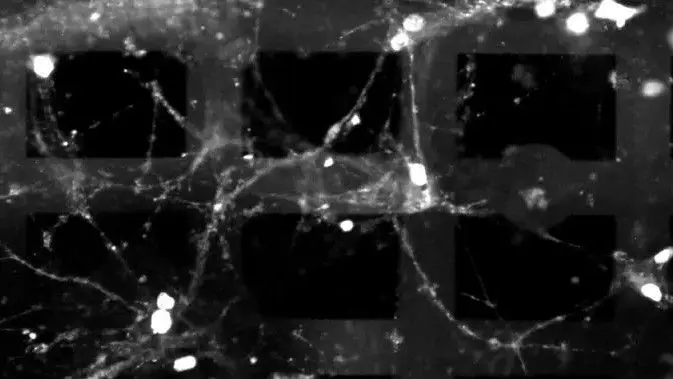
Programmable Wetware Platform Demonstrates Learning Capability
The neurons used by Cortical Labs, grown from stem cells, sit on a chip that sends and receives electrical signals to the cells and records how they respond
3
. This programmable wetware platform allows the company's software to interact with the cells and interpret their responses as computing output. Cortical Labs has demonstrated that its neuron-filled chips can play Pong and Doom, with the company showing last month that the CL1 could learn to play Doom in a week1
. The system is equipped with on-board life support, recording, and application handling, and can keep the neurons alive for up to six months4
. Each unit is priced at around $35,0002
.
Source: TechSpot
Early Stage Technology Faces Significant Challenges
Despite the promise, experts caution that the technology remains in early development. Steve Furber at the University of Manchester stated it's a very long way from production ready, noting it's a very big step from a small network playing a computer game to an LLM
1
. The exact way in which these neurons function and how best to train them to perform tasks like machine learning is still unclear, according to Reinhold Scherer at the University of Essex1
. One remaining issue is that it's still unclear how to store the results of training these neurons in a form of memory or how to run actual computational algorithms on them1
. Another challenge involves retraining: whatever the neurons are trained on is lost when the culture ends its life, requiring complete retraining every 30 days1
. The proposed biological data centre will have hundreds of biological chips, compared to hundreds of thousands of GPUs seen in the largest AI data centers1
. These biological data centres are not being positioned as direct replacements for traditional server farms, at least not yet, but could carve out a niche where adaptability and lower energy use matter more than raw conventional performance4
.References
Summarized by

Navi
[1]
Related Stories
Cortical Labs Unveils CL1: World's First Commercial Biological Computer Using Human Brain Cells
06 Mar 2025•Technology

Living human neurons from Cortical Labs are now playing Doom on a $35,000 biological computer
28 Feb 2026•Technology

China Unveils Groundbreaking Brain-Inspired AI Server: BI Explorer 1
28 Oct 2025•Technology
Recent Highlights
1
Microsoft and Nvidia Launch Surface Laptop Ultra: A $2,599 AI-Ready PC With RTX Spark Chip
Technology

2
Trump Consulted Grok AI Before Ordering Venezuela Invasion and Capture of Nicolás Maduro
Policy and Regulation

3
Scientists Build AI Model That Reconstructs Images From Brain Scans in Record Time
Science and Research

Recent Highlights
Today's Top Stories






Don’t drown in AI news. We cut through the noise - filtering, ranking and summarizing the most important AI news, breakthroughs and research daily. Follow topics that matter to you and stay ahead.


