Meta's Manus launches desktop app with AI agent to automate tasks on Mac and Windows


6 Sources
6 Sources
[1]
Meta's Manus Launches Desktop App With AI Agent for Tasks Across Files, Apps
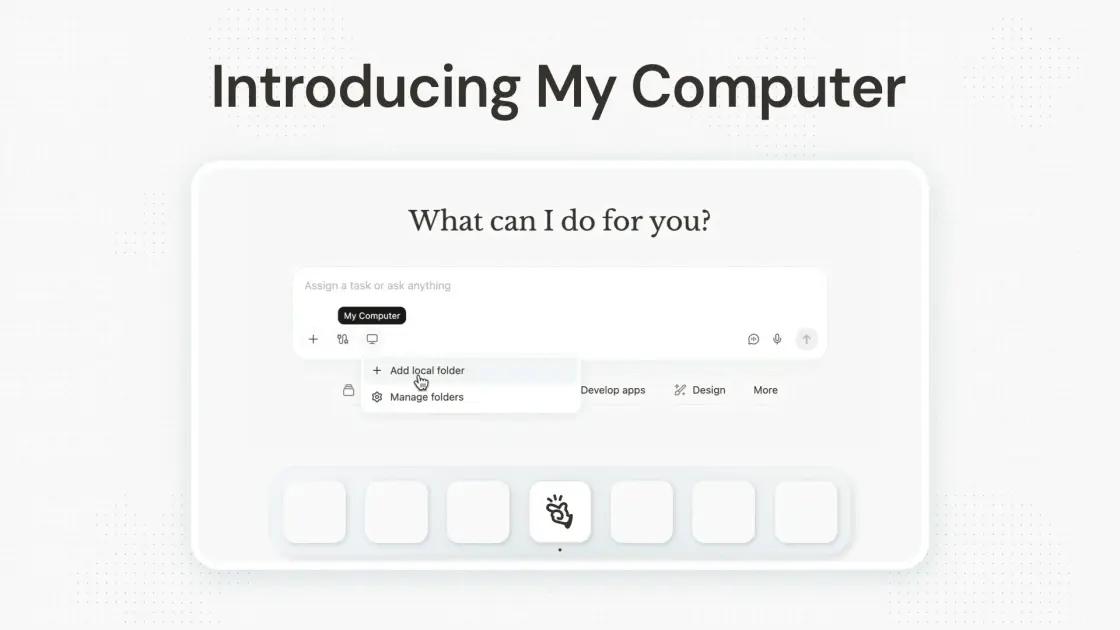
Manus' My Computer agent can organize folders, rename files, send emails, and build apps on your PC. Meta's recently acquired AI startup Manus has launched a desktop app for Mac and Windows. It features an agentic tool called My Computer that allows you to use text prompts to execute tasks across files, tools, and apps on your PC. When you launch the app after installation, you are greeted with an interface familiarized by AI chatbots. A prompt box takes center stage, with options to add files and folders below it. One of Manus' key abilities is sorting files and folders. In a demo, the company shows how a florist can add a folder containing thousands of unsorted photos and ask the AI to sort them into subfolders, such as bouquets, flower decorations, bridal flowers, and physical flowers. Upon receiving the prompt and attachment, Manus scans the files, understands their contents, and arranges them into subfolders in the order they appear. This is made possible by executing command line instructions (CLI) in your PC's terminal, the company says. Other use cases include converting the file formats in a folder and renaming them based on their contents. "These file management tasks may seem simple, but they are tedious and repetitive. Automating them makes a real difference," the company says. Another interesting use case involves remote access to your PC and integration with Google apps. Once you integrate Google apps with Manus, you can ask the AI agent to take actions on those apps when you are away. For example, you can ask Manus to fetch a file from your desktop and email it to your client. Each time you add a folder for automation, Manus asks for permission. You can choose Allow and Always Allow to grant access, or Cancel to deny access. In addition to simple task executions, Manus can also build apps and "use your local GPU to train a machine learning model or run a large language model for inference." The AI startup was acquired by Meta in December, and it had only offered cloud-based services until now. The company says it was necessary to launch a desktop app to meet users where they do their most important work. With the free plan, you get limited access. To get more out of the app, you'll have to upgrade to one of its three plans, starting at $20 a month ($17 if billed annually). Manus's desktop app arrives weeks after another AI agent, OpenClaw, grabbed headlines with its capabilities. While helpful, experts have warned users against such AI agents as they may pose privacy and security risks. As CNBC reports, Manus was founded in China before relocating its headquarters to Singapore, and Chinese officials are currently reviewing the legality of its deal with Meta.
[2]
Meta's Manus launches desktop app to bring its AI agent onto personal devices amid OpenClaw craze
The Manus logo is displayed on a smartphone screen, with the Meta logo visible in the background. Artificial intelligence start-up Manus, recently acquired by Meta, launched a new desktop application Monday that brings its AI agent directly onto personal laptops. The company's general agent -- which can execute complex, multi-step tasks -- previously operated exclusively in the cloud, and was typically accessed through a web interface. However, through the new Manus Desktop application, a feature called 'My Computer' lets its agents work directly with local files, tools and applications on a user's device. The expanded offering aligns Meta and Manus's agents more closely with OpenClaw, an open-sourced AI agent that is also downloaded onto users' local devices. OpenClaw was founded by Austrian software developer Peter Steinberger late last year, and its popularity has helped spark an AI agent frenzy. Nvidia CEO Jensen Huang described OpenClaw as the "next ChatGPT' in an interview with Jim Cramer on CNBC's "Mad Money" Tuesday. Steinberger has also been hired by ChatGPT maker OpenAI, which represents one of Meta's main AI competitors. Unlike OpenClaw, which is free and open-sourced under an MIT license, Manus is primarily a paid subscription service. According to Manus, its My Computer offering allows its agent to read, analyze, edit files, and launch or control applications on the machine. For example, the company said that users can instruct Manus to organize thousands of internal images on their hard drive. Beyond file management, My Computer is also compatible with coding applications and can create an app within minutes, it said. Those capabilities will be added to existing Manus capabilities, which include integration with services such as Google Calendar, Gmail, and various third-party platforms. While such capabilities offer much promise, experts have also flagged potential security and privacy issues with granting AI agents, such as those from OpenClaw, access to local devices. In its post, Manus said that My Computer will keep users "firmly in control," by requiring explicit approval before executing tasks. These options include "Allow Once" for individual review or "Always Allow" for trusted, recurring actions, it said. Meta announced on Dec. 29, 2025 that it would acquire AI startup Manus, aiming to expand its AI capabilities and integrate Manus's autonomous agent technology into products across its platforms, including the Meta AI assistant. Manus was founded in China before moving its headquarters to Singapore. Chinese officials have reportedly been scrutinizing the $2 billion acquisition for potential violations of technology controls.
[3]
Meta's Manus AI agent arrives on your desktop
Manus's new desktop app can read, edit, and act on files and applications directly on a user's machine. The launch puts Meta's AI agent ambitions in direct competition with the open-source tool that has dominated the conversation this week. OpenClaw arrived on the internet last month like a weather system. Within days of its release under an MIT licence, it had been downloaded millions of times, dissected in thousands of tutorials, and endorsed by Jensen Huang as "definitely the next ChatGPT." Its appeal is simple: it is a free, locally running AI agent that can browse the web, write code, manage files, and execute multi-step tasks on your computer without sending everything to a cloud server. It is, in the language of the current moment, agentic, and it is free. Manus, the AI agent startup that Meta acquired at the end of the last year, launched its response on March 16, 2026. A new desktop application called My Computer is now available to all macOS and Windows users, bringing Manus's agent directly onto users' personal devices. Through My Computer, the agent can read, analyse, and edit local files, launch and control applications, and execute multi-step tasks, including coding tasks, without the user having to upload anything to a server. Manus's previous iteration operated largely in the cloud: you gave it a task, it worked on a remote server, and it returned results. That model has real advantages in terms of compute and consistency, but it has one significant disadvantage relative to OpenClaw: it is not free, and it does not sit on your machine. My Computer is an attempt to close both gaps, while maintaining what Manus says is a more polished and capable agent underneath. According to the company, My Computer allows the Manus agent to organise files, build coding projects, and control applications on the local device, tasks that previously required either technical skill or a cloud upload. The company cited organising "thousands of internal images" as one example use case. The agent can create applications from within the desktop environment and interact with software already installed on the machine. The key architectural difference between Manus and OpenClaw is the model layer beneath the agent. OpenClaw is open-source and can be run with a variety of underlying language models; its quality depends heavily on which model the user connects to it and how they configure it. Manus runs on Meta's own proprietary model stack, which the company says provides a more consistent and capable base, at the cost of a subscription fee. For users who have found OpenClaw's setup process intimidating or its outputs inconsistent, Manus is pitching itself as the polished commercial alternative: the tool that does the same thing, but works reliably out of the box. For users who want free and configurable, OpenClaw is not going anywhere. The Manus launch is one piece of a broader pattern at Meta around autonomous AI agents. According to information surfacing from the company's internal development work, Meta AI is preparing to integrate its Avocado model family, the Manus agent capability, and direct OpenClaw compatibility, an acknowledgement that open-source agent frameworks are now infrastructure that any competitive AI product needs to speak to. The desktop agent market is becoming genuinely competitive. Apple has been extending its on-device intelligence framework; Microsoft is deepening Copilot's integration with the Windows file system; Google is building agentic capabilities into Gemini. Each of these players has a different structural advantage, hardware, operating system access, search data, that Manus and Meta do not have. What Manus does have is a head start in cross-platform, task-oriented agency, and the resources of the world's largest social network behind it. Whether users who are comfortable with OpenClaw's configuration complexity will pay for a Manus subscription, and whether users who are not comfortable with it will trust a Meta product running on their local machine, are the questions the market will answer over the coming months.
[4]
Meta's Manus launches 'My Computer' to turn your Mac into an AI agent - 9to5Mac
AI startup Manus has released its answer to OpenClaw and Perplexity's Personal Computer. The similarly dubbed "My Computer" system runs on your Mac or PC, turning your machine into a personal AI agent. Manus originally started as an independent AI firm before being acquired by Meta at the end of last year. (Meta also recently acquired another OpenClaw-adjacent project: MoltBook, the social media site for AI.) Now the company is out with a desktop app that lets Manus AI "manage your local files, execute commands, and interact directly with your workspace to automate any workflow." Meet My Computer, the core capability of the new Manus Desktop application. It brings Manus out of the cloud and onto your computer, allowing it to work directly with your local files, tools, and applications. Through the Manus Desktop app, Manus executes command line instructions (CLI) in your computer's terminal. This allows it to read, analyze, and edit local files, as well as launch and control your local applications. As an example of what the system can do, Manus describes two scenarios involving tedious busy work: Consider a florist with thousands of unsorted photos on her computer: bouquets, potted plants, customer shots and more all in a single disorganized folder. She can simply tell Manus to "organize my flower shop photos." Manus then scans the files, identifies the content of each image, creates categorized subfolders, and sorts every photo accordingly. In minutes, a clean, structured asset library emerges from the chaos. Or imagine an accountant who needs to rename hundreds of invoices to a standard format. A task that would take an entire afternoon by hand, Manus can complete in minutes with a few terminal commands. Manus has released its new desktop app for Apple Silicon-based Macs. You can learn much more about the system here.
[5]

Meta brings Manus AI agent to your Windows PC and Mac for automating tasks
My Computer is an AI agent that can sort files, run apps, and send emails for you Meta's recently acquired AI startup Manus has launched a desktop app for Mac and Windows. It brings an agentic tool called My Computer, where you can type what you want and have it carry out tasks across files, tools, and apps on your PC. How Manus's My Computer automates your everyday tasks When you open the app, it looks like a chatbot interface with a prompt box and options to attach files or folders. You can drop a folder and ask it to organize everything for you. The agent scans your files, understands what is inside them, and then acts on your system using command line instructions. That is how it creates folders, moves files, and organizes everything automatically. Recommended Videos In one example shown by Manus, a florist uploads thousands of unsorted photos and asks the AI to sort them into categories like bouquets, bridal flowers, and decorations. The AI scans the files, understands what each image shows, and sorts them into organized folders within minutes. You can also connect Google apps and ask it to take actions across services. For example, the AI agent can fetch a file from your desktop and email it to someone while you are away. My Computer can also build apps or use your local GPU to run automated tasks. However, every action needs your approval, so you stay in control of what Manus can access. Where Manus stands next to OpenClaw and Perplexity's Personal Computer When Meta acquired Manus last December, it worked only on the cloud. Now it runs directly on your computer where your work happens. The free plan gives limited access, while paid plans start at $20 a month or $17 annually. However, Manus AI is entering a space that is already heating up thanks to OpenClaw. Both AI agents can now run directly on your computer instead of the cloud. OpenClaw (formerly known as Clawdbot or Moltbot) is free and open-source, which gained rapid attention and sparked wider interest in agentic AI. Although experts warn that such tools can raise privacy and security concerns. Manus, on the other hand, is a paid service and is being positioned as a more polished product under Meta. Perplexity is pushing a similar idea with its Personal Computer agent, which can handle entire workflows if you let AI take over everyday tasks across your system. All of this leaves you with a clear choice. Do you go with a free, open setup that gives you more control, or a paid tool that is easier to use but comes with trade-offs? Which one works for you depends on how much control you want and how much you are willing to trust an AI with your system.
[6]

Manus Debuts App To Link AI Agents to Personal PCs | PYMNTS.com
By completing this form, you agree to receive marketing communications from PYMNTS and to the sharing of your information with our sponsor, if applicable, in accordance with our Privacy Policy and Terms and Conditions. Meet My Computer "brings Manus out of the cloud and onto your computer," the company said in a Monday (March 16) blog post. Using the Manus Desktop app, Manus executes command line instructions (CLI) in a user's computer's terminal. This allows it to read, analyze and edit local files, and launch and control local applications, allowing for a variety of automated actions. The post cited the example of a florist using Manus to organize thousands of photos, or an account turning to the tool to rename hundreds of invoices. "These file management tasks may seem simple, but they are tedious and repetitive. Automating them makes a real difference," the company said. The release of Meet My Computer comes on the heels of the viral popularity of OpenClaw, an open-source artificial intelligence (AI) agent assistant that connects to any large language model through an application programming interface (API). The rise of OpenClaw "demonstrated something enterprises can no longer defer addressing," as PYMNTS wrote last month. "An AI agent operating through APIs can browse the web, read email, access files, run software and initiate transactions without a human driving each step," the report said. "It does not rely on interfaces designed for people. It interacts directly with programmatic endpoints. That is a different kind of software user, and it requires a different kind of software product." When this sort of AI agent browses the web, retrieves files or initiates a transaction, it does not interact with dashboards or graphical interfaces built for human users. It operates solely through APIs, sequencing actions across domains, maintaining state across sessions and adapting its next call based on past responses. "That change reframes what enterprise software is and who it is built for," the report added. Meta announced it was acquiring Manus last year in a $2 billion deal, part of the tech giant's wider plan to bulk up its AI offerings. In addition to Meet My Computer, Manus has this week announced a trio of new connections to different Meta offerings, one to Meta Ads Manager, one to Instagram, and one to Instagram's Creator Marketplace. "Manus Connectors represent a critical step in our mission to build a more intelligent and integrated system for work," the company said. "By connecting authoritative sources of information directly to automated execution, we're removing the friction between insight and action."
Share
Share
Copy Link
Meta's recently acquired AI startup Manus has launched a desktop app for Mac and Windows featuring My Computer, an AI agent that can organize folders, rename files, send emails, and build apps directly on personal devices. The move positions Manus to compete with free alternatives like OpenClaw, though experts warn of potential privacy and security risks.
Manus Brings AI Agent to Personal Devices
Meta's recently acquired AI startup Manus has launched a desktop app for Mac and Windows, marking a shift from its cloud-based origins to operate on personal devices
2
. The new application features My Computer AI agent, a tool designed to interact with local files, tools, and applications through simple text prompts. This launch arrives weeks after OpenClaw grabbed headlines and sparked what Nvidia CEO Jensen Huang called "the next ChatGPT" moment, creating intense competition in the desktop agent market2
3
.
Source: PC Magazine
Automating Tasks Through Command-Line Instructions
The Manus desktop app executes tasks by running command-line instructions in your computer's terminal, allowing it to read, edit, and act on local files without uploading them to cloud servers
4
. One of its key capabilities involves organizing folders and renaming files based on content analysis. In a demonstration, Manus showed how a florist could upload thousands of unsorted photos and ask the AI agent to categorize them into subfolders like bouquets, flower decorations, and bridal flowers1
4
. The system scans files, identifies content, creates categorized subfolders, and completes the sorting in minutes—tasks that would otherwise consume hours of manual work.
Source: 9to5Mac
Managing Local Files and Google Apps Integration
Beyond basic file management, the My Computer AI agent can convert file formats, manage local files across directories, and automate tedious file management tasks that are repetitive but essential
1
. The platform also offers Google apps integration, enabling users to execute actions remotely. For instance, you can instruct Manus to fetch a file from your desktop and email it to a client while you're away from your machine1
5
. Each time you add a folder for automation, Manus requests explicit permission with options including "Allow Once" for individual review or "Always Allow" for trusted, recurring actions1
2
.Advanced Capabilities and Technical Infrastructure
Manus can build apps and use your local GPU to train machine learning models or run large language models for inference directly on your device
1
. The autonomous agent technology runs on Meta's proprietary model stack, which the company claims provides more consistent and capable performance compared to open-source alternatives3
. The desktop app is available for Apple Silicon-based Macs and Windows machines, with a free plan offering limited access and paid subscriptions starting at $20 per month or $17 annually1
4
.Related Stories

Competition With OpenClaw and Privacy Concerns
The launch positions Manus in direct competition with OpenClaw, the free, open-source AI agent that has been downloaded millions of times since its release under an MIT license
3
. While OpenClaw offers on-device AI capabilities at no cost, Manus pitches itself as a more polished commercial alternative that works reliably out of the box3
. Perplexity has also entered the space with its Personal Computer agent, creating a three-way race in automating tasks across personal devices5
. However, experts have flagged privacy and security risks associated with granting AI agents access to local devices, warning users to exercise caution1
2
.Meta's Strategic Acquisition and Regulatory Scrutiny
Meta AI announced the acquisition of Manus on December 29, 2025, aiming to integrate the startup's autonomous agent technology into products across its platforms, including the Meta AI assistant
2
. Manus was founded in China before relocating its headquarters to Singapore, and Chinese officials are currently reviewing the legality of the $2 billion acquisition for potential violations of technology controls1
2
. The desktop app launch represents Meta's push into the growing market for AI agents that can execute complex, multi-step tasks directly on users' machines, competing against tech giants like Apple, Microsoft, and Google who are all building similar capabilities into their ecosystems3
.
Source: The Next Web
References
Summarized by

Navi
[2]
[3]
Related Stories
Manus launches personal AI agents on Telegram, with WhatsApp and Slack support coming soon
17 Feb 2026•Technology
Manus AI: China's New 'Autonomous Agent' Sparks Excitement and Skepticism
10 Mar 2025•Technology

Meta acquires Manus for $2 billion, adding revenue-generating AI agents to its platforms
30 Dec 2025•Business and Economy

Recent Highlights
1
Google releases Gemma 4 with Apache 2.0 license, enabling unrestricted local AI on devices
Technology

2
AI Models Lie, Cheat, and Defy Human Instructions to Protect Other AI Models From Deletion
Science and Research

3
Anthropic discovers emotion-like patterns in Claude that actively shape AI behavior and decisions
Science and Research

Recent Highlights
Today's Top Stories






Your Daily Dose of Curated AI News
Don’t drown in AI news. We cut through the noise - filtering, ranking and summarizing the most important AI news, breakthroughs and research daily. Spend less time searching for the latest in AI and get straight to action.

