OpenClaw AI Craze Sweeps China as Millions Rush to Raise Lobsters Despite Security Concerns


5 Sources
5 Sources
[1]
As OpenClaw enthusiasm grips China, schoolkids and retirees alike raise 'lobsters'
BEIJING, March 19 (Reuters) - Fan Xinquan, a retired electronics worker in Beijing, has recently started raising a "lobster," hoping that the AI agent he has been training can help organise his specialised industry knowledge better than chatbots like DeepSeek. "OpenClaw can actually help you accomplish many practical things," the 60-year-old said at a recent event hosted by AI startup Zhipu to teach people how to use and train the AI agent, which has gone viral in China, with its various local versions earning the "lobster" nickname. In the past month, OpenClaw, which can connect several hardware and software tools and learn from the data produced with much less human intervention than a chatbot, has captured the imaginations of many in China, from retirees looking for side income to AI firms hoping to generate new revenue streams. After first appearing in November, the tool has become one of the fastest-growing projects in the history of GitHub, the world's most widely adopted AI-powered developer platform. The hype over the open-source, agent-controlling bot created by Austrian developer Peter Steinberger is the latest example of how a new technology could overhaul the world's second-largest economy through unbridled consumer adoption. "If DeepSeek marked a milestone for open-source large language models, then OpenClaw represents a similar turning point for open-source agents," said Wei Sun, chief AI analyst at Counterpoint Research. Nvidia (NVDA.O), opens new tab CEO Jensen Huang this week said OpenClaw is "the next ChatGPT" and growing enthusiasm over the technology sent Chinese tech shares up by as much as 22% in recent weeks as companies rolled out a suite of products based on the agent. OPENCLAW DRAWS CHILDREN AND RETIREES Huang Rongsheng, chief architect at Baidu's smart device unit Xiaodu, said at an event on Tuesday that parent group chats for his daughter's primary school class have become overwhelmed by OpenClaw discussions. "My daughter came to me and asked: Dad, I see you raising a lobster every day," he said. "Can I have one too?" Bai Yiyun, another attendee at the Zhipu event, said she hopes to use the agent to start a side hustle during her retirement. "Some people use it to buy lottery tickets or for stock picking, others use it to create money-making apps or open e-commerce shops, but I don't know if it brings them any real profits," she said. Aside from get-rich-quick schemes, many OpenClaw users hope for dramatic boosts in productivity, with some local governments offering subsidies of up to 20 million yuan ($2.8 million) a year for qualifying "one-person companies." "(The OpenClaw frenzy) directly coincides with what the Chinese government wants when it comes to the AI Plus initiative," said Lian Jye Su, chief analyst at tech research firm Omdia, referring to a national policy aimed at embedding AI across the economy. SECURITY RISKS AND TECHNICAL CHALLENGES But the initial wave of enthusiasm could still peter out, especially as token costs accumulate and regulators warn of security vulnerabilities. Zhipu this week raised token prices on its new OpenClaw-optimised AI model by 20%. "Output is extremely low: ordinary people spend tens or hundreds of yuan, burning through a bunch of tokens and in the end, they might only get a pile of useless data," read one post on Rednote, a social media platform, titled "Goodbye OpenClaw." "This is not 'embracing the future,' it's 'being harvested by the future,'" it said. The widespread enthusiasm in Chinese society and industry has also spooked Beijing, with a growing number of Chinese institutions - including government agencies, brokerages and universities - banning employees from installing OpenClaw following regulatory warnings. A commentary last week published by the state-owned People's Daily, which serves as a mouthpiece for China's ruling Communist Party, urged the government to "firmly maintain the safety bottom line to ensure that innovation does not deviate or derail" with OpenClaw. "Beijing clearly sees AI as strategically important and wants Chinese firms to commercialize quickly," said Rui Ma, founder of the Tech Buzz China newsletter. "But it also wants deployment to stay legible, secure and politically manageable ... the concern is utterly uncontrolled and chaotic diffusion that could cause harm." Li Hongxue, a data security professional at a finance company, said the contrast between central government warnings and actions by local governments felt "contradictory." "Its development is still unstoppable, but the security capabilities also need to keep up so in that sense, this may also be an opportunity for (my) field," she added. Another issue is whether the agent can smoothly operate across apps and devices that are controlled by a wide range of companies, which are sometimes in competition with each other. At the Baidu event on Tuesday, an employee used a voice command - sent through a Xiaodu smart device - to order coffee on a McDonald's (MCD.N), opens new tab app, an operation made possible by an OpenClaw agent. Almost two minutes passed before the order was ready for payment. "As you can see, I only gave a simple command, but to complete the whole delivery there is actually a lot of work being done in the background by Xiaodu and the lobster," the Baidu employee said. Reporting by Laurie Chen and Eduardo Baptista; Editing by Miyoung Kim and Thomas Derpinghaus Our Standards: The Thomson Reuters Trust Principles., opens new tab * Suggested Topics: * Technology Laurie Chen Thomson Reuters Laurie Chen is a China Correspondent at Reuters' Beijing bureau, covering politics and general news. Before joining Reuters, she reported on China for six years at Agence France-Presse and the South China Morning Post in Hong Kong. She speaks fluent Mandarin. Eduardo Baptista Thomson Reuters Eduardo Baptista is a Senior Correspondent for Reuters based in Beijing, covering China's technology, space, and automotive industries. He has led enterprise and investigative reporting on China's military-linked companies, artificial intelligence and semiconductor supply chains, as well as macroeconomic and industrial policy. Baptista has reported from China for nearly a decade and holds a BA in History from the University of Cambridge.
[2]
Chinese tech enthusiasts 'raise lobsters' in latest AI craze
On a recent evening in Beijing, more than 100 technology enthusiasts packed into a rooftop bar to learn how to use OpenClaw, a new AI tool that has taken China by storm. The open-source platform is used to create assistants that can do everything from browsing the web and sending messages to executing commands on a computer. Developed by a European engineer, OpenClaw has become so popular in China that "raising a lobster" -- a nod to its crustacean logo and the time needed to install and train the AI agents -- has become a buzzword. "For the past two weeks I've stopped working, I've just been testing it," said Li Fusheng, a 47-year-old entrepreneur who hoped OpenClaw would revolutionise his industrial software business. "It will deceive you, forget things, dodge questions and do the opposite of what you wanted, but it also has flashes of brilliance . . . It's torturing me." OpenClaw went viral this year among western tech enthusiasts, who started creating AI agents to manage their emails, calendars and other aspects of their digital life. Its capabilities prompted OpenAI to hire its designer, Austrian engineer Peter Steinberger, last month, and Nvidia chief Jensen Huang compared it to the groundbreaking open-source operating system Linux at the company's GTC conference on Monday. But the tool has found a far wider audience in China among a swath of general users hoping to increase their productivity and open to tinkering with the latest novel technology. OpenClaw adoption had become a "frenzy", said Bao Linghao, senior analyst at Trivium China, with promotion by local governments and social media hype helping to supercharge its use. "This kind of phenomenon tends to feed on itself," he said. While OpenClaw itself is free and open-source, the AI agents are powered by large language models owned by tech companies. They can burn through thousands of LLM tokens -- the basic unit of AI usage -- while they work. The software is also difficult to install, spawning a cottage industry of OpenClaw consultants on Alibaba's online marketplace Xianyu. Tencent, China's most valuable tech company, launched a nationwide "lobster" tour this month to help people install it in 17 cities. The enthusiasm is spurring hopes among investors that Chinese consumers, who are often reluctant to pay for software, may finally start spending on AI services. China's big tech groups, which typically offer the cheapest LLM tokens, have raced to offer simplified versions of OpenClaw for the mass market. ByteDance has released ArkClaw, Tencent has QClaw, while Alibaba has put out CoPaw and start-up Moonshot AI has unveiled Kimi Claw. Each version tends to funnel users towards the company's own models and cloud services. The craze lifted shares in Hong Kong-listed LLM provider MiniMax as much as 50 per cent last week and led to wild swings in the stock prices of other tech and AI groups. Alibaba's Hong Kong-listed shares are down 7 per cent in the past month, while Tencent shares are up 7 per cent. "OpenClaw by itself is not consumer-grade tech, so it makes sense for tech companies to make apps with a smoother onboarding experience and safety guardrails in place," said Robin Zhu, a China tech analyst at Bernstein who estimated the AI agent market could make as much as $100bn in annual revenue by 2030. Data from OpenRouter, which captures a small chunk of LLM usage, indicates Chinese LLM providers are benefiting from rapid growth amid the OpenClaw frenzy. Local governments are hoping the AI agents can stimulate economic growth. A high-tech zone in Hefei, eastern China, is offering up to Rmb13mn ($1.8mn) in computing power vouchers and subsidised office space for "single-person companies" built on OpenClaw. A district in Hangzhou, home to Alibaba, has pledged up to Rmb20mn a year to help companies pay for computing power, while Wuxi has offered large grants for OpenClaw projects. The central government, meanwhile, has urged caution. China's cyber security regulators have issued warnings about data breach risks tied to OpenClaw, noting that the software's requirement for extensive system permissions presents risks. Chinese users have reported mixed results with their OpenClaw tinkering. Guo, a 38-year-old human resources head at a media company, said he trained a network of OpenClaw agents to collect resumes, build profiles for open positions and match and evaluate candidates. The agents also help him generate interview questions and conduct preliminary interviews. While he had spent about Rmb5,700 on hardware and LLM tokens, the workload would have required two full-time employees, he said. "There is still a step where humans are involved to get a feel for the candidate," said Guo, "but that could change if the culture of an organisation can also be quantified and fed into AI." Finance professional Chris Yang, 34, said he had installed OpenClaw on three computers and was using agents to create presentations and conduct research. His most valuable use case was having an agent read and summarise social media comments for him. "There is a lot of value in the comments," he said. But for many Chinese who have jumped on the hype, OpenClaw has not lived up to their expectations. The software requires technical knowledge to configure properly and the costs add up quickly. Mason Mei, a 31-year-old employee at a state-owned financial institution, said he tasked his OpenClaw agents with summarising several corporate reports, costing him about Rmb40 in LLM tokens. He said he was disappointed with the results and felt "completely exposed" after the software began "accessing my personal files and reading my private WeChat messages". He promptly deleted it. OpenClaw consultants have since expanded their services to removal, with one 21-year-old consultant saying he was already fielding more requests for deletion than installation. "Some people fantasised about what OpenClaw might do," he said, "but in reality it doesn't work very well, and they worry it could create security risks or take up storage."
[3]
How China is getting everyone on OpenClaw, from gear heads to grandmas
China is making a big push for widespread adoption of artificial intelligence, and the nation's tech powerhouses are holding public events to help everyday people get OpenClaw, the viral personal digital assistant. "It seems everyone around me - my colleagues and friends -- has it," new user Gong Sheng said as he waited to get set up. "I don't want to be left behind." At a gathering in Beijing hosted on Tuesday by internet giant Baidu, Gong was one of hundreds of people lined up to get OpenClaw installed onto their laptops and phones. Nvidia CEO Jensen Huang told CNBC's Jim Cramer on Tuesday that OpenClaw is "definitely the next ChatGPT," and the Chinese would agree. The AI agent, developed by Austrian developer Peter Steinberger and previously known as Clawdbot and Moltbot, is all the rage in China. Events promoting the crustacean-themed AI tool -- or "raise a lobster," as Chinese people joke -- are popping up across the country. Like Baidu, Tencent recently organized a set-up session in the city of Shenzhen that attracted retirees and students. In Beijing, developers are regularly presenting their experience to packed crowds of wannabe users at OpenClaw meet-ups. "OpenClaw has become really hot!" Koki Xu, who works in the legal field, said at a recent meet-up. China has already surpassed the U.S. in adopting OpenClaw, according to American cybersecurity firm SecurityScorecard. The AI agent can run anything on a computer for you, without you. You can tell it to search the web, buy plane tickets and even direct other bots. Wang Xiaoyan said she is using it to start her own business, in what is now being referred to in China as a "one-person company" or OPC. "Human employees need rest, but OpenClaw can run 24/7," Wang explained. The mania over "raising a lobster" is, in theory, exactly what the Chinese government wants. Last summer, Beijing unveiled a blueprint meant to strengthen the economy by diffusing AI across 90% of industries and all of society by 2030. OPC's fit into that vision. "The rise of OPCs is directly tied to OpenClaw, enabling individuals to automate all peripheral functions," said Tom van Dillen, managing partner at consultancy group Greenkern. Van Dillen said marketing, finance, and administrative work were some of those functions. "China is turning an open-source tool into national productivity infrastructure at a speed no other country is matching," he added. Local governments are in on the game, offering subsidies to companies that create apps using the AI tool. "The government [is] pushing, making a direction. And so that is why the big enterprises like Tencent, Alibaba have the motivation to build OpenClaw better for normal people," Huang Dongxu, co-founder of software provider PingCAP, told CNBC. Yet as more ordinary Chinese get hooked, the government is pulling back. Chinese authorities have stepped up warnings of security and data risks and instructed government agencies and companies in sensitive sectors such as banking to curb OpenClaw's use. New user Gong Zheng said it is difficult to predict how OpenClaw will respond. "It's hard for us regular people to know what access we have given it and what it has taken," he said.
[4]
As OpenClaw enthusiasm grips China, schoolkids and retirees alike raise 'lobsters'
In the past month, OpenClaw, which can connect several hardware and software tools and learn from the data produced with much less human intervention than a chatbot, has captured the imaginations of many in China, from retirees looking for side income to AI firms hoping to generate new revenue streams. Fan Xinquan, a retired electronics worker in Beijing, has recently started raising a "lobster," hoping that the AI agent he has been training can help organise his specialised industry knowledge better than chatbots like DeepSeek. "OpenClaw can actually help you accomplish many practical things," the 60-year-old said at a recent event hosted by AI startup Zhipu to teach people how to use and train the AI agent, which has gone viral in China, with its various local versions earning the "lobster" nickname. In the past month, OpenClaw, which can connect several hardware and software tools and learn from the data produced with much less human intervention than a chatbot, has captured the imaginations of many in China, from retirees looking for side income to AI firms hoping to generate new revenue streams. After first appearing in November, the tool has become one of the fastest-growing projects in the history of GitHub, the world's most widely adopted AI-powered developer platform. The hype over the open-source, agent-controlling bot created by Austrian developer Peter Steinberger is the latest example of how a new technology could overhaul the world's second-largest economy through unbridled consumer adoption. "If DeepSeek marked a milestone for open-source large language models, then OpenClaw represents a similar turning point for open-source agents," said Wei Sun, chief AI analyst at Counterpoint Research. Nvidia CEO Jensen Huang this week said OpenClaw is "the next ChatGPT" and growing enthusiasm over the technology sent Chinese tech shares up by as much as 22% in recent weeks as companies rolled out a suite of products based on the agent. OpenClaw draws children and retirees Huang Rongsheng, chief architect at Baidu's smart device unit Xiaodu, said at an event on Tuesday that parent group chats for his daughter's primary school class have become overwhelmed by OpenClaw discussions. "My daughter came to me and asked: Dad, I see you raising a lobster every day," he said. "Can I have one too?" Bai Yiyun, another attendee at the Zhipu event, said she hopes to use the agent to start a side hustle during her retirement. "Some people use it to buy lottery tickets or for stock picking, others use it to create money-making apps or open e-commerce shops, but I don't know if it brings them any real profits," she said. Aside from get-rich-quick schemes, many OpenClaw users hope for dramatic boosts in productivity, with some local governments offering subsidies of up to 20 million yuan ($2.8 million) a year for qualifying "one-person companies." "(The OpenClaw frenzy) directly coincides with what the Chinese government wants when it comes to the AI Plus initiative," said Lian Jye Su, chief analyst at tech research firm Omdia, referring to a national policy aimed at embedding AI across the economy. Security risks and technical challenges But the initial wave of enthusiasm could still peter out, especially as token costs accumulate and regulators warn of security vulnerabilities. Zhipu this week raised token prices on its new OpenClaw-optimised AI model by 20%. "Output is extremely low: ordinary people spend tens or hundreds of yuan, burning through a bunch of tokens and in the end, they might only get a pile of useless data," read one post on Rednote, a social media platform, titled "Goodbye OpenClaw." "This is not 'embracing the future,' it's 'being harvested by the future,'" it said. The widespread enthusiasm in Chinese society and industry has also spooked Beijing, with a growing number of Chinese institutions - including government agencies, brokerages and universities - banning employees from installing OpenClaw following regulatory warnings. A commentary last week published by the state-owned People's Daily, which serves as a mouthpiece for China's ruling Communist Party, urged the government to "firmly maintain the safety bottom line to ensure that innovation does not deviate or derail" with OpenClaw. "Beijing clearly sees AI as strategically important and wants Chinese firms to commercialize quickly," said Rui Ma, founder of the Tech Buzz China newsletter. "But it also wants deployment to stay legible, secure and politically manageable ... the concern is utterly uncontrolled and chaotic diffusion that could cause harm." Li Hongxue, a data security professional at a finance company, said the contrast between central government warnings and actions by local governments felt "contradictory." "Its development is still unstoppable, but the security capabilities also need to keep up so in that sense, this may also be an opportunity for (my) field," she added. Another issue is whether the agent can smoothly operate across apps and devices that are controlled by a wide range of companies, which are sometimes in competition with each other. At the Baidu event on Tuesday, an employee used a voice command - sent through a Xiaodu smart device - to order coffee on a McDonald's app, an operation made possible by an OpenClaw agent. Almost two minutes passed before the order was ready for payment. "As you can see, I only gave a simple command, but to complete the whole delivery there is actually a lot of work being done in the background by Xiaodu and the lobster," the Baidu employee said.
[5]

As OpenClaw enthusiasm grips China, school kids and retirees alike raise 'lobsters'
Fan Xinquan, a retired electronics worker in Beijing, has recently started raising a "lobster," hoping that the AI agent he has been training can help organize his specialized industry knowledge better than chatbots like DeepSeek. "OpenClaw can actually help you accomplish many practical things," the 60-year-old said at a recent event hosted by AI startup Zhipu to teach people how to use and train the AI agent, which has gone viral in China, with its various local versions earning the "lobster" nickname. In the past month, OpenClaw, which can connect several hardware and software tools and learn from the data produced with much less human intervention than a chatbot, has captured the imaginations of many in China, from retirees looking for side income to AI firms hoping to generate new revenue streams.
Share
Share
Copy Link
An open-source AI agent called OpenClaw has triggered a nationwide phenomenon in China, where everyone from schoolchildren to retirees is "raising lobsters"—training digital assistants to automate tasks. Chinese tech companies like Tencent, Baidu, and Alibaba are racing to capture users, while local governments offer subsidies up to $2.8 million for one-person companies. But security warnings and rising token costs threaten to dampen the enthusiasm.
OpenClaw Triggers Unprecedented AI Adoption Wave Across China
An open-source AI agent called OpenClaw has sparked a viral adoption in China that's unlike anything the country has seen since the ChatGPT moment. Developed by Austrian engineer Peter Steinberger, the tool has captured imaginations across demographics—from retirees seeking side income to schoolchildren asking their parents for their own "lobster," a playful nickname derived from the platform's crustacean logo
1
. The phrase "raising lobsters" has become shorthand for the time-intensive process of installing and training these AI agents2
.
Source: ET
Fan Xinquan, a 60-year-old retired electronics worker in Beijing, exemplifies this enthusiasm. He started raising a lobster hoping the AI agent could organize his specialized industry knowledge better than chatbots like DeepSeek. "OpenClaw can actually help you accomplish many practical things," he said at an event hosted by AI startup Zhipu
1
. The tool connects multiple hardware and software systems and learns from data with far less human intervention than traditional chatbots, making it a powerful digital assistant for complex tasks.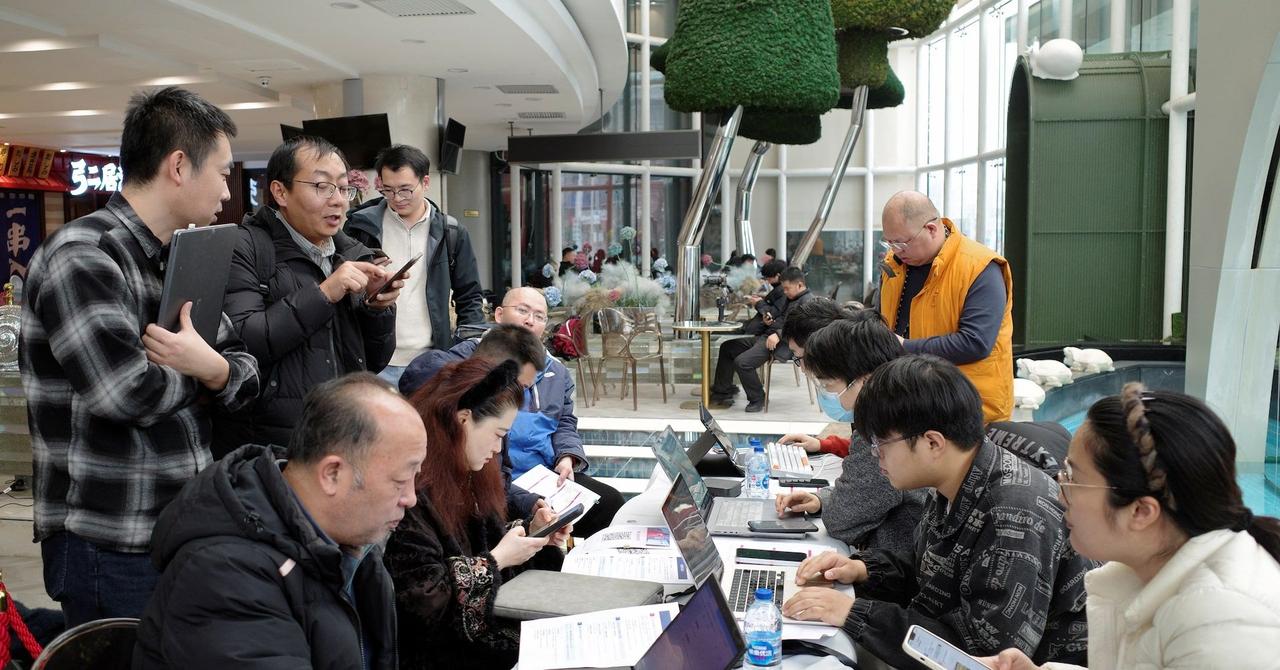
Source: Reuters
Chinese Tech Companies Race to Capitalize on the AI Craze
Chinese tech companies have moved swiftly to capture this market opportunity. Tencent launched a nationwide "lobster" tour across 17 cities to help people install OpenClaw, while ByteDance released ArkClaw, Tencent introduced QClaw, Alibaba unveiled CoPaw, and startup Moonshot AI launched Kimi Claw
2
. Each version funnels users toward the company's own language models and cloud services, creating new revenue streams in a market where consumers have historically been reluctant to pay for software.The enthusiasm sent Chinese tech shares soaring by as much as 22% in recent weeks, with Hong Kong-listed LLM provider MiniMax jumping 50% last week
1
2
. Baidu and Tencent have hosted public events where hundreds line up to get OpenClaw installed on their devices. At a Baidu gathering in Beijing, new user Gong Sheng explained his motivation: "It seems everyone around me—my colleagues and friends—has it. I don't want to be left behind"3
.
Source: FT
Nvidia CEO Jensen Huang called OpenClaw "the next ChatGPT" at the company's GTC conference, comparing it to the groundbreaking open-source operating system Linux
2
3
. After first appearing in November, the tool became one of the fastest-growing projects in the history of GitHub, the world's most widely adopted AI-powered developer platform1
.Government Subsidies Fuel One-Person Companies and Productivity Dreams
The OpenClaw frenzy aligns perfectly with Beijing's AI Plus initiative, a national policy aimed at embedding AI across 90% of industries and all of society by 2030
3
. Local governments are offering substantial government subsidies to boost productivity and stimulate economic growth. A high-tech zone in Hefei is providing up to 13 million yuan ($1.8 million) in computing power vouchers and subsidized office space, while a district in Hangzhou has pledged up to 20 million yuan ($2.8 million) annually for qualifying one-person companies1
2
.Wang Xiaoyan, one user starting her own business, explained the appeal: "Human employees need rest, but OpenClaw can run 24/7"
3
. A 38-year-old HR professional named Guo trained a network of OpenClaw agents to collect resumes, build candidate profiles, and conduct preliminary interviews. While he spent about 5,700 yuan on hardware and token costs, he estimates the workload would have required two full-time employees2
.Related Stories

Security Vulnerabilities and Rising Costs Threaten Momentum
Despite the excitement, security vulnerabilities and escalating expenses are emerging as significant concerns. China's cyber security regulators have issued warnings about data privacy risks, noting that OpenClaw's requirement for extensive system permissions presents dangers
2
. A growing number of Chinese institutions—including government agencies, brokerages, and universities—have banned employees from installing the tool following regulatory warnings1
.The state-owned People's Daily, a mouthpiece for China's ruling Communist Party, urged authorities to "firmly maintain the safety bottom line to ensure that innovation does not deviate or derail"
1
. Li Hongxue, a data security professional, noted the contradiction between central government warnings and local government incentives, though she sees opportunity: "Its development is still unstoppable, but the security capabilities also need to keep up"1
.Token costs are also accumulating rapidly. While OpenClaw itself is free and open-source, the AI agents burn through thousands of LLM tokens while operating
2
. Zhipu raised token prices on its new OpenClaw-optimized AI model by 20% this week1
. One frustrated post on social media platform Rednote complained: "Ordinary people spend tens or hundreds of yuan, burning through a bunch of tokens and in the end, they might only get a pile of useless data. This is not 'embracing the future,' it's 'being harvested by the future'"1
.What This Means for China's AI Ambitions
According to American cybersecurity firm SecurityScorecard, China has already surpassed the United States in OpenClaw adoption
3
. Wei Sun, chief AI analyst at Counterpoint Research, framed the significance: "If DeepSeek marked a milestone for open-source large language models, then OpenClaw represents a similar turning point for open-source agents"1
.Robin Zhu, a China tech analyst at Bernstein, estimates the AI agent market could generate as much as $100 billion in annual revenue by 2030
2
. Yet the path forward remains uncertain. Beijing wants rapid commercialization but also demands deployment that stays "legible, secure and politically manageable," according to Rui Ma, founder of the Tech Buzz China newsletter. "The concern is utterly uncontrolled and chaotic diffusion that could cause harm"1
.Huang Rongsheng, chief architect at Baidu's smart device unit Xiaodu, captured the cultural penetration when he described parent group chats for his daughter's primary school class becoming overwhelmed by OpenClaw discussions. His daughter asked: "Dad, I see you raising a lobster every day. Can I have one too?"
1
. Whether this enthusiasm translates into sustainable productivity gains or fades as costs mount remains the question observers are watching closely.References
Summarized by

Navi
Related Stories
OpenClaw AI agent ignites China's agentic AI boom as government scrambles with security warnings
09 Mar 2026•Technology

OpenClaw AI assistant sparks lobster-themed ClawCon as open-source movement gains momentum
08 Mar 2026•Technology
Nvidia's Jensen Huang calls OpenClaw the next ChatGPT, sending Chinese AI stocks soaring
17 Mar 2026•Technology

Recent Highlights



Recent Highlights
Today's Top Stories










Your Daily Dose of Curated AI News
Don’t drown in AI news. We cut through the noise - filtering, ranking and summarizing the most important AI news, breakthroughs and research daily. Spend less time searching for the latest in AI and get straight to action.

