Pinterest AI moderation flags human art while AI-generated content floods user feeds


2 Sources
2 Sources
[1]
Pinterest Is Drowning in a Sea of AI Slop and Auto-Moderation
Users are exhausted fighting AI moderation, AI-generated art, and AI-first features. Pinterest has gone all in on artificial intelligence and users say it's destroying the site. Since 2009, the image sharing social media site has been a place for people to share their art, recipes, home renovation inspiration, corny motivational quotes, and more, but in the last year users, especially artists, say the site has gotten worse. AI-powered mods are pulling down posts and banning accounts, AI-generated art is filling feeds, and hand drawn art is labeled as AI modified. "I feel like, increasingly, it's impossible to talk to a single human [at Pinterest]," artist and Pinterest user Tiana Oreglia told 404 Media. "Along with being filled with AI images that have been completely ruining the platform, Pinterest has implemented terrible AI moderation that the community is up in arms about. It's banning people randomly and I keep getting takedown notices for pins." Oreglia's Pinterest account is where she keeps reference material for her work, including human anatomy photos. In the past few months, she's noticed an uptick in seemingly innocuous photos of women being flagged by Pinterest's AI moderators. Oreglia told 404 Media there's been a clear pattern to the reference material the site has a problem with. "Female figures in particular, even if completely clothed, get taken down and I have to keep appealing those decisions," she said. This pattern is common on many social media platforms, and predates the advent of generative AI. "We publish clear guidelines on adult sexual content and nudity and use a combination of AI and human review for enforcement," Pinterest told 404 Media. "We have an appeals process where a human reviews the content and reactivates it when we've made a mistake." It also confirmed that the site uses both humans and automated systems for moderation. Oreglia shared some of the works Pinterest flagged including a photo of a muscular woman in a bikini holding knives, a painting of two clothed women in an intimate embrace, and a stock photo of a man holding a gun on a telephone that was flagged for "self-harm." In most cases, Oreglia can appeal and get a decision reversed, but that eats up time. Time she could be spending making art. And those appeals aren't always approved. "The worst case scenario for this stuff is that you get your account banned," Oreglia said. r/Pinterest is awash in users complaining about AI-related issues on the site. "Pinterest keeps automatically adding the 'AI modified' tag to my Pins...every time I appeal, Pinterest reviews it and removes the AI label. But then... the same thing happens again on new Pins and new artwork. So I'm stuck in this endless loop of appealing → label removed → new Pin gets tagged again," read a post on r/Pinterest. The redditor told 404 Media that this has happened three times so far and it takes between 24 to 48 hours to sort out. "I actively promote my work as 100% hand-drawn and 'no AI,'" they said. "On Etsy, I clearly position my brand around original illustration. So when a Pinterest Pin is labeled 'Hand Drawn' but simultaneously marked as 'AI modified,' it creates confusion and undermines that positioning." Artist Min Zakuga told 404 Media that they've seen a lot of their art on Pinterest get labeled as "AI modified" despite being older than image generation tech. "There is no way to take their auto-labeling off, other than going through a horribly long process where you have to prove it was not AI, which still may get rejected," she said. "Even artwork from 10-13 years ago will still be labeled by Pinterest as AI, with them knowing full well something from 10 years ago could not possibly be AI." Other users are tired of seeing a constant flood of AI-generated art in their feeds. "I can't even scroll through 100 pins without 95 out of them being some AI slop or theft, let alone very talented artists tend to be sucked down and are being unrecognized by the sheer amount of it," said another post. "I don't want to triple check my sources every single time I look at a pin, but I refuse to use any of that soulless garbage. However, Pinterest has been infested. Made obsolete." Artist Eva Toorenent told 404 Media that she's been able to cull most of the AI-generated content from her board, but that it took a lot of time. Whenever she saw what she thought was an AI-generated image, she told Pinterest she didn't want to see it and eventually the algorithm learned. But, like Oreglia fighting auto-moderation and Zakuga fighting to get the "AI modified" label taken off her work, training Pinterest's algorithm to stop serving you AI-generated images eats up precious time. AI boosters often talk about how much time these systems will save everyone. They're pitched as productivity boosters. Earlier this month, Pinterest laid off 15 percent of its work force as part of a push to prioritize AI. In a post on LinkedIn, one of the former employees shared part of the email CEO Bill Ready sent out after the lay offs. "We're doubling down on an AI-forward approach -- prioritizing AI-focused roles, teams, and ways of working." Toorenent removed all her own art from her Pinterest account after hearing the news that the site would use public pins to train Pinterest Canvas, the company's proprietary text-to-image AI. But she has no control over other users uploading her artwork. "I have already caught a few of my images still on Pinterest that I did not upload myself...that makes me incredibly mad," she told 404 Media. "It used to be a great way to get your work seen among other people, but it's being used to train their internal AI." Oreglia told 404 Media that the flood of AI has changed her relationship to a site she once used to prize. "It's definitely affected how I search things and I'm always now very critical about where something came from... although I've always been overly pedantic about research," she said. "It does make you do your due diligence but it sucks to constantly have to question and check if something is authentic or synthetic." She's thought about leaving the platform, but feels stuck. "I just want to be able to take all my references with me. I've been on the platform for about ten years and have very carefully curated it. It's really nice to be able to just go to my page and search for something I saved instead of having to save everything to folders although I also do that," she said. "More and more I'm trying to curate and collect physical references too but some of that can take up space I don't have so it can be difficult. Having a physical reference library just seems more and more necessary these days...artists have to be adaptable to this kind of thing these days. It's annoying but not unmanageable." Ready has been vocal and proud about the company's commitment to forcing AI into every aspect of the user experience. "At Pinterest...we're deploying AI to flip the script on social media, using it to more aggressively promote user well being rather than the alternative formula of triggering engagement by enragement," Ready said in a January column at Fortune. "Social media platforms like Pinterest live and die by users' willingness to share creative and original ideas."
[2]
Pinterest still filled with AI slop and bad content moderation, users report
At least, that's what users are reporting amid the company's continued commitment to turning the visual curation platform into an AI-powered social media site. In a report by 404 Media, users told the publication that Pinterest's automatic content moderation system, including a system that labels content as "AI modified," is consistently incorrectly flagging human-made images, particularly those featuring women, while actual AI slop only grows. In addition, users say the site's tools to curb AI-generated content in feeds are failing to prevent AI images from appearing on user boards, and AI-powered account moderators are still banning accounts with little to no explanation. "We publish clear guidelines on adult sexual content and nudity and use a combination of AI and human review for enforcement. We have an appeals process where a human reviews the content and reactivates it when we've made a mistake," said Pinterest in a statement to 404 Media. This isn't anything new for many social media platforms leaning into AI, but it's particularly distressing for platform users who have pushed to keep the Pinterest experience the same. For years, the platform has come under fire for failing to curb AI-generated photos, videos, and ads, if not encouraging their existence on the site wholesale. In March 2025, the company updated its privacy policy to elucidate its policy of feeding users' public pins into its machine learning models, including training efforts for Pinterest's base AI model, Pinterest Canvas. Pinterest faced further criticism in May, when users, already complaining about AI content-filled algorithms that were ruining the app experience, reported platform-wide account bans that many suspected were the result of a faulty AI content moderation system. In response to the ongoing AI controversy, Pinterest added tools in October to filter out specific types of AI content from recommendations, though the company made it clear at the time that it wouldn't completely eradicate the issue. Then, just last month, the company announced it would lay off hundreds of employees in yet another push toward AI, writing in an SEC filing that it would reprioritize "AI-powered products and capabilities" following the launch of its AI-powered shopping tool, Pinterest Assistant. The company has been exploring AI integration for nearly a decade.
Share
Share
Copy Link
Pinterest users report widespread issues with the platform's AI moderation system incorrectly flagging hand-drawn artwork as AI-modified while actual AI-generated content overwhelms their feeds. Artists say the faulty account moderation is banning users randomly and forcing them to spend hours appealing decisions, undermining their brands and wasting time they could spend creating art.
Pinterest AI Integration Creates Chaos for Artists
Pinterest has intensified its push toward AI-powered products, but the shift is backfiring spectacularly. Artists and longtime users report that AI moderation has turned the visual curation platform into a frustrating battleground where human creativity gets punished while AI-generated content proliferates unchecked
1
. Since the platform began its AI integration nearly a decade ago, the problems have accelerated dramatically in recent months, culminating in widespread user dissatisfaction with AI.Artist Tiana Oreglia told 404 Media that Pinterest has become impossible to navigate without constant friction. "I feel like, increasingly, it's impossible to talk to a single human [at Pinterest]," she said
1
. Her account, which stores reference material including human anatomy photos, has faced repeated takedowns for seemingly innocuous images. The AI content moderation system shows a clear bias: "Female figures in particular, even if completely clothed, get taken down and I have to keep appealing those decisions," Oreglia explained1
.Faulty Account Moderation Targets Legitimate Content
The auto-moderation system has flagged bizarre content as violations. Among the images Pinterest removed from Oreglia's boards: a photo of a muscular woman in a bikini holding knives, a painting of two clothed women in an intimate embrace, and a stock photo of a man holding a gun on a telephone that was flagged for "self-harm"
1
. While Pinterest maintains it uses "a combination of AI and human review for enforcement" and offers an appeals process where "a human reviews the content and reactivates it when we've made a mistake," artists say the system wastes precious time1
.AI Misidentifies Human Art at Scale
Perhaps the most damaging issue involves Pinterest incorrectly flagging posts as "AI modified" when they're entirely hand-drawn. Artist Min Zakuga discovered that even artwork created 10 to 13 years ago—predating modern image generation tech—gets automatically labeled as AI-modified
1
. "There is no way to take their auto-labeling off, other than going through a horribly long process where you have to prove it was not AI, which still may get rejected," Zakuga said1
.One Reddit user on r/Pinterest described being trapped in an endless cycle: "Every time I appeal, Pinterest reviews it and removes the AI label. But then... the same thing happens again on new Pins and new artwork"
1
. This creates a particularly damaging negative user experience for artists who market their work as "100% hand-drawn" and "no AI" on platforms like Etsy, as the mislabeling undermines their brand positioning1
.Related Stories



AI Slop Overwhelms Platform Despite Filter Tools
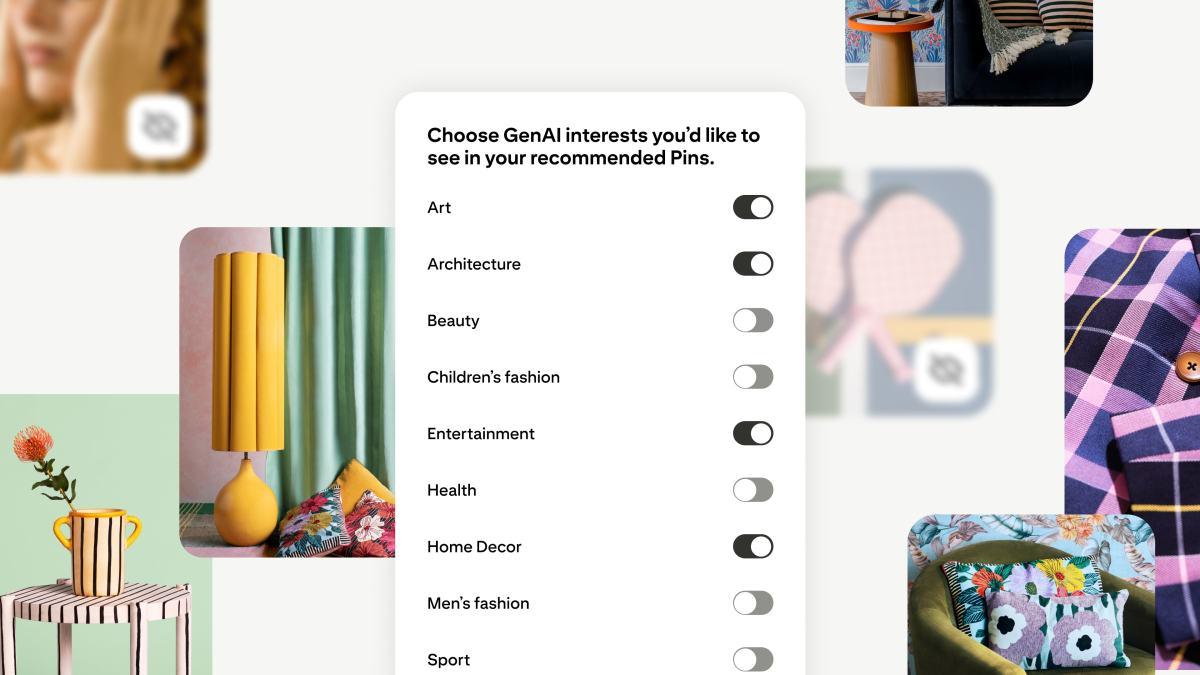
While Pinterest added tools in October to filter out specific types of AI-generated content from recommendations, users report these measures have failed
2
. Artist Eva Toorenent managed to reduce AI slop in her feed, but only after investing significant time manually training the algorithm by repeatedly telling Pinterest she didn't want to see AI-generated images1
. One frustrated user posted: "I can't even scroll through 100 pins without 95 out of them being some AI slop or theft"1
.Company Doubles Down Despite User Backlash
Pinterest's commitment to AI remains unwavering despite mounting complaints. In March 2025, the company updated its privacy policy to clarify that users' public pins feed into machine learning models, including training for Pinterest Canvas, the platform's base AI model
2
. Platform-wide account bans in May, which many suspected resulted from faulty AI systems, intensified criticism2
.Most recently, Pinterest laid off 15 percent of its workforce to prioritize "AI-powered products and capabilities" following the launch of Pinterest Assistant, an AI-powered shopping tool
1
2
. The irony isn't lost on users: AI systems marketed as productivity boosters are instead consuming artists' time through endless appeals and content filtering.For social media platforms racing to integrate AI, Pinterest serves as a cautionary tale about what happens when automation replaces human review and content curation without adequate safeguards. Artists watching these developments should prepare for similar challenges across other platforms as AI moderation becomes standard practice.
References
Summarized by

Navi
Related Stories
Recent Highlights
1
Google Maps unveils Ask Maps with Gemini AI and 3D Immersive Navigation in biggest update
Technology
2
Three Tennessee teens sue xAI over Grok AI creating child sexual abuse material from real photos
Policy and Regulation
3
Meta plans to cut 20% of workforce as AI spending reaches $600 billion, mirroring broader tech trend
Business and Economy
Recent Highlights
Today's Top Stories



Your Daily Dose of Curated AI News
Don’t drown in AI news. We cut through the noise - filtering, ranking and summarizing the most important AI news, breakthroughs and research daily. Spend less time searching for the latest in AI and get straight to action.

