Qualcomm unveils Arduino Ventuno Q, a powerful AI board designed to bring robotics offline


6 Sources
6 Sources
[1]
Qualcomm's new Arduino Ventuno Q is an AI-focused computer designed for robotics
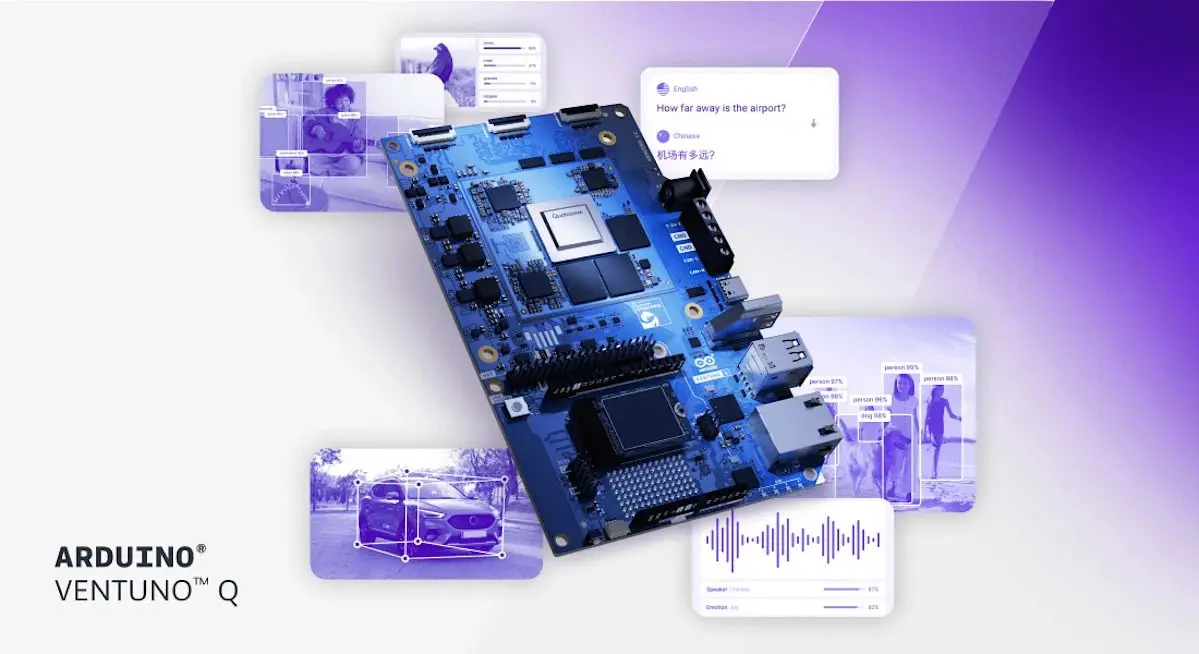
Qualcomm, which purchased microcontroller board manufacturer Arduino last year, just announced a new single-board computer that marries AI with robotics. Called the Arduino Ventuno Q, it uses Qualcomm's Dragonwing IQ8 processor along with a dedicated STM32H5 low-latency microcontroller (MCU). "Ventuno Q is engineered specifically for systems that move, manipulate and respond to the physical world with precision and reliability," the company wrote on the product page. The Ventuno Q is more sophisticated (and expensive) than Arduinio's usual AIO boards, thanks to the Dragonwing IQ8 processor that includes an 8-core ARM Cortex CPU, Adreno Arm Cortex A623 GPU and Hexagon Tensor NPU that can hit up ot 40 TOPs. It also comes with 16GB of LPDDR5 RAM, along with 64GB of eMMC storage and an M.2 NVME Gen.4 slot to expand that. Other features include Wi-Fi 6, Bluetooth 5.3, 2.5Gbps ethernet and USB camera support. The Ventuno Q includes Arudino App Lab, with pre-trained AI models including LLMs, VLMs, ASR, gesture recognition, pose estimation and object tracking, all running offline. It's designed for AI systems that run entirely offline like smart kiosks, healthcare assistants and traffic flow analysis, along with Edge AI vision and sensing systems. It also supports a full robotics stack including vision processing combined with deterministic motor control for precise vision and manipulation. It's also ideal for education and research in areas like computer vision, generative AI and prototyping at the edge, according to Arduino. "With Ventuno Q, AI can finally move from the cloud into the physical world," Qualcomm wrote. "This platform enables building machines that perceive, decide, and act -- all on a single board. Our goal is to make advanced robotics and edge AI accessible to every developer, educator, and innovator." The Arduino Ventuno Q will be available in Q2 2026 from the Arduino Store and elsewhere and is expected to cost under $300.
[2]
Arduino Ventuno Q marks Qualcomm's entry into offline AI and robotics
Serving tech enthusiasts for over 25 years. TechSpot means tech analysis and advice you can trust. In brief: A few months after acquiring Arduino, Qualcomm is introducing its first product designed to combine its processor technology with the "maker" ethos of the Italian company. Unsurprisingly, the device is primarily focused on AI, generative AI, and large language models. Named after the Italian word for "21," Ventuno Q is Qualcomm's first attempt to soothe the wary Arduino community. The UK chip designer acquired the Italian microcontroller maker in October, quickly drawing mistrust from users after changing the platform's terms of service. While Arduino is now a more corporate-friendly product line, the freedom to experiment and create has not entirely vanished. Ventuno Q represents a significant improvement over the "dual-brain" architecture used in the Arduino Uno Q platform. The microcontroller is built on the Dragonwing IQ8 Series, Qualcomm's AI-focused SoC line, described as a high-performance computing processor designed for robotics, industrial automation, machine vision, and other offline AI workloads. The SoC delivers up to 40 TOPS of NPU performance, an octa-core Kryo Gen 6 CPU, and an Adreno 623 GPU. Ventuno Q also includes a dedicated STM32H5 microcontroller for low-latency actuation and motor control. The device comes with 16GB of RAM, 64GB of eMMC storage, and extensive connectivity and expansion options, including Wi-Fi, Ethernet, Bluetooth, and USB. According to Arduino Vice President Fabio Violante, Ventuno Q is designed to bring AI from the cloud to the "physical" world at the edge of computing. Machines and devices built with the new microcontroller can perceive their environment, make decisions, and act based on programmed tasks and AI models. To support AI development, Arduino is providing the App Lab environment, which unifies the development experience. The software suite includes numerous pre-trained models for tasks such as speech recognition, gesture recognition, object tracking, and more. Ventuno Q is also hardware-compatible with other platforms, including Arduino Uno shields, Qwiic sensors, and Raspberry Pi HATs. Thanks to its ability to process real-world inputs and run popular AI software, Ventuno Q can power fully offline AI systems, robotics and motion-control devices, and AI-based sensing systems. Qualcomm also highlighted its potential as an educational tool, ideal for teaching computing concepts or rapidly prototyping classroom projects. While Ventuno Q promises to be a powerful successor to the Arduino Uno Q, advanced performance comes at a cost. The new single-board computer is expected to launch in Q2 2026 with a price around $300, compared to $59 for the current 4GB Arduino Uno Q model.
[3]
Canonical and Arduino collaborate to enable Ubuntu on the VENTUNO Q, the next generation platform for AI | Ubuntu
Through a strategic partnership with Canonical, Arduino's latest product offers a seamless Linux experience for complex AI workloads in robotics, edge AI vision and more. LONDON, UK - March 9, 2026 - Today, Arduino announced the launch of the Arduino® VENTUNO™ Q, a dual-brain board designed for high-performance computing and physical actuation. VENTUNO Q represents a significant step in the Arduino-Qualcomm Technologies, Inc.-Canonical collaboration, embracing a developer-first philosophy with Ubuntu. VENTUNO Q introduces a high-performance dual-brain architecture, engineered for machines that must move as fast as they think. Powered by the Qualcomm Dragonwing™ IQ-8275 processor, the board brings 40 dense TOPS of industrial-grade AI compute to a compact form factor. This allows for the local execution of Large Language Models (LLMs), Visual Language Models (VLMs), and high-throughput computer vision entirely at the edge. Ubuntu runs natively on this primary processor providing the core development and inference environment. A dedicated STM32H5 microcontroller ensures sub-millisecond, deterministic control for motors and sensors. This allows AI-driven decisions to be translated into physical action instantly, without the latency associated with traditional single-processor systems. To ensure a frictionless out-of-the-box experience, the VENTUNO Q arrives with Ubuntu. This enables developers to go from unboxing to AI inference in minutes, eliminating the traditional hurdles of complex board support packages (BSPs) and fragmented kernel drivers. Running natively on top of Ubuntu is the Arduino App Lab. This unified, collaborative environment allows developers to blend Arduino sketches, Python scripts, and advanced AI Bricks into ready-to-deploy applications. Whether in Standalone Mode, connected directly to a monitor, or PC-Connected Mode, the Arduino App Lab provides a smooth path for both hobbyists and R&D engineers to master the Qualcomm AI stack. While optimized for the Arduino DIY maker market, the VENTUNO Q is built with industrial-grade specs. By integrating the IQ-8275 with Ubuntu, it offers a seamless path for developers to transition their prototypes directly into production-ready industrial applications. "Arduino VENTUNO Q is the definitive powerhouse for AI and robotics," said Fabio Violante, Vice President and General Manager of Arduino at Qualcomm. "By merging high-performance AI capabilities with their direct, real-time application in actuation, we are empowering creators to build systems that interact with the world. With Ubuntu and the Arduino App Lab experience, we are delivering the most flexible edge AI ecosystem ever built." "Our collaboration with Arduino and Qualcomm provides a production-ready starting line for innovators," said Cindy Goldberg, VP of Silicon Alliances at Canonical. "By providing a reliable Ubuntu foundation for VENTUNO Q, we ensure that a successful prototype can scale into a securely-designed industrial solution with 10 years of security maintenance." Arduino VENTUNO Q will be available for open sale soon. Developers can get a first look at the Ubuntu powered platform and new Arduino App Lab models at Embedded World 2026. Contact us to schedule a meeting at the event. Visit the official page at arduino.cc/product-ventuno-q to sign up for notifications and be the first to know when the product is available. To find out more about the Canonical and Qualcomm partnership, check out our video: what it takes to build and scale developer platforms | Canonical x Qualcomm Arduino (a Qualcomm Technologies, Inc. company) is a leading open-source hardware and software provider and an accessible platform for creating interactive projects. With an estimated 33 million active users, the Arduino ecosystem has expanded over 20 years to address new demands and challenges, offering products for IoT, wearables, 3D printing, and embedded environments. Canonical, the publisher of Ubuntu, provides open source security, support and services. Our portfolio covers critical systems, from the smallest devices to the largest clouds, from the kernel to containers, from databases to AI. With customers that include top tech brands, emerging startups, governments and home users, Canonical delivers trusted open source for everyone. Learn more at https://canonical.com/
[4]
Qualcomm and Arduino unleash VENTUNO Q that lets AI move offline
* VENTUNO Q runs fully autonomous AI agents completely offline without external servers * The Dragonwing processor delivers up to forty dense TOPS of AI compute * Robotics applications include vision-guided arms and autonomous machines navigating complex environments Qualcomm and Arduino have launched Arduino VENTUNO Q, a single-board computer designed for robotics, generative AI, and edge computing able to operate fully offline. The board uses the Qualcomm Dragonwing IQ8 Series processor and a dedicated STM32H5 microcontroller for deterministic control, enabling systems to perceive, decide, and act on the same device. Qualcomm says the neural processing unit delivers up to 40 dense TOPS of compute, supporting simultaneous inference and complex processing locally, while 16GB of RAM and 64GB expandable storage handle demanding multitasking. A new board built for edge AI workloads Fabio Violante, VP and GM at Arduino, said the platform enables "systems that don't just interpret the world, they interact with it," allowing machines to operate without reliance on cloud connectivity. The architecture integrates AI acceleration with real-time microcontroller logic, uniting perception, decision, and actuation on a single board. VENTUNO Q can run fully autonomous AI agents for tasks including offline voice assistants, gesture-responsive smart mirrors, and interactive kiosks at transport hubs, healthcare desks, or tourist centers. The system supports robotics applications, including pick-and-place robotic arms guided by vision and service robots capable of following individuals across dynamic spaces. It also enables autonomous machines to navigate complex environments using Visual SLAM combined with path optimization. Edge AI vision systems are also possible, allowing proactive security monitoring, traffic observation, and automated quality inspections with local visual language models. All of these functions are handled on the board, eliminating the need to transmit data to external servers. VENTUNO Q runs Ubuntu and Debian Linux on its main processor and Arduino Core on Zephyr OS for real-time control. Arduino App Lab supports Python scripts, Arduino sketches, and ready-to-use AI models, including gesture recognition and object tracking. It also supports local LLMs powered by Qualcomm AI Hub, while Edge Impulse Studio allows training custom models. Industrial I/Os, multiple MIPI CSI camera connectors, audio, displays, and 2.5Gb Ethernet provide comprehensive hardware compatibility. "With VENTUNO Q, AI can finally move from the cloud into the physical world. This platform makes it possible to build machines that perceive, decide, and act, all on a single board," said Fabio Violante, VP & GM, Arduino, Qualcomm Technologies, Inc. "Our goal is to make advanced robotics and edge AI accessible to every developer, educator, and innovator. VENTUNO Q is the natural evolution of Arduino's mission, and a major step toward bringing real world intelligence to everyone." VENTUNO Q is compatible with Arduino UNO shields, Modulino nodes, Qwiic sensors, and Raspberry Pi HAT expansions. It will be available in Q2 2026 through the Arduino Store and other authorized resellers such as DigiKey, Farnell, Mouser Electronics, and RS Components, although the board's practical influence on existing platforms like the Raspberry Pi remains uncertain. Follow TechRadar on Google News and add us as a preferred source to get our expert news, reviews, and opinion in your feeds. Make sure to click the Follow button! And of course you can also follow TechRadar on TikTok for news, reviews, unboxings in video form, and get regular updates from us on WhatsApp too.
[5]

Qualcomm introduces AI-focused Ventuno Q single-board computer
Qualcomm announced the Arduino Ventuno Q, a new AI-focused single-board computer designed for robotics applications. The platform follows Qualcomm's purchase of Arduino last year and targets developers requiring offline AI and deterministic control. The board combines high-performance processing with integrated robotics capabilities for edge deployment. The Ventuno Q uses Qualcomm's Dragonwing IQ8 processor and a dedicated STM32H5 low-latency microcontroller. The Dragonwing IQ8 includes an 8-core ARM Cortex CPU, an Adreno Arm Cortex A623 GPU, and a Hexagon Tensor NPU capable of up to 40 TOPs. The board features 16GB of LPDDR5 RAM, 64GB of eMMC storage, and an M.2 NVMe Gen.4 expansion slot. Connectivity options include Wi-Fi 6, Bluetooth 5.3, 2.5Gbps Ethernet, and USB camera support. The system supports a full robotics stack that combines vision processing with deterministic motor control for precise manipulation. The Ventuno Q includes Arduino App Lab with pre-trained AI models running offline. Models include LLMs, VLMs, ASR, gesture recognition, pose estimation, and object tracking. The board targets offline systems such as smart kiosks, healthcare assistants, traffic flow analysis, and Edge AI vision and sensing. Arduino stated the platform is ideal for education and research in computer vision, generative AI, and edge prototyping. Qualcomm stated the platform aims to make advanced robotics and edge AI accessible to developers, educators, and innovators. "With Ventuno Q, AI can finally move from the cloud into the physical world," Qualcomm stated. "This platform enables building machines that perceive, decide, and act -- all on a single board." Qualcomm added its goal is to make advanced robotics and edge AI accessible to every developer, educator, and innovator. The Arduino Ventuno Q will be available in Q2 2026 from the Arduino Store and other retailers. The unit is expected to cost under $300. Qualcomm purchased Arduino last year. The Dragonwing IQ8 processor line targets edge AI and industrial applications.
[6]

Meet Ventuno Q: Tiny Arduino board with 40 TOPS for offline GenAI projects
Back in school, I spent more hours than I can count hunched over an Arduino Uno - blinking LEDs, wiring up sensors, and building clunky robots that barely worked but felt like magic. The Uno was humble, simple, and perfectly matched to what a curious student needed. So when Arduino announced the Ventuno Q, powered by Qualcomm's Dragonwing IQ8, I felt that same spark, except this time, the ambitions are anything but humble.A Also read: Copilot Cowork: AI-Powered Task Automation for Microsoft 365 Users The Ventuno Q is Arduino's most powerful board to date, and it's built for a very different era. Where the Uno taught a generation to think in circuits, the Ventuno Q is designed to think in AI models - running large language models, vision AI, and generative workloads entirely offline, no cloud connection required. At the heart of the board is Qualcomm's Dragonwing IQ8 SoC, which brings a neural processing unit capable of 40 dense TOPS. That's serious edge AI performance in a maker-friendly form factor. Paired with an 8-core Kryo Gen 6 CPU, Adreno 623 GPU, 16GB of LPDDR5 RAM, and 64GB of eMMC storage, this is essentially a capable Linux computer that also happens to speak fluent Arduino. Also read: SanDisk Extreme Fit USB-C Flash Drive: Practical, portable, and properly tiny That dual-brain architecture is what makes the Ventuno Q genuinely interesting. Alongside the Qualcomm SoC sits a dedicated STM32H5 microcontroller, an Arm Cortex-M33, handling real-time motor control and low-latency actuation. In practice, this means you can run a vision AI model on one brain while the other precisely controls a robotic arm. That combination has been notoriously difficult to achieve on a single affordable board, until now. Connectivity is equally well-specced. The board includes Wi-Fi 6, Bluetooth 5.3, 2.5Gb Ethernet, CAN-FD, PWM, MIPI-CSI camera ports, and an M.2 NVMe Gen 4 expansion slot. It's ROS 2 compatible, works with standard Arduino shields, Raspberry Pi HATs, and Qwiic sensors, making it easy to drop into existing project setups. Software support spans Ubuntu/Debian Linux on the main processor and Arduino Core on Zephyr OS on the microcontroller, with the Arduino App Lab environment handling AI model deployment and integration with Edge Impulse Studio for custom model training. The Ventuno Q arrives in Q2 2026, priced under $300. For makers, roboticists, and anyone who once stayed up late debugging a breadboard, it's well worth the wait.
Share
Share
Copy Link
Qualcomm and Arduino launched the Ventuno Q, a single-board computer that combines AI processing with robotics control. The device features the Dragonwing IQ8 processor delivering 40 TOPs of compute power and runs entirely offline. Expected in Q2 2026 for under $300, it targets developers building autonomous systems, smart kiosks, and industrial applications without cloud dependency.
Qualcomm and Arduino Launch Ventuno Q for Offline AI and Robotics Applications
Qualcomm has introduced the Arduino Ventuno Q, a single-board computer that merges AI processing with robotics control in a compact platform designed to operate entirely without cloud connectivity. Following Qualcomm's acquisition of Arduino last year, this marks the chip designer's first major product combining its processor technology with Arduino's maker-focused philosophy
1
. Named after the Italian word for "21," the device addresses a growing demand for edge computing solutions that can perceive, decide, and act autonomously in physical environments2
.
Source: TechSpot
The platform represents a shift from cloud-dependent AI systems to fully autonomous edge AI workloads. "With Ventuno Q, AI can finally move from the cloud into the physical world," Qualcomm stated, emphasizing the board's ability to build machines that operate independently on a single device
5
. This approach eliminates latency issues and data transmission requirements that typically constrain real-time robotics applications.Dual-Brain Architecture Powers High-Performance Computing
The Arduino Ventuno Q employs what developers call a dual-brain board architecture, combining the Qualcomm Dragonwing IQ8 processor with a dedicated STM32H5 microcontroller for deterministic motor control
3
. The Dragonwing IQ8 includes an 8-core ARM Cortex CPU, Adreno Arm Cortex A623 GPU, and a Hexagon Tensor NPU capable of delivering up to 40 TOPs of dense AI compute power1
. This processing capability enables simultaneous inference and complex AI workloads locally.The board comes equipped with 16GB of LPDDR5 RAM and 64GB of eMMC storage, expandable through an M.2 NVMe Gen.4 slot
2
. Connectivity features include Wi-Fi 6, Bluetooth 5.3, 2.5Gbps Ethernet, and USB camera support, providing comprehensive hardware compatibility for diverse robotics applications1
. The STM32H5 microcontroller ensures sub-millisecond, deterministic control for motors and sensors, allowing AI-driven decisions to translate into physical action instantly3
.Ubuntu Partnership Delivers Seamless Development Experience
Through a strategic collaboration with Canonical, the Ventuno Q arrives with Ubuntu pre-installed, providing a production-ready foundation for developers
3
. This integration enables developers to progress from unboxing to AI inference within minutes, eliminating traditional hurdles associated with complex board support packages and fragmented kernel drivers. The board also supports Debian Linux on its main processor and Arduino Core on Zephyr OS for real-time control4
.
Source: Ubuntu
"Our collaboration with Arduino and Qualcomm provides a production-ready starting line for innovators," said Cindy Goldberg, VP of Silicon Alliances at Canonical. "By providing a reliable Ubuntu foundation for VENTUNO Q, we ensure that a successful prototype can scale into a securely-designed industrial solution with 10 years of security maintenance"
3
. This long-term support makes the platform viable for industrial automation projects that require extended deployment cycles.Arduino App Lab Simplifies AI Model Deployment
Running natively on Ubuntu, the Arduino App Lab provides a unified development environment that blends Arduino sketches, Python scripts, and advanced AI capabilities into deployable applications
3
. The platform includes pre-trained AI models for offline AI tasks including LLMs, VLMs, automatic speech recognition (ASR), gesture recognition, pose estimation, and object tracking1
. These models run entirely on-device without requiring external servers.The board supports local LLMs powered by Qualcomm AI Hub, while Edge Impulse Studio allows developers to train custom models for specific use cases
4
. This flexibility addresses both hobbyist experimentation and professional R&D requirements. The platform is also hardware-compatible with Arduino UNO shields, Modulino nodes, Qwiic sensors, and Raspberry Pi HAT expansions, enabling developers to leverage existing ecosystem components2
.Related Stories

Target Applications Span Robotics, Smart Kiosks, and Machine Vision
The Ventuno Q targets fully autonomous systems that operate without cloud connectivity, including smart kiosks at transport hubs and healthcare assistants that handle sensitive data locally
4
. Robotics applications include vision-guided pick-and-place robotic arms, service robots capable of following individuals across dynamic spaces, and autonomous machines navigating complex environments using Visual SLAM combined with path optimization4
.
Source: Engadget
The board also enables edge AI vision systems for proactive security monitoring, traffic flow analysis, and automated quality inspections with local visual language models
1
. Fabio Violante, VP and GM at Arduino, emphasized that the platform enables "systems that don't just interpret the world, they interact with it," allowing machines to operate independently in physical environments4
.Educational and Industrial Pathways Create Long-Term Opportunities
While optimized for the Arduino DIY maker market, the Ventuno Q incorporates industrial-grade specifications that provide a seamless transition path from prototype to production-ready industrial applications
3
. The platform is designed for education and research in computer vision, generative AI, and prototyping at the edge, making it accessible to students and researchers exploring AI concepts1
.Qualcomm's goal centers on making advanced robotics and edge AI accessible to every developer, educator, and innovator
5
. This democratization approach could accelerate adoption of offline AI systems across sectors where cloud connectivity presents security, latency, or cost challenges. The Arduino Ventuno Q will be available in Q2 2026 from the Arduino Store and authorized resellers including DigiKey, Farnell, Mouser Electronics, and RS Components, with pricing expected under $3004
. This positions it as a more expensive but significantly more capable alternative to the current $59 Arduino Uno Q model2
.References
Summarized by

Navi
Related Stories
Qualcomm Acquires Arduino: A Strategic Move into Edge AI and Open-Source Development
07 Oct 2025•Technology
Qualcomm unveils Dragonwing IQ10 robotics platform, betting big on humanoid robots at CES 2026
05 Jan 2026•Technology

Qualcomm Enters Industrial Computing with AI-Powered Dragonwing IQ-X Series Chipsets
13 Nov 2025•Technology
Recent Highlights


Recent Highlights
Today's Top Stories





Your Daily Dose of Curated AI News
Don’t drown in AI news. We cut through the noise - filtering, ranking and summarizing the most important AI news, breakthroughs and research daily. Spend less time searching for the latest in AI and get straight to action.

