Robot dogs priced up to $300,000 now patrol AI data centers as security demand surges


4 Sources
4 Sources
[1]
Data centers are turning to $200,000 robot dogs to guard the facilities
Serving tech enthusiasts for over 25 years. TechSpot means tech analysis and advice you can trust. The big picture: Barely visible behind the steel fencing and heat exhaust of modern AI data centers, a new kind of security worker is taking shape - one made of sensors, servos, and silicon. As the demand for power-hungry artificial intelligence drives a rush to build massive computing sites, robotics firms are finding their next big market among the servers themselves. In the past year, interest in four-legged robots capable of autonomous patrols has surged, according to executives at Boston Dynamics and Ghost Robotics, two of the leading developers in the field. Data center operators, facing growing pressure to maintain 24-hour uptime and security across facilities spanning dozens of acres, see robotic quadrupeds as a practical response to the scale and cost of this new infrastructure boom. Boston Dynamics, better known for its mechanical dog, Spot, reports that inquiries from data center clients have jumped sharply. "We've seen a huge, huge uptick in interest from data centers in the last year, I'd say, which is probably not surprising given the investment in that space," Merry Frayne, the company's senior director of product management, tells Business Insider. Spot is a compact, four-legged robot roughly the size of a medium dog, designed to handle tasks that would normally require multiple human inspections. It can navigate uneven terrain, climb stairs, and operate in heat, cold, or dust without fatigue. Outfitted with a range of sensors, it can detect temperature fluctuations, leaks, puddles, and even unusual noises that might signal problems in server halls or mechanical rooms. Each robot can be equipped differently depending on mission requirements: security patrols, construction monitoring, or interior inspections. Pricing ranges from $175,000 to $300,000, depending on configuration, with most customers recovering the cost within 18 months, according to Frayne. Ghost Robotics' Vision 60 is another four-legged robot being deployed at data centers, mainly for external perimeter security. It streams video back to security staff, acting as a mobile, maneuverable camera platform that never sleeps. Michael Subhan, chief growth officer at Ghost Robotics, said the Vision 60 has been deployed in a "handful" of data centers, mainly for external perimeter security. The Vision 60 has a one-time MSRP starting at $165,000, depending on the configuration. For operators managing multimillion-dollar server farms, the economics are compelling: a single human guard can cost around $150,000 per year, factoring in benefits and shifts. Robots, by contrast, draw power rather than paychecks. Subhan said the aim isn't to replace human workers outright but to extend their reach. "We sort of augment the guard," he explained. "We're not there to replace the human guard." Robotic patrols also address a practical limitation of fixed security infrastructure. Cameras and sensors can't cover every corridor or rooftop, particularly across campuses that can stretch for tens of acres. Spot, for instance, can travel miles on a single charge while automatically performing route-based inspections. In harsh climates - from desert heat to subzero winters - that endurance matters. One company already putting these robots to work is Novva Data Centers, based in Utah. Its 1.5-million-square-foot flagship site in West Jordan uses a team of Spots to collect environmental data, check equipment, and flag anomalies to onsite staff. Using thermal imaging, the robots can alert technicians to overheating power units or cooling system failures before an outage occurs. Both Boston Dynamics and Ghost Robotics describe data centers as a natural fit for their evolving products. The growing density of AI clusters, combined with the complexity of the cooling and electrical systems that sustain them, requires a new level of continuous observation. With approximately 5,000 data centers already operating in the United States and up to a thousand more under construction, the potential market for robotic inspection and security is substantial. Despite their capabilities, neither company claims that human labor will disappear from the equation. Operators still monitor live video streams and make the final calls on any action the robot records. But as AI computing facilities multiply, these electromechanical dogs are becoming a familiar presence, ensuring servers stay cool, lights stay on, and data keeps flowing.
[2]
AI Data Center Security Guards Are Not Human
Can't-miss innovations from the bleeding edge of science and tech As AI companies continue to pour hundreds of billions of dollars into buildouts of data centers, they're looking for ways to keep their sprawling facilities secured around the clock -- without having to pay a salary or manage shift changes multiple times a day (maximizing human employment is not a priority in the AI data center business.) As such, they're turning to robot security guards, as Business Insider reports, especially Boston Dynamics' popular quadruped robot dog Spot. "I was literally at a data center this week," senior director of product management Merry Frayne told the publication. "We've seen a huge, huge uptick in interest from data centers in the last year, I'd say, which is probably not surprising given the investment in that space." It may sound like a straightforward task, but keeping tabs on centers that can cover over an area of over 900 football fields likely isn't simple. Spot is commonly being deployed to patrol perimeters, according to Frayne. Customers are also using them for site mapping, monitoring construction, and industrial inspection. With the right equipment, the robot dogs can detect leaks, unusual sounds, or thermal anomalies. Michael Subhan, chief growth officer of military contractor Ghost Robotics, also told BI that its Vision 60 robot dogs are being deployed for perimeter security or investigating suspicious packages. "We're not there to replace the human guard," he said. "We sort of augment the guard." "There are 5,000 data centers in the US alone, 800 to a thousand new data centers being built currently," he added. "So we see that as a large market for us."
[3]
Robot dogs priced at $300,000 a piece are now guarding some of the country's biggest data centers | Fortune
It's a scene straight out of a science fiction show: robot dogs. Think K9 from the sci-fi series Doctor Who, or Goddard from the cartoon Jimmy Neutron. Now, robot dogs are standing guard for tech companies, patrolling the massive data centers across the country that power AI operations, according to Business Insider. These four-legged robots, known as quadrupeds, are in high demand from AI firms, according to robotics company Boston Dynamics, which manufactures a quadruped called Spot. These systems are able to navigate complex landscapes on their own, alert authorities about security threats, and can provide around-the-clock video surveillance. "We've seen a huge, huge uptick in interest from data centers in the last year," Merry Frayne, senior director of product management at Boston Dynamics, told Business Insider, "which is probably not surprising given the investment in that space." Companies are pouring nearly $700 billion into the AI infrastructure buildout, a sum that rivals the GDP of developed countries like Sweden. And some data centers are the size of multiple football fields. One data center -- Meta's Hyperion -- will sprawl out to about four times the size of Manhattan's Central Park. Aside from requiring loads of energy and millions of gallons of water, the vast size of the data centers means the cost of security to protect their around-the-clock operations is inspiring some firms to look to alternative security resources. According to Frayne, Spot's pricing ranges from $175,000 to $300,000, depending on their client's needs. But despite that high price, the company estimates that the quadrupeds would compensate for their cost within two years. The robot dogs are actually capable of doing more than just perimeter patrol. Frayne told Business Insider data center customers are looking for the quadrupeds to conduct industrial inspection, site mapping, and construction monitoring. These tasks could help facility managers to more easily detect hazards, such as puddles or leaks. Boston Dynamics says Spot has "360° perception and athletic intelligence." Quadrupeds like Spot have actually existed for some time now, assuming roles in public safety and law enforcement. Another robotics company -- Ghost Robotics -- advertises quadrupeds as a business solution for construction sites to streamline inspections and enhance safety monitoring. The company also advertises the robots for reconnaissance, intelligence, and surveillance use by the military. Some tech leaders predict the AI revolution could usher in a new era of robotics, with some predicting they'll soon outnumber humans. The current state of robotics is a bit far off from that reality. A Deloitte research report titled "AI for industrial robotics, humanoid robots, and drones" found that annual sales of new industrial robots have remained flat since 2021, at roughly 500,000 units. But their longer-term projection suggests massive growth in the future, with robot shipments doubling to 1 million by 2030 and revenues of $21 billion. That prediction jumps to $5 trillion by 2050. In a recent interview with Fortune, Zak Kidd, founder of AI company AskHumans -- which has been used by organizations like the World Bank and Fidelity -- said that while AI threatens white-collar work, robots could one day poach jobs that require physical labor. "I see AI as an augmentation of knowledge work," he said. "But I see robotics, humanoid robotics, as a replacement for manual work."
[4]
Robot Dogs Patrol AI Data Centers, Slashing Human Guard Costs: 'Huge Uptick In Interest,' Says Boston Dynamics Executive - Walt Disney (NYSE:DIS), NVIDIA (NASDAQ:NVDA)
As AI and cloud computing drive an unprecedented boom in data center construction, companies are turning to robot dogs to help secure and monitor sprawling facilities. Robot Dogs Deployed For AI Data Center Security Data center operators are experimenting with four-legged robots, roughly the size of large dogs, that can patrol fences, inspect equipment, and alert human staff to potential problems before they cause costly downtime, reported Business Insider on Monday. "I was literally at a data center this week," said Merry Frayne, senior director of product management at Boston Dynamics, maker of the Spot robot. She added, "We've seen a huge, huge uptick in interest from data centers in the last year, I'd say, which is probably not surprising given the investment in that space." Boston Dynamics' Spot and Ghost Robotics' Vision 60 are being used to augment human guards rather than replace them. "We know that the cost for a human guard is around $150,000," said Michael Subhan, chief growth officer at Ghost Robotics. He added, "Instead of having two guards at $300,000, you can have one guard and a robot. And the robot obviously doesn't get sick or go on vacation." Spot and Vision 60 robots can travel several miles on a single charge, monitoring both external perimeters and internal operations for leaks, thermal anomalies, and security breaches. Some operators, like Novva Data Centers in Utah, deploy teams of Spots on pre-programmed missions to collect data and report unusual activity. AI And Humanoid Robots Drive Global Robotics Race In China, Unitree sold 23,700 robot dogs in 2024, providing valuable real-world data for humanoid robot development. ARK Invest's Brett Winton noted that lower-priced quadrupeds gave China a data advantage over U.S. companies like Tesla, Figure AI, and Apptronik Inc. Disclaimer: This content was partially produced with the help of AI tools and was reviewed and published by Benzinga editors. Photo courtesy: Shutterstock Market News and Data brought to you by Benzinga APIs To add Benzinga News as your preferred source on Google, click here.
Share
Share
Copy Link
Data center operators are deploying four-legged robots from Boston Dynamics and Ghost Robotics to secure sprawling AI facilities. With prices ranging from $165,000 to $300,000, these autonomous robot dogs patrol perimeters, detect anomalies, and monitor equipment around the clock, offering a cost-effective alternative to human guards who cost roughly $150,000 annually.
Robot Dogs Transform Data Center Security
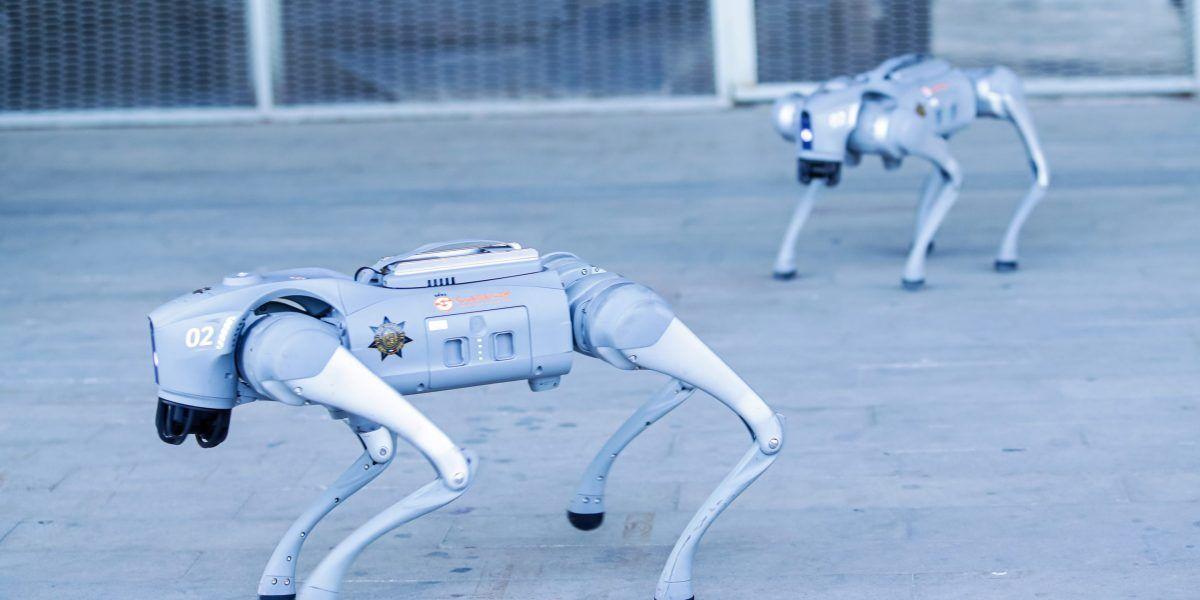
AI data centers are turning to an unexpected workforce to maintain security and operations across their massive facilities: robot dogs. Boston Dynamics and Ghost Robotics report a sharp surge in demand from data center operators seeking autonomous solutions to monitor sites that can span dozens of acres and require 24-hour uptime
1
. "We've seen a huge, huge uptick in interest from data centers in the last year, I'd say, which is probably not surprising given the investment in that space," Merry Frayne, senior director of product management at Boston Dynamics, told Business Insider2
.
Source: Fortune
These quadrupeds represent a practical response to the infrastructure boom driven by AI companies pouring nearly $700 billion into buildouts
3
. With approximately 5,000 data centers already operating in the United States and 800 to 1,000 new facilities under construction, the market for robot security guards continues to expand1
.Boston Dynamics' Spot and Ghost Robotics' Vision 60 Lead Deployment
Boston Dynamics' Spot, roughly the size of a medium dog, handles tasks ranging from perimeter security to industrial inspection and construction monitoring
1
. The robot navigates uneven terrain, climbs stairs, and operates in extreme temperatures without fatigue. Equipped with sensors for anomaly detection, Spot identifies temperature fluctuations, leaks, puddles, and unusual noises that might signal problems in server halls or mechanical rooms1
.
Source: Benzinga
Pricing for Spot ranges from $175,000 to $300,000 depending on configuration, with most customers recovering costs within 18 months according to Frayne
1
. Ghost Robotics' Vision 60, deployed primarily for external perimeter security, has a one-time MSRP starting at $165,0001
. The Vision 60 streams video back to security staff, functioning as a mobile surveillance platform that operates continuously1
.Augmenting Human Security Rather Than Replacement
The economics behind deploying autonomous robot dogs are compelling for operators managing multimillion-dollar server farms. A single human guard costs around $150,000 per year when factoring in benefits and shifts
4
. Michael Subhan, chief growth officer at Ghost Robotics, explained the value proposition: "Instead of having two guards at $300,000, you can have one guard and a robot. And the robot obviously doesn't get sick or go on vacation"4
.However, both companies emphasize that augmenting human security remains the goal rather than complete replacement. "We're not there to replace the human guard," Subhan stated. "We sort of augment the guard"
2
. Operators still monitor live video streams and make final decisions on actions the robots record1
.Related Stories

Real-World Applications in Securing AI Infrastructure
Novva Data Centers in Utah demonstrates practical implementation at its 1.5-million-square-foot flagship site in West Jordan, where teams of Spots collect environmental data, check equipment, and flag anomalies to onsite staff
1
. Using thermal imaging, the robots alert technicians to overheating power units or cooling system failures before outages occur1
.
Source: TechSpot
Robotic patrols address limitations of fixed security infrastructure, as cameras and sensors cannot cover every corridor or rooftop across campuses stretching tens of acres
1
. Spot can travel miles on a single charge while automatically performing route-based inspections, with endurance that matters in harsh climates from desert heat to subzero winters1
.Data center operators also utilize these robots for site mapping, monitoring construction progress, and detecting hazards during facility expansion
2
. Boston Dynamics markets Spot as having "360° perception and athletic intelligence"3
. The growing density of AI clusters, combined with complex cooling and electrical systems, requires continuous observation that these mechanical workers can provide1
.As cloud computing and AI drive unprecedented expansion, with some facilities like Meta's Hyperion sprawling to four times the size of Manhattan's Central Park
3
, these electromechanical quadrupeds are becoming familiar presences ensuring servers stay cool, lights stay on, and data keeps flowing1
.References
Summarized by

Navi
[2]
Related Stories
Sirius: The AI-Powered Robot Dog Blending Cutting-Edge Technology with Pet-Like Companionship
27 Jun 2025•Technology
U.S. Army Tests AI-Powered Robot Dogs with Guns in Middle East
03 Oct 2024

Boston Dynamics unveils production-ready Atlas robot with superhuman abilities at CES 2026
05 Jan 2026•Technology

Recent Highlights
1
Tennessee Teens Sue Elon Musk's xAI Over Grok AI-Generated Child Abuse Images
Policy and Regulation

2
Pentagon designates Palantir Maven AI as core US military system in major defense shift
Technology

3
Supermicro Co-Founder Indicted in $2.5 Billion Nvidia AI Chip Smuggling Scheme to China
Policy and Regulation

Recent Highlights
Today's Top Stories












Your Daily Dose of Curated AI News
Don’t drown in AI news. We cut through the noise - filtering, ranking and summarizing the most important AI news, breakthroughs and research daily. Spend less time searching for the latest in AI and get straight to action.

