Scientists Launch DinoTracker, an AI App That Identifies Dinosaur Footprints in Seconds


5 Sources
5 Sources
[1]
Scientists Are Using AI to Help Identify Dinosaur Footprints
Julian is a contributor and former staff writer at CNET. He's covered a range of topics, such as tech, crypto travel, sports and commerce. His past work has appeared at print and online publications, including New Mexico Magazine, TV Guide, Mental Floss and NextAdvisor with TIME. On his days off, you can find him at Isotopes Park in Albuquerque watching the ballgame. An international team of researchers has devised a futuristic tool to examine the footprints left by dinosaurs in our ancient past. The AI-powered app, Dinotracker, can identify dinosaur footprints in moments. The research comes from a joint project by the Helmholtz-Zentrum research center in Berlin and the University of Edinburgh in Scotland. The Proceedings of the National Academy of Sciences published the paper on Monday. Don't miss any of our unbiased tech content and lab-based reviews. Add CNET as a preferred Google source. Identifying a dinosaur species from a footprint isn't always easy. The footprint is hundreds of millions of years old, often preserved in layers of rock that have shifted over the eons since the track was laid. Also, we still have a lot to learn about dinosaurs, and it's not always clear which species left a footprint. Subjectivity or bias can come into play when identifying them, and scientists don't always agree with the results. Gregor Hartmann of Helmholtz-Zentrum, who led the project, told CNET that the research team sought to remove this propensity from the identification process by developing an algorithm that could be neutral. "We bring a mathematical, unbiased point of view to the table to assist human experts in interpreting the data," Hartmann said. Researchers trained the algorithm on thousands of real fossil footprints, as well as millions of simulated versions that could recreate "natural distortions such as compression and shifting edges." How AI is being used on dinosaur tracks The system was trained to focus on eight major characteristics of dinosaur footprints, including the width of the toes, the position of the heel, the surface area of the foot that contacted the ground and the weight distribution across the foot. The AI tool uses these traits to compare new footprints to existing fossils, and then determines which dinosaur was most likely responsible for the footprint. The team tested it against human expert classifications and found that the AI agreed with them 90% of the time. Hartmann made it clear that the AI system is "unsupervised." "We do not use any labels (like bird, theropod, ornithopod) during training. The network has no idea about it," Hartmann said. "Only after training, we compare how the network encodes the silhouettes and compare this with the human labels." Hartmann said that the hope is for Dinotracker to be used by paleontologists and that the AI tool's data pool grows as it's used by more experts. Bird vs. dinosaur Using Dinotracker, the researchers have already uncovered some intriguing possibilities on the evolution of birds. When analyzing footprints more than 200 million years old, the AI found strong similarities with the foot structures of extinct and modern birds. The team says one possibility is that birds originated tens of millions of years earlier than we thought. But it's also possible that early dinosaur feet just look remarkably like bird feet. This evidence, Hartmann notes, isn't enough to rethink the evolution of birds, since a skeleton is the "true evidence" of earlier bird existence. "It is essential to keep in mind that over these millions of years, lots of different things can happen to these tracks, starting from the moisture level of the mud where it was created, over the substrate it was created on, up to erosion later," he said. "All this can heavily change the shape of the fossilized track we find, and ultimately makes it too difficult to interpret footprints, which was the motivation for our study." Dinotracker is available for free on GitHub. It's not in a download-and-use format, so you'll have to know a bit about software to get it up and running.
[2]
This AI app can tell which dinosaur made a footprint
A newly developed app powered by artificial intelligence (AI) is giving scientists and the public a new way to identify dinosaur footprints left behind millions of years ago, according to a recent study. The technology aims to make sense of fossil tracks that have long challenged researchers. For many years, paleontologists have studied ancient footprints while debating what kinds of animals created them. Some tracks may belong to meat eating predators, others to plant eating dinosaurs, and some have even raised questions about whether early bird species were involved. Turning Photos Into Instant Analysis With the new DinoTracker app, researchers and dinosaur fans can upload a photo or drawing of a footprint using a mobile phone and receive an immediate analysis. The app evaluates the shape and structure of the track to estimate which type of dinosaur likely made it. Fosilized dinosaur footprints offer valuable insight into prehistoric life, helping scientists understand how dinosaurs moved and behaved. However, earlier studies have shown that these tracks are often difficult to interpret because their shapes can be altered over time. Moving Beyond Traditional Methods In the past, researchers relied on manually built computer databases that linked specific footprints to specific dinosaurs. Experts note that this approach could introduce bias, especially when the identity of a track was uncertain or disputed. To address this problem, a research team led by the Helmholtz-Zentrum research centre in Berlin, working with the University of Edinburgh, developed advanced algorithms that allow computers to learn on their own how dinosaur footprints vary in shape. The AI system was trained on nearly 2,000 real fossil footprints, along with millions of additional simulated examples. These extra variations were designed to reflect realistic changes, such as compression and edge displacement, that occur as footprints are preserved over time. What the AI Looks For The model learned to recognize eight key features that distinguish one footprint from another. These included how far the toes spread, where the heel was positioned, how much surface area contacted the ground, and how weight was distributed across different parts of the foot. After identifying these variations, the system compared new footprints with known fossil examples to predict which dinosaur most likely made the tracks. When evaluated, the algorithm matched the classifications made by human experts about 90 percent of the time, even for species that are considered controversial or difficult to identify. Unexpected Links to Birds One of the most surprising findings came from tracks that are more than 200 million years old. The AI detected striking similarities between some dinosaur footprints and the feet of both extinct and modern birds. According to the research team, this could mean that birds emerged tens of millions of years earlier than scientists have previously believed. Another possibility is that some early dinosaurs happened to have feet that closely resembled bird feet by coincidence. New Insights From Scotland The system also offered new clues about mysterious footprints found on the Isle of Skye in Scotland. These tracks were formed on the muddy edge of a lagoon around 170 million years ago and have puzzled scientists for decades. The analysis suggests that these footprints may have been left by some of the oldest known relatives of duck-billed dinosaurs, making them among the earliest examples of this group identified anywhere in the world. Opening Paleontology to Everyone Researchers say the technology creates new opportunities to study how dinosaurs lived and moved across the Earth. It also gives the public a chance to take part in fossil research by analyzing footprints themselves. The study was published in PNAS and funded by the innovations pool of the BMBF-Project: Data-X, the Helmholtz project ROCK-IT, the Helmholtz-AI project NorMImag the National Geographic Society and the Leverhulme Trust. Dr. Gregor Hartmann of Helmholtz-Zentrum research center, said: "Our method provides an unbiased way to recognize variation in footprints and test hypotheses about their makers. It's an excellent tool for research, education, and even fieldwork." Professor Steve Brusatte, Personal Chair of Palaeontology and Evolution, School of GeoSciences, said: "This study is an exciting contribution for paleontology and an objective, data-driven way to classify dinosaur footprints -- something that has stumped experts for over a century. "It opens up exciting new possibilities for understanding how these incredible animals lived and moved, and when major groups like birds first evolved. This computer network might have identified the world's oldest birds, which I think is a fantastic and fruitful use for AI."
[3]
Identifying dinosaurs from their footprints is difficult - but AI can help
When you hear the word "dinosaur", the first thing that might spring to mind is a hulking skeleton like Sue the T rex in Chicago's Field Museum or Sophie the Stegosaurus at the Natural History Museum in London. Dinosaur skeletons give us striking evidence of what these ancient animals looked like, from the plates and spikes on stegosaurs like Sophie to the long-necked, airplane-sized bodies of titanosaurs. However, despite their iconic status as museum centerpieces, skeletons are not the most common type of dinosaur fossil known. That prize goes to dinosaur footprints. The abundance of dinosaur footprints is intuitive. Each dinosaur could only leave one skeleton - but on any single day of its life, it could make thousands of footprints. So, even if only a tiny fraction were fossilised, we could expect to see many more of them in the fossil record. Dinosaur footprints form in environments where the ground is soft enough to leave an impression, but still cohesive enough so that the shape of the track does not collapse. We find dinosaur footprints in Mesozoic (252-66 million years old) sedimentary rocks all around the world. Dinosaurs left their mark along coastlines in the UK, ranging from sauropod tracks on the Isle of Skye to Iguanodon tracks on the Isle of Wight. Prosauropod tracks adorn Italian mountainsides. In Bolivia, the largest dinosaur tracksite currently known consists of upwards of 16,000 theropod tracks plus a variety of swimming tracks. Although dinosaur footprints are abundant, they are challenging fossils to study and identify. Our team, led by Gregor Hartmann at Helmholtz-Zentrum Berlin, has combined AI techniques from photon science with palaeontology in a novel attempt to address this issue. The footprint puzzle Dinosaur footprints are not perfect snapshots of the feet that made them. They reflect the shape of the foot, how the dinosaur was moving, and how soft or hard the ground was at the time. Millions and millions of years of geological history have passed during which the original surface on which the dinosaur walked was buried, transformed to rock, and exposed again. Working on dinosaur footprints necessitates taking all of those factors into account when studying their shapes. Another challenge arises when trying to determine what dinosaur made which footprints. In particular, tridactyl (three-toed) dinosaur footprints are very tricky to identify, because a wide variety of different dinosaurs have three functional toes on their hind foot. Dinosaurs as different as Megalosaurus and Iguanodon, Edmontosaurus and Albertosaurus, and Tyrannosaurus and Hadrosaurus all have three toes. These dinosaurs fall into two main groups: meat-eating theropods and plant-eating ornithopods. When we take into account all of the different factors that contribute to the shape of a dinosaur footprint, it becomes extremely challenging to determine whether some three-toed footprints come from theropod or ornithopod dinosaurs. An unlikely collaboration Every fossil is a miracle. It takes the perfect combination of circumstances for a fossil to form, be preserved through millions of years, and be found and recognised by human eyes. Our collaboration arose in a similarly serendipitous way. A physicist and data scientist, Hartmann was reading The Rise and the Fall of the Dinosaurs to his young son Julius, who was very interested in dinosaurs. As he read, Hartmann wondered if the AI methods he was using in photon science could be applied to paleontological questions. So he reached out to the book's author, Steve Brusatte. This led to the idea of developing an unsupervised neural network for studying dinosaur footprints. We built our training data from around 2,000 real footprints, then added millions of augmented variations to that initial dataset through strategies like displacing the edges of the footprints by a few pixels. Optimising the network took us over a year. The key step forward for this network was its unsupervised nature. Only the outlines of the footprints were input, with no additional information about what dinosaurs might have made them. Then the network was allowed to independently discover how the different shapes varied. This approach meant we avoided human bias in footprint identifications at the training stage. In the end, our model identified eight core axes of footprint variation, including digit spread and heel position. When we compared the footprint groupings with expert classifications afterwards, we found 80-93% agreement overall. Thus, we could be reasonably confident the model provides a data-driven way to test the identity of particular footprints. Our findings have just been published in the scientific journal PNAS. However, we wanted to make the network accessible to everyone, not just scientific specialists. That desire gave rise to DinoTracker, a free public app that can enable anyone to upload a picture of a dinosaur's footprint, sketch its outline, and get instant analysis of what footprints their track is most similar to. The app can be downloaded onto a desktop from Github with the support of this installation guide. This app certainly isn't the end of the story when it comes to puzzling over the mysteries of dinosaur footprints. It's a useful research resource for figuring out what tracks any footprint is most similar to in terms of shape, and what features are driving that similarity. More excitingly, it's a tool for curious children like Julius to take outside when they are exploring. Anyone can snap a photo, draw an outline and compare their discoveries to other dinosaur footprints. This article includes a reference to a book included for editorial reasons, and a link to bookshop.org. If you click that link and go on to buy something from bookshop.org, The Conversation UK may earn a commission.
[4]
AI is learning how to identify dinosaur footprints
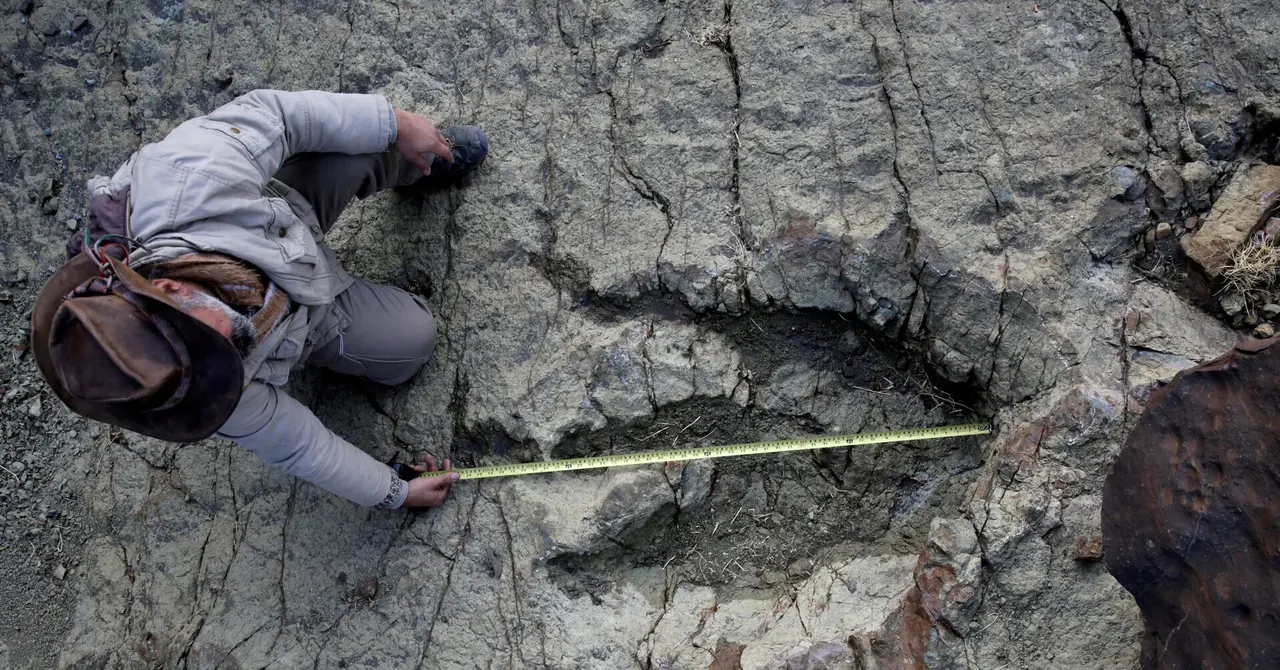
For more than a century, dinosaur footprints have been both a gift and a headache. They're some of the most direct evidence we have of animals moving through real landscapes, but they're also notoriously hard to interpret. A footprint is not just a "stamp" of a foot. It's a record of soft mud squishing, toes sliding, edges collapsing, and later erosion that rewrites the shape. That's why researchers can look at the same trackway and still argue over whether it came from a predator, a plant-eater, or something in between. A new study suggests artificial intelligence can help bring order to that mess. Researchers have created a tool called DinoTracker, a mobile app that lets people upload a photo - or even a sketch - of a dinosaur footprint and get an instant analysis of which kind of dinosaur may have made it. Dinosaur footprints confuse scientists Footprints don't fossilize in a neat, standardized way. Two animals with the same foot anatomy can leave very different tracks depending on the sediment, the moisture, how fast they were moving, and how much the ground deformed under their weight. On top of that, a footprint can change after it's made. Sediment can compact, edges can crumble, and later weathering can erase or exaggerate details. Because of all this, traditional footprint research often depends on expert judgment and careful comparison with known examples. Many older computer-based methods relied on researchers to manually compile datasets. In those datasets, researchers assigned tracks to specific dinosaurs, a step that can introduce bias or reinforce assumptions. AI was trained to "see" variation The team behind DinoTracker was led by researchers at a Helmholtz Research Center in Berlin, working with colleagues at the University of Edinburgh. Instead of trying to force footprints into overly tidy categories, they trained their algorithms to recognize how tracks realistically vary. The AI learned from nearly 2,000 real fossil footprints, but it also trained on millions of simulated variations designed to mimic what happens in nature. Those extra versions reproduced effects such as compression, edge displacement, and other distortions. These changes can make the same kind of footprint look different from one site to another. From there, the system learned to focus on a set of key traits that help distinguish trackmakers even when the print isn't perfect. The research describes features such as how far the toes spread, where the heel sits, how large the contact area is, and how weight seems to be distributed as the foot hits the ground. When AI agrees with experts After training, the model was tested by asking it to predict which dinosaur likely made a footprint by comparing it with existing fossil tracks. According to the article, the algorithm reached around 90 percent agreement with classifications made by human experts, including cases that are usually controversial. That doesn't mean the AI is "right" in some absolute sense. Footprints can be ambiguous, and paleontology often deals in best-supported interpretations rather than certainty. But a system that performs at that level can act as a consistent second opinion and highlight which tracks deserve closer study. Dinosaur footprints that look like birds One of the most intriguing findings came from very old footprints, more than 200 million years old. The AI flagged several tracks that share unusually bird-like features, resembling prints associated with extinct and modern birds. The researchers suggest two possibilities. Either birds could have originated tens of millions of years earlier than many timelines assume, or some early dinosaurs had feet that coincidentally looked very similar to birds' feet. The result doesn't settle the debate, but it strengthens the case that footprints may contain signals that have been underappreciated. Scotland's tracks get reexamined The system also took a fresh look at puzzling footprints from the Isle of Skye in Scotland. These tracks were made around 170 million years ago on the muddy shore of a lagoon, and they've been difficult to confidently assign to a specific dinosaur group. Researchers say the AI points to some of the oldest known relatives of duck-billed dinosaurs as the trackmakers. If that interpretation holds up, it could shift how scientists think about when and where that lineage began to spread. Taking AI to real tracks DinoTracker isn't just a research demo; it's designed for broader use. Footprints are one of the most common kinds of dinosaur evidence that people encounter in the wild, and an accessible tool could help both scientists and the public. In research settings, it could help screen large numbers of tracks quickly and identify patterns across sites. In education, it turns footprints into something interactive rather than purely descriptive. And for fieldwork, it offers a fast way to test hypotheses on the spot, especially in places where track interpretation has traditionally depended on whoever happens to be standing there with experience. "This study is an exciting contribution for paleontology and an objective, data-driven way to classify dinosaur footprints," said paleontologist Steve Brusatte from the University of Edinburgh. "It opens up exciting new possibilities for understanding how these incredible animals lived and moved, and when major groups like birds first evolved." Turning mess into meaning Dinosaur footprint research probably won't ever be fully settled by an app. Tracks are messy, and the past doesn't come with labels. But this study points to something valuable: a tool that treats variation as information instead of noise. If DinoTracker can reliably recognize how real footprints warp and still connect them to likely trackmakers, it could speed up research, widen participation, and push debates onto firmer ground. And maybe it also does something else: it makes the ancient world feel a little more reachable. A footprint is a moment of contact between an animal and the ground beneath it. If we can read those moments more clearly, we get closer to understanding how dinosaurs actually lived, moved, and evolved. Image credit: Tone Blakesley -- - Like what you read? Subscribe to our newsletter for engaging articles, exclusive content, and the latest updates. Check us out on EarthSnap, a free app brought to you by Eric Ralls and Earth.com.
[5]

Scientists launch AI DinoTracker app that identifies dinosaur footprints
Researchers say artificial intelligence system matches human expert classification about 90% of the time Experts have created an app that uses artificial intelligence to identify dinosaurs from the footprints left behind after they stomped across the land tens of millions of years ago. "When we find a dinosaur footprint, we try to do the Cinderella thing and find the foot that matches the slipper," said Prof Steve Brusatte, a co-author of the work, from the University of Edinburgh. "But it's not so simple, because the shape of a dinosaur footprint depends not only on the shape of the dinosaur's foot but also the type of sand or mud it was walking through, and the motion of its foot." Writing in the Proceedings of the National Academy of Sciences, Brusatte and colleagues report how previous AI systems based their learning on footprints that had already been labelled as having been made by particular types of dinosaur. But, the team note, if those identifications are incorrect then the AI system will also be flawed. "You never find a footprint and alongside [it] the dinosaur that had made this footprint," said Dr Gregor Hartmann, the first author of the new research from Helmholtz-Zentrum in Germany. "So, no offence to palaeontologists and such, but most likely some of these labels are wrong." Taking a different approach, Brusatte, Hartmann and colleagues fed their AI system with 2,000 unlabelled footprint silhouettes. The system then determined how similar or different the imprints were from each other by analysing a range of features it identified as meaningful. The researchers discovered these eight features reflected variations in the imprints' shapes, such as the spread of the toes, amount of ground contact and heel position. The team have turned the system into a free app called DinoTracker that allows users to upload the silhouette of a footprint, explore the seven other footprints most similar to it and manipulate the footprint to see how varying the eight features can affect which other footprints are deemed most similar. Hartmann said that at present experts had to double check if factors such as the material the footprints were made in, and their age, matched the scientific hypothesis, but the system clustered prints with those expected from classifications made by human experts about 90% of the time. Among other results, the team said the AI system supported what palaeontologists had previously noticed: that a set of footprints from the Triassic and early Jurassic are remarkably birdlike despite being about 60m years older than the oldest bird skeletons, the fossilised bones of Archaeopteryx. Brusatte said this showed that the similarities were not just down to wishful thinking. "If these tracks were made by birds, that would mean that birds have a much older, much deeper ancestry than we used to think. And not just a few million years but tens of millions of years," he said. However, it is far from case closed. "I suspect it is more likely that these tracks were made by meat-eating dinosaurs with very birdlike feet - maybe bird ancestors, but not true birds," Brusatte said. Dr Jens Lallensack, of Humboldt University of Berlin, who has also used AI to help identify dinosaur tracks but was not involved in the study, said a key limitation was that the features of interest identified by the new system were not necessarily based on the shape of the foot itself. He added that the birdlike tracks may be a result of the way the foot of a regular theropod sank into soft ground. "They are not evidence for an early appearance of birds," he said.
Share
Share
Copy Link
Researchers from Helmholtz-Zentrum Berlin and the University of Edinburgh have developed DinoTracker, a free AI-powered app that can identify which dinosaur made a footprint by analyzing its shape. The system matches human expert classifications about 90% of the time and has already uncovered intriguing clues about bird evolution that could push back their origins by tens of millions of years.
AI Transforms How Scientists Study Ancient Tracks
A collaboration between Helmholtz-Zentrum and University of Edinburgh has produced DinoTracker, an AI-powered app that can identify dinosaur footprints in moments by analyzing photos or sketches uploaded through a mobile phone
1
2
. The research, published in PNAS, addresses a challenge that has stumped paleontology experts for over a century: determining which species left behind the fossil footprints scattered across ancient landscapes2
5
.
Source: The Conversation
Dinosaur footprints are the most common type of dinosaur fossil known, far outnumbering skeletal remains. Each dinosaur could only leave one skeleton but could make thousands of footprints in a single day . Yet these tracks prove notoriously difficult to interpret because their shapes reflect not just the foot structure but also how the dinosaur was moving, the softness of the ground, and millions of years of geological transformation
1
4
.Removing Human Bias from Fossil Analysis
Gregor Hartmann, who led the project at Helmholtz-Zentrum, explained that the team sought to remove subjectivity from the identification process by developing an algorithm that could remain neutral
1
. Previous AI systems relied on manually built computer databases where researchers assigned tracks to specific dinosaurs, a step that could introduce human bias, especially when track identity was uncertain or disputed2
4
.The breakthrough came from using an unsupervised neural network approach. Researchers trained the algorithm on nearly 2,000 real fossil footprints, along with millions of simulated variations designed to recreate natural distortions such as compression and shifting edges
1
2
. Critically, the system received no labels identifying whether tracks came from theropod or ornithopod dinosaurs during training1
.
Source: CNET
Eight Key Features Drive Track Recognition
The AI system independently discovered eight key features that distinguish one footprint from another, including how far the toes spread, where the heel was positioned, how much surface area contacted the ground, and how weight was distributed across different parts of the foot
2
4
. After identifying these variations, the system compared new footprints with known fossil examples to predict which dinosaur most likely made the tracks2
.When evaluated against human expert classifications, the algorithm reached 80-93% agreement overall, including for species considered controversial or difficult to identify
4
. Steve Brusatte, Personal Chair of Palaeontology and Evolution at the University of Edinburgh and co-author of the work, called it "an objective, data-driven way to classify dinosaur footprints"2
.Unexpected Clues About Bird Evolution
One of the most surprising findings emerged from tracks more than 200 million years old from the Triassic and early Jurassic periods. The AI detected striking similarities between some dinosaur footprints and the feet of both extinct and modern birds
1
2
. These tracks are approximately 60 million years older than the oldest bird skeletons, the fossilized bones of Archaeopteryx5
.According to the research team, this could mean that bird evolution occurred tens of millions of years earlier than scientists have previously believed
1
4
. However, Brusatte cautioned that another possibility exists: some early meat-eating dinosaurs may have had feet that coincidentally looked very similar to bird feet5
. Hartmann noted that footprint evidence alone isn't enough to rethink bird evolution, since a skeleton remains the "true evidence" of earlier bird existence1
.Related Stories

New Insights from Scottish Tracks
The system also offered fresh analysis of mysterious footprints found on the Isle of Skye in Scotland. These tracks were formed on the muddy edge of a lagoon around 170 million years ago and have puzzled scientists for decades
2
. The analysis suggests that these footprints may have been left by some of the oldest known relatives of duck-billed dinosaurs, making them among the earliest examples of this group identified anywhere in the world2
4
.Opening Paleontology to Public Participation
DinoTracker is available for free on GitHub and as a mobile app, allowing anyone to upload a picture of a dinosaur footprint, sketch its outline, and receive instant analysis
1
. Users can explore the seven other footprints most similar to their upload and manipulate the footprint to see how varying the eight features affects which other footprints are deemed most similar5
.The technology creates new opportunities to study how dinosaurs lived and moved across Earth while giving the public a chance to participate in fossil research
2
. In research settings, it could help screen large numbers of tracks quickly and identify patterns across sites. For fieldwork, it offers a fast way to test hypotheses on the spot4
. Hartmann emphasized that the hope is for DinoTracker to be used by paleontologists and for the AI tool's data pool to grow as it's used by more experts1
.References
Summarized by

Navi
[2]
[3]
[4]
Related Stories
New AI method tackles century-old challenge of identifying which dinosaur made which footprints
06 Feb 2026•Science and Research
AI Revolutionizes Paleontology: Ancient Tegu Fossil Discovered in Florida
13 May 2025•Science and Research

AI Breakthrough Detects Ancient Life Signatures in 3.3-Billion-Year-Old Rocks
18 Nov 2025•Science and Research

Recent Highlights
1
Tennessee Teens Sue Elon Musk's xAI Over Grok AI-Generated Child Abuse Images
Policy and Regulation

2
Supermicro Co-Founder Indicted in $2.5 Billion Nvidia AI Chip Smuggling Scheme to China
Policy and Regulation

3
Val Kilmer to appear posthumously in As Deep as the Grave through AI-generated performance
Entertainment and Society

Recent Highlights
Today's Top Stories



Your Daily Dose of Curated AI News
Don’t drown in AI news. We cut through the noise - filtering, ranking and summarizing the most important AI news, breakthroughs and research daily. Spend less time searching for the latest in AI and get straight to action.

