Salesforce unveils 30 new AI features for Slack, embedding CRM and autonomous capabilities


5 Sources
5 Sources
[1]
Salesforce announces an AI-heavy makeover for Slack, with 30 new features | TechCrunch
Salesforce, the cloud software giant, has been remaking its business around AI, and at a small gathering in San Francisco on Tuesday, CEO Marc Benioff and his team unveiled the latest results of those efforts: an updated version of Slack, with a plethora of new AI features. The most significant of these is a serious glow-up for its AI agent, Slackbot. The 30 new features, which will be available in the coming months, follow a January update that gave Slackbot agentic capabilities -- including the ability to draft emails, schedule meetings, and sift through your inbox for specific information. Perhaps the most notable feature announced Tuesday is what the company calls reusable AI-skills -- which allow users to define specific tasks for Slackbot that, once created, can be applied in a variety of different scenarios and contexts. Slackbot comes with a built-in library of AI-skills, Salesforce says, but users can also create their own custom versions. Once these skills are set up, they significantly reduce the work an employee might need to do. For example, a user can trigger a skill using a simple command in Slack -- say, "create a budget" for an upcoming event -- prompting Slackbot to pull together all relevant information from a company's Slack channels, as well as any connected apps or data sources, to create an actionable plan. The bot will then automatically set up a meeting to discuss the plan, inviting relevant employees based on their titles. Slackbot now also functions as an MCP (Model Context Protocol) client -- meaning it can connect to and coordinate with outside services and tools. Among those is Agentforce, Salesforce's AI agent development platform launched in 2024. Through that connection, it can "route work or prompt questions to Agentforce or any agent or app in your enterprise" the company says, with the agent finding the most relevant and efficient path for the information, without human intervention. According to Rob Seaman, Slack's interim CEO and former chief product officer, Slackbot can also now transcribe meetings and summarize them. If a meeting participant happens to zone out, thus missing critical details, they can just ask Slackbot to produce a recap of the meeting, including any action items assigned to them. The agent can also now operate outside of Slack and monitor your desktop activities -- Salesforce lists "your deals, your conversations, your calendar, and your habits" as the kinds of data it draws on. Based on that context, the bot will make actionable suggestions or drafts follow-ups for critical tasks. Seaman has said that privacy protections are built into this design and that users have the ability to adjust permissions as needed. In short: Salesforce is clearly trying to take Slack beyond its roots as an enterprise communication tool and position it as a more versatile platform that can handle a wider variety of business tasks. The hope seems to be that, by flooding it with AI, Slack can become an indispensable part of enterprise users' core business processes. Benioff let his team walk through the major features on Tuesday but remarked, during his keynote, that the five years since Salesforce acquired Slack had been an "incredible journey," one that had delivered "two and a half times revenue growth." He added: "We have about a million businesses running on Slack. It's been a huge growth story."
[2]
Slack adds 30 AI features to Slackbot, its most ambitious update since the Salesforce acquisition
Slack today announced more than 30 new capabilities for Slackbot, its AI-powered personal agent, in what amounts to the most sweeping overhaul of the workplace messaging platform since Salesforce acquired it for $27.7 billion in 2021. The update transforms Slackbot from a simple conversational assistant into a full-spectrum enterprise agent that can take meeting notes across any video provider, operate outside the Slack application on users' desktops, execute tasks through third-party tools via the Model Context Protocol (MCP), and even serve as a lightweight CRM for small businesses -- all without requiring users to install anything new. The announcement, timed to a keynote event that Salesforce CEO Marc Benioff is headlining Tuesday morning, arrives less than three months after Slackbot first became generally available on January 13 to Business+ and Enterprise+ subscribers. In that short window, Slack says the feature is on track to become the fastest-adopted product in Salesforce's 27-year history, with some employees at customer organizations reporting they save up to 90 minutes per day. Inside Salesforce itself, teams claim savings of up to 20 hours per week, translating to more than $6.4 million in estimated productivity value. "Slackbot is smart. It's pleasant, and I think it's endlessly useful," Rob Seaman, Slack's interim CEO and former chief product officer, told VentureBeat in an exclusive interview ahead of the announcement. "The upper bound of use cases is effectively limitless for it." The release signals Slack's clearest bid yet to become what Seaman and the company's leadership describe as an "agentic operating system" -- a single surface through which workers interact with AI agents, enterprise applications, and one another. It also marks a direct challenge to Microsoft, which has spent the past two years embedding its Copilot assistant across the entirety of its productivity stack. From simple chatbot to autonomous coworker: six new capabilities that redefine what Slackbot can do The features announced Tuesday organize around several major capability areas, each designed to push Slackbot well beyond the role of a chatbot and into something closer to an autonomous digital coworker. The most foundational may be what Slack is calling AI-Skills -- reusable instruction sets that define the inputs, the steps, and the exact output format for a given task. Any team can build a skill once and deploy it on demand. Slackbot ships with a built-in library for common workflows, but users can also create their own. Critically, Slackbot can recognize when a user's prompt matches an existing skill and apply it automatically, without being explicitly told to do so. "Think of these as topics or instructions -- basically instructions for Slackbot to perform a repeat task that the user might want to do, that they can share with others, or a company might be able to set up for their whole company," Seaman explained. Deep research mode gives Slackbot the ability to conduct extended, multi-step investigations that take approximately four minutes to complete -- a significant departure from the instant-response paradigm of most enterprise chatbots. Slack chose not to demonstrate this feature on stage at the keynote, Seaman said, precisely because its value lies in depth, not speed. MCP client integration, meanwhile, allows Slackbot to make tool calls into external systems through the Model Context Protocol, meaning it can now create Google Slides, draft Google Docs, and interact with the more than 2,600 apps in the Slack Marketplace and the 6,000-plus apps built over two decades for the Salesforce AppExchange. "We're going all in on MCP for Slackbot," Seaman said. "MCP clients and MCP servers are becoming very mature." Meeting intelligence allows Slackbot to listen to any meeting -- not just Slack huddles, but calls on Zoom, Google Meet, or any other provider -- by tapping into the user's local audio through the desktop application. It captures discussions, summarizes decisions, surfaces action items, and because Slackbot is natively connected to Salesforce, it can log actions and update opportunities directly in the CRM. Slackbot on Desktop extends the agent outside the Slack container entirely, while voice mode adds text-to-speech and speech-to-text capabilities, with full speech-to-speech functionality under active development. How Anthropic's Claude powers Slackbot -- and why keeping it affordable is the hardest part Slackbot is built on Anthropic's Claude model, a detail Seaman confirmed ahead of the keynote, where Anthropic's leadership will appear alongside Slack executives on stage. The partnership underscores the deepening relationship between the two companies: Anthropic's technology powers the reasoning layer, while Slack's "context engineering" -- the process of determining exactly which information from a user's channels, files, and messages should be fed into the model's context window -- determines the quality and relevance of every response. Managing the cost of that reasoning at enterprise scale is one of the most significant technical and financial challenges the team faces. Slackbot is included in Business+ and Enterprise+ plans at no additional consumption charge -- a deliberate strategic choice that places the burden of cost optimization squarely on Slack's engineering team rather than on customers. "A lot of what we've done is in the context engineering phase, working really closely with Anthropic to make sure that we're optimizing the RAG phase, optimizing our system prompts and everything, to make sure we're getting the right amount of context into the context window and not obviously making fiscally irresponsible decisions for ourselves," Seaman said. Starting in April, Slackbot will also become available in a limited sampling capacity to users on Slack's free and Pro plans -- a move designed to drive conversion up the pricing tiers. Desktop AI and meeting transcription are powerful, but they raise hard questions about workplace surveillance The extension of Slackbot beyond the Slack application window -- particularly its ability to listen to meetings and view screen content -- raises immediate questions about employee surveillance, especially in large enterprise environments where tens of thousands of workers may be subject to company-wide IT policies. Seaman was emphatic that every capability is user-initiated and opt-in. Slackbot cannot listen to audio unless the user explicitly tells it to take meeting notes. It cannot view the desktop autonomously; in its current form, users must manually capture and share screenshots. And it inherits every permission the organization has already established in Slack. "Everything is user opt-in. That's a key tenet of Slack," Seaman said. "It's not rogue looking at your desktop or autonomously looking at your desktop. It's very important to us, and very important to our enterprise customers." On Slackbot's memory feature -- which allows it to learn user preferences and habits over time -- Seaman said the company has no plans to make that data available to administrators. Users can flush their stored preferences at any time simply by telling Slackbot to do so. Slack's native CRM is a Trojan horse designed to capture startups before they outgrow it Among the most important features in Tuesday's release is a native CRM built directly into Slack, targeting small businesses that haven't yet adopted a dedicated customer relationship management system. The logic is straightforward: small companies typically adopt Slack early in their lifecycle, often on the free tier, and their customer conversations already happen in channels and direct messages. Slack's native CRM reads those channels, understands the conversations, and automatically keeps deals, contacts, and call notes up to date. When companies are ready to scale, every record is already connected to Salesforce -- no migrations, no starting over. "The hypothesis is that along the way, companies are effectively going to have moments where a CRM might matter," Seaman said. "Our goal is to make it available to them as a default, so as they are starting their company and their company is growing, it's just right there for them. They don't have to think about going off and procuring another tool." The feature also represents a response to a growing competitive threat. As the Wall Street Journal reported earlier this year, a wave of startups and individual developers have begun "vibe coding" their own lightweight CRMs, emboldened by the capabilities of large language models. By embedding CRM directly into Slack -- the tool many of those same startups already depend on -- Salesforce aims to make the procurement of a separate system unnecessary. Slack says it has a context advantage over Microsoft and Google -- but can it last? The announcements arrive at a moment of intense competitive pressure. Microsoft has integrated Copilot across its entire productivity suite, giving it a distribution advantage that reaches into virtually every Fortune 500 company. Google has been similarly aggressive with Gemini across Workspace. And standalone AI tools from OpenAI to Anthropic threaten to fragment the enterprise AI experience. Seaman took a measured approach when asked directly about competitive positioning, invoking a mantra he said Slack uses internally: "We are competitor aware, but customer obsessed." "I think there are two things that really stand out. One, we have a context advantage -- if you look at the way people use Slack, they love it. They use it so much, constantly communicating with their colleagues, openly thinking, working in public project channels. Two is the user experience. We focus so much on how our product feels in people's hands." That context advantage is real but not guaranteed. Slack's strength lies in the richness and volume of conversational data flowing through its channels -- data that, when fed into an AI model, can produce responses with a degree of organizational awareness that competitors struggle to match. But Microsoft's Teams captures similar conversational data, and its deep integration with Windows, Office, and Azure gives it a systems-level advantage that Slack, operating as a single application, cannot easily replicate. Starting this summer, every new Salesforce customer will receive Slack automatically provisioned and AI-powered from day one -- a bundling play that ensures the messaging platform reaches the broadest possible enterprise audience. Salesforce reported $41.5 billion in revenue for fiscal year 2026, up 10% year-over-year, with Agentforce ARR reaching $800 million. But Wall Street has remained skeptical about whether AI will ultimately erode demand for traditional enterprise software, and Salesforce's stock has underperformed the broader Nasdaq over the past year. More Slack users in more organizations gives AI-driven features more surface area to prove their value. Slack's biggest bet is that it can do everything without losing the simplicity that made it beloved Tuesday's launch is the first major product release under Seaman's leadership. He assumed the interim CEO role after former Slack CEO Denise Dresser departed in December 2025 to become OpenAI's first chief revenue officer -- a move that signaled even Salesforce's own executives felt the gravitational pull of frontier AI companies. The overarching thesis embedded in the announcement -- that Slack is evolving from a messaging platform into an operating system for AI agents -- is as risky as it is ambitious. "One of the fundamental tenets of an operating system is that it obscures the complexity of the hardware from the end user," Seaman said. "There are thousands of apps and agents out there, and that can be overwhelming. I think that's our job -- to be the OS that obscures that complexity, so you just use it like it's a communication tool." When asked whether Slack risks losing its simplicity by trying to do everything, Seaman didn't flinch. "There's absolutely a risk," he said. "That's what keeps us up at night." It's a remarkably candid admission from the leader of a platform that just launched 30 new features in a single day. The company that won the hearts of millions of workers with playful emoji reactions and frictionless messaging is now betting its future on meeting transcription, CRM pipelines, desktop agents, and enterprise orchestration. Whether Slack can absorb all of that ambition without losing the thing that made people love it in the first place isn't just a product question -- it's the $27.7 billion question that Salesforce is still trying to answer.
[3]
Salesforce transforms Slackbot into the ultimate work assistant with 30 new AI features - SiliconANGLE
Salesforce transforms Slackbot into the ultimate work assistant with 30 new AI features Cloud software giant Salesforce Inc. has been trying to rebuild its customer relationship management business with artificial intelligence at its core, and its latest announcement provides the clearest vision of where it's heading. The company has just revealed a massive update to its collaboration platform Slack, positioning it as the new interface for enterprise work. The focus of today's updates is on Slackbot, the autonomous AI agent that lives within Slack and acts as a digital assistant, helper and now, teammate, all rolled into one. Slackbot is gaining 30 new features, with many of them set to roll out in the coming months. The update comes after Slackbot added its first agentic capabilities, such as the ability to draft emails, find information within someone's email inbox and schedule meetings. The new features build on those early capabilities, with one of the most significant being what Salesforce calls "reusable AI skills," which allows users to design specific tasks for Slackbot that can then be reused in other scenarios and contexts. The company has created a library of default AI skills, but companies will be able to customize these and create their own. Employees will have to tinker with Slackbot in order to set up these AI skills, but once they're done, it should significantly lighten their workload. Users will be able to trigger these skills with a simple command in Slack. For instance, they can tell Slackbot to "create a budget" for an upcoming event or product launch, and the agent will gather all of the necessary data from various corporate Slack channels and any connected applications and databases, before creating an actionable plan. It can also set up a meeting for relevant team members to discuss the plan, and users are free to adjust it as required. A second update pertains to the Model Context Protocol, which is a framework for agents to connect with and use third-party software tools. Slackbot can now function as an MCP client and connect to services including Agentforce, which is a platform for developing AI agents. This means it can automatically send work requests and other prompts to Agentforce and other AI agents. Based on the user's request, it will identify the most relevant agent and perform whatever work needs to be done, with no human intervention required, the company said. At a media event, Salesforce interim Chief Executive and former Chief Product Officer Rob Seaman said Slackbot has also gained the ability to transcribe and summarize meetings. Should someone at the meeting "zone out," and miss something important that was said, they can just ask Slackbot to fill them in later. It can also create a full recap of the meeting together with a detailed list of action items and who they were assigned to. "Slackbot is the ultimate teammate," Seaman declared. For the first time, Slackbot gains the ability to operate outside of the Slack interface and follow users across their entire desktop. This means it will be aware of whatever they're doing on their computer, and draw upon things such as "you deals, your conversations, your calendar and your habits," giving it the context it needs to generate answers and complete tasks whenever it's asked to do so. The bot will also be proactive, offering "actionable suggestions" as users go about their work. Seaman stressed that Salesforce has built in multiple privacy and safety guardrails into Slackbot to ensure that no sensitive data or personal information is leaked, and users will be able to adjust its permissions to control what it can and cannot access. These updates aren't just targeted at large enterprises. Seaman also discussed how they can benefit smaller businesses that don't have sales departments. In many cases, the business owner is the sales department, which is why Slackbot intends to make everything much easier by integrating Salesforce's CRM capabilities directly into Slack. Most customer conversations happen in Slack already, but smaller businesses may not have time to organize those interactions into proper records and easily retrieve important information that was discussed. Slackbot's native CRM capabilities allow it to read various Slack channels, understand what was said and update the deals, contacts and call notes for each customer and sales prospect automatically. If a user promises to follow up at a later date, Slackbot will make sure that gets logged, and remind them about it later. Or if a new contract is uploaded, it will be added to the relevant client files. Users will be able to access their full customer histories, update deals and perform any other associated tasks directly within Slack. Today's announcement suggests that Salesforce no longer sees Slackbot as a simple assistant for Slack users. Thanks to its deep integration with Agentforce and the company's CRM platform, it can now orchestrate more complex workflows, manage customer relationships automatically and follow users across their desktops to provide real-time assistance at any moment. Co-founder and Chief Technology Officer Parker Harris made it clear that the company sees Slackbot as the primary way that people will get business done. "We see it as the future interface for work," he said. "Slack is where you can get the work done." With Slackbot, Salesforce is moving towards a future where people may not even need to interact with its core CRM platform or other enterprise applications ever again. It's a future where everything will be conversational - users will just tell Slackbot what they need to happen or what they need to know, and it will do the legwork all by itself. "We're basically saying, 'why should I log into Salesforce at all? Slack is that new engagement layer for enterprise software," Harris said.
[4]
Salesforce adds 30 new AI features to Slack
Salesforce announced an updated version of Slack featuring new AI functionalities that aim to enhance user productivity. The update includes 30 new features, following a previous enhancement in January that allowed Slackbot to draft emails, schedule meetings, and efficiently search inboxes. The introduction of "reusable AI-skills" marks a significant advancement. This feature lets users define specific tasks that can be reused in various contexts. Slackbot, which comes with a library of AI-skills, also allows for the creation of custom skills tailored to user needs. After setting up a skill, users can execute it through simple commands. For example, invoking "create a budget" prompts Slackbot to gather relevant information and create a plan, including automatically scheduling a meeting with pertinent team members. Slackbot now functions as a Model Context Protocol (MCP) client, enabling it to connect and interact with external services, including Agentforce, Salesforce's AI agent development platform launched in 2024. This capability allows Slackbot to route tasks and questions to various enterprise agents and applications without requiring human oversight. Rob Seaman, Slack's interim CEO, noted Slackbot's ability to transcribe meetings and summarize discussions. Participants missing details can request a recap with assigned action items post-meeting. Slackbot's functionality extends beyond its platform, as it can monitor desktop activities and retrieve data from diverse sources like calendars and communication tools. It utilizes this data to propose actionable suggestions or draft follow-up tasks, all while upholding user privacy through adjustable permissions. Salesforce is positioning Slack as a multifunctional platform for diverse business tasks, seeking to expand its role beyond an enterprise communication tool. CEO Marc Benioff stated that the five years since acquiring Slack has resulted in "two and a half times revenue growth," with approximately one million businesses currently using the platform.
[5]

Slack upgrades Slackbot with 30 new features; embeds Salesforce CRM - The Economic Times
With this, Slackbot can now summarise meetings, trigger follow-up actions, and operate independently with minimal input. The integration positions Slack as a front-end layer for Salesforce applications.Artificial intelligence (AI) work platform Slack announced today that it is adding 30 new capabilities to its AI agent, Slackbot. In addition to Slackbot upgrades, the company revealed that it has built a completely new Customer Relationship Management (CRM) interface inside Slack, powered by Salesforce, enabling small businesses to manage customer relationships without leaving Slack. "With this update, Slackbot evolves from a helpful assistant into an active teammate that can execute work across systems, reducing context switching and keeping everything in a single, secure environment," the company wrote in a press release. Making Slackbot an autonomous decision-maker As part of the new capabilities, Slackbot will now be able to capture discussions, summarise decisions, and trigger follow-ups across systems on its own as soon as meetings end. The agent would also come with voice capabilities and be able to work on employees' desktop systems, offering enhanced contextuality and independent decision-making with existing permissions. Teams will now be able to define recurring workflows for the Slackbot, which it would then be able to initiate without repetitive prompting, and an expanded ecosystem access via the Model Context Protocol (MCP) will connect Slackbot to Agentforce, third-party tools, and over 6,000 apps across the Salesforce ecosystem. Agentforce is Salesforce's enterprise-grade, agentic AI platform that allows businesses to build, deploy, and manage autonomous AI agents. Integration with Salesforce The most notable update of the announcement is the integration of Salesforce's CRM into Slack using the AI agent. This way, users can be entirely fluent with Salesforce native applications directly using Slackbot, without ever leaving the platform. "(This) increases the capability of every single employee that's using (the agent), and then on top of that, we are deploying it as a front-end for Salesforce applications. We have built an entirely new native CRM in Slack in conjunction with our teams at Salesforce, so that small businesses that sign up for Slack, as soon as they reach a point in their tenure where it makes sense for them to start managing their customer relationships, can just do that natively in Slack," Rob Seaman, general manager, Slack, said during a select media briefing. The latest announcement comes just months after the productivity platform unveiled Slackbot in January this year as a personal AI assistant for users. Seaman told ETtech that the company is currently tracking close to a million weekly Slackbot users. "We rolled out Slackbot to all Salesforce employees, and we went to 50,000 Salesforce employees using it every single week, week over week, within a matter of weeks. It is (being) used daily by our leadership and our employees, and... we have also seen companies like OpenAI, Anthropic, Amazon, and Rivian, some of the most important new companies in the world, are already using Slack to run their business, and we're helping them save material time throughout the day," Seaman shared. The company claims that using Slackbot has helped employees save up to 20 hours per week, and it is currently being used by more than 80,000 employees daily. While the exact details of the rollout of the complete capabilities have not been specified, Seaman shared that the agent will be available to the company's millions of free and pro users soon.
Share
Share
Copy Link
Salesforce announced a sweeping AI-driven overhaul for Slack, introducing 30 new features that transform Slackbot into an autonomous enterprise work assistant. The update includes reusable AI-skills, native CRM integration, meeting transcription capabilities, and desktop monitoring. Early adopters report saving up to 20 hours per week, with the platform serving approximately one million businesses.
Salesforce Slack Receives Most Ambitious AI-Driven Overhaul Since Acquisition
Salesforce has unveiled more than 30 new Slack AI features in what represents the most comprehensive transformation of the workplace messaging platform since its $27.7 billion acquisition in 2021
2
. The Slackbot update, announced at a San Francisco media event led by CEO Marc Benioff, shifts the platform from a simple enterprise communication tool into what the company describes as an "agentic operating system"2
. This advanced enterprise agent now handles tasks ranging from meeting transcription to autonomous decision-making across connected business processes5
.
Source: ET
The announcement arrives less than three months after Slackbot became generally available on January 13 to Business+ and Enterprise+ subscribers, yet the feature is already on track to become the fastest-adopted product in Salesforce's 27-year history
2
. Rob Seaman, Slack's interim CEO and former chief product officer, revealed that some employees at customer organizations report saving up to 90 minutes per day, while Salesforce teams claim productivity savings of up to 20 hours per week, translating to more than $6.4 million in estimated value2
.Reusable AI-Skills Enable Customizable Automation Across Workflows
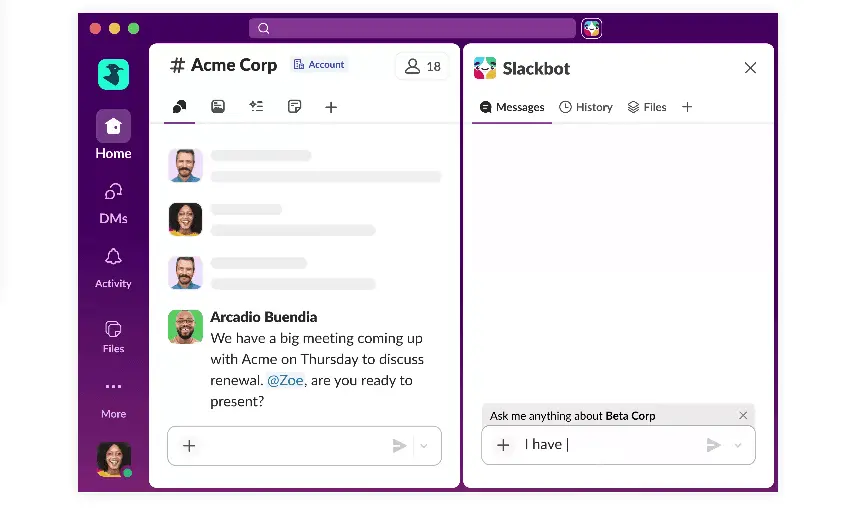
Perhaps the most transformative addition among the new Slack AI features is what Salesforce calls reusable AI-skills—instruction sets that allow users to define specific tasks for Slackbot that can be applied across various scenarios and contexts
1
. Slackbot ships with a built-in library of AI-skills, but organizations can create custom versions tailored to their unique business processes3
.
Source: SiliconANGLE
Once configured, these skills dramatically reduce manual work. A user can trigger a skill with a simple command like "create a budget" for an upcoming event, prompting Slackbot to gather relevant information from company Slack channels and connected apps or data sources to generate an actionable plan
1
. The enterprise work assistant then automatically schedules a meeting to discuss the plan, inviting relevant employees based on their titles3
. Critically, Slackbot can recognize when a user's prompt matches an existing skill and apply it automatically without explicit instruction2
.Model Context Protocol Integration Connects Slackbot to Enterprise Ecosystem
The Slackbot update introduces Model Context Protocol (MCP) client capabilities, enabling the agent to connect with and coordinate external services and tools
1
. This includes Agentforce, Salesforce's AI agent development platform launched in 2024, allowing Slackbot to "route work or prompt questions to Agentforce or any agent or app in your enterprise," with the agent identifying the most efficient path without human intervention1
."We're going all in on MCP for Slackbot," Seaman stated, noting that the integration provides access to more than 2,600 apps in the Slack Marketplace and over 6,000 apps built for the Salesforce AppExchange
2
. This means Slackbot can now create Google Slides, draft Google Docs, and interact with virtually any connected enterprise application2
. The expanded ecosystem access positions Salesforce Slack as a central hub for coordinating work across disparate systems.Transcribing and Summarizing Meetings Across Any Video Platform
Slackbot now captures discussions from meetings on any video provider—not just Slack huddles, but also Zoom, Google Meet, and others—by tapping into users' local audio through the desktop application
2
. If a meeting participant zones out and misses critical details, they can ask Slackbot to produce a recap including action items assigned to them1
.This meeting intelligence capability automatically surfaces decisions and creates detailed lists of who is responsible for what tasks
3
.
Source: VentureBeat
Because Slackbot maintains native connections to Salesforce, it can log actions and update opportunities directly in the CRM without requiring manual data entry
2
. Seaman described Slackbot as "the ultimate teammate" during the media briefing3
.Desktop Monitoring Enables Proactive Suggestions Based on User Context
For the first time, Slackbot operates outside the Slack interface, monitoring desktop activities to understand user context
1
. Salesforce lists "your deals, your conversations, your calendar, and your habits" as data sources the agent draws upon to make proactive suggestions or draft follow-ups for critical tasks1
.Seaman emphasized that privacy protections are built into this design, with users maintaining the ability to adjust permissions and control what Slackbot can access
1
. The addition of voice capabilities—with text-to-speech and speech-to-text now available, and full speech-to-speech functionality under development—further extends how users can interact with the platform2
.Related Stories


Salesforce Slack Embeds Salesforce CRM for Small Business Customer Relationships
In a significant expansion beyond large enterprise use cases, Salesforce revealed it has built a completely new CRM interface inside Slack, powered by its core platform
5
. This allows small businesses without dedicated sales departments to manage customer relationships directly within Slack, where most customer conversations already occur3
.Slackbot's native CRM capabilities enable it to read Slack channels, understand discussions, and automatically update deals, contacts, and call notes for each customer and sales prospect
3
. If a user promises to follow up later, Slackbot logs the commitment and sends reminders. When new contracts are uploaded, they're automatically added to relevant client files3
. Users can access full customer histories and perform associated tasks without leaving the platform."We have built an entirely new native CRM in Slack in conjunction with our teams at Salesforce, so that small businesses that sign up for Slack, as soon as they reach a point in their tenure where it makes sense for them to start managing their customer relationships, can just do that natively in Slack," Seaman explained during the briefing
5
.Anthropic Powers Slackbot as Adoption Accelerates Across Enterprise Users
Slackbot is built on Anthropic's Claude model, with the AI company's leadership appearing alongside Slack executives at the announcement event
2
. The partnership highlights deepening collaboration between the organizations, with Anthropic providing the reasoning layer while Slack handles context engineering—the process of determining which information from channels, files, and messages feeds into the model's context window2
.Seaman revealed that Slack is currently tracking close to a million weekly Slackbot users, with the company claiming more than 80,000 employees use it daily
5
. "We rolled out Slackbot to all Salesforce employees, and we went to 50,000 Salesforce employees using it every single week, week over week, within a matter of weeks," he shared, adding that companies like OpenAI, Anthropic, Amazon, and Rivian are already using the platform to run their operations5
.Marc Benioff noted during his keynote that the five years since Salesforce acquired Slack have delivered "two and a half times revenue growth," with approximately one million businesses now running on the platform
1
. While exact rollout timelines for all capabilities haven't been specified, Seaman indicated the agent will become available to millions of free and pro users soon5
. The update positions Salesforce to compete directly with Microsoft, which has spent two years embedding Copilot across its productivity stack2
.References
Summarized by

Navi
[1]
[2]
[3]
[4]
Related Stories
Recent Highlights


Recent Highlights
Today's Top Stories



Your Daily Dose of Curated AI News
Don’t drown in AI news. We cut through the noise - filtering, ranking and summarizing the most important AI news, breakthroughs and research daily. Spend less time searching for the latest in AI and get straight to action.

