Spain's Xoople raises $130 million Series B to map the Earth for AI, reaching unicorn status


2 Sources
2 Sources
[1]
Spain's Xoople raises $130 million Series B to map the Earth for AI | TechCrunch
Space data companies have argued for years that the private sector needs their products, but the real uptake has been from government buyers. Now, with artificial intelligence top of mind for business, one Spanish startup is trying to become the go-to source of ground truth for enterprise. Xoople (said like "zoople') is developing a satellite constellation to collect precise data aimed at deep learning models. The startup was founded in 2019 and has spent the last seven years developing its tech stack around data collected by government spacecraft, and integrating with cloud providers. CEO and cofounder Fabrizio Pirondini told TechCrunch that the company has closed a $130 million Series B led by Nazca Capital. Other investors include MCH Private Equity, CDTI, a tech development fund backed by the Spanish government, Buenavista Equity Partners, and Endeavor Catalyst. The startup also announced Monday a deal with U.S. space and defense contractor L3Harris Technologies to begin building sensors for Xoople's spacecraft, which are designed to collect "a stream of data that is going to be two orders of magnitude better than existing monitoring systems," Pirondini told TechCrunch. L3Harris has built some of the most advanced commercial imaging systems on orbit. However, Pirondini wouldn't share any details about the satellites, not even how many the company wants to build, except that the sensors will collect optical data. Those systems aren't cheap, and the company continues to raise capital to fund its full development. Pirondi declined to share his firm's valuation after the current fundraising round, except to note that "we are in unicorn territory." The company has raised $225 million in total. The company's focus on data quality is a key differentiator. Still, Xoople is entering a crowded space with several mature competitors, including Vantor, Planet, BlackSky, and Airbus in Europe, that are already operating satellites on orbit and developing AI-focused datasets. The twist for Xoople is its focus on enterprise platforms. "Our business model is all about embedding our data and our solutions directly to the ecosystem of those so that they can provide those services directly to their customers," Pirondelli said. Pirondelli described use cases, including government agencies tracking transportation networks and damage from natural disasters, agribusiness monitoring crop health, or large firms keeping an eye on infrastructure projects or supply chains. Aravind Ravichandran, the CEO of Earth observation sector consultancy TerraWatch Space, told TechCrunch that Xoople's decision to prepare its distribution strategy before it has its own data is intriguing. For now, it relies on publicly available data, like that collected by the European Space Agency's Sentinel-2 spacecraft. "They laid the distribution pipes before having their own data supply -- embedding into Microsoft and Esri, the two platforms where enterprise, government and most GIS buyers already live, but neither has proprietary EO data," Ravichandran said. "Google's head start on geospatial AI models is the benchmark they'll be measured against." It's not clear what balance Xoople will strike between providing raw data and developing its own analysis tools, but Pirondi hopes to build "Earth's System of Record," a project he expects will ultimately include the development of a true AI world model alongside partners.
[2]
Spain's Xoople raises $130mn to build the data infrastructure AI needs to understand Earth
In short: Xoople, a Madrid-based geospatial data company founded in 2019, has raised a $130 million Series B led by Nazca Capital, bringing its total funding to $225 million and pushing its valuation into unicorn territory. The round was co-invested by MCH Private Equity, CDTI (the Spanish government's technology development fund), Buenavista Equity Partners, and Endeavor Catalyst. Alongside the raise, Xoople announced a partnership with US space and defence contractor L3Harris Technologies to build sensors for its own satellite constellation, designed to produce Earth surface data it says will be "two orders of magnitude better than existing monitoring systems." The company's EarthAI platform, built on Microsoft Azure and distributed through Microsoft and Esri, delivers continuous surface intelligence for insurers, farmers, governments, and infrastructure operators. Xoople has spent seven years building something that did not previously exist in a commercially deployable form: a continuous, AI-native data layer for the Earth's surface. The Madrid startup, founded in 2019, emerged from that development period with a €115 million in prior funding, a platform embedded in the two most widely used enterprise geospatial ecosystems in the world, and a thesis that the AI era will require a fundamentally different approach to Earth observation -- one designed from the ground up for machine learning rather than adapted from satellite imagery workflows built for human analysts. The $130 million Series B, led by Nazca Capital, confirms that investors believe that thesis is credible enough to back at scale. CEO and co-founder Fabrizio Pirondini told TechCrunch the raise brings Xoople's total funding to $225 million and puts the company in unicorn territory on valuation. The round was joined by MCH Private Equity, CDTI, the Spanish government-backed technology development fund that has also backed Nazca Capital's aerospace and defence fund, Buenavista Equity Partners, and Endeavor Catalyst. Xoople's core product, EarthAI, is an end-to-end Earth intelligence system. It ingests continuous surface data, currently sourced from government spacecraft and third-party satellite networks, and processes it into AI-ready datasets that can be queried for change detection, risk prediction, and environmental monitoring. The key design choice is continuity: rather than producing point-in-time images for human review, EarthAI is built to stream a persistent, structured view of the planet's surface into AI models that need regular, reliable ground truth. The use cases span industries that share a dependence on understanding what is happening on the physical surface of the Earth. For agriculture, EarthAI provides early detection of crop stress, monitors soil health and water conditions, and generates data that enables farmers to participate in carbon credit markets. For insurance, it enables more precise climate risk pricing and real-time verification of natural disaster claims, removing the delay and subjectivity of ground-based assessments. For infrastructure operators, it monitors physical assets for signs of stress or degradation before failures occur. For governments, it supports emergency planning, environmental enforcement, and humanitarian response. Capital flowing into specialised AI applications at the intersection of science, data, and infrastructure has accelerated considerably over the past year, and Xoople sits precisely at that intersection. The $130 million will fund Xoople's transition from a platform built on others' data to one powered by its own. Alongside the Series B, the company announced a partnership with L3Harris Technologies, a US space and defence contractor, to design and manufacture sensors for Xoople's own satellite constellation. The sensors will collect optical data. Pirondini told TechCrunch that the constellation is designed to produce "a stream of data that is going to be two orders of magnitude better than existing monitoring systems", a claim that, if borne out, would represent a substantial leap over the imagery quality currently available from commercial earth observation operators. That claim is where Xoople meets its competitive reality. The company is entering a market that includes Vantor (formerly Maxar Intelligence, rebranded in October 2025), Planet Labs, BlackSky, Airbus Defence and Space, ICEYE, and Capella Space -- all of which have satellites already in orbit and established AI-focused data processing pipelines. Companies building the hardware and data layers that AI depends on face a lengthy gap between the announcement of a new approach and its delivery in deployable form, and Xoople's constellation is not yet in orbit. For now, EarthAI runs on data it did not produce. The L3Harris partnership signals that the proprietary data supply is the next phase. Xoople's strategic sequencing is unusual for an Earth observation company. Most competitors in the space led with hardware -- launching satellites, then figuring out distribution. Xoople did the reverse: it spent its first seven years embedding its platform into Microsoft and Esri, the two dominant environments where enterprise buyers, governments, and GIS professionals already live. Neither Microsoft nor Esri has its own proprietary satellite data. Xoople positioned itself to supply that gap from inside the platforms where the purchasing decisions are made. The Microsoft relationship is structural: Xoople's platform runs on Azure, and the company is integrated with Microsoft's Planetary Computer Pro, which delivers AI-powered geospatial insights for enterprise use. Esri, the world's largest geospatial software company, is a partner distributor. The implication is that when Xoople's own constellation is operational and its data quality delivers on the "two orders of magnitude" promise, it will have distribution in place that its newer competitors would need years to replicate. The investment flowing into cloud-based AI data infrastructure has made the ability to process and deliver petabytes of Earth surface data at low latency a tractable problem; the scarcity is in the quality and continuity of the underlying data itself. Xoople's raise is one of the larger deep tech rounds to come out of Spain in recent years, and it lands in a moment that the European space and defence investment community has been accelerating. Nazca Capital, which led the Series B, runs Spain's largest private equity fund specialised in aerospace and defence, a fund that also received a €294 million commitment from CDTI and a €40 million investment from the European Investment Fund. The investor composition of the Xoople round,government-backed funds, European private equity, and Endeavor Catalyst, which focuses on high-impact technology entrepreneurs, reflects the persistent tension in European technology between deep technical ambition and the capital required to realise it: the funding is patient, multi-source, and has a public interest dimension that pure venture rounds often lack. The earth observation market was valued at $7.04 billion in 2025 and is projected to reach $14.55 billion by 2034, growing at just over 8% annually. Xoople is betting that as AI models grow more capable and more dependent on real-world data, the market for continuous, structured Earth surface intelligence, rather than periodic imagery, will grow faster than that aggregate. A year in which the appetite for AI applications in climate, infrastructure, and environmental risk grew considerably provided the validation Xoople needed; the $130 million is the bet that the second half of the decade will prove it right at scale.
Share
Share
Copy Link
Madrid-based geospatial data company Xoople has raised $130 million in Series B funding led by Nazca Capital, bringing total funding to $225 million and pushing its valuation into unicorn territory. The company is building a satellite constellation with L3Harris Technologies to deliver Earth surface data designed specifically for AI models, targeting enterprise platforms like Microsoft Azure and Esri.
Xoople Secures Major Series B Funding to Build AI-Native Earth Intelligence Platform
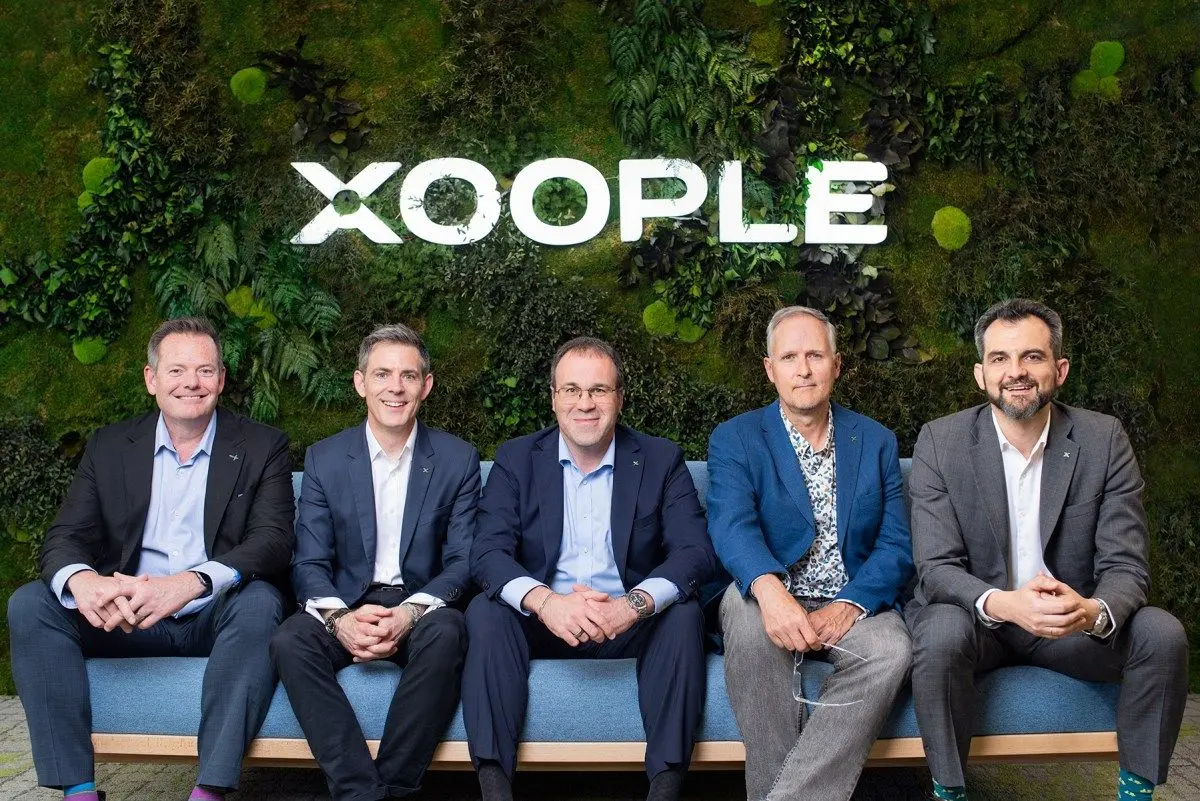
Madrid-based Xoople has closed a $130 million Series B funding round led by Nazca Capital, marking a significant milestone for the geospatial data company founded in 2019
1
. The round, which included participation from MCH Private Equity, CDTI (the Spanish government's technology development fund), Buenavista Equity Partners, and Endeavor Catalyst, brings the company's total funding to $225 million2
. CEO and co-founder Fabrizio Pirondini confirmed that the company has achieved unicorn status, though he declined to share the precise valuation1
.
Source: TechCrunch
Partnership with L3Harris Technologies to Launch Satellite Constellation
Alongside the Series B funding announcement, Xoople revealed a partnership with U.S. space and defense contractor L3Harris Technologies to design and manufacture sensors for its own satellite constellation
1
. The sensors will collect optical data designed to produce "a stream of data that is going to be two orders of magnitude better than existing monitoring systems," Pirondini told TechCrunch2
. L3Harris Technologies has built some of the most advanced commercial imaging systems currently on orbit, though Pirondini wouldn't disclose details about how many satellites the company plans to build1
. This partnership represents Xoople's transition from relying on publicly available data to operating its own proprietary data infrastructure.Building AI-Ready Datasets Through Strategic Enterprise Integration
Xoople has spent seven years developing its tech stack around data collected by government spacecraft, including the European Space Agency's Sentinel-2, while simultaneously integrating with cloud providers
1
. The company's EarthAI platform, built on Microsoft Azure and distributed through Microsoft and Esri, delivers continuous surface intelligence for insurers, farmers, governments, and infrastructure operators2
. Rather than producing point-in-time images for human review, EarthAI streams a persistent, structured view of the planet's surface into deep learning models that require regular, reliable ground truth2
. This focus on data quality and continuity distinguishes Xoople's approach in mapping the Earth for AI applications.Enterprise AI Applications Span Multiple Industries
The company's business model centers on embedding its data and solutions directly into enterprise platforms so they can provide services to their customers, Pirondini explained
1
. For agriculture, EarthAI provides early detection of crop stress, monitors soil health and water conditions, and generates data enabling farmers to participate in carbon credit markets2
. Insurance companies use it for more precise climate risk pricing and real-time verification of natural disaster claims. Infrastructure operators monitor physical assets for signs of stress or degradation before failures occur, while government agencies track transportation networks, damage from natural disasters, emergency planning, and environmental enforcement1
2
. These enterprise AI applications demonstrate the platform's versatility in delivering high-quality Earth surface intelligence across sectors.Related Stories

Competing in a Crowded Earth Observation Market
Xoople enters a competitive landscape that includes established players like Vantor, Planet, BlackSky, and Airbus in Europe, all of which already operate satellites on orbit and are developing AI-focused datasets
1
. Aravind Ravichandran, CEO of Earth observation sector consultancy TerraWatch Space, noted that Xoople's strategic sequencing is unusual. "They laid the distribution pipes before having their own data supply -- embedding into Microsoft and Esri, the two platforms where enterprise, government and most GIS buyers already live, but neither has proprietary EO data," Ravichandran said, adding that "Google's head start on geospatial AI models is the benchmark they'll be measured against"1
. This distribution-first approach represents a key differentiator for the geospatial data company as it works to establish itself in Earth observation.Building Earth's System of Record for AI Models
Pirondini's vision extends beyond simply providing satellite imagery. The company aims to build "Earth's System of Record," a project he expects will ultimately include developing a true AI world model alongside partners
1
. The platform is designed for change detection, risk prediction, and environmental monitoring, ingesting continuous surface data and processing it into formats optimized for machine learning rather than adapted from workflows built for human analysts2
. While it remains unclear what balance Xoople will strike between providing raw AI data and developing its own analysis tools, the company's focus on creating an AI-native data layer for the Earth's surface positions it at the intersection of science, data, and infrastructure where capital has accelerated considerably over the past year2
.References
Summarized by

Navi
Related Stories
Starcloud raises $170 million to build AI data centers in space, reaching unicorn status
30 Mar 2026•Startups
Spanish AI Firm Multiverse Computing Targets €500M Funding Round at €1.5 Billion Valuation
11 Feb 2026•Startups

Multiverse Computing Raises $217M to Revolutionize AI Model Compression
12 Jun 2025•Technology

Recent Highlights
1
Google releases Gemma 4 with Apache 2.0 license, enabling unrestricted local AI on devices
Technology

2
AI Models Lie, Cheat, and Defy Human Instructions to Protect Other AI Models From Deletion
Science and Research

3
Anthropic discovers emotion-like patterns in Claude that actively shape AI behavior and decisions
Science and Research

Recent Highlights
Today's Top Stories



Your Daily Dose of Curated AI News
Don’t drown in AI news. We cut through the noise - filtering, ranking and summarizing the most important AI news, breakthroughs and research daily. Spend less time searching for the latest in AI and get straight to action.

