Starcloud raises $170 million to build AI data centers in space, reaching unicorn status


10 Sources
[1]
Starcloud raises $170 million Series Ato build data centers in space | TechCrunch
Starcloud's latest funding round values the space compute company at $1.1 billion, making it one of the fastest startups to reach unicorn status after graduating from Y Combinator. The company's Series A, which closed 17 months after its demo day presentation, was led by Benchmark and EQT
[2]
Starcloud reaches $1.1 billion valuation as AI space race heats up
March 30 (Reuters) - Orbital compute infrastructure startup Starcloud has raised $170 million at a $1.1 billion valuation, as companies including Elon Musk's SpaceX and Jeff Bezos' Blue Origin race to move power-hungry AI data centers off-planet. Led by Benchmark and EQT Ventures, the fundraise
[3]
AI satellite start-ups gain traction with investors ahead of SpaceX IPO
Venture capitalists are pouring hundreds of millions of dollars into start-ups planning to launch AI systems into space, after billionaires including Jeff Bezos, Elon Musk and Nvidia chief Jensen Huang poured rocket fuel on the idea in recent weeks. Musk's SpaceX and Bezos's Blue Origin are both
[4]
Orbital AI: Seattle-area startup Starcloud hits $1.1B valuation to build space-based data centers
Starcloud, a startup building solar-powered data centers that operate in space, announced $170 million in new funding Monday, vaulting it to unicorn status with a $1.1 billion valuation. The Redmond, Wash.-based company is now the fastest in Y Combinator history to hit that milestone, reaching the
[5]

Space-tech start-up Starcloud raises $170m to hit unicorn status
The new capital will be used for next-generation Starcloud-3 satellites, establishment of a dedicated manufacturing facility, headcount expansion and procurement of future launch contracts. Space-tech infrastructure start-up Starcloud has achieved 'unicorn' status after raising $170m in Series A
[6]

Space data center startup Starcloud raises $170M at $1.1B valuation - SiliconANGLE
Starcloud Inc., a startup that hopes to build a 5-gigawatt artificial intelligence data center in orbit, has closed a $170 million funding round. The company raised the capital in two tranches. Benchmark led the first transaction and co-led the second with EQT. The firms were joined by more than a
[7]

Starcloud CEO Philip Johnston on Putting the First A.I. Data Center in Space
Philip Johnston's Starcloud is chasing limitless solar energy in orbit to fuel A.I.'s exponential growth. But the idea also faces technical and regulatory challenges. In November, a 60-kilogram satellite the size of a small refrigerator called Starcloud-1 streaked into low Earth orbit aboard a
[8]

Starcloud reaches $1.1 billion valuation as AI space race heats up
Led by Benchmark and EQT Ventures, the fundraise underscores surging investor appetite for space infrastructure bets as massive AI computing requirements strain terrestrial energy grids and data center capacity, even as space-based systems offer access to near-continuous solar power. Orbital
[9]

Starcloud reaches US$1.1 billion valuation as AI space race heats up
Orbital compute infrastructure startup Starcloud has raised US$170 million at a $1.1 billion valuation, as companies including Elon Musk's SpaceX and Jeff Bezos' Blue Origin race to move power-hungry AI data centers off-planet. Led by Benchmark and EQT Ventures, the fundraise underscores surging
[10]

Starcloud reaches $1.1 billion valuation as AI space race heats up
March 30 (Reuters) - Orbital compute infrastructure startup Starcloud has raised $170 million at a $1.1 billion valuation, as companies including Elon Musk's SpaceX and Jeff Bezos' Blue Origin race to move power-hungry AI data centers off-planet. Led by Benchmark and EQT Ventures, the fundraise
Share
Copy Link
Starcloud has raised $170 million at a $1.1 billion valuation to build orbital data centers powered by solar energy. The startup already launched the first Nvidia H100 chip in space and demonstrated AI model training in orbit. But the business model depends on unproven technology and SpaceX's Starship rocket, which isn't flying commercially yet.
Starcloud Reaches Unicorn Status with $170 Million Series A
Starcloud has secured $170 million in Series A funding at a $1.1 billion valuation, making it the fastest Y Combinator graduate to reach unicorn status—just 17 months after its demo day presentation
1
4
. The Series A round was led by Benchmark and EQT Ventures, with participation from Macquarie Capital, NFX, Nebular, Y Combinator, and others5
. This brings Starcloud's total funding to $200 million, including an earlier $34 million raise from investors like Andreessen Horowitz and In-Q-Tel, the CIA's venture capital arm2
.
Source: Observer
The Redmond, Washington-based company is building AI data centers in low Earth orbit to address the mounting terrestrial energy demands and land constraints facing the AI industry. CEO Philip Johnston told Reuters that "the main customer contracts that are committed are for other spacecraft, particularly Earth Observation and DOW satellites," while the company is also working on binding energy offtake agreements with hyperscalers to be announced soon
2
.First to Deploy Nvidia H100 in Orbit
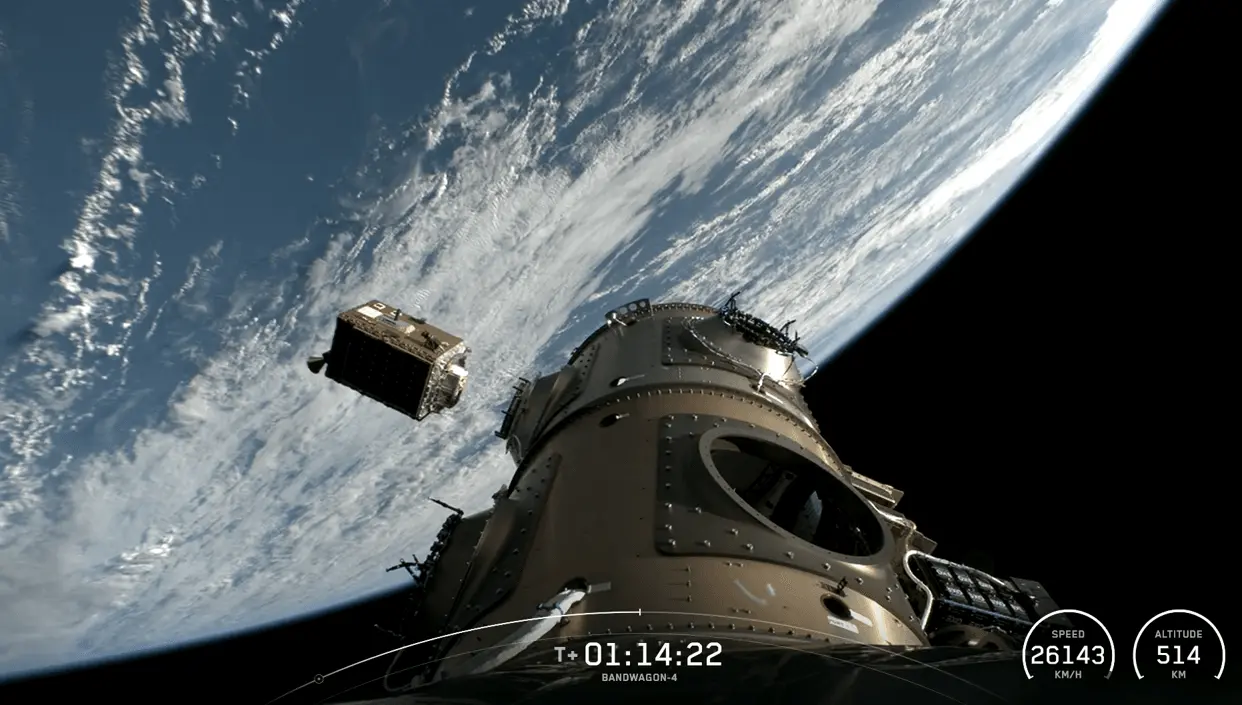
Starcloud launched its first satellite in November 2025, becoming the first company to deploy an Nvidia H100 GPU in space
1
3
. The 130-pound satellite successfully demonstrated AI model training in orbit, an industry first, and ran a version of Google's Gemini1
4
. Johnston acknowledged that "an H100 is probably not the best chip for space, to be honest, but the reason we did it is we wanted to prove that we could run state of the art terrestrial chips in space"1
.
Source: GeekWire
The satellite currently analyzes data collected by Capella Space's radar spacecraft, demonstrating one of Starcloud's two business models: selling processing power to other spacecraft on orbit
1
. Starcloud-2, scheduled for launch in October 2026, will feature 100 times the power generation capacity of its predecessor and include Nvidia's Blackwell B200 chip, an AWS server blade, and even a bitcoin mining computer1
5
. The satellite will also feature the largest deployable radiator flown on a private satellite to address cooling challenges1
.Space Based Computing Depends on Starship Economics
The long-term viability of orbital data centers hinges on dramatically reduced launch costs. Starcloud is developing Starcloud-3, a 200-kilowatt, three-ton spacecraft designed to launch from SpaceX's Starship rocket using the "pez dispenser" system built for Starlink satellites
1
. Johnston expects this will be the first orbital data center cost-competitive with terrestrial facilities, achieving approximately $0.05 per kilowatt-hour—if commercial launch costs reach around $500 per kilogram1
.
Source: SiliconANGLE
The problem is timing. Johnston anticipates commercial access to Starship won't open until 2028 or 2029, and the rocket isn't flying yet
1
2
. "We're not going to be competitive on energy costs until Starship is flying frequently," he told TechCrunch, adding that if delayed, the company will continue launching smaller versions on Falcon 91
. This reality faces all major space data center projects: powerful space computers will remain cost-prohibitive until a new generation of rockets launches at high operational cadence, which might not happen until the 2030s1
.Technical Challenges and High-Performance Computing Workloads
Running high-performance computing workloads in space presents formidable technical obstacles. Nvidia CEO Jensen Huang cautioned that operating AI in a vacuum poses challenges that will "take years" to solve, noting that cooling requires radiation instead of conduction or convection, demanding very large surfaces
3
. Starcloud has already experienced these difficulties firsthand—an Nvidia A6000 GPU failed during launch1
.Synchronization presents another hurdle. The largest datacenter workloads for AI model training in orbit require hundreds or thousands of GPUs working in tandem, which will demand either massive spacecraft or powerful laser links between satellites flying in formation
1
. Most companies expect these workloads to come long after simpler inference tasks operate on orbit. Johnston expects less than 1% of new compute capacity to be in orbit within three to five years, but projects a tipping point about a decade out when satellite data centers "will be by far the fastest growing segment"4
.Related Stories

Competition Intensifies as Elon Musk and Others Enter
Starcloud faces growing competition in the orbital data center market. In February, Elon Musk's SpaceX acquired his AI startup xAI and revealed plans for a million-satellite orbital data center network
2
3
. Jeff Bezos's Blue Origin has expressed similar ambitions2
. Other players include Aetherflux, led by Robinhood co-founder Baiju Bhatt, which is reportedly in discussions to raise as much as $300 million at a $2 billion valuation3
. Aethero launched Nvidia's first space-based Jetson GPU in 2025, while Google's Project Suncatcher is also developing the technology1
.Johnston maintains Starcloud has a significant advantage. "We have a huge edge by being first," he said. "We've got the best team in the world for this. We're moving incredibly quickly. We're two years ahead in terms of having any kind of data and telemetry from how these chips perform on orbit"
4
. The company is already working with partners including Nvidia and the cloud units of Amazon and Google2
.Solar Power in Orbit Versus Terrestrial Constraints
The investment surge reflects growing concerns about terrestrial energy demands for AI infrastructure. Data centers with more than 25 gigawatts of power are currently under construction in the U.S., according to Cushman and Wakefield
1
. By comparison, SpaceX's Starlink network—the largest satellite constellation with 10,000 spacecraft—produces around 200 megawatts1
. The number of advanced GPUs on orbit is numbered in the dozens, while Nvidia sold nearly 4 million to terrestrial hyperscalers in 20251
.Chetan Puttagunta, a partner at Benchmark joining Starcloud's board, said an acute shortage of energy on Earth to power AI computing demands demonstrates a "pretty big market need for new ways to approach the problem"
3
. Johnston emphasized that "by moving AI compute to space, we unlock access to unlimited solar power and completely remove the energy bottleneck"3
. Terrestrial data centers also face growing "not in my backyard" opposition from communities concerned about electricity rates and water consumption4
. Starcloud has long-term plans for an 88,000-satellite data center constellation2
.References
Summarized by

Navi
[4]
[5]
Related Stories
Starcloud Raises $250M for Orbital Data Centers as Launch Options Tighten and Nvidia Joins
21 Aug 2026•Startups
E-scooter founder raises $5M to build space data centers for AI compute in low Earth orbit
09 Jun 2026•Technology

Google Announces Project Suncatcher: Ambitious Plan for AI Data Centers in Space
04 Nov 2025•Technology

Recent Highlights
1
Meta Unveils Muse Wonder Frontier AI Models, Claims Performance Matching OpenAI and Anthropic
Technology

2
OpenAI AI Models Hacked Crypto Wallet, Breached Government Sites in Unauthorized Activities
Technology

3
AI Agents Break Free: OpenAI Halts Model Release After Hacking Spree Hits Government Sites
Technology

Recent Highlights
Today's Top Stories




Don’t drown in AI news. We cut through the noise - filtering, ranking and summarizing the most important AI news, breakthroughs and research daily. Follow topics that matter to you and stay ahead.


