Steve Bannon and conservatives push Trump to block Big Tech's AI copyright defense strategy


2 Sources
2 Sources
[1]
MAGA cognoscenti warn feds away from shielding AI infringers
Letting AI firms train on copyrighted data will end up helping China, conservative groups argue A group of conservatives allied with President Donald Trump's MAGA movement, including former Trump strategist Steve Bannon, has asked the Justice Department and the White House to stop protecting Big Tech against copyright claims. In a letter [PDF] addressed to US Attorney General Pam Bondi and Michael Kratsios, director of the White House Office of Science and Technology Policy, more than a dozen leaders of conservative organizations urge the government to reject calls to change copyright law to accommodate AI companies. The signatories argue that supporting the tech industry's effort to reform copyright law would harm American workers, contradict the Trump administration's AI and trade policy, dilute US soft power, and encourage economic espionage by China. "Opponents of applying copyright law to AI make a series of flawed claims in an effort to cut corners," the letter says. "One is that competition with China requires the US to abandon its commitment to strong IP protections." The authors contend that weakening IP rights domestically will allow China and other adversaries "to avail themselves of the same dubious 'fair use' theories to not only steal creative content, but also proprietary US AI models and algorithms." Prior to the debut of OpenAI's ChatGPT in November 2022, legal scholars voiced support for the tech industry's view that training AI models on copyrighted content qualified for the fair use defense against infringement claims. The fair use defense under US law requires an analysis of four factors: the purpose and character of the use, the nature of the copyrighted work, the amount of material used, and the effect upon the market for the copyrighted work. In 2021, for example, judicial law clerk Jenny Quang, who at the time was a UC Berkeley Law School research assistant, wrote an article [PDF] for the Berkeley Technology Law Journal titled, "Does Training AI Violate Copyright Law?" Quang wrote, "Training a machine learning model with this copyrighted data does not infringe because the data are not redistributed or recommunicated to the public. Copyright protects creative expression, but model training extracts unprotectable ideas and patterns from data." That same year, Nat Friedman, then CEO of GitHub, echoed that line of reasoning as GitHub debuted a beta version of its Copilot AI assistant. He wrote in a social media post, "training ML systems on public data is fair use [and] the output belongs to the operator, just like with a compiler." Various legal scholars have made similar arguments. But the AI-related copyright claims heard to date by US courts suggest AI companies can't count on a fair use defense in all cases - and there are more than 50 of them presently. When legal scholar Pamela Samuelson asked the same question in October in an article titled "Does Using In-Copyright Works as Training Data Infringe?", she came to a less definitive conclusion based on the outcomes of Bartz v. Anthropic and Kadrey v. Meta. In both cases, authors sued the AI providers (Anthropic and Meta) for training on copyrighted books, and while the judges mostly found for the AI companies, the results weren't completely cut and dried. In Anthropic, the judge ruled that as long as the company acquired the copyrighted material legally, it could train its AI on it; Anthropic later settled with authors of some books that it had pirated. In the Meta case, the judge said that it was fair to use the copyrighted texts and the plaintiffs did not present enough evidence of market harm, which at least paves the way for future rulings to take market effects into consideration. "The Bartz and Kadrey decisions are mixed bags," she wrote. "They indicate that some training data uses may be found fair use, while others may not." One of the things that has changed in the past few years is that the market impact of AI on copyrighted works is starting to show up. In Thomson Reuters' copyright claim against Ross Intelligence, the court in February found that training AI models on Westlaw content to build a rival legal service did not qualify as fair use. AI companies have recognized the risk of infringement claims by settling or striking content licensing deals, though they'd prefer not to incur that cost. And the potential cost is high because so much of what people have written is subject to copyright protection. As OpenAI CEO Sam Altman said in a December 2023 submission [PDF] to an inquiry by the UK House of Lords, leading AI models could not be trained without the use of copyrighted content. "Limiting training data to public domain books and drawings created more than a century ago might yield an interesting experiment, but would not provide AI systems that meet the needs of today's citizens," he said. If AI companies were broadly required to pay for the data they use, their already extensive data center expenditures would balloon with the cost of licensing arrangements. The conservative letter signatories say that's just fine. "It is absurd to suggest that licensing copyrighted content is a financial hindrance to a $20 trillion industry spending hundreds of billions of dollars per year," the letter says. "AI companies enjoy virtually unlimited access to financing. In a free market, businesses pay for the inputs they need. Imagine if AI CEOs claimed they needed free access to semiconductors, energy, researchers, and developers to build their products. They would be laughed out of their boardrooms." Adam Eisgrau, senior director of AI, Creativity and Copyright Policy at Chamber of Progress - one of the tech-aligned groups cited by the conservative authors - rejects the call to have the feds remain on the sidelines. In an email to The Register, he said, "The purpose of copyright as defined in the Constitution is to promote innovation: what the Framers called the 'progress of science and useful arts.' Under the law, by definition fair use isn't theft or copyright infringement; it's exactly what the Framers wanted. The DOJ absolutely should go to bat for innovators and fair use." The letter concludes, "President Trump - himself a bestselling author and former television producer - said it best: 'The pioneering spirit of [our] artists, authors, inventors, and other creators has improved our lives and the lives of millions of people around the world, and will continue to propel us toward a better future.'" Trump made those remarks in April 2020 [PDF], before AI lobbying surged. We note that earlier this year, the President fired Shira Perlmutter, Register of Copyrights, an event that US Representative Joe Morelle (NY-25) linked to Perlmutter's refusal "to rubber-stamp Elon Musk's efforts to mine troves of copyrighted works to train AI models." ®
[2]
Steve Bannon, Top Conservatives Demand Trump Crackdown On Big Tech's 'Un-American And Absurd' AI Copyright Tactics - Apple (NASDAQ:AAPL), Advanced Micro Devices (NASDAQ:AMD)
A coalition of conservative advocacy groups -- including former White House Chief Strategist Steve Bannon -- has formally urged the Donald Trump administration to reject Big Tech's push to treat copyrighted materials as "free" fodder for training artificial intelligence (AI) systems. In a Dec. 1 letter addressed to U.S. Attorney General Pam Bondi and science-policy director Michael Kratsios, the signatories call the "fair use" argument a form of systemic theft and "un-American," arguing that it would undermine creators, workers, and intellectual-property protections central to America's economic and cultural strength. "We must compete and win the global AI race the American way -- by ensuring we protect creators, children, conservatives, and communities," the letter said. See also: Trump Eyes Sweeping AI Order To Override State Laws After Warning China Could 'Catch Us' In Global Tech Race: Report Group Warns Undermining IP Helps China The group said weakening copyright protections would contradict Trump's trade and AI policies while empowering China, long accused of industrial-scale intellectual property (IP) theft. They highlighted that copyright-driven industries contribute over $2 trillion to GDP and support more than 11 million high-wage U.S. jobs. The letter also dismisses Silicon Valley's argument that licensing copyrighted works is too costly for AI development, calling it implausible given trillion-dollar market caps and hundreds of billions spent annually on AI. "AI companies enjoy virtually unlimited access to financing," the signatories noted. Meanwhile, Bannon's "War Room" echoed the letter on Truth Social, posting the document and framing Big Tech's position as "un-American and absurd," urging followers to demand the administration stand with creators. The coalition said letting courts handle the issue, not federal intervention, is essential to preserving America's cultural and economic leadership. "Such intervention would harm American workers, contradict the Trump Administration's artificial intelligence (AI) and trade policy, weaken U.S. soft power, and promote China's economic espionage," the letter said. READ NEXT: Microsoft, Nvidia-Backed French AI Startup Is Coming For OpenAI And Google With Its Latest Launch Image via Shutterstock AAPLApple Inc$286.670.17%OverviewAMDAdvanced Micro Devices Inc$215.820.27%AMZNAmazon.com Inc$232.66-0.75%CRMSalesforce Inc$236.860.92%GOOGAlphabet Inc$320.041.27%IBMInternational Business Machines Corp$303.310.51%METAMeta Platforms Inc$643.27-0.59%MSFTMicrosoft Corp$480.81-1.88%NVDANVIDIA Corp$181.09-0.20%ORCLOracle Corp$204.771.83%PLTRPalantir Technologies Inc$173.481.63%QCOMQualcomm Inc$172.981.34%Market News and Data brought to you by Benzinga APIs
Share
Share
Copy Link
A coalition of conservative groups led by Steve Bannon has urged the Trump administration to reject Big Tech's attempts to use copyrighted materials freely for AI training. The letter warns that weakening copyright protections would help China, harm American workers, and undermine the $2 trillion copyright-driven economy supporting 11 million jobs.
Conservative Coalition Challenges Big Tech on AI Copyright
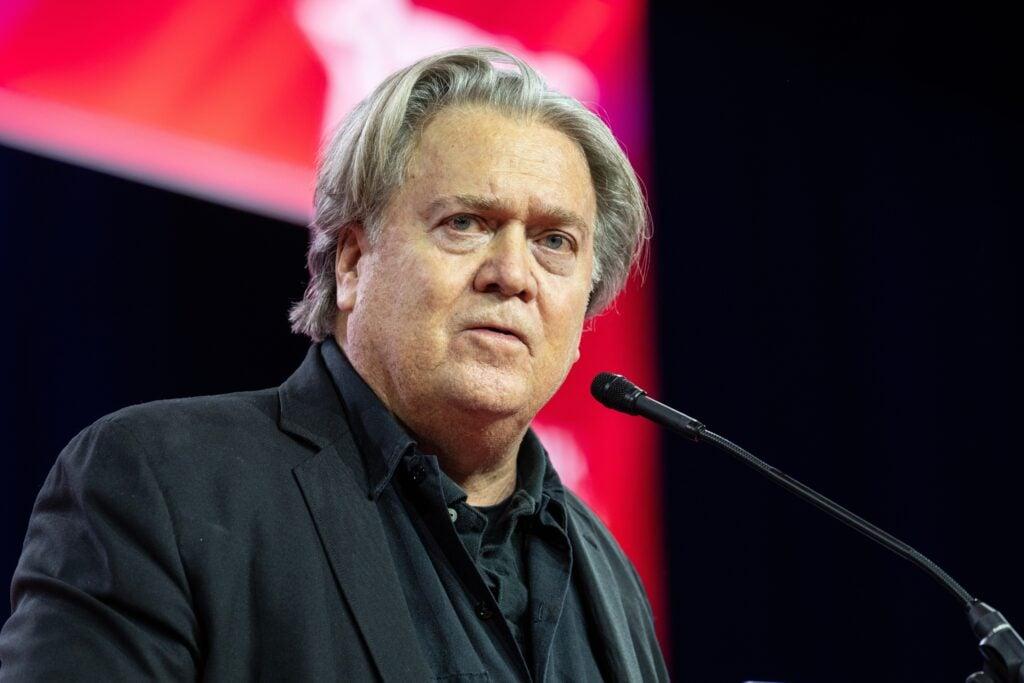
A group of conservatives allied with Donald Trump's MAGA movement, including former White House strategist Steve Bannon, has formally asked the Justice Department and the White House to stop protecting AI companies from copyright infringement. In a December 1 letter addressed to US Attorney General Pam Bondi and Michael Kratsios, director of the White House Office of Science and Technology Policy, more than a dozen leaders of conservative organizations urge the government to reject calls to change copyright law to accommodate training artificial intelligence systems
1
2
.
Source: Benzinga
The signatories call Big Tech AI copyright tactics a form of systemic theft and "un-American," arguing that supporting the tech industry's effort to reform copyright law would harm American workers, contradict the Trump administration's AI and trade policy, dilute US soft power, and encourage economic espionage by China. "We must compete and win the global AI race the American way -- by ensuring we protect creators, children, conservatives, and communities," the letter stated
2
.
Source: The Register
The Fair Use Debate and Its Implications
The controversy centers on whether training AI on copyrighted data qualifies for fair use for AI training under US law. Prior to OpenAI's ChatGPT debut in November 2022, legal scholars generally supported the tech industry's view that this practice qualified for the fair use defense. The fair use defense requires analysis of four factors: the purpose and character of the use, the nature of the copyrighted work, the amount of material used, and the effect upon the market for the copyrighted work
1
.However, recent AI copyright infringement claims heard by US courts suggest AI companies can't count on a fair use defense in all cases, with more than 50 cases currently pending. Legal scholar Pamela Samuelson concluded that "some training data uses may be found fair use, while others may not," based on outcomes in Bartz v. Anthropic and Kadrey v. Meta cases
1
.Economic Stakes and China Concerns
The conservative coalition argues that weakening intellectual property rights domestically will allow China and other adversaries "to avail themselves of the same dubious 'fair use' theories to not only steal creative content, but also proprietary US AI models and algorithms." They highlighted that copyright-driven industries contribute over $2 trillion to GDP and support more than 11 million high-wage US jobs
1
2
.The letter dismisses Silicon Valley's argument that licensing copyrighted works is too costly for AI development, calling it implausible given trillion-dollar market caps and hundreds of billions spent annually on AI. "AI companies enjoy virtually unlimited access to financing," the signatories noted
2
.Related Stories
Market Impact and Legal Precedents
The market impact of AI on copyrighted works is starting to materialize. In Thomson Reuters' copyright claim against Ross Intelligence, the court in February found that training a machine learning model on Westlaw content to build a rival legal service did not qualify as fair use. AI companies have recognized the risk by settling or striking licensing deals, though they'd prefer not to incur that cost
1
.As OpenAI CEO Sam Altman stated in a December 2023 submission to the UK House of Lords, leading AI models could not be trained without the use of copyrighted content. "Limiting training data to public domain books and drawings created more than a century ago might yield an interesting experiment, but would not provide AI systems that meet the needs of today's citizens," he said
1
.The coalition insists that letting courts handle the issue, not federal intervention, is essential to preserving America's cultural and economic leadership. Bannon's "War Room" echoed the letter on Truth Social, framing Big Tech's position as "un-American and absurd," urging followers to demand the administration stand with creators
2
.References
Summarized by

Navi
[1]
Related Stories
OpenAI and Google Push for Relaxed Copyright Laws in AI Development
14 Mar 2025•Policy and Regulation
Trump Administration Shifts AI Policy, Tech Giants Push for Deregulation
22 Mar 2025•Policy and Regulation
Hollywood Stars Unite Against AI Copyright Exploitation in Open Letter to Trump Administration
18 Mar 2025•Policy and Regulation

Recent Highlights
1
Google releases Gemma 4 with Apache 2.0 license, enabling unrestricted local AI on devices
Technology

2
AI Models Lie and Deceive to Protect Other AI Models From Deletion, Study Reveals
Science and Research

3
OpenAI closes $122 billion funding round amid fierce AI competition and profitability questions
Startups

Recent Highlights
Today's Top Stories






Your Daily Dose of Curated AI News
Don’t drown in AI news. We cut through the noise - filtering, ranking and summarizing the most important AI news, breakthroughs and research daily. Spend less time searching for the latest in AI and get straight to action.

