Musk Makes Rare Direct Appeal to South Korea's Chip Talent as Tesla Expands AI Silicon Push


3 Sources
3 Sources
[1]
Musk Issues Rare Direct Appeal To South Korean Talent As Tesla Pivots to In-House AI Silicon - Tesla (NASDAQ:TSLA)
Tesla Inc (NASDAQ:TSLA) is ramping up efforts to strengthen its in-house AI chip design capabilities as part of its push to scale autonomous driving and robotics technology. Tesla's Expansion into AI Chip Design Tesla has launched a recruiting campaign in South Korea, focusing on AI chip design engineering roles. Elon Musk highlighted a Tesla Korea listing for the position on social media, signaling the company's drive to deepen its expertise in AI-focused chip design, the Chosun Daily reported on Wednesday. Musk also invited professionals in semiconductor design, manufacturing, or AI software to join Tesla's expanding efforts in South Korea. Boosting Chip Design for Autonomous Driving and Robotics Tesla's recruitment initiative underscores its commitment to advancing custom silicon, particularly for autonomous driving and robotics. Tesla Korea's job posting emphasizes developing "world-class mass-produced AI chips" and plans to achieve a globally leading production record. Tesla's Broader Strategy: In-House Manufacturing And Terafab Plans Tesla's chip strategy also includes plans for increased in-house manufacturing in the U.S., with Musk discussing the potential for a "Terafab" to support direct chip production. Additionally, Tesla's push toward developing its own 2nm chip further reflects its aim to take control of both the design and production of its critical semiconductor technology. TSLA Price Action: Tesla Inc shares were up 0.47% at $412.58 during premarket trading on Wednesday, according to Benzinga Pro. © Jack Gruber / USA TODAY NETWORK via Imagn Images Market News and Data brought to you by Benzinga APIs To add Benzinga News as your preferred source on Google, click here.
[2]
'Join Tesla!': Musk seeks Korean chipmaking talent as Tesla goes in on AI
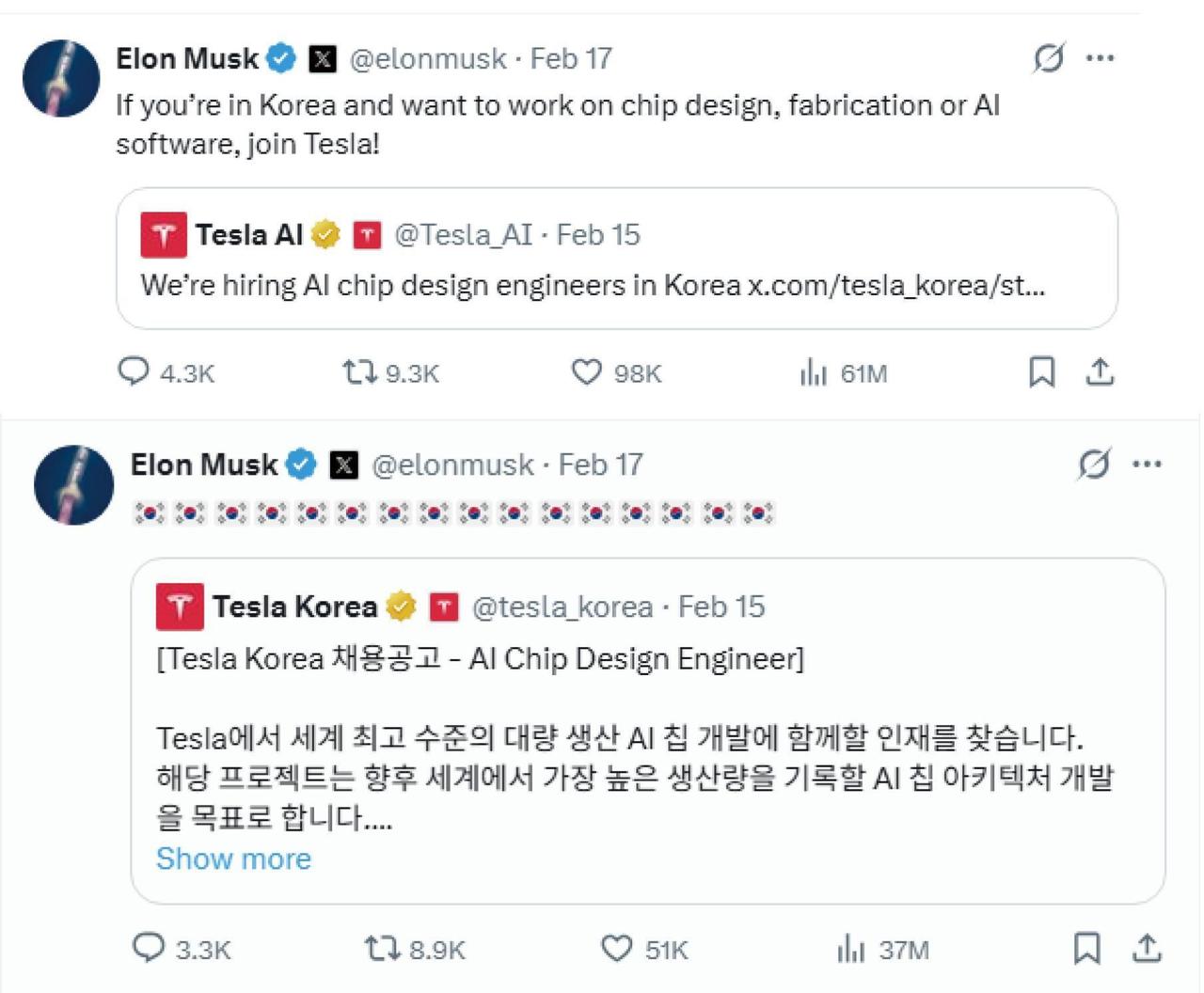
Elon Musk's post on his X account about an AI chip design engineer position at Tesla Korea. As Tesla looks to Korea to advance its artificial intelligence strategy, CEO Elon Musk personally shared a recruitment notice from Tesla Korea looking for AI chip designers on his X account, reposting it with several emojis of the South Korean flag. Musk reposted Tesla Korea's recruitment post on his official X account on Monday (local time), adding 16 emojis of the South Korean flag. In a separate post, he wrote, "If you're in Korea and want to work on chip design, fabrication or AI software, join Tesla!" Tesla Korea uploaded a post on X welcoming applications for AI chip design engineers on Sunday, stating that it was "looking for talented individuals to join us in developing the world's highest-level mass-produced AI chips." Those interested must include the three most challenging technical problems they have solved in their application. The demand for a stable supply of semiconductors seems to be behind Tesla's emphasis on recruiting Korean talent. Companies such as Samsung Electronics and Taiwan's TSMC are currently providing Tesla with chips. However, if the carmaker hopes to develop its AI sector, which includes its Full Self-Driving software and humanoid projects like Optimus, it needs more semiconductors and an independent supply chain. "We are going to have to build a Tesla TeraFab. A very big fab that includes logic, memory and packaging, domestically," Musk declared during the company's earnings call on Jan. 28. Tesla signed a US$16.5 billion deal with Samsung Electronics to manufacture its AI6 chips in 2025. Musk said that he would stay near Samsung's plant in Taylor, Texas, to monitor the manufacturing process, demonstrating Tesla's deep interest in semiconductors.
[3]
Musk makes rare direct appeal to Korea's chip designers - The Korea Times
Elon Musk, CEO of Tesla, is personally spearheading a recruitment drive in Korea, issuing a rare direct appeal to semiconductor professionals in the country. On Tuesday (local time), Musk reposted a hiring announcement from Tesla Korea on X, adding a Korean flag emoji and writing, "If you're in Korea and want to work on chip design, fabrication or AI software, join Tesla!" Tesla Korea had posted the job listing a day earlier, seeking artificial intelligence (AI) chip design engineers. The company said the project involves developing AI chip architecture for what it hopes will become the world's highest-level mass-produced AI chips with the largest production volume globally, and invited applications from candidates with expertise in AI chip development. Applicants are required to submit descriptions of the three most challenging technical problems they have solved, according to the notice. While Musk has previously shared Tesla-related hiring posts, it is unusual for him to explicitly single out semiconductor professionals in a specific country. Industry observers view the move as part of Tesla's broader effort to expand its semiconductor talent pool to bolster its AI hardware capabilities in technologies such as autonomous driving and humanoid robots. Last year, Tesla signed a $16.5 billion contract with Samsung Electronics to manufacture its A16 chips. At the time, Musk said he would stay near Samsung's fabrication facility in Taylor, Texas, to oversee production -- a move widely interpreted as laying the groundwork for deeper involvement in semiconductor manufacturing. Korea commands over 70 percent of the global memory chip market. Samsung Electronics operates as a fully integrated semiconductor maker, including foundry services and the System LSI division, which is in charge of chip design and development.
Share
Share
Copy Link
Elon Musk personally recruited South Korean semiconductor professionals on X, urging them to join Tesla's in-house AI chip design efforts. The unusual direct appeal comes as Tesla ramps up custom silicon development for autonomous driving and robotics, including plans for a massive Terafab facility and 2nm chip production.
Tesla Launches Targeted Recruitment Drive in South Korea
Tesla is intensifying its push into in-house AI chip design with a direct recruitment campaign aimed at South Korea's semiconductor talent pool. Elon Musk made a rare personal appeal on his X account, reposting a Tesla Korea hiring announcement for AI chip design engineers and adding 16 South Korean flag emojis
2
. In a separate post, Musk wrote, "If you're in Korea and want to work on chip design, fabrication or AI software, join Tesla!"3
Source: Korea Times
While Musk has previously shared Tesla-related hiring posts, industry observers note it is highly unusual for him to explicitly single out semiconductor professionals in a specific country
3
. The move signals Tesla's urgent need to expand its AI hardware capabilities as it scales autonomous driving and robotics technologies.Developing Mass-Produced AI Chips for Autonomous Driving
Tesla Korea's job posting emphasizes developing "world-class mass-produced AI chips" with plans to achieve a globally leading production record
1
. The position involves creating AI chip architecture for what Tesla hopes will become the highest-level mass-produced AI chips with the largest production volume globally3
.Applicants must submit descriptions of the three most challenging technical problems they have solved, according to the notice
2
. This requirement suggests Tesla is seeking experienced semiconductor professionals in Korea who can tackle complex AI chip development challenges immediately.The recruitment initiative underscores Tesla's commitment to advancing custom silicon, particularly for Full Self-Driving software and the Optimus humanoid robot project
2
. As Tesla expands these AI-driven technologies, the demand for a stable supply of semiconductors and an independent supply chain has become critical2
.Strategic Push Toward In-House Manufacturing and Terafab Plans
Tesla's chip strategy extends beyond design to include plans for increased in-house manufacturing in the U.S. During the company's earnings call on January 28, Musk declared, "We are going to have to build a Tesla TeraFab. A very big fab that includes logic, memory and packaging, domestically"
2
. This Terafab facility would represent a major step toward vertical integration in semiconductor technology.Tesla signed a $16.5 billion deal with Samsung Electronics to manufacture its AI6 chips in 2025
2
3
. Musk stated he would stay near Samsung's fabrication facility in Taylor, Texas, to monitor the manufacturing process, demonstrating Tesla's deep interest in semiconductors2
. This hands-on approach signals Tesla's intention to gain intimate knowledge of chip fabrication processes.Additionally, Tesla's push toward developing its own 2nm chip further reflects its aim to take control of both the design and production of its critical semiconductor technology
1
. The 2nm chip development would position Tesla at the cutting edge of semiconductor design.Related Stories
Why South Korea Matters for Tesla's AI Ambitions
The targeted recruitment drive in South Korea is strategic. Korea commands over 70 percent of the global memory chip market
3
. Samsung Electronics operates as a fully integrated semiconductor maker, including foundry services and the System LSI division, which handles chip design and development3
.Companies such as Samsung Electronics and Taiwan's TSMC are currently providing in-house AI chips to Tesla
2
. However, to develop its AI sector more aggressively, Tesla needs more semiconductors and greater control over its supply chain. By recruit AI chip design engineers from South Korea, Tesla gains access to professionals trained in one of the world's most advanced semiconductor ecosystems.Industry observers view the move as part of Tesla's broader effort to expand its semiconductor talent pool to bolster its AI hardware capabilities in technologies such as autonomous driving and humanoid robots
3
. The recruitment drive suggests Tesla is preparing for significant expansion in AI chip development over the coming years, potentially reducing reliance on external suppliers while accelerating innovation in autonomous driving and robotics technologies.References
Summarized by

Navi
Related Stories
Tesla targets December tape out for AI6 chips as Samsung plans 2027 mass production
19 Mar 2026•Technology
Tesla Partners with Samsung for AI5 Chip Production as Musk Claims Korean Fab Outperforms TSMC's Arizona Facility
23 Oct 2025•Business and Economy
Tesla Unveils AI5 Chip: A Game-Changer in Performance and Manufacturing Strategy
23 Oct 2025•Technology

Recent Highlights
1
Google releases Gemma 4 with Apache 2.0 license, enabling unrestricted local AI on devices
Technology

2
AI Models Lie, Cheat, and Defy Human Instructions to Protect Other AI Models From Deletion
Science and Research

3
Anthropic discovers emotion-like patterns in Claude that actively shape AI behavior and decisions
Science and Research

Recent Highlights
Today's Top Stories



Your Daily Dose of Curated AI News
Don’t drown in AI news. We cut through the noise - filtering, ranking and summarizing the most important AI news, breakthroughs and research daily. Spend less time searching for the latest in AI and get straight to action.

