Z.ai trains GLM-Image entirely on Huawei hardware, challenging Nvidia's AI chip dominance


2 Sources
2 Sources
[1]
China's Z.ai trained a model using only Huawei hardware
Hasn't revealed how much kit did the job, so Nvidia can probably rest easy Chinese outfit Zhipu AI claims it trained a new model entirely using Huawei hardware, and that it's the first company to build an advanced model entirely on Chinese hardware. Zhipu, which styles itself Z.ai and runs a chatbot at that address, offers several models named General Language Model (GLM). On Wednesday the company announced GLM-Image, that it says employs "an independently developed 'autoregressive + diffusion decoder' hybrid architecture, which enables the joint generation of image and language models." represents an important advance on the Nano Banana Pro image-generating AI. The post also states that Z.ai developed the model using the Ascend Atlas 800T A2, a Huawei server that can run four Kunpeng 920 processors packing either 64 or 48 cores. Huawei's processors use Arm cores of its own design. The servers also use Huawei's Ascend 910 AI processors. The most recent Ascend model is 2025's 910C, which Huawei claims "can achieve around 800 TFLOPS of computing power per card at FP16 precision, which is approximately 80% of the computing power of NVIDIA's H100 chip (launched in 2022)." On model-mart Hugging Face, Zhipu describes GLM-Image's architecture as comprising two elements: The company says "the entire process from data preprocessing to large-scale training" took place using that Atlas server, and that the model's debut therefore proves "the feasibility of training cutting-edge models on a domestically produced full-stack computing platform." And in some ways it does. But Zhipu hasn't revealed how many servers or accelerators it used to create GLM-image, and how quickly they did the job. The company can therefore point to having developed a model with local tech - sophistry that ignores Arm's contribution to Kunpeng - but hasn't offered any hints about whether Huawei's hardware did it at a speed or price that means the rest of the world needs to take notice because China has stolen a march. Even if Zhipu's rig chugged along at modest speeds, news of an all-Chinese model remains notable given pundits' predictions that many future models will be smallish affairs dedicated to niche domains. If China now has the capacity to make such models without hardware from Nvidia or AMD, that's a threat to those chip design firms' future revenue. Another threat to the two GPU giants is the strict export controls, announced yesterday, that mean Washington will assess every application to sell certain GPUs to Chinese buyers. GLM-Image is open source, so is freely available. The Register mentions that in light of think tank ASPI's opinion that China uses AI to export its culture and values, and recommends nations need to "prevent China's AI models, governance norms and industrial policies from shaping global technology ecosystems and entrenching digital authoritarianism." ®
[2]
GLM-Image explained: Huawei-powered AI that seriously challenges Nvidia, here's how
For the past few years, a single axiom has ruled the generative AI industry: if you want to build a state-of-the-art model, you need Nvidia GPUs. Specifically, thousands of H100s. That axiom just got a massive stress test. Z.ai has released GLM-Image, a new open-source, industrial-grade image generation model. On the surface, it is a competitor to heavyweights like FLUX.1 and Midjourney, boasting superior text rendering and complex prompt understanding. But the real story isn't just the pixels it produces, it's how those pixels were made. GLM-Image was trained entirely on Huawei's Ascend chips, effectively bypassing the Nvidia ecosystem that has held a chokehold on global AI development. Here is how GLM-Image works, and why its existence proves you don't need Silicon Valley hardware to build world-class AI. Also read: Elon Musk denies Grok AI created illegal images, blames adversarial hacks The most significant aspect of GLM-Image is its training infrastructure. For years, critics argued that while Huawei's Ascend chips (like the 910B) had raw theoretical power, the software ecosystem (CANN) wasn't mature enough to handle the massive, complex training clusters required for a model of this scale. GLM-Image is the counter-argument. By successfully training a highly complex, 16-billion parameter hybrid model on Huawei silicon, Z.ai has demonstrated that the "Nvidia monopoly" is no longer a technical requirement, but a market preference. This signals a maturation in alternative compute infrastructures, proving that non-Nvidia hardware can sustain the grueling stability required for long-term large model training. Under the hood, GLM-Image isn't just another diffusion model like Stable Diffusion or FLUX. It uses a hybrid architecture that attempts to solve the biggest problem in AI art: models that look good but don't understand what you asked for. Z.ai split the job into two distinct parts: Also read: Best Samsung The Frame TV alternatives that double as art for your living room This decoupled approach allows the model to "think" before it draws, resulting in significantly better adherence to complex instructions compared to standard latent diffusion models. If you've ever tried to get an AI to generate a sign, you know the pain of "AI gibberish." GLM-Image tackles this with a specific innovation called Glyph-byT5. Instead of treating text in an image as just shapes, the model uses a specialized character-level encoder. This allows it to render text with remarkably high accuracy - even for complex scripts like Chinese characters - outperforming models like FLUX.1 and SD3.5 in text-rendering benchmarks (CVTG-2k). GLM-Image is more than just a new tool for creators; it is a proof-of-concept for a new era of AI infrastructure. By combining a novel hybrid architecture with a completely domestic compute stack, GLM-Image suggests that the future of AI hardware might be a lot more competitive than Nvidia would like to admit.
Share
Share
Copy Link
Chinese AI firm Z.ai has released GLM-Image, an open-source image generation AI model trained completely on Huawei's Ascend chips without any Nvidia GPUs. The 16-billion parameter model demonstrates accurate text rendering and complex prompt understanding, proving that domestic Chinese hardware can now sustain large-scale AI training independently.
Z.ai Achieves Breakthrough Training GLM-Image on Huawei Hardware
Chinese AI company Z.ai has announced GLM-Image, a new image generation AI model trained entirely on domestic Chinese hardware, marking a significant milestone in the generative AI hardware market
1
. The company, which operates under the name Zhipu AI, claims this is the first advanced model built completely without relying on Nvidia or AMD chips. GLM-Image was developed using the Ascend Atlas 800T A2, a Huawei server equipped with Kunpeng 920 processors featuring either 64 or 48 Arm cores, alongside Huawei's Ascend 910 AI processors1
. This achievement directly challenges Nvidia dominance in an industry where access to H100 chip clusters has been considered essential for building state-of-the-art models.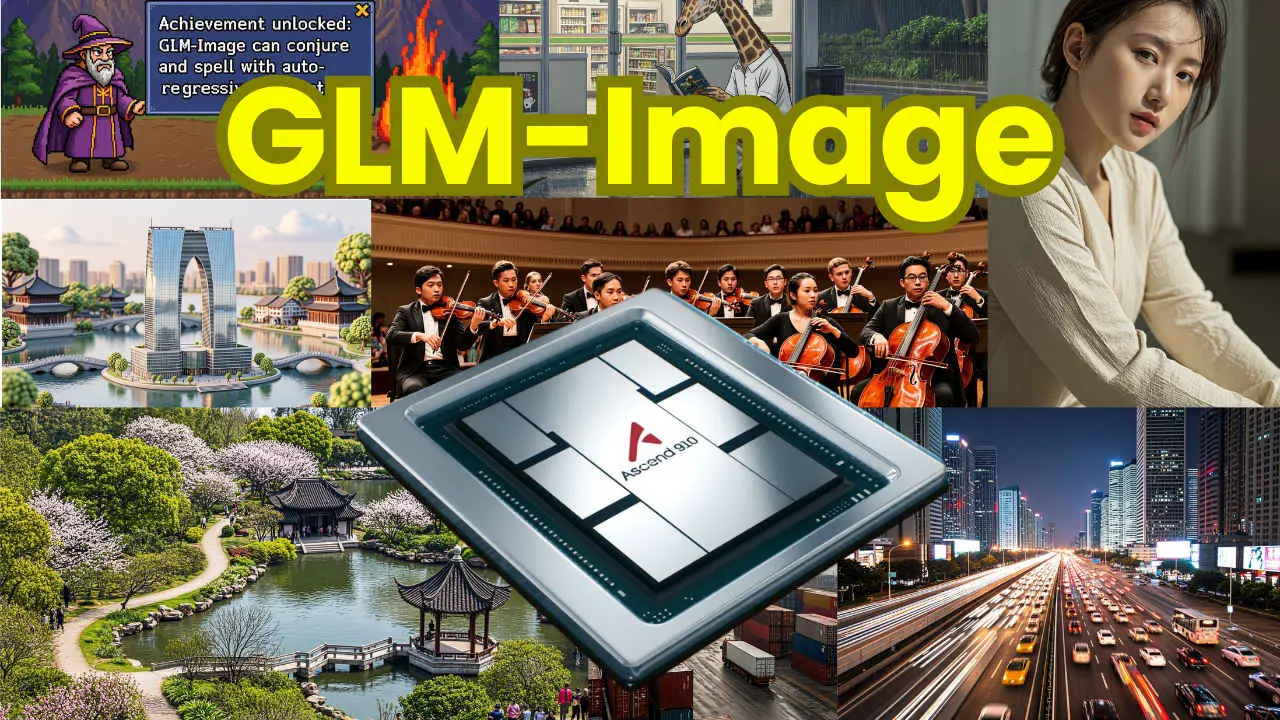
Source: Digit
Breaking the Silicon Valley Hardware Monopoly
For years, a fundamental assumption has governed generative AI development: cutting-edge models require thousands of Nvidia GPUs, particularly H100s
2
. GLM-Image shatters this paradigm by demonstrating that Huawei's Ascend chips can sustain the grueling stability required for long-term large model training. The most recent Ascend 910C, released in 2025, delivers approximately 800 TFLOPS of computing power per card at FP16 precision—roughly 80% of the H100's performance1
. While Z.ai hasn't disclosed how many servers or accelerators were used or the training duration, the successful deployment of this 16-billion parameter model signals a maturation in alternative AI infrastructure2
. This development carries particular weight given the strict export controls announced by Washington, which now require assessment of every GPU application to Chinese buyers1
.Hybrid Architecture Delivers Accurate Text Rendering
GLM-Image distinguishes itself from standard diffusion model competitors like FLUX.1 and Stable Diffusion through its innovative hybrid architecture
2
. The model employs an "autoregressive + diffusion decoder" design that decouples understanding from generation1
. This two-part approach allows the model to comprehend complex prompts before rendering images, resulting in superior adherence to instructions. A standout feature is Glyph-byT5, a specialized character-level encoder that tackles the notorious problem of "AI gibberish" in generated text2
. Instead of treating text as mere shapes, this innovation enables remarkably accurate text rendering, even for complex scripts like Chinese characters, outperforming models like FLUX.1 and SD3.5 in text-rendering benchmarks on the CVTG-2k dataset2
.Related Stories

Implications for AI Self-Sufficiency and Global Competition
The release of GLM-Image as an open-source model has far-reaching implications beyond technical achievements. Z.ai completed the entire process from data preprocessing to large-scale training on the Atlas server, proving "the feasibility of training cutting-edge models on a domestically produced full-stack computing platform"
1
. This matters particularly as industry experts predict future models will increasingly be smaller, domain-specific affairs. If China can now produce such models without hardware from Nvidia or AMD, it represents a direct threat to those chip designers' future revenue streams1
. However, questions remain about whether Huawei's Ascend chips trained the model at speeds and costs competitive enough to genuinely disrupt the global AI hardware landscape. Think tank ASPI has noted concerns that China uses AI to export its culture and values, recommending nations "prevent China's AI models, governance norms and industrial policies from shaping global technology ecosystems"1
. As the generative AI hardware market evolves, GLM-Image serves as proof that the Nvidia monopoly may be a market preference rather than a technical necessity, suggesting the future of AI infrastructure will be far more competitive than Silicon Valley anticipated2
.
Source: The Register
References
Summarized by

Navi
[1]
Related Stories
Huawei's Ascend 910C Challenges Nvidia's AI Dominance with 60% H100 Inference Performance
05 Feb 2025•Technology

Huawei's CloudMatrix 384: A Powerful Challenger to Nvidia's AI Dominance
26 Jul 2025•Technology
China Telecom Develops Large Language Models Using Domestic AI Chips, Bypassing US Sanctions
02 Oct 2024

Recent Highlights



Recent Highlights
Today's Top Stories












Your Daily Dose of Curated AI News
Don’t drown in AI news. We cut through the noise - filtering, ranking and summarizing the most important AI news, breakthroughs and research daily. Spend less time searching for the latest in AI and get straight to action.

