India targets $200 billion in AI infrastructure investment as Adani commits $100B for data centers


28 Sources
28 Sources
[1]
India bids to attract over $200B in AI infrastructure investment by 2028 | TechCrunch
India has set out an aggressive push to attract more than $200 billion in artificial-intelligence infrastructure investment over the next two years, as it seeks to position itself as a global hub for AI computing and applications at a time when capacity, capital, and regulation are becoming strategic assets. The plans were outlined on Tuesday by India's IT minister Ashwini Vaishnaw (pictured above) at the Indian government-backed five-day AI Impact Summit in New Delhi, attended by senior executives from OpenAI, Google, Anthropic, and other global technology firms. To attract investment, the government is rolling out a mix of tax incentives, state-backed venture capital, and policy support aimed at pulling more of the global AI value chain into the South Asian nation. India's pitch comes as U.S. technology giants, including Amazon, Google, and Microsoft, have already committed about $70 billion to expand AI and cloud infrastructure in the country, giving New Delhi a foundation to argue it can combine scale, cost advantages, and policy incentives to attract the next wave of global AI computing investment. While the bulk of the projected $200 billion is expected to flow into AI infrastructure -- including data centers, chips, and supporting systems, and encompassing the around $70 billion already pledged by Big Tech companies -- Vaishnaw said the Indian government also anticipates an additional $17 billion of investment into deep-tech and AI applications, highlighting a push to move beyond infrastructure and capture more of the value chain. The effort is backed by recent policy decisions aimed at making India a more attractive base for AI computing, including long-term tax relief for export-oriented cloud services and a ₹100 billion (about $1.1 billion) government-backed venture program targeting high-risk areas such as AI and advanced manufacturing. Earlier this month, New Delhi also extended the period for which deep-tech companies qualify as startups to 20 years and raised the revenue threshold for startup-specific benefits to ₹3 billion (about $33.08 million). "We have seen VCs committing funds for dtech startups," Vaishnaw said at a press briefing on the sidelines of the AI Impact Summit in New Delhi. "We have seen VCs and other players committing funds for big solutions, big applications. We have seen VCs committing funds for further research in cutting-edge models." India plans to scale its shared compute capacity under the IndiaAI Mission beyond its existing 38,000 GPUs, the minister said, with an additional 20,000 units to be added in the coming weeks, signalling what he described as the next phase of the country's AI strategy. Looking ahead, Vaishnaw said the Indian government is preparing a second phase of its AI Mission, with a stronger focus on research and development, innovation, and wider diffusion of AI tools, alongside further expansion of shared compute capacity, as India seeks to broaden access to AI infrastructure beyond a small group of companies. The push also faces structural challenges, including access to reliable power and water for energy-intensive data centres, underlining the execution risks as India seeks to compress years of AI infrastructure build-out into a much shorter timeframe. Vaishnaw acknowledged those challenges, saying the government was cognizant of the pressure AI infrastructure would place on power and water resources, and pointed to India's energy mix -- with more than half of installed generation capacity coming from clean sources -- as an advantage as demand from data centers rises. Whether India can deliver on that vision will matter well beyond its borders, as companies seek new locations for AI computing amid rising costs, capacity constraints, and intensifying global competition.
[2]
Adani pledges $100B to build AI data centers as India seeks bigger role in the global AI race | TechCrunch
Indian conglomerate Adani Group said on Monday it would invest $100 billion over the next decade to build data centers specialized for AI across the country, a move that underscores India's ambition to play a larger role in the global AI race. The investment, which will run through 2035, is aimed at building renewable-energy-powered data centers designed to support AI workloads, the company said. It expects the plan to catalyze an additional $150 billion in related investments and result in a $250 billion AI infrastructure ecosystem in India over the decade. Adani is making this commitment against a backdrop of skyrocketing investments in AI infrastructure as companies increasingly look beyond the U.S. for computing power, energy and friendly regulation. India, with its expanding digital economy and growing renewable-energy capacity, has emerged as a major destination for data centers and AI-related infrastructure over the past couple of years. The announcement coincides with India's ongoing AI Impact Summit in New Delhi this week, where leaders from some of the world's top AI companies, including OpenAI, Nvidia, Anthropic, Microsoft and Google, are meeting policymakers and industry executives. Adani Group chairman Gautam Adani (pictured above) described the plan as a long-term bet on the convergence of energy and computing. "India will not be a mere consumer in the AI age," he said, adding that the group aims to help build a domestic AI infrastructure base. The plan is to build atop Adani's own existing data-center platform and its partnerships with companies like Google and Microsoft. The conglomerate is developing large-scale AI data-center campuses in Visakhapatnam and Noida, and has plans for more facilities in Hyderabad and Pune. An expanded partnership with Walmart-owned Flipkart will focus on another AI data center. Adani said the broader plan calls for deploying up to 5 gigawatts of data-center capacity. The company said the facilities will be developed as a unified system that would scale power generation and processing capacity in parallel. The effort builds on AdaniConneX, a joint venture between Adani Enterprises and U.S.-based EdgeConneX, a developer and operator of data centers for hyperscale and enterprise customers. The JV, Adani said, has already developed about 2 gigawatts of data-center capacity across India. Central to the strategy is Adani's renewable-energy portfolio, which the group said will supply carbon-neutral power to the data centers. The company pointed to its 30-gigawatt Khavda renewable project in western India -- more than 10 gigawatts of which is already operational -- and said it plans to invest an additional $55 billion to expand renewable generation and battery energy storage over the coming years. To reduce exposure to global supply-chain disruptions, Adani said it plans to co-invest in domestic manufacturing of critical components, such as transformers, power electronics and thermal management systems. Adani did not respond to questions about how much of the $100 billion investment is already committed capital, how the spending will be phased over the coming years, and when the first large-scale AI workloads are expected to become operational.
[3]
Indian conglomerate Adani plans slow $100 billion AI build
PM Modi tells citizens AI will lift them up, not take their jobs Giant Indian industrial conglomerate Adani has said it will spend up to $100 billion on AI datacenters to equip the nation with sovereign infrastructure, but will do so at slower pace than Big Tech tech companies plan to bring their own bit barns to Bharat. The organization yesterday announced its plan to spend the cash on 5 GW worth of "renewable-energy-powered, hyperscale AI-ready datacenters" and gave itself the deadline of the year 2035 to get it done. Labor is cheap in India, so $100 billion can go a long way. But $100 billion over nine years is a modest and slow plan compared to the $635 billion Amazon, Google, Meta, say they'll spend on AI infrastructure in 2026 alone. AWS, Google and Microsoft have also promised to spend $67 billion on AI infrastructure in India over the next few years. Despite not yet having secured land for the facilities, Adani says they will "be optimised for large high-density compute clusters and next-generation AI workloads, supported by advanced liquid cooling systems and high-efficiency power architecture." The company expects the datacenters will host compute capacity dedicated to Indian-language LLMs and "national data initiatives." Adani made its announcement on the same day as India's government staged an "AI Impact Summit" at which prime minister Narendra Modi declared "AI stands at a civilizational inflection point. It can expand human capability in unprecedented ways, but it can also test existing social foundations if left unguided." "India should be among the top three AI superpowers globally, not just in the consumption of AI but in creation," the PM added, offering a vision of enthusiastic global adoption of made-in-India AI models, Indian AI startups scoring stratospheric valuations, and India's citizens seeing AI as "an enabler of opportunity, a multiplier of capability, and a servant of human dignity, not as a threat to their livelihood or an instrument of control." He also pitched AI as a problem-solver, not another tool Big Tech uses to gain dominance of India's market. To illustrate that approach, Minister of Electronics & Information Technology Ashwini Vaishnaw pointed to India's National AI Mission, which operates a collection of 38,000 GPUs it rents to local companies for ₹65 ($0.72) an hour. The minister used the Summit to announce a plan to add another 20,000 GPUs to the system. Nvidia claims it will provide some of the hardware and also pointed to its partnerships with other Indian cloud operators to build AI factories. Adani will therefore face some local competition quite soon, while also having to wait for Big Tech's billions to land in India. ®
[4]
India Eyes $200 Billion in AI Investments Over Two Years
Investment is coming in all the five layers of AI stack, with VCs committing funds for deep-tech startups, big solutions and applications, and further research in cutting-edge models. India expects to attract more than $200 billion in artificial intelligence-driven investments over the course of two years, a top federal minister said, underscoring the world's most populous nation's surging ambitions in the new technology. Prime Minister Narendra Modi's administration has designed a five-layer framework comprising applications, AI models, compute capacity, data centers and network infrastructure as well as energy to democratize and deploy the technology at scale. "Investment is coming in all the five layers of AI stack," Technology Minister Ashwini Vaishnaw told reporters at the India AI Impact Summit in New Delhi. "We have seen VCs committing funds for deep-tech startups, we have seen VCs and other players committing funds for big solutions and big applications, we have seen VCs committing funds for further research in cutting-edge models." New Delhi kicked off the India AI Summit Monday, and Modi is scheduled to address the event on Thursday. In attendance will be more than a dozen heads of state, including from France and Brazil, and some of the most influential leaders in the tech world -- from OpenAI's Sam Altman, Alphabet Inc.'s Sundar Pichai to Anthropic PBC's Dario Amodei. Read more stories from India AI Summit Nvidia Corp. CEO Jensen Huang was widely expected to arrive in New Delhi for the conference but withdrewBloomberg Terminal. Vaishnaw said Huang could not attend due to "unavoidable" circumstances, adding that the US tech giant was working with Indian firms on large investments in AI infrastructure and also homegrown software firms. He did not give specifics.
[5]
Nvidia is partnering with major Indian VC firms in search for the country's next AI start-ups
Nvidia H100 chips inside a server room at the Yotta Data Services Pvt. data center, in Navi Mumbai, India, March 14, 2024. American AI chip darling Nvidia is expanding its partnerships in India, including with venture capital firms, as it bets on the country's AI ecosystem that has drawn massive Big Tech investments. The company in statement on Wednesday said it was working with several venture capital firms, including Peak XV, Z47, Elevation Capital, Nexus Venture Partners and Accel India to identify and fund AI startups. This comes as venture capital investors have been increasingly showing interest in India's technology startups, with the country's strong initial public offerings market providing lucrative returns. India is currently holding an AI summit that has seen major tech CEOs as well as heads of states participate in the event. Nvidia top boss Jensen Huang was also expected to attend it but withdrew due to "unforeseen circumstances." More than 4,000 AI startups in India's have already joined Nvidia's global startup program, which helps tech startups build, scale, and go to market, according to the chip designer. The world's largest company by market cap also said it was collaborating with government agencies and research institutions, as well as continuing efforts to build the country's domestic data centers. Nvidia's efforts are framed around New Delhi's "IndiaAI mission," aimed at strengthening the country's AI capabilities and free up funding for its AI entrepreneurs. More broadly, Prime Minister Narendra Modi's government has set goals for India to grow into a global tech superpower. As of September last year, New Delhi had approved $18 billion worth of semiconductor projects as it looks to build a domestic supply chain. Nvidia has also partnered with Indian cloud providers such as Yotta, Larsen & Toubro, and E2E Networks to provide its AI chip clusters and help build data centers in the country. A New Delhi official reportedly said Tuesday that the country expects as much as $200 billion in investments for data centers over the next few years. India's Adani has announced plans to invest $100 billion toward renewable energy-powered AI-ready data centers. American tech firms including hyperscalers Amazon, Microsoft and Google have committed more than $50 billion toward AI infrastructure and chips in the country. Meanwhile, Nvidia said it was also supporting India's AI companies through its "NVIDIA Nemotron models" -- a family of Nvidia AI models that organizations can use to build new chatbots, agents, and speech systems. These Nvidia models can be used by Indian companies to train new AI systems on India-specific data and language, aligning with the the country's goal of build sovereign AI. Sovereign AI refers to a country's ability to build artificial intelligence based on its own infrastructure, data and industry, so that increasingly critical AI systems don't depend on foreign providers.
[6]

India eyes $200B in data center investments as it ramps up its AI hub ambitions
NEW DELHI (AP) -- India is hoping to garner as much as $200 billion in investments for data centers over the next few years as it scales up its ambitions to become a hub for artificial intelligence, the country's minister for electronics and information technology said Tuesday. The investments underscore the reliance of tech titans on India as a key technology and talent base in the global race for AI dominance. For New Delhi, they bring in high-value infrastructure and foreign capital at a scale that can accelerate its digital transformation ambitions. The push comes as governments worldwide race to harness AI's economic potential while grappling with job disruption, regulation and the growing concentration of computing power in a few rich countries and companies. "Today, India is being seen as a trusted AI partner to the Global South nations seeking open, affordable and development-focused solutions," Ashwini Vaishnaw told The Associated Press in an email interview, as New Delhi hosts a major AI Impact Summit this week drawing participation from at least 20 global leaders and a who's who of the tech industry. In October, Google announced a $15 billion investment plan in India over the next five years to establish its first artificial intelligence hub in the South Asian country. Microsoft followed two months later with its biggest-ever Asia investment announcement of $17.5 billion to advance India's cloud and artificial intelligence infrastructure over the next four years. Amazon too has committed $35 billion investment in India by 2030 to expand its business, specifically targeting AI-driven digitization. The cumulative investments are part of $200 billion in investments that are in the pipeline and New Delhi hopes would flow in. Vaishnaw said India's pitch is that artificial intelligence must deliver measurable impacts at scale rather than remain an elite technology. "A trusted AI ecosystem will attract investment and accelerate adoption," he said, adding that a central pillar of India's strategy to capitalize on the use of AI is building infrastructure. The government recently announced a long-term tax holiday for data centers as it hopes to provide policy certainty and attract global capital. Vaishnaw said the government has already operationalized a shared computing facility with more than 38,000 graphics processing units, or GPUs, allowing startups, researchers and public institutions to access high-end computing without heavy upfront costs. "AI must not become exclusive. It must remain widely accessible," he said. Alongside the infrastructure drive, India is backing the development of sovereign foundational AI models trained on Indian languages and local contexts. Some of these models meet global benchmarks and in certain tasks rival widely used large language models, Vaishnaw said. India is also seeking a larger role in shaping how AI is built and deployed globally as the country doesn't see itself strictly as a "rule maker or rule taker," according to Vaishnaw, but an active participant in setting practical, workable norms while expanding its AI services footprint worldwide. "India will become a major provider of AI services in the near future," he said, describing a strategy that is "self-reliant yet globally integrated" across applications, models, chips, infrastructure and energy. Investor confidence is another focus area for New Delhi as global tech funding becomes more cautious. Vaishnaw said the technology's push is backed by execution, pointing to the Indian government's AI Mission program which emphasizes sector specific solutions through public-private partnerships. The government is also betting on reskilling its workforce as global concerns grow that AI could disrupt white collar and technology jobs. New Delhi is scaling AI education across universities, skilling programs and online platforms to build a large AI-ready talent pool, the minister said. Widespread 5G connectivity across the country and a young, tech-savvy population are expected to help with the adoption of AI at a faster pace, he added. Balancing innovation with safeguards remains a challenge though, as AI expands into sensitive sectors such as governance, health care and finance. Vaishnaw outlined a fourfold strategy that includes implementable global frameworks, trusted AI infrastructure, regulation of harmful misinformation and stronger human and technical capacity to hedge the impact. "The future of AI should be inclusive, distributed and development-focused," he said.
[7]
Adani Plans to Invest $100 Billion in AI Data Centers by 2035
Adani Group plans to invest $100 billion by 2035 to develop green-powered, AI-ready data centers as billionaire Gautam Adani seeks to capitalize on India's emergence as a hub for artificial intelligence and cloud computing. The investment will likely "catalyse" an additional $150 billion investment across server manufacturing, advanced electrical infrastructure and related sectors over the next decade, flagship Adani Enterprises Ltd. said in a filing Tuesday. The company's shares advanced as much as 2.4% after the announcement. "The world is entering an Intelligence Revolution more profound than any previous Industrial Revolution," Chairman Adani said in a statement. The announcement mirrors the global trend where governments and large corporations are spending trillions in an unprecedented AI hardware arms race. India is also currently hosting the AI Impact Summit, a gathering that has drawn the industry's most influential figures, including Alphabet's Sundar Pichai and OpenAI Inc.'s Sam Altman. Anthropic PBC has partnered Indian technology firm Infosys Ltd. to develop advanced artificial intelligence solutions for companies across sectors including telecommunications and financial services. The partners will develop custom AI agents tailored for specific industries and business functions, Infosys said in a statement Bloomberg Terminalto exchanges. Anthropic will combine its Claude models, including Claude Code, with Infosys' Topaz AI products to help companies automate complex work flows and speed up software delivery. Infosys shares gained 4.8% on Tuesday, the most in two weeks, while the benchmark NSE Nifty index rose 0.3%. The partnership underscores the intensifying race among global AI developers to secure enterprise customers as companies demand industry-specific automation tools. Earlier, Anthropic said it is embedding its marquee AI coding agent within prominent Indian firms including flag carrier Air India and outsourcing giant Cognizant Technology Solutions Corp. India kicked off one of the world's largest artificial intelligence summits this week as Prime Minister Narendra Modi seeks to make the country an AI hub amid intense competition to develop frontier models. Read more on AI The Infosys collaboration will start with telecommunications with a dedicated Anthropic center for building AI agents for industry-specific operations. The partnership will then expand to other industries, including financial services, manufacturing and software development. "From modernizing financial services with intelligent risk management and compliance, to enabling engineering businesses to lead with AI-driven design and manufacturing, the goal is to leverage the joint expertise of Infosys and Anthropic to accelerate AI value realization for global enterprises," Infosys Chief Executive Officer Salil Parekh said.
[8]

India Fuels Its AI Mission With NVIDIA
From AI infrastructure leaders to frontier model developers, India is teaming with NVIDIA to drive AI transformation across the nation. India is the nexus of AI innovation this week as the host of the AI Impact Summit, which brings together global heads of state and industry to chart the future of AI. At the summit, taking place in New Delhi, industry leaders, government agencies, educational institutions and startups are sharing how they're working with NVIDIA to drive the AI industrial revolution in the world's most populous country. These initiatives support the IndiaAI Mission, a government effort that's infusing India's AI ecosystem with over $1 billion to bolster the nation's compute capacity and foster the development of sovereign AI datasets, frontier models and applications. The mission also supports AI education, startup innovation and frameworks for trustworthy AI. Read how NVIDIA is supporting IndiaAI Mission priorities including: NVIDIA Cloud Partners Boost India AI Infrastructure To achieve its AI ambitions, India is investing heavily in its computing infrastructure. Under the IndiaAI Compute Pillar, the nation is building out its AI cloud offerings with systems including tens of thousands of NVIDIA GPUs. NVIDIA is collaborating with next‑generation cloud providers Yotta, L&T and E2E Networks to deliver advanced AI factories to meet India's growing need for AI compute and enable it to develop AI models and services that drive innovation. * Yotta is a hyperscale data center and cloud provider building large‑scale sovereign AI infrastructure for India, branded as Shakti Cloud, powered by over 20,000 NVIDIA Blackwell Ultra GPUs. Its campuses in Navi Mumbai and Greater Noida deliver GPU‑dense, high‑bandwidth AI cloud services on a pay‑per‑use model, designed to make advanced AI training and inference affordable and compliant for Indian enterprises and public sector customers. * E2E Networks is building an NVIDIA Blackwell GPU cluster on its TIR platform, hosted at the L&T Vyoma Data Center in Chennai. The TIR cloud compute platform will feature NVIDIA HGX B200 systems and NVIDIA Enterprise software as well as NVIDIA Nemotron open models to supercharge sovereign development across agentic AI, healthcare, finance, manufacturing and agriculture. India's AI cloud infrastructure will host workloads as well as manufacture intelligence for model training, fine-tuning and high‑scale inference. Capacity within these data centers will be reserved for model builders, startups, researchers and enterprises to build, fine-tune and deploy AI in India. Further expanding access to NVIDIA AI infrastructure in India, Netweb Technologies is launching its Tyrone Camarero AI Supercomputing systems built on the NVIDIA Grace Blackwell architecture. The NVIDIA GB200 NVL4 platforms -- manufactured in India by Netweb under the government's "Make in India" mission -- feature four NVIDIA Blackwell GPUs and two NVIDIA Grace CPUs to power scientific computing, model training and inference. NVIDIA and India AI-Native Companies Build the Nation's Frontier AI Models Another key goal of the IndiaAI Mission -- led by its Innovation Center Pillar -- is to develop and deploy foundation models trained on India-specific data and domestic AI infrastructure. For a nation as multilingual as India -- with 22 constitutionally recognized languages and over 1,500 more recorded by the country's census -- frontier AI models are a powerful tool to help its more than 1.4 billion residents interact with technology in their primary language. Organizations across the country are building AI applications with NVIDIA Nemotron to support public-sector services, financial systems and enterprise operations in multiple languages. NVIDIA Nemotron open models, datasets, tools and libraries enable organizations to build frontier speech, language and multimodal models at scale and across languages for government, consumer and enterprise applications. It includes India-specific datasets like Nemotron-Personas-India, an open dataset built from publicly available census data using NeMo Data Designer that includes 21 million fully synthetic Indic personas to enable population-scale sovereign AI development. Adopters in India of Nemotron -- and NeMo Curator, an open library for multilingual and multimodal data curation -- include: * BharatGen, a sovereign AI initiative supported by the Government of India aimed at strengthening the country's multilingual and multimodal AI ecosystem. As part of this effort, BharatGen has developed a 17-billion-parameter mixture-of-experts (MoE) model from the ground up, using the NVIDIA NeMo framework for pretraining and the NeMo RL library for post-training. The open source models are designed to power applications across public services, agriculture, security and cultural preservation. * Chariot, a company building AI systems for speech and multimodal communication. Using the NeMo framework, Chariot is developing an 8-billion-parameter model for real-time text to speech, supporting applications that improve accessibility and digital interaction across consumer and enterprise use cases. * Commotion, backed by Tata Communications, which has developed an AI operating system to automate complex enterprise workflows. By integrating NVIDIA Nemotron models and speech capabilities, the platform enables governed, production-grade AI deployments, helping enterprises scale AI across critical business operations. * CoRover.ai, which has deployed NVIDIA Nemotron Speech open models and NVIDIA Riva libraries for end-to-end, ultralow-latency speech AI -- including the NVIDIA Riva Whisper v3 model for multilingual automatic speech recognition in English, Hindi and Gujarati. Powering customer service applications for the Indian Railway Catering and Tourism Corporation, CoRover's platform supports around 10,000 concurrent users and more than 5,000 daily ticket bookings. * Gnani.ai, which offers enterprises a multilingual agentic AI platform that can interact with customers through voice and text. Gnani is building a 14-billion-parameter speech-to-speech model built on NVIDIA Nemotron Speech models, datasets and NeMo libraries including NeMo libraries through NVIDIA Cloud Partner E2E Networks -- with plans to expand to a 32-billion-parameter model. By fine-tuning the NVIDIA Nemotron Speech model for Indic languages, Gnani has achieved a 15x reduction in inference costs, enabling the company to scale to support more than 10 million calls per day for customers in telecom, banking and hospitality. * National Payments Corporation of India (NPCI), which operates India's retail payment and settlement systems and is deploying AI models to support digital financial services. Building on its production deployment of the AI-powered UPI Help Assistant -- a pilot initiative for India's Unified Payments Interface (UPI) -- NPCI is exploring training FiMi, a financial model for India, using the NVIDIA Nemotron 3 Nano model and its own datasets. The model, fine-tuned with the NeMo framework, will support multilingual customer service across India's banking ecosystem. * Sarvam.ai, a leader in full-stack sovereign generative AI that provides enterprise-grade multimodal, speech-to-text, text-to-speech, translation and reasoning models. The company is open sourcing its Sarvam-3 series of text and multimodal large language model variants, trained for 22 Indic languages, English math and code. Sarvam is using NeMo Curator to construct high-quality multilingual training data while adopting a subset of NVIDIA Nemotron datasets. The foundation models were pre-trained from scratch across 3B, 30B and 100B parameter sizes using the NVIDIA NeMo framework and Megatron-LM, and post-trained with NeMo RL. Training was conducted on NVIDIA H100 GPUs through NVIDIA Cloud Partners, including Yotta. With these sovereign models, Sarvam.ai's new Pravah platform enables production-grade inference for Indian government and enterprise applications. * Soket.ai, which is using a modern large-model training stack on open NVIDIA Nemotron technologies, including NVIDIA Megatron and NVIDIA NeMo. These open source components enable scalable experimentation, training stability and efficient GPU usage, while preserving full control over the model's data, design and life cycle. * Tech Mahindra, which has developed an 8-billion-parameter foundation model tailored for Indian languages and dialects. The model, built with Nemotron, is being designed for use in classrooms, where it can help make educational materials available in a wider range of Indian languages including Hindi, Maithili and Dogri. The team generated synthetic data with Nemotron libraries and tools such as NeMo Data Designer and conducted supervised fine-tuning with NeMo AutoModel. * Zoho, which is advancing its Zia LLM platform with proprietary models built using NVIDIA NeMo on the NVIDIA Blackwell and Hopper platforms, integrated across its software-as-a-service applications. This privacy-first architecture delivers contextual, production-grade AI for critical business workflows like customer relation management and finance, ensuring technology sovereignty and enterprise security at a global scale. Developers building sovereign AI systems can access NVIDIA Nemotron and NeMo today. Nemotron models can be deployed anywhere on NVIDIA-accelerated infrastructure -- including on NVIDIA DGX Spark, which is now available in India through qualified partners including PNY, RP tech India, Tech Data, a TD SYNNEX Company, as well as on NVIDIA Marketplace. A version manufactured in India as part of the "Make in India" initiative is available through Netweb. DGX Spark also runs sovereign AI models by Indian model builders including Sarvam.ai. Government and Academic Partnerships to Support Research in AI for Science and Engineering Under its Application Development Initiative Pillar, the IndiaAI Mission is supporting high-impact AI applications -- and its Startup Financing Pillar aims to democratize funding availability for AI entrepreneurs across the country. NVIDIA is collaborating with government agencies, research institutions, venture capital firms and startups to advance projects aligned with these goals. NVIDIA is collaborating with the Anusandhan National Research Foundation (ANRF), a statutory body under the Indian government, to spur even more cutting-edge AI research across the nation's leading academic institutions. The initiative will support ANRF's AI for Science & Engineering program and future AI programs. NVIDIA will offer ANRF grantee institutions complimentary access to NVIDIA AI Enterprise software and specialized technical mentorship through the NVIDIA AI Technology Center. The collaboration will also include AI bootcamps, workshops and hackathons to strengthen India's AI research ecosystem. NVIDIA is also partnering with prominent venture capital firms including Peak XV, Z47, Elevation Capital,, Nexus Venture Partners and Accel India to identify and fund promising startups of all stages that are building AI solutions for India and international use. More than 4,000 of India's AI startups are already part of the NVIDIA Inception program. For more from the India AI Summit, learn how NVIDIA and global industrial software leaders are partnering with India's largest manufacturers -- and how India's global systems integrators are building enterprise AI agents with NVIDIA.
[9]
India's Adani to invest $100 billion in AI data centers over the next decade
The logo of the Adani Group is seen on the facade of its Corporate House on the outskirts of Ahmedabad, India, November 21, 2024. India's Adani on Tuesday announced plans to invest $100 billion to develop renewable energy-powered AI-ready data centers by 2035, seeking to establish the world's largest integrated data center platform. The blockbuster investment, which comes as India pushes to gain a stronger foothold in the global AI race, is expected to create a $250 billion AI infrastructure ecosystem in India over the next decade, Adani said. "The world is entering an Intelligence Revolution more profound than any previous Industrial Revolution," Gautam Adani, chairman of Adani Group, said in a statement. "India will not be a mere consumer in the AI age. We will be the creators, the builders and the exporters of intelligence and we are proud to be able to participate in that future," he added. Shares of Adani Enterprises, the flagship company of Adani Group, rose 2.5% on the news, making it one of the top gainers on the benchmark Nifty 50 stock index. Shares of Adani Green Energy were last seen up 1.8%.
[10]
India's Global Systems Integrators Build Next Wave of Enterprise Agents With NVIDIA AI, Transforming Back Office and Customer Support
Technology leaders tap NVIDIA Nemotron open models, data and software to build and deploy agentic and generative AI, accelerating productivity and efficiency for enterprises and consumers across call centers, healthcare, software development and telecommunications. Agentic AI is reshaping India's tech industry, delivering leaps in services worldwide. Tapping into NVIDIA AI Enterprise software and NVIDIA Nemotron models, India's technology leaders are accelerating productivity and efficiency across industries -- from call centers to telecommunications and healthcare. Infosys, Persistent, Tech Mahindra and Wipro are leading the way for business transformation, improving back-office productivity and customer services with integrated agentic AI platforms built with NVIDIA AI Enterprise. At this year's India AI Impact Summit, the state of the art for next-generation business services driven by agentic and generative AI was on full display. India's tech industry is on track to reach $500 billion in revenue by 2030, up from about $250 billion in 2023, according to IBEF, citing momentum in AI from 38,000 GPUs secured in September. Wipro WEGA Platform Boosting Efficiency for Call Centers With NVIDIA AI Enterprise For health insurance plans in government‑regulated markets, customer experience is important -- especially during peak enrollment cycles, when deadlines loom and subscribers need 24/7 support to assess options and optimize enrollment decisions for their families. Traditional contact center business models, built around seasonal hiring and lengthy training, simply can't keep pace. What's needed is a new operating model that improves customer experience while containing the growing cost of service. Wipro's AI‑agent-assisted solution, powered by the WEGA platform and NVIDIA AI Enterprise software, offers a glimpse of that future. Deployed for a major U.S. healthcare insurance provider, the system is already reshaping member experiences by enabling service representatives to handle more complex requests, accelerate resolution times, deliver more personalized support and improve operational efficiencies. AI agents help meet the expectations customers bring to their health plans: immediate access to accurate information, conversational self‑service, frictionless enrollment and consistent guidance across channels. Behind the scenes, payers face rising call volumes, fragmented data and heavy administrative workloads. AI agents bridge that gap by scaling instantly, operating around the clock and supporting human representatives with real‑time intelligence. The results have been striking: 42% of inbound calls are now handled by AI agents and near‑instant responsiveness across 900 concurrent calls and 164 requests per second -- all with sub‑200‑millisecond latency. Members benefit from natural, conversational self‑service. Human agents receive real‑time prompts and knowledge retrieval. A centralized data hub surfaces personalized insights, while automated digitization removes manual work from downstream processes. Using production grade, horizontally scalable NVIDIA NIM microservices and NVIDIA NeMo Guardrails, part of NVIDIA AI Enterprise, the solution includes the performance, governance and safety required in regulated healthcare environments. Its impact is already extending beyond healthcare, with similar deployments underway in financial services. Anywhere accuracy, compliance and scale matter, AI agents are becoming a transformative force. Tech Mahindra Deploying Large Telco Model to Power Autonomous Network Operations Using NVIDIA NIM Tech Mahindra is accelerating the shift toward AI-assisted network operations with a new platform built in collaboration with NVIDIA. At the center is a large telco model (LTM) that generates prioritized, data‑driven recommendations to help field technicians rank each fix by its historical success rate across the network. The result is faster, more accurate resolutions -- often in a single visit -- and a clear path toward level‑4‑plus operational maturity. A large telecommunications services provider is adopting the same LTM foundation as part of its operations roadmap, targeting improvements in service‑layer issue resolution, customer experience and back‑office efficiency through higher‑quality tickets and fewer escalations. The platform uses NVIDIA Nemotron embedding models for semantic search across telemetry and a Nemotron reranking model to sharpen decision relevance. These models are deployed with NVIDIA NIM microservices for rapid, reliable accelerated AI inference. NVIDIA NeMo Agent Toolkit orchestrates agent workflows across network domains, enabling true agentic operations at scale. By embracing autonomous network operations, Tech Mahindra shows how AI can transform a global telecom industry generating more than $1.5 trillion in annual revenue -- where even small gains in uptime and efficiency deliver outsized economic impact. Infosys Builds an Enterprise-Grade Coding Small Language Model With NVIDIA AI Enterprise Infosys developed a new small language model for coding, built using the NVIDIA NeMo framework that's part of NVIDIA AI Enterprise, and integrated within Infosys Topaz Fabric. The model accelerates software delivery with frontier‑grade performance while remaining lightweight, and it can be deployed across on-premises enterprise data centers, cloud environments and even standard desktops. The 2.5‑billion‑parameter model supports agent development, code generation, refactoring and end‑to‑end software‑engineering workflows. It's trained on a curated blend of high‑quality code, synthetic data, mathematical reasoning and natural language inputs -- an approach that enables it to match frontier‑model performance on benchmarks such as MBPP, MBPP+ and BFCL. Infosys also prioritized safety and trust. The model incorporates safety‑aligned training and responsible AI practices that reduce harmful outputs while preserving fluency. Its secure‑coding capabilities are validated through industry benchmarks including Stanford AIR‑Bench and Meta's CyberSecEval, giving enterprises confidence to deploy it across code generation, debugging and multi‑agent development pipelines. Persistent Accelerates AI‑Driven Molecular Discovery With NVIDIA BioNeMo and NeMo Agent Toolkit Persistent Systems is working with NVIDIA to push early‑stage drug discovery into a new era of speed and scientific fidelity. The collaboration brings together Persistent's deep life sciences engineering expertise with NVIDIA's full‑stack accelerated computing platform, giving researchers a powerful path from AI experimentation to production‑grade discovery workflows. At the center of the effort is Persistent's new Generative Molecules and Virtual Screening (GenMoIVS) solution, built on the NVIDIA BioNeMo platform and the NeMo Agent Toolkit. GenMoIVS uses large, domain‑specific models to simulate molecular behavior with high accuracy, generating and evaluating candidate compounds before they ever reach a wet lab. These agentic workflows continuously reason across virtual screening, prioritization and experimental planning, helping teams de‑risk early discovery and shorten development cycles. The platform runs on NVIDIA's accelerated computing platform, including NVIDIA AI Enterprise software and NIM microservices, enabling high‑throughput simulation and real‑time scientific decision-making in regulated environments. By combining scalable infrastructure with production‑ready agentic AI, Persistent is giving life sciences organizations a faster, more cost‑effective way to explore the compound space and improve downstream success rates.
[11]

India cobbles together $200 billion-plus for data-center investment | Fortune
The investments underscore the reliance of tech titans on India as a key technology and talent base in the global race for AI dominance. For New Delhi, they bring in high-value infrastructure and foreign capital at a scale that can accelerate its digital transformation ambitions. The push comes as governments worldwide race to harness AI's economic potential while grappling with job disruption, regulation and the growing concentration of computing power in a few rich countries and companies. "Today, India is being seen as a trusted AI partner to the Global South nations seeking open, affordable and development-focused solutions," Ashwini Vaishnaw told The Associated Press in an email interview, as New Delhi hosts a major AI Impact Summit this week drawing participation from at least 20 global leaders and a who's who of the tech industry. In October, Google announced a $15 billion investment plan in India over the next five years to establish its first artificial intelligence hub in the South Asian country. Microsoft followed two months later with its biggest-ever Asia investment announcement of $17.5 billion to advance India's cloud and artificial intelligence infrastructure over the next four years. Amazon too has committed $35 billion investment in India by 2030 to expand its business, specifically targeting AI-driven digitization. The cumulative investments are part of $200 billion in investments that are in the pipeline and New Delhi hopes would flow in. Vaishnaw said India's pitch is that artificial intelligence must deliver measurable impacts at scale rather than remain an elite technology. "A trusted AI ecosystem will attract investment and accelerate adoption," he said, adding that a central pillar of India's strategy to capitalize on the use of AI is building infrastructure. The government recently announced a long-term tax holiday for data centers as it hopes to provide policy certainty and attract global capital. Vaishnaw said the government has already operationalized a shared computing facility with more than 38,000 graphics processing units, or GPUs, allowing startups, researchers and public institutions to access high-end computing without heavy upfront costs. "AI must not become exclusive. It must remain widely accessible," he said. Alongside the infrastructure drive, India is backing the development of sovereign foundational AI models trained on Indian languages and local contexts. Some of these models meet global benchmarks and in certain tasks rival widely used large language models, Vaishnaw said. India is also seeking a larger role in shaping how AI is built and deployed globally as the country doesn't see itself strictly as a "rule maker or rule taker," according to Vaishnaw, but an active participant in setting practical, workable norms while expanding its AI services footprint worldwide. "India will become a major provider of AI services in the near future," he said, describing a strategy that is "self-reliant yet globally integrated" across applications, models, chips, infrastructure and energy. Investor confidence is another focus area for New Delhi as global tech funding becomes more cautious. Vaishnaw said the technology's push is backed by execution, pointing to the Indian government's AI Mission program which emphasizes sector specific solutions through public-private partnerships. The government is also betting on reskilling its workforce as global concerns grow that AI could disrupt white collar and technology jobs. New Delhi is scaling AI education across universities, skilling programs and online platforms to build a large AI-ready talent pool, the minister said. Widespread 5G connectivity across the country and a young, tech-savvy population are expected to help with the adoption of AI at a faster pace, he added. Balancing innovation with safeguards remains a challenge though, as AI expands into sensitive sectors such as governance, health care and finance. Vaishnaw outlined a fourfold strategy that includes implementable global frameworks, trusted AI infrastructure, regulation of harmful misinformation and stronger human and technical capacity to hedge the impact. "The future of AI should be inclusive, distributed and development-focused," he said.
[12]
NVIDIA and Global Industrial Software Leaders Partner With India's Largest Manufacturers to Drive AI Boom
India's largest manufacturers are teaming with global industrial software leaders Cadence, Siemens and Synopsys to build AI factories for design and manufacturing accelerated by NVIDIA AI infrastructure, CUDA-X and Omniverse libraries. India is entering a new age of industrialization, as AI transforms how the world designs, builds and runs physical products and systems. The country is investing $134 billion dollars in new manufacturing capacity across construction, automotive, renewable energy and robotics, creating both a massive challenge and opportunity to build software-defined factories from day one. At the center of this transformation are applications accelerated by NVIDIA CUDA-X and NVIDIA Omniverse libraries, which connect data from design to operations and bring physical AI into factories, warehouses and infrastructure. India's largest manufacturers are teaming with global industrial software leaders Cadence, Siemens and Synopsys to advance the nation's AI boom using applications accelerated by CUDA-X and Omniverse libraries. India's Manufacturing Leaders Modernize Factories With Siemens and NVIDIA To scale India's growth, manufacturers are using Siemens industrial software integrated with NVIDIA CUDA-X and Omniverse libraries to design, build and operate next-generation, software-defined factories. Reliance New Energy, the clean energy arm of Reliance industries, is expanding its collaboration with NVIDIA and Siemens by combining Siemens' digital twin technology with NVIDIA Omniverse libraries for faster, more precise simulation and plant design for its next-generation gigafactories. Addverb Technologies, a leading Indian company providing robots and innovative warehouse automation solutions, is using Siemens' Technomatix portfolio, NVIDIA Omniverse libraries and NVIDIA Cosmos world foundation models to create digital twins of its factories and train its quadruped and wheeled humanoid robots in simulation. Hero MotoCorp is utilizing Siemens Xcelerator and NVIDIA infrastructure to accelerate the product development lifecycle by enhancing its capabilities in computer-aided engineering, numerical virtual verification and validation. Partners Advance Design and Engineering With NVIDIA-Accelerated Software From Synopsys and Cadence Leading enterprises are integrating Synopsys and Cadence's electronic design automation tools, powered by NVIDIA AI infrastructure and libraries, to enable rapid design iteration and operational intelligence across the energy, automotive and electronics sectors. Electrical equipment and home appliances leader Havells India Limited is using Synopsys' Ansys Fluent to accelerate simulation powered by NVIDIA CUDA-X. Havells has obtained 6x faster fluid dynamic simulations, enabling exploration of more design options to optimize airflow and energy efficiencies, and achieve faster time to market. Larsen and Toubro Semiconductor is using Cadence Spectre X, accelerated by CUDA-X libraries, on Cadence Millennium M2000 -- a high-performance supercomputer built on the NVIDIA Blackwell architecture -- to shorten design iterations of next-generation AI chips to systems. India's Technology Leaders Advance Industrial Automation With Physical AI India's IT and business consulting sector has grown into a global powerhouse, projected to reach over $350 billion this year, serving as a primary engine for transforming the world's largest industries. Tata Consultancy Services (TCS), a global leader in IT services, is investing in large-scale AI infrastructure to deliver enterprise solutions at scale. By harnessing the NVIDIA Metropolis platform, the NVIDIA Blueprint for video search and summarization and digital twins built on Omniverse libraries, TCS is setting safety and precision benchmarks at Tata Motors, converting standard camera feeds into intelligent sensors for automated quality checks and real-time safety compliance. TCS is also deploying physical AI applications, including autonomous safety and quality inspections via quadruped robots, to minimize risk across complex manufacturing environments. Wipro PARI, a leader in industrial automation, is integrating NVIDIA AI infrastructure, Omniverse libraries and the NVIDIA Isaac robotics development platform to deliver solutions for its consumer and automotive customers. This includes real-time simulation and validation of robotic workflows, as well as virtual stress-testing of operations before physical deployment. Tata Consulting Engineers is launching its Cognitive Twin platform, built on NVIDIA Omniverse, to create real-time industrial simulations that link physical assets with digital intelligence across manufacturing, energy and infrastructure. The platform supports both capital project planning and operational optimization through early-stage simulation and AI-enabled decision-making. Pilot projects are underway with National High Speed Rail Corporation Limited, Torrent Power and Power Grid Corporation of India Limited. To see what's next, explore industrial AI and manufacturing sessions at NVIDIA GTC.
[13]
AI investments surge in India as tech leaders convene for Delhi summit | Fortune
India's AI infrastructure is getting a boost from American investors and tech firms just as the world's leading technology executives converge on New Delhi for one of the largest artificial intelligence summits in the world. Blackstone announced on Monday it was leading a $600 million equity investment in Indian AI cloud startup Neysa, while chip giant AMD announced an expanded partnership with Mumbai-based Tata Consultancy Services to deploy up to 200 megawatts of AI infrastructure capacity in India. Blackstone's multi-million-dollar commitment to Neysa will help deploy more than 20,000 GPUs for AI training in India, while AMD's partnership with TCS aims to support India's sovereign AI initiatives and accelerate enterprise deployments. The Neysa investment includes participation from Teachers' Venture Growth, TVS Capital, 360 ONE, and Nexus, with the company also seeking an additional $600 million in debt financing. The investments coincide with the five-day India AI Impact Summit that kicked off on Monday. The event features global AI leaders, including OpenAI's Sam Altman, Anthropic's Dario Amodei, Google's Sundar Pichai, and Meta's Alexandr Wang, alongside political leaders such as French President Emmanuel Macron. More than 20 heads of state and government, along with representatives from over 60 countries, are expected to attend the gathering, including notable European AI figures like Arthur Mensch, the French computer scientist who founded Mistral AI. AI companies are also using the summit to emphasize their growth beyond Western markets. This week, Anthropic announced that India has become the second-largest market for its Claude AI platform, with run-rate revenue doubling since October 2025. Meanwhile, OpenAI CEO Sam Altman wrote in the Times of India that India now has 100 million weekly active ChatGPT users, making it the company's second-largest user base after the United States. On Monday, Anthropic also announced it had opened its second Asian office in Bengaluru, led by Managing Director Irina Ghose, focusing on hiring local talent and helping Indian enterprises build Claude-powered solutions. The company said its India team will offer applied AI expertise to enterprise customers, digital natives, and startups, helping them design, build, and scale Claude-powered solutions tailored to their business needs. The Modi government plans to use the summit to push for a "global AI commons" -- a shared repository of AI applications and use cases focused on education, health, and agriculture that could be adopted by developing nations. Abhishek Singh, chief executive of India's AI mission, told The Financial Times that the country wants to ensure AI capabilities and standards don't become "private infrastructure controlled by a few companies," reflecting broader geopolitical concerns that frontier AI development is currently too concentrated in the U.S. and China. India is well placed to capitalize on the AI boom and ranks third globally in AI competitiveness, trailing only the U.S. and China, according to Stanford University's Institute for Human-Centered AI. The country has been particularly successful in leveraging its digital infrastructure -- including a biometric ID system covering over a billion citizens -- to rapidly scale technology adoption. Now, government officials believe AI could accelerate the nation's technological development timelines even faster.
[14]

AI Impact Summit: India Could See Over $200 Billion Worth of AI Investments
AI Impact Summit 2026 is being hosted in New Delhi's Bharat Mandapam The India AI Impact Summit 2026, which began on February 16, entered its second day on Tuesday. During the five-day event, the government is hosting various industry leaders and technocrats, who are attending the summit to discuss the prospects of the country's AI and deep tech ecosystem. On the sidelines of the summit on Tuesday, the Union Minister of Electronics and Information Technology, Ashwini Vaishnaw, said that India expects to receive significant investments to accelerate AI adoption over the next two years. India's AI and Deep Tech Ecosystem Expected to Leverage the Existing Technology Framework Citing the Union IT minister, ANI reports that India expects to receive more than $200 billion (about Rs. 18,14,000 crore) worth of investments in the country's AI and deep tech ecosystem over the next two years. On the second day of the AI Impact Summit 2026 in New Delhi, the minister reportedly said that there are interests on two fronts. First is AI investments in the country, and second is funding from venture capitalists in India's deep tech ecosystem. The government in the past years has been backing the development of digital public infrastructure (DPI) as part of the Digital India mission, including UPI, Aadhaar, DigiLocker, and Open Network Digital Commerce (ONDC). This has led to the creation of notable technology frameworks in the country. On how the same will bolster AI adoption in India, the minister highlighted the technology framework in the country, backed by DPI, which is expected to accelerate AI adoption. Further, the report added that the Union Minister pointed out that global tech leaders and CEOs have shown "keen interest" in investing in India, specifically in the country's growing deep tech startup ecosystem and infrastructure. However, these are not isolated interests in India's AI ecosystem. In the past, various global tech giants have made commitments to invest in India, to tap into the large Internet-using demographic by offering cheaper plans, set up operations in the country, and build data centres across India. Most recently, Anthropic inaugurated its first Indian office in Bengaluru, while also listing job openings to hire local talent. The US-based company also announced that India is home to the second-largest user base for its AI-powered chatbot Claude. Recently, OpenAI also began hiring people ahead of the opening of its first office in India's New Delhi. The AI giant also plans to build data centres across the country. Similarly, in December 2025, Microsoft announced its plans to invest about $17.5 billion (roughly Rs. 1.57 lakh crore) in India over the next four years.
[15]

India among key hubs for AI innovation, company deepening India partnerships: Nvidia
Nvidia's diversity of partnerships is critical as AI is not a single product, nor a lone one-off breakthrough, he said, likening Artificial Intelligence to a five-layer cake spanning energy (as the base), with chips, infrastructure, models and applications on top. India, with its deep base of developers, startups and partners, has become one of the most important hubs for AI innovation, said Nvidia managing director for South Asia, Vishal Dhupar, while highlighting that the company was working closely with technology leaders across the country to accelerate transformation and supercharge growth. Nvidia's diversity of partnerships is critical as AI is not a single product, nor a lone one-off breakthrough, he said, likening Artificial Intelligence to a five-layer cake spanning energy (as the base), with chips, infrastructure, models and applications on top. Each of the layers has its own diverse ecosystem, and Nvidia is working with India's technology leaders at every single level of the stack, Dhupar said. According to him, Nvidia's ecosystem in India is thriving and growing fast. Nvidia said it is collaborating with next-generation cloud providers Yotta, L&T and E2E Networks to deliver advanced AI factories to meet India's growing need for AI compute. Further, organisations across the country are building AI applications with Nvidia 'Nemotron' to support public-sector services, financial systems and enterprise operations in multiple languages, it said. In India, adopters of Nemotron and NeMo Curator, an open library for multilingual and multimodal data curation, include BharatGen, Chariot, Commotion, Gnani.ai, CoRover.ai, National Payments Corporation of India (NPCI), Sarvam.ai, Tech Mahindra, Zoho, among others. "We are proud to be working with Indian visionaries at every single layer of this stack," Dhupar told reporters during a virtual briefing. Today, there are about 8,00,000 developers in India who are building, training and deploying AI solutions on Nvidia's platforms. The "exciting" week of India AI Summit brings innovation and opportunity, he pointed out. "The activity schedule for this week reflects India's rapid growth as a global hub for AI talent. We are honoured to host the senior Nvidia delegation led by executive vice president Jay Puri to celebrate our exceptional researchers, startups and developers who are building the nation's AI infrastructure," he said. Throughout the Summit, attendees can join 15 Nvidia-hosted sessions covering everything from open models to agentic and physical AI, he said. "Over 100 Nvidia partners are here showcasing their latest work using AI infrastructure and open source models. This progress builds on decades of collaboration with India's technology leaders. "Our ecosystem, from startups to large enterprises, is working harder than ever to solve real-world challenges using advanced computing and generative AI. Together, we have a unique opportunity to accelerate progress in healthcare... industries and digital public infrastructure," he said. As AI is built for India and for the world, one must understand that AI is not a single product or a lone breakthrough; it is an entire industrial system, Dhupar said, terming artificial intelligence as an essential infrastructure, just like electricity or the internet were to previous generations. One of the world's largest and most valuable technology companies, Nvidia is central to the global AI boom, designing powerful GPUs that train and run advanced artificial intelligence models. Its chips power data centres worldwide, making them critical infrastructure for tech giants, startups, and governments racing to build next-generation AI systems. Nvidia's heady market capitalisation underscores its massive scale and influence in AI and computing.
[16]

Nvidia Expands India Partnerships Amid $1 Billion National AI Initiative Focused On Sovereign Models, Startup Funding And Research - NVIDIA (NASDAQ:NVDA)
Nvidia Corp (NASDAQ:NVDA) is expanding its footprint in India through government, academic and venture capital partnerships aligned with the country's $1 billion AI push. IndiaAI Mission Targets Sovereign AI And Compute Expansion On Tuesday, Nvidia detailed collaborations supporting the IndiaAI Mission, a national program investing more than $1 billion to boost computing capacity, develop sovereign datasets and build frontier AI models and applications. Nvidia is working with the Anusandhan National Research Foundation, a statutory body that fosters research and development, to accelerate AI research in science and engineering. Under the partnership, select institutions will receive complimentary access to Nvidia AI Enterprise software and technical mentorship through Nvidia's AI Technology Center, along with bootcamps and hackathons aimed at expanding research capabilities. Venture Capital Alliances To Back Indian AI Startups The Jensen Huang-led company is also collaborating with leading venture firms, including Peak XV Partners and Accel India, to identify and support high-potential AI startups. More than 4,000 Indian startups are already part of Nvidia's Inception program. Nvidia Expands Global Footprint While Doubling Down On US The move follows reports last month that Taiwan's government approved Nvidia's plan to invest NT$3.3 billion ($105 million) in a new headquarters on the island. At the same time, the Donald Trump administration is urging Nvidia to focus on U.S.-based manufacturing and domestic priorities. President Trump has repeatedly stressed the importance of bringing chip production back to the U.S. for both national security and job growth. Jensen Huang Cancelled Last Minute Huang canceled his planned appearance at the ongoing India AI Impact Summit at the last minute. On Tuesday, during a press briefing, when asked why Huang canceled his trip, Vishal Dhupar, Managing Director for South Asia at Nvidia, explained that the CEO had been traveling for three consecutive weeks and had fallen ill. "He's under the weather," Dhupar said, adding that they are thrilled to have Jay Puri, executive vice president of Worldwide Field Operations, to lead the delegation in India. Price Action: Nvidia shares were up 1.201% during Tuesday's regular session. It gained another 0.52% in after hours trading, according to Benzinga Pro. Nvidia shows a strong long-term price trend but is trending downward in the short and medium term, coupled with a low value ranking, according to Benzinga's Edge Stock Rankings. Disclaimer: This content was partially produced with the help of AI tools and was reviewed and published by Benzinga editors. Photo by Robert Way via Shutterstock Market News and Data brought to you by Benzinga APIs To add Benzinga News as your preferred source on Google, click here.
[17]
Adani Group Plans to Set Up Hyperscale AI-Ready Data Centres by 2035
Adani cited partnerships with Google, Microsoft, and Flipkart for project Adani Group has announced a major investment plan in AI-ready data centre infrastructure on the second day of the India AI Impact Summit 2026, which began on February 16 and will run until February 20. The company said it will invest $100 billion (roughly Rs. 9,07,300 crore) to develop renewable energy-powered hyperscale data centres by 2035. The project will roll out over the next decade, with the company positioning the investment as part of India's broader push to build domestic AI infrastructure. Adani Group Partners Google, Microsoft, Flipkart for Next-Gen AI Data Centre Projects The company confirmed the plan in a press release issued on Monday, stating that the investment will expand its data centre capacity and create what it described as a sovereign energy and compute platform for India. The group said the programme could also drive an additional $150 billion (roughly Rs. 13,61,100 crore) in related investments across server manufacturing, electrical infrastructure, sovereign cloud platforms, and supporting industries by 2035. AdaniConneX's existing 2GW national data centre platform will also be expanded to 5GW over the next decade. The company said it is working with Google to develop a large AI data centre campus in Visakhapatnam and additional facilities in Noida. The firm also referenced partnerships with Microsoft for data centre projects in Hyderabad and Pune. The company's partnership with Flipkart will also be expanded to develop a second high-performance AI data centre to support digital commerce and large-scale computing needs. The company said the data centre expansion will integrate renewable power generation, transmission infrastructure, and AI compute capacity within a single system. It added that the facilities will support high-density compute clusters and next-generation AI workloads, using advanced cooling and high-efficiency power systems. The firm also said it will reserve part of the computing capacity for Indian AI startups, research institutions, and deep-tech companies. The company also claimed it will support Indian large language models and national data initiatives as part of its broader AI infrastructure plans. Further, the company has linked its data centre strategy to its renewable energy portfolio, including Adani Green Energy's Khavda project, which it said has a planned capacity of 30GW, with more than 10GW already operational. The firm also said it will invest another $55 billion (roughly Rs. 4,99,000 crore) to expand renewable generation and battery energy storage systems. The Adani Group said it will co-invest in domestic manufacturing partnerships for critical infrastructure such as transformers, power electronics, grid systems, inverters, and thermal management solutions to reduce supply chain risks. The group also said it plans to work with academic institutions to develop specialised AI infrastructure engineering programmes, applied research labs focused on energy and logistics, and a national fellowship initiative to address talent needs.
[18]
Adani Pledges $100 billion for Data Infrastructure
The Adani Group announced a $100 billion plan to build India's sovereign artificial intelligence (AI) and data infrastructure over the next decade, one of the largest commitments toward the country's data centre ecosystem. The Adani Group announced a $100 billion plan to build India's sovereign artificial intelligence (AI) and data infrastructure over the next decade, one of the largest commitments toward the country's data centre ecosystem. The investment in green data centres will catalyse an additional $150 billion in server manufacturing, electrical infrastructure, sovereign cloud and other supporting sectors over the next decade, the company said. To cut exposure to global supply chain volatility, the group will also co-invest in local manufacturing partnerships. The announcement comes as India hosts the AI Impact Summit in the national capital. Demand for digital infrastructure fuelled by AI has unleashed a wave of investments in India's data centre industry. Global hyperscalers Google, Microsoft, Amazon Web Services and Indian corporates such as Reliance, Tata, Airtel and L&T have already pledged a cumulative $70 billion investment in the domestic data centre industry over the next five-seven years, expected to take total capacity to about 10 GW from 1 GW now. Digital infrastructure has taken centre stage in ongoing US-India trade discussions, IT and electronics minister Ashwini Vaishnaw has said. Investments in the sector are expected to cross $200 billion in the next few days, he said on Tuesday. The government has proposed a 20-year tax holiday for foreign cloud companies, aiming to establish India as a global hub. The tax break, along with safe-harbour provisions, will embolden overseas companies to make long-term bets on the country's data infrastructure. Nations that master the symmetry between energy and compute will shape the next decade, said chairman Gautam Adani. "At Adani, we are building on our foundation in data centres and green energy to expand into the complete five-layer AI stack focused on India's technological sovereignty," he said in a statement. "India will not be a mere consumer in the AI age. We will be the creators, the builders and the exporters of intelligence." The Adani Group is investing $55 billion in renewable energy. This will include "one of the world's largest battery energy storage systems (BESS)," it said. BESS is gaining global importance for ensuring stable energy supply as AI clusters consume 10-18 times more power than traditional computing infrastructure. Adani Green Energy is setting up a 30 gigawatt (GW) renewable energy project in Khavda, Gujarat, of which 10 GW is already operational. Subsea cable landing stations, including those at Adani ports, will strengthen low-latency integration with the Americas, Europe, Africa and Asia, it said. AdaniConneX, the group's data centre joint venture, is aiming to scale up its capacity from 2 GW to 5 GW over the next few years, driven by demand from hyperscalers, global cloud service providers and large enterprises. It's in discussions with several global technology companies, in addition to existing partnerships with Google and Microsoft. On Monday, AdaniConneX incorporated a wholly owned step-down subsidiary, Navi Mumbai Power Transmission Ltd (NMPTL), focused on power generation and transmission, it informed the stock exchanges. The group is expanding its partnership with Flipkart to develop a second dedicated AI data centre.
[19]

India's Adani plans to invest $100B in AI-ready data centers
Join the community built by investors, for investors. Create your free account >> India's Adani Group committed to invest $100B to develop renewable-energy-powered hyperscale AI-ready data centers by 2035. The move is aimed at establishing a long-term sovereign energy and compute platform designed to position India as a leader in the emerging intelligence The investment aims to establish India as a global leader in AI-ready data centers and could spur $150B in additional spending across related industries, driving significant growth in India's AI and data infrastructure ecosystem. The initiative builds on partnerships with Google (Visakhapatnam campus), EdgeConneX (AdaniConneX JV), Microsoft (Hyderabad, Pune), and Walmart-owned Flipkart (AI data center for digital commerce), with more discussions ongoing with other major players. A significant portion of GPU capacity will be reserved for Indian AI startups, research institutions, and deep-tech entrepreneurs, encouraging innovation in India's AI sector.
[20]
India's Adani Group To Invest $100 Billion In AI Data Centers Amid Strategic Partnership With Google, Microsoft - Alphabet (NASDAQ:GOOG), Alphabet (NASDAQ:GOOGL)
India's Adani Group said on Tuesday it will invest $100 billion in the development of renewable energy-powered, AI-ready data centers by 2035. Adani's $250 Billion AI Data Center Vision The investment is part of a broader plan to build the world's largest integrated data center platform. Chairman Gautam Adani estimated the investment to generate an additional $150 billion by 2035 across server manufacturing, advanced infrastructure, cloud platforms, and related industries, creating a $250 billion AI infrastructure ecosystem in India over the decade. The announcement was made during India's AI Impact Summit, a five-day event that started on Monday in New Delhi and features global leaders and technology executives such as OpenAI CEO Sam Altman and Alphabet CEO Sundar Pichai. India Becomes Hotspot for AI Investment Notably, in July 2025, Google announced plans for a $6 billion data center in India, its largest in Asia. Not just the Mag 7 companies, but start-ups like OpenAI and Anthropic are banking on India. Altman sees India as a potential "full-stack AI leader" and is strengthening the company's presence and government connections there. Meanwhile, Anthropic CEO Dario Amodei said that its India revenue run-rate doubled over the past four months, as the AI start-up opened its first India office in Bengaluru. Disclaimer: This content was partially produced with the help of AI tools and was reviewed and published by Benzinga editors. Image via Shutterstock Market News and Data brought to you by Benzinga APIs To add Benzinga News as your preferred source on Google, click here.
[21]

India expands IndiaAI Mission with NVIDIA support for sovereign AI models
India is scaling its artificial intelligence ecosystem through collaborations with NVIDIA, covering compute infrastructure, sovereign model development, research support, and startup enablement. These initiatives align with the government-led IndiaAI Mission, which directs over $1 billion toward expanding domestic AI capacity, datasets, and applications. The efforts are being highlighted at the AI Impact Summit in New Delhi, where policymakers, enterprises, startups, and academic institutions are outlining how AI infrastructure and open frameworks are being deployed across India. The IndiaAI Mission focuses on coordinated priorities that include: A central component is the IndiaAI Compute pillar, which is building large-scale AI cloud infrastructure powered by tens of thousands of GPUs to support model training, fine-tuning, and high-volume inference. Capacity is reserved for startups, researchers, enterprises, and model developers operating in India. To support this build-out, NVIDIA is collaborating with domestic cloud and infrastructure providers: Together, these deployments form the foundation of India's domestic AI compute strategy. Another core priority of the mission is building foundation models trained on India-specific datasets using domestic infrastructure. Multilingual capability is central to this effort, reflecting India's 22 constitutionally recognised languages and more than 1,500 additional languages recorded in census data. Indian organisations are using NVIDIA Nemotron open models and the NeMo framework to develop speech, language, and multimodal AI systems for public services, financial platforms, enterprise automation, and accessibility applications. The Nemotron ecosystem includes India-focused datasets such as Nemotron-Personas-India, containing 21 million fully synthetic Indic personas generated from publicly available census information. These datasets support large-scale sovereign AI training while maintaining domestic control over development pipelines. Multiple Indian entities are applying NVIDIA AI frameworks to foundation model training and real-world deployments: These sovereign models can be deployed on NVIDIA-accelerated platforms, including DGX Spark systems now available in India through qualified partners and local manufacturing channels. The IndiaAI Mission also strengthens research and entrepreneurship pipelines through partnerships with academic institutions and investors. NVIDIA is collaborating with the Anusandhan National Research Foundation to support AI research programs across Indian universities. Participating institutions receive access to enterprise AI software, technical mentorship, and structured training initiatives including bootcamps, workshops, and hackathons. Startup growth is supported through venture partnerships and the NVIDIA Inception program, which includes thousands of Indian AI startups developing domestic and global applications. India's continued investment under the IndiaAI Mission signals a long-term effort to expand domestic AI infrastructure, sovereign model development, research collaboration, and startup participation. Ongoing work with NVIDIA supports scalable compute access and open AI frameworks, positioning Indian organisations to build, train, and deploy AI systems while retaining local control over data and infrastructure.
[22]
'India will not follow the AI century, India will shape it,' says Gautam Adani after investing $100 billion in AI-ready data centres by 2035
Adani Group will invest $100 billion to build AI-ready data centers powered by renewable energy by 2035. This initiative aims to create a $250 billion AI ecosystem in India. The company plans to expand its data center infrastructure and partner with global tech firms. New Delhi: Gautam Adani, Chairman, AdGroup has signaled a massive shift in India's technological role with a commitment to invest $100 billion in AI-ready data centers by 2035. In a post on Twitter, he said, Renewable energy. Grid resilience. Hyperscale AI. A $250B intelligence ecosystem in motion. India will not follow the AI century. India will shape it. The Adani Group on Tuesday announced plans to invest $100 billion to develop renewable-energy-powered, hyperscale AI-ready data centres by 2035, marking one of the world's largest integrated energy and compute commitments. In an official statement, the company said the initiative will establish a long-term sovereign energy and compute platform designed to position India as a global leader in the emerging Intelligence Revolution. The investment will focus on building hyperscale data centre infrastructure powered by renewable energy to support artificial intelligence (AI) workloads and national digital infrastructure. It stated "The Adani Group today announced one of the world's largest integrated energy-compute commitments, a direct investment of $100 billion to develop renewable-energy-powered, hyperscale AI-ready data centres by 2035". The company stated that the $100 billion investment is expected to catalyse an additional $150 billion across server manufacturing, advanced electrical infrastructure, sovereign cloud platforms, and supporting industries by 2035. Together, this is projected to create a $250 billion AI infrastructure ecosystem in India over the decade. Adani Group Chairman Gautam Adani said, "The world is entering an Intelligence Revolution more profound than any previous Industrial Revolution. Nations that master the symmetry between energy and compute will shape the next decade. India is uniquely positioned to lead. At Adani, we are building on our foundation in data centres and green energy to expand into the complete five-layer AI stack focused on India's technological sovereignty. India will not be a mere consumer in the AI age. We will be the creators, the builders and the exporters of intelligence and we are proud to be able to participate in that future." The company said the roadmap builds on AdaniConnex's existing 2 GW national data centre infrastructure and aims to expand toward a 5 GW target. The expansion includes partnerships with global technology companies, including Google, to establish the nation's largest gigawatt-scale AI data centre campus in Visakhapatnam, along with additional campuses in Noida, and collaborations with Microsoft spanning Hyderabad and Pune. The Group is also in discussions with other global players to establish large-scale campuses across India. The company will also deepen its partnership with Flipkart by developing a second AI data centre designed to support next-generation digital commerce, high-performance computing, and large-scale AI workloads. The planned 5 GW deployment is expected to create the world's largest integrated data centre platform, combining renewable power generation, transmission infrastructure, and hyperscale AI computing in a unified system. These facilities will be optimised for high-density AI computing and next-generation workloads, supported by advanced cooling systems and efficient power infrastructure. Dedicated compute capacity will also support Indian Large Language Models and national data initiatives. The Adani Group said its renewable energy strategy will support this expansion. The company highlighted Adani Green Energy's 30 GW Khavda project, with over 10 GW already operational. Additionally, the Group has committed another $55 billion to expand its renewable energy portfolio, including large battery energy storage systems. The company also plans to invest in domestic manufacturing of critical infrastructure components such as transformers, power electronics, grid systems, and thermal management solutions to strengthen India's supply chains and reduce dependence on global sources. The Adani Group said the initiative aligns with national priorities and aims to strengthen India's digital infrastructure. The platform will support AI startups, research institutions, and innovation ecosystems by providing access to high-performance computing resources. In line with India's five-layer AI architecture (Applications, Models, Chips, Energy and Data Centres), the Group will actively participate in partnerships across the full stack. Working with leading academic institutions, the Adani Group will establish specialised AI Infrastructure Engineering curricula, applied AI research labs focused on energy and logistics and a national fellowship program to address the growing skills gap. This long-term investment by Adani group will establish one of the world's largest integrated renewable energy and AI infrastructure platforms which will help in positioning India as a major global hub for AI and digital infrastructure development. (You can now subscribe to our Economic Times WhatsApp channel)
[23]
Adani stocks rise up to 3% after group announces $100 billion AI-energy investment plan
Adani Group stocks rose sharply after the conglomerate announced a $100 billion plan to build renewable-powered, AI-ready data centres by 2035. The initiative includes a 5 GW data centre platform and ties with global tech giants, positioning India as a major AI infrastructure hub. Shares of Adani Group companies advanced on Tuesday after the conglomerate unveiled a $100 billion investment plan to build renewable energy-powered, AI-ready data centres by 2035, marking one of the largest integrated energy and compute commitments globally. Adani Energy Solutions led the gains, rising around 3%, while Adani Enterprises and Adani Ports climbed about 2% each. Adani Green Energy also added roughly 2%, and Adani Power was up 1% in early trade. The rally followed the group's announcement of a long-term plan to create a 5-gigawatt integrated data centre platform powered by renewable energy, positioning India as a key hub in the global AI infrastructure build-out. Adani Group said it would invest $100 billion directly over the next decade to develop hyperscale, AI-ready data centres backed by green power. The initiative is expected to catalyse an additional $150 billion in investments across server manufacturing, advanced electrical infrastructure, sovereign cloud platforms and related industries, creating a projected $250 billion AI ecosystem in India by 2035. Chairman Gautam Adani described the plan as a response to what he called an "Intelligence Revolution," arguing that countries able to combine energy security with computing power will define the next decade. He said India should aim to be a creator and exporter of intelligence rather than just a consumer. The roadmap builds on AdaniConnex's existing 2 GW data centre capacity and aims to scale it to 5 GW. The group has already tied up with Google to set up a gigawatt-scale AI data centre campus in Visakhapatnam and additional campuses in Noida. Also read: Infosys, Tata Steel among 11 stocks with EPS CAGR potential of up to 106% It is also working with Microsoft on facilities in Hyderabad and Pune and is in discussions with other global technology players. The announcement also includes an expanded partnership with Flipkart to develop a second AI-focused data centre to support high-performance computing and large-scale AI workloads. From a market perspective, the biggest beneficiaries of the announcement are likely to be Adani Green and Adani Energy Solutions, given the heavy focus on renewable energy and transmission infrastructure. The 5 GW data centre plan is closely linked to Adani Green's 30 GW Khavda renewable energy project, of which over 10 GW is already operational. The group has also committed an additional $55 billion to expand its renewable portfolio, including large battery energy storage systems. Also read: Mutual funds slash stakes in 9 of 10 IT stocks but Rs 4 lakh crore still at play The group said the data centres will be designed as a unified energy-and-compute ecosystem, where renewable generation, transmission and high-density processing capacity are developed together rather than as separate projects. Facilities will be optimised for large AI workloads and advanced cooling systems, with dedicated capacity to support Indian large language models and national data initiatives. (Disclaimer: Recommendations, suggestions, views and opinions given by the experts are their own. These do not represent the views of The Economic Times) (You can now subscribe to our ETMarkets WhatsApp channel)
[24]
'$200 billion and counting...': Ashwini Vaishnaw announces major investments at AI impact summit
India is expecting more than USD 200 billion in investments over the next two years, Union Minister for Electronics and IT Ashwini Vaishnaw said on Tuesday at the India AI Impact Summit, highlighting strong global interest in the country's AI and deep tech ecosystem. "There are two types of interest. The first type is investment. There is an expectation of more than 200 billion dollars in investment over the next two years. The second type is deep tech funding by VC. And the third type is India's innovativeness and India's digital public infrastructure," Vaishnaw told ANI on the sidelines of the Summit at Bharat Mandapam in the national capital. Elaborating on the role of technology frameworks in driving adoption, he added, "Because of the digital public infrastructure, there is a very good technology framework under the leadership of the Prime Minister. Because of this framework, the diffusion of AI in India can be accelerated. This is what everyone believes." The minister said global CEOs are displaying keen interest in investing in India, particularly in deep tech startups and infrastructure.
[25]

India's Adani Group to Invest $100 Billion on AI Infrastructure -- Update
Adani Group plans to invest $100 billion to develop renewable-energy powered, large-scale data centers by 2035, the largest such commitment in India so far, as the South Asian nation looks to become a global leader in the age of artificial intelligence. The Indian conglomerate said Tuesday that the new initiative will build on partnerships with Google and Microsoft and aim to expand its data-center portfolio to 5 gigawatts, from its current 2-gigawatt plan, through a joint venture with Virginia-based EdgeConneX. Adani said its investment is expected to spur further spending across server manufacturing, electrical infrastructure, cloud platforms and supporting industries over the next decade. The group also said it will strengthen its partnership with Flipkart and develop a second AI data center to support the Walmart-owned online retailer's digital commerce. Adani said it is uniquely positioned to provide competitively priced, carbon-neutral power for AI workloads. In addition to Adani Green Energy's 30-gigawatt Khavda project in the western coastal state of Gujarat, the group plans to further expand its renewable-energy portfolio. "Nations that master the symmetry between energy and compute will shape the next decade. India is uniquely positioned to lead," said Adani Group Chairman Gautam Adani. To reduce exposure to global supply-chain volatility, Adani Group said it will also invest in domestic partnerships to produce critical infrastructure components, including high-capacity transformers and grid systems. The conglomerate said dedicated compute capacity will support Indian large language models and national data initiatives, ensuring long-term data sovereignty. Adani said cable landing stations, including those at Adani ports, will ensure low-latency connectivity with the rest of the world. The announcement comes as India has become one of the hottest markets globally for U.S. tech titans looking to cater to the country's large population. In October, Google announced a $15 billion investment in data centers in southeastern India, as well as undersea cable links. In December, Microsoft unveiled its largest-ever investment in Asia with a $17.5 billion pledge to develop the country's cloud and AI infrastructure. Indian officials say the country is well-placed to host data centers, which require significant energy, given its investments in renewables in recent years.
[26]
Adani to invest $100 billion in AI data centres by 2035 - The Economic Times
The Adani Group announced on Tuesday that it will invest $100 billion to build data centers for artificial intelligence (AI) in India by 2035. These data centers will be powered by renewable energy. The company said in a statement this investment aims to make India a leader in AI by creating the necessary energy and computing platforms. This initial investment is expected to lead to an additional $150 billion in related industries by 2035, including server manufacturing, electrical systems, and cloud platforms. This will create $250 billion worth of AI infrastructure in India over the next decade, the company stated. Gautam Adani, chairman of the Adani Group, said that countries that control both energy and computing power will lead in the future. "At Adani, we are building on our foundation in data centres and green energy to expand into the complete five-layer AI stack focused on India's technological sovereignty. India will not be a mere consumer in the AI age," he said in a prepared statement. This builds on AdaniConnex's existing 2 GW data center network, with a goal to reach 5 GW. Adani is working with Google to build a large AI data center campus in Visakhapatnam. They also have partnerships with Microsoft in Hyderabad and Pune. The Group will also expand its data center collaboration with Flipkart to support their ecommerce and AI needs.
[27]
India eyes $200 billion in data center investments as it ramps up its AI hub ambitions
The investments underscore the reliance of tech titans on India as a key technology and talent base in the global race for AI dominance. For New Delhi, they bring in high-value infrastructure and foreign capital at a scale that can accelerate its digital transformation ambitions. India is hoping to garner as much as $200 billion in investments for data centers over the next few years as it scales up its ambitions to become a hub for artificial intelligence, the country's minister for electronics and information technology said Tuesday. The investments underscore the reliance of tech titans on India as a key technology and talent base in the global race for AI dominance. For New Delhi, they bring in high-value infrastructure and foreign capital at a scale that can accelerate its digital transformation ambitions. The push comes as governments worldwide race to harness AI's economic potential while grappling with job disruption, regulation and the growing concentration of computing power in a few rich countries and companies. "Today, India is being seen as a trusted AI partner to the Global South nations seeking open, affordable and development-focused solutions," Ashwini Vaishnaw told The Associated Press in an email interview, as New Delhi hosts a major AI Impact Summit this week drawing participation from at least 20 global leaders and a who's who of the tech industry. In October, Google announced a $15 billion investment plan in India over the next five years to establish its first artificial intelligence hub in the South Asian country. Microsoft followed two months later with its biggest-ever Asia investment announcement of $17.5 billion to advance India's cloud and artificial intelligence infrastructure over the next four years. Amazon too has committed $35 billion investment in India by 2030 to expand its business, specifically targeting AI-driven digitization. The cumulative investments are part of $200 billion in investments that are in the pipeline and New Delhi hopes would flow in. Vaishnaw said India's pitch is that artificial intelligence must deliver measurable impacts at scale rather than remain an elite technology. "A trusted AI ecosystem will attract investment and accelerate adoption," he said, adding that a central pillar of India's strategy to capitalize on the use of AI is building infrastructure. The government recently announced a long-term tax holiday for data centers as it hopes to provide policy certainty and attract global capital. Vaishnaw said the government has already operationalized a shared computing facility with more than 38,000 graphics processing units, or GPUs, allowing startups, researchers and public institutions to access high-end computing without heavy upfront costs. "AI must not become exclusive. It must remain widely accessible," he said. Alongside the infrastructure drive, India is backing the development of sovereign foundational AI models trained on Indian languages and local contexts. Some of these models meet global benchmarks and in certain tasks rival widely used large language models, Vaishnaw said. India is also seeking a larger role in shaping how AI is built and deployed globally as the country doesn't see itself strictly as a "rule maker or rule taker," according to Vaishnaw, but an active participant in setting practical, workable norms while expanding its AI services footprint worldwide. "India will become a major provider of AI services in the near future," he said, describing a strategy that is "self-reliant yet globally integrated" across applications, models, chips, infrastructure and energy. Investor confidence is another focus area for New Delhi as global tech funding becomes more cautious. Vaishnaw said the technology's push is backed by execution, pointing to the Indian government's AI Mission program which emphasizes sector specific solutions through public-private partnerships. The government is also betting on reskilling its workforce as global concerns grow that AI could disrupt white collar and technology jobs. New Delhi is scaling AI education across universities, skilling programs and online platforms to build a large AI-ready talent pool, the minister said. Widespread 5G connectivity across the country and a young, tech-savvy population are expected to help with the adoption of AI at a faster pace, he added. Balancing innovation with safeguards remains a challenge though, as AI expands into sensitive sectors such as governance, health care and finance. Vaishnaw outlined a fourfold strategy that includes implementable global frameworks, trusted AI infrastructure, regulation of harmful misinformation and stronger human and technical capacity to hedge the impact. "The future of AI should be inclusive, distributed and development-focused," he said.
[28]

Sarvam to Yotta: NVIDIA shows India AI ecosystem scale
From Nemotron models to Blackwell-powered AI cloud factories Jensen Huang not attending the India AI Impact Summit 2026 might have grabbed all the early headlines, but that was until everyone realised just how much of India's burgeoning AI ambitions rest squarely on NVIDIA's chip to models to leading edge applications stack. It will make your head spin! "We build infrastructure, we create models, and finally applications," outlined Vishal Dhupar, Managing Director, Asia-South, NVIDIA, during a briefing call. "Each of these layers has its own diverse ecosystem and we are working with India's technology leaders at every single level of this stack." Dhupar wasn't exaggerating one bit, "Indeed, NVIDIA's ecosystem in India is thriving and is growing fast." Let's start with models, shall we? In the past, I've written about NVIDIA's push to release their family of Nemotron open-source models, trained on uniquely Indian data sets for local relevance. According to Dhupar and Jay Puri, Executive VP at NVIDIA (who attended the India AI Impact Summit 2026), these open models, datasets, tools and libraries are "enabling organizations to build frontier speech, language and multimodal models at scale and across languages for government, consumer and enterprise applications." India's AI-native startups and enterprise innovators are already putting Nemotron to work in ways that feel both ambitious and deeply local. Sarvam.ai, for instance, is open-sourcing its Sarvam-3 series of text and multimodal LLMs trained for 22 Indic languages, with model variants spanning 3B, 30B and 100B parameters. Built using NVIDIA's NeMo framework and Megatron-LM, and trained on NVIDIA H100 GPUs via cloud partners including Yotta, these sovereign models now power Sarvam's Pravah platform for production-grade inference across government and enterprise use cases. Another example NVIDIA highlights is BharatGen, which is backed by the Government of India. Using the NVIDIA NeMo framework and RL libraries, the initiative has built a 17-billion-parameter mixture-of-experts model designed for public services, agriculture, security and cultural preservation. Meanwhile, Gnani.ai is building a 14-billion-parameter speech-to-speech model on NVIDIA Nemotron Speech datasets and libraries. By fine-tuning for Indic languages, Gnani claims a 15x reduction in inference costs while scaling to more than 10 million calls per day across telecom, banking and hospitality customers. CoRover.ai is deploying Nemotron Speech and NVIDIA Riva libraries for ultralow-latency multilingual speech AI powering Indian Railways' customer service stack, supporting around 10,000 concurrent users and over 5,000 ticket bookings daily. Tech Mahindra, Zoho and NPCI are also building domain-specific models - from an 8B-parameter classroom-ready Indic model to financial service assistants for UPI - demonstrating just how rapidly sovereign AI models are moving from experimentation to deployment at population scale. Of course, none of this model ambition exists without the brute-force compute humming behind the scenes. Under the IndiaAI Mission's compute push, NVIDIA is working with next-generation cloud providers to build AI factories that can train and serve these models domestically. Yotta's Shakti Cloud is emerging as one of the centrepieces - a hyperscale sovereign AI cloud powered by over 20,000 NVIDIA Blackwell Ultra GPUs across its Navi Mumbai and Greater Noida campuses. The GPU-dense infrastructure is designed for high-bandwidth training and inference, offered on a pay-per-use model to make advanced AI compute accessible to enterprises and public-sector customers alike. E2E Networks is building a complementary NVIDIA Blackwell-based GPU cluster on its TIR platform hosted at the L&T Vyoma datacentre in Chennai. Featuring NVIDIA HGX B200 systems, enterprise software and Nemotron models, the platform is designed to power sovereign development across agentic AI, healthcare, finance, manufacturing and agriculture. Together, these AI cloud factories are not just hosting workloads - they're manufacturing intelligence at scale for India's next wave of model builders and startups. Even the hardware ecosystem is localising fast. Netweb Technologies is launching its Tyrone Camarero AI supercomputing systems built on NVIDIA Grace Blackwell architecture and manufactured in India, featuring GB200 NVL4 platforms with four Blackwell GPUs and two Grace CPUs. The message is unmistakable: AI infrastructure is no longer something India merely consumes - it is increasingly something India builds. Beyond startups and hyperscale datacentres, NVIDIA is also embedding itself into India's research and public-sector AI backbone. Through a collaboration with the Anusandhan National Research Foundation (ANRF). The partnership supports ANRF's AI for Science and Engineering programs and aims to seed the next generation of Indian AI breakthroughs. Venture support is also scaling in parallel. NVIDIA is working with firms like Peak XV, Nexus Venture Partners, Accel and Elevation Capital to identify and fund promising AI startups, while more than 4,000 Indian startups are already part of the NVIDIA Inception program. Take a step back and the pattern becomes impossible to ignore. From Sarvam's sovereign LLMs to Yotta's GPU megaclusters, from railway chatbots to research labs, NVIDIA's end-to-end stack - infrastructure, models and applications - is quietly becoming the scaffolding on which "Made in India" AI is being built.
Share
Share
Copy Link
India has launched an aggressive campaign to attract over $200 billion in AI infrastructure investment by 2028, positioning itself as a global hub for AI computing. The push includes Adani Group's $100 billion commitment to build renewable-energy-powered data centers over the next decade, alongside partnerships with Nvidia and major venture capital firms to develop the country's AI ecosystem.
India Launches Ambitious $200 Billion AI Infrastructure Push
India has unveiled plans to attract more than $200 billion in AI infrastructure investment over the next two years, marking one of the most aggressive national strategies to capture a larger share of the global AI race. IT Minister Ashwini Vaishnaw outlined the plans at the government-backed AI Impact Summit in New Delhi, attended by senior executives from OpenAI, Google, Anthropic, and other global technology firms
1
. The investment target encompasses data centers, chips, and supporting systems, with approximately $70 billion already pledged by Amazon, Google, and Microsoft1
.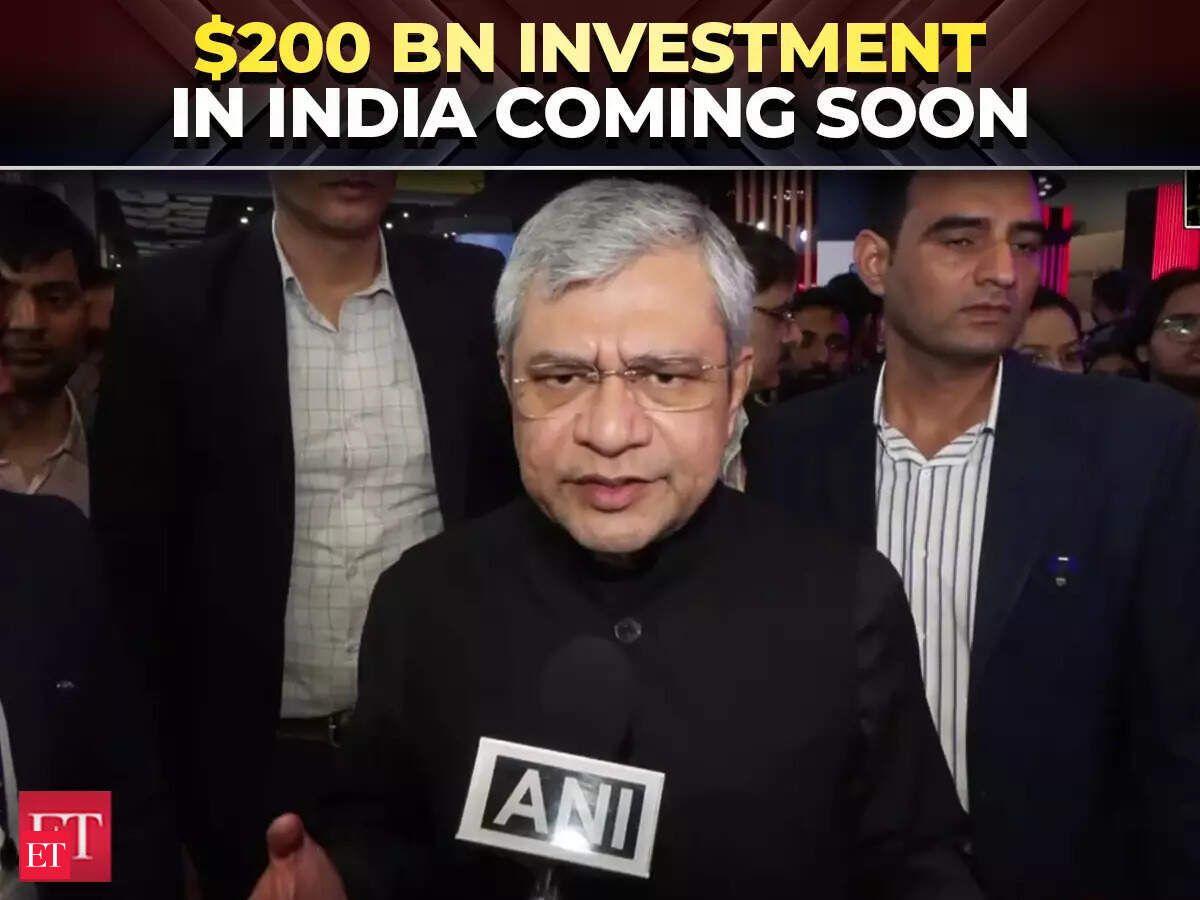
Source: ET
The government expects an additional $17 billion to flow into deep-tech and AI applications, signaling a strategic shift beyond infrastructure to capture more of the AI value chain
1
. Prime Minister Narendra Modi, addressing the AI Impact Summit, declared that "India should be among the top three AI superpowers globally, not just in the consumption of AI but in creation"3
. The initiative is backed by tax incentives, a ₹100 billion (about $1.1 billion) government-backed venture program targeting high-risk areas, and policy support including extending the startup qualification period for deep-tech companies to 20 years1
.Adani Group Commits $100 Billion to Build AI-Ready Data Centers
Adani Group announced a $100 billion investment over the next decade to build renewable-energy-powered hyperscale data centers specialized for AI workloads across India
2
. The conglomerate expects this commitment to catalyze an additional $150 billion in related investments, creating a $250 billion AI infrastructure ecosystem by 20352
. Chairman Gautam Adani described the plan as a long-term bet on the convergence of energy and computing, stating that "India will not be a mere consumer in the AI age"2
.
Source: Gadgets 360
The plan calls for deploying up to 5 gigawatts of data-center capacity, building on AdaniConneX's existing 2 gigawatts of capacity developed through its joint venture with U.S.-based EdgeConneX
2
. The company is developing large-scale AI data-center campuses in Visakhapatnam and Noida, with additional facilities planned for Hyderabad and Pune2
. Central to this strategy is Adani's renewable energy portfolio, including its 30-gigawatt Khavda renewable project in western India, with more than 10 gigawatts already operational2
.IndiaAI Mission Expands Compute Capacity and GPU Access
The IndiaAI Mission, which currently operates 38,000 GPUs rented to local companies for ₹65 ($0.72) an hour, will add another 20,000 units in the coming weeks, Vaishnaw announced
3
. This expansion represents the next phase of India's strategy to democratize access to AI infrastructure beyond a small group of companies1
. The minister noted that venture capital investors are committing funds across all five layers of India's AI stack, including deep-tech startups, applications, and cutting-edge model research4
.
Source: NVIDIA
The government is preparing a second phase of its AI Mission with stronger focus on research and development, innovation, and wider diffusion of AI tools
1
. This aligns with India's goal to build sovereign AI capabilities, enabling the country to develop artificial intelligence based on its own infrastructure, data, and industry without depending on foreign providers5
.Related Stories

Nvidia Expands Partnerships with Indian Venture Capital Firms
Nvidia announced partnerships with major Indian venture capital firms including Peak XV, Z47, Elevation Capital, Nexus Venture Partners, and Accel India to identify and fund AI startups
5
. More than 4,000 AI startups in India have already joined Nvidia's global startup program, which helps tech companies build, scale, and go to market5
. The chip designer is also collaborating with Indian cloud providers such as Yotta, Larsen & Toubro, and E2E Networks to provide AI chip clusters and help build data centers5
.Nvidia is supporting Indian companies through its Nemotron models, which organizations can use to train new AI systems on India-specific data and language, supporting the country's sovereign AI goals
5
. Though CEO Jensen Huang withdrew from attending the AI Impact Summit due to "unforeseen circumstances," Vaishnaw confirmed the company is working with Indian firms on large investments in AI infrastructure4
.Challenges and Strategic Advantages in India's AI Ambitions
The push faces structural challenges, including access to reliable power and water for energy-intensive data centers, highlighting execution risks as India seeks to compress years of AI infrastructure build-out into a shorter timeframe
1
. Vaishnaw acknowledged these pressures but pointed to India's energy mix, with more than half of installed generation capacity coming from clean sources, as an advantage as demand from data centers rises1
.Adani plans to co-invest in domestic manufacturing of critical components such as transformers, power electronics, and thermal management systems to reduce exposure to global supply chain disruptions
2
. The AI Impact Summit, attended by more than a dozen heads of state from countries including France and Brazil, alongside leaders from Microsoft, Google, and Anthropic, underscores India's growing importance in global AI strategy4
. Whether India can deliver on this vision will matter beyond its borders, as companies seek new locations for AI computing amid rising costs, capacity constraints, and intensifying competition in the global AI race.References
Summarized by

Navi
[2]
[3]
Related Stories
Nvidia Accelerates AI Push in India with Strategic Partnerships and Infrastructure Expansion
22 Oct 2024•Technology

India's Robotics and Manufacturing Sectors Embrace NVIDIA AI and Omniverse for Innovation
24 Oct 2024•Technology

NVIDIA CEO Highlights India's Potential to Lead Global AI Revolution
22 Oct 2024•Technology

Recent Highlights
1
Apple Plans Major Siri AI Overhaul in iOS 27 With Third-Party Chatbot Integration
Technology

2
OpenAI shuts down Sora after six months, ending Disney's $1 billion licensing partnership
Technology

3
AI chatbots validate you too much, making you less kind to others, Stanford study reveals
Science and Research

Recent Highlights
Today's Top Stories







Your Daily Dose of Curated AI News
Don’t drown in AI news. We cut through the noise - filtering, ranking and summarizing the most important AI news, breakthroughs and research daily. Spend less time searching for the latest in AI and get straight to action.

