AMD brings Ryzen AI processors to desktops with NPU for first time, targets business PCs


12 Sources
12 Sources
[1]
AMD will bring its "Ryzen AI" processors to standard desktop PCs for the first time
AMD has been selling "Ryzen AI"-branded laptop processors for around a year and a half at this point. In addition to including modern CPU and GPU architectures, these attempting to capitalize on the generative AI craze by offering chips with neural processing units (NPUs) suitable for running language and image-generation models locally, rather than on some company's server. But so far, AMD's desktop chips have lacked both these higher-performance NPUs and the Ryzen AI label. That changes today, at least a little: AMD is announcing its first three Ryzen AI chips for desktops using its AM5 CPU socket. These Ryzen AI 400-series CPUs are direct replacements for the Ryzen 8000G processors, rather than the Ryzen 9000-series, and they combine Zen 5-based CPU cores, RDNA 3.5 GPU cores, and an NPU capable of 50 trillion operations per second (TOPS). This makes them AMD's first desktop chips to qualify for Microsoft's Copilot+ PC label, which enables a handful of unique Windows 11 features like Recall and Click to Do. The six chips AMD is announcing today -- the 65 W Ryzen AI 7 Pro 450G, Ryzen AI 5 Pro 440G, and Ryzen AI 5 Pro 435G, along with low-power 35 W "GE" variants -- all bear AMD's "Ryzen Pro" branding as well, which means they support a handful of device management capabilities that are important for business PCs managed by IT departments. At this point, it doesn't seem as though AMD will be offering boxed versions to regular consumers; the Ryzen AI desktop chips will appear mainly in business PCs that don't need a dedicated graphics card, but which do benefit from more robust graphics than AMD offers in regular Ryzen desktop CPUs. Like past G-series Ryzen chips, these are essentially laptop silicon repackaged for desktop systems. They share most of their specs in common with Ryzen AI 300 laptop processors, despite their Ryzen AI 400-series branding. The two chip generations are extremely similar overall, but the Ryzen AI 400-series laptop CPUs include slightly faster 55 TOPS NPUs. Unlike past launches, AMD is not providing its top-end laptop silicon for desktop use, at least not yet. None of these chips include the full compliment of 12 CPU cores that you can get in the Ryzen AI 9 HX 375 or 370; you also can't get the Radeon 880M or Radeon 890M integrated GPUs. The three models AMD is announcing today top out at 8 CPU cores (likely split evenly between the faster Zen 5 cores and slower, smaller, and more power-efficient Zen 5c cores) and a Radeon 860M integrated GPU with 8 RDNA 3.5 graphics cores. AMD could always decide to release higher-end processor options at a later date, but the fact is that it makes little financial sense to try and build mini gaming PCs around socket AM5 processors right now. These need pairs of fast DDR5 sticks to maximize their performance, and prices for fast DDR5 sticks have shot into the stratosphere over the last year. It's hard to make any kind of gaming PC make financial sense right now, but the frames-per-second-per-dollar you get from a desktop iGPU make them particularly unappealing. This may explain why the CPUs are targeting business desktops first. The Ryzen AI 400 desktop CPU announcement is in line with what AMD announced at CES earlier this year: low-key iterations on existing technology that do little to push the envelope. Maybe that's the best that we can expect, given current RAM and storage shortages and the fact that most of the world's chipmakers are all competing for manufacturing capacity at TSMC.
[2]
AMD details Ryzen AI 400 desktop with up to 8 cores, Radeon 860M graphics -- APUs won't be available as boxed units, only in OEM systems
After teasing desktop Ryzen AI 400 processors at the beginning of the year, AMD has finally provided details on its new (but slim) desktop product stack. Previously known as "Gorgon Point," the desktop range shares DNA with the Ryzen AI 400 mobile lineup, carrying the same Zen 5 CPU cores and RDNA 3.5 graphics with a focus on power efficiency over peak performance. AMD is offering two variations of the processors, one with the PRO designation for enterprise and another without it, but neither will be available as boxed retail units. At this time, they'll only show up in OEM systems. The desktop lineup features three processors and six total SKUs. For each chip, AMD is offering 65W and 35W versions, again showcasing how similar these chips are to AMD's mobile offerings. The top-end Ryzen AI 7 450G comes with eight Zen 5 cores, 16 threads, a boost clock of 5.1 GHz, 24MB of cache, and Radeon 860M graphics with eight RDNA 3.5 CUs. There are two six-core offerings with the 440G and 435G, which only differ in maximum boost clock and cache amount. Both include Radeon 840M graphics with four RDNA 3.5 CUs. AMD is using a 65W TDP for these chips, and the 35W versions are noted with an "E" suffix (i.e. Ryzen AI 7 450GE). Otherwise, the specs are identical, from the core counts and iGPU to the maximum boost clock speeds. The differentiator compared to AMD's other consumer chips is the 50 TOPS NPU, earning them Microsoft's Copilot+ certification. The silicon here, including the NPU, GPU, and CPU, is identical to the mobile Ryzen AI 400 lineup. The 450 on desktop is identical to the 450 on mobile, short of the power limit and form factor. As with all Zen 5 chips, Ryzen AI 400 desktop CPUs slot into the AM5 socket. Although the silicon is identical, AMD is only pushing out the bottom rung of its Gorgon Point lineup on desktop right now. On mobile, AMD climbs up to the Ryzen AI 9 HX 475, which features a 60 TOPS NPU, Radeon 890M graphics with 16 RDNA 3.5 CUs, and 12 cores that can boost up to 5.2 GHz. AMD hasn't made any performance claims about the desktop chips yet, which isn't surprising given this is a new category of product for Team Red. Given that the thermal design is similar and the silicon is nearly identical, we expect to see slightly higher overall performance from the Ryzen AI 400 desktop offerings compared to their mobile counterparts. As we've seen with consumer chips like the Ryzen 7 9700X and Ryzen 5 9600X, Zen 5 is fairly efficient around 65W, with the optional 105W TDP mode offering only slightly higher performance for nearly double the power. AMD will only offer these APUs in OEM systems for now. They come with Copilot+ certification, which calls for more than just an NPU. Critically, Copilot+ calls for at least 16GB of system memory, which is a variable AMD can't control with boxed retail units. For now, AMD says commercial designs with these chips will be available in Q2 2026. In total, AMD says it will have over 200 commercial designs available with its PRO chips, but that includes mobile offerings as well. Some of the OEMs AMD is working with include Acer, Asus, Dell, HP, and Lenovo. As you can see in the slide above, AMD is featuring smaller desktop designs, which is likely where we'll see Ryzen AI 400 desktop chips in action. In addition to desktop offerings, AMD is introducing its Ryzen AI PRO 400 series for mobile, which mirrors the consumer lineup in the product naming and specs, as you can see in the table above. With both the mobile and desktop offerings, the PRO validation is what sets these chips apart from AMD's consumer lineup. AMD includes additional features, like a multi-layer security ecosystem and manageability for IT administrators. We should see designs with these CPUs roll out shortly. We've asked AMD if we can expect the lineup to expand up to AMD's 12-core Gorgon Point design that we see on mobile. We've also asked about the fate of the long-rumored Ryzen 9000G APU lineup, though we don't expect much news on that front at this time. Follow Tom's Hardware on Google News, or add us as a preferred source, to get our latest news, analysis, & reviews in your feeds.
[3]
AMD Packs an NPU Into Ryzen Desktop Processors Built for AI
AMD is trying to appeal to businesses with desktop processors optimized for AI applications, including Microsoft's Copilot+. At Mobile World Congress, it introduced the Ryzen AI Pro 400 Series, which doesn't just pack a CPU and a built-in GPU, but also a neural processing unit. At CES in January, AMD introduced its next-generation XDNA 2 NPU, which excels at running AI applications at low power. But at the time, the NPU was reserved for the company's consumer-focused Ryzen AI 400 series for laptops and mini PCs, which are slated to arrive this quarter. At MWC, AMD is talking up Ryzen Pro silicon for enterprises. The chip maker is expanding the XDNA 2 NPU to desktops as Microsoft and other software companies push more generative AI applications in the workplace. In a briefing, AMD specifically noted that the new desktop processors can run Copilot+ features, which have been limited to chips with dedicated AI processing power. It looks like the Ryzen AI Pro 400 Series will be the first desktop chips that can power Copilot+. The most powerful of the three chips, the Ryzen AI 7 Pro, features 8 CPU cores with an up to 5.1GHz in boost clock speeds along with 8 RDNA 3.5 GPU cores for graphics processing. Each chip also comes with a lower-power 35-watt variant, enabling PC makers to fit it into smaller desktop devices. Ryzen AI Pro 400 Comes to Laptops, Too For business laptops, AMD is introducing the Ryzen AI Pro 400 Series mobile processors, which also pack an XDNA 2 NPU and a built-in RDNA 3 GPU. There are six chips in the series, with up to 12 CPU cores and a boost clock speed of up to 5.2GHz. According to AMD, the chips can deliver up to 19.8 hours of battery life. Team Red also claims the most powerful processor in the series, the AMD Ryzen AI 9 HX Pro 470, can beat Intel's "Panther Lake" Core Ultra X7 358H in processing speeds, including for AI workloads. Like before, these AMD chips have also been optimized to run Microsoft Copilot+ features. AMD envisions using these processors to power next-generation AI PC laptops and more powerful mobile workstations. The first PCs with the new Ryzen AI Pro 400 chips are expected in Q2. AMD says over 200 "commercial designs" are in the works from companies including Acer, Asus, Lenovo, HP, and Dell.
[4]
AMD adds an AI-focused CPU to its Ryzen desktop lineup
* AMD has launched its Ryzen AI Pro 400 desktop CPUs with integrated GPU and XDNA 2 NPU. * These are the first desktop chips validated to power Windows Copilot+ features like Recall and Click to Do. * The three Pro SKUs (450G/450GE, 440G/440GE, 435G/435GE) target business PCs needing onboard graphics. Like pretty much every company, AMD is going all-in on AI. At MWC 2026, the chipmaker revealed its new Ryzen AI Pro 400 desktop CPU series, which features a CPU and built-in GPU, and a neural processing unit (NPU) focused on AI. Back at CES, AMD revealed its XDNA 2 NPU, but this CPU was reserved for its consumer Ryzen AI 400 series laptops and mini PCs, while it's new Ryzen AI Pro 400 chips are designed for the desktop. AMD says that its new desktop processors are designed to take advantage of Copilot+ features, which are limited to chips that include a dedicated AI processor. This makes the Ryzen AI Pro 400 series the first desktip chip to be able to officially power Microsoft'ss Copilot+, which offers several unique Windows 11 features, like Recall and Click to Do. In terms of the lineup, the Ryzen AI Pro 400 series includes following CPUs: Cores / Threads Frequency Cache (L2 + L3) NPU Tops Graphics Ryzen AI 7 450G / 450GE 8 /16 2 GHz / 5.1 GHz 24MB 50 Radeon 860M (8 CUs) Ryzen AI 5 440G / 440GE 6 / 12 2 GHz / 4.8 GHz 22MB 50 Radeon 840M (4 CUs) Ryzen AI 5 435G / 435GE 6 / 12 2 GHz / 4.5 GHz 14MB 50 Radeon 840M (4 CUs) These Ryzen AI desktop chips will likely primarily be featured in business-focused PCs that don't require dedicated graphics cards, but that still need somewhat powerful graphics architecture and Copilot+ compatibility. With this in mind, it's unlikely they'll be available to regular consumers. Qualcomm is already laying the groundwork for 6G Didn't we just get 5G? Posts By Patrick O'Rourke
[5]

AMD announces Ryzen AI 400 Series desktop chips with Zen 5, RDNA 3.5, and an XDNA 2 NPU
Serving tech enthusiasts for over 25 years. TechSpot means tech analysis and advice you can trust. What just happened? AMD has been slapping its "Ryzen AI" branding on laptops for over a year now. At MWC, the company announced that it is finally dragging the name into the desktop world with three AM5 Ryzen AI chips featuring dedicated NPUs. Announced today, the new Ryzen AI 400 Series and Ryzen AI PRO 400 Series desktop processors are being positioned as AMD's first real "AI PC" desktop lineup. They pair Zen 5 CPU cores with RDNA 3.5 integrated graphics and an XDNA 2 NPU rated at up to 50 TOPS for local acceleration. The new chips are being positioned as direct replacements for the 8000G-style APUs rather than anything meant to rival the Ryzen 9000 desktop CPUs - something the specs make clear. These are mainstream, iGPU-equipped parts designed for compact desktops, office machines, and budget builds that might not have a dedicated GPU. AMD's initial Ryzen AI 400 Series consists of three chips split into six SKUs, with each model offered in a standard 65W "G" version and a 35W "GE" low-power variant. At the top of the stack is the Ryzen AI 7 450G/450GE, an 8-core/16-thread part with up to a 5.1GHz boost clock, 24MB of total cache, Radeon 860M graphics, and the full 50 TOPS NPU. Radeon 860M packs 8 RDNA 3.5 compute units, which is a meaningful step up from the iGPU configurations typically seen in desktop CPUs that aren't APUs. The two Ryzen AI 5 options are both 6-core/12-thread: the 440G/440GE boosts up to 4.8GHz with 22MB cache, while the 435G/435GE tops out at 4.5GHz and drops to 14MB cache. Both use Radeon 840M integrated graphics (4 RDNA 3.5 CUs), but still keep the same "up to 50 TOPS" XDNA 2 NPU rating as the flagship. AMD is explicitly pitching the chips' on-device AI features for office work, developer tools, and "Copilot+ PC" experiences, and the 50 TOPS number aligns with Microsoft's current minimum requirement for that category of machine. Whether you care about Copilot branding or not, the practical point is that AMD now has a path to offload certain AI workloads without leaning entirely on a discrete GPU (or just hammering CPU cores), which could matter in small-form-factor desktops and all-in-ones where power and thermals are tight. AMD and multiple reports say these won't be sold as typical boxed retail CPUs at launch, with availability focused on OEM systems first. AMD specifically calls out major partners and says the first desktop systems with Ryzen AI 400 are expected in Q2 2026; that likely means you'll see them show up in prebuilds before they ever land on a shelf.
[6]

AMD punts Ryzen AI 400 to business desktops and laptops
AMD also launched Radeon AI Pro GPUs including the R9700 with 383 TOPS performance, positioning for AI workstations rather than consumer gaming markets. AMD's Ryzen AI Pro 400 chip will be offered as a desktop processor, giving users another option for a low-power, efficient desktop or mini PC. But AMD is marketing both its desktop and mobile Ryzen AI 400s under its Pro brand for businesses, apparently conceding that consumers will pass them by. Well, maybe that's not entirely true. There's nothing stopping a consumer buying one of the estimated 200 different PCs with a Ryzen AI Pro 400 (Gorgon Point) chip inside, including either a desktop, laptop, or even a workstation. They'll ship from the usual suspects, including Acer, Asus, Dell, HP, and Lenovo. Still, AMD's Ryzen AI 300 performance was outstanding, and the company marketed them at both consumers and corporations alike. Now, the Ryzen AI Pro 400 chips are being designed in with AMD's security initiatives for enterprises, alongside AMD's existing Radeon AI Pro lineup of GPUs. Well, AIPUs, anyway: Absolutely nothing of AMD's marketing mentions games, and instead positions the chips as powerful solutions for local LLMs. To reiterate the obvious: AMD is leaning hard into AI, and the corporate budgets willing to pay for it. The desktop chips are new, though: Socketed desktop processors that AMD tipped off when it announced the Ryzen AI 400 family. There are three, but in two flavors: The "G" series denotes a 65W chip, and the "GE" suffix indicates a 35W chip. All of the chips include an NPU with 50 TOPS, qualifying them for Copilot+ status on desktop PCs. They'll slot in to the AMD AM5 platform, supporting DDR5 memory modules of up to 8,533 megatransfers/s. * Ryzen AI 7 Pro 450G/450GE: 8 cores/16 threads, 2.0GHz base/5.1GHz turbo, 24MB total cache; Radeon 860M graphics w/8 CUs * Ryzen AI 5 Pro 440G/440GE: 6 cores/12 threads, 2.0GHz base/4.8GHz turbo, 22MB total cache; Radeon 840M graphics w/4 CUs * Ryzen AI 5 Pro 435G/435GE: 6 cores/12 threads, 2.0GHz base/4.5GHz turbo, 14MB total cache; Radeon 840M graphics w/4 CUs AMD's mobile Ryzen AI Pro 400 chips were spelled out earlier by AMD, and contain more information than AMD provided in a recent briefing. AMD's Ryzen AI Pro 400 chips don't use the performance or efficiency cores that Intel's Core Ultra or Qualcomm's Snapdragon X Elite chips do; instead, they use a "compact" version of the same core (Zen5c), typically manufactured in a finer 3nm process with a smaller die area. Remember, gamers still have AMD's superb Ryzen 9000X3D desktop chips, the Ryzen 9000X, and even the AMD Ryzen AI Max+ to choose from for desktop PCs and gaming. Still, we can at least hope that we'll see a consumer release of the Ryzen AI Pro 400 chips, eventually. Performance: It's all about the CPU Of the 2025 mobile platforms, AMD's strength was in CPU performance; Intel excelled in 3D, while Qualcomm's Arm architecture was the most energy efficient and competed strongly in battery life. The Ryzen AI Pro 400 should continue the trend, AMD says. AMD is expecting 20 percent faster single-core performance and 30 percent faster multithreaded performance in Cinebench 2026, alongside 50 percent faster rendering in the CPU-only Blender "Classroom" demo file. AMD also thinks that a Ryzen AI Pro 400 laptop should get about 19.8 hours of battery life using MobileMark 30, which uses a variety of real-world applications to estimate battery life. (I've struggled to find a good battery benchmark, and recently tested battery life using Netflix streaming as another metric.) GPUs? Or AIPUs? At Computex 2025, AMD launched the AMD Radeon AI Pro R9700, an AI-optimized GPU with 32GB of GDDR6 memory across a 256-bit memory bus. (More VRAM typically allows larger AI models to be run.) It featured 64 RDNA4 Compute Units (CUs), or about 4,096 streaming processors (SPs). Peak 8-bit precision (INT8 Matrix) performance is 383 TOPS, while single-precision FP32 performance is 47.8 TFLOPS. Now, AMD has announced the Radeon AI Pro 9600 as well for AI workstations, which also uses 32GB of GDDR6 memory across a 256-bit bus. But it has a smaller number of compute units, 48CUs, with 3,072 stream processors, running at a game frequency of 1,080MHz and a boost frequency of 2,020MHz. Peak 8-bit precision (INT8 Matrix) performance is 199 TOPS, or about half that of the R9700. The same goes for peak single-precision (FP32 vector) performance, at 24.8 TFLOPS. Finally, AMD also launched the Radeon AI Pro R9700S and Radeon AI Pro R9600D GPUs, both designed for enterprise racks.
[7]

AMD's new Ryzen desktop CPUs are all about AI with a powerful NPU for exclusive Copilot+ features -- but will anyone care?
AMD just revealed Ryzen AI 400 CPUs boasting an NPU with 50 TOPS at MWC 2026 * AMD reveals its Ryzen AI 400 series at MWC 2026 as the successor to the Ryzen 8000G range * These chips have been refocused on AI, with an NPU that hits 50 TOPS * It means a desktop PC will qualify for Windows 11's Copilot+ features Over at MWC 2026 AMD has revealed new Ryzen AI processors designed to bring a powerful NPU - and Copilot+ (AI) features - to desktop PCs. As TechSpot flagged up, the Ryzen AI 400 series (which comes alongside Pro variants for businesses) is built with Zen 5 CPU cores (as with Ryzen 9000), along with an RDNA 3.5 integrated GPU and an XDNA 2-powered NPU for accelerating on-device AI tasks. The idea is to provide a relatively wallet-friendly all-in-one processor for more budget-oriented PCs which don't have a discrete graphics card, bringing in the ability to use AI features with an NPU that's rated at 50 TOPS. That's fast enough to qualify as a Copilot+ PC and to access Windows 11's AI trappings therein, such as Windows Studio Effects for improving video chats. The flagship model is the Ryzen AI 7 450G, which offers eight cores (16 threads), 24MB of cache, and boosts up to 5.1GHz, packing Radeon 860M graphics. The latter is RDNA 3.5 and has eight Compute Units (CUs). There are also Ryzen AI 5 chips, the 440G and 435G, which have six cores (12 threads) and boost up to 4.8GHz and 4.5GHz respectively (with 22MB and 14MB cache). They step down to a Radeon 840M integrated GPU with four CUs, but all chips have the full-fat NPU with (up to) 50 TOPS. The TDP of these processors is 65W, but they also come in low-power versions (GE models) that only use 35W. According to TechSpot, AMD (and other sources) have said that these Ryzen AI 400 desktop models won't be sold as boxed standalone products, at least not initially - they'll be for PC makers (OEMs) instead. In other words, you'll likely only be able to buy prebuilt machines with these CPUs, with those PCs expected to debut in Q2 2026. However, later on, these chips should be available directly on retailer's shelves. Analysis: It's all about that AI As mentioned, these processors are targeted for budget builds with no GPU, or mini PCs, or indeed office computers (there are Ryzen AI Pro 400 versions as mentioned). If you're wondering where they fit in AMD's range of silicon, they're replacements for the old Ryzen 8000G offerings. So, they could theoretically be Ryzen 9000G chips, but due to the new AI slant - and that much more powerful NPU for the desktop - AMD has rejigged the naming to reflect this. These chips are mainly designed for efficiency (particularly the power-sipping GE variants) and the ability to run AI tasks swiftly, or indeed running (modest) LLMs (Large Language Models) locally. That isn't an exciting prospect for many folks, though, and a good deal of the early online feedback very much reflects this. The Ryzen AI 7 450G flagship will make a decent enough effort at casual gaming, but there's been some disappointment around the chip's performance levels in that respect, too. Mainly because the integrated GPU has fewer CUs than its flagship Ryzen 8000G predecessor, and so isn't much of a step forward. (It's architecturally more advanced, of course, being built on RDNA 3.5, which means a refreshed RDNA 3). Would you rather have had the extra chip space put into a powerful NPU so you can have Copilot+ offerings in Windows, or would you have rather had the effort put into a juicier integrated GPU for a machine that could handle a bit more gaming as well as office work? We'll have to see how pricing shakes out with the prebuilt PCs that turn up with Ryzen AI 400 processors inside, but obviously the likes of Lenovo, HP and Dell are going to struggle keeping a lid on price tags with the RAM crisis still very much making life miserable for anyone looking at buying (or upgrading) a computer. TechRadar is on the show floor for this year's MWC (Mobile World Congress) in Barcelona, Spain, and we'll be covering the latest news from some of the biggest names in mobile, computing, fitness and more. Follow TechRadar on Google News and add us as a preferred source to get our expert news, reviews, and opinion in your feeds. Make sure to click the Follow button! And of course, you can also follow TechRadar on YouTube and TikTok for news, reviews, unboxings in video form, and get regular updates from us on WhatsApp too.
[8]

AMD just gave desktop PCs an AI brain with the Ryzen AI 400 series
Mobile World Congress Read our complete coverage of Mobile World Congress Updated less than 2 minutes ago At MWC 2026 (Mobile World Congress), AMD announced a major expansion to its Ryzen AI processor lineup with the new Ryzen AI 400 and Ryzen AI PRO 400 series of desktop processors. These chips bring a dedicated NPU for strong on-device AI capabilities. After laptops getting the tag of Copilot+ compatible, this marks the first time its Ryzen AI processors support Copilot+ on desktops. What Ryzen AI 400 series brings to the table The new Ryzen AI 400 series of desktop processors combines multiple key technologies in a single package. It pairs high-performance Zen 5 CPU cores with AMD's integrated Radeon RDNA 3.5 graphics and a 2nd-gen AMD XDNA 2 NPU. Recommended Videos Each of the new chips in the Ryzen AI 400 lineup packs an NPU that is capable of up to 50 TOPS (trillions of operations per second) of AI compute for on-device AI tasks like inference, local LLM usage, and Copilot+ workflows. In other words, desktops powered by AMD's latest chips bring "Copilot+ PC" that can run intelligent assistance tools, productivity enhancements, and AI workflows that are independent from the cloud. There's a chip for everyone: consumers and businesses This time around, AMD didn't just stop with consumer-grade desktop chips. It hasalso introduced the Ryzen AI PRO 400 series aimed at enterprises and business users. These offer the same AI horsepower with added security, manageability, and enterprise-grade features. It basically allows OEMs to bring a broad lineup of next-gen AI PCs, from desktops to mobile workstations, to the market. Why this is big for AI PCs While Microsoft's focus on Copilot is still messy, integrating a dedicated NPU into mainstream desktop processors helps AMD tackle the growing demand for local AI compute. PCs previously relied on their dedicated GPU for AI workloads, but newer Ryzen-powered systems can have access to Copilot features without the added cost of a pricey component. It enables various features such as: Offline AI assistants and workflows On-device model inference without cloud reliance Enhanced productivity with context-aware computing Better privacy and data control by storing data locally The lineup is expected to hit the market sometime in Q2 2026, with partners like HP and Lenovo readying their offerings, based on the AM5 design.
[9]

AMD brings Ryzen AI 400G APUs to AM5 with Zen 5 (for system builders)
AMD has expanded its Socket AM5 desktop lineup with the Ryzen AI 400G series, based on the 4 nm "Gorgon Point" APU silicon. This marks AMD's second desktop APU generation for AM5 after the Ryzen 8000G family, but the focus is different this time around. Instead of centering the story on integrated graphics performance, Ryzen AI 400G is positioned around on-die AI acceleration, with an XDNA 2 NPU rated at 50 TOPS. AMD is effectively using the NPU as a defining feature for these parts, aligning them with the broader "AI PC" messaging that has been building across the industry. Under the hood, Gorgon Point also changes the CPU topology compared to Phoenix Point. Where the previous AM5 desktop APUs used a single CCX design with up to eight full-size CPU cores, Gorgon Point uses a dual-CCX layout that mixes two core types. One CCX carries four standard Zen 5 cores with 8 MB of shared L3 cache, while the second CCX carries four Zen 5c cores, again paired with 8 MB of shared L3 cache. Zen 5c is designed as a denser implementation of Zen 5, maintaining the same instruction set and similar IPC behavior, but typically operating at lower peak frequencies than the full-size cores. That split design can be advantageous for mixed workloads, but it also introduces the usual cross-complex considerations. When threads migrate between CCXs, the data path runs across Infinity Fabric, and that can add latency compared to keeping related threads and memory activity within a single complex. In desktop usage, how noticeable that becomes will depend on workload characteristics and OS scheduling behavior -- particularly for applications that are sensitive to synchronization, cache locality, or inter-thread communication. Model Cores / Threads Boost / Base Frequency TDP Total Cache Graphics Model Graphics Cores NPU TOPS AMD Ryzen AI 7 450G 8 / 16 Up to 5.1 GHz / 2.0 GHz 65 W 24 MB AMD Radeon 860M graphics 8 Up to 50 AMD Ryzen AI 5 440G 6 / 12 Up to 4.8 GHz / 2.0 GHz 65 W 22 MB AMD Radeon 840M graphics 4 Up to 50 AMD Ryzen AI 5 435G 6 / 12 Up to 4.5 GHz / 2.0 GHz 65 W 14 MB AMD Radeon 840M graphics 4 Up to 50 AMD Ryzen AI 7 450GE 8 / 16 Up to 5.1 GHz / 2.0 GHz 35 W 24 MB AMD Radeon 860M graphics 8 Up to 50 AMD Ryzen AI 5 440GE 6 / 12 Up to 4.8 GHz / 2.0 GHz 35 W 22 MB AMD Radeon 840M graphics 4 Up to 50 AMD Ryzen AI 5 435GE 6 / 12 Up to 4.5 GHz / 2.0 GHz 35 W 14 MB AMD Radeon 840M graphics 4 Up to 50 AMD Ryzen AI 7 PRO 450G 8 / 16 Up to 5.1 GHz / 2.0 GHz 65 W 24 MB AMD Radeon 860M graphics 8 Up to 50 AMD Ryzen AI 5 PRO 440G 6 / 12 Up to 4.8 GHz / 2.0 GHz 65 W 22 MB AMD Radeon 840M graphics 4 Up to 50 AMD Ryzen AI 5 PRO 435G 6 / 12 Up to 4.5 GHz / 2.0 GHz 65 W 14 MB AMD Radeon 840M graphics 4 Up to 50 AMD Ryzen AI 7 PRO 450GE 8 / 16 Up to 5.1 GHz / 2.0 GHz 35 W 24 MB AMD Radeon 860M graphics 8 Up to 50 AMD Ryzen AI 5 PRO 440GE 6 / 12 Up to 4.8 GHz / 2.0 GHz 35 W 22 MB AMD Radeon 840M graphics 4 Up to 50 AMD Ryzen AI 5 PRO 435GE 6 / 12 Up to 4.5 GHz / 2.0 GHz 35 W 14 MB AMD Radeon 840M graphics 4 Up to 50 AMD's segmentation choices are arguably the most telling part of this launch. The top Ryzen AI 7 450G is configured as an 8-core/16-thread part using a 4 Zen 5 + 4 Zen 5c arrangement, even though Gorgon Point is described as supporting higher total core counts in fully enabled configurations. Integrated graphics is also clearly being held back versus what the silicon can offer: the 450G exposes 8 compute units, while lower models drop to 4 compute units. Taken together, the configuration suggests AMD is prioritizing CPU capability and NPU throughput over delivering a desktop APU that targets mainstream 1080p gaming without a discrete GPU. The rest of the stack continues that theme, with Ryzen AI 5 models differentiated by how many Zen 5 versus Zen 5c cores are enabled. That approach lets AMD tune performance behavior by emphasizing higher-frequency "big" cores in one tier and leaning more heavily on dense cores in another, while keeping the same platform and NPU capability consistent across the range.
[10]

AMD's new Ryzen AI 400 Series desktop processors feature integrated Radeon 860M GPUs
TL;DR: AMD unveiled the Ryzen AI 400 and Ryzen AI PRO 400 Series desktop processors at Mobile World Congress, featuring integrated NPUs delivering up to 50 TOPS for advanced on-device AI and Copilot+ PC capabilities. These processors combine Zen 5 cores with RDNA 3.5 graphics, targeting enhanced AI acceleration and up to 30% faster multithreaded performance, with availability expected in Q2 2026. At the recent Mobile World Congress event in Barcelona, AMD announced that it was expanding its Ryzen AI lineup with a new series of desktop processors for next-gen AI and Copilot+ PC features. The new AMD Ryzen AI 400 Series and Ryzen AI PRO 400 Series desktop processors include a wide range of configurations, all of which support on-device AI with an integrated NPU, delivering up to 50 TOPS of AI performance. Like their mobile counterparts, this new desktop series blends AMD's 'Zen 5' CPU cores with RDNA 3.5 graphics and an XDNA 2 NPU. However, the desktop series appears more conservative in its offerings, as the flagship AMD Ryzen AI 7 450G features an 8-core, 16-thread processor with a boost clock of 5.1 GHz and Radeon 860M graphics with 8 Compute Units. Compared to the mobile Ryzen AI 9 HX 470's 12-core, 24-thread processor and Radeon 860M graphics with 16 Compute Units, the desktop lineup's pure graphics capabilities seem like a step down. That said, the goal here is to bring Ryzen AI to more users. For pure performance, the workstation-focused Ryzen AI PRO 400 Series reportedly delivers up to 30% faster multithreaded performance than competitive processors. "The desktop PC is evolving from a tool you use to an intelligent assistant that works alongside you," said Jack Huynh, senior vice president and general manager of the Computing and Graphics Group at AMD. "With the Ryzen AI 400 Series processors - the world's first designed to power new Copilot+ experiences on the desktop - we're bringing powerful AI acceleration that enables our partners to build systems that empower both enterprises and consumers to do more and create more." AMD notes that availability is expected in the second quarter of 2026, with these processors arriving in new offerings from OEM partners such as HP and Lenovo. Here's a look at the specs for the new Ryzen AI 400 Series and Ryzen AI PRO 400 Series desktop processors.
[11]
AMD Reveals Ryzen AI Pro 400 Series at MWC 2026
AMD used MWC 2026, which opened on March 2, to introduce the Ryzen AI Pro 400 series, a commercial processor family aimed at business laptops and compact desktops. The announcement is notable mostly because MWC is typically dominated by connectivity news, but AMD's focus here was client compute: CPU performance, integrated graphics capability, and on-device AI acceleration through an NPU. At the architectural level, Ryzen AI Pro 400 is described as a combination of Zen 5 CPU cores, RDNA 3.5 integrated graphics, and an XDNA 2 NPU. AMD positions the stack as "Pro," which brings the AMD Pro technology framework into play. AMD Pro is presented as four pillars: Security, Manageability, Quality, and Performance. In the provided information, Security receives the clearest breakdown, including Shadow Stack support in the Zen processing architecture, a Secure Processor enabling platform features such as TPM functionality and secure boot, and AMD Memory Guard to help protect data in system memory. Quality is explicitly tied to stability and support, suggesting an emphasis on validation and lifecycle consistency for enterprise deployments. Manageability is referenced as a pillar but not expanded upon in the text. Performance, as framed by AMD, is primarily the benefit of the Zen 5, RDNA 3.5, and XDNA 2 building blocks working together. AMD's mobile lineup spans three tiers: Ryzen AI 9 Pro, Ryzen AI 7 Pro, and Ryzen AI 5 Pro. The flagship model listed is the Ryzen AI 9 HX Pro 475, specified with 12 cores and 24 threads, 36 MB total cache, up to 5.2 GHz maximum boost clock, and an NPU rated at 60 TOPS. Integrated graphics for this part is identified as Radeon 890M with 16 compute units. Other mobile SKUs mentioned include the Ryzen AI 9 HX Pro 470 (noted with a 55 TOPS NPU rating) and the Ryzen AI 9 Pro 476 (10 cores / 20 threads, 34 MB cache, 50 TOPS NPU, Radeon 880M with 12 compute units), followed by Ryzen AI 7 Pro and Ryzen AI 5 Pro parts that scale down in cache, clocks, and iGPU configuration. Ryzen AI Pro 400 Series - Mobile SKUsCores / ThreadsBase FreqMax BoostTotal CacheNPUGraphicsCUsRyzen AI 9 HX Pro 47512/242.0GHz5.2GHz36MB60 TOPSRadeon 890M16Ryzen AI 9 HX Pro 47055 TOPSRyzen AI 9 Pro 47610/205.0GHz34MB50 TOPSRadeon 880M12Ryzen AI 7 Pro 4508/165.1GHz24MBRadeon 860M8Ryzen AI 5 Pro 4406/124.8GHz22MBRadeon 840M4 On desktop, AMD lists three "GE" models, with the Ryzen AI 7 Pro 450GE at the top. That chip is stated at 8 cores / 16 threads, up to 5.1 GHz boost, 24 MB total cache, a 50 TOPS NPU rating, and Radeon 860M graphics with 8 compute units. Two Ryzen AI 5 Pro desktop parts (440GE and 435GE) fill out the remainder. Ryzen AI Pro 400 Series-Desktop SKUsCores / ThreadsBase FreqMax BoostTotal CacheNPUGraphicsCUsRyzen AI 7 Pro 450GE8/162.0GHz5.1GHz24MB50 TOPSRadeon 860M8Ryzen AI 5 Pro 440GE6/124.8GHz22MBRadeon 840M4Ryzen AI 5 Pro 435GE4.5GHz14MB OEM systems using Ryzen AI Pro 400 are expected to arrive in Q2, with Acer, ASUS, Dell, HP, and Lenovo named as participating partners. AMD also briefly referenced RDNA 4-based Radeon AI Pro workstation graphics, listing R9700, R9700S, R9600, and R9600D, without providing further details during this segment.
[12]

AMD Unveils Ryzen AI 400 Desktop APUs: 8 CPU & GPU Cores, 50 TOPS, AM5 Socket Support
AMD has officially announced its Ryzen AI 400 Desktop APUs, featuring up to 8 CPU & 8 GPU cores on the AM5 platform. AMD Finally Brings Strix Point To AM5 Desktops With Ryzen AI 400 APUs, Currently Limited To OEMs AMD's Ryzen AI 400 APUs are finally coming to Desktop PCs, bringing the Strix Point architecture to more audiences. The new APUs feature the beloved Zen 5 CPU architecture, alongwith the first outing of RDNA 3.5 for desktop iGPUs. These APUs also bring the fastest NPU, XDNA 2, to desktops, so let's start with the full rundown of what the new series has to offer. First of all, AMD is calling its Ryzen AI 400 Desktop APUs the World's first next-gen AI desktop CPU with Copilot+ PC support. These APUs are designed to offer desktop-class performance with mobile-level efficiency, enabling them to run cool and quiet, and offering compact designs based on the AM5 platform. As for a high-level spec overview, the AMD Ryzen AI 400 lineup will consist of six SKUs. The desktop lineup includes the Ryzen AI 7 PRO 450G/450GE, Ryzen AI 5 PRO 440G/440GE, and the Ryzen AI 5 PRO 435G/435GE. The "G" series chips feature the RDNA 3.5 iGPU, while the "GE" chips don't feature integrated graphics. Starting with the specifications, the AMD Ryzen AI 7 450G series APUs feature up to 8 cores and 16 threads, with boost clocks of 5.1 GHz, 24 MB of combined cache, and Radeon 860M iGPU with 8 compute units. The Ryzen AI 5 series features 6 cores, 12 threads, up to 4.8 GHz clocks, 22 MB of cache, and a Radeon 840M iGPU with 4 compute units. All APUs feature 50 XDNA 2 NPU, AMD Pro Technologies, and the aforementioned Copilot+ support. It is interesting that AMD isn't bringing out full capabilities for desktop platforms yet. The Strix & Gorgon APUs on mobile platforms feature up to 12 CPU cores and up to 16 RDNA 3.5 compute units. So there's quite a difference in what the desktop and mobile platforms offer in terms of capabilities. Also, while the AMD Ryzen AI 400 lineup is designed for AM5 Desktops, the lineup will initially be limited to OEMs only. A standard DIY launch is not expected yet, but based on previous releases, we can expect it a few months after the Q2 2026 commercial availability. AMD is working with various partners, including Acer, ASUS, Dell, HP, and Lenovo, to bring Ryzen AI 400 Desktop APUs to shelves. Follow Wccftech on Google to get more of our news coverage in your feeds.
Share
Share
Copy Link
AMD announced its first Ryzen AI desktop processors at Mobile World Congress, marking the debut of NPU-equipped chips for standard desktop PCs. The Ryzen AI 400 Series features Zen 5 CPU cores, RDNA 3.5 graphics, and a 50 TOPS NPU, making them the first desktop chips certified for Microsoft's Copilot+ PC features. However, these won't be available as retail boxed units—only through OEM systems starting Q2 2026.
AMD Introduces Ryzen AI Desktop Processors with Dedicated NPU
AMD has officially brought its Ryzen AI branding to desktop processors for the first time, announcing the Ryzen AI 400 Series at Mobile World Congress 2026
1
. While AMD has been selling Ryzen AI-branded laptop processors for approximately a year and a half, desktop chips have lacked both higher-performance NPUs and the Ryzen AI label until now1
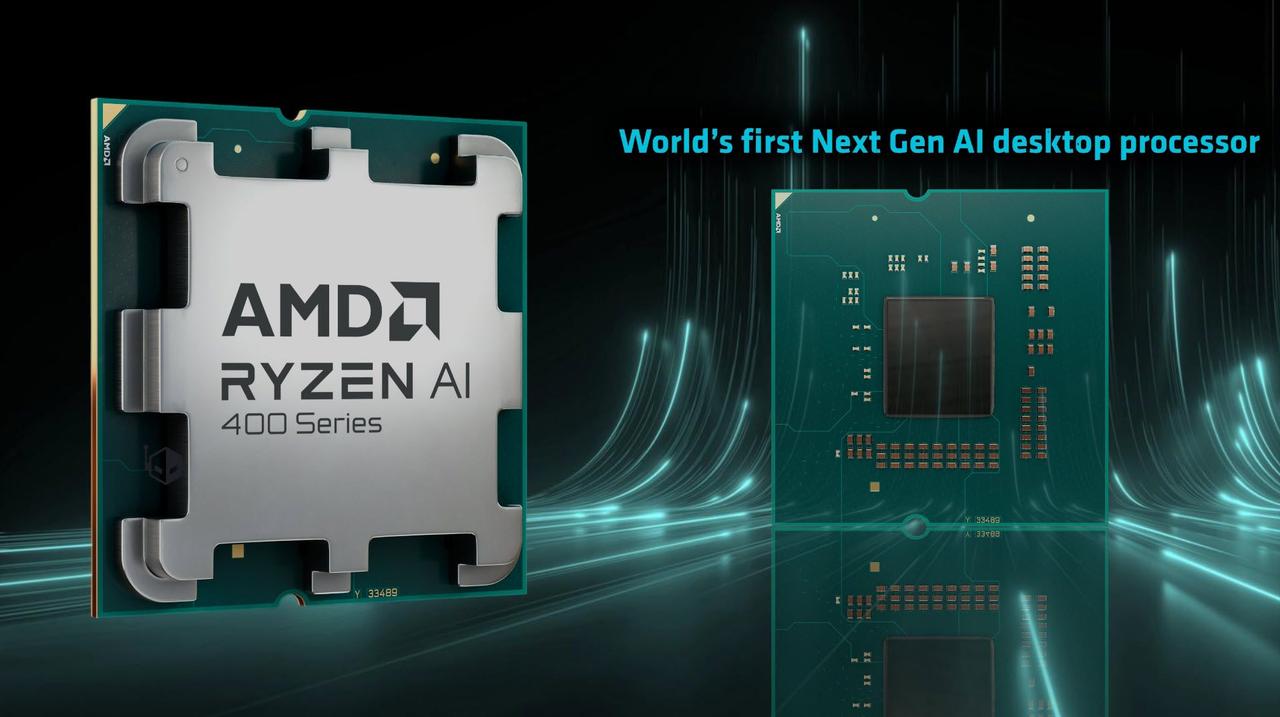
. The new lineup combines Zen 5 CPU cores, RDNA 3.5 graphics, and an XDNA 2 NPU capable of 50 TOPS, positioning these as AMD's first desktop chips to qualify for Microsoft's Copilot+ PC certification1
3
.
Source: Wccftech
Ryzen AI 400 Series Specifications Target Business PCs
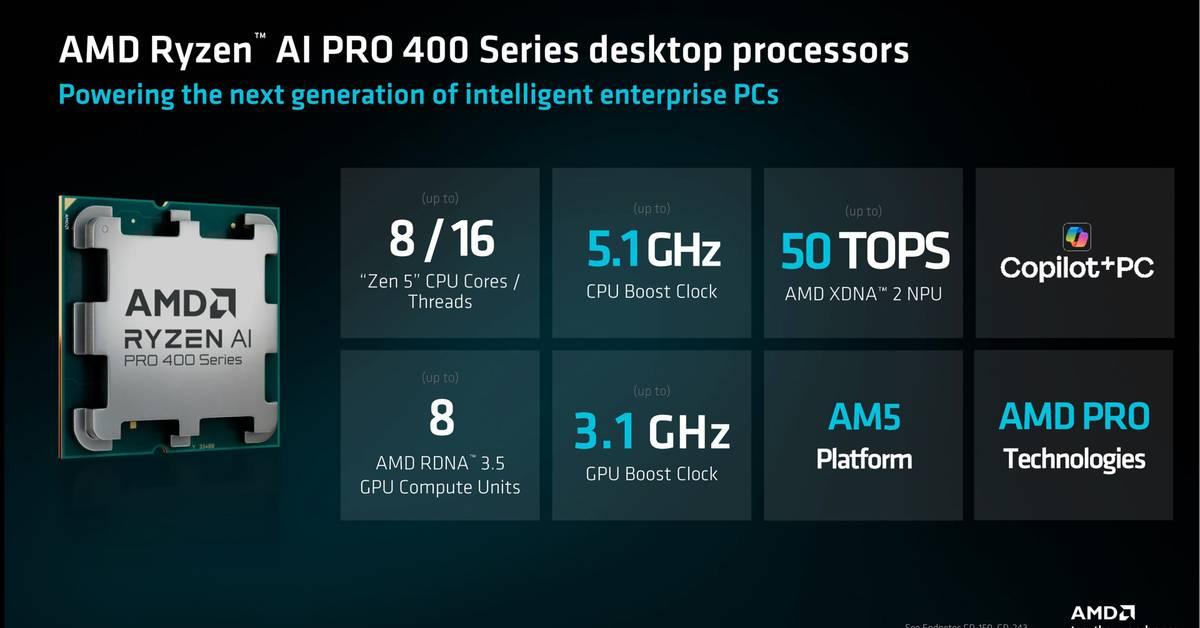
The desktop lineup features three processors with six total SKUs, as each chip is offered in both 65W and 35W versions
2
. The top-end Ryzen AI 7 450G comes with eight Zen 5 cores, 16 threads, a boost clock of 5.1 GHz, 24MB of cache, and Radeon 860M graphics with eight RDNA 3.5 CUs2
. The two six-core offerings, the Ryzen AI 5 440G and 435G, differ only in maximum boost clock and cache amount, both featuring Radeon 840M graphics with four RDNA 3.5 CUs2
. The 35W versions are noted with an "E" suffix, such as Ryzen AI 7 450GE, but maintain identical specs otherwise2
.
Source: XDA-Developers
These Ryzen AI desktop chips serve as direct replacements for the Ryzen 8000G processors rather than the Ryzen 9000-series, and they slot into the AM5 socket
1
5
. All six chips bear AMD's "Ryzen Pro" branding, supporting device management capabilities important for business PCs managed by IT departments1
.First Desktop Chips Validated for Copilot+ PC Features
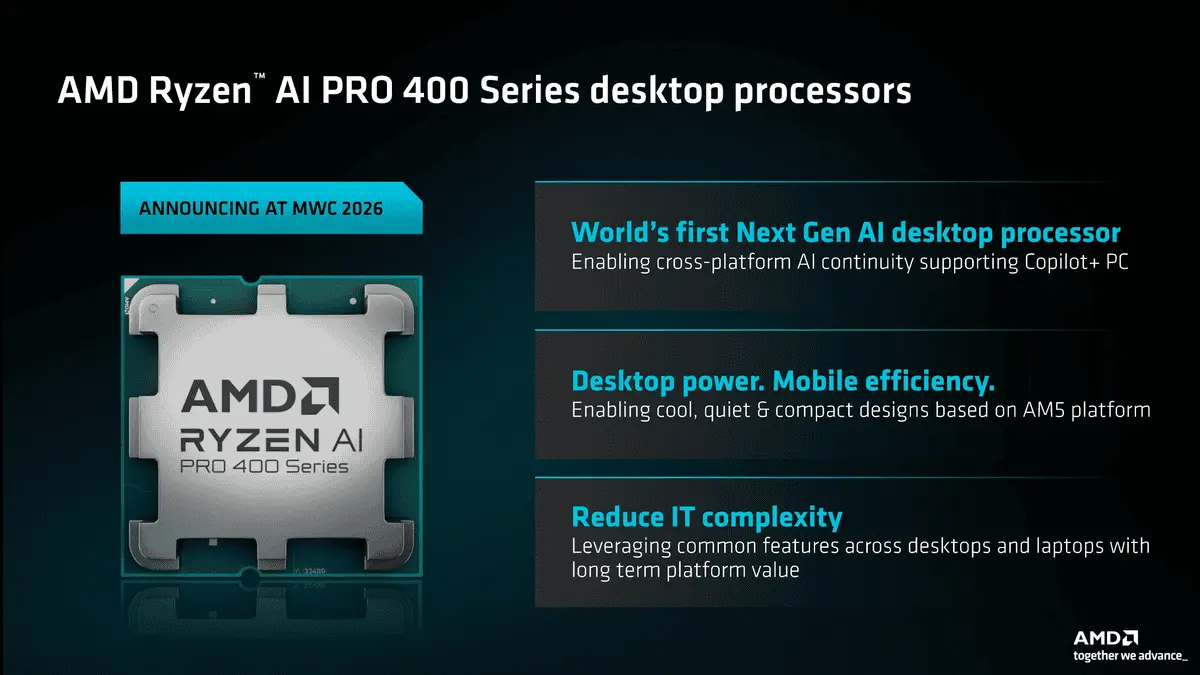
The differentiator compared to AMD's other consumer chips is the 50 TOPS NPU, earning them Microsoft's Copilot+ certification
2
. This makes the Ryzen AI 400 Series the first desktop chip to officially power Copilot+ PC, which enables unique Windows 11 features like Recall and Click to Do1
4
. AMD is explicitly pitching the chips' on-device AI features for office work, developer tools, and AI PC experiences5
. The practical benefit is that AMD now has a path to offload certain AI workloads without leaning entirely on discrete GPUs, which matters in small-form-factor desktops and all-in-ones where power and thermals are tight5
.
Source: Tom's Hardware
OEM Systems Only: No Retail Boxed Units Available
AMD will only offer these APUs in OEM systems for now, with no boxed versions available to regular consumers
1
2
. The Ryzen AI desktop chips will appear mainly in business PCs that don't need dedicated graphics cards but benefit from more robust integrated graphics than AMD offers in regular Ryzen desktop CPUs1
. Copilot+ certification calls for at least 16GB of system memory, which is a variable AMD can't control with boxed retail units2
. Commercial designs with these chips will be available in Q2 2026, with AMD partnering with major OEMs including Acer, Asus, Dell, HP, and Lenovo2
3
.Related Stories

Desktop Silicon Mirrors Mobile Lineup with Gorgon Point Architecture
Like past G-series Ryzen chips, these are essentially laptop silicon repackaged for desktop systems
1
. Previously known as "Gorgon Point," the desktop range shares DNA with the Ryzen AI 400 mobile lineup, carrying the same Zen 5 CPU cores and RDNA 3.5 graphics with a focus on power efficiency over peak performance2
. The silicon, including the NPU, GPU, and CPU, is identical to the mobile Ryzen AI 400 lineup2
. However, AMD is only pushing out the bottom rung of its Gorgon Point lineup on desktop right now, as the mobile range climbs up to the Ryzen AI 9 HX 475 with a 60 TOPS NPU, Radeon 890M graphics with 16 RDNA 3.5 CUs, and 12 cores that can boost up to 5.2 GHz2
.Market Positioning Reflects Current Hardware Economics
The announcement aligns with what AMD revealed at CES earlier this year: low-key iterations on existing technology that do little to push the envelope
1
. AMD is not providing its top-end laptop silicon for desktop use, at least not yet, as none of these chips include the full complement of 12 CPU cores available in higher-end mobile processors1
. The fact that it makes little financial sense to build mini gaming PCs around socket AM5 processors right now may explain why the AI-focused CPU targets enterprise and business desktops first1
. These processors need pairs of fast DDR5 sticks to maximize performance, and prices for fast DDR5 have shot into the stratosphere over the last year, making desktop iGPU builds particularly unappealing for gaming1
.References
Summarized by

Navi
[2]
[3]
[4]
Related Stories
AMD unveils Ryzen AI 400 Series with 60 TOPS, challenging Intel and Qualcomm in AI PC race
06 Jan 2026•Technology
AMD Launches Ryzen AI PRO 300 Series: Powering Next-Gen Enterprise AI PCs
11 Oct 2024•Technology

AMD Unveils AI-Optimized Processors at CES 2025, Advancing AI PC Market
01 Jan 2025•Technology

Recent Highlights


Recent Highlights
Today's Top Stories










Your Daily Dose of Curated AI News
Don’t drown in AI news. We cut through the noise - filtering, ranking and summarizing the most important AI news, breakthroughs and research daily. Spend less time searching for the latest in AI and get straight to action.

