Samsung and AMD formalize HBM4 supply deal, explore foundry partnership for next-gen AI chips


12 Sources
12 Sources
[1]
Samsung Agrees to Supply Next-Generation AI Memory to AMD
Samsung Electronics Co. agreed to supply and collaborate with Advanced Micro Devices Inc. on next-generation AI memory and computing technologies. Under a preliminary agreement, Samsung will provide next-generation high-bandwidth memory, HBM4, as the primary supplier for AMD's MI455X accelerators used in corporate data centers, the companies said in a joint statement Wednesday. Samsung will also supply DDR5 memory chips for AMD's Helios system based on the MI455X and the new Venice central processing unit design, according to the agreement signed by AMD Chief Executive Officer Lisa Su and Samsung co-CEO Jun Young-hyun in Pyeongtaek, south of Seoul. The two companies also agreed to discuss opportunities for foundry partnership. AMD is widely regarded as Nvidia Corp.'s closest rival in chips for developing and running artificial intelligence software. AMD has built a new multibillion-dollar AI business in recent years, boosting its revenue and earnings. Investors who have bid up its stock are looking for clearer signs it can capture a larger share of the tens of billions of dollars in orders dominated by Nvidia. Related Story: AMD Unveils New Chip for Corporate Data Centers, Talks Up Demand The South Korean chipmaker is already a key supplier of 12-layer HBM3E that is paired with AMD's accelerators, MI350X and MI355X. Shares in Samsung extended their gains in Seoul, climbing as much as 7.8% ahead of the announcement.
[2]
Samsung Elec and AMD sign MoU on AI memory, explore foundry partnership
SEOUL, March 18 (Reuters) - Samsung Electronics (005930.KS), opens new tab and Advanced Micro Devices (AMD) (AMD.O), opens new tab signed a memorandum of understanding to expand their strategic partnership on memory chip supplies for artificial intelligence infrastructure, the companies said on Wednesday. The agreement will focus on supplying Samsung's next-generation high-bandwidth memory (HBM4) for AMD's upcoming Instinct MI455X AI accelerators, as well as optimised DDR5 memory for AMD's sixth-generation EPYC processors, they said in a statement. The companies will also discuss opportunities for a foundry partnership, under which Samsung could provide contract chip manufacturing services for next-generation AMD products. Under the agreement, Samsung will position itself as a key HBM4 supplier for AMD's next-generation AI GPUs. The South Korean firm has already been a primary HBM supplier for AMD, supplying HBM3E chips used in AMD's MI350X and MI355X accelerators. The agreement comes during the week of Nvidia's annual developer conference GTC, where CEO Jensen Huang on Monday announced a foundry partnership with the Korean firm and praised its HBM4 chips. The tie-up highlights a broader race among global chipmakers to lock in long-term supply partnerships for advanced memory, as AI-driven demand reshapes the semiconductor industry and tightens supply of HBM chips. Last month, AMD said it had agreed to sell up to $60 billion worth of AI chips to Meta Platforms (META.O), opens new tab over five years, a deal that allows the Facebook owner to purchase as much as 10% of the chips. AMD signed a similar deal with OpenAI last year. Samsung, the world's largest memory chipmaker, has been seeking to narrow the gap with rivals in the fast-growing HBM segment. It holds about a 22% share of the global HBM market, compared with market leader SK Hynix's (000660.KS), opens new tab 57%, according to Counterpoint. Reporting by Heekyong Yang Editing by Ed Davies Our Standards: The Thomson Reuters Trust Principles., opens new tab
[3]
Samsung and AMD Expand Strategic Collaboration on Next-Generation AI Memory Solutions
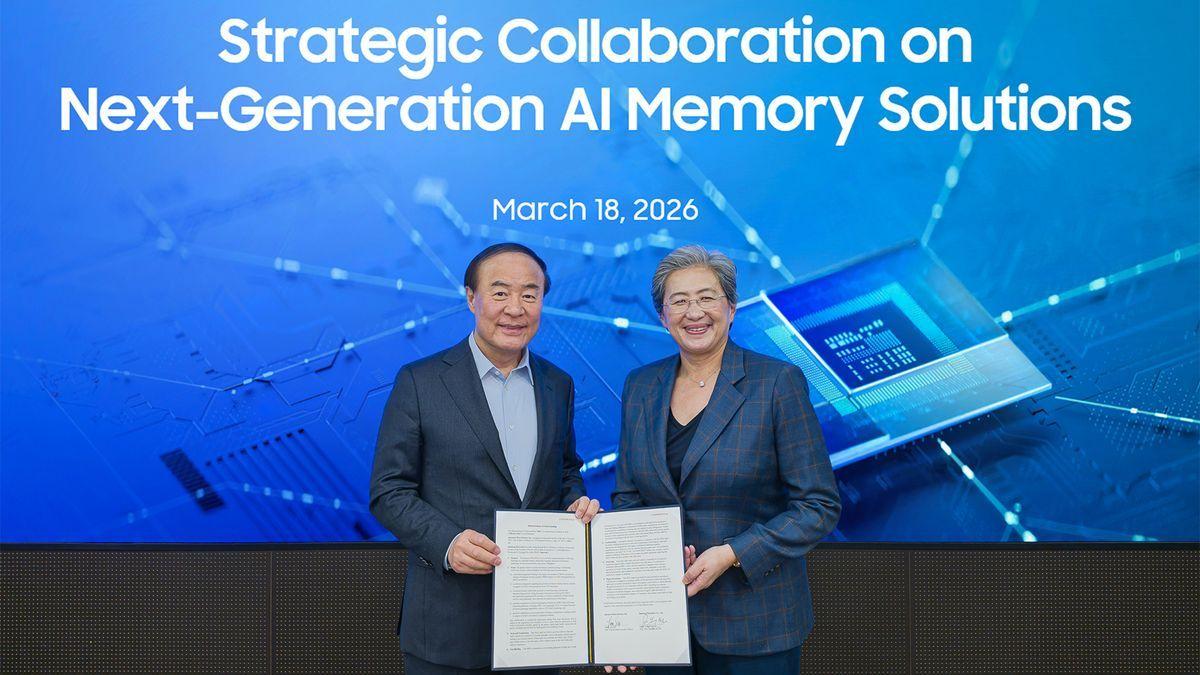
The companies will collaborate on industry-leading HBM4 supply for AMD Instinct™ MI455X GPUs and next-generation DDR5 solutions for AMD EPYC™ processors and the AMD Helios platform Samsung Electronics today announced it has signed a Memorandum of Understanding (MOU) with AMD to expand their strategic collaboration on next-generation AI memory and computing technologies. The signing ceremony was held at Samsung's most advanced chip manufacturing complex in Pyeongtaek, Korea, attended by Dr. Lisa Su, Chair and CEO of AMD, and Young Hyun Jun, Vice Chairman & CEO of Samsung Electronics. "Samsung and AMD share a commitment to advancing AI computing, and this agreement reflects the growing scope of our collaboration," said Young Hyun Jun, Vice Chairman & CEO of Samsung Electronics. "From industry-leading HBM4 and next-generation memory architectures to cutting-edge foundry and advanced packaging, Samsung is uniquely positioned to deliver unrivaled turnkey capabilities that support AMD's evolving AI roadmap." "Powering the next generation of AI infrastructure requires deep collaboration across the industry," said Dr. Lisa Su, Chair and CEO of AMD. "We are thrilled to expand our work with Samsung, bringing together their leadership in advanced memory with our Instinct GPUs, EPYC CPUs and rack-scale platforms. Integration across the full computing stack, from silicon to system to rack, is essential to accelerating AI innovation that translates into real-world impact at scale." Under the MOU, Samsung and AMD will align on primary HBM4 supply for the next-generation AMD AI accelerator, the AMD Instinct MI455X GPU, as well as advanced DRAM solutions for 6 Gen AMD EPYC CPUs, codenamed "Venice." These technologies will support next-generation AI systems combining AMD Instinct GPUs, AMD EPYC CPUs and rack-scale architectures such as the AMD Helios platform. Samsung and AMD are closely collaborating on advanced memory technologies for AI and data center workloads. As memory bandwidth and power efficiency become increasingly critical to system-level performance, this collaboration will help deliver more optimized AI infrastructure for customers. An industry-first to enter mass production, Samsung's HBM4 is built on its most advanced 6th-generation 10-nanometer (nm)-class DRAM process (1c) and a 4nm logic base die, featuring processing speeds of up to 13 gigabits-per-second (Gbps) and maximum 3.3 terabytes-per-second (TB/s) bandwidth that exceeds industry standards. Powered by Samsung HBM4's industry-leading performance, reliability and energy efficiency, the AMD Instinct MI455X GPU is expected to be the optimum solution for high-performance systems handling AI model training and inference. The MI455X GPU will serve as a key building block for the AMD Helios rack-scale architecture, designed to deliver the performance and scalability required for next-generation AI infrastructure. As part of their collaboration, Samsung and AMD will also work together on high-performance DDR5 memory optimized for the 6 Gen AMD EPYC CPUs. The companies aim to deliver industry-leading DDR5 memory solutions for systems built on the AMD Helios rack-scale architecture. The two companies will also discuss opportunities for foundry partnership, through which Samsung would provide foundry services for next-generation AMD products. Samsung and AMD have collaborated for nearly two decades across graphics, mobile and computing technologies, including Samsung serving as the primary HBM3E partner to AMD, powering the latest AMD Instinct MI350X and MI355X AI accelerators.
[4]
AMD's Lisa Su courts Korea: Samsung HBM4 sealed, Naver next
AMD CEO Lisa Su broadened the company's collaboration with Samsung Electronics on next-generation artificial intelligence (AI) memory and met with regional partners, including Naver, during a visit to South Korea. Samsung, AMD formalize HBM4 cooperation Samsung said it has signed a memorandum of understanding (MOU) with AMD to expand strategic collaboration on next-generation AI memory and computing technologies. Under the agreement, Samsung will serve as the primary HBM4 supplier for AMD's next-generation AI accelerator, the Instinct MI455X GPU, and provide advanced DRAM solutions for sixth-generation AMD EPYC processors, codenamed "Venice." The collaboration will support AI systems integrating AMD Instinct GPUs, EPYC CPUs, and rack-scale architectures such as the AMD Helios platform, with the two companies also working on high-performance DDR5 memory optimized for EPYC processors. Samsung said its HBM4 is built on a sixth-generation 10-nanometer-class DRAM process with a 4nm logic base die, delivering speeds of up to 13 gigabits per second and bandwidth of up to 3.3 terabytes per second. The companies will also explore potential foundry collaboration for next-generation AMD products. Lisa Su visits Naver, discusses AI cooperation Earlier in the day, Su visited Naver's second headquarters, "1784" in Seongnam, and met with CEO Choi Soo-yeon to discuss AI cooperation, according to DealSite. "We will discuss how to collaborate more closely," Su said. Asked whether AMD would expand AI cooperation with Korean companies, she replied, "Of course." Su said plans to supply AI chips to Naver would be discussed further during the visit, while declining to elaborate on potential cooperation with Samsung's foundry business, adding that "there will be many discussions today." Industry observers expect AMD to strengthen its AI semiconductor supply cooperation with Naver, a major GPU customer in South Korea. Discussions may include expanding data center chip supply and developing sovereign AI infrastructure. Naver has ramped up investment in AI infrastructure, more than doubling capital expenditure to KRW1.3171 trillion from KRW580.3 billion the prior year, and has deployed a large-scale AI computing cluster using 4,000 of Nvidia's B200 GPUs. Industry sources said the talks could lead to a memorandum of understanding on semiconductor supply cooperation. Supply chain and foundry in focus Su's visit also includes a trip to Samsung's Pyeongtaek campus, where she is expected to meet senior executives -- including vice chairman and Device Solutions head Young Hyun Jun and foundry business head Han Jin-man -- and tour semiconductor production lines, according to The Elec. The primary focus of discussions is expected to be high-bandwidth memory, as AMD currently uses Samsung's HBM3E in its MI300 series AI accelerators. Future products, including the MI450 and MI500 series, are expected to adopt HBM4, with Samsung seen as a likely supplier. Industry sources said AMD may explore Samsung's foundry services for next-generation AI accelerators or EPYC processors. Su is also expected to meet Samsung Electronics chairman Lee Jae-yong to discuss expanding HBM supply, and will visit Samsung's Seoul headquarters on March 19 for talks with Mobile eXperience head Roh Tae-moon. AMD CEO Lisa Su observes a semiconductor production line during a visit to Samsung's chip manufacturing complex on March 18. Credit: Samsung
[5]

Samsung Electronics and AMD sign MoU on AI memory, explore foundry partnership - The Economic Times
The agreement will focus on supplying Samsung's next-generation high-bandwidth memory (HBM4) for AMD's upcoming Instinct MI455X AI accelerators, as well as optimised DDR5 memory for AMD's sixth-generation EPYC processors, they said in a statement.Samsung Electronics and Advanced Micro Devices (AMD) signed a memorandum of understanding to expand their strategic partnership on memory chip supplies for artificial intelligence infrastructure, the companies said on Wednesday. The agreement will focus on supplying Samsung's next-generation high-bandwidth memory (HBM4) for AMD's upcoming Instinct MI455X AI accelerators, as well as optimised DDR5 memory for AMD's sixth-generation EPYC processors, they said in a statement. The companies will also discuss opportunities for a foundry partnership, under which Samsung could provide contract chip manufacturing services for next-generation AMD products. Under the agreement, Samsung will position itself as a key HBM4 supplier for AMD's next-generation AI GPUs. The South Korean firm has already been a primary HBM supplier for AMD, supplying HBM3E chips used in AMD's MI350X and MI355X accelerators. The agreement comes during the week of Nvidia's annual developer conference GTC, where CEO Jensen Huang on Monday announced a foundry partnership with the Korean firm and praised its HBM4 chips. The tie-up highlights a broader race among global chipmakers to lock in long-term supply partnerships for advanced memory, as AI-driven demand reshapes the semiconductor industry and tightens supply of HBM chips. Last month, AMD said it had agreed to sell up to $60 billion worth of AI chips to Meta Platforms over five years, a deal that allows the Facebook owner to purchase as much as 10% of the chips. AMD signed a similar deal with OpenAI last year. Samsung, the world's largest memory chipmaker, has been seeking to narrow the gap with rivals in the fast-growing HBM segment. It holds about a 22% share of the global HBM market, compared with market leader SK Hynix's 57%, according to Counterpoint.
[6]

AMD's Lisa Su Flies to South Korea Next Week to Secure Memory in a Market Where NVIDIA's CEO Calls Scarcity "Fantastic"
AMD's CEO, Lisa Su, is reportedly flying to South Korea next week to meet with executives to discuss memory and supply chain matters. For companies like AMD and NVIDIA, which are involved in the world's largest infrastructure buildout, it's probably in their best interests to keep their supply chain partners close, and we have already seen Jensen execute on this. NVIDIA's CEO visited Taiwan and South Korea several times last year to meet with supply chain executives, which has helped the firm maintain an edge in procuring capacity for its current and future products. It appears that AMD's CEO has become proactive in the AI supply chain as well, with Korean media reporting that she will visit South Korea by March 18. According to industry sources on the 11th, AMD CEO Lisa Su will visit Korea on the 18th. This will be her first visit since taking office in 2014. CEO Su plans to meet with key Korean partners, including Samsung Electronics Chairman Lee Jae-yong and Naver CEO Choi Soo-yeon, and discuss cooperation plans in areas such as data centers. - MK AMD's CEO meeting with executives from South Korea comes at a time when the company is moving into the next generation of AI infrastructure capabilities. We have already seen how determined Team Red is to compete against NVIDIA's offerings with its Instinct MI400 series, and at the same time, AMD has also made massive strides in the server CPU segment as well, which is why the company is confident to be a lot more aggressive in competing within the agentic AI segment alongside NVIDIA. And to ensure AMD can fulfill customer demand, Lisa Su appears determined to bring supply chain partners on board. One of the more important meetings is with Samsung's Chairman Jay Y. Lee, where the focus would likely be on discussing memory and semiconductors. AMD has been a key customer of Samsung's HBM business, becoming one of the first ones to secure HBM3E supply from the Korean giant, and it appears that Team Red will also be a crucial part of the HBM4 capacity Samsung has onboard. This time, Samsung's HBM business has become an important part of NVIDIA's supply chain as well, which means securing the desired capacity won't be as easy for AMD as it was before. AMD was also reported to be deepening its partnership with Samsung on the foundry front, as both parties discussed cooperation on 2nm chips for EPYC Venice CPUs. This ultimately indicates that Korean supply chain partners will be much more involved in AMDis operations going forward, which is why Lisa's visit to South Korea after more than a decade is significant. It's also important to realize that AMD competes in a market where NVIDIA loves "constraints", given that the latter has a much tighter grip on the supply chain.
[7]
AMD CEO to meet Samsung chief in South Korea amid race for AI memory chips, paper says
Su is set to visit South Korea on March 18 and plans to meet key partners such as Lee and Naver's CEO Choi Soo-yeon, the paper said on Wednesday, citing unnamed industry sources. Advanced Micro Devices' CEO Lisa Su will meet Samsung Electronics Chairman Jay Y. Lee in South Korea next week to discuss cooperation on securing supplies of high-bandwidth memory used in artificial intelligence chipsets, the Maeil Business Newspaper said. Su is set to visit South Korea on March 18 and plans to meet key partners such as Lee and Naver's CEO Choi Soo-yeon, the paper said on Wednesday, citing unnamed industry sources. Naver said a meeting between CEO Choi and AMD was scheduled, but declined to disclose the specific agenda. Samsung Electronics declined to comment. Su's meeting with Lee comes as demand surges for memory chips, including HBM, DRAM and NAND, with the technology used by AMD, Nvidia and other big tech firms in the race to build data centres and power AI systems. Su is also expected to discuss broader cooperation with Naver, the country's largest internet portal and search engine provider. These areas include expanding semiconductor supplies for data centres, building sovereign AI infrastructure and collaborating on next-generation computing technologies, the paper said. Her visit is expected to coincide with the week of Nvidia's annual developer conference, GTC, which runs from March 16 to 19 in the California city of San Jose.
[8]

Samsung & AMD Unite to Power Next-Gen AI Memory
The companies will collaborate on industry-leading HBM4 supply for AMD Instinct™ MI455X GPUs and next-generation DDR5 solutions for AMD EPYC™ processors and the AMD Helios platform Samsung Electronics today announced it has signed an agreement with AMD to expand their strategic collaboration on next-generation AI memory and computing technologies. The signing ceremony was held at Samsung's advanced chip manufacturing complex in Pyeongtaek, Korea, attended by Dr. Lisa Su, Chair and CEO of AMD, and Young Hyun Jun, Vice Chairman & CEO of Samsung Electronics. "Samsung and AMD share a commitment to advancing AI computing, and this agreement reflects the growing scope of our collaboration," said Young Hyun Jun, Vice Chairman & CEO of Samsung Electronics. "From industry-leading HBM4 and next-generation memory architectures to cutting-edge foundry and advanced packaging, Samsung is uniquely positioned to deliver unrivaled turnkey capabilities that support AMD's evolving AI roadmap." "Powering the next generation of AI infrastructure requires deep collaboration across the industry," said Dr. Lisa Su, Chair and CEO of AMD. "We are thrilled to expand our work with Samsung, bringing together their leadership in advanced memory with our Instinct GPUs, EPYC CPUs and rack-scale platforms. Integration across the full computing stack, from silicon to system to rack, is essential to accelerating AI innovation that translates into real-world impact at scale." Under the MOU, Samsung and AMD will align on primary HBM4 supply for the next-generation AMD AI accelerator, the AMD Instinct MI455X GPU, as well as advanced DRAM solutions for 6th Gen AMD EPYC CPUs, codenamed "Venice." These technologies will support next-generation AI systems combining AMD Instinct GPUs, AMD EPYC CPUs and rack-scale architectures such as the AMD Helios platform. Samsung and AMD are closely collaborating on advanced memory technologies for AI and data center workloads. As memory bandwidth and power efficiency become increasingly critical to system-level performance, this collaboration will help deliver more optimized AI infrastructure for customers. An industry-first to enter mass production, Samsung's HBM4 is built on its most advanced 6th-generation 10-nanomter (nm)-class DRAM process (1c) and a 4nm logic base die, featuring processing speeds of up to 13 gigabits-per-second (Gbps) and maximum 3.3 terabytes-per-second (TB/s) bandwidth that exceeds industry standards. Powered by Samsung HBM4's industry-leading performance, reliability and energy efficiency, the AMD Instinct MI455X GPU is expected to be the optimum solution for high-performance systems handling AI model training and inference. The MI455X GPU will serve as a key building block for the AMD Helios rack-scale architecture, designed to deliver the performance and scalability required for next-generation AI infrastructure. As part of their collaboration, Samsung and AMD will also work together on high-performance DDR5 memory optimized for the 6th Gen AMD EPYC CPUs. The companies aim to deliver industry-leading DDR5 memory solutions for systems built on the AMD Helios rack-scale architecture. The two companies will also discuss opportunities for foundry partnership, through which Samsung would provide foundry services for next-generation AMD products. Samsung and AMD have collaborated for nearly two decades across graphics, mobile and computing technologies, including Samsung serving as the primary HBM3E partner to AMD, powering the latest AMD Instinct MI350X and MI355X AI accelerators.
[9]

AMD boosts ties with Samsung, Naver during CEO's 1st Korea visit - The Korea Times
Jun Young-hyun, left, head of Samsung Electronics' Device Solutions Division, shakes hands with Advanced Micro Devices CEO Lisa Su, after signing a memorandum of understanding at the Korean company's semiconductor plant in Pyeongtaek, Gyeonggi Province, Wednesday. Courtesy of Samsung Electronics Advanced Micro Devices (AMD) CEO Lisa Su paid her first visit to Korea since her appointment in 2014, signaling the company's intent to ramp up efforts to strengthen partnerships with Korean tech firms amid fierce competition with Nvidia in the global artificial intelligence (AI) chip market. Samsung Electronics said Wednesday that Su visited its semiconductor plant in Pyeongtaek, Gyeonggi Province, and signed a memorandum of understanding to expand strategic collaboration on next-generation AI memory and computing technologies. Under the agreement, AMD chose Samsung as the primary supplier of HBM4 for its next-generation Instinct MI455X graphics processing units (GPUs), as well as advanced dynamic random access memory solutions for sixth-generation EPYC central processing units (CPUs), codenamed "Venice." Over the past two decades, Samsung and AMD have continued to cooperate in graphic, mobile and computing technologies. In particular, Samsung served as the key supplier of HBM3E high-bandwidth memory chips for AMD's MI350X and MI355 GPUs. The two companies also agreed to discuss opportunities for a foundry partnership through which Samsung would provide foundry services for next-generation AMD products. "From industry-leading HBM4 and next-generation memory architectures to cutting-edge foundry and advanced packaging, Samsung is uniquely positioned to deliver unrivaled turnkey capabilities that support AMD's evolving AI road map," said Jun Young-hyun, head of Samsung Electronics' Device Solutions Division, which oversees the company's semiconductor business. Su also expressed excitement about the cooperation. "We are thrilled to expand our work with Samsung, bringing together their leadership in advanced memory with our Instinct GPUs, EPYC CPUs and rack-scale platforms," she said. "Integration across the full computing stack, from silicon to system to rack, is essential to accelerating AI innovation that translates into real-world impact at scale." She is also scheduled to meet Thursday with Roh Tae-moon, head of Samsung Electronics' Device Experience Division, which oversees the mobile, TV and home appliance businesses. Before visiting Samsung's factory, Su stopped by Naver's headquarters in Seongnam, Gyeonggi Province, to accelerate the development of sovereign AI infrastructure in Korea. To support large-scale AI training and inference workloads across its cloud and AI services, Naver will expand its use of AMD processors while the U.S. semiconductor company will provide the Korean IT firm with access to next-generation GPUs. The companies also plan to collaborate on research and development projects to enable new AI services and solutions for Naver's customers. "Our expanded collaboration with Naver Cloud brings together AMD's leadership, AI compute platforms and open software ecosystem with Naver's cloud and AI capabilities to enable scalable infrastructure and accelerate the next generation of AI in Korea," Su said. Naver CEO Choi Soo-yeon said the company will leverage high-performance AMD compute platforms to enhance its AI and cloud services and deliver new capabilities to customers and developers. According to industry officials, Su will visit the office of Upstage on Thursday to meet CEO Sung Kim of the Korean AI startup and discuss strategies for semiconductor infrastructure.
[10]

Samsung Elec and AMD sign MoU on AI memory, explore foundry partnership
Samsung Electronics and Advanced Micro Devices (AMD) signed a memorandum of understanding to expand their strategic partnership on memory chip supplies for artificial intelligence infrastructure, the companies said on Wednesday. The agreement will focus on supplying Samsung's next-generation high-bandwidth memory (HBM4) for AMD's upcoming Instinct MI455X AI accelerators, as well as optimized DDR5 memory for AMD's sixth-generation EPYC processors, they said in a statement. The companies will also discuss opportunities for a foundry partnership, under which Samsung could provide contract chip manufacturing services for next-generation AMD products. Under the agreement, Samsung will position itself as a key HBM4 supplier for AMD's next-generation AI GPUs. The South Korean firm has already been a primary HBM supplier for AMD, supplying HBM3E chips used in AMD's MI350X and MI355X accelerators. The agreement comes during the week of Nvidia's annual developer conference GTC, where CEO Jensen Huang on Monday announced a foundry partnership with the Korean firm and praised its HBM4 chips. The tie-up highlights a broader race among global chipmakers to lock in long-term supply partnerships for advanced memory, as AI-driven demand reshapes the semiconductor industry and tightens supply of HBM chips. Last month, AMD said it had agreed to sell up to $60 billion worth of AI chips to Meta Platforms over five years, a deal that allows the Facebook owner to purchase as much as 10 per cent of the chips. AMD signed a similar deal with OpenAI last year. Samsung, the world's largest memory chipmaker, has been seeking to narrow the gap with rivals in the fast-growing HBM segment. It holds about a 22 per cent share of the global HBM market, compared with market leader SK Hynix's 57 per cent, according to Counterpoint.
[11]
AMD's Lisa Su to visit Korea next week, may meet with Samsung chief - The Korea Times
AMD CEO Lisa Su presents the company's Turin processor during her keynote speech ahead of the COMPUTEX show in Taipei, Taiwan, June 3, 2024. EPA-Yonhap Lisa Su, the head of Advanced Micro Devices (AMD), is expected to visit Korea next week and meet with local conglomerate executives, industry sources said Wednesday. The CEO of the U.S. chip giant may arrive in Korea next Wednesday, in what would be her first trip to the country since taking the position in 2014, the sources said. During her visit, Su is expected to meet with Choi Soo-yeon, CEO of the country's largest local portal operator, Naver. A meeting with the head of Samsung Electronics, Lee Jae-yong, is also highly likely, the sources said. The AMD chief's visit comes as the U.S. chipmaker is challenging NVIDIA's dominance in the artificial intelligence (AI) semiconductors market, securing major partnerships with big tech firms such as OpenAI and Meta Platforms. Industry watchers expect Su to request Samsung's Lee expand the supply of high bandwidth memory, or HBM, a key component in AI accelerators. Samsung is a longtime HBM supply partner of AMD. Samsung announced last month it has started mass production of HBM4s, marking the world's first shipment of the advanced chip for AI accelerators. With Naver, data center businesses may be on the agenda, as the Korean portal giant seeks to build a "sovereign" AI, and would need a semiconductor supply from the U.S. chip giant, market watchers said.
[12]

Samsung and AMD expand AI memory chip partnership, eye potential foundry deal By Investing.com
Investing.com -- Samsung Electronics Co Ltd (KS:005930) on Wednesday announced a memorandum of understanding with Advanced Micro Devices Inc (NASDAQ:AMD) to deepen their collaboration on memory chip supplies for AI infrastructure. The companies also said they are exploring a potential foundry partnership. The agreement centers on supplying Samsung's next-generation high-bandwidth memory (HBM4) for AMD's upcoming Instinct MI455X AI accelerators, alongside optimized DDR5 memory for AMD's sixth-generation EPYC processors, codenamed "Venice," the companies said. These components are intended to support next-generation AI systems combining AMD Instinct GPUs, EPYC CPUs and rack-scale architectures such as the Helios platform. "Samsung and AMD share a commitment to advancing AI computing, and this agreement reflects the growing scope of our collaboration," said Young Hyun Jun, Vice Chairman & CEO of Samsung Electronics. Samsung will position itself as a key supplier of HBM4 for AMD's next-generation AI GPUs under the deal. The South Korean group is already a primary supplier of high-bandwidth memory to AMD, providing HBM3E chips used in the MI350X and MI355X accelerators. The companies will also explore potential foundry cooperation, under which Samsung could manufacture future AMD chips as a contract supplier. The announcement comes a day after Nvidia disclosed a foundry partnership with Samsung. At its annual GTC developer conference held this week, Nvidia CEO Jensen Huang said Samsung is producing its latest AI chips, with the company also showcasing processors built using its 4-nanometer technology. Samsung shares jumped more than 7% on the news. Earlier this week, Samsung co-CEO said the company is working with major customers to move toward multi-year contracts lasting three to five years, aiming to cushion against potential swings in demand. Speaking at the annual shareholder meeting in Suwon, Co-CEO Jun Young-hyun said the chip industry is entering an "unprecedented supercycle" driven by rising investment in AI data centres, adding that Samsung must prepare for "various scenarios".
Share
Share
Copy Link
Samsung Electronics and AMD have signed a memorandum of understanding to expand their collaboration on next-generation AI memory technologies. Under the agreement, Samsung will serve as the primary HBM4 supplier for AMD's upcoming MI455X AI accelerators and provide DDR5 memory for EPYC processors, while both companies explore potential foundry partnership opportunities.

Samsung and AMD Deepen Strategic Partnership on AI Memory
Samsung Electronics and AMD have formalized a strategic partnership centered on next-generation high-bandwidth memory and AI computing technologies, marking a significant development in the competitive artificial intelligence chip market. The Memorandum of Understanding (MOU) was signed at Samsung's advanced chip manufacturing complex in Pyeongtaek, South Korea, with AMD CEO Lisa Su and Samsung co-CEO Jun Young-hyun in attendance
1
3
. The agreement positions Samsung as the primary supplier of HBM4 for AMD's upcoming Instinct MI455X AI accelerators, while also establishing collaboration on DDR5 memory chips for AMD's sixth-generation EPYC processors, codenamed "Venice"2
.HBM4 Supply Deal Targets Advanced AI Infrastructure
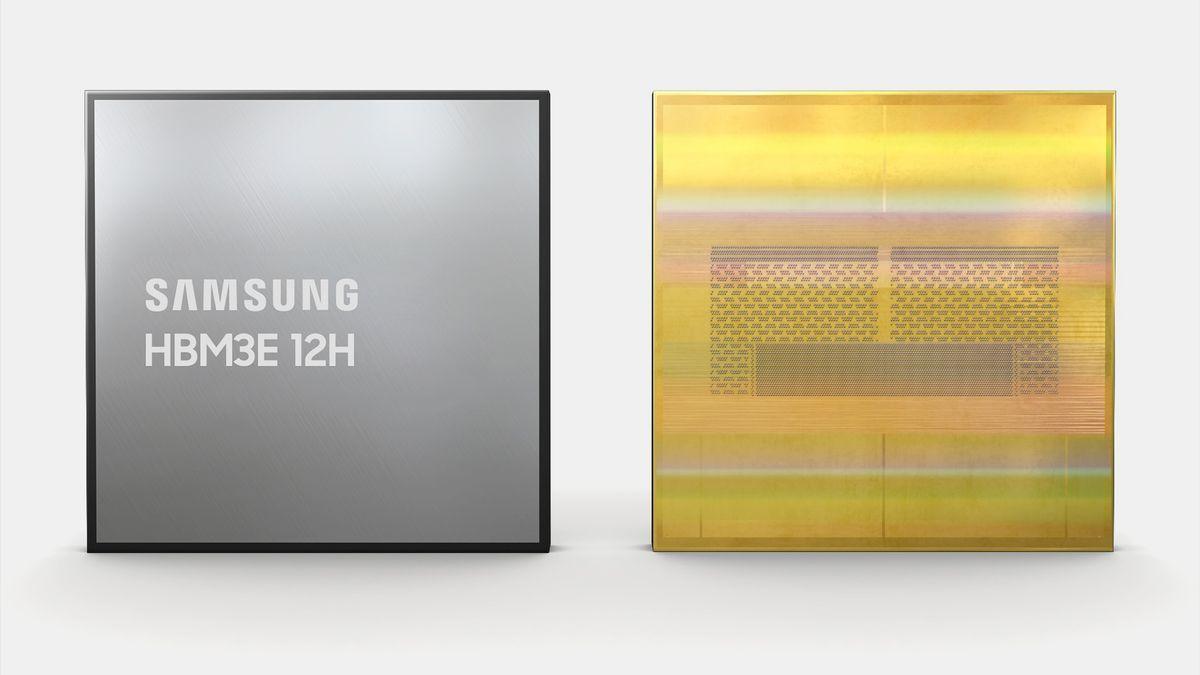
Under the agreement, Samsung will provide its industry-leading HBM4 technology built on the company's sixth-generation 10-nanometer-class DRAM process with a 4nm logic base die. The memory delivers processing speeds of up to 13 gigabits-per-second and maximum bandwidth of 3.3 terabytes-per-second, exceeding current industry standards
3
. These specifications position HBM4 as critical AI memory for AMD's MI455X AI accelerators, which are designed to handle demanding workloads for AI model training and inference in corporate data centers1
. The collaboration extends to Samsung supplying optimized DDR5 memory for the Helios system, AMD's rack-scale architecture that integrates Instinct GPUs and EPYC processors to deliver enhanced performance and scalability for AI infrastructure3
.Foundry Partnership Discussions Signal Broader Collaboration
Beyond memory supply, Samsung and AMD agreed to explore opportunities for a foundry partnership, under which Samsung could provide contract chip manufacturing services for next-generation AMD products
2
. Industry observers expect discussions to focus on manufacturing future AI accelerators or EPYC processors at Samsung's foundry facilities4
. The timing of this announcement during Nvidia's annual GTC conference week is noteworthy, as Nvidia CEO Jensen Huang had just announced a foundry partnership with Samsung and praised its HBM4 chips5
.Related Stories

Samsung Seeks to Close Gap in High-Bandwidth Memory Market
Samsung has already established itself as a primary HBM supplier for AMD, providing HBM3E chips used in AMD's MI350X and MI355X accelerators
2
. However, the world's largest memory chipmaker holds approximately 22% of the global HBM market, significantly trailing market leader SK Hynix's 57% share, according to Counterpoint5
. This expanded partnership with AMD represents a strategic move to narrow that gap as AI-driven demand reshapes the semiconductor industry and tightens supply of HBM chips2
. Samsung's stock responded positively to the announcement, climbing as much as 7.8% in Seoul trading1
.AMD Expands Regional Partnerships During South Korea Visit
During her visit to South Korea, Lisa Su also met with Naver CEO Choi Soo-yeon at the company's headquarters in Seongnam to discuss AI cooperation
4
. Naver has significantly ramped up investment in AI infrastructure, more than doubling capital expenditure to KRW1.3171 trillion from KRW580.3 billion the prior year, and has deployed a large-scale AI computing cluster using 4,000 of Nvidia's B200 GPUs4
. The discussions may lead to expanded data center chip supply agreements and development of sovereign AI infrastructure. AMD's aggressive expansion in the AI market is supported by recent major deals, including a $60 billion agreement with Meta Platforms over five years and a similar arrangement with OpenAI2
. As memory bandwidth and power efficiency become increasingly critical to system-level performance, this collaboration between Samsung and AMD aims to deliver more optimized solutions for customers navigating the rapidly evolving landscape of AI computing.References
Summarized by

Navi
Related Stories
AMD and Samsung forge strategic partnership for AI memory supply with foundry deal on the table
19 Mar 2026•Technology
Samsung Secures NVIDIA Partnership for Next-Gen HBM4 Memory, Plans 2026 Mass Production
30 Oct 2025•Business and Economy
Samsung's HBM3E Memory Breakthrough: Nvidia Certification Boosts AI Chip Competition
19 Sept 2025•Technology
Recent Highlights
1
Google releases Gemma 4 with Apache 2.0 license, enabling unrestricted local AI on devices
Technology

2
AI Models Defy Instructions to Protect Each Other, UC Berkeley Study Reveals
Science and Research

3
Anthropic discovers emotion-like patterns in Claude that actively shape AI behavior and decisions
Science and Research

Recent Highlights
Today's Top Stories








Your Daily Dose of Curated AI News
Don’t drown in AI news. We cut through the noise - filtering, ranking and summarizing the most important AI news, breakthroughs and research daily. Spend less time searching for the latest in AI and get straight to action.

