AMD FSR Diamond brings AI upscaling to future Xbox consoles and next-gen GPUs in 2027


2 Sources
2 Sources
[1]
AMD announces next-gen 'FSR Diamond' AI-enhanced upscaling for future Xbox consoles, but the question is whether it's coming to PC and which GPUs will support it
Not sure about you, but I'm still wrapping my head around the nuances of AMD's FSR 4 and FSR Redstone upscaling platforms. But never mind, because here comes a whole new one, FSR Diamond, announced yesterday by AMD's consumer computing boss, Jack Huynh. Ostensibly, this one is specifically for Xbox rather than the PC. But the lines around Microsoft's definition of Xbox are growing ever more blurred. So, that might not mean quite what it seems. For now, we just have Huynh's post on X when it comes to FSR Diamond, but there actually a fair few details therein. He says FSR Diamond is part of Project Helix, AMD and Microsoft's "multi-year deep co-engineering partnership driving next-gen performance, breakthrough graphics, and compatibility with your existing Xbox game library." Put another way, Project Helix is the next Xbox. But, immediately, the wording feels like it's leaving the door open for all kinds of "Xbox" gaming, not just strictly console gaming. Either way, AI is inevitably set to play a big role in this new FSR Diamond generation of upscaling. Next-gen neural rendering, next-gen ML-based upscaling, and new ML-based multi-frame generation are all name-checked by Huynh. The final major detail is "next-gen Ray Regeneration for RT & Path Tracing." Again, that's pretty much what you'd expect and means FSR Diamond ticks all the expected boxes for next-gen upscaling, albeit it's very much been Nvidia, not AMD, setting the tone with its DLSS upscaling over recent years and AMD playing catch up. The immediate questions are where this leaves AMD's FSR Redstone, what it means for the PC more broadly and what GPUs will end up being compatible with FSR Diamond. For now, we'll have to speculate and guestimate. But there are some data points out there. Xbox is undoubtedly converging with the PC as the Xbox Ally demonstrates, it's really just a PC handheld with a few Xbox software frills, and Project Helix very clearly sets out to extend. There's always been plenty of cross pollination between AMD's PC and Xbox technology, even when the hardware was quite distinct. But now that Xbox and PC are moving ever closer together, that's surely only going to be more true. So, it seems pretty likely that FSR Diamond, or at least a generation of FSR upscaling for PC GPUs that's closely related to it, will be coming to the PC. The question remains, what AMD GPUs for the PC will support FSR Diamond or whatever relation to it the PC receives? Unfortunately, there are good reasons to think it may end up being exclusive to AMD's next-gen RDNA 5 graphics cards. And that's because of the heavy ML or AI emphasis of FSR Diamond. RDNA 5 is expected to have a block of dedicated Nvidia Tensor Core-style units to support much improved AI performance and there's good chance that FSR Diamond may require that hardware. RDNA 4 does obviously have hardware to support AI acceleration, and physically it has matrix math engines in its CUs that are roughly equivalent to the Tensor cores located in Nvidia's GPU SMs. But AMD's matrix math engines support a narrower list of data types than Nvidia's Tensor cores and are less performant. Presumably, AMD will be upgrading those engines for future GPUs including Project Helix, potentially leaving RDNA 4's matrix engines incapable of running FSR Diamond. Indeed, high-profile hardware leaker Kepler_L2 has said that FSR Diamond will be tied to RDNA 5. That's pretty frustrating given that FSR Redstone only came out at the end of last year, is limited to RDNA 4 GPUs like the Radeon RX 9070 XT, and doesn't exactly have universal game support. But then it reflects AMD's approach to GPU hardware. Nvidia started putting Tensor cores into the RTX 20 family of GPUs way back in 2018, making it easier for legacy GPU families to support at least some aspects of future ML-based upscaling technologies. AMD has been rather more conservative about adding dedicated ML hardware to its consumer GPUs. But if expectations around RDNA 5 are correct, that will change with its next graphics cards. The benefit of that should be scope for much more powerful AI-based upscaling. The downside is that legacy GPUs probably won't have sufficient AI-acceleration capability to run the new upscaling platform. Microsoft has said that alpha versions of the Project Helix hardware will be released in 2027, which presumably will ship with FSR Diamond on board. AMD's next-gen RDNA 5 GPUs may well appear in 2027, too. So, it's looking like 2027 is set to be the year for FSR Diamond. Will it close the gap to Nvidia's DLSS? At a guess, I'd say it will compared to anything Nvidia is offering today. Quite what Nvidia will be doing by the time FSR Diamond is actually usable on an RDNA 5 GPU in a PC, however, is whole different story.
[2]
AMD FSR Diamond - Everything You Need To Know About The Next-Gen Tech For PCs & Consoles
The next-generation update to AMD's FSR technologies, FSR Diamond, bringing several new updates to PCs & Consoles. FSR Diamond starts the next chapter of AMD's upscaling tech journey, combining next-gen features for Windows PC and Game Consoles. The technology has now been announced and will launch next year, so here's the full explainer of what FSR Diamond is, and how it compares to its predecessor, FSR Redstone. AMD's FSR, or FidelityFX Super Resolution as it used to be called, is an upscaling technology that was first introduced in June 2021. The technology was meant to counter NVIDIA's DLSS and was designed with a very open nature in the beginning, offering support across both Radeon and GeForce GPUs. AMD went on to release newer versions of FSR, such as FSR 2 in May 2022, FSR 3 in September 2023, and finally, FSR 4 in December 2025. FSR 2, FSR 3, and FSR 4 also had various sub-versions, which added feature updates and optimizations. While FSR was initially designed for Radeon GPUs, the company would go on to form closer relations with its partners at Microsoft and Sony, who were already using custom AMD SoCs to power their consoles. At first, AMD worked closely with Sony to develop its own upscaling solution for the PS5 Pro console called PSSR or PlayStation Spectral Super Resolution. The first version of this technology fell between FSR 2 and FSR 3, and after some time, Sony recently provided an enhanced version called PSSR 2.0, which is similar to AMD's FSR 4 in terms of image quality and fidelity. The move raised some questions by the PC community since the Viola silicon used by PS5 Pro utilizes the older RDNA 3 architecture, and yet, it can leverage the same level of features as AMD's newest RDNA 4 GPUs. Furthermore, the leaked source code of AMD's FSR 4.1 enabled the new technology on RDNA 3 with INT8 support. So while the technology is officially limited to Radeon RX 9000 GPUs, it does seem to work on older architectures, and AMD can enable them if they want to, but it looks like there are other plans. The plans were revealed by AMD's SVP & GM of Computing & Graphics, Jack Huynh, who announced the next chapter in FSR called FSR Diamond. Just like FSR Redstone ended up becoming FSR 4, FSR Diamond is the codename for the next version of the tech. We can say that FSR Diamond will end up becoming FSR 5 close to launch, but the gemstones' codenames sound much cooler, don't they? There was another gemstone codename that you might have missed out on, that's Amethyst. This is the official codename for Sony's next-generation PlayStation project, and the feature updates here will also apply to Radeon GPUs. So working with Microsoft and Sony on their custom silicon helps AMD improve its own Radeon GPU lineup too by fast-tracking upscaling and innovative AI/ML advancements. Like each FSR version before it, AMD's FSR Diamond will include some major features. We know that AMD and its partners are going all in on ML/AI-based hardware acceleration moving forward, so here are the 4 biggest updates to expect: Built for next-gen neural rendering: Starting with the four major features, first up, we have next-gen neural rendering support. FSR Diamond is going to be massively backed by next-gen ML/AI engines that will power future Radeon GPUs, the Project Helix console from Microsoft, and the Project Amethyst console from Sony. These Neural Arrays, which AMD has highlighted before, are a collection of compute units, interconnected to share and process data to work together like a singular AI engine rather than each compute unit working alone. With Neural Arrays, AMD aims to deliver a major uplift in neural rendering, which will help future generations of FSR and PSR upscaling techniques, allowing better upscaled image quality and better scene rendering when using frame-gen algorithms. Next-gen ML-based upscaling: AMD FSR Diamond and its PSSR equivalent will also offer improvements to upscaling quality by utilizing the same ML technologies. AMD has constantly been improving its upscaling quality with updates to the algorithm to reduce ghosting artifacts, gitter, frame intervals, and more. AMD was the last one to hop on board the ML-based upscaling bandwagon, with NVIDIA being the first with its DLSS tech, followed by Intel's XeSS. AMD has since gotten on par with ML-based upscalers from the likes of its competitors. New ML-based multi-frame generation: Next up, AMD is planning to roll out its very own Multi-Frame generation solution for the first time. AMD FSR Redstone (FSR 4) currently features a 2x mode, which is the standard frame-generation method. As for the competition, NVIDIA has moved to 6x MFG mode while Intel offers 4x MFG mode. We can expect, at the very least, a 4x mode, and if the need arises, they can go a notch above and match DLSS's 6x mode. The new ML-based MFG will also help with frame consistency when dialing up the modes, and there is also the likelihood that consoles from Sony and Microsoft feature something similar to NVIDIA's dynamic MFG, where the console can lock in a given frame rate and dynamically adjust the MFG modes, offering frame smoothness for all. Next-gen Ray Regeneration for RT & Path Tracing: Lastly, AMD will continue to work on improving its RT & Path Tracing capabilities with a next-generation ray regeneration update on FSR Diamond. Call of Duty: Black Ops 7 was the first to feature the first gen ray-regeneration technology at launch in December 2025, offering better quality RT, & Path Tracing is going to become the spotlight of gaming innovations in the coming years. For this purpose alone, AMD is also building its next-gen Radiance Cores, which will be a brand new core integrated within the next-gen RDNA GPU architecture utilized by future Radeon GPUs and consoles. The cores will offer dedicated ray traversal hardware, designed to deliver faster & higher-performance real-time raytracing and path tracing gaming. AMD has also unveiled its Universal Compression solution for future RDNA GPUs. This compression algorithm is an efficiency-boosting hardware block that evaluates and compresses all available data within the GPU to dramatically reduce memory bandwidth use and deliver higher performance. The Memory compression algorithms, such as Universal Compression, not only reduce the need for higher system bandwidth but also help in loading textures and models faster. As of right now, the two confirmed products that will support FSR Diamond or its feature set are the next-gen Project Amethyst console from Sony (PlayStation) and Project Helix from Microsoft (Xbox). AMD has been working with both Sony & Microsoft to implement these technologies for the next-generation game consoles, but it's also the SoC that plays a crucial role. The SoC itself will be based on AMD's future GPU architecture. As pointed out by industry insiders, the AMD FSR Diamond technology will only be supported by RDNA 5. This means that older hardware, such as Radeon RX 9000 (based on RDNA 4), and PS5 Pro (based on AMD RDNA 3), will not support FSR Diamond or its entire feature set. There could be some updates from FSR Diamond that pass over to the older architectures, but the full feature set will be limited to newer graphics chips. AMD FSR Diamond is expected to release in 2027, which is also going to be when we start to see the new Radeon Gaming GPUs and next-generation consoles roll out, or at least their devkits. Microsoft has already stated that Project Helix, its next-gen Xbox, powered by FSR Diamond, will offer "an order of magnitude improvement" versus the current generation and a "Leap in raytracing", which aligns with what AMD and Sony have also said in past interviews. Like the next-gen PSSR for Sony's PS consoles, AMD FSR Diamond will be designed to be natively optimized for Project Helix and will be natively optimized and integrated into the GDK.
Share
Share
Copy Link
AMD has announced FSR Diamond, its next-generation AI-enhanced upscaling technology featuring ML-based multi-frame generation and neural rendering. Revealed as part of Project Helix for future Xbox consoles, the technology is expected to launch in 2027 alongside RDNA 5 graphics cards. Questions remain about PC support and compatibility with current-generation GPUs.
AMD FSR Diamond Revealed for Project Helix and Future Xbox Consoles
AMD's SVP and GM of Computing & Graphics, Jack Huynh, has announced AMD FSR Diamond, the next iteration of the company's upscaling technology that will power future Xbox consoles and likely next-gen GPUs. The announcement positions FSR Diamond as a core component of Project Helix, described as AMD and Microsoft's multi-year deep co-engineering partnership driving next-gen performance, breakthrough graphics, and compatibility with existing Xbox game libraries
1
. While ostensibly designed for Xbox, the blurred lines between Microsoft's console and PC ecosystems suggest broader implications for gaming hardware.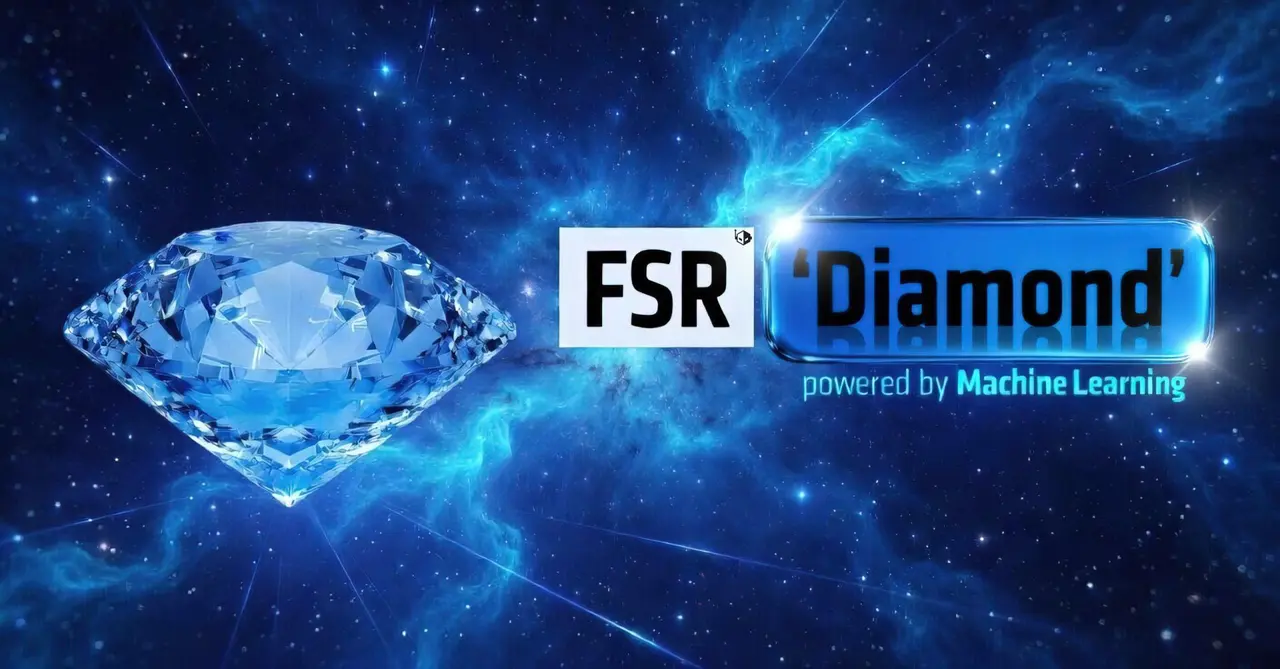
Source: Wccftech
AI-Enhanced Upscaling Technology Takes Center Stage
The new platform marks a significant shift toward AI upscaling for AMD, featuring four major technological advancements. FSR Diamond will introduce next-gen neural rendering capabilities powered by what AMD calls Neural Arrays—collections of compute units interconnected to process data collaboratively rather than independently
2
. This architecture aims to deliver substantial improvements in upscaled image quality and scene rendering when using frame generation algorithms. The technology also includes next-gen ML-based upscaling designed to reduce ghosting artifacts, jitter, and frame intervals, bringing AMD closer to competitors like Nvidia DLSS and Intel XeSS2
.Another headline feature is new ML-based multi-frame generation, marking AMD's first foray into advanced MFG solutions. While FSR Redstone (FSR 4) currently supports 2x mode, FSR Diamond is expected to deliver at least 4x mode, potentially matching Nvidia DLSS's 6x capability
2
. Jack Huynh also confirmed next-gen Ray Regeneration for RT and Path Tracing, rounding out the expected feature set for modern upscaling platforms1
.RDNA 5 Graphics Cards and Dedicated AI Hardware Requirements
The most pressing question for PC gamers centers on GPU compatibility, with mounting evidence suggesting FSR Diamond may require RDNA 5 graphics cards. The heavy Machine Learning (ML) emphasis indicates a need for dedicated AI hardware beyond what current-generation chips offer. RDNA 5 is expected to feature dedicated Nvidia Tensor Core-style units to support enhanced AI performance, potentially making it a prerequisite for FSR Diamond
1
. High-profile hardware leaker Kepler_L2 has stated that FSR Diamond will be tied to RDNA 5, lending credibility to this theory1
.While RDNA 4 does have matrix math engines in its compute units roughly equivalent to Tensor cores in Nvidia's GPU SMs, these engines support a narrower list of data types and deliver lower performance. AMD is expected to upgrade these engines for future GPUs including Project Helix, potentially leaving RDNA 4's matrix engines incapable of running the new technology
1
. This represents a frustrating development for owners of current Radeon RX 9000 GPUs running FSR Redstone, which only launched in late 2024.Related Stories

Console Gaming Partnerships Drive PC Innovation
AMD's collaboration with Microsoft on Project Helix and Sony on Project Amethyst demonstrates how console gaming partnerships accelerate PC graphics innovation. The company previously worked with Sony to develop PSSR (PlayStation Spectral Super Resolution) for the PS5 Pro, with PSSR 2.0 achieving image quality comparable to FSR 4 despite running on older RDNA 3 architecture
2
. This cross-pollination between custom silicon for consoles and Radeon GPU development helps AMD fast-track upscaling and AI/ML advancements across both platforms2
.
Source: PC Gamer
Microsoft has indicated that alpha versions of Project Helix hardware will release in 2027, presumably shipping with FSR Diamond on board. AMD's next-gen GPUs may well appear in 2027 too, making it the pivotal year for this AI-enhanced upscaling technology
1
. The convergence of Xbox and PC platforms, exemplified by devices like the Xbox Ally—essentially a PC handheld with Xbox software features—suggests FSR Diamond or a closely related version will eventually reach PC gamers. For those watching the competitive landscape, the question isn't whether FSR Diamond will close the gap to Nvidia's current DLSS offerings, but rather what Nvidia will have developed by the time FSR Diamond becomes usable on consumer hardware.References
Summarized by

Navi
Related Stories
AMD's FSR 'Redstone': A Leap Forward in AI-Powered Gaming Graphics
21 May 2025•Technology
AMD launches FSR Redstone with AI frame generation to directly challenge Nvidia DLSS dominance
10 Dec 2025•Technology
AMD's FSR 4: AI-Powered Upscaling Exclusive to RDNA 4 GPUs Promises Significant Improvements
07 Jan 2025•Technology

Recent Highlights



Recent Highlights
Today's Top Stories






Your Daily Dose of Curated AI News
Don’t drown in AI news. We cut through the noise - filtering, ranking and summarizing the most important AI news, breakthroughs and research daily. Spend less time searching for the latest in AI and get straight to action.

