Anthropic launches enterprise AI agents with plugins for finance, HR, and investment banking


17 Sources
17 Sources
[1]
Anthropic launches new push for enterprise agents with plugins for finance, engineering, and design
On Tuesday, Anthropic unveiled its new enterprise agents program, its most aggressive push yet to integrate agentic AI into everyday workplaces. In an official briefing, Anthropic's head of Americas, Kate Jensen, told reporters that the new system would finally deliver on the promise of agentic AI. "2025 was meant to be the year agents transformed the enterprise, but the hype turned out to be mostly premature," Jensen said. "It wasn't a failure of effort. It was a failure of approach." Under the new program, companies can use the plug-in system to deploy pre-built agents to help with common enterprise tasks, including financial research and engineering specifications. The result is a major opportunity to grow Anthropic's enterprise client base -- and a significant threat to SaaS products currently performing those functions. "We believe that the future of work means everybody having their own custom agent," Anthropic product officer Matt Piccolella told TechCrunch. Much of the enterprise agents program draws on previously announced technology, particularly Claude Cowork and the plugin system, which was announced in research preview on January 30th. The systems launched today are largely focused on making those tools easier to deploy within a company, including private software marketplaces, controlled data flows, and customized plugins. The result is a system for deploying Claude-powered agents with the same controls a corporate IT department would expect when deploying software. "Admins want to be able to have really, really, really tailored workflows and skills for their specific organization," Piccolella said. "And this allows the admin of a Claude Cowork organization to be able to do this in a very centralized way." The stock plugins included at launch take aim at particular departments present within most companies, including agents designed for finance, legal, and HR departments. Each plugin includes basic skills common across different companies, although Anthropic expects that companies will modify each plugin to bring it in line with unique needs and customs. In the case of finance, the stock plugin gives Claude the basic information and data flows necessary to perform market and competitive research, financial modeling, and other common tasks for finance teams. The HR plugin includes skills for generating job descriptions, onboarding materials, and offer letters, among others. The launch also includes a number of new enterprise connectors, including integrations for Gmail, DocuSign, and Clay, among others. Previously unavailable, these connectors will allow agents to pull in data and context directly from the linked system.
[2]
Anthropic's Claude Cowork is plugging AI into more boring enterprise stuff
On Tuesday, Anthropic announced updates to its Claude Cowork platform that allow the AI to help with a wider range of office tasks. Claude Cowork can now connect with several popular office apps, including Google Workspace, Docusign, and WordPress. New pre-built plugins can also automate tasks in a range of fields, including HR, design, engineering, and finance. Additionally, according to Anthropic, "Claude can now also handle multi-step tasks end-to-end across Excel and PowerPoint," passing context between the two apps. The update is Anthropic's latest push into AI agents, following the initial launch of Claude Cowork last month. Anthropic's coding agent, Claude Code, has been growing in popularity over recent months, even with Anthropic's rival Microsoft, which has its own AI features for office tasks. Earlier this month, Anthropic also released Claude Opus 4.6 and Sonnet 4.6, both of which it says are better at performing complex, multi-step tasks, including work-related tasks like navigating spreadsheets. The new Claude Cowork tools will be available starting on Tuesday to all users on Cowork, which is currently a research preview feature limited to users on paid Pro, Max, Team, and Enterprise subscriptions.
[3]
Anthropic Links AI Agent With Tools for Investment Banking, HR
Anthropic PBC is expanding the reach of its Claude chatbot into new sectors, weeks after the startup sparked a market meltdown with the release of tools that raised questions about AI's potential to render entire businesses obsolete. The company unveiled new AI tools on Tuesday for its Claude Cowork agent software that are designed to automate work in fields including human resources, investment banking and design. Anthropic said they were developed with partner companies, such as a plugin created with financial data provider FactSet Research Systems Inc. Anthropic and rival OpenAI have spent much of the past year developing artificial intelligence tools to streamline a wider range of professional tasks -- from financial services to health care -- with the goal of courting more business customers and justifying their lofty valuations. Their efforts to expand into new industries have rattled Wall Street in recent weeks. The quiet release of a tool for Claude Cowork to automate certain legal work wiping nearly $1 trillion off the value of software stocks in a matter of days. Shares of financial services also slumped after Anthropic released a new version of its Opus model that's meant to be better at financial research. The reactions reflect broader concerns about which companies and services will eventually be disrupted by AI. Scott White, Anthropic's head of product for Claude AI models, said the company aims to bridge a gap between the ways people use AI to answer work-related queries and the tools they use to do specific work. He said it's a "little bit of an overreach or overreaction" to connect market performance to a single product release, and that the company's AI models are helping its business customers grow. Anthropic has more than 300,000 business customers who use its models to streamline workplace responsibilities, particularly in the field of computer programming where it has emerged as a market leader with its AI coding assistant, Claude Code. The company recently raised a new round of funding at a $380 billion valuation.
[4]
Anthropic touts new AI tools weeks after legal plug-in spurred market rout
SAN FRANCISCO, Feb 24 (Reuters) - Artificial intelligence lab Anthropic on Tuesday unveiled 10 new ways for business customers to plug in its technology to key areas of their work, weeks after other releases sparked an aggressive selloff of traditional software company shares. The San Francisco-based startup said its plug-ins could now help with investment banking tasks like reviewing deals, wealth-management tasks such as portfolio analysis and human resource-related tasks such as making new-hire materials reflect a brand's tone and policies. Other items that Anthropic touted included plug-ins for private equity, engineering and design. Backed by Alphabet's Google (GOOGL.O), opens new tab and Amazon.com (AMZN.O), opens new tab, the lab also said it was releasing ways to connect its Claude AI to some commonly used business tools like Google Calendar and Gmail. The rapid-fire releases this year show how Anthropic is seeking to get ahead of the pack in selling increasingly autonomous AI to the lucrative enterprise market ahead of a widely expected public offering. Anthropic faces competition from Google itself, OpenAI and Elon Musk's xAI, among others. The startup has previously said it has not decided about going public. Last month, Anthropic's release of a legal plug-in ignited an $830 billion global selloff in software and services stocks - including some of the startup's partners - over six trading days as investors worried that AI-powered automation could undercut large chunks of those companies' revenue streams. Scott White, Anthropic's head of product for enterprise, said the goal was for Claude to deliver better outcomes for customers, not replace them. "It's not a product that's trying to own every workflow," he said in an interview. "We're providing infrastructure and intelligence so our partners or our customers can bring their business knowledge, their expertise, their trusted relationships and their customers to the equation." Anthropic said its new plug-ins were developed jointly with partners, among them LSEG (LSEG.L), opens new tab and FactSet (FDS.N), opens new tab. It also said companies including Thomson Reuters (TRI.TO), opens new tab, which owns Reuters news agency, and RBC Wealth Management (RY.TO), opens new tab were using AI agents powered by Anthropic. Companies can build and manage their own plug-ins as well, Anthropic said. Reporting By Jeffrey Dastin and Deepa Seetharaman in San Francisco; Editing by Kevin Buckland Our Standards: The Thomson Reuters Trust Principles., opens new tab
[5]

Anthropic goes from software foe to friend. These stocks should benefit
Anthropic's Tuesday event positioned its products as additive -- rather than threatening -- to existing software providers. Wall Street sees that helping some stocks in the space. The buzzy artificial intelligence startup announced updates to its Claude Cowork tool aimed at improving office workers' productivity. Companies can now connect Cowork to platforms such as Google Drive, Gmail and Docusign under the enhancements. The undisruptive nature of Tuesday's announcement has allowed software stocks to regain some ground lost following prior rollouts. The iShares Expanded Tech-Software Sector ETF (IGV) added nearly 2% in Tuesday's session following Monday's drop of more than 4%. Still, the fund has tumbled 24% in 2026. "Anthropic's announcement is evidence that domain expertise and data assets are crucial in building industry specific AI," Wells Fargo analyst Jason Haas wrote in a Wednesday note to clients. IGV 5D mountain IGV, 5-day chart Given that take, Haas listed Fair Isaac , Moody's , S & P Global , Verisk Analytics , Equifax and Thomson Reuters as companies that can benefit. That's because they offer sector-specific data sets that "are difficult, if not impossible, to replicate," the analyst said. "They operate in concentrated markets and are regarded as industry standards, with minimal displacement risk," Haas said. "We see AI as a tailwind that will drive more usage for their data and build differentiated capabilities." If anything, Tuesday's event showed Anthropic can't drive software companies to extinction because it relies on their products, according to RBC's Matthew Hedberg. Hedberg said traders should view Anthropic as "embracing" the software-as-a-service ecosystem. He pointed to CrowdStrike , Datadog , MongoDB , Cloudflare , Palo Alto Networks and Snowflake . "Ultimately, we believe the event highlighted Anthropic's need/willingness to partner with existing software companies, rather than a rip-and-replace scenario, which remains underappreciated by investors," Hedberg wrote in a Tuesday note to clients. Barclays' Manav Patnaik bolstered Anthropic's view that 2026 could be the year that AI could move to enterprise-wide deployment. However, he said the company's sentiment around AI seemed focused on data quality and trust rather than just model performance. That mindset could benefit the information services space, he said. What's more, the analyst said Anthropic's partnerships with FactSet and MSCI, as well as S & P Global, continue to be both "logical" and "positive." Bank of America, meanwhile, found a few stocks that stood to benefit from Tuesday's gathering. Analyst Curtis Nagle said Cowork's ability to integrate with Thomson Reuters "reframes" the risk and opportunities AI poses the business in a note titled "AI scare, meet data pair." Thomson Reuters shares surged more than 11% on Tuesday as the company was an example of integration highlighted during Anthropic's presentation, marking its best day since 2009. But shares are still down more than 25% year to date, underscoring the strength of the sell-off on fears of AI's disruption. TRI YTD mountain Thomson Reuters in 2026 "We view the stock's reaction as a rebuttal to concerns that LLMs (including Claude) pose a risk to TRI's workflow and research tools," Nagle write to clients, using an acronym for large-language models. Bank of America's David Amira said Thomson Reuters' inclusion in the event has a positive read through for peer RELX . While Anthropic's release of a legal plugin prompted a derating in the information services sector, Amira said Tuesday's event signaled an interest in collaborating with specialty data providers. U.S.-listed shares of the LexisNexis parent have dropped 19% this year. But shares jumped more than 2% on Tuesday and have added nearly 5% in midday trading Wednesday. "We continue to view market concerns as overblown," Amira told clients in a note reiterating its buy rating.
[6]

Anthropic's Claude Comes for Knowledge Work as Markets Freak Out
Anthropic is coming for knowledge work. Earlier this month, the debut of AI assistant Claude Cowork and the subsequent release of industry-specific plug-ins, such as Legal, made waves. Worried investors sent software stocks spiraling down, as the market tried (and is still trying) to contend with a possible major AI disruption to the way we work. On Tuesday, Anthropic announced Cowork plugins targeting even more lines of work, giving organizations the ability to build their own, customized private plugins from scratch with the help of Claude. Using Claude Cowork's pre-built plug-ins, companies can now make AI agents to theoretically automate work across HR, design, engineering, operations, financial analysis, investment banking, equity research, private equity, and more. The AI agents can also now connect to Google Drive, Gmail, Google Calendar, DocuSign, FactSet, LegalZoom, WordPress, and other apps. On top of the Cowork announcements, Anthropic also shared that Claude can now edit files and pass context between Cowork, Excel, and PowerPoint, so if you are using it on one document, it will remember what you're working on when you switch to another. "In 2025, Claude transformed how developers work, and in 2026, it will do the same for knowledge work," Anthropic's head of Americas Kate Jensen said in a briefing on Tuesday. That's roughly in line with what Wall Street seems to believe, as well. Following an AI thought experiment published Sunday on Substack detailing how AI can cause widespread annihilation of white-collar work and skyrocketing unemployment, the market went into a sell frenzy. "The impact of this technology on the economy and on the labor market more broadly will be in some sense shaped by whether tasks become automated or whether they augment how we do our work," Anthropic head of economics Peter McCrory said in the briefing. "An interesting thing that we see in the data when we turn our attention to how businesses are embedding Claude in their workflows through the API is that we see overwhelmingly [that] Claude is being embedded in automated ways." Leading Stanford economist Erik Brynjolfsson found in a study last year that AI-related employment declines in the U.S. were largely concentrated in jobs where AI was used to completely or partially automate rather than augment. AI companies aren't helpless bystanders, though. The economist argues AI integration should follow augmentation instead of automation, and to do so, AI companies should develop benchmarks to test how well models can collaborate with humans to jointly solve tasks, rather than focusing on perfecting AI in the absence of humans. McCrory is worried about AI automating "pure implementation" jobs like data entry workers who handle unstructured data or technical writers who synthesize and explain jargon in an accessible way. He says that Claude is already being used for the central tasks associated with those kinds of jobs, making them more at risk of displacement. Another way that AI has been showing up in employment trends is through its impact on early-career workers. Just last week, the Irish government released a report saying that it was already starting to see AI impact job growth for workers aged 15 to 29 in high-risk sectors like financial services and information and communication technologies. The Irish report aligns with Brynjolfsson's findings from the August study focusing on the American job market. While American authorities haven't released official data on AI's impact on young workers, Fed Chair Jerome Powell did concede in September that AI is probably a factor in the dismal early-career employment trends in the U.S. But except for finance and technology, AI adoption rates across sectors are still relatively low, and some experts remain skeptical about AI's power to completely disrupt the labor market. Whether Anthropic's Cowork assistants or any competitors can change that is, for now, a matter of speculation. Anthropic, for its part, seems determined. "There's no aspect of the economy that's not set to change," McCrory said.
[7]
Anthropic updates Claude Cowork tool built to give the average office worker a productivity boost
Anthropic's Claude Cowork, which rocked Wall Street last month, is getting a wider release. The artificial intelligence startup launched a series of connectors and plugins for the knowledge worker tool on Tuesday that enterprises can use to help "turbo charge" the capabilities of individual employees. Anthropic launched Claude Cowork in a research capacity last month, rattling software stocks as investors grappled with AI's disruptive potential. The company said Claude Cowork's new updates mark its transition into a true enterprise-grade product. Starting Tuesday, organizations will be able to connect Claude Cowork to their existing tools like Google Drive, Gmail, DocuSign and FactSet. They can also deploy customizable plugins across domains like financial analysis, engineering and human resources that encode institutional knowledge and workflows, Anthropic said. "We're trying to make it much more accessible and much more ready for anyone to be able to use," Kate Jensen, Head of Americas at Anthropic, told CNBC in an interview. Investors were on edge ahead of Anthropic's expected announcement. The iShares Expanded Tech-Software Sector ETF closed down nearly 5% on Monday.
[8]

Anthropic says Claude Code transformed programming. Now Claude Cowork is coming for the rest of the enterprise.
Anthropic opened its virtual "Briefing: Enterprise Agents" event on Tuesday with a provocation. Kate Jensen, the company's head of Americas, told viewers that the hype around enterprise AI agents in 2025 "turned out to be mostly premature," with many pilots failing to reach production. "It wasn't a failure of effort, it was a failure of approach, and it's something we heard directly from our customers," Jensen said. The implicit promise: Anthropic has figured out the right approach, and it starts with the playbook that made Claude Code one of the most consequential developer tools of the past year. "In 2025 Claude transformed how developers work, and in 2026 it will do the same for knowledge work," Jensen said. "The magic behind Claude Code is simple. When you can delegate hard challenges, you can focus on the work that actually matters. Cowork brings that same power to knowledge workers." That framing is central to understanding what Anthropic announced on Tuesday. The company rolled out a sweeping set of enterprise capabilities for Claude Cowork, the AI productivity platform it first released in research preview in January. Scott White, head of product for Claude Enterprise, described the ambition plainly during the keynote: "Cowork makes it possible for Claude to deliver polished, near final work. It goes beyond drafts and suggestions -- actual completed projects and deliverables." The product updates are dense but consequential. Enterprise administrators can now build private plugin marketplaces tailored to their organizations, connecting to private GitHub repositories as plugin sources and controlling which plugins employees can access. Anthropic introduced new prebuilt plugin templates spanning HR, design, engineering, operations, financial analysis, investment banking, equity research, private equity, and wealth management. The company also shipped new MCP connectors for Google Drive, Google Calendar, Gmail, DocuSign, Apollo, Clay, Outreach, SimilarWeb, MSCI, LegalZoom, FactSet, WordPress, and Harvey -- dramatically extending Claude's reach into the software ecosystem that enterprises already use. And Claude can now pass context seamlessly between Cowork, Excel, and PowerPoint, including across multiple files, without requiring users to restart when switching applications. White emphasized that the system is designed to feel native to each organization rather than generic. "We've heard loud and clear from enterprises -- you want Claude to work the way that your company works, not just Claude for legal, but Cowork for legal at your company," he said. "That's exactly what today's launches deliver." Real-world results from Spotify, Novo Nordisk, and Salesforce hint at what's coming To ground the product announcements in measurable outcomes, Anthropic showcased three enterprise deployments that illustrate both the scale and the variety of impact the company claims Claude can deliver. At Spotify, engineers had long struggled with code migrations -- the slow, manual work of updating and modernizing code across thousands of services. Jensen explained that after integrating Claude directly into the system Spotify's engineers use daily, "any engineer can kick off a large-scale migration just by describing what they need in plain English." The company reports up to a 90% reduction in engineering time, over 650 AI-generated code changes shipped per month, and roughly half of all Spotify updates now flowing through the system. At Novo Nordisk, the pharmaceutical giant built an AI-powered platform called NovoScribe with Claude as its intelligence layer, targeting the grueling process of producing regulatory documentation for new medicines. Staff writers had previously averaged just over two reports per year. After deploying Claude, Jensen said, "documentation creation went from 10 plus weeks to 10 minutes. That's a 95% reduction in resources for verification checks. Medicines are reaching patients faster." Jensen also noted that Novo Nordisk used Claude Code to build the platform itself, enabling contributions from non-engineers -- their digitalization strategy director, who holds a PhD in molecular biology rather than engineering, now prototypes features using natural language. "A team of 11 is operating like a team many times its size," Jensen said. Salesforce, meanwhile, uses Claude models to help power AI in Slack, reporting a 96% satisfaction rate for tools like its Slack bot and saving customers an estimated 97 minutes per week through summarization and recap features. The partnership reflects Anthropic's broader ecosystem strategy: Jensen described the companies featured at the event as "Claude partners and domain experts with the data and trusted relationships that make Claude work in the real world." Enterprise leaders reveal the messy reality behind AI transformation Perhaps the most illuminating segment of the event was a panel discussion featuring executives from Thomson Reuters, the New York Stock Exchange, and Epic, who provided candid assessments of AI's enterprise reality that went well beyond the polished case studies. Sridhar Masam, CTO of the New York Stock Exchange, described his organization as "rewiring our engineering process" with Claude Code and building internal AI agents using the Claude Agent SDK that can take instructions from a Jira ticket all the way to a committed piece of code. But he also identified fundamental shifts in how leaders must think. "The accountability is shifting," he said. "Traditionally, we are so used to building deterministic platforms. You write code requirements and build. And now, with AI being probabilistic, the accountability doesn't end when the project goes live, but on a daily basis, monitoring the behavior and outcomes." He described a new paradigm beyond "buy versus build" -- what he called "assembly," the practice of combining multiple models, multiple vendors, platforms, data, and internal capabilities into solutions. And he noted that highly regulated industries must shift "from risk avoidance to risk calibration," because simply avoiding AI is no longer a competitive option. Steve Haske from Thomson Reuters, whose Co-Counsel product has reached a million users, was frank about the gap between what the technology can do and what organizations are ready for. "The tools are in many senses ahead of the change management," he said. "A general counsel's office, a law firm, a tax and accounting firm, an audit firm, need to rewire the processes to be able to take advantage of the benefits that the tools provide. And I think it's 18 months away before that sort of change management catches up with the standard of the tool." He also stressed an "ironclad guarantee" to Co-Counsel customers that "their input will not be part of our AI output," and urged enterprise leaders to be "feverish" about protecting institutional intellectual property. Seth Hain from Epic -- the healthcare technology company behind MyChart -- offered a finding that may foreshadow where enterprise AI adoption is truly heading. "Over half of our use of Claude Code is by non-developer roles across the company," Hain said, describing how support and implementation staff had adopted the tool in ways the company never anticipated. Hain also described a deliberate trust-building strategy: Epic's first AI capability was a medical record summarization that included links to the underlying source material, giving clinicians the ability to verify and build confidence before the company introduced more autonomous agent capabilities. A year of Claude Code and MCP adoption explains why this moment feels different Tuesday's announcements cannot be understood in isolation. They are essentially the culmination of a year in which Anthropic transformed itself from a research-focused AI lab into a company with genuine enterprise distribution and developer ecosystem gravity. The trajectory began with Claude Code, which Jensen noted had taken coding use cases "from assisting on tiny tasks to AI writing 90 or sometimes even 100% of the code, with enterprises shipping in weeks what once took many quarters." But the deeper structural shift was the adoption of MCP -- the Model Context Protocol -- which has become the connective tissue allowing Claude to reach into and act upon data across an organization's entire technology stack. Where previous AI tools were constrained to the information users manually fed them, MCP-connected Claude can pull context from Slack threads, Google Drive documents, CRM records, and financial systems simultaneously. This is what makes the plugin architecture announced Tuesday fundamentally different from earlier chatbot-style enterprise AI: it turns Claude into a reasoning layer that sits across an organization's existing infrastructure rather than alongside it. The implications for the broader AI industry are profound. Anthropic is effectively building a platform play -- private plugin marketplaces, portable file-based plugins, and an expanding library of MCP connectors -- that echoes the ecosystem strategies of earlier platform giants like Salesforce and Microsoft. The difference is velocity: Anthropic is compressing into months the kind of ecosystem development that previously took years. The company's willingness to ship sector-specific plugin templates for investment banking, equity research, and wealth management alongside general-purpose tools signals that it sees no bright line between platform and application, between enabling partners and competing with them. This strategic ambiguity is precisely what has spooked Wall Street. IBM shares suffered their worst single-day loss since October 2000 -- down nearly 13.2% -- on Monday after Anthropic published a blog post about using Claude Code to modernize COBOL, the decades-old programming language that runs on IBM's mainframe systems. Enterprise software stocks had already been under heavy pressure since the initial Cowork announcement on January 30, with companies like ServiceNow, Salesforce, Snowflake, Intuit, and Thomson Reuters all experiencing steep declines. Cybersecurity companies tumbled after the company unveiled Claude Code Security on February 20. Yet Tuesday's event triggered a partial reversal that revealed something important about how markets are processing AI disruption. Companies named as Anthropic partners and integration targets -- Salesforce, DocuSign, LegalZoom, Thomson Reuters, FactSet -- all rallied, some sharply. Thomson Reuters surged more than 11%. The market appears to be drawing a new distinction: companies integrated into Anthropic's ecosystem may benefit, while those standing outside it face existential risk. Anthropic's own economist warns that AI's impact will be uneven -- and fast Peter McCrory, Anthropic's head of economics, presented data from the Anthropic Economic Index that offered a sober counterweight to the event's product optimism. Using privacy-preserving methods to analyze how people and businesses use Claude, McCrory's team has tracked AI's diffusion across more than 150 countries and every US state. The headline finding is striking: a year ago, roughly a third of all US jobs had at least a quarter of their associated tasks appearing in Claude usage data. That figure has now risen to approximately one in every two jobs. "The scope of impact is broadening out throughout the economy as the tools and as the technology becomes more capable," McCrory said. He characterized AI as a "general purpose technology" in the economic sense -- meaning virtually no facet of the economy will be unaffected. McCrory drew a critical distinction between automation, where Claude simply executes a task, and augmentation, where it collaborates with a human on more complex work. When businesses embed Claude through the API, he noted, "we see overwhelmingly Claude is being embedded in automated ways" -- a pattern consistent with how transformative technologies have historically diffused through the economy. On the question of job displacement, McCrory was measured but direct. He noted that "roles that typically require more years of schooling have the largest productivity or efficiency gains," suggesting a dynamic economists call skill-biased technical change. He expressed concern about "jobs that are pure implementation" -- citing data entry workers and technical writers as examples where Claude is already being used for tasks central to those occupations. But he emphasized that no evidence of widespread labor displacement has materialized yet, and pointed to forthcoming research that would introduce methodology for monitoring whether highly exposed workers are beginning to experience it. His advice to enterprise leaders cut to the heart of the organizational challenge. "It might not just be about fundamental capabilities of the model," McCrory said. "Do you have the right sort of data ecosystem, data infrastructure to provide the right information at the right time?" If the knowledge Claude needs to execute a sophisticated task exists only in a coworker's head, he argued, "that's not a technical problem, per se. That's an organizational problem." The question every enterprise leader is now asking -- and why no one has the answer yet Jensen described a concept Anthropic calls "the thinking divide" -- the growing gap between organizations that embed AI across employees, processes, and products simultaneously, and those that treat it as a point solution. The companies on the right side of that divide, she argued, will compound their advantage over time. Those on the wrong side "will find themselves falling further and further behind." Whether Anthropic ultimately functions as the rising tide that lifts the enterprise software ecosystem or the wave that swamps it remains genuinely uncertain. The same event that triggered a rally in shares of Anthropic's named partners has also accelerated a broader reckoning for legacy software companies that cannot yet articulate how they fit into an AI-native world. McCrory, the economist, counseled humility. "Capabilities are moving very, very quickly," he said. "It might represent an innovation in the method of innovation. So it's not just making us better at the things that we do -- it's helping us discover new ways to do things." Thomson Reuters' Haske perhaps put it most practically. "As leaders, we all have to get personally involved and personally invested in using the tools," he said. "We've got to move fast. This environment is changing quickly. We cannot afford to get left behind." A Fortune 10 CIO recently told Jensen that enterprises would need to fit a decade of innovation into the next few years. The CIO smiled and said: "We're going to do it in one with you." Whether that confidence proves prescient or premature, one thing is clear from Tuesday's event -- the window for figuring it out is closing faster than most boardrooms realize.
[9]

Anthropic launches job-specific tools
Why it matters: Anthropic is making Claude easier to use for enterprises as it works to become the go-to AI platform for businesses. State of play: Anthropic's latest plugins let Claude act as a conductor working in other apps or systems in continually more autonomous ways. * When a user prompts Claude to do something, instead of it feeding back instructions, it can go do it: connecting with other programs, or completing tasks in Excel or PowerPoint without the user being involved. * The plugins are meant to be customized and trained by so-called "power users" at different companies. Those users will help design plugins that can then be easily used by more novice team members. The other side: OpenAI launched its own enterprise platform to manage corporate AI agents earlier this month. Zoom in: Some of the companies that investors worry AI will kill are instead partnering with Anthropic on these plugins, and their stocks are up as a result. * DocuSign and Intuit stocks rallied off the back of their partnership announcements with Anthropic. Threat level: It can also connect with Google's apps, including Google Drive and Gmail. * It's interesting that Google allowed that given its own AI ambitions with its model, Gemini. What we're watching: To what extent these tools actually drive enterprise revenue.
[10]

Anthropic's New Claude Plugins Take Aim at Finance, HR, and More. Is Your Job Next?
Here's the list of new plugins available to enterprise customers on Claude Cowork, along with a description of their capabilities. * Financial analysis: An agent that understands how to conduct market/competitor research, and can undertake financial modeling tasks. * Investment banking: An agent that can review transaction documents, analyze comparable companies, and prepare pitch materials. * Equity research: An agent that can parse earnings transcripts, update financial models, and draft research notes. * Private equity: An agent that can review and extract financial data from large document sets, model scenarios, and score opportunities against investment criteria. * Wealth management: An agent that can analyze an investment portfolio and generate asset rebalancing recommendations customized to mirror a firm's own voice. * HR: An agent that can generate customized job descriptions, offer letters, onboarding materials, and performance summaries. * Design: An agent that can work alongside Figma to generate creative briefs, copy variations, and design decision documentation. * Engineering: An agent that can generate technical documentation and decision write-ups that go directly to the places where they need to be posted, including repositories, ticketing systems, and wikis. * Operations: An agent designed to handle the varying challenges that operations teams face in any given week, such as generating standard order of practice documents, vendor proposal summaries, and project updates. * Brand voice (by Tribe AI): An agent that trains Claude to generate outputs that adhere to a company's specific voice and editorial standards. In addition to these Anthropic-made plugins, enterprises will be able to develop their own plugins and make them available to employees through a digital marketplace, located in a new "Customization" tab. Anthropic also announced that Claude Cowork on Apple computers can now seamlessly use Microsoft PowerPoint and Excel, making it more useful and valuable in data-heavy work like financial analysis. Cowork can also connect directly to external applications like Google Drive and legal AI tool Harvey. In a video, Anthropic's head of product for Claude Enterprise, Scott White, used a fake company to demonstrate how these plugins will help businesses on a daily basis. In White's scenario, a finance services company uses Cowork's analysis plugin to identify the business's growth blockers, directs Claude to turn that analysis into a PowerPoint presentation, and connect to ThompsonReuters' Claude-powered legal Counsel platform to check a new deal against similar older deals. The plugins are currently only available for customers of Claude Enterprise, Anthropic's workplace-focused plan. Agentic systems that can use computers are fast becoming a major trend of 2026, from the viral agent OpenClaw to OpenAI's Frontier platform.
[11]

Anthropic unveils new business tools after release sparked market sell-off
AI firm Anthropic unveiled a new set of connectors and plug-ins for its productivity tool on Tuesday, following a series of recent updates that roiled financial markets. The updates to AI tool Claude Cowork were designed to "make it easier to create, use, and manage plugins" across organizations, according to a blog post outlining the changes. Organizations will now be able to connect to software providers such as Google Workspace, DocuSign, and LegalZoom, the company said. "Cowork handles complex tasks best when connected to the tools you already use. Connectors bring Claude closer to where your work lives -- helping you move faster across tools, not replace the expertise or software you rely on," the post noted. The update comes weeks after Anthropic released a legal plug-in that triggered an $830 billion global selloff of software and service stocks, according to Reuters. The company also introduced expanded plug-ins to help streamline workflows and complete administrative tasks across a range of industries, from human resources to engineering to investment banking. "Each was designed with practitioners in the relevant field, so workflows, terminology, and outputs reflect how that work actually gets done," the company said. Anthropic's latest release also comes the same day as CEO Dario Amodei is set to meet with Defense Secretary Pete Hegseth amid ongoing discussions about the U.S. military's use of Claude. A dispute with the Pentagon centers on the company's usage policy, which prohibits its AI models from being used to conduct mass surveillance or develop weapons that can be used without human oversight. Hegseth is reportedly considering cancelling a $200 million contract awarded last summer as the Trump administration pushed for greater AI adoption across government agencies. Former OpenAI employees started Anthropic in 2021, and the two have since been locked in a public battle to win over corporate clients that has intensified in recent weeks, following a pair of controversial Super Bowl ads. The commercials paid for by Anthropic took a swing at OpenAI for placing ads on free and cheaper versions of its AI language model ChatGPT.
[12]

After IT, Anthropic targets new industries with 10 fresh AI use cases
Anthropic Claude AI 10 new enterprise AI tools: AI firm Anthropic is expanding Claude's reach beyond IT with 10 new enterprise plug-ins for sectors like investment banking and HR. These tools, developed with partners like LSEG and Slack, aim to enhance workflows by integrating business expertise, not replace employees. This move intensifies competition for traditional software providers. Anthropic Claude AI 10 new enterprise AI tools: Artificial intelligence startup Anthropic is widening its focus beyond traditional IT functions, unveiling 10 new enterprise plug-ins designed to bring its Claude AI into departments ranging from investment banking to human resources. The San Francisco-based company said the new tools will help businesses handle tasks such as reviewing investment banking deals, analyzing wealth management portfolios, and creating new-hire materials that reflect a company's brand tone and internal policies, as per a Reuters report. Additional plug-ins are aimed at private equity, engineering, and design teams. The move comes less than a month after Anthropic introduced earlier plugins for Claude, releases that rattled Wall Street and contributed to a sharp selloff in software and services stocks as investors worried AI automation could disrupt established revenue models. This time, Anthropic is emphasizing collaboration rather than replacement. Scott White, the company's head of product for enterprise said, "It's not a product that's trying to own every workflow," adding, "We're providing infrastructure and intelligence so our partners or our customers can bring their business knowledge, their expertise, their trusted relationships and their customers to the equation," as quoted by Reuters. Also read: Quote of the day by Dustin Hoffman: 'Better to be fired than to do bad...' - lessons on work ethic, professionalism and integrity by the Oscar-winning actor of Kramer vs Kramer and Rain Man The new capabilities were developed with partners including LSEG, FactSet, Salesforce's Slack, and DocuSign. Anthropic said companies such as Thomson Reuters and RBC Wealth Management are already using AI agents powered by Claude. Shares of several partner companies rose following the announcement. Salesforce climbed 4%, FactSet gained 5%, and DocuSign jumped nearly 6%. Anthropic, which is backed by Alphabet and Amazon, also said it is releasing new ways to connect Claude to commonly used business tools such as Google Calendar, Gmail, Google Drive, DocuSign, and LegalZoom. The company is also allowing customers to build customized plug-ins tailored to specific internal tasks. According to Matt Piccolella, who works on products at Anthropic, enterprises could eventually create "dozens, hundreds, or even thousands" of these mini-app-like plug-ins and distribute them across departments, as per a Yahoo Finance report. Anthropic is offering a marketplace where companies can host and manage these internal tools. Piccolella explained, "We think that enterprises will be able to build hundreds of these things and then distribute them to their employees," adding, "So whether it's each department wanting its own plugin, whether it's different kinds of workflows or different things that companies are doing, they can build plugins for those that are custom to their company," as quoted by Yahoo Finance. Also read: Bitcoin (BTC USD) is 50% down from its peak - where is the world's largest crypto headed The broader push into enterprise functions has intensified concerns that AI firms like OpenAI and xAI could challenge traditional software providers, either by building rival software or enabling businesses to create their own. Since Anthropic first announced Claude-focused enterprise tools in late January, shares of major software companies have fallen sharply. ServiceNow is down more than 23%, Salesforce has dropped 22%, Snowflake is off 20%, Intuit has declined 33%, and Thomson Reuters has fallen 31%. Anthropic's earlier launch of Claude Code Security, designed to scan codebases for vulnerabilities and suggest patches for human review, also pressured cybersecurity stocks. CrowdStrike and Zscaler fell more than 7%, while Palo Alto Networks dropped 2.6%. Which major companies are partnering with Anthropic? Partners include LSEG, FactSet, Slack, and DocuSign, while companies like Thomson Reuters and RBC Wealth Management are already using Claude-powered agents. Is Claude replacing employees? No. According to company executives, the goal is to support teams with infrastructure and intelligence, not take over entire workflows.
[13]

Anthropic's 'Cowork' Update Ignites Enterprise Software Stock Rally - These Stocks Surge - Salesforce (NYSE:CRM), CrowdStrike Holdings (NASDAQ:CRWD)
On Tuesday, stocks of several enterprise software and data providers jumped following a product announcement from AI startup Anthropic. Anthropic Names New Enterprise Connector Partners On Tuesday, Anthropic published a blog post detailing major updates to Cowork, its enterprise AI platform, and its plugin ecosystem. The post announced that new connectors from enterprise software providers are now available, explicitly listing Google Workspace, Docusign, Apollo, Clay, Outreach, Similarweb, MSCI, LegalZoom, FactSet, WordPress, and Harvey as available integrations. The announcement also named Slack by Salesforce, LSEG, S&P Global, Apollo, Common Room, and Tribe AI as companies that have built plugins for joint customers. What Anthropic's Cowork Update Covers Anthropic's introduces several enterprise capabilities. Admins can now build private plugin marketplaces within their organizations, set up plugins from starter templates or from scratch, and manage connectors through a new unified menu called "Customize." The post notes that Claude can also now "orchestrate across Excel and PowerPoint, working end-to-end and passing context between apps," currently available as a research preview for all paid plans on Mac and Windows. New pre-built plugin templates were also announced for HR, Design, Engineering, Operations, Financial Analysis, Investment Banking, Equity Research, Private Equity, and Wealth Management functions. Anthropic Has Been Moving Fast Investors have grown concerned that rapid advances in AI-driven security tools could bypass or disrupt traditional "legacy" cybersecurity vendors. However, Wedbush analyst Dan Ives argues this selloff reflects panic rather than fundamentals, stating that AI actually represents the "biggest total addressable market opportunity" in the industry's history. Price Action: Similarweb shares were up 3.33% at $2.60, FactSet Research Systems shares were up 6.27% at $202.19, Docusign shares were up 3.75% at $42.27 and Salesforce shares were up 4.41% at $186.02 at the time of publication on Tuesday, according to Benzinga Pro data. Photo: santima.studio / Shutterstock Market News and Data brought to you by Benzinga APIs To add Benzinga News as your preferred source on Google, click here.
[14]
US Stocks: Anthropic touts new AI tools weeks after legal plug-in spurred market rout
Artificial intelligence lab Anthropic on Tuesday unveiled 10 new ways for business customers to plug in its technology to key areas of their work, weeks after other releases sparked an aggressive selloff in traditional software company shares. Artificial intelligence lab Anthropic on Tuesday unveiled 10 new ways for business customers to plug in its technology to key areas of their work, weeks after other releases sparked an aggressive selloff in traditional software company shares. The San Francisco-based startup said its plug-ins could now help with investment banking tasks like reviewing deals, wealth-management tasks such as portfolio analysis and human resource-related tasks such as making new-hire materials reflect a brand's tone and policies. Other items that Anthropic touted included plug-ins for private equity, engineering and design. Anthropic said its new plug-ins were developed with partners, including LSEG, FactSet, Salesforce's Slack, and DocuSign. Companies including Thomson Reuters, which owns Reuters news agency, and RBC Wealth Management were using AI agents powered by Anthropic, it said. The announcement lifted the shares of Anthropic's partner companies - Salesforce rose 4%, FactSet 5% and DocuSign nearly 6%. Backed by Alphabet's Google and Amazon.com , the lab said it was releasing ways to connect its Claude AI to some commonly used business tools like Google Calendar and Gmail. The rapid-fire releases this year show how Anthropic is seeking to get ahead of the pack in selling autonomous AI to the lucrative enterprise market ahead of a widely expected public offering. Anthropic faces competition from Google itself, OpenAI and Elon Musk's xAI, among others. The startup has said it has not decided about going public. Last month, Anthropic's release of a legal plug-in ignited an $830 billion global selloff in software and services stocks, including some of the startup's partners, over six trading days as investors worried that AI-powered automation could undercut a revenue streams of these companies. Scott White, Anthropic's head of product for enterprise, said the goal was for Claude to deliver better outcomes for customers, not replace them. "It's not a product that's trying to own every workflow," he said in an interview. "We're providing infrastructure and intelligence so our partners or our customers can bring their business knowledge, their expertise, their trusted relationships and their customers to the equation." Companies can build and manage their own plug-ins as well, Anthropic said.
[15]

Anthropic Pushes Claude Beyond Chat Into Enterprise Workflows | PYMNTS.com
By completing this form, you agree to receive marketing communications from PYMNTS and to the sharing of your information with our sponsor, if applicable, in accordance with our Privacy Policy and Terms and Conditions. The announcement, made Feb. 24 during the company's Enterprise Agents event, centers on a push to make Claude easier to customize and govern across departments. Anthropic said enterprises can now build private plugin marketplaces to distribute approved agents across their organizations, while administrators gain tighter control over what tools those agents can access. In a note following the event, investment banking firm William Blair said Anthropic is trying to establish Claude as a "platform-level intelligence layer across enterprise workflows," framing the model as infrastructure that enhances existing enterprise systems rather than displacing them. The firm argued the strategy is aimed at making AI useful to broader employee populations, not only technical teams. A key product change is a revamped administrative experience for creating and managing plugins. Anthropic said admins can start from templates or build from scratch, with Claude guiding setup by asking questions to tailor skills, commands and connectors to a specific company's environment. Those capabilities are being consolidated into a new Customize menu that brings plugins, skills and connectors into one management surface. Anthropic also updated the connector experience with an improved directory and streamlined controls for bundling connectors into plugins. On the distribution side, the company is adding org-specific marketplaces, per-user provisioning and auto-install features, and it is testing private GitHub repositories as plugin sources in a private beta, according to the announcement. For end users, Anthropic said slash commands can now launch with structured forms, making workflows such as generating a report or dashboard feel closer to filling out a brief than writing a long prompt. Cowork is also adding more company branding in the interface, including a redesigned home experience tailored to the organization. Anthropic said it is also adding usage and tooling visibility so administrators can track usage, costs and tool activity across teams -- features typically required for enterprise procurement and governance. To make agentic workflows practical, Anthropic is expanding connectors -- integrations that pull Claude closer to the systems where work already lives. The company highlighted new connectors that include Google Workspace apps such as Calendar, Drive and Gmail, as well as enterprise tools and data platforms including DocuSign, FactSet, Similarweb, LegalZoom, WordPress, Slack (Salesforce), LSEG, S&P Global, MSCI and OpenTelemetry, among others listed in its materials. It also expanded its library of prebuilt plugin templates meant to reflect how specific jobs are performed. New templates include agents for HR, design, engineering and operations, plus more specialized agents for financial analysis, investment banking, equity research, private equity and wealth management. Anthropic also pointed to third-party and partner-built plugins, including a "brand voice" plugin by Tribe AI that can distill internal materials into enforceable guidelines. Anthropic described plugins as portable "file systems" that customers own and can use across Cowork as well as applications built on the Claude Agent SDK, positioning this portability as a way to share approved agents across teams and, potentially, with outside experts. One of the more concrete demonstrations focused on cross-application work. Anthropic said Claude can now handle multistep tasks across Excel and PowerPoint, passing context between the two Office add-ins to support larger projects, such as running analysis in Excel and turning it into a presentation in PowerPoint. The company called it an "early research preview" and said it is available for paid plans on Mac and Windows. Anthropic's materials leaned heavily on partner validation. PwC's Anthropic Alliance Leader, Sanjay Subramanian, said the firm is partnering with Anthropic to bring "enterprise-grade agents" into the office of the CFO, arguing this could make finance teams more strategic by giving staff tools to take on more ambitious work. Another quote, from Blank Metal COO Mark Hines, emphasized a view that Anthropic's approach is more practical than the market's earlier hype around "digital employees." Still, the William Blair note underscored a key uncertainty: As AI moves from answering questions to executing multistep workflows, it is not yet clear who captures the economic value of the "agentic layer" -- the model provider, the incumbent software platform that holds the data, or both. The firm suggested the market may settle into an equilibrium where model providers supply reasoning while systems of record retain contextual data and business logic, limiting the likelihood of near-term, widespread displacement of entrenched platforms. That tension also showed up in Anthropic's own framing. During the event, Anthropic executives argued that transforming knowledge work depends not only on model capability but also on the data ecosystem and infrastructure that can deliver the right information at the right moment -- an implicit acknowledgment that integrations, permissions and governance will be as decisive as raw model performance. For enterprise buyers, the announcement amounts to a clearer product bet: Anthropic is pushing Claude toward being a managed, governable layer that can plug into the tools companies already pay for, with more "out-of-the-box" agents for functions like finance and research. Whether that turns into durable advantage will depend on adoption outside of technical teams -- and on whether enterprises view Anthropic's plugin-and-connector approach as the safest path to scale agentic AI without surrendering control of their data and workflows.
[16]

Why did Anthropic's New Agentic AI Push Now Cause Software Stock to Rebound?
Barely three weeks after Anthropic's Claude plug-in caused a stock market rout, the company's latest reveal of its agentic AI program for enterprises has actually had the opposite impact on software stocks, which made a comeback hours after the AI giant had hosted their enterprise agents event. Market watchers and analysts in the US believe that the new partnerships that Anthropic revealed has helped smoothen ruffled feathers among investors who felt that the software and IT services business could be wiped out by artificial intelligence (AI). Besides a range of software stocks, even IBM staged a recovery after losing big a day earlier when Anthropic announced its new tool that could automate COBOL programming on IBM computers. So what exactly did Anthropic announce and how did all of it result in the rekindling of trust in the egregious software sector? Anthropic unveiled an enterprise agents program that could finally deliver on the promise of agentic AI in 2026. "2025 was meant to be the year agents transformed the enterprise, but the hype turned out to be mostly premature. It wasn't a failure of effort. It was a failure of approach," said Anthropic's head of Americas Kate Jensen in a media briefing. The program envisages companies using the plug-in system to deploy pre-built agents to help with common enterprise tasks that includes financial research and engineering applications. Anthropic believes this could further boost its the enterprise client base and become a significant threat to SaaS products currently doing these tasks. Given this scenario, why did the stock markets still react positively, as this was almost the same reason that caused an earlier rout. Anthropic's new updates to Claude Cowork now allows companies to integrate the tool into several enterprise apps such as Salesforce's Slack, Intuit, Docusign, LegalZoom, FactSet and Gmail, among others. What's more, enterprise can also deploy custom plugins across sectors like financial analysis, engineering and human resources. In fact, some market analysts such as Wedbush Securities went to the extent of claiming that Anthropic's latest launch actually indicates that the competition risk to software could be "overblown" as these models cannot replace entire workflows as they remain embedded in the software infrastructure. A few more details from the Anthropic reveal itself This release also makes plugins easier to build and customize, gives admins more control over marketplaces and connectors, and adds new plugins and connectors across a wider range of job functions. Claude can also now orchestrate across Excel and PowerPoint, working end-to-end and passing context between apps, says a blog post. Most of the enterprise agents program draws from previously announced tech around Claude Cowork and the plug-in system. What came today is focussed on making these tools easier to deploy in an enterprise, be it private software marketplaces, controlled data flows or customised plug-ins. All of this results in a system where Claude-powered agents can be deployed with the same controls that would make IT departments happy. The admins can deployed deeply customised workflows within an organisation and with Claude Cowork it can now be done in a centralised manner. "Admins can now set up plugins from starter templates or build them from scratch, with Claude guiding you through setup by asking questions to tailor skills, commands, and connectors (MCPs) to your company. All of this lives in a new unified menu called 'Customize,' which consolidates plugins, skills, and connectors so admins can see and manage everything in one place," Anthropic says. And finally, Anthropic says that Claude can now handle multi-step tasks end-to-end across Excel and PowerPoint. It can use and pass context from one Office add-in to the other, which makes it possible to assign larger projects, like running an analysis in Excel and turning it into a presentation in PowerPoint to the tool. It's an early research preview that points toward Claude working across apps just like we do, the Anthropic blog post concluded.
[17]
Anthropic Expands Claude to Cover HR and Investment Banking | PYMNTS.com
By completing this form, you agree to receive marketing communications from PYMNTS and to the sharing of your information with our sponsor, if applicable, in accordance with our Privacy Policy and Terms and Conditions. The artificial intelligence startup announced the expansions of its chatbot Tuesday during a livestream event, the report said. The rollout comes weeks after Anthropic triggered stock market turmoil with the launch of new tools that raised questions about whether AI could make entire business types obsolete. During the livestream, Anthropic said it will let business customers tailor plug-ins to meet their organizations' standards, according to the report. Many of Anthropic's new customization offerings are aimed at the finance industry, with new plugins designed for areas like financial analysis, private equity and wealth management. Anthropic and competitor OpenAI have spent much of the last year working on AI tools to streamline various professional tasks, efforts that have shaken Wall Street over the past few weeks, the report said. Several cybersecurity software companies saw their share prices fall last week following Anthropic's launch of new security capabilities for Claude, for example. Scott White, Anthropic's head of product for Claude AI models, said, per the Bloomberg report, it's a "little bit of an overreach or overreaction" to tie market behavior to a single product release, and the company's AI tools are helping its business clients grow. Meanwhile, although bigger enterprises "are treating AI as a moonshot for enterprise-wide transformation, middle-market companies have more practical ... outcomes in mind," PYMNTS reported Tuesday. These medium-sized firms, which account for one-third of GDP and private sector employment in the United States, don't have multimillion-dollar AI labs or large data science teams. That means their chief financial officers are interested in how the technology can do the heavy lifting of corporate finance, according to the PYMNTS Intelligence report "What Happens When CFOs Get Serious About Gen AI." The report found that 87% of CFOs at mid-market companies are turning to AI to handle financial reporting work, which can drag out reporting cycles. These tasks include "extracting often-messy data across multiple systems, flagging anomalies for human review and churning out management narratives," PYMNTS reported Tuesday. "The result? Faster, cleaner statements with less of the exhausting scramble."
Share
Share
Copy Link
Anthropic unveiled its enterprise agents program on Tuesday, introducing 10 new plugins designed to automate tasks across finance, HR, investment banking, and design. The launch marks a strategic shift toward collaboration with software providers, following a market selloff triggered by earlier AI tool releases. Companies including FactSet, Thomson Reuters, and LSEG are partnering with Anthropic to integrate Claude Cowork into enterprise workflows.
Anthropic Unveils Enterprise AI Agents Program with Industry-Specific Plugins
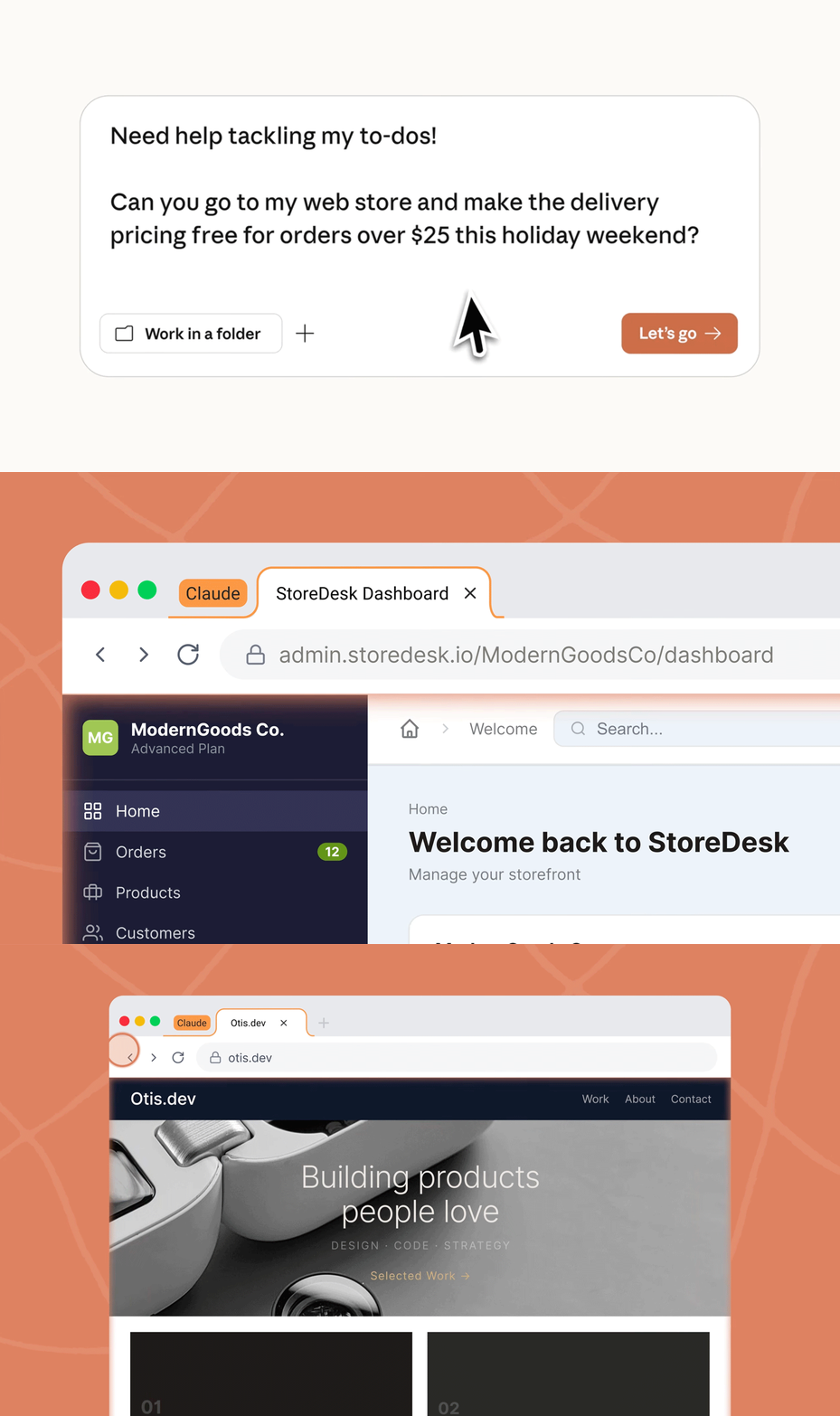
Anthropc on Tuesday introduced its most aggressive push yet to embed AI agents into corporate environments, launching an enterprise agents program with 10 pre-built plugins designed to automate professional tasks across finance, HR, investment banking, engineering, and design
1
. The San Francisco-based startup, backed by Google and Amazon, aims to address what its head of Americas Kate Jensen called a "failure of approach" in delivering on the promise of agentic AI to transform workplaces1
.
Source: Inc.
The new system builds on Claude Cowork, which was initially announced in research preview on January 30th, and focuses on making AI tools for business customers easier to deploy within organizations through private software marketplaces, controlled data flows, and customized plugins
1
. "We believe that the future of work means everybody having their own custom agent," Anthropic product officer Matt Piccolella told TechCrunch1
.Plugins for Finance and HR Target Core Business Functions
The stock plugins included at launch take aim at departments present within most companies, with each designed to handle common tasks while allowing customization for unique organizational needs. The finance plugin equips Claude AI with capabilities for market and competitive research, financial modeling, and other essential functions for finance teams
1
. For HR departments, the plugin includes skills for generating job descriptions, onboarding materials, and offer letters1
.
Source: The Hill
Investment banking AI tools were developed in partnership with financial data providers including FactSet Research Systems, enabling tasks like reviewing deals and portfolio analysis
3
4
. Other partners include LSEG, while companies such as Thomson Reuters and RBC Wealth Management are already using AI-powered automation through Anthropic's platform4
.AI Integration with Enterprise Software Signals Collaborative Approach
The launch includes new enterprise connectors for popular business tools, allowing Claude Cowork to connect with Google Workspace, Gmail, DocuSign, WordPress, and Clay
1
2
. According to Anthropic, Claude can now handle multi-step tasks end-to-end across Excel and PowerPoint, passing context between applications2
. These integrations allow agents to pull data and context directly from linked systems, addressing what Scott White, Anthropic's head of product for enterprise, described as bridging the gap between how people use AI for queries and the tools they use for specific work3
.The collaborative tone marks a strategic pivot following market disruption caused by earlier releases. Last month, Anthropic's legal plugin ignited an $830 billion global selloff in software and financial services stocks over six trading days, as investors worried about AI's potential to undercut revenue streams
4
. White emphasized that the goal is delivering better outcomes for customers, not replacing them: "It's not a product that's trying to own every workflow. We're providing infrastructure and intelligence so our partners or our customers can bring their business knowledge, their expertise, their trusted relationships and their customers to the equation"4
.Related Stories
Wall Street Sees Opportunity in Data Providers and Domain Expertise
The undisruptive nature of Tuesday's announcement helped software and financial services stocks regain ground, with the iShares Expanded Tech-Software Sector ETF adding nearly 2% following Monday's 4% drop
5
. Thomson Reuters shares surged more than 11% on Tuesday after being highlighted as an integration partner during Anthropic's presentation, marking its best day since 20095
.
Source: CXOToday
Wells Fargo analyst Jason Haas noted that "Anthropic's announcement is evidence that domain expertise and data assets are crucial in building industry specific AI," listing Fair Isaac, Moody's, S&P Global, Verisk Analytics, Equifax, and Thomson Reuters as companies positioned to benefit
5
. RBC's Matthew Hedberg said traders should view Anthropic as "embracing" the SaaS ecosystem, pointing to CrowdStrike, Datadog, MongoDB, Cloudflare, Palo Alto Networks, and Snowflake as potential beneficiaries5
.Anthropc has more than 300,000 business customers using its models to streamline workplace responsibilities, particularly in computer programming where its Claude Code assistant has emerged as a market leader
3
. The company recently raised funding at a $380 billion valuation and faces competition from Google, OpenAI, and Elon Musk's xAI in selling increasingly autonomous AI to the enterprise market ahead of a widely expected public offering3
4
. The new tools are available to all users on Cowork, currently limited to paid Pro, Max, Team, and Enterprise subscriptions2
.References
Summarized by

Navi
[1]
Related Stories
Anthropic's Claude AI Sparks $1 Trillion Market Disruption as Software Stocks Tumble
03 Feb 2026•Technology

Anthropic eyes October IPO as Claude AI sees record subscriber growth amid Pentagon battle
27 Mar 2026•Business and Economy

Anthropic doubles funding target to $20B as enterprise AI revenue surges toward $18B in 2026
27 Jan 2026•Business and Economy

Recent Highlights


Recent Highlights
Today's Top Stories









Your Daily Dose of Curated AI News
Don’t drown in AI news. We cut through the noise - filtering, ranking and summarizing the most important AI news, breakthroughs and research daily. Spend less time searching for the latest in AI and get straight to action.

