China's humanoid robot industry dominates supply chain as U.S. scrambles for alternatives


3 Sources
3 Sources
[1]
Why China's humanoid robot industry is winning the early market | TechCrunch
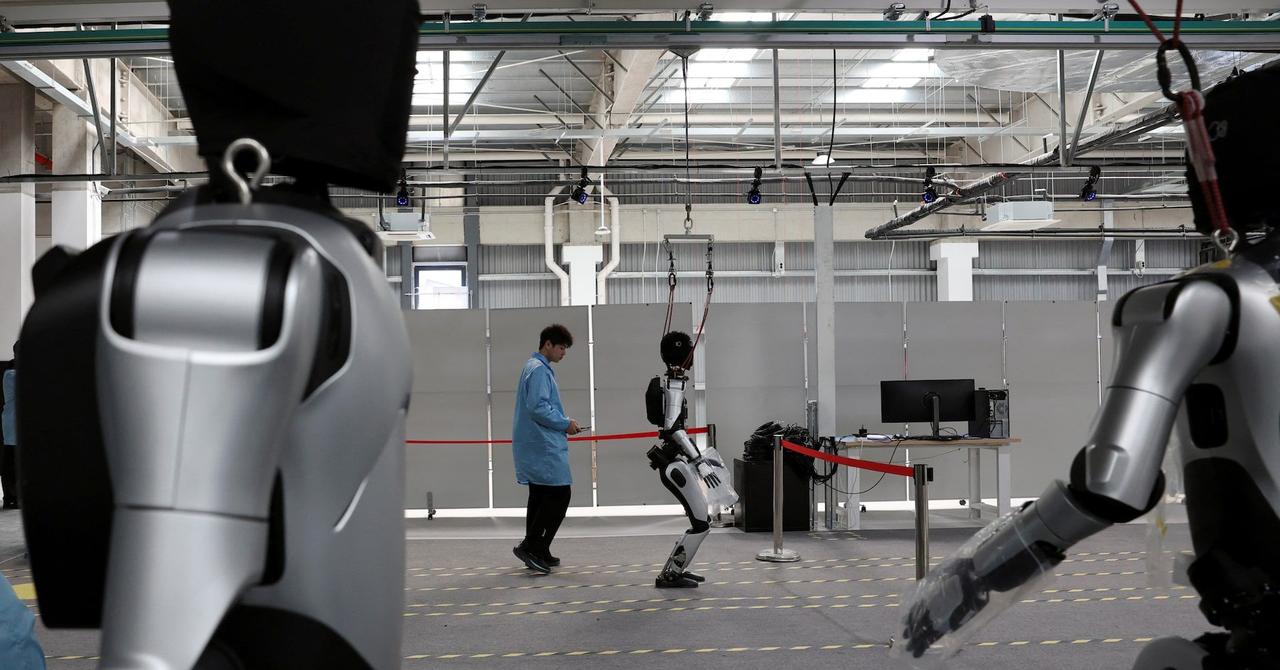
China's humanoid robots grabbed global attention with kung fu flips at the nation's televised Spring Festival Gala, while Chinese phone maker Honor is set to unveil its first humanoid robot at MWC in Spain. Robotics was flagged as a priority under the country's "Made in China 2025" plan, albeit originally focused on factory automation, rather than humanoids. Now, rapid advances in multimodal AI are accelerating so-called embodied AI -- autonomous machines operating in the real world -- a push officials say could help offset labor shortages and drive productivity gains. At this early stage of humanoid robot development, Chinese companies are outpacing their U.S. rivals in both speed and volume, Selina Xu, a China and AI policy lead at the office of Eric Schmidt said. "China has a more robust hardware supply chain -- much of it built up through the EV sector, from sensors to batteries -- and the world's strongest manufacturing base, allowing companies to iterate far faster than Western competitors," Xu told TechCrunch. As a result, not only are Chinese robots cheaper but companies can also release new models more quickly, Xu noted, adding that leading Chinese player Unitree shipped roughly 36 times more units last year than U.S. rivals Figure and Tesla. Global humanoid robot shipments totaled just 13,317 units last year, according to a Forbes report released last month. That is a tiny base for an industry expected to nearly double annually and reach 2.6 million units by 2035. (Still, the figures should be viewed with caution. The report notes it remains unclear how many units represent commercial sales versus demo models or pilot deployments, underscoring the early-stage nature of the industry.) The top humanoid robot makers by 2025 shipments were led by China's Agibot and Unitree, followed by UBTech, Leju Robotics, Engine AI, and Fourier Intelligence, underscoring Beijing's early dominance in the sector. The biggest shift recently has been from "demo-driven excitement" to "operations-driven adoption," Yuli Zhao, chief strategy officer at Galbot, told TechCrunch. Galbot's humanoid robot, the G1, appeared at this year's Spring Festival Gala, China's annual, state-run lunar New Year's Eve television show, alongside robots from Unitree Robotics, Noetix, and MagicLab. "More customers are asking: Can the robot run stably in real environments and actually take work off people's plates? That practical pull is strengthened in China because policy and industrial strategy encourage automation upgrades, and the manufacturing ecosystem makes iteration extremely fast," Zhao said. While increased funding toward humanoid startups "has definitely accelerated" the pace of progress, "the most durable adoption comes when you can show reliable and repeatable value in production or service operations, not just a one-off showcase," Zhao added. Still, investing helps and Chinese robotics makers are securing it. Last year Unitree was valued at around $3 billion after closing its Series C, with ambitions to reach as much as $7 billion in a future IPO. Meanwhile, Galbot has raised more than $300 million in fresh funding, reportedly pushing its valuation to $3 billion, one of the largest financings in China's humanoid robotics sector to date. U.S. companies are moving beyond flashy demos as well to focus on real-world deployments. Plus, they are pursuing their own aggressive goals. U.S. startup Foundation, for instance, plans to build 50,000 humanoid robots by the end of 2027. But China is already targeting a mix of affordable mass-market models and high-end applications, rapidly expanding humanoids across industrial, consumer, and rehabilitation sectors, according to a December TrendForce report. When it comes to AI systems and integrated software, it's still unclear where Chinese humanoid firms truly stand. The industry is largely betting on vision-language-action models and "world models," but both technologies remain in early stages. Nvidia currently leads the space with its end-to-end humanoid software stack, according to Xu, so naturally most humanoid startups in China are powered by Nvidia's Orin chips. However, domestic chipmakers are developing homegrown alternatives, she said. Yet humanoid robotics makers are still working on fundamental problems. The challenge is enabling robot foundation models to predict the "next physical state" the robot will face in unpredictable environments, like how large language models predict the next word. But unlike LLMs, humanoid robotics companies can't simply scrape the internet for training data, Xu said. So most are relying on simulation environments, which generates synthetic data, though real-world data collection remains essential. "Because of the data scarcity problem, humanoids are still far away from autonomy. The hardware is currently ahead of the software -- the robot body can handle a lot more dexterity today than years ago (though it has reliability issues, as we saw with the robots that broke down at humanoid marathons), but the brain is still nascent," the analyst said. Safety is a major hurdle for humanoid robots, too. One high-profile accident could trigger public backlash, and China is likely weighing how to roll out the technology quickly without moving too fast. As the industry matures, more regulations are expected. Given the lack of data, Zhao believes that demand for humanoids will grow first in fairly contained workplaces. "Early momentum is likely to be in industrial manufacturing, warehouse logistics, and retail, where tasks are repetitive, hours are long, and processes are clear -- creating real demand and ideal conditions for humanoid robots to deliver value at scale," he said. Humanoid robot development is not a two-country race. Japan's robotics ecosystem -- from startups to semiconductor heavyweights -- is targeting humanoid mass production by 2027. Long a pioneer through projects like Honda's Asimo, Murata Manufacturing's Murata Boy, and SoftBank Robotics' Pepper, Japan leans on precision and advanced control. One area unique to this nation: Humanoid robots are increasingly used in eldercare. Coral Capital CEO James Riney, who invests in tech companies in Japan, believes Tokyo will continue to thrive in the humanoid robotics industry. "There are three factors likely to drive the adoption of robotics in Japan. One is the labor shortage and the desire to depend less on mass immigration. The second is the widespread cultural view of robots as our friends -- more Doraemon vs. Terminator. The third is that Japan is already dominant in many parts of the robotics supply chain." Hyundai Motor's Boston Dynamics unit introduced a new Atlas humanoid for factory use by 2028, with plans to produce up to 30,000 units annually in the U.S. as part of its AI-driven robotics push. Still, for China, government policy, industrial strategy, labor shortages, and private capital are all converging to turbocharge the country's humanoid robotics push. "China's leadership is best understood as a speed-to-scale advantage," Zhao said. "The ecosystem here compresses the entire cycle -- R&D, supply chain, manufacturing, integration, and customer deployment -- into a very tight loop. That means humanoid companies can move from prototype to real-world deployment faster, learn from real operations, and iterate at a pace that's difficult to match elsewhere."
[2]
China increases presence in Korea's advanced robot market - The Korea Times
Hypershell's exoskeleton devices are displayed at its launching event in Seoul, Feb. 24. Courtesy of VD Robotics Chinese robot firms are stepping up their push into the Korean market, evolving from task-oriented service robots such as robot vacuum cleaners and serving robots to advanced robotics including exoskeletons and humanoids. Hypershell, a Chinese robotics firm specializing in leisure-focused exoskeletons, launched its Hypershell X series in Korea last week, highlighting the country's preference for premium fitness gear. The Hypershell X series is a wearable exoskeleton device that uses artificial intelligence (AI) to augment and regulate power in real time, adapting to terrain and the user's movements. More than 30,000 units have been sold globally, and the company's Korean retailer, VD Robotics, seeks to sell more than 3,000 units in Korea this year. Weighing around two kilograms, the device is designed for outdoor activities including running, trekking, hiking and cycling. The price starts at 1.5 million won ($1,023), a level that could appeal to tech enthusiasts willing to invest in advanced gear. Unlike conventional wearable exoskeletons that have largely catered to medical or specialized industrial uses, Hypershell is targeting general consumers here who are more receptive to premium outdoor equipment. According to VD Robotics, a pre-order campaign on crowdfunding platform Wadiz raised 100 million won as of Feb. 18, reaching 3,721 percent of its initial funding target. Unitree, one of China's leading humanoid and quadruped robot firms, is also improving its presence among Korean consumers, beginning offline sales at a local discount chain store. Emart opened a robot store on Jan. 30 at its outlet in Yeongdeungpo, Seoul, showcasing Unitree's humanoid robot G1 and the quadruped robot Go2. They are available for sale with the G1 priced at 30 million won and Go2 for 3.99 million won. Although sales remain limited, with most of the robots seeing single-digit sales and only one Go2 reportedly being sold, the store has drawn a large number of visitors, signaling strong consumer interest that could eventually translate into purchases as consumers begin to perceive robots as products for everyday life. On March 4, major Chinese robotics companies held the China Humanoid Conference during AW Summit 2026 in Seoul, with industry leaders including Unitree, AgiBot, Fourier, Leju and Huawei presenting their global expansion strategies in general purpose, industrial and medical humanoid robotics. Korean dealers also set up booths at the exhibition, showcasing humanoid robot applications in areas such as smart factories and automation solutions. China's growing presence Chinese robotics firms already hold a dominant presence in the Korean market. According to the Korea Association of AI Robot Industry, Chinese firms account for over 70 percent of the domestic service robot market and 54 percent of the domestic robot vacuum cleaner market. Recent trends suggest that the Chinese push in the Korean market is moving beyond relatively simple task-oriented robots to more comprehensive systems capable of performing complex functions. Given Korea's role as a global test bed for advanced technology products, industry observers say the launch of increasingly sophisticated Chinese robots here suggests that these firms are positioning themselves at the forefront of the global robotics market, rather than merely expanding in an overseas market. Chinese firms are rapidly gaining ground in the global humanoid robot market. According to UBS Global analyst Phyllis Wang, the world's total humanoid shipments reached about 18,600 units in 2025, with the majority supplied by Chinese manufacturers. The figures include roughly 5,000 units each from Unitree and AgiBot. The Korea Institute for Robot Industry Advancement said in a recent report that China's rise in the advanced robotics industry is not a result of corporate success but rather a state-backed industrial ecosystem called "industrial commons." Under this model, manufacturing capacity, supply chains, R&D infrastructure and talent pools are shared across industries, allowing technological gains in one sector to accelerate progress in others. As a result, China's robotics industry has benefited from technological spillovers from electric vehicles (EVs), batteries and other advanced manufacturing areas. Expertise in motors, power systems and precision manufacturing has extended into robotics and intelligent production. "Chinese EV makers' push into humanoid robotics is a clear example of the interlocking innovation flywheel now taking shape across China's advanced industries," the report said. Automaker GAC Group has introduced a humanoid robot called GoMate, while Xiaomi unveiled its CyberOne humanoid robot in 2022. Electric vehicle giant BYD is also working on a humanoid robot project known as Yao Shun Yu. Among Korean firms, Hyundai Motor Group is widely regarded as one of the frontrunners in humanoid robotics with its Atlas robot, developed by its subsidiary Boston Dynamics. However, there are concerns that Chinese companies may already hold a competitive edge at the ecosystem level, particularly in localized component supply chains. According to a report by the Korea Institute for Industrial Economics and Trade, the localization rate of China's industrial robot market reached 57.5 percent in 2024, and rates for key components such as reducers, servo systems and controllers have already surpassed 50 percent. In contrast, the localization rate for robot components and materials in Korea remains at around 40 percent. "The industrial relations between Korea and China has shifted from a vertical division to a horizontal competition, meaning the strategy of using China primarily as a manufacturing base or supply source is no longer effective," the report said. "From a long-term perspective, Korea needs a strategy on how to respond to and leverage China-led global supply chains to maximize national economic interests."
[3]
The humanoid arms race: can the U.S. and China actually coexist? By Investing.com
Investing.com -- The global race for humanoid robots is getting crowded. For years, the narrative was simple: the U.S. designs the "brains" while China produces the hardware. But according to a Morgan Stanley report, that clean divide is falling apart. China is no longer just a workshop; it's a powerhouse that shipped over 12,000 humanoids in 2025 alone. Now, everyone is looking at the upcoming Trump-Xi meeting to see if these two giants will shake hands or keep attacking each other over supply chains. Can a U.S. robot actually function without Chinese parts? Right now, the answer is a flat no. Chinese suppliers like Leaderdrive and Minth Group Ltd (HK:0425) make the high-precision actuator assemblies that let these machines move. To dodge geopolitical landmines, they're now forming joint ventures to build factories on U.S. soil. It's a classic strategy that lets the U.S. internalize manufacturing secrets while China keeps its grip on the parts market. OpenAI and the hunt for domestic steel In late January, OpenAI threw a massive wrench into the gears. They put out an RFP specifically hunting for U.S.-based suppliers for bearings, motors, and actuators. It's a clear signal that the AI darlings are tired of being tethered to Shenzhen. Firms such as OpenAI want to de-risk the hardware side before things get even messier. But building a domestic supply chain from scratch is a big task, and U.S. industrial players will have to hustle to catch up to China's 28,000-unit forecast for 2026. Optimus Gen 3: The shadow over the market Tesla Inc (NASDAQ:TSLA) is the elephant in the room. Everyone is waiting for Elon to launch Optimus Gen 3 before the end of March. Analysts are expecting a "first-principles" redesign that showcases how easily humanoid robots can be mass-produced. Tesla's advantage isn't just the tech, it's the data. The company can let the robots roam its factories all through 2026, collecting millions of hours of training data while competitors are still trying to figure out how to make their prototypes work well in non-scripted environments. Software firms like OpenMind are trying to play both sides, hosting Chinese hardware on U.S. servers to keep the regulators happy. It's a "messy" middle ground that shows just how intertwined these two economies really are. The U.S. government can try to "onshore" all it wants, but the robot revolution is being built with a mix of Silicon Valley code and Chinese gears.
Share
Share
Copy Link
China shipped over 12,000 humanoid robots in 2025, led by Unitree and Agibot, while controlling critical supply chains for actuators and motors. The U.S. faces a stark reality: no American humanoid robot can function without Chinese parts. OpenAI is now hunting for domestic suppliers as the humanoid arms race between U.S. and China intensifies.
China's Humanoid Robot Industry Leads Global Shipments
China's humanoid robot industry has seized early dominance in the global market, shipping over 12,000 units in 2025 and positioning itself to deliver 28,000 units in 2026
3
. Chinese companies Agibot and Unitree topped the shipment charts, with Unitree alone delivering roughly 5,000 units and shipping approximately 36 times more humanoid robots than U.S. rivals Figure and Tesla combined1
2
. Global humanoid robot shipments totaled just 13,317 units last year according to Forbes, though UBS Global analyst Phyllis Wang reported approximately 18,600 units, with the majority supplied by Chinese manufacturers1
2
. The industry is expected to nearly double annually and reach 2.6 million units by 2035, though these figures should be viewed cautiously as it remains unclear how many represent commercial sales versus demo models.Supply Chain Control Creates U.S. Dependency
The supply chain reality is stark: no U.S. humanoid robot can currently function without Chinese parts
3
. Chinese suppliers like Leaderdrive and Minth Group manufacture the high-precision actuators and motors that enable humanoid movement. This dependency stems from China's robust hardware supply chain, much of it built through the electric vehicle sector, from sensors to batteries1
. Selina Xu, China and AI policy lead at the office of Eric Schmidt, told TechCrunch that China's manufacturing base allows companies to iterate far faster than Western competitors. The result: Chinese robots are not only cheaper but companies can release new models more quickly.Manufacturing Ecosystem Drives Advanced Robotics Innovation
China's rise in advanced robotics stems from a state-backed industrial ecosystem called "industrial commons," where manufacturing capacity, R&D infrastructure, and talent pools are shared across industries
2
. The Korea Institute for Robot Industry Advancement noted that technological spillovers from electric vehicles, batteries, and precision manufacturing have accelerated robotics progress. Expertise in motors, power systems, and factory automation has extended seamlessly into the manufacturing ecosystem supporting humanoid development. Chinese automaker GAC Group introduced the GoMate humanoid robot, while Xiaomi unveiled its CyberOne in 2022, and BYD is developing the Yao Shun Yu project2
.OpenAI Seeks Domestic Alternatives Amid Humanoid Arms Race
In late January, OpenAI issued a request for proposals specifically seeking U.S.-based suppliers for bearings, motors, and actuators, signaling a push to de-risk hardware dependencies
3
. The move reflects growing concerns about geopolitical tensions between U.S. and China affecting component supply chains. Chinese suppliers are responding by forming joint ventures to build factories on U.S. soil, allowing America to internalize manufacturing secrets while China maintains its grip on the parts market. Building a domestic supply chain from scratch presents significant challenges as U.S. industrial players scramble to catch up to China's production capabilities.Embodied AI and Labor Shortages Drive Adoption
Rapid advances in multimodal AI are accelerating embodied AI development—autonomous machines operating in the real world—a push officials say could help offset labor shortages and drive productivity gains
1
. Robotics was flagged as a priority under Made in China 2025, originally focused on factory automation before expanding to humanoids. Yuli Zhao, chief strategy officer at Galbot, told TechCrunch the biggest shift has been from "demo-driven excitement" to "operations-driven adoption," with customers asking whether robots can run stably in real environments and actually reduce workloads. China's policy and industrial strategy encourage automation upgrades, strengthening practical demand.Related Stories

Investments Fuel China's Humanoid Robot Expansion
Chinese robotics makers are securing substantial investments. Unitree was valued at around $3 billion after closing its Series C, with ambitions to reach as much as $7 billion in a future IPO
1
. Galbot has raised more than $300 million in fresh funding, reportedly pushing its valuation to $3 billion, one of the largest financings in China's humanoid robotics sector. Chinese firms already hold dominant positions in overseas markets: they account for over 70 percent of Korea's domestic service robot market and 54 percent of the robot vacuum cleaner market2
. Chinese robotics firms are now moving beyond task-oriented robots to comprehensive systems performing complex functions, with Unitree's G1 priced at 30 million won ($20,500) in Korean retail stores.Tesla Optimus Gen 3 and Data Collection Advantage
Tesla remains the wildcard in the global humanoid robot industry. Analysts expect Elon Musk to launch Optimus Gen 3 before the end of March, showcasing a "first-principles" redesign demonstrating mass production capabilities
3
. Tesla's advantage extends beyond technology to data collection: the company can deploy robots throughout its factories during 2026, gathering millions of hours of training data while competitors struggle with non-scripted environments. U.S. startup Foundation plans to build 50,000 humanoid robots by the end of 2027, pursuing aggressive goals1
.Software and AI Challenges Remain Unsolved
When it comes to AI systems and integrated software, it remains unclear where Chinese humanoid firms truly stand
1
. The industry is betting on vision-language-action models and "world models," but both technologies remain in early stages. Nvidia currently leads with its end-to-end humanoid software stack, and most Chinese humanoid startups are powered by Nvidia's Orin chips, though domestic chipmakers are developing alternatives. The fundamental challenge is enabling robot foundation models to predict the "next physical state" in unpredictable environments. Unlike large language models that scrape internet data, humanoid robotics companies face data scarcity problems, relying heavily on simulation environments for synthetic data while real-world data collection remains essential. Because of this, humanoids are still far from autonomy, with hardware currently ahead of software capabilities.
Source: TechCrunch
References
Summarized by

Navi
Related Stories
China Dominates Humanoid Robots Shipments, Outpacing Tesla and US Rivals in 2025
09 Jan 2026•Technology

China dominates humanoid robots race as robot coworkers move from labs to factory floors
20 Jan 2026•Technology

China's AI-Powered Humanoid Robots: Transforming Manufacturing and Driving Economic Growth
13 May 2025•Technology
Recent Highlights



Recent Highlights
Today's Top Stories









Your Daily Dose of Curated AI News
Don’t drown in AI news. We cut through the noise - filtering, ranking and summarizing the most important AI news, breakthroughs and research daily. Spend less time searching for the latest in AI and get straight to action.

