Qualcomm and Nvidia race to define AI-native 6G as telecom industry shifts focus at MWC 2026


10 Sources
[1]
Qualcomm, Nvidia push 'AI-native' 6G - definition pending
It seems like just yesterday that the 5G rollout started. Now, at Mobile World Congress, major companies are already talking about commercializing 6G. Never mind that binding 6G standards haven't been nailed down yet. The world has been joking about when telecoms would push the sixth generation of
[2]
Nvidia Forms Alliance to Make Sure 6G Networks Embrace AI
Nvidia Corp., the world's most valuable company, is throwing its weight behind an effort to make sure the forthcoming 6G phone networks provide a strong platform for services and devices that take advantage of artificial intelligence. Nvidia is teaming up with a group of telecommunications
[3]
At MWC 2026, the telecom industry pivoted from 5G to AI-powered 6G
Serving tech enthusiasts for over 25 years. TechSpot means tech analysis and advice you can trust. Heading to Barcelona for this year's Mobile World Congress, I had a feeling there might be some early discussions on the potential for 6G. Boy, was I wrong. Instead of 6G being a sideline topic, it
[4]
NVIDIA and Global Telecom Leaders Commit to Build 6G on Open and Secure AI-Native Platforms
* Leading operators and infrastructure providers including Booz Allen, BT Group, Cisco, Deutsche Telekom, Ericsson, MITRE, Nokia, ODC, SK Telecom, SoftBank Corp. and T-Mobile will build on open and trusted software-defined wireless platforms. * The commitment complements NVIDIA's ongoing
[5]

Qualcomm CEO: "resistance is futile" as 6G mobile revolution approaches | Fortune
I remember sending my first email in the early 1990s, a clunky experience which meant logging on to two different computer systems. I thought it would never replace the much swifter fax. The internet was already revolutionizing the flow of information and, as the editor of The Guardian's gargantuan
[6]

Qualcomm bets on AI-native 6G by 2029 and says Europe can lead
"6G is not an evolution, it's a revolution," Qualcomm's Wassim Chourbaji tells Euronews Next at the Mobile World Congress. Semiconductor giant Qualcomm has set an ambitious 2029 date for 6G commercialisation and says the next generation of wireless is a "revolution, not an evolution," that Europe
[7]

6G Gets an Early Launch Date
We may earn a commission when you click links to retailers and purchase goods. More info. Did the promises of 5G ever happen? I don't know. 5G is fine. It seems mostly mature at this stage and our wireless networks in the US are all pretty good. T-Mobile's network wins awards, Verizon's does too,
[8]

Telco giants join forces with Nvidia for AI-ready 6G infrastructure
Collaborators include BT, Cisco, Deutsche Telekom and its subsidiary T-Mobile, and Nokia. Nvidia has announced a new joint project with global telecommunication leaders to fast track AI-ready 6G infrastructure. Expected to be commercially adopted before the end of the decade, 6G promises leaps in
[9]

Ahead of MWC Barcelona, Nvidia bets AI-native platforms will carry telecom into 6G - SiliconANGLE
Ahead of MWC Barcelona, Nvidia bets AI-native platforms will carry telecom into 6G Nvidia Corp. early Sunday announced ahead of the MWC Barcelona conference that its joining global telecom leaders in a commitment to build 6G on open and secure artificial intelligence-native platforms, bringing
[10]

Jio and Airtel Step into Early 6G Ecosystem as Qualcomm Targets 2029 Rollout
Leading companies such as Airtel, Jio, Samsung, Nokia, Ericsson, Cisco and others are actively involved At Mobile World Congress (MWC) Barcelona 2026, Qualcomm Technologies announced a strategic coalition with leading global partners to accelerate the development of next-generation 6G networks.
Share
Copy Link
At Mobile World Congress 2026, Qualcomm and Nvidia announced competing initiatives to build AI-native 6G networks, with both tech giants forming alliances with major telecom operators. Despite no finalized 6G standards, the companies aim for commercial rollouts by 2029, positioning the next generation of wireless networks as essential infrastructure for physical AI applications like autonomous vehicles and robots.
Qualcomm and Nvidia Unveil Competing 6G Visions
At Mobile World Congress in Barcelona, the telecom industry made a dramatic pivot from 5G discussions to aggressive 6G positioning, with Qualcomm and Nvidia leading separate but overlapping initiatives to define the next generation of wireless networks
1
. Both companies framed AI-native 6G as critical infrastructure for an era where billions of autonomous systems, vehicles, sensors, and robots will demand unprecedented network intelligence and reliability4
.
Source: Silicon Republic
Nvidia, now the world's most valuable company, announced a commitment with global telecom leaders including Nokia, Ericsson, T-Mobile, Deutsche Telekom, SK Telecom, BT Group, Cisco, and SoftBank Corp. to build 6G on open and secure AI-native platforms
2
. Qualcomm countered with its own coalition, sharing many of the same partners, and outlined plans to develop a software-defined 6G network built on three pillars: connectivity, wide-area sensing, and high-performance compute1
.Racing Against Undefined Standards
The urgency around these announcements stands in stark contrast to the absence of finalized technical specifications. The International Telecommunication Union published its IMT-2030 framework for 6G in 2023, while the 3rd Generation Partnership Project has begun early-stage study work, but neither body has established binding 6G standards
1
. Qualcomm aims to drive "development of essential 6G standards, early system validation, demonstration of 6G spec-compliant pre-commercial devices and networks" by 2028, with initial commercial 6G systems rolling out in 20291
.Qualcomm CEO Cristiano Amon told Fortune that "if you actually believe in the AI revolution, 6G will be required. Resistance is futile"
5
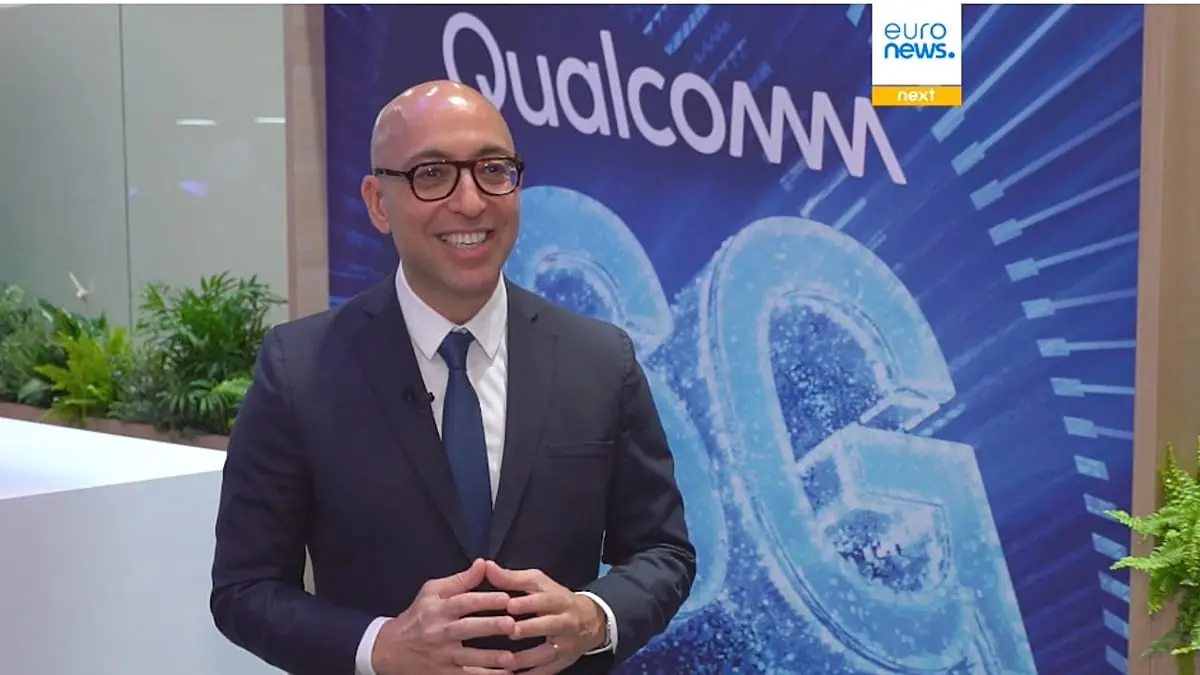
. The company's Chief Financial Officer and Chief Operating Officer Akash Palkhiwala explained that 6G represents "the first AI native wireless network that's ever been built," designed for agent traffic rather than traditional consumer voice calls and video downloads5
.
Source: Euronews
Physical AI Drives Network Requirements
Nvidia's vision centers on addressing what it describes as a fundamental limitation of current infrastructure. "The networks of today simply aren't ready for the use cases of tomorrow," said Ronnie Vasishta, who heads Nvidia's telecommunications business and strategy
2
. The company argues that telecommunications networks will require "hundreds of thousands of times" more efficiency because available radio spectrum cannot support the explosion of physical AI applications without fundamental architectural changes2
.Nvidia CEO Jensen Huang framed the initiative in sweeping terms: "AI is redefining computing and driving the largest infrastructure buildout in human history -- and telecommunications is next"
4
. The company's approach emphasizes AI-powered Radio Access Networks and software-defined networks that can continuously evolve through software updates rather than requiring constant hardware redesigns1
.Related Stories

Integrated Sensing and Communications Emerges as Key Differentiator
Qualcomm highlighted integrated sensing and communications (ISAC) technology as a critical feature distinguishing 6G from 5G
3
. ISAC leverages RF sensing, using radio frequency waveforms to provide real-time radar-like views of physical environments. This technology tracks cellular signal paths and reflections to create physical maps of surrounding areas, enabling applications like digital twins, asset tracking, connected vehicles, and robotics without the privacy concerns associated with camera networks3
.
Source: TechSpot
The 6G mobile revolution promises to transform how networks handle traffic. Palkhiwala described a shift from today's "application economy" to an "agent economy," where a single AI agent handles multiple tasks across services rather than users manually navigating separate applications for travel, transportation, food ordering, and entertainment
5
.Industry Momentum Builds Despite Technical Uncertainty
Nvidia's Vasishta suggested that the shift to open and secure AI-native platforms could enable new entrants: "This will be how a new telecom unicorn is born," noting the telecom industry has seen too few startups achieve billion-dollar valuations over the past decade
2
.At Mobile World Congress, Nvidia's influence was evident even without a physical presence at the show
3
. The company's Aerial software project for using GPUs to accelerate Radio Access Network (RAN) workloads gained traction after years of skepticism about power consumption and cost. Nvidia's new Aerial RAN Computer Pro (ARC Pro) addresses these concerns by using lower-power GPUs that fit within 330-watt power envelopes comparable to existing solutions .Qualcomm also announced the Snapdragon Wear Elite SoC for wearable devices, the first in its wearable chip line to integrate an NPU for on-device AI capabilities
3
. Combined with edge computing and more efficient bandwidth management through AI-enabled load control, these developments point toward a distributed computing architecture spanning devices, local infrastructure, and cloud services5
.Qualcomm stated that first 6G applications will reach consumer testing by the 2028 Los Angeles Olympics, with broader rollouts beginning in 2029
5
. Whether competing initiatives from Qualcomm and Nvidia will converge on compatible standards or create fragmentation remains an open question as the race to define AI-native 6G accelerates.References
Summarized by

Navi
[1]
[4]
Related Stories
Qualcomm and MediaTek Lead the Charge Towards 6G: AI Integration and Technological Advancements
27 Feb 2025•Technology

Qualcomm Unveils 6G Plans and AI-Centric Future at Snapdragon Summit
25 Sept 2025•Technology

Nvidia pushes open-source 6G with telecom giants, challenging how mobile networks get built
03 Mar 2026•Technology

Recent Highlights



Recent Highlights
Today's Top Stories






Don’t drown in AI news. We cut through the noise - filtering, ranking and summarizing the most important AI news, breakthroughs and research daily. Follow topics that matter to you and stay ahead.


