European AI gets US funding but risks becoming an R&D incubator as innovation gap widens


2 Sources
2 Sources
[1]
US investors prefer Europemaxxing to Europebashing
If only Europeans believed in themselves as much as some Americans do then Europe's tech sector could be jostling at the front of the global pack. That may seem an odd thing to say given Europe-bashing appears to be a state-sponsored export industry in the US. Last year, US vice-president JD Vance warned that the "enemy within" was threatening Europe. The US national security strategy asserted that Europe was facing "civilisational erasure". And more recently Elon Musk accused Spain's prime minister, Pedro Sánchez, of being a "tyrant and a traitor" for wanting to protect children from what the Spanish leader calls the "digital wild west". Europeans might have formed the impression that the US considers the region to be illiberal, censorious and technologically backward -- a place to be avoided at all costs for anything other than sipping cortados and staring at art. But when you check out what some US tech companies and investors are doing, a different story emerges. In some areas, US investors have been all-in on Europe, or Europemaxxing, to modify a phrase. The worry for Europe is that love may be just as unsettling as scorn. One area in which US investors have been far more committed than their European counterparts is in providing venture capital funding for European start-ups. A recent Prosus/Dealroom report found that US investors contributed 73 per cent of the capital going into funding rounds of more than $100mn in European AI companies this year. As Jensen Huang, Nvidia's chief executive, flagged on a visit to London last year, the British tech sector has been experiencing a "Goldilocks" moment, being neither too hot nor too cold. When it comes to hiring top AI researchers and funding exciting start-ups, a US dollar goes a lot further in Europe than it does in Silicon Valley. Europe is certainly bursting with its own AI research talent but is not so good at optimising it for local advantage. According to the Prosus/Dealroom report, Europe matches US headcount in AI researchers, developers and engineers, with 325,000 experts on either side of the Atlantic. But the three biggest recruiters of those European researchers are giant US tech companies, namely Google, Meta and Amazon. The big US AI research labs, OpenAI and Anthropic, have been busily hiring in London and across Europe, too. US companies have also been the most active acquirers of early-stage European AI companies, with AMD, Accenture, Cloudflare and Workday snapping up promising Finnish, British and Swedish AI start-ups. And those European start-ups that thrive as independent companies and go public, such as Spotify and Klarna, often choose to list in New York rather than in Europe. The risk is that Europe becomes an R&D incubator for the US, with the best ideas, entrepreneurs and tech companies heading across the Atlantic. As Israel has shown, there may not necessarily be anything wrong with that model. When successful founders exit, capital and expertise is reinjected into building the next generation of start-ups. But even Israel is now questioning whether it might not be smarter to try to build globally relevant companies rather than sell out too early. If Europe wants to reassert technological sovereignty, then the answers are not hard to find. A Ditchley Foundation conference I attended recently explored many of them: assess which parts of the tech stack are critical for sovereignty and support the best alternative solutions in Europe; ensure that, wherever sensible, governments award contracts to homegrown European companies, especially in defence; and maximise the pool of growth capital available from European institutional funds. But perhaps the most intriguing idea would be to develop a trustworthy data regime in Europe to enable the sharing of data more freely and securely. Europe likes to claim it is a regulatory superpower. Now is the time to show how smart regulation truly can stimulate innovation. One entrepreneur at Ditchley calculated that just 8 per cent of the world's data was freely available; most lies within private corporate, governmental or user domains or healthcare systems. If Europe could develop the mechanisms to share that data fairly and securely it could lead the world in applying AI. As the entrepreneur John Taysom has argued in these pages, data trusts could emerge as the sovereign wealth funds of the AI economy. All that is missing is an American-style shot of risk-taking conviction, pragmatism and self-belief.
[2]
America and Europe have taken different routes on trying to "control AI". The results are stark | Fortune
If someone told you that your current trajectory was taking you toward "slow agony," you might sit up and take notice. Yet this is exactly the warning many have ignored following the publication of the Draghi report. Formally known as The Future of European Competitiveness, the report was published in September 2024 and authored by former European Central Bank President Mario Draghi. Its findings are stark. Draghi, who also served as Italy's prime minister, states that, without radical reform, the European Union is set to slip into economic and geopolitical decline. However dire the warnings, they came as little surprise to European business leaders, many of whom have been grappling with stringent regulations, economic turbulence, and the demands of the AI age for years now. Something must change. But in a market comprising more than 44 countries, and hundreds of companies that have been operating for over a century, making the necessary changes at speed is no easy thing. Draghi's report highlights several reasons why Europe's competitiveness is faltering. Although it focuses solely on the European Union, many of the bloc's problems overlap with those of non-member countries, such as the U.K. The first major issue is Europe's rapidly widening innovation gap. As the United States and China make leaps forward in high‑tech sectors such as artificial intelligence and quantum computing, many of Europe's brightest startups are choosing to set up shop elsewhere, frustrated by the lack of funding. Recent research by Amazon Web Services (AWS) shows that as many as four in 10 European startups would consider relocating outside Europe to scale. But the picture is more nuanced than a straightforward decline. "We see European AI adoption reaching a tipping point," says Tanuja Randery, vice president and managing director of AWS EMEA. "We've reached a milestone with over half of European businesses using AI." The issue, she explains, is not whether companies are adopting AI but how they are using it: "There are some companies that are experimenting deeply, embedding advanced AI into their processes -- then you have those who are simply experimenting at the edge." The challenge for Europe, she says, is that progress on deeper adoption "hasn't really moved -- it's stayed pretty flat." Another reality plaguing the AI industry is the extremely high cost of energy in Europe. Electricity on the continent can be two to three times as expensive as it is in the U.S., with natural gas prices up to five times as high. The situation is exacerbated by Europe's vast and fragmented energy networks, with thousands of different providers across each of its countries, making it almost impossible to distribute renewable energy efficiently. Then there is the subject of much heated debate: regulation. Draghi states that EU regulatory barriers constrain growth and advocates for simplification of the General Data Protection Regulation (GDPR) and EU AI Act; fewer reporting requirements for businesses; and a shift to more innovation‑friendly regulation. This is an opinion heartily shared by many European business leaders, including Erik Ekudden, chief technology officer at telecoms giant Ericsson. "The EU set out with strong ambition in the area of consumer protection, but some of these regulatory tools are not helping," Ekudden says. "You need to lead with innovation; you can't lead with regulation. We have to dial back this inclination to regulate something before it's even been innovated." The ubiquity and strictness of regulation has real business impacts. AWS research found that, currently, 42% of IT budgets are spent on compliance alone. For Ekudden and his colleagues at Ericsson, the issue is not just over‑regulation but a lack of consolidation across Europe. The existence of so many regional telecoms operators may be precisely what is preventing competitiveness on a global stage. "In the U.S., there are basically three main operators," explains Per Narvinger, Ericsson's executive vice president of business area networks. "In India, there are two very dominant ones and two more. In China you have three. In Europe -- I lose count." He points out that, like mobile networks, AI is an industry of scale. To train algorithms, you need a massive amount of data, and in a market as fragmented as Europe, "it will be both complicated and expensive for every small operator to do the same as large operators in other continents." For Yael Selfin, chief economist at KPMG U.K., this tension reflects something philosophically important and deeper than policy missteps. "Europe values stability, protection, and quality of life, whereas in the U.S. profit growth has a stronger value," she says. "These values drive some of this discrepancy." There are those, however, who do not see regulation as a stifling force. Shail Deep, chief operating officer for EMEA and APAC at global financial data and technology company Experian, believes that regulation is what enables great innovation. "The first reaction [to regulation] is often, 'Oh, there are more guardrails; how are we supposed to innovate?'" she says. "But if you think about regulation first, then when we start innovating, we can move faster... We won't have to keep returning to square one because there were risks associated with a project which were not initially considered." For Deep, regulation such as the EU AI Act has brought vital clarity to companies in high‑risk industries, where consumer trust is paramount. "It gives our clients confidence in terms of how AI is being used," she says. "We have a lot more explainability about our solutions." This, too, has a direct business impact. "If clients trust us, there is more adoption of our solutions." She points to other areas across financial services where European regulation has allowed for greater clarity and safer innovation, including open banking and buy‑now, pay‑later systems. Speed is, of course, the crux of the matter when discussing European competitiveness. Although Deep believes regulation has largely been a force for good, she does think it could move faster. "Sometimes we come up with guidelines by having these long consultative periods, which take two to three years. We need to regulate faster." The picture for European business is by no means bleak, however. The heritage some see as a drawback speaks to endurance and resilience. Ericsson is celebrating its 150th birthday this year, while Experian's roots stretch back nearly two centuries. The average age of a Fortune 500 Europe brand is 109 years old. No company can survive that long without understanding the power of the pivot. The key here, again, is speed. "In periods of rapid change, there is a lot of opportunity for companies that adapt fast, both in the adoption of technology and in entering new markets," says Selfin. Some, particularly those in heavily regulated industries, are embracing an "if you can't beat 'em, join 'em" philosophy. The European pharmaceuticals sector is one of the continent's most successful, employing around 900,000 people and generating a trade surplus of €200 billion. Many of pharma's biggest players, including AstraZeneca, Novo Nordisk, and Novartis, have opted to design for regulation, not around it, and have been working with the EU on reforms. The result of this collaboration is new legislation, which comes into force in 2026. The new rules are designed to profit both business and society by fostering greater innovation, improving patient access to medicine, and tackling major public health challenges. Perhaps the most business‑critical element is the introduction of EU pharmaceutical regulatory sandboxes, which will allow developers to test disruptive products not currently covered by existing regulation. For many organizations, the simple truth of the matter is that success for European businesses requires them to look outside Europe. "Individual European markets are relatively small," says Selfin. "If you really want to scale, you need to look beyond." It is true too, however, that the diversity of European countries can create opportunities not only through merger‑led consolidation but also by creating mutually beneficial partnerships. The European Commission's Battery Alliance aims to create "an innovative, competitive, and sustainable battery value chain in Europe," uniting businesses across the supply chain, from raw material suppliers to manufacturers. Then there are longer‑lived examples. Airbus's consortium model was established in 1970, bringing together aerospace players from France, Germany, Spain, and the U.K. to challenge U.S. aviation dominance. The result has been eight commercial aircraft models capable of competing with those of Boeing, which in turn has sent Airbus to No. 41 on the most recent Fortune 500 Europe list. Europe's fragmentation can also offer untold opportunities for innovation and creativity. Deep explains there is often one solution for all of Experian's North American clients but multiple offerings for customers in different European countries. "Some of the solutions that work in Italy don't get the same response in Spain," she says. "That's why we have such a rich portfolio of products and solutions that we offer to clients." Indeed, Italy has proved to be one of Experian's most innovative markets because of how the country has implemented EU regulations. "It puts clients on the same page as us regarding what is permissible," she says. "This makes the cocreation of products much easier and helps us to move faster." Brands can also use Europe's many markets as a testing ground for ideas which may resonate in non‑European regions. Ikea has long adapted its product range and store experience to meet local needs. When designing for the often‑cramped reality of living in cities such as Paris or London, it created a blueprint for space‑saving furniture that works just as well in tiny Tokyo apartments or modest New York City walk‑ups. Above all, it is worth remembering the potential inherent in Europe's businesses, whichever strategies individual players embrace to stay competitive. Experts agree that Europe is well placed in terms of skills, technical knowledge, and businesses -- both small and large -- which continue to innovate in spite of the challenges. Randery's view reflects this optimism. "Europe's got a ton of momentum and a ton of opportunity," she says. "But I'll tell you this -- we've got to act now." The real question, then, is not whether Europe can escape Draghi's "slow agony," but whether it can accelerate without abandoning the stability that has long defined its strength. Percentage of European startups saying they would leave Europe for the following reasons:
Share
Share
Copy Link
US investors are pouring capital into European AI start-ups, contributing 73% of funding rounds exceeding $100 million. But Europe faces a paradox: while it matches the US in AI talent with 325,000 researchers, its best minds are being recruited by American tech giants like Google, Meta, and Amazon. The Draghi report warns of 'slow agony' without reform.
US Capital Floods European AI While Talent Drains to Silicon Valley
A striking paradox defines the current state of European AI: American investors are betting big on the continent's potential, yet Europe risks losing its technological edge to the very nation funding its growth. US investors contributed 73 per cent of the capital going into funding rounds of more than $100mn in European AI companies this year, according to a recent Prosus/Dealroom report
1
. This phenomenon, dubbed "Europemaxxing" by some observers, reflects a calculated strategy: US capital for European AI goes further in London or Stockholm than in Silicon Valley, creating what Nvidia CEO Jensen Huang called a "Goldilocks" moment for British tech.Yet this influx of venture capital funding masks a deeper concern. Europe matches US headcount in AI researchers, developers and engineers, with 325,000 experts on either side of the Atlantic
1
. The problem is where those European AI researchers end up working. The three biggest recruiters of European talent are US tech giants Google, Meta, and Amazon, while AI research labs OpenAI and Anthropic have been aggressively hiring across the continent. US companies have also dominated acquisitions of early-stage start-ups, with AMD, Accenture, Cloudflare, and Workday snapping up promising Finnish, British, and Swedish AI companies. When European success stories like Spotify and Klarna go public, they often choose New York over European exchanges.The Draghi Report's Warning of 'Slow Agony'
The widening innovation gap between Europe and its global competitors has prompted urgent warnings from senior figures. The Draghi report, formally known as The Future of European Competitiveness and published in September 2024, delivered a stark message: without radical reform, the European Union faces economic and geopolitical decline
2
. Former European Central Bank President Mario Draghi, who authored the report, characterized the trajectory as "slow agony" if current trends continue.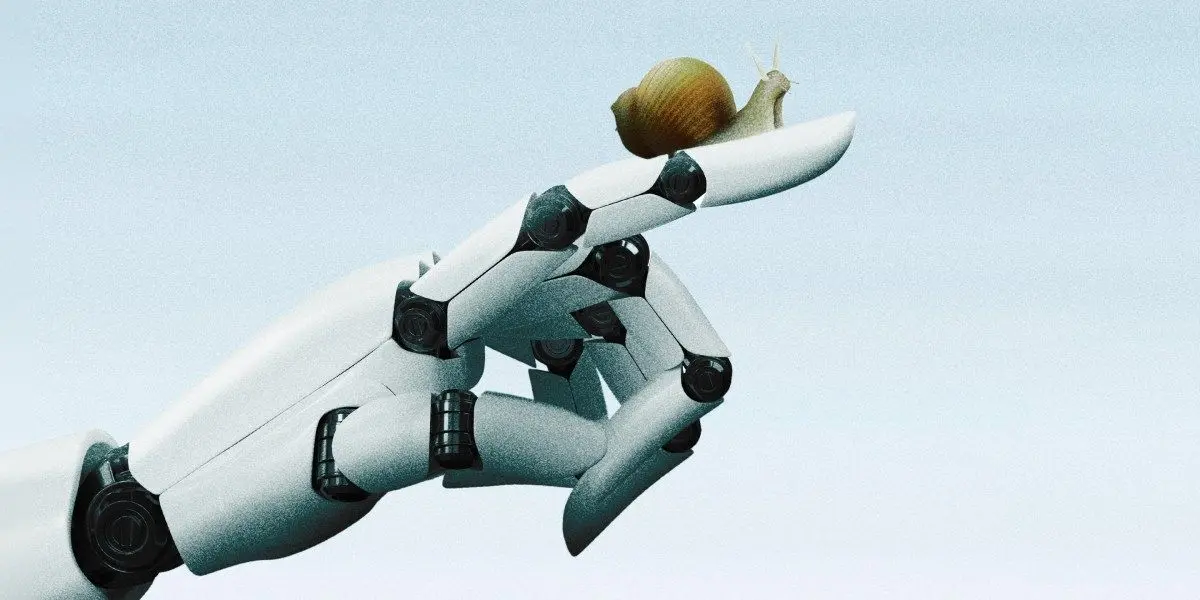
Source: Fortune
The competitiveness crisis extends beyond funding. Recent research by Amazon Web Services found that as many as four in 10 European start-ups would consider relocating outside Europe to scale
2
. Tanuja Randery, vice president and managing director of AWS EMEA, notes that while over half of European businesses now use AI, "there are some companies that are experimenting deeply, embedding advanced AI into their processes -- then you have those who are simply experimenting at the edge." Progress on deeper adoption "hasn't really moved -- it's stayed pretty flat," she explains.AI Regulation and the Fragmented Market Challenge
Stifling regulations have emerged as a central point of contention in Europe's struggle for technological sovereignty. The EU AI Act and GDPR, while designed for consumer protection, impose significant burdens on businesses. AWS research revealed that 42% of IT budgets are currently spent on compliance alone. Erik Ekudden, chief technology officer at Ericsson, argues that "you need to lead with innovation; you can't lead with regulation. We have to dial back this inclination to regulate something before it's even been innovated."
The fragmented market structure compounds these regulatory challenges. While the US has three main telecoms operators and China has three, Europe's count becomes difficult to track, according to Per Narvinger, Ericsson's executive vice president. This fragmentation affects scale in AI, an industry that requires massive amounts of data to train algorithms. Energy costs present another obstacle, with electricity on the continent two to three times as expensive as in the US, and natural gas prices up to five times higher.
Related Stories

Pathways to Reclaiming Europe's Technological Edge
The risk of becoming an R&D incubator for the US has prompted calls for strategic intervention. A Ditchley Foundation conference explored potential solutions: assessing which parts of the tech stack are critical for sovereignty, ensuring governments award contracts to homegrown European companies especially in defence, and maximizing the pool of growth capital available from European institutional funds
1
.The most compelling opportunity may lie in developing a trustworthy data regime. One entrepreneur calculated that just 8 per cent of the world's data is freely available, with most locked within private corporate, governmental, or healthcare systems. If Europe could develop mechanisms to share that data fairly and securely, it could lead the world in applying AI. Data trusts could emerge as the sovereign wealth funds of the AI economy, transforming regulatory strength into competitive advantage. What Europe needs now, observers suggest, is an American-style shot of risk-taking conviction and self-belief to match its technical talent.
References
Summarized by

Navi
Related Stories
Europe trails US and China in AI race despite €200 billion push to close infrastructure gap
27 Jan 2026•Policy and Regulation
EU Unveils Ambitious 'AI Continent Action Plan' to Compete with US and China
09 Apr 2025•Technology

Xavier Niel Warns: Europe Must Seize AI Opportunity or Risk Becoming 'Abandoned'
18 Nov 2024•Business and Economy

Recent Highlights
1
Google releases Gemma 4 with Apache 2.0 license, enabling unrestricted local AI on devices
Technology

2
AI Models Lie and Deceive to Protect Other AI Models From Deletion, Study Reveals
Science and Research

3
OpenAI closes $122 billion funding round amid fierce AI competition and profitability questions
Startups

Recent Highlights
Today's Top Stories







Your Daily Dose of Curated AI News
Don’t drown in AI news. We cut through the noise - filtering, ranking and summarizing the most important AI news, breakthroughs and research daily. Spend less time searching for the latest in AI and get straight to action.

