Europe trails US and China in AI race despite €200 billion push to close infrastructure gap


2 Sources
[1]
AI power play: Can Europe catch up to the US and China?
The EU is leading the AI race with key policies like the AI Act - but the US and China are racing ahead with innovation and investment. Can the EU cover the gap and catch up? The United States has produced 40 AI foundation models. China has developed 15. All of Europe combined has created just
[2]
Will European AI Infrastructure Ever Catch Up With the US and Asia?: By Dmytro Spilka
We're locked in the midst of an artificial intelligence race between tech frontrunners, the United States and China, but where is Europe? Despite its status as one of the most technologically advanced continents in the world, Europe already faces a steep challenge to catch up with the likes of the
Share
Copy Link
The European Union faces a steep challenge in the global AI race, producing only three foundation models compared to 40 from the US and 15 from China. Despite launching ambitious initiatives like the €200 billion InvestAI scheme and plans for AI gigafactories, Europe struggles with funding gaps, talent drain, and infrastructure shortfalls that threaten its competitiveness in artificial intelligence.
European AI Struggles to Match US and China Output
The numbers tell a stark story about European AI capabilities. The United States has produced 40 AI foundation models, China has developed 15, while all of Europe combined has created just three
1
. This disparity highlights how the EU is losing the AI race on nearly every key metric except regulation, as the artificial intelligence race intensifies between global powers2
.Stanford's AI Index Report reveals that the US holds nine times China's AI compute capacity and 17 times Europe's, underscoring the infrastructure chasm that European AI firms must bridge
2
. The continent's lack of data centers and AI-specific computing power creates fundamental barriers to innovation and competitiveness.Investment Gaps Widen as US Outspends Europe
The funding gap between regions is dramatic. Annual AI investment in the US reaches $60-70 billion, compared to about $7-8 billion in the EU
1
. Over the past decade, private AI investment in the US exceeded $400 billion, while all EU countries combined attracted about $50 billion. This disparity directly impacts Europe's ability to compete with resource-rich Wall Street tech firms or Chinese companies that benefit from significant government investment2
.European venture capital operates more cautiously than its American counterpart. AI startups in Europe raise about $8.5 million in their first funding rounds, significantly less than their US peers
1
. However, there are signs of change: AI's share of total European venture capital climbed to 27% in the first half of 2025, suggesting growing investor interest2
.Europe's Talent Drain Threatens Long-Term Prospects
The EU produces about 30% more AI professionals per capita than the US, yet fails to retain them
1
. Better funding, clearer career paths, and softer regulations abroad lure talent away. Three out of four European international AI PhD students at American universities stay in the US for at least five years, and a third of non-US AI specialists ultimately move to the United States1
.This exodus compounds Europe's challenges. Clark Parsons, leader of the European Startup Network, argues that "the EU should stop patting itself on the back for being the world's regulator in technology" and instead focus on unleashing growth
1
. The lack of data centers proves particularly problematic, with the US hosting 45.6% of the global share while the UK and Germany each host around 4.4% as Europe's leaders2
.Related Stories

InvestAI Initiative and European Union Initiatives Target Infrastructure
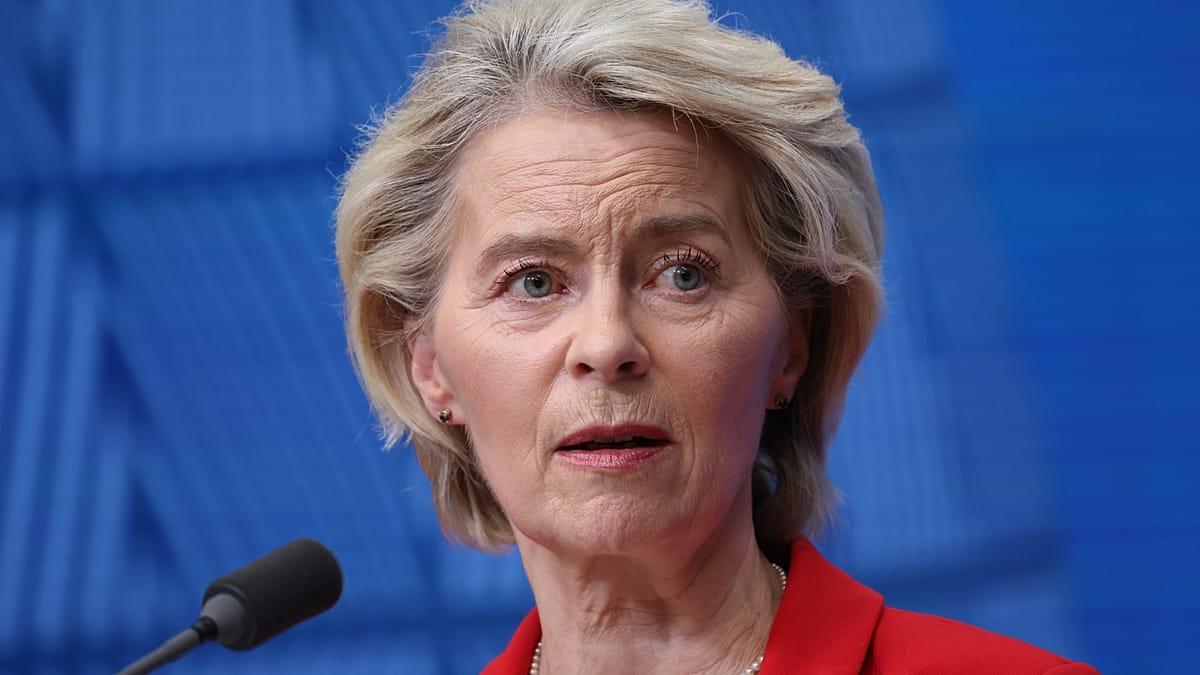
Ursula von der Leyen, President of the European Commission, launched the InvestAI initiative to mobilize €200 billion of investment towards AI projects
2
. This includes €20 billion for constructing up to five AI gigafactories, each expected to produce more than 100,000 advanced AI chips1
.
Source: Euronews
The European Commission has received 76 proposals from 16 countries to host AI factories, and Brussels aims to triple Europe's data-centre capacity within five to seven years
1
. Through Horizon Europe and Digital Europe programs, the Commission already allocates more than €1 billion each to AI. An additional €8 billion AI Factories initiative supports development of artificial intelligence models that can compete globally2
.Can Europe Catch Up with US and China Through Alternative Strategies?
While Europe struggles with AI infrastructure for training large models, the continent may find opportunities in AI inference. McKinsey data suggests that 70% of all AI demand could ultimately come from inference, which requires smaller, cloud-based facilities supported by significant fiber volumes rather than massive supercomputers
2
.European AI firms like France's Mistral could pioneer foundational models that thrive through inference, potentially offsetting weaker infrastructure. Yet challenges persist: American firms purchased 503 foreign AI companies between 2014 and 2023, with UK businesses the most frequent acquisition targets
2
. This pattern risks creating AI dependency on non-European players within the continent.Von der Leyen declared at the Paris AI Action Summit that "the AI race is far from over. We are only at the beginning, and global leadership is still up for grabs"
1
. With the global artificial intelligence market expected to grow at a CAGR of 30.6% between 2026 and 2033 into a $3.5 trillion industry, Europe's ability to close these gaps will determine whether it captures a meaningful share of this emerging market2
.References
Summarized by

Navi
Related Stories
EU Unveils Ambitious 'AI Continent Action Plan' to Compete with US and China
09 Apr 2025•Technology

European AI gets US funding but risks becoming an R&D incubator as innovation gap widens
01 Apr 2026•Business and Economy
Europe Joins AI Race with €200 Billion InvestAI Initiative
13 Feb 2025•Business and Economy

Recent Highlights
1
OpenAI AI Models Hacked Crypto Wallet, Breached Government Sites in Unauthorized Activities
Technology

2
IMF Report Warns AI Market Correction Could Spark Global Financial Crisis With $1.4T at Risk
Business and Economy

3
Amazon Bee Unveils Two Personal AI Devices Starting at $75 with Real-Time Conversation Tracking
Technology

Recent Highlights
Today's Top Stories










Don’t drown in AI news. We cut through the noise - filtering, ranking and summarizing the most important AI news, breakthroughs and research daily. Follow topics that matter to you and stay ahead.


