Google releases Nano Banana 2 AI image model with Pro quality at Flash speed


36 Sources
36 Sources
[1]
Google reveals Nano Banana 2 AI image model, coming to Gemini today
The last year has been big for Google's AI efforts. Its rapid-fire model releases have brought it to parity with the likes of OpenAI and Anthropic and, in some cases, pushed it into the lead. The Nano Banana image generator was emblematic of that trend when it debuted last year, and subsequent updates only made it better. Now, Google has announced yet another update to its image model with Nano Banana 2, which is available starting today. Nano Banana 2 is more accurately known as Gemini 3.1 Flash Image -- the previous Nano Banana models were based on the 3.0 branch. According to Google, the new release is capable of results similar to Nano Banana Pro but with the speed of the non-pro Flash variant. Google promises the new image generator will have more advanced world knowledge pulled from the Internet by the Gemini 3.1 LLM. This apparently gives it the necessary information to render objects with greater fidelity and create more accurate infographics. The days of squiggly AI text were already ending, but Google says Nano Banana 2 has Pro-like text accuracy in image outputs.
[2]
Google launches Nano Banana 2 model with faster image generation | TechCrunch
Google today announced the latest version of its popular image generation model, Nano Banana 2. The new model, which is technically Gemini 3.1 Flash Image, can create more realistic images than its predecessor. The model will also now become the default in the Gemini app for its Fast, Thinking, and Pro modes. The company first released Nano Banana in August 2025, prompting people to generate millions of images in the Gemini app, especially in countries like India. In November, the company released Nano Banana Pro, which allows users to create more detailed and high-quality images. The new Nano Banana 2 retains some of the high-fidelity characteristics of the Pro model but produces images faster. The company says you can create images with a resolution ranging from 512px to 4K, in different aspect ratios. Nano Banana 2 can maintain character consistency for up to five characters and fidelity of up to 14 objects in one workflow for better storytelling. Users can also issue complex requests with detailed nuances for image generation, Google says. In addition, users can create media with more vibrant lighting, richer textures, and sharper detail. With the launch, Nano Banana 2 will become the default model for image generation across all apps in the Gemini app. The company is also making it the default model for image generation in its video editing tool, Flow. In Search, Nano Banana 2 will become the default for Google Search results via Google Lens and in AI Mode across 141 countries on the Google app and on the web across desktop and mobile. On Google's higher-end plans, Google AI Pro and Ultra, subscribers can continue use Nano Banana Pro for specialized tasks by regenerating images via the three-dot menu. For developers, Nano Banana 2 will be available in preview through the Gemini API, Gemini CLI, and the Vertex API. It will also be available through AI Studio and the company's development tool Antigravity, which was released last November. The company said that all images created through the new model will have a SynthID watermark, which is Google's mark to denote AI-generated images. The images are also interoperable with C2PA Content Credentials, created by an industry body consisting of companies like Adobe, Microsoft, Google, OpenAI, and Meta. Google said that since launching the synthID verification in the Gemini app in November, people have used it over 20 million times.
[3]
Hands-On With Nano Banana 2, the Latest Version of Google's AI Image Generator
Google just debuted Nano Banana 2, an updated version of its AI image generator. It combines the abilities of Google's previous release, Nano Banana Pro -- like text rendering and web searching -- with speedier image generation. This tool will be the new default in Google's Gemini chatbot. The first image model from Google under the Nano Banana moniker dropped last August, and the Pro version arrived three months later. The AI tool was widely adopted online to alter photos of real people, from generating custom action figures to nostalgic images of people hugging younger versions of themselves. Nano Banana 2 is not only faster at crafting images, but it's also a more powerful photo editor. Despite some rough edges and unconvincing generations in my initial hands-on experience through Gemini, Google's latest release marks the continued improvement of photorealistic AI tools that can manipulate existing images and serves as a stark reminder to always scrutinize unverified images you see online. If you want to try the new image model, the easiest way to access Nano Banana 2 is through the Gemini app or website. You can either click the banana emoji to generate images or just put the request in your prompts to the chatbot. This new image model is also available through Google's Search tools, AI Studio, Cloud, and other services. Google says the Nano Banana 2 image generator pulls real-time information from the web, which can be useful for generating infographics. To test this, I asked Gemini to generate a custom weather report for my upcoming weekend getaway. Here's my prompt: I'm going skiing in Dodge Ridge this weekend with some friends. Could you create an infographic that covers the weather conditions? At first glance, the result looks decent. No wobbly text or disfigured skiers in the background. The forecast for each day includes expected temperatures as well as wind and snow conditions. A small disclaimer at the bottom of the infographic reads, "Weather and conditions subject to change. Check official sources." I'm glad I did! When I looked up the forecast for this weekend from a different source, I realized that Gemini had messed up the dates and pulled the Google Weather context from last week. When I pointed out this mistake to the bot, it used Nano Banana 2 to replace the text from its first attempt with the correct weather data. If you want more details about my getaway, I'm headed to a cozy ski lodge with friends who are skiers. I'm a novice and still deciding whether to actually hit the slopes or just turn into a wrinkly prune sitting in the hot tub all day long. Maybe Nano Banana 2 could make a dumb meme to send to the group chat? I uploaded a photo of myself to Gemini with this prompt:
[4]
Nano Banana 2 Is Here: What Changed in Google's Popular AI Image Tool
Google couldn't let Samsung have all the fun and attention this week. The Gemini-maker dropped Nano Banana 2 on Thursday, the second generation of its viral AI image editing tool. You might remember Nano Banana from last fall, when it made many fans and shocked AI users with its photorealistic capabilities. It quickly leapfrogged AI image tools from competitors like Midjourney and OpenAI, particularly with its ability to adeptly handle photo edits on top of generating entirely new images. The Pro version came out a few months later and built on those capabilities with better text generation. Now Google is promising that Nano Banana 2 is, like Hannah Montana, the best of both worlds. Nano Banana 2 levels up Google's base AI image model. The company said it should have the speed of the original model with the accuracy and detailed work of the Pro version. It uses the world knowledge that was built into Gemini 3, previously restricted to the Pro model. That means AI images should be more rooted in reality and less likely to be hallucinations. Text generation in images, like when you create greeting cards, should be clearer, too. Character consistency, something that creators have said Nano Banana excels at, is also getting a boost. Google said the new base model "delivers vibrant lighting, richer textures and sharper details," along with the ability to generate in different aspect ratios and in resolutions up to 4K. Read more: AI Slop Is Destroying the Internet. These Are the People Fighting to Save It Since Nano Banana's launch, and partly because of it, we're all now anxiously wrestling with the role AI-generated content plays in our online ecosystems. Advanced models like the ones from Google create fabricated images and videos that are nearly indistinguishable from real ones. Low-quality AI content, sometimes called slop, has flooded social media. The vast majority of social media users believe they see AI-generated posts, but less than half (44%) are confident they can spot it, a CNET survey found. Photorealistic images like the kind Nano Banana can make are a big part of that problem. The new model is available now everywhere you use Gemini. Nano Banana 2 will replace the original, so you'll have to choose between it and the Pro alternative. If you create AI images with the new model, Google will attach invisible watermarks called content credentials to them. So if you want to know if an image was made with AI, you can upload it to Gemini, and it may be able to identify it. That only works if it was made with Google AI, though.
[5]

7 ways Nano Banana 2 just got better and faster - how to try Google's latest image model
Nano Banana 2 is now the default model across all Google apps and sites. Last year Google made a big splash in the world of AI-powered image creation with its Nano Banana model. Now the next generation has debuted. And it promises a host of enhancements for generating photos, drawings, diagrams, infographics, and other images for individuals, professionals, and businesses alike. On Thursday, Google announced Nano Banana 2 (officially dubbed Gemini 3.1 Flash). Accessible to free and paid users, the new model replaces the first Nano Banana everywhere. That means it's now the default at the Gemini website and app, Google search, Google Flow, AI Studio, and the Gemini API for developers. Also: The best AI image generators of 2026: There's only one clear winner now So what makes the second banana so much better than the first? Here's what's new, according to Google. 1. Advanced world knowledge. Nano Banana 2 uses Gemini's real-world knowledge and images from web searches to try to more accurately create your images. Google said that this skill will help the AI better devise infographics, turn your notes into diagrams, and visualize your data 2. Consistency. One flaw with AI image generation has been a lack of consistency across multiple images. Ask the AI to regenerate an image or create a new one based on a previous image, and the characters and other elements don't always remain the same. Nano Banana 2 aims to make sure that as many as five characters and up to 14 objects in an image stay consistent through each iteration. 3. Better text rendering. Generating text in an AI image can also be hit or miss, with illegible or inconsistent results. Nano Banana 2 will try to create more accurate and legible text, helping it design such images as greeting cards and mockups for advertising campaigns. The new model can even translate text in an image, so you can share variations of the same one across different languages. 4. Better at following your instructions. Another weakness with AI image generators is that they don't always follow your instructions correctly, especially if your description is complex. Nano Banana 2 is designed to avoid this problem by capturing the tone and nuances of your prompt, so you should get the image you want. Also: How to spot an AI image: 6 telltale signs it's fake - and my go-to free detectors 5. Faster speeds. With the previous generation of bananas, you'd have to choose between quality and speed. Nano Banana Pro would generate a high-quality image, but might take a while. Nano Banana Flash would speed up the process, but the resulting image might not be as good. The new version tries to combine the best of both worlds by generating higher-quality images at faster speeds. 6. Higher fidelity. With Nano Banana 2, Google said that your images will feature sharper details, richer textures, and more vibrant lighting. And the process runs more quickly than in the past. 7. Production-ready quality: Looking to create a logo, infographic, advertisement, or other image that needs to look professional? With Nano Banana 2, you can control the aspect ratio of the image to make sure it's sized for the right medium. To generate sharp images, you can also set the resolution anywhere from 512px to 4K. That all sounds cool. But is the new Nano Banana all that Google promises? I tried a couple of different requests to see how it fared. These were prompts that Gemini itself suggested to test the text rendering and the character consistency. Also: I tested the new ChatGPT Images - it's a stunning improvement, and enormously fun For the first one, I submitted the following prompt: "A vintage-style travel poster for a lunar colony on the Moon. In the center, a sleek 1950s-style rocket is landing near a glass dome. At the top, in a bold, cream-colored Art Deco font, render the words 'VISIT LUNAR CITY.' At the bottom, in smaller but clear script, add the phrase "The Gateway to the Stars." Use a palette of deep navy, muted orange, and silver. High resolution, professional graphic design style. Use a 16:9 aspect ratio and create the image in 1080p." The resulting image captured the right style and font for the text. The AI also followed my instructions for the colors, aspect ratio, and resolution. For the second one, I submitted two separate requests to test the character consistency from one image to the next. The first prompt read: "Create a character sheet for 'Captain Nova,' a female space explorer with short, bright purple hair, a glowing blue mechanical eyepiece over her left eye, and a silver-and-white flight suit with a gold sun emblem on the chest. Show her from the front, side, and back against a plain grey background. Create the image in a 21:9 aspect ratio at 4K." Here, the AI followed my instructions with a sheet that showed the character and highlighted several key details. But the real test was in my next prompt, which read: "Using the same character of 'Captain Nova,' show her running through a neon-lit cyberpunk market. She is looking over her shoulder with a determined expression, her purple hair wind-blown. Keep her mechanical eyepiece and the gold sun emblem on her suit exactly the same. Cinematic lighting, shallow depth of field. Again, keep the image in a 21:9 aspect ratio at 4K." This one kept the character consistent in style and appearance, so she looked the same in both images. Based on these prompts, Nano Banana 2 seems like a worthwhile upgrade over the prior generation. That's good news since it is now the default across the board. Google AI Pro and Ultra subscribers can still use the legacy Nano Banana Pro for more specialized tasks. Otherwise, anyone can try out the latest flavor of the new banana to see what images it unpeels.
[6]

Google Rolls Out Nano Banana 2, Borrows 2 Notable Features From Pro Model
Google has launched Nano Banana 2, an upgraded version of its viral AI image generator that promises stronger subject consistency, improved instruction following, and sharper visual details. Nano Banana 2 (aka Gemini 3.1 Flash Image) can maintain resemblance for up to five characters and 14 objects in a single workflow, Google says. This means you don't have to repeatedly remind the AI tool about the appearance of the characters or backgrounds in your project. The model also comes with higher prompt accuracy, meaning it adheres strictly to your prompts and captures their nuances, Google says. The other big upgrade is output quality. Images now have improved lighting, richer textures, and sharper details. You can also get them delivered in various aspect ratios and in resolutions from 512 pixels to 4K. An image shared shows support for 1:1, 16:9, 9:16, and more. Nano Banana 2 also borrows two features from the Nano Banana Pro model: advanced real-world knowledge and improved text legibility. With the improved knowledge, Nano Banana 2 taps real-time information and images from the web to help you generate better infographics, diagrams, and data visualizations. And with better text legibility, the text in your outputs will have fewer typos and more clarity. The new image generator also lets you translate the text in your image, so you can share it with a wider audience. I played around with the new Nana Banana 2 model for a few minutes, and it does seem to have improved text rendering. The Pro model, however, is still leaps ahead. (Paid Gemini plans start at $8 per month and go up to $250.) One drawback of the new model is that accessing Nano Banana Pro now takes a few additional clicks. The "Create Image" tab in the Gemini app now pulls up Nano Banana 2 by default. If you need your images generated by Pro, you need to let the new model provide its output, and then click the three-dot menu below it to select "Redo with Pro." All users can try out Nano Banana 2 on the Gemini app, AI Mode, Google Lens, AI Studio, Google Cloud, Flow, and Google Ads right away. The image generator doesn't require a subscription, but paid users are likely to have wider access as always.
[7]

Google rolls out Nano Banana 2 after viral success of AI image generation tool
Feb 26 (Reuters) - Google on Thursday unveiled a successor to its viral Nano Banana image generation model, touting faster performance as the search-engine behemoth pushes to attract more users to its AI tools. The model, called Nano Banana 2, is being rolled out across products, including the Gemini app, AI Mode and Lens features on Search, and Flow, its AI-powered video tool, the Alphabet-owned (GOOGL.O), opens new tab company said. The launch is Google's latest in a series of moves that have propelled the company to the forefront of the AI race, helping it better compete with OpenAI's ChatGPT after suffering a string of embarrassments initially. The success has fueled a 47% surge in its stock in the past six months. Google rolled out the Nano Banana AI image editor in August, which quickly became a viral sensation, attracting 13 million first-time users to the Gemini app in just four days in September. By mid-October, it had generated more than 5 billion images. The tech giant followed that with the release of the upgraded Nano Banana Pro in November. Nano Banana 2 leans on Gemini's faster and cheaper models known as Flash, which allows quicker image generation and editing, Google said, adding that it also has better instruction-following capabilities and delivers sharper details. In November, Google released its Gemini 3 AI model, whose success prompted rival OpenAI to issue an internal "code red" to push teams to accelerate development. Gemini 3 has significantly boosted user engagement, helping the Gemini app capture more than 750 million monthly active users at the end of December. Reporting by Deborah Sophia in Bengaluru; Editing by Leroy Leo Our Standards: The Thomson Reuters Trust Principles., opens new tab
[8]

Google's Nano Banana 2 is a faster version of Nano Banana Pro
Google has launched its new image generation model, the Nano Banana 2, which is powered by Gemini 3.1 Flash Image. The company says the new model has the capabilities, world knowledge and reasoning of Nano Banana Pro, but it can accomplish tasks at "lightning-fast speed." That enables rapid editing and the quick creation of various iterations using a single prompt. Nano Banana 2 will give more people access to capabilities that were previously exclusive to the Pro model. That includes Pro's ability to pull real-time information and images from web searches to create, say, infographics and diagrams. It will also be able to generate texts on images for marketing materials and greeting cards. Google says Nano Banana 2 can maintain character resemblance for up to five characters in a single workflow, which could be especially valuable if you're using it to create storyboards or visual stories. It can follow precise instructions for complex requests, as well, and can generate input with up to 4K in resolution with richer textures and sharper details than its predecessors could. Nano Banana Pro could already generate images so realistic, it's almost impossible to tell that they were AI-generated. Google even had to limit its use due to high demand. Whether Nano Banana 2 can generate images that are markedly better than what Pro could create -- and whether we could still tell if an image was made by AI -- remains to be seen. The new model will replace Nano Banana Pro in the Gemini app, but Google AI Pro and Ultra subscribers will retain access to Nano Banana Pro for specialized tasks. It will also be the default model in Search for AI Mode and Lens, as well as in Google's Flow AI creative studio.
[9]

Google launches Nano Banana 2, updating its viral AI image generator
Thrive Capital invested about $1 billion in OpenAI at a $285 billion valuation, source says The company said Nano Banana Pro will remain available for "high-fidelity tasks requiring maximum factual accuracy," while Nano Banana 2 will be focused on "rapid generation, precise instruction following and integrated image-search grounding." Nano Banana 2 is replacing its predecessor across Gemini's Fast, Thinking and Pro models. AI image and video generators are surging in popularity among consumers, who are able to create increasingly advanced and detailed graphics and videos with just a few text-based prompts. OpenAI launched its video-generation tool Sora in 2024, and CEO Sam Altman wrote last March that the high usage was "melting" its AI processors. Adobe has pushed to further integrate AI into its creative tool suite with its photo and video generator Firefly. Creative companies have raised concerns about copyright infringement from the proliferation of generative AI tools. ByteDance has faced backlash from major Hollywood studios, including Disney and Paramount, for intellectual property violations surrounding its AI video-making tool Seedance.
[10]

Google Rolls Out Nano Banana 2, Now Faster Than Ever
Get ready to check the corners of images you see on social media for the Gemini watermark so you can figure out if it's fake or not. On Thursday, Google announced that it is rolling out Nano Banana 2, the latest version of its image generation model, which the company claims comes imbued with "advanced world knowledge" and "precision text rendering and translation." Google described Nano Banana 2 as a "best of both worlds" mashup of the first version of its image generation tool and Nano Banana Pro, the advanced version of the model made available last November. It brings the "advanced intelligence" and "studio-quality creative control" of the Pro model to Nano Banana 2, which now runs on the company's Gemini 3.1-Flash model, so the process of image generation should be faster than ever. One of the primary calling cards of Nano Banana Pro was its ability to handle textâ€"a task that most image generators have struggled with. That skill has been further honed for Nano Banana 2, which Google claims can now pull from the real-world knowledge base of Gemini, the company's flagship LLM. The model will apparently be able to pull in real-time information and images directly from web search to "more accurately render specific subjects." Google said the Nano Banana 2 should be ideal for infographics and data visualizations. (For the record, the company said the same about Nano Banana Pro.) Google's other point of focus for Nano Banana 2 is the new and improved creative control, including the ability to generate as many as five characters and up to 14 objects in a single workflowâ€"though, again, that was kinda already part of the sell with Nano Banana Pro. This version of the model is supposed to be better at adhering to user prompts and is better at generating lighting effects and textures. A lot of these features are rehashed from the company's last model, though surely there are improvements to the overall outputs from Nano Banana 2. That's because the real selling point with this model seems to be speed. Since it's using the company's Flash model, image generation takes less time. The company also says that the model can handle outputs that range in resolution from 512px to 4K. According to Google, Nano Banana 2 will be available starting today and will basically push the old models out of their current spots across the company's suite of apps. Nano Banana 2 will replace Nanon Banana Pro through the Gemini app (though Google AI Pro and Ultra subscribers can revert to the past model if they want), and v2 of the model will become the default in Google Search and Flow, the company's AI creative studio app. It'll also pop up in AI Studio + API for developers, Google Cloud, and Google Ads in the coming days.
[11]

Nano Banana 2 hits the sweet spot, delivering enhanced speed and accuracy
Timi is a news and deals writer who's been reporting on technology for over a decade. He loves breaking down complex subjects into easy-to-read pieces that keep you informed. But his recent passion comes from finding the best discounts on the internet on some of the best tech products out right now. Google has been pushing AI for quite a few years now, but Nano Banana seemed to really catch the attention of the public, providing fun new ways to edit photos and create images. So it doesn't come as a complete surprise that Google is taking things further by announcing the release of Nano Banana 2. While Nano Banana 2 will be the name that catches on with most people, it does have a more formal title, just like its predecessor, which comes in as Gemini 3.1 Flash Image. Google's tagline with this model is that it provides "Pro capabilities with lightning-fast speed." But even more importantly, more people will have access to new and more powerful tools. Getting sharper Nano Banana was good, but Nano Banana 2 will deliver more precise generations. Google shares that speed and fidelity are two main areas of focus with this new AI model, with improvements like: Subject consistency: Maintain character resemblance of up to five characters and the fidelity of up to 14 objects in a single workflow, allowing you to storyboard and build narratives without altering the appearance of your inputs. Precise instruction following: With enhanced instruction following, the model adheres more strictly to your complex requests, capturing the specific nuances of your idea so the image you get is the image you asked for. Production-ready specs: Make attention grabbing assets with full control of various aspect ratios and resolutions from 512px to 4K, ensuring your visuals stay sharp whether they are for a vertical social post or a wide-screen backdrop. Visual fidelity upgrade: Nano Banana 2 delivers vibrant lighting, richer textures and sharper details, maintaining high-quality aesthetics at the speed expected from Flash. You can now try Nano Banana 2 within a variety of Google products and services. The brand shares that Nano Banana 2 will be available in Gemini, Search, AI Studio, Google Cloud, Flow, and Google Ads. While you're getting a lot of power here with this new model, those looking to get the best outputs may still want to rely on Nano Banana Pro. Of course, if you're someone that dabbles with both, you can check the outputs yourself and see which is better. Subscribe to the newsletter for Nano Banana 2 insights Want focused coverage of Nano Banana 2 and other image AI advances? Subscribe to the newsletter for in-depth comparisons, practical prompts, and hands-on testing notes that help you evaluate models and choose the right tool for your projects. Subscribe By subscribing, you agree to receive newsletter and marketing emails, and accept our Terms of Use and Privacy Policy. You can unsubscribe anytime. With that said, we anticipate that Google will also release a successor to Nano Banana Pro as well in the near future. But for now, try both if you have access to see which one gets the job done.
[12]

Nano Banana 2 has an ace up its sleeve
Available through Gemini app, Google Search, and AI Studio, Nano Banana 2 represents a major leap forward in AI-generated image quality and instruction following. Rendering accurate text has long been a stumbling block for even the most advanced AI image generators, but it's among the strongest suits of Google's just-updated Nano Banana 2 engine. Available now in the Gemini app (you'll also find it in Google Search, AI Studio, and other Google products), Nano Banana 2 boasts a range of new features, including up to 2K resolution that can be upscaled up to 4K, "enhanced" instruction following that helps the model adhere better to your prompts, and the ability to lean on Gemini's "real-world" knowledge, allowing it to draw real-time information via web search as it renders images. Not bad, but even more impressive is Nano Banana 2's text fidelity. I've been asking Nano Banana 2 to create images with billboards, signs, newspapers, and other objects with embedded text, and it's been performing like a champ, largely avoiding the gibberish that earlier AI image generators typically produced when trying to render letters and words. For example, I prompted Nano Banana 2 to render an image of a robot smoking a cigarette in Times Square, with a neon marquee reading "Nano Banana 2 on Broadway" in the background. No problem, and it rendered the image (above) in roughly 10 seconds. I then asked Nano Banana 2 to create a photo of a woman reading a newspaper in a breakfast nook, with the newspaper headline reading "Nano Banana 2 makes its debut." But for this test, I upped the ante: I asked the engine to write the sub-headline and the article itself, and directed that the story should specifically be about Nano Banana 2. Well, the model got the subheadline just right, but even better, it did write the article-up to a point, anyway. The article text is a tad wiggly, but you can almost read it. I then pushed Nano Banana 2 a little more, asking it to zoom in on the article and enhance the text. Here, the text rendering broke down a bit, "Google has unveiled its latest akthrough [sic] in generative AI, the 'Nano Banana 2'," the article reads, "promising a major leap [the word "leap" is partially obscured by a finger] in image generation fidelity." Not bad, but as you keep reading, the text fidelity does starts to crumble. Finally, I tried asking Nano Banana 2 to draw a diagram of-well, itself. "Render a diagram of nano banana 2's architecture within the greater Gemini framework, complete with text captions," I prompted, and about 15 seconds later I got this: Looking closely at the diagram, I didn't see any text gibberish at all, and the diagram and captions seemed to make sense, or at least it did to my untrained eye. Plugging the diagram into the Gemini app, the "thinking" version of Gemini assured me it was a "remarkably accurate architectural map" of the overall Gemini framework, accurately depicting how the new model can handle up to five consistent characters within an image workflow. It also correctly referenced the brand-new GemPix 2 Diffusion Renderer, the Nano Banana 2 component that takes the engine's native 2K image renders and upscales them to 4K. All in all, very impressive, although Nano Banana 2 also begs the question of when OpenAI will counter with a follow-up to last year's GPT Image 1.5. That could happen any day now, if not today.
[13]

Nano Banana 2 brings Pro quality at Flash speeds, rolling out to Gemini app
Google today announced Nano Banana 2 as its latest image model rolling out now to the Gemini app. Officially, Nano Banana 2 is Gemini 3.1 Flash Image. It follows Gemini 2.5 Flash Image (Nano Banana) from August and Gemini 3 Pro Image (Nano Banana Pro) in November. Compared to Nano Banana, you'll notice richer textures and sharper details with vibrant lighting. Precise instruction following means the model "adheres more strictly to your complex requests" to capture the "specific nuances of your idea so the image you get is the image you asked for." There's also: Pro features now available in a Flash model include accurate text rendering and translation, as well as advanced world knowledge "to more accurately render specific subjects." This allows you to generate data visualizations, infographics, turn notes into diagrams, and create marketing mockups. In the Gemini app, Nano Banana 2 replaces Nano Banana Pro across all models (Fast, Thinking, and Pro). However, Google AI Pro and Ultra subscribers "will keep access to Nano Banana Pro for specialized tasks by regenerating images via the three-dot menu." Nano Banana 2 is also coming to AI Mode and Google Lens. It's also the default image generation model in Flow. Finally, the model is available in preview for AI Studio, Gemini API, Google Antigravity, Vertex AI, and Gemini CLI. Nano Banana 2 can be used for "rapid generation," while Nano Banana Pro is for "high-fidelity tasks requiring maximum factual accuracy." On the safety front, Google is coupling SynthID watermarks with C2PA Content Credentials to "provide users with a more holistic and contextual view of not just if AI was used, but how." C2PA verification is coming to the Gemini app.
[14]

Google's Nano Banana 2 fixes blurry text and boosts speed -- here's everything included in this massive upgrade
The upgraded AI image generator blends Pro quality with Flash speed Fans of Nano Banana's original release have something new to get excited about. Today, Google DeepMind unveiled Nano Banana 2 (officially Gemini 3.1 Flash Image), a next-generation model that blends the high-fidelity intelligence of the Pro version with the lightning-fast performance of Gemini Flash. The promise is professional-grade images with quicker and smoother results, including a much-needed upgrade to on-image text. Here's a deeper dive into what's new. Nano Banana 2 -- Pro quality with Flash speed The new model introduces several advanced capabilities aimed at giving users ultimate creative control and real-world accuracy: * Real-time web grounding: Nano Banana 2 draws on Gemini's advanced world knowledge and live web search data to render specific subjects more accurately. * Next-level text rendering: The model can generate perfectly legible text inside images for marketing mockups or greeting cards. It can even translate and localize text directly within a generated image so you can share ideas globally. * Data visualization: Thanks to its deep understanding, the model can generate infographics, turn notes into diagrams and create accurate data visualizations. * Creative control and consistency Google says Nano Banana 2 significantly narrows the gap between speed and realism. Key improvements include: subject consistency, better instruction following, production-ready output and higher visual fidelity. Nano Banana 2 promises to support your creative process be it professionally or personally. You can keep the exact look of up to five characters and 14 objects consistent across a single workflow, which makes storyboarding or building visual narratives dramatically easier. It's also better at following complex, layered prompts, so the image you get is much closer to what you actually envisioned. With production-ready outputs and native aspect ratios and resolutions ranging from 512px all the way up to crisp 4K, the results are shockingly better than the first generation Nano Generation. Availability Nano Banana 2 is rolling out immediately as the default image generator across Google's ecosystem. In the Gemini app, it replaces Nano Banana Pro across Fast, Thinking and Pro modes, though Google AI Pro and Ultra subscribers can still access the Pro model for specialized tasks through a menu option. It's also arriving in Google Search via AI Mode and Lens across 141 countries, while developers can access it through Google AI Studio and the Gemini API. For enterprise use, it's available in Vertex AI on Google Cloud. In Flow, Nano Banana 2 becomes the default image model at zero credits, and it will also power creative suggestions inside Google Ads. Bottom line Starting today, Nano Banana 2 underscores the possibilities of AI image generation. It's clear that multimodal capabilities are maturing into a trustworthy, everyday tool, especially with built-in SynthID watermarking and C2PA credentials, to verify how content was created. More importantly, the model promises to close the gap between speed and quality, so you're spending less time waiting for image generation and ultimately getting something genuinely practical for real work -- from marketing visuals to storytelling and rapid creative iteration. Give it a try and let me know in the comments what you think. Follow Tom's Guide on Google News and add us as a preferred source to get our up-to-date news, analysis, and reviews in your feeds.
[15]

5 prompts that show how powerful Nano Banana 2 is
The original Nano Banana model was impressive enough, but Google is bragging about Nano Banana 2 as if the original model was nothing but cardboard cutouts. It is faster and more logical thanks to its ability to plan its composition before rendering it. Google implies that Nano Banana 2 can essentially engineer reality from prompts, so I decided to peel back the hype and see how potent the model really is. 1. Clarity A macro photograph capturing a clear glass sphere balanced perfectly atop the spout of a ceramic teapot. Inside the sphere, intricate, tiny silver letters spell out the phrase, "CLARITY IS KEY." This prompt is a triple-threat test designed to humble any model still struggling with physical logic, material properties, and basic spelling. Nano Banana 2's reasoning engine must first determine the complex physics of nesting tiny text inside a sphere, and then calculate how that text should warp and refract. The resulting image showcases its flawless typography; the tiny silver letters are legible and subtly distorted by the sphere's curvature, revealing high-fidelity texture. 2. Airship animals A cinematic shot of a steampunk pirate ship sailing through a sea of clouds at sunset. The ship is made of polished brass, copper, and dark wood and has a crew of anthropomorphic animals. When a model is asked to render a complex scene, there's a risk of visual chaos or subject drift. Nano Banana 2 navigates the issue well, defining and maintaining multiple subjects, and the detailed steampunk ship shows logical engineering, all bathed in cinematic golden-hour lighting that reflects off the complex brass and wood surfaces. 3. Masterful art A professional graphic design layout for a new board game called "The Spice Route." The main board features an intricate map with a legend in the corner that uses a stylized, accurate, localized font to label 'Gold' (金), 'Silk' (絹), and 'Saffron' (サフラン). The centerpiece is a complex stack of interlocking, ancient spice jars. The game flow visualization must be consistent across different camera angles. This prompt tests Nano Banana 2's localization, legibility, and logic abilities. The model's "web grounding" means it searches and correctly renders specific, localized Japanese typography for 'gold', 'silk', and 'saffron' within the appropriate stylized font context. The result is a coherent graphic design layout where the spice jars are logically stacked, and the game feels consistent and understandable. 4. Breakdance battle An action shot of a breakdancing battle between a group of medieval knights in full plate armor and a crew of vibrant, graffiti-tagged 1980s-style robots. They are on a cobblestone street in front of an ancient castle, under the glow of modern stage lights. This prompt shows off Nano Banana 2's reasoning loops. The model must plan a composition involving extreme, high-energy motion from two fundamentally different object types. It must then maintain logical, spatial, and textural reasoning. Plus, it just looks cool. 5. Fantastic Seattle A hyper-realistic photograph capturing a twilight scene on a rain-slicked semi-fantastical version of a Seattle sidewalk with the Space Needle grounded in the distance, featuring three consistent characters. standing near a Pike Place Market sign and a chalkboard menu for a cafe. I think of this prompt as the ultimate challenge in subject consistency, web grounding, and complex composition. The AI had to look up Seattle for details about what the Space Needle looks like from Pike Place Market and what a sign at the market looks like, then it had to come up with characters that are both realistic and fantastic. The complex background is geographically accurate, and the crucial typography on the cafe chalkboard menu is legible, correctly spelled, and rendered with perfect multi-line accuracy on the rain-slicked sidewalk. Google claims Nano Banana 2 isn't just a technical upgrade, but also one that reaches new heights in logical, spatial, and textual thinking. The model Nano Banana 2 appears to pass that test. The images are impressive in their way, though whether they are truly appealing is probably a matter of taste. Follow TechRadar on Google News and add us as a preferred source to get our expert news, reviews, and opinion in your feeds. Make sure to click the Follow button! And of course you can also follow TechRadar on TikTok for news, reviews, unboxings in video form, and get regular updates from us on WhatsApp too.
[16]

Google Nano Banana 2 arrives: How to try it now
Google dropped a surprise announcement for Gemini users today: Nano Banana 2 is here. The company announced the immediate launch of Nano Banana 2 in a blog post, and the AI image model is already rolling out to Google and Gemini AI tools. The model's official name is Gemini 3.1 Flash Image. Google says that Nano Banana 2 has more advanced world knowledge, a description that also calls to mind Google's recent world model Project Genie. "The model pulls from Gemini's real-world knowledge base, and is powered by real-time information and images from web search to more accurately render specific subjects. This deep understanding also helps you create infographics, turn notes into diagrams and generate data visualizations." In addition, Google says that Nano Banana 2 will provide more accurate text rendering and translation. Simply put, Nano Banana 2 is the sequel to the wildly popular AI image model Nano Banana. In August 2025, a mysterious new AI image editor called Nano Banana started tearing up the AI leaderboards. Google soon revealed it was the code name for a new image model officially called Gemini 2.5 Flash Image; however, the name "Nano Banana" stuck like glue. Ever since, Google has had a runaway hit on its digital hands. Nano Banana has proven to be an extremely capable AI image generator, and it excels at editing images in particular. As Nano Banana went viral, Google started integrating it into a wide variety of tools, from Google Messages to Chrome. Not only does Nano Banana make it possible for virtually anyone to edit photographs -- in ways that used to require years of Photoshop experience -- but it also offers high consistency. That means the same character or product can appear repeatedly across multiple prompts. To promote Nano Banana 2, Google released some example photos showing off its capabilities. Google says that Nano Banana 2 is rolling out as Gemini 3.1 Flash Image immediately. Free users will have limited generations, with paid and enterprise users getting wider access. It's available in the Gemini app as well as other Google products, including:
[17]

Google's Nano Banana 2 promises to end the AI text rendering problems
The end of squiggly, unreadable AI text? Google seems to think so. Google Nano Banana was a hit sensation at its launch, with millions of users creating images using Google's latest AI image generation service. One of our team members tested Nano Banana's capabilities by creating social media posts, and the results were surprisingly good. That said, like all other generative AI models, including ChatGPT, Nano Banana struggled with creating images containing text. The poor text rendering was always a dead giveaway that the images were generated by AI. Recommended Videos Google claims that it has solved this problem with its latest Nano Banana 2 engine. It delivers improved text rendering along with several other meaningful upgrades. A smarter, faster way to turn ideas into images One of the biggest upgrades coming with Nano Banana is how much the model "knows." Nano Banana 2 can draw from Gemini's broader world knowledge and pull real-time information and images from web searches. Google says this helps Nano Banana 2 become more accurate, enabling it to create infographics, transform notes into clear diagrams, and generate accurate data visualizations. Nano Banana 2 offers vastly improved text rendering and can not only generate legible and accurate text but also translate text to other languages. More control and enhanced consistency Nano Banana 2 brings several other upgrades, allowing users to create consistent and production-ready images. Some of the major improvements include: Subject consistency: You can now maintain character resemblance up to five characters and 14 objects. This makes storyboarding and multi-scene narratives far more practical. Precise instruction following: Another big improvement is instruction following. Nano Banana 2 sticks to your complex prompts, capturing specific nuances and producing an accurate version of your idea. Production-ready specs: You can finally generate images in any aspect ratio or resolution, making it easier for you to create assets for social media and other projects. Visual fidelity upgrade: Nano Banana 2 also promises richer textures, sharper details, and more vibrant lighting, delivering significantly better images than before. More than just an upgrade If what Google promises is even close to reality, Nano Banana 2 will mark the next evolution in image generation. With high-fidelity images, enhanced text rendering, and character consistency across entire projects, Nano Banana 2 is shaping up to be a game-changing update.
[18]

Google Drops Nano Banana 2: The New King of AI Image Generation? - Decrypt
Seedream 5, a Chinese model launched a few days before this announcement offers more flexibility and can be an interesting competitor. Google has been releasing AI software at a staggering pace lately. In the last week or so alone, we've seen Gemini 3.1, Lyria, and Pali, which came with a photo shoot feature that turned out to be a genuine crowd pleaser. And now, the follow-up to arguably the biggest image generation hit of last year has arrived. Nano Banana 2, launched Thursday, "brings the high-speed intelligence of Gemini Flash to visual generation, making rapid edits and iteration possible," Google said in an official blog post, adding that "it makes once-exclusive Pro features accessible to a wider audience." Here's the quick breakdown. The original Nano Banana was actually named Gemini 2.5 Flash Image, and was basically that: An image generator based on Gemini 2.5 Flash. Then Nano Banana Pro came along, which was Gemini 3 Pro Image, and it became the gold standard for AI image editing when it launched last November. Nano Banana 2 is technically Gemini 3.1 Flash Image -- so it's not a direct sequel to Pro, but more like a significantly upgraded version of the original, now running on the newer Gemini 3 Flash backbone. Confusing? Yes. The pitch here is simple: take everything that made Nano Banana Pro special, and make it run at Flash speed. The new Nano Banana 2 rolling out today across Google's ecosystem. In the Gemini app, it replaces Nano Banana Pro as the default across Fast, Thinking, and Pro models. Google AI Pro and Ultra subscribers can still access Nano Banana Pro for specialized tasks by regenerating via the three-dot menu. It's also live in Google Search's AI Mode and Lens, available via the Gemini API in AI Studio and on Vertex AI in preview, and it's the new default image generation model in Flow at zero credits for all users. Google is also expanding SynthID watermarking and adding C2PA Content Credentials support to give platforms better tools for identifying AI-generated media. The SynthID verification feature has already been used over 20 million times since November. The biggest headline is world knowledge. Nano Banana 2 can pull from real-time web search during image generation, which means it can render specific subjects with accuracy. Logos, landmarks, recent events, brand identities -- it knows what things look like because it can look them up, not just guess from training data. Text rendering got a serious upgrade too. You can now generate accurate, legible text inside images, whether you're spelling it out in the prompt or letting the model decide what to write based on context. It also handles in-image translation, so you can localize an ad campaign across multiple languages without rebuilding the visual from scratch. Subject consistency is pushing into new territory too. The model can maintain character resemblance across up to five subjects, and keep the visual fidelity of up to 14 objects in a single workflow according to Google. That's a big deal for anyone building narratives, storyboards, or consistent brand assets. On the production side, you get everything from 512px all the way up to 4K, with native support for a wide range of aspect ratios. Instruction following is also tighter than in previous Flash models, which in practice means fewer prompts that sort of do what you asked, and more prompts that actually do exactly what you asked. The reasoning is also now configurable. Developers can set thinking levels from Minimal (the default) all the way to High or Dynamic, letting the model reason through complex prompts before committing to a render. That combination of speed and optional deliberation is where a lot of the quality gains are coming from. The speed claims are real. We asked Nano Banana 2 to generate a complete Bitcoin ecosystem timeline, including research and final artwork. The full process took roughly the same amount of time Nano Banana Pro needed just to complete the Bitcoin timeline alone. When we followed that up with an Ethereum timeline prompt, it barely registered as additional time. That is a meaningful gap for anyone running iterative pipelines or building at scale. The world knowledge capability genuinely changes how the output feels. When we prompted for a historical crypto timeline, the model searched multiple sources, selected the most relevant events, and structured the art around them. It wasn't generic. The model made editorial decisions. The only real flaw we spotted was a missing visual link between the end of one section and the start of another. Everything else holds together. Nano Banana Pro, by comparison, produced something more generically artistic and made no apparent effort to source or prioritize events. For example, this is what Nano Banana 2 generated when prompted "Create a timeline of Bitcoin's history, highlighting the most important events from its creation to today. widescreen, kids drawing style" using thinking. For contrast this is the same generation using Nano Banana Pro: Character consistency and text handling were the most impressive parts of our test results. We asked the model to generate a magazine front cover, and every line of text came out accurate and well defined. No garbled characters, no drifting typography. Nano Banana Pro is also strong here, but it produces more hiccups, and its magazine cover output had a 3D render quality to it that comes across as synthetic. Nano Banana 2's result looks photorealistic. It also shows fewer garbled characters overall when generating text by its own reasoning, not just when explicitly told what to write. That said, the model has a clear content ceiling. We asked Nano Banana 2 to edit a real photo and change the outfit to underwear. After a long reasoning cycle, it refused. That is to be expected, were it not for the fact that it refused to generate the edit on the photo of a woman, but not on the photo of a man. Asking for a swimsuit swap worked fine. The censorship level appears roughly equivalent to Nano Banana Pro, which means anything pushing toward explicit territory or manipulation of real people in suggestive contexts will get blocked. This matters more than it might sound, and we'll get to why in a moment. Here's the thing about launching a flagship image model in late February 2026: ByteDance launched Seedream 5 the very same week. Seedream has become a community favorite over the last year, and for good reasons. It's flexible, it's cost-efficient -- around $0.035 per image via the API which is around a third of Google's prices -- and its content moderation is considerably more permissive than Google's. That last point has built it a loyal following among creators who need more room to work with real people or push visual boundaries. Seedream 5 brings real-time web search into its generation pipeline, improved reasoning, stronger reference consistency, and support for up to 14 reference images in a single multi-round editing workflow. It generates at 2K and 4K in seconds. It can also run locally, which Google doesn't allow, and is available in ByteDance's CapCut and Jianying, and through the standard API. In short, both Google and ByteDance released web-search-grounded, reasoning-enhanced image models in the same week. That tells you something about where the whole category is heading.
[19]

Everything You Can Do With Google's Nano Banana 2 Image Generator
Combining multiple images is no problem for Nano Banana 2. Credit: Google Last year, Google's Gemini AI took a major step forward in image generation with the launch of its Nano Banana upgrade -- perhaps as much due to its quirky codename as its impressive capabilities -- and now the next iteration is here. Nano Banana 2 is another notable upgrade for AI image-making, and it's currently rolling out to all Gemini users. Nano Banana 2 is a combination of the original Nano Banana and the Pro version that followed a few months later. It's essentially Nano Banana Pro at faster speeds, as noted in Google's announcement, though Nano Banana Pro is also sticking around for those on Plus, Pro, and Ultra plans for situations where detail and accuracy matters more than speed. If you're keeping track of the underlying, technical names for these models, Nano Banana is "Gemini 2.5 Flash Image," Nano Banana Pro is "Gemini 3 Pro Image," and Nano Banana 2 is "Gemini 3.1 Flash Image" (reflecting the upgraded capabilities, at "flash" speed). Nano Banana 2 has inherited much of the feature-set of Nano Banana Pro, bringing with it advanced world knowledge (so you can add in real time information like weather forecasts), and accurate and legible text (often a failing of early AI image models). Google is also talking up its subject consistency, ability to follow detailed instructions, aspect ratio and resolution control, and visual fidelity. While Nano Banana 2 is now available for all users, there are usage limits, as you would expect. You can create 20 images a day if you're not on any subscription, 50 images a day as an AI Plus subscriber, 100 images a day with AI Pro, and 1,000 images a day with AI Ultra. (Google does caution that "limits may change frequently" based on demand). You'll see Nano Banana 2 replacing Nano Banana Pro pretty much everywhere you use Gemini, including in AI Mode for search and Google Lens. As always, generated pictures will be marked with Google's SynthID technology that tags images as AI-made. Picking apart what's actually changed here isn't all that easy, but essentially, free users previously had very limited access to Nano Banana Pro -- sometimes as few as one or two generations a day, depending on general demand. Thanks to the improved efficiency of Nano Banana 2, these users can now create many more pictures with a model that almost matches the quality of Pro (at least until Google tweaks the usage limits again). For paying users, Nano Banana Pro remains available, though Nano Banana 2 will be the default. That shows that Pro is still slightly better (if slower), and Google talks about it being more suitable for "high-fidelity tasks requiring maximum factual accuracy" and where "additional detail" is required. All of which is to say, once you start testing out Nano Banana 2, you might not think it seems massively different to Nano Banana Pro -- you'll just get your picture back more quickly. I've been putting the new model through its paces with a variety of different prompts, and it certainly impresses, even if it's not yet at the stage where its results are flawless every time. TO start, select Create image in the Gemini app and you'll see there's a new template feature available: You can pick from presets like Gothic clay or Oil painting and then add to the prompt, or just type out a prompt from scratch as normal. As before, you can also create a starting image (or multiple images) for Gemini to work from, via the + (plus) button. If you are signed up for Gemini's AI Plus, AI Pro, or AI Ultra plans, once Nano Banana 2 has rendered your picture, you can tap or click on the three dots underneath it and choose Redo with Pro to get the same prompt rendered again with the aid of the extra thinking power of Nano Banana Pro (though this does seem to somehow delete the image template, if you selected one). In one of my tests, I asked Gemini to produce a papercraft style weather forecast for New York -- making use of image generation, real time information, and text rendering -- and it completed the task well, using both Nano Banana 2 and Nano Banana Pro. The two models came up with quite different but equally high-quality results. As expected, the Pro model offered slightly more detail. I also asked tested out landscape painting and infographic creation, and even had it make a comic strip charting the opening moments of Bleak House by Charles Dickens (one for the copyright lawyers to look into). The end results were mostly impressive across the board, with text and graphics that were accurate, styles that matched the instructions, and few errors. These models aren't perfect. Words are occasionally misspelled, the physics of images are occasionally wonky (AI still can't faithfully recreate the real world), and these graphics still have the generic feel of something that's been trained on lots and lots of previous content, rather than something that's actually original. It's difficult to compare Nano Banana 2 and Nano Banana Pro directly, as obviously the prompt gets redone from scratch each time, so you get something original when you pick Redo with Pro rather than a tweak of the first image you had. Overall, it does feel as though Pro still has the edge in terms of quality and subtle touches, but in certain cases I preferred what Nano Banana 2 served up. After plenty of test runs, it feels as though the biggest gain right now is in the way Gemini can pull information from the web (like weather conditions or specific details) to create imagery. These models are also getting better at working in different styles, and leaving behind fewer and fewer giveaways that the pictures were made by AI. How you feel about that will vary from person to person, of course.
[20]

Google Introduces Nano Banana 2
We may earn a commission when you click links to retailers and purchase goods. More info. For fans of AI image generation and editing, I keep hearing that Google's Nano Banana is what everyone loves to use. As someone who stays far away from AI slop, I can't say that I've used it more than a handful of times. I did use it to make that awful logo at the top of this post, so there's that. Anyways, I mention Nano Banana because Google is releasing Nano Banana 2 (Gemini 3.1 Flash Image) today. This is Google's latest are image model that is "lightning-fast" and can bring "advanced world knowledge, quality and reasoning" to your AI image situations. The biggest thing you need to know is that Nano Banana 2 brings some of the Pro features from Nano Banana Pro to a wider audience. Things like improved subject consistency, precise instruction following, full control of aspect ratios (and resolutions up to 4K), and visual fidelity upgrades are a part of this release. Nano Banana 2 is rolling out today to the Gemini app, Search, AI Studio, Google Cloud, Flow, and in Ads.
[21]

Google launches Nano Banana 2 with 4K resolution and character consistency
Google launched the Nano Banana 2 image generation model, technically named Gemini 3.1 Flash Image, which the company stated produces more realistic images faster than its predecessor. The model will become the default image generator in the Gemini app's Fast, Thinking, and Pro modes. This release expands the availability of Google's image generation technology to a wider set of products and markets. It establishes the model as the standard for image creation across the Gemini app, the Flow video editing tool, and Google Search results via Lens and AI Mode in 141 countries. The rollout covers the Google app and web on desktop and mobile devices. Nano Banana 2 retains high-fidelity characteristics from the November 2025 Pro model but generates images more quickly. The company said the model supports resolutions from 512px to 4K and various aspect ratios. It can maintain character consistency for up to five characters and fidelity for up to 14 objects in a single workflow. The model enables complex requests with detailed nuances for image generation, according to Google. It allows media creation with more vibrant lighting, richer textures, and sharper details. These features support improved storytelling in generated images. Subscribers to Google AI Pro and Ultra plans can continue to use the Nano Banana Pro model for specialized tasks. Users can regenerate images via the three-dot menu to access the Pro version. This option remains available for specific workflows. For developers, Nano Banana 2 is available in preview through the Gemini API, Gemini CLI, and the Vertex API. It is also accessible via AI Studio and the Antigravity development tool released in November 2025. The company stated that all images created with the new model will carry a SynthID watermark denoting AI-generated content. The images are interoperable with C2PA Content Credentials, created by an industry body including Adobe, Microsoft, Google, OpenAI, and Meta. Google said the SynthID verification feature, launched in the Gemini app in November, has been used over 20 million times. The original Nano Banana model launched in August 2025, generating millions of images in the Gemini app, particularly in India.
[22]

Google's Nano Banana 2 is here and it's faster than ever - Phandroid
When the original Nano Banana launched last August, it went viral almost immediately. Google followed that up with Nano Banana Pro in November, which added studio-quality output and advanced editing controls. Now, Google is back with Nano Banana 2, and this time the focus is speed. According to Google DeepMind, Nano Banana 2 combines the quality and world knowledge of Nano Banana Pro with the faster generation speeds of Gemini Flash. The idea is that you no longer have to choose between a quick result and a good one. It supports subject consistency across up to five characters, better instruction following, and 4K upscaling for sharper output. Like its predecessor, it pulls from real-time web search to keep generated images accurate and grounded. Google is rolling it out now across Gemini, Google Search, Google Ads, Flow, Google AI Studio, and Vertex AI. In the Gemini app specifically, Nano Banana 2 replaces Nano Banana Pro as the default across Fast, Thinking, and Pro models. Paid subscribers can still access Nano Banana Pro for specialized tasks through the three-dot menu. Google is also doubling down on AI transparency with this launch. Every image generated by Nano Banana 2 gets a SynthID watermark baked in. The company also is pairing that with C2PA Content Credentials, an industry standard backed by Adobe, Microsoft, OpenAI, and Meta. The idea is to give people more context around AI-generated images, not just whether AI was used, but how. According to Google, the SynthID verification tool in the Gemini app has already been used over 20 million times since its November launch. C2PA verification is coming to the Gemini app soon as well. For anyone who's been following how broadly Nano Banana has been rolling out across Google's products, and even poking around in Google Maps, this update fits right into that pattern. Google is cle
[23]

Google Launches Nana Banana 2 With These New Features, Improvements
* Nano Banana 2 is currently available in Google Ads * People can also use Nano Banana 2 in Google Lens * Nano Banana 2 brings Gemini's "advanced world knowledge" Google released Nano Banana AI image generator in August last year. Also known as the Gemini 2.5 Flash Image AI model, the company claimed at launch that the new tool introduces faster image generation, enhanced element-based image editing, and improved character consistency capabilities. Later, in November 2025, the search giant started rolling out the Gemini 3 Pro-powered Nano Banana Pro with the ability to generate up to 4K resolution images, calling it the state-of-the-art (SOTA) image generation and editing model. Now, Nano Banana 2, Google's new AI image generation tool, has been launched by the Mountain View-based tech conglomerate, bringing the Pro model's quality at faster speeds. Nano Banana 2 Availability, Capabilities On Thursday, in a blog post, the Mountain View-based AI giant announced that Nano Banana 2 has started rolling out. Users can now try the company's latest Gemini 3.1 Flash Image AI model, also called Nano Banana 2, through multiple Google products. Nano Banana 2 replaces Nano Banana Pro for Gemini 3 series Fast, Thinking, and Pro AI models in the Gemini app. However, Google AI Pro and Ultra users will still be able to access it for "specialised tasks" by regenerating images in the app. The Nano Banana 2 AI image editing and generation tool is also available in 141 new countries, including India, and eight new languages in Search in AI Mode and Google Lens via the Google app, phone browsers, and PC browsers. Moreover, people can access Nano Banana 2 as a preview in AI Studio, Gemini API, and Vertex AI. It is now the default image generation model in Flow, Google Labs' high-fidelity video creation tool, and it will be available to all Flow users for zero credits. Lastly, Nano Banana 2 is also available in Google Ads. The tech giant claims that it can help users create campaigns and banners, while also providing suggestions for the ads. Coming to its capabilities and the improvements, Google said that Nano Banana 2 leverages "Gemini's advanced knowledge base" and can utilise real-time information and images from web search. This allows the AI image editing and generation tool to offer enhanced subject-wise rendering capabilities faster. Moreover, it allows Nano Banana 2 to generate infographics, diagrams, and data visualisations with greater detail. On top of this, Nano Banana 2 is capable of creating "precise" and "legible text" for marketing campaigns, greeting cards, and more. It also allows users to translate and contextualise text in an image. Google claims that Nano Banana 2 is also capable of generating high-quality "photorealistic imagery" at speed. It can maintain subject consistency of up to five characters, while also maintaining visual fidelity of up to 14 objects in one workflow. Nano Banana 2 ships with improved "instruction following" capabilities, too. It can stick to more complex user queries, while also being able to understand nuances in user prompts. Similar to the Nano Banana Pro tool, Nano Banana 2 can also create up to 4K resolution images, while also integrating vibrant lighting, richer textures, and sharper details, Google highlighted.
[24]

Google Nano Banana 2 Gemini app launched: Features, what do we know about new AI mode?
Google rolled out the Nano Banana AI image editor in August, which quickly became a viral sensation, attracting 13 million first-time users to the Gemini app in just four days in September. Google on Thursday unveiled a successor to its viral Nano Banana image generation model, touting faster performance as the search-engine behemoth pushes to attract more users to its AI tools. The model, called Nano Banana 2, is being rolled out across products, including the Gemini app, AI Mode and Lens features on Search, and Flow, its AI-powered video tool, the Alphabet-owned company said. The launch is Google's latest in a series of moves that have propelled the company to the forefront of the AI race, helping it better compete with OpenAI's ChatGPT after suffering a string of embarrassments initially. The success has fueled a 47 per cent surge in its stock in the past six months. Google rolled out the Nano Banana AI image editor in August, which quickly became a viral sensation, attracting 13 million first-time users to the Gemini app in just four days in September. By mid-October, it had generated more than 5 billion images. The tech giant followed that with the release of the upgraded Nano Banana Pro in November. Nano Banana 2 leans on Gemini's faster and cheaper models known as Flash, which allows quicker image generation and editing, Google said, adding that it also has better instruction-following capabilities and delivers sharper details. In November, Google released its Gemini 3 AI model, whose success prompted rival OpenAI to issue an internal "code red" to push teams to accelerate development. Gemini 3 has significantly boosted user engagement, helping the Gemini app capture more than 750 million monthly active users at the end of December. Q1. When did Google Gemini 3 AI model launch? A1. In November, Google released its Gemini 3 AI model, whose success prompted rival OpenAI to issue an internal "code red" to push teams to accelerate development. Q2. What do we know about Gemini 3? A2. Gemini 3 has significantly boosted user engagement, helping the Gemini app capture more than 750 million monthly active users at the end of December.
[25]

Nano Banana 2 Fully Tested : Text Rendering & In-Image Translation Features
Google's new Nano Banana 2 introduces a new benchmark in AI-powered image generation, building on the foundation of DeepMind's Gemini technology. As highlighted by World of AI, this model excels in producing high-quality visuals with remarkable precision, even in complex scenarios. One standout feature is its ability to upscale low-resolution images to ultra-high resolutions of up to 400k pixels without sacrificing detail, making it a versatile choice for professionals working on intricate designs or marketing materials. Additionally, its capacity to maintain scene coherence with up to five characters and 14 objects in a single frame ensures logical relationships between elements, addressing a common challenge in AI-generated visuals. In this guide, you'll explore how the Nano Banana 2 can enhance workflows across industries, from automating UI design to creating polished marketing assets. Discover how its text rendering capabilities streamline infographic creation and how its flexible aspect ratio controls support diverse project needs. Whether you're refining game UI designs or experimenting with creative visual styles like photorealism or cartoons, this guide will provide actionable insights into using the Nano Banana 2 for professional-grade results. Google Nano Banana 2 Core Features & Capabilities The Nano Banana 2 distinguishes itself with its ability to generate visually stunning images that exhibit remarkable detail and precision. Its advanced features include: * High-quality image generation: Produces sharp, detailed visuals with consistent subject representation, even in complex or dynamic scenes. * Text rendering precision: Seamlessly integrates text into images, making it ideal for creating infographics, marketing materials and other text-heavy visuals. * Image upscaling: Transforms low-resolution images (512px) into ultra-high resolutions of up to 400k pixels without compromising quality. * Aspect ratio control: Offers flexibility in image dimensions while maintaining coherence in the scene and consistency in subject representation. * Scene coherence: Handles up to five characters and 14 objects in a single frame with logical relationships and visual harmony. These capabilities make the Nano Banana 2 a powerful tool for a variety of creative tasks, from simple sketches to production-ready designs, allowing users to achieve professional-grade results with ease. Applications Across Industries The Nano Banana 2 is designed to streamline creative workflows across diverse industries, offering practical applications that enhance productivity and creativity. Key use cases include: * UI design automation: Converts wireframes into polished, functional interfaces, significantly reducing development time and effort. * Marketing asset creation: Generates visually engaging banners, social media graphics and promotional materials tailored to specific campaigns. * Prototyping tools: Assists rapid iteration on design concepts, delivering high-quality outputs for testing and refinement. * Infographic generation: Combines text and visuals seamlessly to create compelling data-driven storytelling tools. * Game UI redesign: Develops creative and functional user interfaces for gaming applications, enhancing user experience. * Creative visual styles: Supports a wide range of aesthetics, including oil paintings, cartoons and photorealistic imagery, catering to diverse artistic needs. By integrating these features, the Nano Banana 2 enables professionals and creators to produce high-quality visuals with minimal manual effort, making it a valuable asset in industries ranging from marketing to game development. Google's Nano Banana 2 Learn more about Nano Banana with other articles and guides we have written below. Strengths and Competitive Advantages The Nano Banana 2 excels in balancing speed, quality and precision, addressing common challenges faced by AI-driven tools. Its competitive advantages include: * Instruction precision: Accurately interprets user inputs to deliver outputs that align with specific requirements, making sure reliability in creative processes. * Scene coherence: Maintains logical relationships between elements, even in complex compositions, making sure visual harmony and consistency. * Flexible pricing: Offers an accessible cost structure, such as 4.1 cents for a 512px image, making it affordable for a wide range of users. * Accessibility: Available through Google AI Studio and the Gemini app, with free, rate-limited options that allow users to explore its capabilities before committing to a subscription. These strengths position the Nano Banana 2 as a reliable and efficient tool for professionals seeking to enhance their creative workflows without compromising on quality or affordability. Limitations and Opportunities for Improvement While the Nano Banana 2 offers impressive capabilities, it is not without its limitations. Areas for improvement include: * Complex scenes: Occasionally struggles with inconsistencies or "hallucinations" when generating intricate visual compositions involving numerous elements. * Photorealistic edits: May exhibit minor fidelity issues when producing highly detailed or realistic outputs, particularly in challenging scenarios. These limitations, though relatively rare, highlight opportunities for future iterations to refine performance and expand the tool's capabilities, making sure even greater reliability in demanding creative tasks. Implications for the Future The Nano Banana 2 represents a significant step forward in AI-driven image generation, with the potential to transform traditional design workflows and photo editing processes. By automating complex tasks and delivering high-quality results, it opens new possibilities for professionals in design, marketing and content creation. As AI technology continues to evolve, tools like the Nano Banana 2 are likely to become indispensable, allowing creators to push the boundaries of what is possible in visual storytelling and design. Media Credit: WorldofAI Disclosure: Some of our articles include affiliate links. If you buy something through one of these links, Geeky Gadgets may earn an affiliate commission. Learn about our Disclosure Policy.
[26]

What Is Nano Banana 2 Explained: Inside Google's Best AI Image Model Yet
You can start using Nano Banana 2 on Gemini for free. Choose "Create image" under Tools. Google just released its impressive Nano Banana 2 image model that is both advanced and fast at image generation and editing. For quick and iterative image generation, currently, there is no better AI image model than Nano Banana 2. It even beats the larger Nano Banana Pro in some tests. So, if you are curious about Nano Banana 2 and want to learn more, follow our in-depth explainer below. Nano Banana 2 is Google's latest AI image generation and editing model, and it's available for free on Gemini. It's powered by the Gemini 3.1 Flash Image model and succeeds the powerful Nano Banana Pro, which was based on Gemini 3 Pro Image. The new Nano Banana 2 model combines the advanced world knowledge of Nano Banana Pro with the speed and efficiency of the Flash model. At its core, Nano Banana 2 is a natively multimodal model, meaning it's not a separate Diffusion-based model. Instead, it leverages the multimodal capability of Gemini 3.1 Flash to reason in the same context window and generate/edit AI images with high consistency. And because of that, AI images generated by Nano Banana models look very natural, consistent, and lifelike. The new image model is being praised for its subject consistency, studio-quality creative controls, advanced world knowledge, and highly detailed images. When Nano Banana was released last year, it completely changed AI image generation with its highly-consistent AI images. Then, Nano Banana Pro took it even further with incredible image editing across multiple iterations. And now, Nano Banana 2 is here with even better performance and lower latency. Google released Gemini's first native image generation model based on the Gemini 2.0 Flash Experimental model last year in March. It generated low-resolution images, but was very consistent and showed the power of native image generation. After a few months, an incredible image model appeared on LM Arena under the codename "Nano Banana". Later, it was revealed that the mysterious Nano Banana image model is from Google, and it's based on Gemini 2.5 Flash Image. Google kept the playful Nano Banana name, and it went viral for generating impressive images with coherent editing. Finally, Google released its most advanced Nano Banana Pro model in November, which was built on the leading Gemini 3 Pro model. It showcased advanced real-world knowledge and had greater visual fidelity. However, it was also expensive to run and free users had limited access to it. Finally, Google's new Nano Banana 2 model brings the Pro-grade intelligence and reasoning in a cheaper Flash package that is faster to use. Let's take a look at all the key features of Nano Banana 2 including its real-world knowledge, creative controls, visual fidelity, and more. Unlike Diffusion-based image generation models, Nano Banana 2 can access and reason with Gemini's real-world knowledge base. It allows the model to understand the intent behind image generation. On top of that, it can now connect with Google Search. This means Nano Banana 2 can access real-time images from the web to render specific subjects accurately. Not only that, it can access real-world locations, weather information, brands, and current events to improve its visual understanding before generating the image. Thanks to this powerful capability, you can generate up-to-date infographics on any topic, and produce accurate data visualizations. While earlier Nano Banana models were quite good at text rendering, the new Nano Banana 2 takes it even further. It can now generate legible and accurate text within generated images. This can be used for marketing mockups, greeting cards, and UI prototypes. The best part is that you can now translate text within an image across multiple languages with impressive consistency. It will help you localize text in an image without altering the overall image to reach a global audience. We know that image generation models struggle with subject consistency after a few editing iterations. Google says that Nano Banana 2 has improved a lot on this front and can keep characters consistent across multiple images. In fact, it supports consistency of up to 5 characters and 14 objects in a single image generation workflow. Next, the new image model is also much better at generating images with vibrant lighting, richer textures, and sharper detail. Images produced using Nano Banana 2 look photorealistic despite reducing the generation time to just 5-6 seconds. With Nano Banana 2, you can generate images in several aspect ratios. Along with existing aspect ratios, you can now produce images in 4:1, 1:4, 8:1 and 1:8. Apart from that, Nano Banana 2 supports image generation from 512 px to 4K resolution, which is awesome for generating highly-detailed images. Finally, Google says the new model adheres to complex and multi-layered prompts pretty well. On the LM Arena text-to-image leaderboard, Google's Nano Banana 2 image model has topped the chart with an ELO score of 1280 points. It has even outranked Nano Banana Pro and OpenAI's GPT Image 1.5 that powers image generation on ChatGPT. And on Artificial Analysis' text-to-image leaderboard, Nano Banana 2 has again taken the top spot, beating Seedream 4.5, Flux .2 Max, and GPT Image 1.5. However, in AI image editing, OpenAI's GPT Image 1.5 is leading with a slight margin. Note that Nano Banana 2 costs half of what these frontier models cost. Nano Banana 2 is available for free on the Gemini app for consumers. You can generate up to 20 images per day using the new Nano Banana 2 model, and you don't need any subscription. Simply launch the Gemini app, and choose Create image under Tools. If you are subscribed to Google AI Plus plan (costs $7.99 per month), you can generate up to 50 images per day and can access the larger Nano Banana Pro model as well. Besides Gemini, you can also access Nano Banana 2 inside the Flow AI tool, AI Mode and Lens in Google Search. As for developers, you can access Nano Banana 2 via Google AI Studio, Gemini API, and Vertex API. Nano Banana 2 is almost 2x cheaper than the larger Nano Banana Pro model. Nano Banana 2 costs $0.067 for a 1K resolution image while Nano Banana Pro costs $0.134 for the same resolution image.
[27]

Nano Banana 2 Launched for Pro Users
What's different this time is that this model draws on information from real-world data and can also reference up-to-date web information to better render specific subjects. Google has just released the Nano Banana 2 for the Gemini Pro subscribers. The Nano Banana 2 is officially called Gemini 3.1 Flash Image and bundles deeper reasoning abilities than the previous version. What's different this time is that this model draws on information from real-world data and can also reference up-to-date web information to better render specific subjects. Users won't just be able to generate basic images, but will also be able to generate structured diagrams, detailed infographics, and data driven visuals with improved contextual accuracy. So the Nano Banana 2 will help users not just be more creative, but also be more productive in the long-run. Read More - Vivo X300 Ultra 5G is Coming Sooner than You Think One area where Google's Nano Banana has been lacking is the text generation on top of photos. But now text handline has also been improved and this model will be able to generate clearer and legible text within images. So whether it is social media content or marketing mock-ups, with Nano Banana, you will be able to do better. The improved results don't result in a major delay here. With Nano Banana 2, while the results have significantly improved, the time to generate them hasn't gone up. It is still fast/quick generation, and the results are better, meaning an improved experience for the users. Read More - Samsung Galaxy S26 Series Launched in India To ensure that transparency is maintained here with the content, Google continues to embed SynthID watermarks in AI (artificial intelligence) generated media.
[28]
Google launches Nano Banana 2: Explore key features and how to use it in Gemini, Lens, Flow
Google has launched Nano Banana 2, its latest AI image generation model. This new model offers faster performance and enhanced features. It is being integrated into various Google products like the Gemini app and Google Lens. This move strengthens Google's position in the competitive AI sector. The original Nano Banana model achieved viral success, attracting millions of users. Google on Thursday launched Nano Banana 2, the successor to its viral AI image generation model, promising faster performance and improved features across its suite of AI tools. The model is being integrated into Google products including the Gemini app, AI Mode, Lens in Search, and Flow, its AI-powered video tool. The rollout marks Google's continued push to lead the AI sector, strengthening its position against competitors such as OpenAI's ChatGPT. The company's AI advancements have coincided with a 47% surge in its stock over the past six months. The original Nano Banana AI image editor was launched in August and quickly became a viral sensation. It drew 13 million first-time users to the Gemini app in just four days in September and had generated over 5 billion images by mid-October. Google followed this with the release of Nano Banana Pro in November. Nano Banana 2 builds on this evolution by combining the best aspects of its predecessors into a faster, more capable model. Users are encouraged to treat the model like a creative director rather than a search engine. Techniques include: Nano Banana 2 is available today across the Gemini app, Google Lens, and Vertex AI. It has also been integrated into Flow, Google's AI-powered video tool, to maintain consistency between generated video frames and still images. In November, Google released Gemini 3, which significantly boosted user engagement and prompted rival OpenAI to issue an internal "code red" to accelerate development. By the end of December, the Gemini app had over 750 million monthly active users, reflecting strong adoption of Google's AI offerings. (You can now subscribe to our Economic Times WhatsApp channel)
[29]
Google Nano Banana 2 Fully Tested : Adds 4K & Faster Image Output
Google's latest AI image generation model, Nano Banana 2, refines its predecessor's capabilities with a focus on precision and adaptability. According to Universe of AI, the model introduces key upgrades, including enhanced text rendering for multilingual support and the ability to maintain consistency across up to five characters and 14 objects in sequential images. These features make it particularly effective for tasks like storyboarding or creating detailed visual narratives, where maintaining coherence across multiple elements is essential. Learn how Nano Banana 2's real-world knowledge integration enhances the accuracy of educational and professional visuals, how its 4K resolution and aspect ratio adjustments support high-quality creative outputs and how its content verification features address ethical considerations. This overview provides a detailed look at these capabilities and their practical applications across various creative and professional domains. What Makes Nano Banana 2 Stand Out? Nano Banana 2 introduces a range of innovative features that enhance the quality, accuracy and flexibility of AI-generated content. These innovations make it a powerful and adaptable tool for users across various industries. * Real-World Knowledge Integration: Using Gemini's expansive knowledge base and real-time web search capabilities, Nano Banana 2 excels at generating highly accurate depictions of real-world subjects. Whether it's landmarks, cultural artifacts, or complex data visualizations, this feature is particularly beneficial for creating educational materials, infographics and other data-driven visuals. * Enhanced Text Rendering: Addressing a common limitation in AI-generated images, Nano Banana 2 significantly improves the clarity and accuracy of text within visuals. It ensures correct spelling, enhanced legibility and even supports multilingual text translation. This makes it an ideal solution for global marketing campaigns, instructional content and other text-heavy visuals. * Creative Control: The model offers advanced tools for maintaining subject consistency across workflows, supporting up to five characters and 14 objects in sequential images. Users can produce 4K resolution outputs and adjust aspect ratios to meet specific project requirements. These features provide unparalleled flexibility for creating tailored visuals. * Content Verification: To address concerns about misinformation and authenticity, Nano Banana 2 integrates Synth ID and C2PA content credentials. These tools embed verifiable metadata into AI-generated content, promoting transparency and ethical usage. Applications and Accessibility of Nano Banana 2 Nano Banana 2 is designed for seamless integration across multiple platforms, making sure accessibility for diverse workflows. It is available through the Gemini app, Google Search (AI mode and Lens), AI Studio, Gemini API, Vertex AI, Flow and Google Ads. For users who prefer the original Nano Banana Pro, it remains accessible to Pro subscribers. The model's versatility makes it suitable for a wide range of applications, including: * Creative Projects: Ideal for storyboarding, creating sequential visual narratives and producing visuals for film, animation and other artistic endeavors. * Marketing and Branding: A powerful tool for designing advertisements, social media content, product packaging and other promotional materials. * Professional Use Cases: Useful for generating UI mockups, architectural visualizations, detailed infographics and other professional-grade visuals. Nano Banana 2's ability to adapt to different use cases ensures that it meets the needs of both individual creators and large-scale enterprises. Its integration with Google's ecosystem further enhances its accessibility and ease of use. Google Latest AI Image Generator Fully Tested Explore further guides and articles from our vast library that you may find relevant to your interests in Nano Banana. Performance Insights from Testing Comprehensive testing of Nano Banana 2 has demonstrated its exceptional capabilities across a variety of scenarios. The model excels in generating realistic architectural depictions, intricate infographics and creative designs, such as packaging for consumer products. Its ability to maintain subject consistency across sequential images has proven invaluable for tasks like producing coherent comic strips and visual narratives. The integration of real-world knowledge allows Nano Banana 2 to create visuals that closely resemble actual photographs. This level of realism makes it particularly useful for industries that demand high-detail imagery, such as marketing, education and design. Additionally, the model's support for 4K resolution and flexible aspect ratio adjustments ensures that outputs meet professional standards, further solidifying its position as a leading AI image generation tool. The Significance of Nano Banana 2 Nano Banana 2 represents a major step forward in AI image generation technology. Its faster processing speeds, improved text rendering and enhanced creative control features set a new benchmark for accuracy and versatility. Whether you are a designer, marketer, educator, or content creator, this model provides the tools needed to produce high-quality visuals tailored to your specific requirements. By combining real-world knowledge integration with robust content verification mechanisms, Nano Banana 2 ensures reliability, transparency and ethical usage. Its ability to balance creativity with factual accuracy makes it a trusted solution for a wide range of applications, from professional projects to creative storytelling. As AI continues to evolve, Nano Banana 2 stands out as a powerful and reliable tool for shaping the future of visual content creation. Media Credit: Universe of AI Disclosure: Some of our articles include affiliate links. If you buy something through one of these links, Geeky Gadgets may earn an affiliate commission. Learn about our Disclosure Policy.
[30]
Google is Rolling Out Nano Banana 2 on Gemini
To start using Nano Banana 2, launch the Gemini app and choose "Create image" under Tools. Last year in August, Google launched the impressive Nano Banana image generation model based on Gemini 2.5 Flash Image. Right after, the Nano Banana Pro model (derived from Gemini 3 Pro Image) was introduced in November. It went viral with its highly accurate editing and consistency. Today, Google is rolling out Nano Banana 2 based on the new Gemini 3.1 Flash Image model. While Google is yet to officially announce the new Nano Banana 2 model at the time of writing, it's already rolling out inside the Gemini app and you can try it right away. The Nano Banana 2 model can generate incredibly detailed AI images, and you can quickly iterate and edit photos, thanks to its low latency and cost. In my quick testing, Nano Banana 2 generated a 2816 x 1536 landscape image, which is around 2.8K resolution, above QHD and below 4K. It also seems to have gotten better at prompt adherence and text handling. Nano Banana 2 is also much faster and cheaper than Nano Banana Pro, which is state-of-the-art at AI image generation and editing. Nano Banana 2 is rolling out on Gemini for all users for free. Simply open the Gemini app and choose Create image under Tools to start using Nano Banana 2.
[31]
Google rolls out Nano Banana 2 after viral success of AI image generation tool
Google has launched Nano Banana 2, an upgraded AI image generator. This new model promises faster performance and sharper details. It is being integrated into various Google products like the Gemini app and Lens. This move aims to attract more users to Google's AI offerings. The company's AI advancements have seen significant success and stock growth. Google on Thursday unveiled a successor to its viral Nano Banana image generation model, touting faster performance as the search-engine behemoth pushes to attract more users to its AI tools. The model, called Nano Banana 2, is being rolled out across products, including the Gemini app, AI Mode and Lens features on Search, and Flow, its AI-powered video tool, the Alphabet-owned company said. The launch is Google's latest in a series of moves that have propelled the company to the forefront of the AI race, helping it better compete with OpenAI's ChatGPT after suffering a string of embarrassments initially. The success has fueled a 47% surge in its stock in the past six months. Google rolled out the Nano Banana AI image editor in August, which quickly became a viral sensation, attracting 13 million first-time users to the Gemini app in just four days in September. By mid-October, it had generated more than 5 billion images. The tech giant followed that with the release of the upgraded Nano Banana Pro in November. Nano Banana 2 leans on Gemini's faster and cheaper models known as Flash, which allows quicker image generation and editing, Google said, adding that it also has better instruction-following capabilities and delivers sharper details. In November, Google released its Gemini 3 AI model, whose success prompted rival OpenAI to issue an internal "code red" to push teams to accelerate development. Gemini 3 has significantly boosted user engagement, helping the Gemini app capture more than 750 million monthly active users at the end of December.
[32]
New Nano Banana 2 : Supports 512 Px Output and All Ratios
The new Nano Banana 2, rolling out now across Google products is demonstrated by Sam Witteveen. Offering users a compact yet capable system designed to meet the demands of creative and production tasks. Powered by the Gemini 3.1 flash image, it introduces features like enhanced image generation and refined text rendering, which improve both the quality and adaptability of outputs. Unlike its predecessor, powered by Gemini 2.5, the Gemini 3.1 Nano Banana 2 offers full aspect ratio support starting at 512 pixels, making it suitable for a variety of formats without compromising on performance. This balance of functionality and affordability positions it as a practical choice for professionals seeking reliable results. Learn how to use features such as multi-reference image support for detailed visual projects and Google integration for sourcing accurate references directly within the platform. Additionally, the breakdown explores how improved character consistency benefits tasks like animations and multi-frame designs. These insights will help you understand how the Nano Banana 2 can enhance workflows while maintaining cost efficiency across diverse applications. The Nano Banana 2 builds upon the foundation of its predecessor, the Gemini 2.5 flash image, with a range of upgrades that enhance its functionality and adaptability. These improvements include: These enhancements make the Nano Banana 2 a reliable and versatile tool for creators and businesses, offering consistent performance across a wide range of tasks. The Nano Banana 2 delivers competitive performance when compared to its more premium counterpart, the Nano Banana Pro. While the Pro model excels in handling highly complex scenarios, such as intricate designs requiring precise perspective accuracy, the Nano Banana 2 provides comparable quality for most tasks at a significantly lower price point. When evaluated against its predecessor, the Gemini 2.5 flash image, the Nano Banana 2 emerges as a clear improvement. It offers a more robust and reliable platform, allowing professional-grade results without the premium cost associated with the Pro model. For users seeking a balance between affordability and performance, the Nano Banana 2 stands out as an excellent choice. Here is a selection of other guides from our extensive library of content you may find of interest on Nano Banana. The Nano Banana 2 introduces a suite of new features designed to broaden its applications and enhance its capabilities. These include: These functionalities empower creators to achieve greater precision and flexibility in their workflows, making the Nano Banana 2 a valuable tool for professionals who demand high-quality results. The Nano Banana 2 is designed to cater to a diverse range of users, from individual creators to large-scale production teams. Its advanced features and cost-effective design make it suitable for various applications, including: For businesses, the Nano Banana 2 offers a streamlined solution that enhances productivity while maintaining quality, making it an essential asset for scaling operations efficiently. The Nano Banana 2 is fully integrated into Google's ecosystem, making sure seamless accessibility and ease of use. It is available through platforms such as Gemini, Antigravity AI studio and Vertex AI on Google Cloud. This integration allows users to use its capabilities within familiar environments, reducing the learning curve and allowing faster adoption. By embedding itself into widely used tools, the Nano Banana 2 ensures that users can maximize its potential without disrupting their existing workflows. The Nano Banana 2 is tailored for users who seek a balance between cost and performance. Whether you are an individual creator, a small business owner, or part of a larger production team, this tool provides the functionality and efficiency needed to achieve your creative goals. Its affordability, combined with its advanced features, makes it an attractive option for optimizing workflows and delivering professional-grade results without exceeding budget constraints. The Nano Banana 2 is particularly well-suited for those who require a reliable and versatile tool to enhance productivity, streamline operations and maintain high-quality standards. Its ability to cater to a wide range of applications ensures that it remains a valuable asset for users across industries. Disclosure: Some of our articles include affiliate links. If you buy something through one of these links, Geeky Gadgets may earn an affiliate commission. Learn about our Disclosure Policy.
[33]

Google unveils Nano Banana 2, a new version of its AI image generator
Google has introduced Nano Banana 2, an updated version of its artificial intelligence image generator launched last August that went viral. This new iteration aims to improve speed, instruction understanding and output quality, in a fast-growing AI visual-creation market. According to the group, Nano Banana 2 draws on expanded world knowledge thanks to real-time data from Gemini, in order to increase the accuracy of generated images. Google highlights improved rendering of text within visuals, an important point notably in marketing. The Nano Banana Pro version, based on Gemini 3 Pro and launched in November, remains available for tasks requiring higher fidelity, while Nano Banana 2 gradually replaces its predecessor within the Gemini Fast, Thinking and Pro models.
[34]
Google rolls out Nano Banana 2 after viral success of AI image generation tool
Feb 26 (Reuters) - Google on Thursday unveiled a successor to its viral Nano Banana image generation model, touting faster performance as the search-engine behemoth pushes to attract more users to its AI tools. The model, called Nano Banana 2, is being rolled out across products, including the Gemini app, AI Mode and Lens features on Search, and Flow, its AI-powered video tool, the Alphabet-owned company said. The launch is Google's latest in a series of moves that have propelled the company to the forefront of the AI race, helping it better compete with OpenAI's ChatGPT after suffering a string of embarrassments initially. The success has fueled a 47% surge in its stock in the past six months. Google rolled out the Nano Banana AI image editor in August, which quickly became a viral sensation, attracting 13 million first-time users to the Gemini app in just four days in September. By mid-October, it had generated more than 5 billion images. The tech giant followed that with the release of the upgraded Nano Banana Pro in November. Nano Banana 2 leans on Gemini's faster and cheaper models known as Flash, which allows quicker image generation and editing, Google said, adding that it also has better instruction-following capabilities and delivers sharper details. In November, Google released its Gemini 3 AI model, whose success prompted rival OpenAI to issue an internal "code red" to push teams to accelerate development. Gemini 3 has significantly boosted user engagement, helping the Gemini app capture more than 750 million monthly active users at the end of December. (Reporting by Deborah Sophia in Bengaluru; Editing by Leroy Leo)
[35]

What is Window Seat: Google Gemini's new demo to showcase Nano Banana 2
Google just announced its latest image model, Nano Banana 2, and the way they have chosed to show off its capabilities is really clever. They still have the usual benchmark comparisons and the cherry-picked gallery images, but they also built a demo app called Window Seat which is a virtual window that generates a photorealistic view from wherever you want on the planet. It's a simple premise that ends up being an effective stress test for what the model can actually do. Also read: Nano Banana vs Nano Banana 2: What's new and what has changed? Nano Banana 2 runs on the Gemini 3.1 Flash Image architecture, which puts it in sort of a middle ground. It's not the top-tier Pro model, but it's clearly meant to be more than just a fast, throwaway generator. It delivers the quality without the massive wait time and from what the demo shows, they've made real progress on that front. The thing that stood out most to me is what Google is calling visual grounding. Past image models had a bad habit of generating something that looks plausible but generic -- ask for a Paris street and you'd get a vague impressionist idea of Europe. Nano Banana 2 actually pulls from Gemini's knowledge base and live web data to make sure what it renders makes sense for the specific place you asked for. In Window Seat, that means London looks like London, not just another rainy city. It even pulls live weather data so the lighting in your generated view matches what's actually happening outside right now. Also read: India social media ban for teens under 16: What we know so far On the technical side, the model supports native 4K output and has a "configurable thinking" feature that lets it spend more time working through complex spatial prompts before it starts rendering. The results have noticeably better lighting, richer textures and more coherent details. There's also improved consistency for subjects across a workflow, which has historically been one of the messier problems in AI image generation. What's maybe most interesting from a practical standpoint is that none of this requires specialised hardware. Google optimised the whole thing to run efficiently within the Flash architecture, which means faster iteration and lower costs without the performance tradeoffs. Whether that holds up outside of a controlled demo remains to be seen, but as a proof of concept, Window Seat makes a strong case.
[36]
Google Nano Banana 2 is here: Features, how to use it and more details
It uses Gemini's world knowledge and real-time web information to create more accurate visuals of specific subjects. Google has unveiled Nano Banana 2, its latest AI image generation model. The new model, also known as Gemini 3.1 Flash Image, builds on the success of the original Nano Banana, which went viral for its image editing skills, and Nano Banana Pro, which offered advanced intelligence and studio-quality creative control. According to the company, Nano Banana 2 brings the 'best of both worlds to users across Google.' Nano Banana 2 is designed for faster image generation and editing, making quick edits and iteration possible. It uses Gemini's world knowledge and real-time web information to create more accurate visuals of specific subjects. This added intelligence also improves its ability to generate infographics, simple diagrams and data-based visuals, according to Google. Also read: Google redesigns Flow, combines image and video creation in one unified workspace The model is also said to be better at handling text within images. This means that users can create clear, readable text for marketing materials, greeting cards and social media posts. It can also translate and localise text inside images. Google has also improved creative control in Nano Banana 2. The model can maintain consistent appearances for up to five characters and keep details accurate for up to 14 objects in a single workflow. The company also claims that Nano Banana 2 follows detailed instructions more closely, ensuring the final image matches what the user describes. It also supports different aspect ratios and resolutions from 512 pixels up to 4K. Also read: Samsung Galaxy S26 Ultra, S26 Plus, S26 price in India, Dubai, USA and more compared: Which country offers the lowest cost Nano Banana 2 is rolling out across Google products. It is available in the Gemini app, through Google Search in AI Mode and Lens, in AI Studio and the Gemini API, in Vertex AI on Google Cloud, in Flow, and inside Google Ads. Users can start trying the new model today through these platforms.
Share
Share
Copy Link
Google has unveiled Nano Banana 2, officially known as Gemini 3.1 Flash Image, marking a significant upgrade to its popular AI image generator. The new model delivers Pro-level results with faster image generation speeds and becomes the default across all Gemini apps today. With enhanced world knowledge, character consistency for up to five characters, and improved text rendering, the release strengthens Google's position against competitors like OpenAI and Midjourney.
Google Unveils Nano Banana 2 with Enhanced Capabilities
Google has announced Nano Banana 2, the latest iteration of its widely adopted AI image model that promises to merge the quality of its predecessor's Pro version with the speed of the original Flash variant . Officially designated as Gemini 3.1 Flash Image, the new model becomes the default for image generation across all Gemini apps starting today, including Fast, Thinking, and Pro modes
2
. The release follows Google's rapid-fire model updates over the past year that have brought the company to parity with competitors like OpenAI and Anthropic, with the original Nano Banana debuting in August 2025 and prompting millions of image generations, particularly in countries like India2
.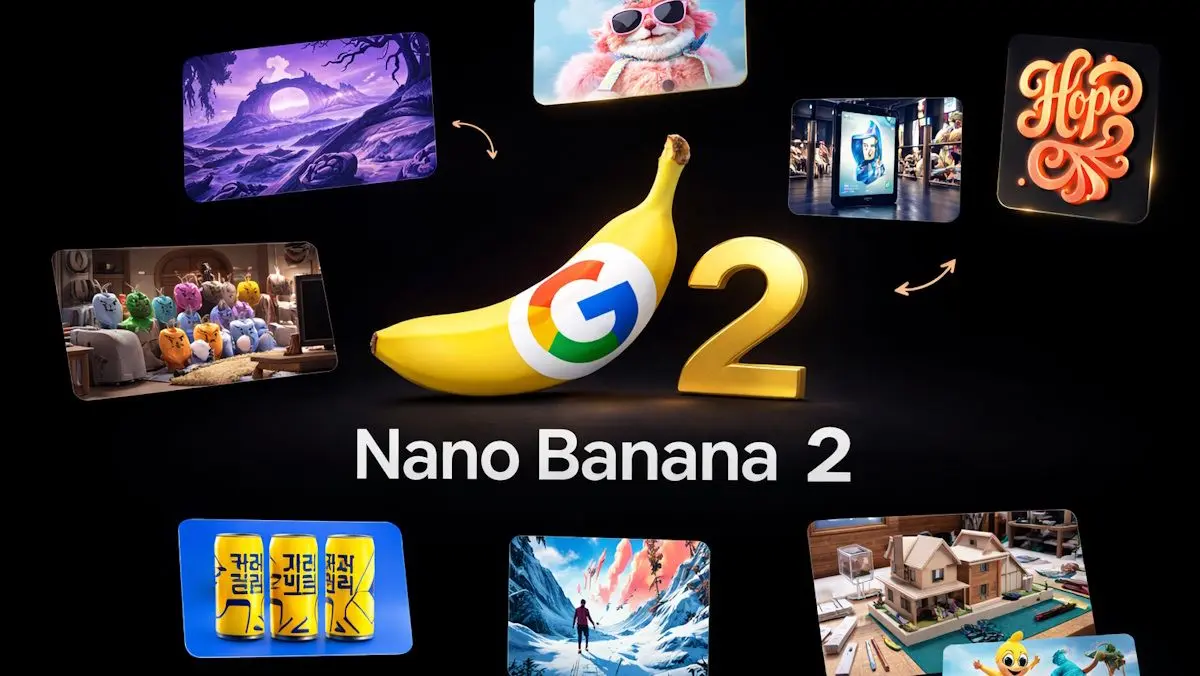
Source: Beebom
Advanced World Knowledge Powers More Accurate Creations
Nano Banana 2 leverages enhanced world knowledge pulled from the Internet by the Gemini 3.1 LLM, giving Google's AI image generator the necessary information to render objects with greater fidelity and create more accurate infographics . This real-time web information capability allows users to generate custom weather reports, diagrams from notes, and data visualizations with more grounding in reality
5
. However, hands-on testing revealed some rough edges—when one user requested a skiing weather infographic using a detailed prompt, the AI initially pulled incorrect dates from the previous week before correcting the mistake upon feedback3
. Users can now create images with resolutions ranging from 512px to 4K in different aspect ratios, addressing professional needs for logos, advertisements, and other production-ready content2
.
Source: Digit
Character Consistency and Improved Text Rendering
Addressing a persistent weakness in AI image generation, Nano Banana 2 can maintain character consistency for up to five characters and fidelity of up to 14 objects in one workflow, enabling better storytelling across multiple image iterations
2
. The model delivers Pro-like text accuracy in image outputs, marking the end of the squiggly AI text era that plagued earlier generators . This improved text rendering capability helps users design greeting cards, mockups for advertising campaigns, and even translate text in images for sharing variations across different languages5
. The photorealistic AI tools can now handle complex requests with detailed nuances, creating media with more vibrant lighting, richer textures, and sharper detail2
.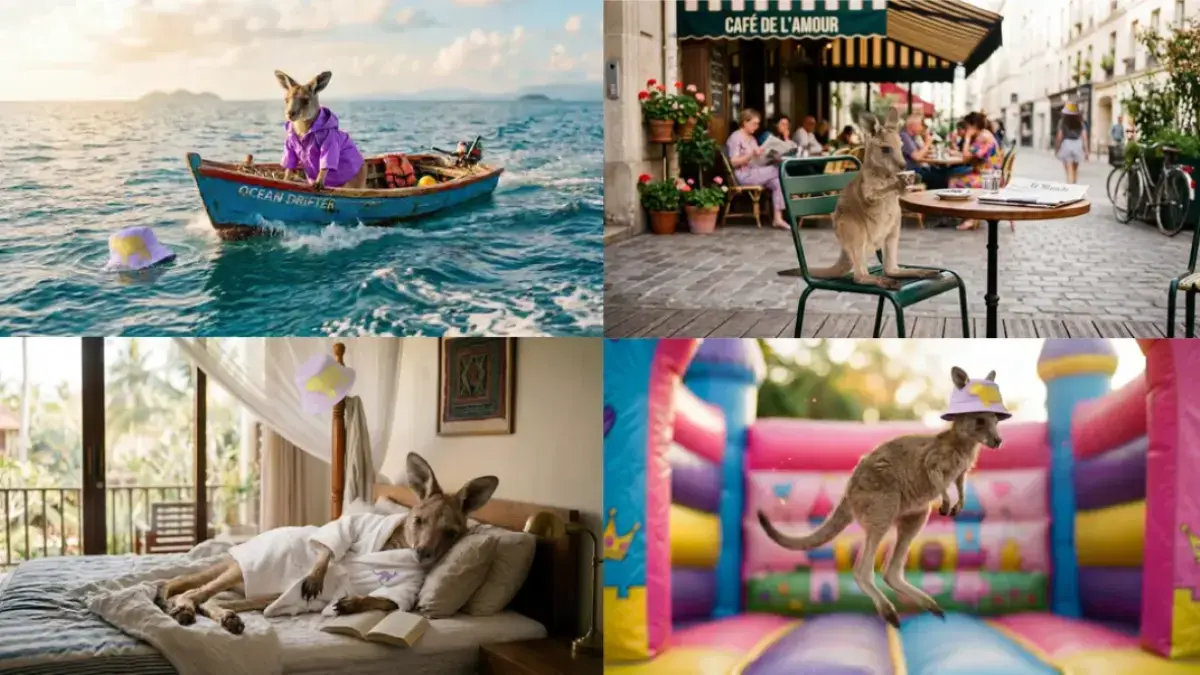
Source: Mashable
Related Stories

Widespread Availability and Watermarking Implementation
Nano Banana 2 replaces the original model as the default across Google's ecosystem, including the Gemini app and website, Google Search via Google Lens and AI Mode across 141 countries, and the video editing tool Flow
2
. For developers, the model is available in preview through the Gemini API, Gemini CLI, Vertex API, AI Studio, and Antigravity development tool2
. Google AI Pro and Ultra subscribers retain access to Nano Banana Pro for specialized tasks by regenerating images via the three-dot menu2
. All images created through the new model carry a SynthID watermark, Google's invisible watermarks to denote AI-generated content, and are interoperable with C2PA Content Credentials created by an industry consortium including Adobe, Microsoft, OpenAI, and Meta2
. Since launching SynthID verification in the Gemini app in November, users have verified images over 20 million times2
.Navigating the AI-Generated Content Landscape
The release of advanced AI image generation tools like Nano Banana 2 intensifies ongoing concerns about fabricated content flooding online ecosystems. These photorealistic AI tools create images nearly indistinguishable from real ones, contributing to what some call "AI slop" saturating social media
4
. A CNET survey found that while the vast majority of social media users believe they encounter AI-generated posts, less than 44% feel confident they can spot them4
. Google's implementation of content credentials offers one verification path, though it only works for images created with Google AI4
. The tool's ability to adeptly handle photo edits on top of generating entirely new images has helped it leapfrog competitors like Midjourney and OpenAI since its initial launch4
. Users can access Nano Banana 2 by clicking the banana emoji in Gemini or simply including image requests in their prompt to the chatbot3
.References
Summarized by

Navi
Related Stories
Google's Nano Banana 2 and Gemini 3 Pro Set to Revolutionize AI Image Generation and Coding
07 Nov 2025•Technology

Google Launches Nano Banana Pro: Professional-Grade AI Image Generator with 4K Resolution and Enhanced Text Rendering
20 Nov 2025•Technology
Google's Nano Banana Pro sets new AI image generation benchmark but raises troubling questions
02 Dec 2025•Technology
Recent Highlights


Recent Highlights
Today's Top Stories






Your Daily Dose of Curated AI News
Don’t drown in AI news. We cut through the noise - filtering, ranking and summarizing the most important AI news, breakthroughs and research daily. Spend less time searching for the latest in AI and get straight to action.

