Humanoid Robots Face Training Gap as Industry Demands Practical Applications Over Demos


2 Sources
2 Sources
[1]
Dancing isn't enough: industry pushes for practical robots
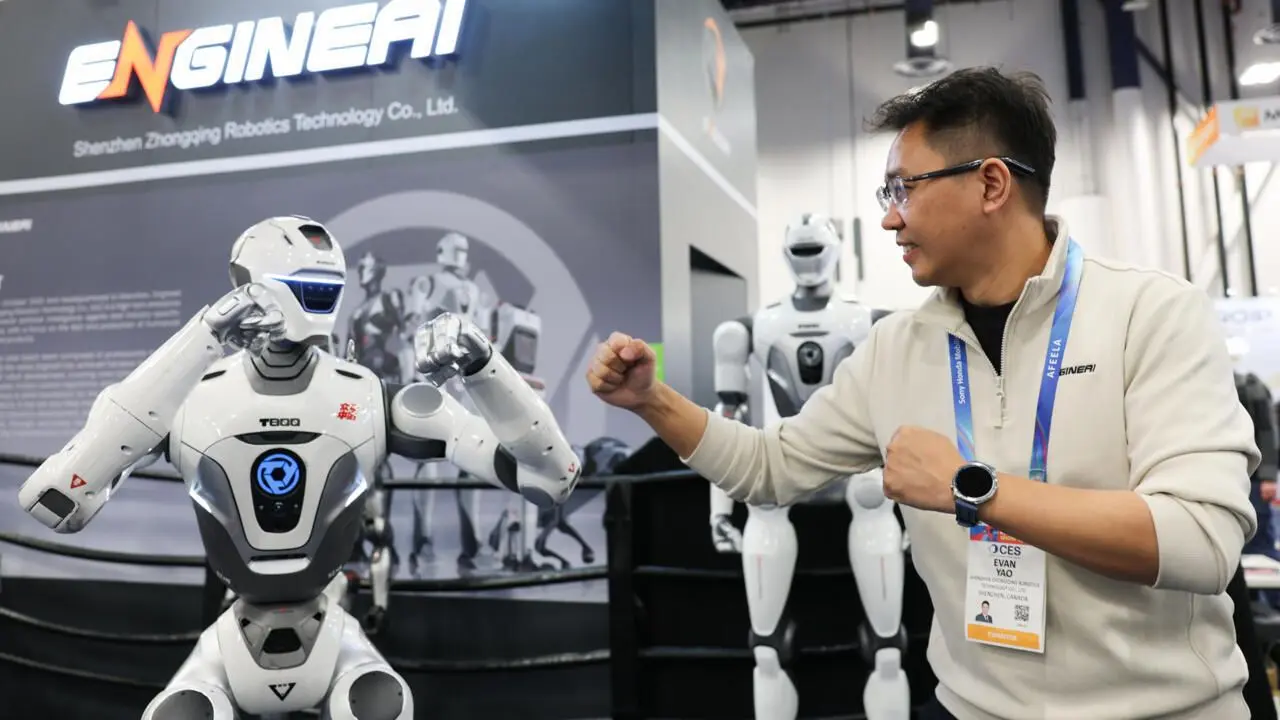
Las Vegas (AFP) - Humanoid robots danced, somersaulted, dealt blackjack and played ping-pong at the Consumer Electronics Show this week, but some in the industry are impatient for them to become more useful, not just a promise of things to come. As robots take their usual spotlight at the annual CES gadget fest, insiders caution that making them truly like humans will take several more years and require lots of training. To become autonomous, humanoid robots need AI that translates what is seen and heard into actions, which is beyond the scope of today's large language models that power tools like ChatGPT. Training a large language model relies on massive amounts of data -- mainly vacuumed up from the internet -- that is of little use when it comes to human-like robots seeking to be useful in the kitchen or on a factory floor. "If you want (robots) to learn embodied things, you have to put them inside a body," said Henny Admoni, an associate professor at the robotics institute at Carnegie Mellon University. Humanoid Guide founder Christian Rokseth, who specializes in the technology, likened the situation to locking a child in a room and expecting it to learn about the world. Even if the pace of development accelerated last year, particularly on the hardware side, Rokseth expressed a degree of impatience about innovation. "They've shown robots dancing and doing kung fu; now show us that they can be productive," Rokseth said. EngineAI founder Evan Yao told AFP that the Shenzhen-based company is working with tech titans such as Amazon and Meta to give its creations AI brains. "We are trying to simulate humans, but the robots will never become human," Yao told AFP as one of his robots kicked in his direction. "Because a human is emotional and much more." Nearby, Yiran Sui was part of a Robotera team whose humanoid robot, developed for researchers, is training to complete the Beijing marathon a few months from now. Factories first? According to the Consumer Technology Association that runs CES, the robotics industry is showing dynamism and potential. It projects the global market will hit $179 billion by 2030. The bulk of that growth is expected in factories, warehouses and other business operations, where robots -- not necessarily humanoid ones -- work in controlled environments. But for Artem Sokolov, founder of the Humanoid robotics startup based in London, humans work in factories so robots copying their bodies can thrive there too. South Korean automotive giant Hyundai used CES to unveil a humanoid robot called Atlas, created in collaboration with Boston Dynamics, that it plans to test in factories. Given the training limitations, industry trackers advise caution when it comes to companies claiming to have humanoid robots that can operate without flesh-and-blood managers overseeing them. "There has been a ton of new companies claiming that they are developing autonomous humanoid robots," Admoni told AFP. But "these systems tend to be teleoperated; you have a person in a suit or using controllers and every movement of that person is then translated into the robot." To solve the training problem, new startups are using methods such as having people wear cameras and haptic gloves while doing chores at home, according to Rokseth. "To make robots general machines, they need to be let out in the real world," Rokseth said, not just assembly lines or warehouses.
[2]
Dancing isn't enough: Industry pushes for practical robots
Humanoid robots danced, somersaulted, dealt blackjack and played ping-pong at the Consumer Electronics Show this week, but some in the industry are impatient for them to become more useful, not just a promise of things to come. - According to the Consumer Technology Association that runs CES, the robotics industry is showing dynamism and potential. Humanoid robots danced, somersaulted, dealt blackjack and played ping-pong at the Consumer Electronics Show this week, but some in the industry are impatient for them to become more useful, not just a promise of things to come. As robots take their usual spotlight at the annual CES gadget fest, insiders caution that making them truly like humans will take several more years and require lots of training. To become autonomous, humanoid robots need AI that translates what is seen and heard into actions, which is beyond the scope of today's large language models that power tools like ChatGPT. Training a large language model relies on massive amounts of data - mainly vacuumed up from the internet - that is of little use when it comes to human-like robots seeking to be useful in the kitchen or on a factory floor. "If you want (robots) to learn embodied things, you have to put them inside a body," said Henny Admoni, an associate professor at the robotics institute at Carnegie Mellon University. Humanoid Guide founder Christian Rokseth, who specializes in the technology, likened the situation to locking a child in a room and expecting it to learn about the world. Even if the pace of development accelerated last year, particularly on the hardware side, Rokseth expressed a degree of impatience about innovation. "They've shown robots dancing and doing kung fu; now show us that they can be productive," Rokseth said. EngineAI founder Evan Yao told AFP that the Shenzhen-based company is working with tech titans such as Amazon and Meta to give its creations AI brains. "We are trying to simulate humans, but the robots will never become human," Yao told AFP as one of his robots kicked in his direction. "Because a human is emotional and much more." Nearby, Yiran Sui was part of a Robotera team whose humanoid robot, developed for researchers, is training to complete the Beijing marathon a few months from now. Factories first? According to the Consumer Technology Association that runs CES, the robotics industry is showing dynamism and potential. It projects the global market will hit $179 billion by 2030. The bulk of that growth is expected in factories, warehouses and other business operations, where robots -- not necessarily humanoid ones -- work in controlled environments. But for Artem Sokolov, founder of the Humanoid robotics startup based in London, humans work in factories so robots copying their bodies can thrive there too. South Korean automotive giant Hyundai used CES to unveil a humanoid robot called Atlas, created in collaboration with Boston Dynamics, that it plans to test in factories. Given the training limitations, industry trackers advise caution when it comes to companies claiming to have humanoid robots that can operate without flesh-and-blood managers overseeing them. "There has been a ton of new companies claiming that they are developing autonomous humanoid robots," Admoni told AFP. But "these systems tend to be teleoperated; you have a person in a suit or using controllers and every movement of that person is then translated into the robot." To solve the training problem, new startups are using methods such as having people wear cameras and haptic gloves while doing chores at home, according to Rokseth. "To make robots general machines, they need to be let out in the real world," Rokseth said, not just assembly lines or warehouses.
Share
Share
Copy Link
At CES 2025, humanoid robots showcased impressive feats like dancing and playing ping-pong, but industry insiders are pushing for real-world utility. Experts warn that achieving true autonomy will take years, as current AI struggles with embodied learning. The robotics industry projects a $179 billion market by 2030, with factories leading adoption.
Humanoid Robots Steal CES Spotlight But Questions Remain
At the Consumer Electronics Show (CES) this week, humanoid robots captivated audiences with their ability to dance, somersault, deal blackjack, and play ping-pong. Yet behind the spectacle, industry experts voiced growing impatience for these machines to move beyond entertainment and deliver genuine utility
1
. Christian Rokseth, founder of Humanoid Guide, captured the sentiment bluntly: "They've shown robots dancing and doing kung fu; now show us that they can be productive"2
. While the hardware side has accelerated over the past year, the path to practical robots capable of operating in kitchens or on factory floors remains fraught with challenges.AI and Training Limitations Block True Autonomy
The core obstacle preventing AI-powered humanoid robots from achieving true autonomy lies in how they learn. To become autonomous, humanoid robots need AI that translates sensory input into physical actions—a capability that extends far beyond today's large language models powering tools like ChatGPT
1
. Henny Admoni, an associate professor at Carnegie Mellon University's robotics institute, explained the fundamental problem: "If you want (robots) to learn embodied things, you have to put them inside a body"2
. Training large language models relies on massive internet data, which proves largely useless for robots that need to navigate physical spaces and manipulate objects. Rokseth likened the current approach to locking a child in a room and expecting it to learn about the world—embodied learning requires real-world interaction that can't be simulated through text alone1
.Tech Giants Partner to Build Robot Brains
Despite these training limitations, companies are forging ahead with ambitious partnerships. EngineAI founder Evan Yao revealed that the Shenzhen-based company collaborates with tech titans including Amazon and Meta to develop AI brains for its creations
2
. "We are trying to simulate humans, but the robots will never become human," Yao told AFP, acknowledging the emotional and cognitive gaps that will persist. Meanwhile, South Korean automotive giant Hyundai unveiled Atlas, a humanoid robot created with Boston Dynamics, which it plans to test in factories1
. The robotics industry shows clear dynamism, with the Consumer Technology Association projecting the global market will hit $179 billion by 20302
.Related Stories

Factories May Lead the Way for Industrial Applications
The bulk of market growth is expected in factories, warehouses, and other business operations where robots work in controlled environments
1
. Artem Sokolov, founder of a London-based humanoid robotics startup, argues that since humans already work in factories, robots copying their bodies can thrive on assembly lines too. This focus on industrial applications makes strategic sense given current technological constraints. However, Admoni cautioned that many companies claiming to develop autonomous humanoid robots are actually using teleoperation—where a person in a suit or using controllers translates every movement to the robot2
. This reality check matters for investors and businesses evaluating which robotics ventures can deliver near-term value versus long-term promises.New Training Methods Target Uncontrolled Environments
To overcome the embodied learning challenge, startups are experimenting with novel training approaches. Some companies now have people wear cameras and haptic gloves while performing chores at home, capturing real-world movement data that robots can learn from
1
. Rokseth emphasized that "to make robots general machines, they need to be let out in the real world," not confined to assembly lines or warehouses. This shift toward training in uncontrolled environments represents a critical evolution for the robotics industry. Meanwhile, Robotera showcased a humanoid robot training to complete the Beijing marathon in coming months—a demonstration that physical endurance tasks may arrive before complex manipulation skills2
. For businesses watching this space, the timeline for truly capable practical robots appears to stretch several more years, requiring patience alongside investment in foundational AI research that bridges the gap between language understanding and physical action.References
Summarized by

Navi
Related Stories
Nvidia unveils full-stack AI robotics platform, positioning itself as the Android of robots
06 Jan 2026•Technology
Humanoid Robots Showcase Skills at Ancient Olympia, Highlighting Progress and Challenges in AI-Driven Robotics
02 Sept 2025•Technology

Silicon Valley summit reveals China's dominance in humanoid robots as AI sparks new momentum
29 Dec 2025•Technology
Recent Highlights
1
Google releases Gemma 4 with Apache 2.0 license, enabling unrestricted local AI on devices
Technology

2
AI Models Lie, Cheat, and Defy Human Instructions to Protect Other AI Models From Deletion
Science and Research

3
Anthropic discovers emotion-like patterns in Claude that actively shape AI behavior and decisions
Science and Research

Recent Highlights
Today's Top Stories







Your Daily Dose of Curated AI News
Don’t drown in AI news. We cut through the noise - filtering, ranking and summarizing the most important AI news, breakthroughs and research daily. Spend less time searching for the latest in AI and get straight to action.

