Microsoft targets frontier AI models by 2027 to reduce OpenAI dependence


3 Sources
3 Sources
[1]
Microsoft Aims to Create Large Cutting-Edge AI Models By 2027
Microsoft Corp. aims to develop large, cutting-edge artificial intelligence models by next year, part of a push to build in-house alternatives to the most powerful AI tools from OpenAI and Anthropic. "We must deliver the absolute frontier," said Mustafa Suleyman, chief executive officer of Microsoft AI, said in an interview. "Certainly by 2027, the objective is to really get to state-of-the-art" across models that can respond to or generate text, images and audio. Suleyman's unit on Thursday rolled out a speech transcription model that Microsoft says is more accurate than rival products in benchmark testing on 11 of the 25 most widely spoken languages. But as with the voice and image-generation models released by the Microsoft AI group to date, it's a specialized tool built for efficiency and trained on fewer data points than general-purpose workhorses like Claude 3 Opus or OpenAI's GPT-4. Microsoft is assembling the computing horsepower to build more broadly capable models, Suleyman said. The company in October started using a cluster of Nvidia GB200 chips, expanding the computing resources at its disposal. "From there, we're sort of ramping over the next sort of 12 to 18 months to get to frontier-scale compute," he said. Get the Tech Newsletter bundle. Get the Tech Newsletter bundle. Get the Tech Newsletter bundle. Bloomberg's subscriber-only tech newsletters, and full access to all the articles they feature. Bloomberg's subscriber-only tech newsletters, and full access to all the articles they feature. Bloomberg's subscriber-only tech newsletters, and full access to all the articles they feature. Plus Signed UpPlus Sign UpPlus Sign Up By continuing, I agree to the Privacy Policy and Terms of Service. The flexibility and prowess of AI models is determined in part by the number of servers used to teach them to parse relationships between words, images or audio. Microsoft's work had long been constrained by contract terms with close partner OpenAI. In exchange for the license to incorporate ChatGPT into its products, Microsoft was prohibited from developing its own broadly capable models. That clause disappeared as part of a renegotiated deal the two companies agreed to last year. Suleyman, who joined Microsoft in 2024 to lead the company's efforts to infuse AI into its consumer products, saw his remit narrow last month to model development. A reorganization gave Jacob Andreou, a former Snap executive, oversight of Microsoft's Copilot assistant for both corporate and individual users, an acknowledgment that the Redmond, Washington, company had failed to build a standalone ChatGPT rival for the masses. Microsoft Chief Executive Officer Satya Nadella spoke at a gathering of the company's model developers this week. "The primary message was just to emphasize the importance of our own state-of-the-art long-term AI self-sufficiency mission over the next three to five years," Suleyman said, adding that the company would also continue to host models built by other companies. The new transcription model, which is designed to filter out background chatter in noisy environments, will start backing the Teams videoconference service and other Microsoft products in the coming months, Suleyman said.
[2]
Microsoft launches 'mid-class' AI model as compute limits bite
Microsoft has unveiled its latest midsized model as it seeks to gain a foothold in the sector, but AI chief Mustafa Suleyman said the tech giant still lacks the computing power needed to build cutting-edge systems. The software giant on Thursday released a speech transcription model that Suleyman called the most advanced of its kind, as it steps up efforts to close in on rivals and reduce its reliance on OpenAI. Microsoft has yet to release large language models capable of competing in more sophisticated areas such as coding and text generation, where it lags market leaders Anthropic, Google and OpenAI. "We are not able to build models in the very largest scale yet although our computation ramp is coming to enable us to do that later this year," Suleyman told the FT. "So we're competing in the mid-class range," he said, adding this was "optimal" in terms of balancing cost, performance, quality and large-scale usage. Microsoft has been investing heavily to achieve "self-sufficiency" in AI models after restructuring its exclusive relationship with OpenAI late last year. It is working to develop frontier models that will enable it to power a number of its commercial and consumer services without relying on third parties. Microsoft, which has one of the world's largest cloud computing businesses, has to balance the allocation of data centre capacity for its own internal AI efforts with customers such as OpenAI as well as its traditional enterprise software. The company has, like other providers, also been hamstrung in the delivery of capacity due to factors including local opposition as well as shortages of equipment, power and labour. Suleyman's comments suggest these constraints are weighing on its internal AI development. He was speaking to the FT from an off-site meeting in Miami for the tech giant's new Superintelligence team. He and chief executive Satya Nadella this week addressed the 350-strong group about Microsoft's "long-term compute roadmap" and objectives. The Google DeepMind co-founder joined Microsoft in 2024 to lead its consumer AI effort. He set up the Superintelligence team late last year amid contract renegotiations between Microsoft and OpenAI. The new deal allows OpenAI to agree cloud computing deals with Microsoft's rivals, but also frees the software giant to build its own advanced models and compete directly with the start-up. Microsoft unveiled its first foundation model MAI-1 last year which it said was an "in-house mixture-of-experts model" that had been trained on 15,000 Nvidia H100 GPUs. This model is in preview and not generally available. Suleyman has poached staff from rivals including Google and recently hired Ali Farhadi, former chief executive of the Allen Institute in Seattle, to bolster his team's ranks. "The mission of our lab is to deliver AI self-sufficiency for Microsoft over the next two or three years," he said. "This means building the [chip] clusters that are frontier scale, investing in the data budgets, so that over the next few years we can get to the state of the art." Suleyman said the team was focused on driving down the costs of AI tools and that its transcription model would undercut rivals on pricing. "We expect to see an enormous amount of demand," he said. His role within the company was reduced last month to focus purely on model development. Former Snap executive Jacob Andreou was placed in charge of all Copilot-branded AI products and reports directly to Nadella.
[3]
Microsoft plans to develop frontier AI models by 2027 By Investing.com
Investing.com -- Microsoft Corp. (NASDAQ:MSFT) is working to develop large-scale artificial intelligence models by next year as part of efforts to create in-house alternatives to advanced AI tools from OpenAI and Anthropic. Mustafa Suleyman, chief executive officer of Microsoft AI, said in an interview with Bloomberg News the company aims to achieve state-of-the-art capabilities by 2027 across models that can respond to or generate text, images and audio. On Thursday, Suleyman's unit released a speech transcription model that Microsoft says outperforms competing products in benchmark testing on 11 of the 25 most widely spoken languages. The model is a specialized tool designed for efficiency and trained on fewer data points than general-purpose models like Claude 3 Opus or OpenAI's GPT-4. Microsoft is building the computing infrastructure needed to develop more broadly capable models, Suleyman said. In October, the company began using a cluster of Nvidia (NASDAQ:NVDA) GB200 chips to expand its computing resources. The company plans to scale up to frontier-level computing capacity over the next 12 to 18 months, he said. This article was generated with the support of AI and reviewed by an editor. For more information see our T&C.
Share
Share
Copy Link
Microsoft AI is ramping up efforts to develop cutting-edge AI models by 2027, aiming for AI self-sufficiency after renegotiating its OpenAI partnership. CEO Mustafa Suleyman revealed the company is scaling computing infrastructure with Nvidia GB200 chips but currently lacks the power to compete at the highest level, focusing instead on mid-class models like its new speech transcription tool.
Microsoft AI Pushes for Frontier Models Amid Computing Constraints
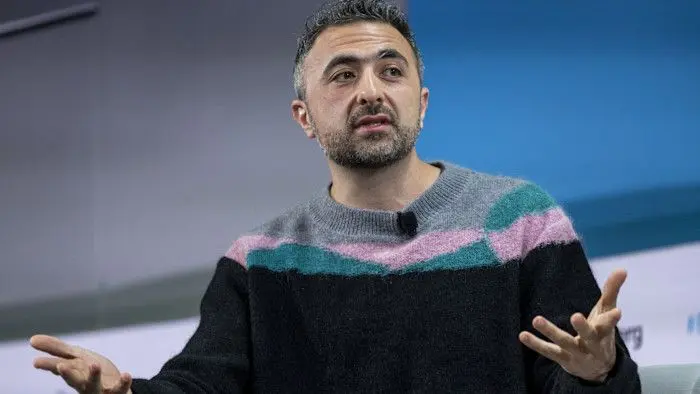
Microsoft is accelerating its mission to develop cutting-edge AI models by 2027, marking a strategic shift toward AI self-sufficiency and creating in-house alternatives to OpenAI and Anthropic. Mustafa Suleyman, CEO of Microsoft AI, told Bloomberg that the company "must deliver the absolute frontier" with state-of-the-art capabilities across models handling text, image, and audio generation
1
. The ambitious timeline comes as Microsoft renegotiated its partnership with OpenAI last year, removing contractual restrictions that previously prevented the tech giant from building broadly capable models1
.
Source: FT
Computing Power Gaps Limit Current Capabilities
Despite its ambitions, Microsoft AI currently lacks the computing power needed to compete with market leaders in sophisticated areas like coding and advanced text generation. "We are not able to build models in the very largest scale yet although our computation ramp is coming to enable us to do that later this year," Suleyman told the Financial Times
2
. The company is "competing in the mid-class range," which Suleyman described as optimal for balancing cost, performance, quality and large-scale usage2
. Microsoft began using a cluster of Nvidia GB200 chips in October and is investing in computing infrastructure to reach frontier-scale compute within 12 to 18 months1
.
Source: Bloomberg
Speech Transcription Model Signals Progress
Microsoft's Superintelligence team on Thursday released a speech transcription model that outperforms competitors in benchmark testing on 11 of the 25 most widely spoken languages
1
. Designed to filter out background noise in challenging environments, the specialized tool will integrate into Microsoft Teams and other products in coming months1
. Unlike general-purpose workhorses like Claude 3 Opus or GPT-4, this model is trained on fewer data points for efficiency1
. Suleyman emphasized the team is focused on driving down costs and expects "enormous demand" for the competitively priced transcription tool2
.Related Stories

Strategic Reorganization and Long-Term Vision
Satya Nadella addressed Microsoft's 350-strong Superintelligence team this week in Miami, emphasizing the importance of the company's "long-term AI self-sufficiency mission over the next three to five years"
1
. The mission involves building frontier-scale chip clusters and investing in data budgets to reach state-of-the-art capabilities within two to three years, according to Suleyman2
. Last month, Suleyman's role narrowed to focus purely on model development, while former Snap executive Jacob Andreou took charge of all Copilot-branded AI products1
. This restructuring acknowledges Microsoft's struggle to build a standalone ChatGPT competitor for mass consumers1
.Balancing Internal Development and Cloud Obligations
Microsoft faces unique challenges in allocating data center capacity between its internal AI development and cloud customers including OpenAI, alongside traditional enterprise software demands
2
. The company has been constrained by local opposition, equipment shortages, power limitations and labor availability issues affecting capacity delivery2
. To reduce reliance on third parties, Microsoft unveiled its first foundation model MAI-1 last year, an in-house mixture-of-experts model trained on 15,000 Nvidia H100 GPUs, though it remains in preview2
. Suleyman has recruited talent from rivals including Google and recently hired Ali Farhadi, former CEO of the Allen Institute in Seattle, to strengthen the team2
. The renegotiated OpenAI deal allows the startup to pursue cloud computing agreements with Microsoft's competitors while freeing Microsoft to build large-scale AI models and compete directly2
3
.References
Summarized by

Navi
Related Stories
Microsoft pushes for AI self-sufficiency as it builds in-house models to reduce OpenAI dependence
12 Feb 2026•Business and Economy

Microsoft Develops In-House AI Models to Reduce Dependence on OpenAI
08 Mar 2025•Technology
Microsoft Unveils In-House AI Models, Signaling Potential Shift from OpenAI Dependency
29 Aug 2025•Technology

Recent Highlights
1
AI chatbots validate you too much, making you less kind to others, Stanford study reveals
Science and Research
2
Anthropic's Claude Code Source Leak Reveals Hidden AI Agent Plans and Extensive System Access
Technology

3
Judge blocks Pentagon from branding Anthropic a security risk over AI safety guardrails dispute
Policy and Regulation

Recent Highlights
Today's Top Stories




Your Daily Dose of Curated AI News
Don’t drown in AI news. We cut through the noise - filtering, ranking and summarizing the most important AI news, breakthroughs and research daily. Spend less time searching for the latest in AI and get straight to action.

