Normal Computing raises $50M to solve the AI energy crisis with thermodynamic chip technology


2 Sources
2 Sources
[1]
AI chips are getting too expensive -- and too power-hungry. This startup just raised $50M to change that. | Fortune
New investors include Galvanize, Brevan Howard Macro Venture Fund, and ArcTern Ventures, alongside existing backers Celesta Capital, Drive Capital, Eric Schmidt's First Spark Ventures, and Micron Ventures. CEO Faris Sbahi told Fortune the company's software platform is already being used by more than half of the top 10 semiconductor companies by revenue, as it targets one of the industry's biggest challenges: the rising cost and complexity of designing advanced AI chips, where even small errors can lead to expensive delays and rework. Designing advanced AI chips has become so complex that even getting a design to "tape-out" -- the point where it's finalized for manufacturing -- is increasingly prone to costly failure. Modern AI chips, which pack in tens of billions of transistors to support today's frontier models, can cost more than $500 million to develop before a single unit ships. Normal, founded in 2022 by former engineers and scientists from Google Brain, Google X, and Palantir, is also using its chip design software internally to build its own experimental AI hardware. It has already taped out a prototype chip using the company's "thermodynamic" approach, which uses the inherent randomness of physical systems to compute more efficiently than traditional GPUs. It's an early step in a longer-term effort to significantly reduce the energy demands of AI. "The mission of the company is to go after this so-called AI energy crisis," said Sbahi. "Data centers are expected to hit an energy wall around 2030, and most of the strategy now is to find new ways to acquire more energy -- but our position is to solve the problem in terms of the hardware that we're using." Normal Computing is part of a growing group of startups exploring alternatives to conventional AI hardware, including Unconventional AI, led by former Intel AI chief Naveen Rao, which raised a $475 million seed round in January led by Andreessen Horowitz and Lightspeed Ventures. Another is Extropic, which is developing probabilistic AI chips based on a different technical approach. Sbahi said the company chose the name "Normal Computing" to reflect its view that its approach is closer to how computation should naturally work. "We think this is the more normal way of computing," he said, pointing to how the company's software and hardware are designed to align with the underlying physics. "The software really matches the hardware." While building energy-efficient AI chips is the company's long-term goal -- initially focused on inference workloads for generative AI -- the current fundraise will focus on scaling Normal's commercial software business. "Hopefully someday we'll be integrated into mainstream semiconductor design manufacturing," said Sbahi. He added that the semiconductor industry's high costs and complexity make it difficult for new approaches to break in, which is why Normal has focused on working with existing chipmakers rather than trying to disrupt the system from the outside.
[2]
Normal Computing raises $50M to tackle the soaring energy demands of AI chips - SiliconANGLE
Normal Computing raises $50M to tackle the soaring energy demands of AI chips Normal Computing Corp., a startup that's trying to reinvent the fundamental physics of artificial intelligence, said today it has raised $50 million in a Series B funding round led by Samsung Catalyst. Today's round also saw participation from Galvanize, Brevan Howard Macro Venture Fund and ArcTern Ventures, plus existing backers like Celesta Capital, Drive Capital, Micron Ventures and Eric Schmidt's First Spark Ventures, bringing Normal's total amount raised to more than $85 million. Normal says it's trying to fix what could ultimately prove to be an existential crisis for the AI industry. As AI models scale and become more powerful, the chips they run on require increasing amounts of power to run. Chief Executive Faris Sbahi says the industry is fast approaching an "energy wall," as conventional graphics processing units demand prohibitive amounts of energy that will soon be impractical to supply. The startup intends to fix this problem by doing two things: First, it intends to transform the way silicon chips are designed, and second, use its new methods to create a fundamentally new kind of processor that embraces the laws of physics instead of trying to oppose them. Before it can even hope to change how chips work, Normal says it needs to rethink how they are made. That's why it developed the Normal EDA, or electronic design automation platform, which is currently being used by half of the world's top ten semiconductor design firms. AI has already transformed the way people code, but its impact on chip design hasn't been anywhere near as significant. The Normal EDA platform changes that, using a frontier AI technique called "auto-formalization." It combines large language models with formal logic to help engineers design, optimize and prove the correctness of their silicon designs. The idea is that the AI learns the intent behind new chip designs, before helping to suggest better ways of doing it and make them run more efficiently. It can help to compress chip development times from years into just months, as an additional benefit. "Meeting growing 'intelligence-per-dollar-per-watt' demands a fundamentally novel architecture," Sbahi said. "Normal EDA exists to accelerate custom silicon to market by two-times today, and over time, to enable 1,000-times gains in efficiency with our platform." But the more ambitious aspect of Normal's vision is not to change the way chips are designed, but to alter the way they compute. The company explains that existing silicon chips require vast amounts of energy trying to keep transistors in rigid "0" or "1" states to minimize power and heat generation. Normal, on the other hand, implements thermodynamic cooling that allows it to avoid fighting the inherent randomness of physical systems. Its physics-based application-specific integrated circuits harness thermal dynamics to perform computations in order to improve the efficiency of silicon-based compute. It works by treating nature's randomness as a feature rather than a bug. So while traditional GPUs use massive amounts of energy trying to suppress noise and ensure a perfect "0" or "1" state, Normal's ASICs let the system fluctuate naturally, harnessing the noise to perform computations. The company has already taped out the world's first thermodynamic computing chip. It's called the CN101, and it's the first step towards the company's ambitious goal of 1,000-times energy efficiency gains. Normal is researching its thermodynamic chip architecture in collaboration with the U.K.'s Advanced Research and Invention Agency, known as ARIA. Suraj Bramhavar, who is director of ARIA's Scaling Compute program, said his own research is focused on helping the chip industry move away from incremental performance gains and take a giant leap, with transformational improvements. That's why he's so keen to work with Normal. "Its team has taken a fundamentally unconventional approach and delivered working silicon in CN101," Bramhavar said. "That is an exceptionally rare outcome for work this ambitious."
Share
Share
Copy Link
Normal Computing secured $50 million in Series B funding led by Samsung Catalyst to address the escalating cost and power consumption of AI chips. The startup is developing thermodynamic computing technology and an EDA platform already used by half of the world's top semiconductor companies. CEO Faris Sbahi warns data centers will hit an energy wall by 2030.
Normal Computing Secures $50 Million to Address AI Energy Consumption Crisis
Normal Computing has raised $50 million in funding led by Samsung Catalyst to tackle the soaring energy demands of AI chips, bringing its total capital raised to more than $85 million
2
. The Series B round attracted new investors including Galvanize, Brevan Howard Macro Venture Fund, and ArcTern Ventures, alongside existing backers Celesta Capital, Drive Capital, Eric Schmidt's First Spark Ventures, and Micron Ventures1
. Founded in 2022 by former engineers and scientists from Google Brain, Google X, and Palantir, the startup is positioning itself at the intersection of two critical challenges facing the semiconductor industry: the escalating cost and power consumption of AI chips.
Source: Fortune
Electronic Design Automation Platform Gains Traction with Semiconductor Companies
CEO Faris Sbahi revealed that the company's software platform for semiconductor companies is already being used by more than half of the top 10 semiconductor firms by revenue
1
. The Normal EDA platform addresses one of the industry's most pressing issues: the rising complexity of designing advanced AI chips, where even minor errors can trigger expensive delays and rework. Modern AI chips pack in tens of billions of transistors to support today's frontier models and can cost more than $500 million to develop before a single unit ships1
. The chip design software uses a frontier AI technique called auto-formalization, combining large language models with formal logic to help engineers design, optimize and prove the correctness of their silicon designs2
.Thermodynamic Computing Chip Architecture Promises 1,000x Efficiency Gains
Beyond its commercial software business, Normal Computing is developing energy-efficient AI chips based on a radically different approach. The company has already achieved tape-out of its prototype thermodynamic computing chip, the CN101, which represents the world's first thermodynamic computing chip
2
. Unlike traditional GPUs that consume massive amounts of energy fighting the inherent randomness of physical systems to maintain rigid "0" or "1" states, Normal's thermodynamic computing chip architecture harnesses thermal dynamics and treats nature's randomness as a feature rather than a bug2
. This approach aims to deliver 1,000-times energy efficiency gains, initially focused on generative AI inference workloads.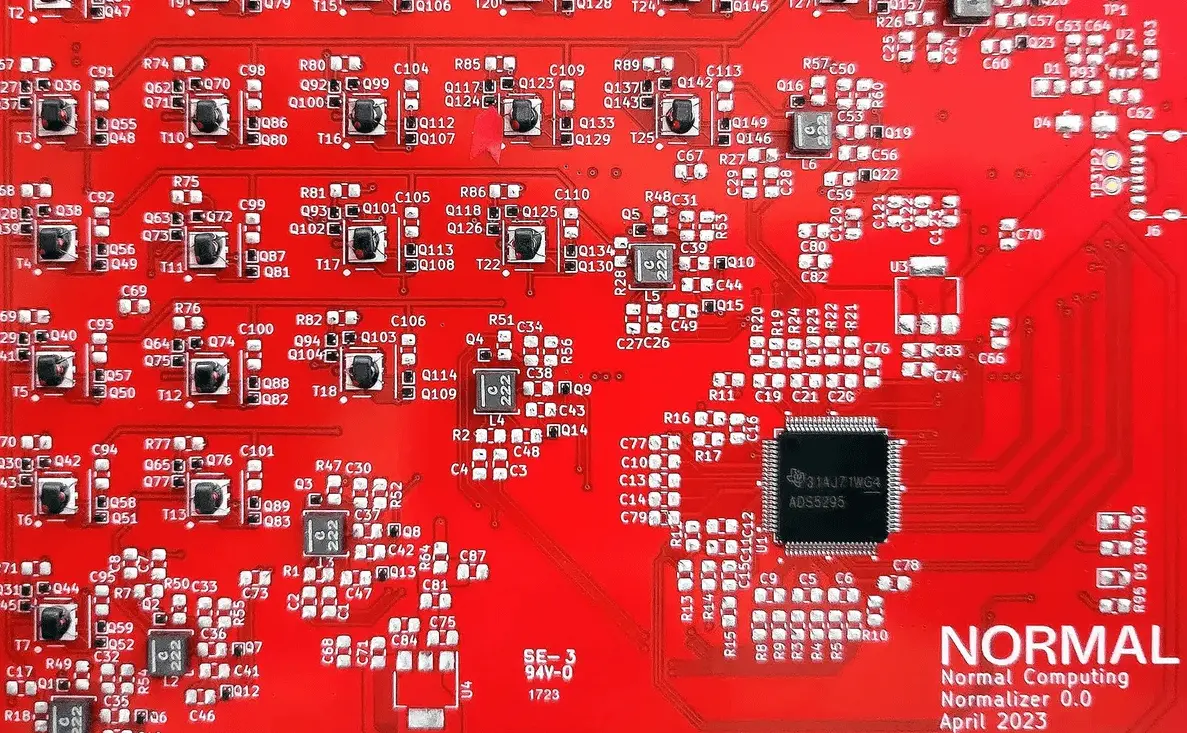
Source: SiliconANGLE
Related Stories


Data Centers Face Energy Wall by 2030
"The mission of the company is to go after this so-called AI energy crisis," Sbahi told Fortune. "Data centers are expected to hit an energy wall around 2030, and most of the strategy now is to find new ways to acquire more energy -- but our position is to solve the problem in terms of the hardware that we're using"
1
. Normal Computing joins a growing cohort of startups exploring alternatives to conventional AI hardware, including Unconventional AI, led by former Intel AI chief Naveen Rao, which raised a $475 million seed round in January led by Andreessen Horowitz and Lightspeed Ventures. The company is researching its thermodynamic chip architecture in collaboration with the U.K.'s Advanced Research and Invention Agency, known as ARIA. Suraj Bramhavar, director of ARIA's Scaling Compute program, noted that Normal's team "has taken a fundamentally unconventional approach and delivered working silicon in CN101," calling it "an exceptionally rare outcome for work this ambitious"2
. The current fundraise will focus on scaling Normal's commercial Electronic Design Automation platform, with the long-term goal of integrating into mainstream semiconductor design manufacturing.References
Summarized by

Navi
Related Stories
Recent Highlights
1
OpenAI shuts down Sora video app after six months, ending Disney's $1 billion investment deal
Technology

2
AI-Generated Val Kilmer to Posthumously Appear in As Deep as the Grave After His Death
Entertainment and Society

3
Supermicro Co-Founder Indicted in $2.5 Billion Nvidia AI Chip Smuggling Scheme to China
Policy and Regulation

Recent Highlights
Today's Top Stories




Your Daily Dose of Curated AI News
Don’t drown in AI news. We cut through the noise - filtering, ranking and summarizing the most important AI news, breakthroughs and research daily. Spend less time searching for the latest in AI and get straight to action.

