Nvidia unveils DLSS 4.5 with 6x Frame Generation and improved AI upscaling at CES 2026


19 Sources
19 Sources
[1]
Nvidia's Gaming Announcements at CES 2026 Are All About the Software
While the Nvidia keynote at CES 2026 on Monday afternoon brought the usual cavalcade of robots, autonomous driving models and massive commercial hardware for AI, its low-key gaming news didn't get to join the party. Given there's no new gaming hardware, it's understandable. But Nvidia did launch version 4.5 of its DLSS upscaling and optimization technology, bringing dynamic multi-frame generation and an upgraded transformer model for its super-resolution upscaling that optimizes for high frame rate 4K gaming, notably the latest crop of 240Hz 4K displays. The company also introduced new capabilities for its RTX Remix modding platform and launched apps for Linux and Amazon Fire TV. Don't miss any of our unbiased tech content and lab-based reviews. Add CNET as a preferred Google source. Nvidia's multi-frame generation works within DLSS to extrapolate multiple frames from a single rendered frame, and in conjunction with the upscaling, to raise game frame rates and resolution. (Sadly, it works only on RTX 50 series cards.) In 4.5, it goes from generating up to four frames for each rendered frame to six frames for each, and it can dynamically target the refresh rate of your monitor to adjust the render-to-generated ratio on the fly to maintain consistent speed and latency. The new model for Super Resolution has fewer temporal artifacts -- less ghosting, improved antialiasing and better clarity -- and works with any RTX graphics card. On the Blackwell cards, it helps with the multi-frame generation image quality as well. G-Sync-capable monitors also potentially get a new feature, Ambient Adaptive Technology. (It requires a light sensor on the monitor, which is rare on desktop monitors but pretty common on general-purpose laptops.) As the name implies, it can automatically adjust color temperature and brightness based on environmental conditions. In addition to AAT, Nvidia announced that the G-Sync Pulsar monitors it launched in September 2024 will soon be available. In case you've forgotten, Pulsar improves clarity on fast-moving games played on high refresh-rate monitors. While the company's RTX Remix platform for modding games with AI-generated assets isn't for everyone, Nvidia's added a new capability, Remix Logic, that sounds awfully cool. In essence, it lets a game make decisions about what assets to use -- like specific weather or particle behavior -- based on things happening within the game.
[2]
Nvidia announces DLSS 4.5 with 6x Frame Generation and improved image quality
Nvidia is announcing its next major update to its Deep Learning Super Sampling (DLSS) feature at CES today. DLSS 4.5 includes Nvidia's second-generation Super Resolution transformer model and a new 6x Multi Frame Generation mode for RTX 50-series GPUs that uses AI to generate up to five additional frames for every single rendered one. DLSS 4.5 will be available for all RTX GPUs today, but will run the fastest on Nvidia's latest RTX 40- and 50-series cards. The latest transformer model is designed to improve image quality overall and reduce some of the artifacting that we saw with DLSS 4. "This second-generation model is our most sophisticated yet," says Henry Lin, director of product management at Nvidia, in a briefing with The Verge. "It utilizes 5x the compute power over the original transformer model, it's trained on a significantly expanded high-fidelity dataset, and it also takes full advantage of our GeForce RTX 40- and 50-series GPUs, which benefit from faster and more advanced Tensor Cores." Nvidia has updated its DLSS model to better understand scenes in games so it can use game engine data to improve lighting, finer edges, and motion clarity. In a briefing, Nvidia demonstrated improvements to DLSS 4.5 in a variety of games. Ghosting is reduced in The Elder Scrolls IV: Oblivion Remastered, anti-aliasing is improved in Indiana Jones and the Great Circle, and there is less shimmering in certain scenes in Kingdom Come: Deliverance II. While the AI model improvements to DLSS 4.5 will benefit all RTX owners today, Nvidia is also launching a new 6x Multi Frame Generation mode for RTX 50-series owners in spring. Targeted at 240Hz 4K gaming, the 6x mode will generate five additional fake frames for every single rendered one, instead of the maximum of three additional in DLSS 4. Nvidia is also launching a Dynamic Multi Frame Generation mode that automatically switches between different Multi Frame Generation levels depending on when you need more or less fake frames. "When things are really graphically intense, it upshifts and increases the Frame Generation required to bridge the performance dips, ensuring that your high refresh rate monitor remains buttery smooth," explains Lin. "When the workload lightens, it seamlessly shifts the multiplier down to compute only what's needed." DLSS 4.5 will be available for more than 400 games and apps through Nvidia's app today, allowing RTX owners to force 4.5 on in games that haven't been updated yet. Nvidia is only committing to a vague "spring 2026" timeframe for its 6x Multi Frame Generation and Dynamic Frame Generation modes for RTX 50-series owners.
[3]
Nvidia introduces DLSS 4.5 and Multi Frame Generation 6X at CES 2026 -- updated models can generate higher-quality upscaled frames and more of them, dynamically
At CES 2026, Nvidia's gaming updates lean heavily on AI. The company is making its DLSS suite of tech even better with the new version 4.5 of its upscaling, or "Super Resolution" model, as well as an enhanced version of its Multi Frame Generation model that can support even more aggressive multipliers than the current 4x version. The DLSS upscaler kicked off a revolution in gaming performance when its second version arrived in 2020, and the company has held a lead in upscaling quality ever since. In addition, Nvidia's introduction of Tensor Cores on RTX 20-series GPUs dating all the way back to 2018 means that the most recent DLSS 4 Super Resolution model, powered by a transformer architecture, still works with those products. At CES 2026, DLSS 4.5 marks the arrival of the second generation of the transformer architecture model. Nvidia says it's constantly training DLSS to address edge cases where it might produce undesirable artifacts. The first case the company highlighted is highly distracting "shimmering" or flicker on static surfaces. DLSS 4.5 claims to improve temporal stability in these situations, resulting in a more solid-looking image. Second, ghostly trails or after-images can form behind objects close to the player, like guns or swords. This is another case that Nvidia has spent training time refining in DLSS 4.5, and we should see reduced instances of this ghosting with the new model. Finally, the company says that DLSS 4.5 should deliver better anti-aliasing performance in some titles, such as Indiana Jones and the Great Circle. We had a chance to go hands-on with DLSS 4.5 across several games before the company's announcement this evening, and our experience suggests that DLSS 4.5 will indeed be an impressive improvement over the existing transformer model. What we didn't expect is that DLSS 4.5 actually makes certain lighting and particle effects look richer and more natural, too. We'll go into these points in more depth with DLSS 4.5 once we're home from CES and back at the test bench. Nvidia says that DLSS 4.5 is more computationally intense than past models, but the increased resource demand will be offset to some degree by support for accelerated FP8 processing in the Tensor Cores of RTX 40-series and RTX 50-series graphics cards. The company says that RTX 20- and 30-series cards will still be able to run the new model despite their lack of Tensor Core FP8 acceleration, but it doesn't make any guarantees about performance on that older hardware. Even so, if DLSS 4.5 incurs a large increase in a relatively small portion of overall frame time, it might still result in a relatively small hit to performance, as upscaling models have to be relatively lightweight by design in order to provide their performance-boosting magic. DLSS 4 and its transformer architecture already incurred a small but measurable performance loss on Turing and Ampere, so it's likely we'll see a larger dip with the new model on those cards. We'll need to do some testing and see whether the image quality refinements this model offers are worth the performance tradeoff on older hardware. As with past DLSS Super Resolution updates, gamers will be able to pick and choose among model versions using the Nvidia App on Windows to pick the one that offers the best balance of performance and image quality for a given application. DLSS 4.5 should be available right away as an Nvidia App override, so check for updates and see whether new models become available in those override options (you'll see choices for models L and M in the selection dropdown.) DLSS Multi-Frame Generation is also getting a couple of major improvements this year, although they're coming later than the updated Super Resolution model. First off, DLSS MFG will now have multipliers ranging up to a whopping 6x, versus the current model's 4x. In part, Nvidia says this is possible thanks to the improved image quality provided by the DLSS 4.5 super resolution model, as well as the smooth frame pacing measures it's built into its hardware and software stack. Giving the MFG model better input data should in theory result in better image quality across generated frames, although we'll have to see how well stretching a single native frame out into 4 or 5 generated frames works in practice. It's also worth remembering, as we've long cautioned and proven through dedicated testing, that DLSS MFG isn't a way of making unplayable frame rates into playable ones. If you're trying to boost average frame rates of just 30 FPS or below with MFG, your experience will still feel as laggy and unresponsive as it's likely to at 30 FPS. Instead, MFG 5x and 6x will likely work best as tools for making the most of the ultra-high-refresh-rate monitors coming out this year and into the future. Frame rate isn't a perfect proxy for input lag, but if you have a solid 90 FPS to work with, MFG 5x and 6x could make it practical to use 360Hz or 480Hz+ monitors in tandem with DLSS Performance or Ultra Performance without crushing graphical fidelity in exchange. Nvidia is also introducing a new dynamic mode for MFG that will automatically adjust the frame gen multiplier to maintain a target frame rate that's set in the Nvidia App. As long as the mode switch doesn't cause stutter or other perceptible issues in exchange for maintaining that target frame rate, a dynamic MFG could be a handy feature, but we'll need to try it out to see how quickly and smoothly it can handle the transitions between multipliers. DLSS MFG with dynamic mode and extended multipliers will arrive in spring 2026, and as with the original MFG, it'll be an RTX 50-series exclusive. For all that, some elements of DLSS 4 remain in the oven even a year after this family of features was first announced. Nvidia says that its Reflex 2 lag reduction technology with Frame Warp reprojection, which could further improve perceived responsiveness, remains targeted for a future release.
[4]
Nvidia Is Pushing the Number of Fake Frames for Games to Ludicrous Levels
Nvidia wants to prove it’s still the leader of the pack with AI upscaling. The company’s DLSS technology is still the best for increasing in-game frame rates and enhancing visuals at the same time, but AMD and Intel’s latest efforts have narrowed the gap. To stake its claim, Nvidia is honing in on multi-frame generation for artificially bumping in-game frame rates, even if all those so-called “fake frames†make little sense if you already own one of its expensive graphics cards. Let’s get one thing out of the way: DLSS 4.5 isn’t a whole new generation of AI enhancements. It builds upon last year’s major update to the technology that brought a new transformer model into the upscaling pipeline. Essentially, DLSS (deep-learning super sampling) takes a frame that’s rendered at a lower resolution and massages the pixels so it appears to run at a higher resolution. This enhances performance, though the transformer model has the added benefit of a large pre-trained dataset that's supposed to recapture the glory of the game rendered at the native resolution. Nvidia said the new transformer model has five times the compute behind it compared to the original transformer model introduced in 2025. DLSS was already good enough; it was hard to spot a difference between native and non-native images, but we’ll take better clarity any day of the week. This could be especially important for in-game lighting effects. You can see this impact in a game like Black Myth: Wukong, which normally defaults to DLSS on PC. There are more than 250 games running DLSS 4 (though there are more available if you force DLSS 4 settings through the Nvidia app), and Nvidia promises you’ll be able to get this working on RTX 40-series GPUs as well. Intel’s XeSS 3 and AMD’s FSR Redstone upscalers both introduced a new form of multi-frame gen with their latest updates. Essentially, the GPU crafts AI-generated frames, which are then interlaced between rasterized (natively rendered) frames. This increases performance at the risk of making games feel floaty or unresponsive due to higher latency. Currently, the max frame gen on these other models is limited to 4X. Nvidia is now pushing that to 6X, and we once again have to wonder about the point of this move. Nvidia says the updated frame generation is coming in spring this year. I try to warn gamers when we discuss frame generation that maintaining a solid playing experience means you’ll need to have between 50 and 60 fps already before enabling frame generation. This cuts down on latency and results in fewer visual glitches. So if you enable 6X frame gen on a PC that’s already pushing games hard, you won’t see the benefit unless you have a monitor that can handle a 240Hz or higher refresh rate. And if you can afford that monitor, you can probably afford a higher-end 50-series GPU. In which case, why do you even need so many fake frames? But, hey, it's still worth upgrading to DLSS 4.5. You can do so by switching “DLSS Override feature†to “latest†in the Nvidia app.
[5]

Seeing means believing for Nvidia's new DLSS 4.5 and G-Sync Pulsar monitors
Nvidia's new DLSS 4.5 and G-Sync Pulsar monitors bring game-changing visual improvements that are hard to capture on camera. But trust me: They rock. Nvidia may not have announced any new graphics cards at CES 2026, but it did reveal two stunning technology upgrades: Upgraded G-Sync Pulsar monitors and DLSS 4.5. The problem is it's damned near impossible to see the advantages each provides in pictures and video -- the visual quality differences don't translate well when captured through a camera lens. The Nvidia promo videos below give good oversight into the new technologies, for example, but you don't get the full experience secondhand, kind of like VR. Well, friends, I spent two full hours in Nvidia's booth getting deep-dive, hands-on demonstrations of both G-Sync Pulsar and DLSS 4.5, and let me assure you: They're amazing. I'm going to try to get my grubby gamer paws on a G-Sync Pulsar monitor after CES to do a deeper analysis, but the upshot? These puppies use technical tricks mixed with complex science to all but solve motion blur. Everything stays crystal clear while you're panning around without ugly motion blur -- the difference is so stark I picked up on it immediately. Gamers who love complex strategy or tactics games (like Civilation or Anno) or esports games like DOTA 2 and LoL should strongly consider picking up one of these 1440P, 360Hz displays over an OLED monitor. Sacrilege, I know, but Pulsar's IPS display felt that damned good. I also got the chance to poke around with DLSS 4.5, and my demos had a handy toggle that let you switch between DLSS 4 and 4.5 on the fly so you can see the changes instantly. Once again, side by side, the upgrade is clear as day. DLSS 4.5's new second-gen transformer AI model delivers tangible improvements in some key areas. It damn near solves ghosting, an issue that's plagued upscaling since infancy, and makes temporal stability -- the shimmering effect you might see in small, detailed areas like a ball of yarn or wavering tree leaves -- so much better than before. Sharper anti-aliasing also makes imagery more crisp, which was especially noticeable in Outer Worlds 2's space scenes and the ornate armor of Black Myth Wukong's warrior. Flipping between DLSS 4 and 4.5, the improved visual fidelity was immediately obvious. DLSS 4.5's new 6x and Dynamic Multi-Frame Gen capabilities make maxing out your monitor's capabilities seamless, too. Dynamic MFG automatically manages how many AI-generated frames are inserted between traditionally rendered frames, to scale to match your monitor's refresh rate. I tried it on several systems. In an RTX 5070 desktop attached to a 4K 240Hz display, Dynamic MFG usually ran at 5x or 6x, to be able to match the refresh rate. On a similar system attached to a 4K 165Hz display, it stayed relatively stable at 3x, since you don't need to create anywhere near as many frames to keep that lower refresh rate fed. Better yet, I felt zero judder or jankiness when Dynamic MFG shifted up or down to the next level. That was a worry of mine when the technology was announced; would you feel it when it suddenly changed from 6x to 4x while transitioning environments? Nope. Bonus: Dynamic MFG is smart enough to shut off AI frames completely when sections of a game don't need brute force, such as pre-generated cutscenes running at a locked 60fps. I'll be able to dive much deeper into both G-Sync Pulsar and DLSS 4.5 when I'm back at home with my gaming rig -- it's kind of hard to test gaming fidelity when you're traveling with a work-issued laptop. But I wanted to get this information out there ASAP since DLSS 4.5's transformer upgrade and the first G-Sync Pulsar monitors are already being sold online. Don't be scared. Even if you can't see the advantages of DLSS 4.5 and Pulsar monitors in a web video, they are there -- and they look amazing. (Seriously, Civ and League of Legends fanatics should take a long, deep look at investing in a Pulsar display.)
[6]

I tested Nvidia's DLSS 4.5 beta update: here's how much faster it made Cyberpunk 2077 run
AI was a popular initialism at CES 2026 in Las Vegas this week, and Nvidia helped lead the charge. But while company chief Jensen Huang talked chiefly about algorithms and AI-powered robots during Nvidia's keynote, after hours the company announced exciting news for GeForce owners: there's a new version of DLSS on the block. This is a big deal because DLSS brings big things to PC gaming. Nvidia's upscaling tech is industry-leading and helps scores of folks eke a playable framerate out of modern games running on underpowered PCs. I've been covering this stuff for decades, and I think it's no exaggeration to say DLSS has been a game-changer for the PC gaming business. So a new version is significant, even when it's clearly telegraphed as a half-step forward. And while DLSS 4.5 doesn't officially start rolling out until next Tuesday (January 13), you can already download and check out the beta version if you're curious to see what a difference the new features could make in your favorite games. According to Nvidia's announcement, the biggest upgrades you get with DLSS 4.5 are an upgraded Super Resolution model that's better trained to take full advantage of Nvidia GeForce RTX 40-series and 50-series GPUs, as well as a new 6X Multi-Frame Generation mode (up from the current 1X-4X speeds) and a Dynamic Multi-Frame Generation mode which intelligently attempts to generate just enough additional game frames to hit your target refresh rate. Those three additions make this a meaty update, so rest assured we plan to put DLSS 4.5 through the wringer in our testing lab once the official release goes live. But since the beta version is already available to try and certified to support 400-plus games already, I decided to test it out this week while so many of my colleagues were running around CES hunting for the coolest laptops and gadgets they could find. My results, while terribly unscientific, might help you decide whether to try the DLSS 4.5 beta now or wait for the official release to go live and get a few updates. At the time of writing I saw minor performance improvements in Cyberpunk 2077: Phantom Liberty when toggling the Super Sampling between Quality, Performance and Ultra Performance modes, but the difference was biggest the farther I got from Quality. When testing how much of a difference (if any) the DLSS 4.5 beta made, I found that configuring everything for Performance I saw an average uplift of 3-5 FPS by upgrading to DLSS 4.5. When configuring for Ultra Performance, I saw a reliable improvement of 5-7 FPS. However, I barely saw any framerate improvement when enabling DLSS 4.5 with settings optimized for Quality. Now, a better framerate is just one component of what the DLSS 4.5 beta is meant to accomplish -- the new transformer model for Super Resolution "has a deeper understanding in every scene, and more intelligently uses game engine pixel sampling and motion data to deliver images that have better lighting, finer edges, and improved motion clarity," according to Nvidia, which is a fancy way of saying it should make your game not only run faster but look better doing it. So even if the upgrade to DLSS 4.5 doesn't kickstart the framerate in your favorite games, it should make playing those games with DLSS 4.5 enabled look better than they did under boring ol' 4.0. Nvidia claims the visual upgrade is biggest when you're optimizing games for Performance or Ultra Performance, as the second-gen transformer is especially good at that. And sure enough, that lines up with my anecdotal experience testing the DLSS 4.5 beta this week. And while I don't have the keenest eyes in the biz, I feel like I did notice a minor but appreciable improvement in image quality when flipping between DLSS 4 and DLSS 4.5 in both Quality and Performance modes. So while I can't say for sure whether enabling the DLSS 4.5 beta will deliver a good or noticeable improvement while playing the best PC games, I definitely say it's worth trying if you're curious. The process of enabling DLSS 4.5 is fairly easy, even while it's still in beta. I'll walk you through it step-by-step to show you what I mean. That's all there is to it! If you've made it this far, you should be well-equipped to mess around with these new (and at the time of writing, still in beta) features in your favorite games. You will want to double-check what you've read here matches up with the latest guidance from Nvidia, and rest assured you can always click the "Restore to default" button in the Nvidia app if you don't like your changes!
[7]
Surprise! Nvidia's DLSS 4.5 can help modest GPUs max out high-end monitors
Gamers, 2025 was a year that drove high-fidelity graphics at high frame rates and lofty resolutions to new heights. Last year, we witnessed the release of the first 4K, 240HZ monitors ever - a feat that earned MSI's model "best accessory" nod in our annual Full Nerd awards - and the introduction of Nvidia's magical DLSS 4 Multi-Frame Generation, which unlocked the capability to hit those speeds on high-end GeForce RTX 50-series GPUs. At CES 2026, Nvidia is bringing those capabilities to more affordable graphics cards. Meet DLSS 4.5. Whereas DLSS 4 can insert up to four AI-generated frames between every GPU-rendered frame to quadruple frame rates, DLSS 4.5 amps that up to 6x thanks to a new "Dynamic Multi-Frame Generation" feature. It shouldn't add much additional latency over standard 1x frame gen thanks to the way the underlying technology works - and it could let more modest RTX 50-series cards like the RTX 5070 and 5070 Ti max out those spiffy 4K, 240Hz displays now available. That's not all. DLSS 4.5 includes enhanced AI training for extended failure modes (which should hopefully mean fewer visual artifacts), a new 2 generation "transformer" model with enhanced visuals, and better image quality all around. The proof will be in the pudding, but if DLSS 2, 3, and 4's success is anything to go by, the pudding could be mighty delicious indeed. DLSS 4.5 improves how the AI model handles temporal stability, ghosting, and anti-aliasing, which you can see if you zoom in on the images below - all welcome additions. The new 6x Dynamic Multi-Frame Generation wraps in the utterly delightful and woefully unheralded "GPU flip metering" feature that debuted in DLSS 4. That means your GPU is in control of handling the image output timing to your monitor, delivering frames at a consistent pace. This unsung gem makes games look and feel so much smoother than native. Star Wars Outlaws is notorious for its, uh, uneven technical performance, but will DLSS 4 enabled, it feels just as buttery as Doom 2016. The technology is that damned good! Hilariously, Nvidia used the ferocious RTX 5090 flagship to illustrate its claims. Why is it so funny? Because as the Nvidia-supplied graph below shows, the RTX 5090 can already hit 240Hz on 4K monitors even with vanilla 4x frame gen even in path traced games. Dynamic MFG's 6x capabilities only help it blast past those levels - and past the refresh rate of even the most advanced 4K 240Hz monitors. But again, that's a good thing - faster is (almost always) better, and Dynamic MFG's prowess should unlock killer performance on more modest 5070-class GPUs at 4K. My body is ready. Over 400 games will support DLSS 4.5, though you'll need to tune settings for many of those in the Nvidia app. The second-gen Transformer Super Resolution feature (and all the image enhancements it provides) are available now for all RTX GPUs - not just the latest ones - while Dynamic Multi-Frame Gen is expected to hit RTX 50-series cards alone sometime this spring. Multi-frame gen requires dedicated hardware that prior GeForce generations lack.
[8]
Nvidia DLSS 4.5 brings another AI leap forward for PC gaming -- 4K path traced gameplay at 240 FPS and everything else you need to know
I was slightly nervous that Nvidia was bringing AI, data center and robotics news to CES 2026, so consider this a huge sigh of relief to see Team Green bring DLSS 4.5 -- targeting 4K path-traced gaming at a whopping 240 FPS. For those not in the know, Deep Learning Super Sampling (DLSS) is Nvidia's AI-driven learning of how a game works and runs, which is applied to making that game run so much better on your gaming desktop or laptop. So far, over 250 games support it, and over 80% of 2025's top 20 new games support it, so let's see what new features are coming with this sizable upgrade. How DLSS works Just like other versions of Nvidia's AI gaming trickery in the past, DLSS 4.5 is split into two things -- super resolution and frame generation, which both use those on-board GPU cores for AI smarts in rendering and running games. The first one takes many hours of gameplay and trains a Transformer model, so the game can be rendered at a lower resolution and visually upscaled by AI -- drastically easing the rendering pressure put on your GPU. And the second uses that same model trained on games to add additional AI-generated frames for every rendered frame. What's the end result? A bit of a PC gaming breakthrough for mid-range and lower-end cards. As I saw testing the RTX 5060 Ti, the previous version DLSS 4 enabled me to run AAA titles at 4K 120 FPS with the greatest of ease. And now, this update may sound iterative on paper, but looks set to bring significant gains to the table. Super Resolution gets more super Previously, Nvidia's DLSS ran on a Convolutional Neural Network (CNN) -- it did the job, but wasn't the most efficient, as each pipeline of work is super linear in a network like this. However, flipping to a Transformer Model (like what the likes of ChatGPT and Gemini use) for DLSS 4 brought a breakthrough. Now it could learn a lot faster and more efficiently, and the end result was a tidy boost in graphical fidelity in super resolution. DLSS 4.5 takes this one step further by doing two key things with the hundreds of games the model is trained on: * A more efficient training loop: every element from motion and geometry to lighting, motion and game engine data is analyzed and paired with a high-fidelity dataset to get a deeper understanding of the on-screen action. There are even more fail state signals, too, just in case DLSS 4.5 gets something wrong, so it can learn much more rapidly to fix problems going forward. * 2nd Generation Transformer: With 5x more compute power over DLSS 4, smarter pixel sampling and greater context awareness, this makes all the above possible. The end result is better picture stability, vastly reduced ghosting, less shimmering on brightly lit surfaces and much smoother edges. Multi-frame generation gets smarter And sure, there is a blunt instrument in the form of 6x multi-frame generation -- the improved frame pacing also means that in testing, we saw this add only a few extra milliseconds of latency for adding five AI-generated frames for every one rendered picture. Black Myth: Wukong, for example, was found running at over 240 FPS with 55ms response time at 6x over 50ms for 4x. But most interesting to me is what Nvidia is calling Dynamic Multi-Frame Generation. Instead of slapping on a multiplier and calling it a day -- maybe trying to pump too many frames through your monitor's refresh rate and creating a slight disconnect your eyes will notice -- the model can instead be fluid with the various multipliers in real-time to maximize the FPS to your monitor refresh rate. For example, if you have a 4K 240Hz monitor like the Alienware 2725Q I have, I can tell DLSS 4.5 the refresh rate, and it'll act accordingly to give me bang on or as close to 240 FPS gameplay as possible. Outlook I'll be honest -- while I empathize with the criticisms I see and talk to friends in the industry about (such as the AI generative side of things feeling like a shortcut to not increasing VRAM capacity or core count, and latency complaints), I speak to the regular folks in my life and believe it's all been blown a bit out of proportion. Like, I get their frustration, but to most gamers, DLSS unlocks a lot of value from your pricey GPU. It may not be huge news like the RTX 50 SUPER Series, but DLSS 4.5 is another step to stay in the lead when it comes to AI-infused PC gaming. Of course, there's much for us to test -- pixel peeping Super Resolution and checking out any potential latency issues in Dynamic Frame Generation. So keep it locked on Tom's Guide for my full testing of these new features before they launch (later this month for Super Resolution and in spring 2026 for the new frame generation tech). Follow Tom's Guide on Google News and add us as a preferred source to get our up-to-date news, analysis, and reviews in your feeds.
[9]

CES 2026: Nvidia's Updated DLSS Makes Games Run Worse on Older GPUs
You can choose a different upscaling model in the Nvidia app to fix the problem. Unless you run an AI data center, Nvidia's announcements this CES have been more on the quiet end. There were updates to GeForce Now cloud streaming and its DLSS upscaling tech, but no new graphic cards. That's fine -- it's normal for Nvidia to have a quiet year on consumer tech every now and then, and the RTX 50-series GPUs just came out last year. Unfortunately, it turns out those DLSS updates are actually making games run worse on older GPUs. The new version of DLSS, called DLSS 4.5, is pretty great when it works. It already makes lighting appear far more realistic even when ray tracing or HDR isn't being used, and in the spring, it will introduce dynamic frame generation, which can adjust how many AI frames are inserted into your game on the fly, so that it doesn't waste compute producing more frames than necessary, or than your monitor can produce. I saw examples of both of these use cases in person at CES, and as someone who mostly plays without upscaling when I can, I was impressed enough that I might want to get a new GPU and make the swap. And I stress that "new GPU" part. Unfortunately, DLSS 4.5 only seems to work best on Nvidia's newest cards. It released in beta for all Nvidia GeForce RTX cards yesterday, but gamers on older RTX 3000-series cards are already reporting issues. According to a report from X user Mostly Positive Reviews (via Tom's Hardware), users on the Nvidia GeForce RTX 3080 Ti GPU could see up to a 24% dip in performance in Cyberpunk 2077, and a 14% drop in The Last of Us Part 2. Those are just a few examples, but others in the comments posted their own headaches, as did users on Reddit. That's not a small issue. The RTX 3080 Ti might be a few generations behind, but it was near the top of the line when it was current. More importantly, according to Steam's own data, the RTX 3060 is currently the most common graphics card on Steam, and it's weaker than the RTX 3080 Ti. And technically, DLSS 4.5 is available for the even weaker RTX 2000-series, which are bound to run into even more severe problems. So where's this massive performance loss coming from, and what can you do about it? Likely, it has to do with the new AI transformer model powering DLSS, which Nvidia said was built with RTX 40-series and RTX 50-series cards in mind. While you can use DLSS 4.5 with an older GPU, it doesn't seem like it's intended. Thankfully, if you decided to try out DLSS 4.5 on an older card and you don't like what you're seeing, you're not stuck with it. Currently, public DLSS 4.5 implementation is in beta, and needs to be applied to games by choosing either the "Model M" or "Model L" preset in the Nvidia app (under "Latest" and "Custom," respectively). Choosing another model, like Model K, should get you back to normal. When DLSS 4.5 gets a full release on January 13, I assume this will get even simpler. Still, it's not a great look that most Nvidia gamers can't use its exciting new feature. Because it can be reversed, it doesn't break anything, but it also shows that Nvidia is starting to leave all but its most loyal GPU customers behind. And as someone who mostly only uses upscaling while on weaker hardware like the Steam Deck, what I find especially weird is that upscaling is already all about using software to improve performance when you're lacking raw power. That should theoretically make gamers with weaker cards the target audience. But it's not all doom-and-gloom for my fellow cheap gamers. Alongside DLSS 4.5, Nvidia also announced a native Linux client for Nvidia GeForce Now, alongside a native Amazon Fire TV app. That extends the cloud gaming platform to even more users, and because GeForce Now has a free tier, it's a pretty sweet deal. Play it right, say by getting a Fire TV on sale and loading up a free game, and you could game using Nvidia's latest GPUs on the big screen while spending less than $20. Sure, you might have to deal with some latency and video compression while doing it -- as is the tradeoff with cloud gaming -- but as DLSS 4.5 shows, even using local hardware comes with its own problems.
[10]

Amidst a sea of GenAI, Nvidia's DLSS 4.5 update means gamers are at least getting something out of CES
The PC graphics market might be in peril in hardware terms, with prices spiraling and availability inconsistent, but on the software side things are at least reliably moving forward - with Nvidia today announcing the latest upgrade to its DLSS technology. DLSS 4.5 is shadow dropping today, and is already available across a suite of hundreds of compatible PC games. It'll offer performance enhancements to a variety of games across a wide gamut of Nvidia gaming hardware. If you're among the uninitiated, DLSS stands for Deep Learning Super Sampling, and is an AI-powered piece of tech aimed at increasing game image quality and performance. This is, it has to be said, one of the more readily accepted pieces of AI used in and around video games - used to stretch your hardware further rather than replace the work of any humans. The way it works is complex, obviously, but it can be summed up fairly simply: DLSS initially renders a game at a lower resolution - for the sake of this example let's say 720p rather than 1440p. Rendering at a lower res in turn allows the game to display at higher frame rates thanks to the lowered visual fidelity. But then that super sampling kicks in - using a custom-trained neutral network to upscale the 720p output image to your target resolution (in this case, 1440p). The result is you get the 720p frame rate, but you get a visual fidelity and image quality that is very close indeed to a native 1440p output. DLSS is Nvidia's proprietary version of this tech, but other versions exist. PlayStation 5 has PSSR, its equivalent. AMD PC GPUs have FidelityFX Super Resolution. Nvidia has always sat at the cutting edge of this technology, however - and with an Nvidia chip inside, the Switch 2 actually uses a version of Nvidia's DLSS too - so upgrades to DLSS have potential implications there. This tech is useful at a base line, but it can also be especially handy in games that make use of graphical features that absolutely tank performance, like real-time ray tracing. In the end, there is always an argument to be made about untouched rendering - raw rasterisation - versus these 'processed' images, and if a 'pure' and pristine frame is better. But for many users, this upscaling is unnoticeable - and indeed, on consoles many users are playing without even realising their games are being AI-upscaled from lower resolutions. DLSS 4.5 is Nvidia's latest evolution, and is as previously mentioned out today. DLSS 4.5 is centered around two upgrades to the tech. First up is the second generation version of the 'Super Resolution Transformer'. We could get into this at length, but in short the Super Resolution Transformer was a new version of the upscaler introduced in the last version of DLSS - though users still broadly have the choice between the old technique and the new transformer-based model. Each had its pros and cons. But with this second iteration of the transformer model, Nvidia now seems confident that it is hands-down the best they have to offer, with the new version trained much more extensively. From this Nvidia says it sees better image quality - with more stability, reduced ghosting, and smoother edges. The transformer is now less likely to be tripped up by fast-moving action or smaller bits of detail in the distance. This is largely consistent with the gradual upgrades DLSS has seen over the years. The new super resolution transformer model is fully-compatible with the GeForce RTX 40 and 50 series graphics cards, but if you have an older piece of hardware there is still a benefit to you. GeForce RTX 30 and 20 series cards can also enjoy some of the benefits of DLSS 4.5 - though due to differences in the hardware, those cards will see a less impressive performance increase - but an increase nevertheless. Older cards from six or seven years ago being included in the party can only be a good thing, especially with upgrade prices presently so ridiculous. The second and more controversial element of this upgrade is to the Multi Frame Generation feature, which was also first introduced in base DLSS4. This one requires a tiny bit of additional explanation. If you didn't follow the RTX 50-series reviews, MFG is exactly what it sounds like - generating all-new frames for games from scratch. To cut an extremely long story short, frame generation involves not just upscaling frames created by the game to get smoother performance... but also creating whole new frames with AI. Basically, this means Nvidia's technology looks at two frames of your game, then generates and inserts an extra frame that is visually the 'midpoint' between them, slipping it into the flow to create a higher frame rate and a smoother-feeling image. This has been controversial, creating a divide between those who feel 'fake frames' are an equally fake way of generating 'performance' from expensive graphics cards, and those who just feel like this feature is part of the future march of gaming graphics tech. Certainly it is useful for trying to drive games up to 120fps or even 240fps for higher-end displays. Multi frame generation is exactly what it sounds like, generating multiple frames rather than just one. This is where the upgrade comes in: the first version of MFG topped out at generating a maximum of four frames between each game frame - but the DLSS 4.5 version of this technology ups that to six frames. In real terms, this could turn a 60fps base frame rate into 360fps. Which sounds ridiculous when you write it out like that - but that is theoretically the maths that this technology can achieve. Added alongside the 6X MFG is a new dynamic setting for frame generation. This basically means rather than select 2, 3, 4, or 6X MFG, you can simply tell your GPU a target FPS - at which point your GPU will automatically adjust the MFG rate as necessary to hit that target. The 6X MFG is limited only to RTX 50-series GPUs, however. It's set to release at some point this Spring. All of this naturally requires access to an Nvidia 'RTX' GPU, and for the games you're playing to support Nvidia's DLSS technology. But Nvidia is quick to point out that over 250 games and apps support DLSS4, with 80 percent of the top-twenty new games of 2025 (by some metric - they did not explain that one) supporting DLSS4. This tracks, as well - if you buy a new PC game, it probably supports it - be that Arc Raiders, or Oblivion Remastered, or Battlefield, or Game of the Year nominees like Expedition 33 and Kingdom Come Deliverance 2. At a CES where Nvidia has seemed largely focused on broader AI developments, DLSS stands as the one area where the company continues to show its gaming chops, striving forwards with improvements that gamers can actually see, touch, and use. It's good stuff. If you can get your hands on the hardware, anyway.
[11]

Nvidia's promising '4K 240 Hz path traced gaming' with DLSS 4.5 but do you want 6x Multi Frame Gen?
It's convinced the 2nd gen Transformer model is good enough that you will. Nvidia's new DLSS 4.5 announcement comes with the promise of 4K 240 Hz path-traced gameplay, and you know there's only one way we're going to get there right now: AI. With a combination of a second generation transformer model and an expanded Multi Frame Generation feature offering up to 6x frame gen, the green team reckons it can deliver "incredible 240 Hz+ smoothness" in some of the most graphically intensive games around. Though, I'm guessing your mileage may vary. MFG (or Multi Frame Generation if you're not into the whole brevity thing) was introduced at CES last year as one of the fancy new features of the RTX Blackwell GPU generation. It follows the now-familiar pattern of the original DLSS Frame Generation style of using a mixture of frame interpolation, optical flow calculations, and AI image generation to smooth out your gameplay. Except with MFG on RTX Blackwell chips you're adding in up to three completely generated frames in between each actually rendered one, and now using a new optical flow AI model instead of dedicated accelerator hardware with an enhanced display engine to help frame pacing. The headline-grabbing update for the RTX Blackwell architecture at CES this year, however, is that Nvidia is convinced it can slip up to five extra frames between each rendered frame to give you 4K gaming at 240 Hz even with path-traced games. Whether it can convince you will be the key, however, because that's a bold claim, and I can already feel many a gamer bristling at the thought of upping the ante of frame generation to such an extent. Even as someone who enjoys frame gen on a beefy enough GPU, I will admit my credulity is feeling as stretched as yours right now. But Nvidia's banking on the new transformer model powering the DLSS 4.5 Super Resolution upscaler to help fix the visual artifacts associated with frame generation. We're promised better temporal stability, reduced ghosting, and smoother edges with DLSS 4.5 thanks to a mix of that second-gen transformer model as well as improved training for the model itself. At last year's RTX Blackwell CES event Nvidia's VP of applied deep learning research, Brian Catanzaro noted that it has a supercomputer "with many 1000s of our latest and greatest GPUs, that is running 24/7, 365 days a year improving DLSS." And Nvidia's had another 12 months making that training dataset even bigger and has made it even better at analysing just where its upscaler is going wrong. "When the DLSS model fails it looks like ghosting or flickering or blurriness," Catanzaro tells us. "And, you know, we find failures in many of the games we're looking at and we try to figure out what's going on, why does the model make the wrong choice about how to draw the image there? "We then find ways to augment our training data set. Our training data sets are always growing. We're compiling examples of what good graphics looks like and what difficult problems DLSS needs to solve. "We put those in our training set, and then we retrain the model, and then we test across hundreds of games in order to figure out how to make DLSS better. So, that's the process." There's also more compute being used for DLSS now than even the previous generation of transformer model, which in itself used four times more compute than the old convolutional neural network (CNN) models which DLSS used to be built on. We're told the second-gen transformer now uses five times more compute (presumably than CNN), including greater contextual awareness and smarter pixel sampling. This is essentially where the transformer models are smarter than the old CNN one. CNN models were fine for analysing big images, but transformer models are better at looking at the finer pixel details and the data and means you can spend compute resources more efficiently. Though in its first iteration it was certainly far from perfect, as you can see from my own testing of the 1st gen transformer model. "The idea behind transformer models," Catanzaro explains, "is that attention -- how you spend your compute and how you analyse data -- should be driven by the data itself. And so the neural network should learn how to direct its attention in order to look at the parts of the data that are most interesting or most useful to make decisions. "And, when you think about DLSS, you can imagine that there are a lot of opportunities to use attention to make a neural graphics model smarter, because some parts of the image are inherently more challenging." Nvidia must believe it has made the graphics model smart enough now that it can get past those occasional visual issues and get away with turning the MFG dial up to 6x and not end up with a laggy artifact-ridden gaming experience. You will still need to have an RTX 50-series GPU capable enough of delivering at 60 fps in your chosen path-traced game to be able to take advantage of the extra frame gen levels, however. Because even if you're getting hugely inflated frame rate figures that is all for naught if your PC latency gets into triple figures. I've experienced that throughout all of my RTX Blackwell GPU testing from last year, where it became clear further down the stack just how limited MFG gets when the input frame rate is low and PC latency is high. That's the same situation for any level of frame generation -- whether on Nvidia or AMD -- and it's certainly not the perfect panacea for poor gaming performance it might have at first appeared; you still need to have a whole heap of graphical grunt to make it a functional experience. But if you do have that power already humming away in your rig, then another new feature being added into the Nvidia App sometime in the springtime will be of interest. Dynamic Multi Frame Generation allows you to use the DLSS Override feature of the app to either tie the Dynamic MFG feature to the maximum refresh rate of your screen or to a custom fixed level. This then adjusts the level of MFG you require to hit that frame rate automatically, with Nvidia demonstrating what that might mean if you're lucky enough to have an RTX 5090 running in a selection of games. The example of Black Myth Wukong running at 246 fps on an RTX 5090 at 4K with path tracing and DLSS 4.5 running at 6x MFG looks very impressive, more so that it's reportedly doing so with just a PC latency of 53 ms. That should be eminently playable, and I'm looking forward to testing that out in person when the feature is fully released to the public at large. Especially just to check out the impact of that improved transformer model and what effect it has on the frame gen issues that have put many a gamer off using the feature in the past. But, outside of MFG, the exciting thing is that the new version of DLSS 4.5 Super Resolution isn't tied to the RTX 50-series graphics cards, meaning any RTX GPU will be able to take advantage of the new model. And because of the DLSS Override feature of the Nvidia App, there will be a ton of games -- reportedly over 400 at launch -- that will be able to use it right away. That ought to mean every Nvidia RTX owner's AI-powered gaming will get that bit smarter, clearer, and sharper as 2026 goes on. But whether DLSS 4.5 is enough to convince a sceptical public that Dynamic Multi Frame Gen can be a feature you enable automatically, as upscaling has arguably become, will remain to be seen.
[12]

DLSS 4.5 is available now via the NVIDIA App and works in every game that supports DLSS 4
TL;DR: At CES 2026, NVIDIA launched DLSS 4.5 with a powerful second-generation Transformer model, enhancing image fidelity and upscaling in over 250 games via the NVIDIA App. Full SDK support and an advanced Multi Frame Generation tool for RTX 50 Series GPUs will arrive in 2026, boosting AI frame generation and performance. At CES 2026, NVIDIA not only announced DLSS 4.5 for PC gaming but also made it available now in over 250 games and apps. This is all possible via the NVIDIA App, which offers a DLSS Override tool that lets users choose which model to use for Super Resolution upscaling. NVIDIA's second-generation Transformer model for DLSS 4.5 features five times the computational power of the baseline DLSS 4 and takes full advantage of the more advanced Tensor Cores in GeForce RTX 40 and 50 Series GPUs. However, like with DLSS 4, users will be able to select the new Transformer Model, the older model, or DLSS 3.5's CNN model for upscaling. And if you want to check out DLSS 4.5's improved image fidelity alongside reduced ghosting and shimmering, all you need to do is go to the NVIDIA App's Settings, opt in to access Beta or Experimental features, and DLSS 4.5 will be primed and ready to go. When it comes to native game support for DLSS 4.5, NVIDIA told us to expect to see it arrive in the coming months, as full access to DLSS 4.5 via the SDK for game developers should be available soon. That said, the second part of DLSS 4.5, which is the updated Multi Frame Generation tool exclusive for the GeForce RTX 50 Series, is coming in Spring 2026. This not only improves image quality and frame pacing but also ups the amount of AI-generated frames to 6X from 4X - a mode designed to max out the refresh rate of a display through Dynamic Frame Generation.
[13]

It's nice that Nvidia's DLSS 4.5 is coming to all RTX GPU owners, but that isn't the quality-of-life update I was hoping for from CES
You weren't happy with "fake frames", so Nvidia is giving you more It's hard to believe that it's been a whole year since Jensen Huang came out at last year's CES to announce the RTX 50 Series GPUs. There's been major backlash against the AI super-giant's approach to this current generation of graphics computing, as it became clear that AI frame generation (which has more recently been dubbed "fake frames") was a much bigger priority than offering value for money with hardware power consumers can truly own in their gaming PC. At CES this year, gamers didn't need to sit through Jensen Huang's AI-dominated, shiny jacket keynote speech to get the two minutes' worth of graphics card news they were hoping for. A separate community update for the brand's gaming arm was posted to YouTube. The main draw this year is an almost AMD-flavoured move that supplies a quality-of-life update for all RTX GPU owners. An update to Nvidia's DLSS upscaling tech, called DLSS 4.5, is available now, and it brings with it an update to the visual fidelity you can expect while boosting the frame rate of your games. "We have dramatically improved super resolution with a new second-gen transformer model, and we've expanded the capabilities of Multi Frame Generation," said Bryan Catanzaro, VP of Applied Deep Learning Research at Nvidia. Talking about DLSS 4.5, he said, "These improvements make super resolution performance and ultra performance mode so much better. It has superior anti-aliasing for smoother edges, clearer gameplay even with fast-moving objects, and improved temporal stability from frame to frame." Essentially, the image quality when using these DLSS settings looks like it has less noise, fewer jaggy edges, and a more palatable look overall. The fact this update is coming to all RTX GPU owners feels akin to AMD making FSR available on all GPUs and making it available on a driver level, even for unsupported games. While this is a really great quality of life for folks with older GPUs who are mainly using the performance and ultra performance DLSS settings, I'm not sure it's the gesture of good faith a lot of agitated PC gamers were hoping for. As multi-frame generation also gets a big boost with DLSS 4.5, with a dynamic frame generation that balances out your boosted frame rate in line with your display, I do wish Nvidia had focused more on the issues with using this type of upscaling tech. When I've played with higher 4x frame-gen settings turned on, not only is the image quality worse, but a floaty, uncomfortable degree of latency starts to become noticeable. Remember, this is supposedly one of the big selling points of Nvidia's 50 Series GPUs - you can tell why people aren't too happy. Nvidia Reflex, the brand's way of combating the latency that comes with upscaling, doesn't feel like it's being given the same attention as the frame boosting tech is. Reflex originally launched in 2020, but it's never felt more vital to RTX owners than it does now, and with an updated 6x MFG (multi-frame generation) to contend with, it feels like it's going to struggle to keep up. I know everyone's setups demand different things, but I would much rather have had a DLSS 4.5 boost from CES 2026 that focused on minimizing system latency when using the latest upscaling suite, rather than this one, which will likely make it worse. In fact, in one side-by-side comparison Nvidia showed of Black Myth Wukong, DLSS 4 is shown producing 185fps using MFG 4x, and DLSS 4.5 using MFG 6x produces 245fps, but with 53ms of latency. I understand in real-time, that's not a lot, but it does pretty much confirm what I'm talking about. It doesn't feel like Nvidia is concentrating on the reasons why using this ultra-powerful form of AI upscaling tech doesn't feel as good as natively produced frames. Of course, I haven't had time to test out the latest round of DLSS updates for myself yet, so I'm hoping the feeling of using MFG is balancing out now that Nvidia has had another year to train the upscaler. Dynamic Frame Gen will also arrive later this year, and goes hand-in-hand with that new 6x total multiplier when using MFG. My hope is that this helps to balance out the bigger spikes of frames and latency, but again, it does seem strange that a Reflex 2 hasn't been properly thrown out to counter some of the bad press Nvidia's "fake frames" have built up in the last year.
[14]
DLSS 4.5 announced, powered by an AI model 5 times more powerful than DLSS 4
TL;DR: NVIDIA launched DLSS 4.5, enhancing AI upscaling with a second-generation Transformer model offering five times more computational power than DLSS 4. It improves image quality, reduces artifacts, and supports up to 6X AI-generated frames for smoother 4K 240Hz Path Traced gaming. Although we didn't get any new GeForce RTX GPU announcements from NVIDIA at CES 2026, not that we were expecting any based on the current memory crisis, but we did get the announcement and launch of DLSS 4.5. Building on DLSS 4, which launched alongside the RTX Blackwell-powered GeForce RTX 50 Series in 2025, DLSS 4.5's second-generation Transformer model for Super Resolution features five times the computational power of the original DLSS 4's Transformer model. NVIDIA calls it its most sophisticated AI upscaling model so far, trained on a significantly expanded data set. Now, as we and others have already covered, DLSS 4's Super Resolution model, which improves performance by upscaling from lower resolutions to 1080p, 1440p, or 4K, is (or was) the gold standard, offering impressive image clarity. So then, how good can DLSS 4.5 be? Well, there's always room for improvement, and when it comes to DLSS 4.5's second-generation Transformer model, which NVIDIA says will take advantage of GeForce RTX 40 and 50 Series more advanced Tensor Cores, to reduce unwanted effects like ghosting and shimmering while also restoring fine detail like minor particle effects and more. The result is effectively DLSS upgraded again, with even better image quality. That said, the second part of DLSS 4.5 is Multi Frame Generation, now supporting up to 6X AI-generated frames that benefit from the improved image input quality. This new Dynamic Multi Frame Generation is designed to deliver up to 4K 240 Hz or FPS Path Tracing performance in demanding titles like DOOM: The Dark Ages and others, with better frame pacing. As with the original Multi Frame Generation, this DLSS 4.5 feature is exclusive to the GeForce RTX 50 Series and is set to arrive sometime in Spring 2026. As for DLSS 4.5's new second-generation Super Resolution, it's available now via the NVIDIA App and works right away with all DLSS 4 compatible titles.
[15]

CES 2026 Demo Footage of NVIDIA DLSS 4.5 Dynamic Multi Frame Generation
After years of trailing behind NVIDIA in the upscaling department, AMD finally delivered a worthy competitor with FidelityFX Super Resolution (FSR) 4 in 2025, with the year ending on a high note thanks to the Redstone update that injected FSR with a machine learning algorithm, as well as delivering an improved Frame Generation algorithm and the brand new Ray Regeneration (an analog to NVIDIA's DLSS Ray Reconstruction) and Radiance Caching (seemingly similar to NVIDIA's Neural Radiance Cache, although it is not yet ready for release, as confirmed by the developers of Warhammer 40,000: Darktide). Less than a month later, NVIDIA answered in kind with the release of its second-generation transformer model for the DLSS Super Resolution upscaling algorithm. NVIDIA DLSS 4.5 has been trained on a much larger and higher-fidelity dataset, and as such, utilizes five times the compute power; that's why the initial tests have shown older GeForce RTX graphics cards struggling with it. Luckily, those PC users can still use the older models, either the CNN one or the first-gen transformer model, which run games noticeably faster. NVIDIA DLSS 4.5 is not really about increased speed - that's what Dynamic Multi Frame Generation helps with, but more on that later - it is instead about delivering the highest possible quality. This model demonstrates its power through a deeper understanding of game scenes and a more intelligent use of game engine pixel sampling and motion data, delivering output images with improved lighting, sharper visuals (as demonstrated in an early Red Dead Redemption 2 comparison), and enhanced motion clarity. We had our very own CEO, Abdullah Saad, attending CES 2026 and checking out the various NVIDIA DLSS 4.5 demos available at the booth. He was particularly impressed by the lighting improvement delivered by the new transformer model in the game Black Myth: Wukong, and the NVIDIA rep explained: There's a very technical reason for that. The engine does the math in what's called physical space, which is like how the physics actually operates. It's not thinking in terms of gamma and stuff like that. It's thinking basically in real life math, like the light goes here, this light is at this amount of nits, and then at some point down the pipeline, it gets tone-mapped and ported to your display. The older DLSS, preset K, is accumulating the data at the end of that, so after tone mapping. It's losing some of that data, the highlights for example, and it's accumulating on that. TAA (Temporal AntiAliasing) can also have that problem, but here we move the new one closer to the engine so it's seeing more of what the engine is trying to show as far as the lighting goes, so it's losing less of that highlight detail. In more technical terms, the previous upscaling algorithm worked in logarithmic space to mitigate flickering, but resulted in muted lighting, clipped details, and crushed shadows in high-contrast scenes. Now, DLSS 4.5 Super Resolution trains and infers directly in linear space, the same space used by games, and is thus capable of allowing glowing neon signs and bright reflections to retain their full color range and detail. This could be an indirect been to HDR gaming under NVIDIA DLSS 4.5. The other half of the NVIDIA DLSS 4.5 announcement, Dynamic Multi Frame Generation, won't be available publicly before Spring 2026, but it could be tested at the NVIDIA CES 2026 booth. Beyond unlocking 6X mode (five additional frames rendered apart from the real one), the update will also introduce an intelligent system capable of targeting your specific display's maximum refresh rate. In the CES 2026 demo (featuring Obsidian's The Outer Worlds 2 game), the system was shown targeting the 240Hz of the 1440p display on hand. The NVIDIA rep stated: If you went to a scene where it went up to 300 FPS, you'd see it lowering the multiplier because you'd be generating frames that are just being thrown out, right? This is a smarter way to use it. If you go up to one of the windows, the scene will get a lot lighter. You'll see your frame rate go up, and then it'll start lowering the multiplier because it'll know that you don't need that much frame generation. If you go over here, your frame rate will drop because this is a more intense scene and it's going to start raising the multiplier again. NVIDIA also promises improvements in frame pacing and better accuracy in rendering in-game user interfaces, as shown in the official video above. The former will be particularly important, although we'll have to wait for its public release to test it.
[16]

Nvidia turns Frame Generation up to 6x
Nvidia has announced an upgrade from DLSS 4.0 to 4.5. And while the upscaling part is interesting on its own, it also comes with a new model for doing Frame Generation, the 2. gen Transformer model that upgrades the existing 4X system to 6X, meaning that for each frame rendered the normal way, Nvidia RTX 50 series cards can generated an additional 5 frames. The new upgraded system will release this spring and has been trained on a much bigger dataset than the current system, improving image quality and motion clarity according to Nvidia. As DLSS 4.5 Super Resolution uses more powerful AI based model, data compression is no longer needed, combined with changes to the way calculations are done, resulting in what Nvidia claims is "physical accuracy". The most important news for those that do not own an ultra-highend system is the introduction of Dynamic Multi Frame Generation. As the name suggests, it shifts between how much Multi Frame Generation is used to ensure frame rate, system response and image quality is always balanced out, also putting less load on the system as it locks on the refresh rate of your monitor or a manually chosen number. This is fully backwards compatible, and should be especially visible in those games where frame rates changes a lot depending on the in-game intensity. The Nvidia app is also getting an update, with a beta update already available, and a full release next week.
[17]
Early DLSS 4.5 Testing Reveals Drastically Crisper Details But Older-Gen RTX GPUs Take Nearly 20%+ Performance Hit
Older RTX GPUs will require more VRAM to ensure better visual fidelity, but this will cause drastic performance regressions. With the introduction of NVIDIA DLSS 4.5, the 2nd-gen Transformer model now takes the place for improved visual quality in games by leveraging the AI capabilities of the Tensor cores present on the latest RTX GPUs, such as RTX 40 and RTX 50. However, DLSS 4.5 is supported even on older-gen RTX GPUs such as the RTX 20 and RTX 30 series. So, similar to DLSS 4, DLSS 4.5 will also work on all the RTX GPUs ever released. Now that the latest transformer model is available, users have started to test and compare it with the previous DLSS version, i.e., DLSS 4.0. As you may expect, the 2nd-gen Transformer model is more demanding than the first one, and works to improve the visuals rather than increasing the frame rates. We have already seen how drastically DLSS 4.0 improved the visuals over DLSS 3.5, but it brought some performance regressions, which were quite noticeable on older RTX GPUs. The latest DLSS 4.5 is reportedly much more intensive and can easily reduce the performance by around 20%. As reported by @mpr_reviews, the RTX 3080 Ti received a staggering 24% performance hit when he ran Cyberpunk 2077 at 4K with RT Ultra presets using DLSS Quality mode. With DLSS 4.0, the average frame rate was over 40, but DLSS 4.5 cuts it to around 32 FPS. At 1440p with the same presets, there is a 14% performance hit, which is somewhat lower, but without RT, the perfomrance hit now increases to 20%. This is something that other users have confirmed in the thread, including a user with the RTX 4060 laptop GPU, who saw nearly 16% performance hit. It's expected since, unlike the RTX 50 series, previous-gen RTX GPUs do not natively have the FP4/FP8 precision (RTX 40 does have FP8); however, according to NVIDIA's documentation, the RTX 40 series should consume less VRAM with the latest Transformer model than the earlier generations. Reportedly, the latest DLSS 4.5 will need 40-53% more VRAM on the RTX 40/50 series GPUs, but for the RTX 20 and 30 series, it's a whopping 87-103%. So, those who already boast an 8 GB GPU will face some real performance bottlenecks, particularly when they are already impacted by the lack of FP8 precision used by the latest Transformer model. However, if they have a higher VRAM GPU, such as the RTX 2080 Ti, RTX 3080 Ti, etc., the DLSS 4.5 will bring drastically better image quality, as demonstrated by a user who benchmarked a game using his RTX 4060 laptop. We can clearly see much sharper details overall, including the grass, trees, rocks, and the character.
[18]
NVIDIA DLSS 4.5 Official: 6x MFG With Dynamic Frame-Gen For 240Hz+ Gaming, 2nd Gen Super Resolution Transformer Mode With Improved IQ Across All RTX GPUs, Available In 400+ Games
NVIDIA DLSS 4.5 is official, offering up to 6x MFG "Frame-Gen" & 2nd Gen Super Resolution model for boosted image quality and performance. NVIDIA's DLSS 4.5 Is The Next-Chapter For AI-Powered Upscaling NVIDIA DLSS 4 was a major step for AI-based upscaling, bringing a massive 8x performance boost, multi-frame generation technology of up to 4x, and powered by the latest transformer model, which meant that using RTX Super Resolution will deliver detailed image quality. At launch, NVIDIA had just 75 titles on the support list, but since then, the game library of DLSS 4 titles has expanded to 250 games by the end of 2025. This was a much faster adoption rate than DLSS 3, and the game list keeps on expanding. But rather than just increasing its DLSS 4 game library, NVIDIA is dropping a huge bomb to kick off 2026, and that is DLSS 4.5, the next-generation AI upscaling technology with several new enhancements, and an even bigger list of supported games out of the box. Talking about games, NVIDIA is bringing DLSS 4 support in four of the biggest PC titles in 2026: * 007 First Light (27th May, 2026) * Phantom Blade Zero (9th Sep, 2026) * Pragmata (24th Apr, 2026) * Resident Evil Requiem (27th Feb, 2026) With DLSS 4.5, NVIDIA has two major updates: first is the DLSS 4.5 Super Resolution tech, which has been enhanced tremendously to fix all of the shortcomings encountered with DLSS 4, and the second is DLSS 4.5 6x MFG (Multi-Frame Generation), which adds two additional frames to the MFG algorithm, further boosting FPS and delivering enhanced smoothness in games. So let's start with the details of each of the two technologies. DLSS 4.5's 2nd Gen Transformer Model Improves Everything For Super Resolution, Available On All RTX GPUs NVIDIA has been extensively training its DLSS model on its advanced data centers featuring the latest Blackwell GPUs. Each iteration sees a model being trained on expanded failure modes and bigger data sets, which helps fine-tune image quality, leading to better image quality when enabling the RTX Super Resolution upscaler. The model analyzes various failure points in a large variety of games, such as Motion, Geometry, Lighting, and Disocclusion. These are some of the key areas where image quality can take a large hit when Super Resolution is used. With DLSS 4, NVIDIA introduced its new Transformer model, which leveraged the latest Tensor Core AI hardware capabilities to deliver better IQ. The technology was a step up from the older CVN model, & improved several areas where DLSS 3 lagged. However, there are still several areas where the upscaling tech can improve. This is where the 2nd Generation Transformer model for NVIDIA's DLSS 4.5 Super Resolution comes in. The new model offers 5x the computational prowess and harnesses Blackwell's FP8 capabilities for much better contextural awareness and smarter pixel sampling. This addresses three major areas in games: temporal stability, ghosting, and edges. Temporal stability can be disrupted when using AI Upscaling or Frame-Gen. This means that each frame is not consistent with the previous frame, leading to lower visual details on certain objects or the entirety of the scene. DLSS 4.5 improves the overall temporal stability, offering higher image quality than DLSS 4 Super Resolution. Ghosting occurs when an object moves and leaves a ghosting trail behind it. For example, fast-moving objects such as cars, or equipping/using weapons, and generally objects that move, can sometimes leave a trail which becomes a nuisance and can cause unwanted distractiveness. The issue is more prevalent when using frame generation modes beyond 2x. DLSS 4.5 helps to further reduce ghosting and eliminates these trails. Another area where DLSS 4.5 Super Resolution improves is anti-aliasing. An example shows an NPC moving about with a slight jagged appearance along the edges. DLSS 4.5 smooths this out with its superior anti-aliasing, offering more detail. DLSS 4.5 MFG 6x Mode Gives You 6x The FPS Boost, Dynamic Frame-Gen Enables Super-Smooth 240Hz+ Gaming DLSS 4 also introduced a major update to frame-generation called Multi-Frame Generation or MFG. This enabled NVIDIA to dial up the number of frames generated by up to 4x, delivering unparalleled levels of motion and gameplay smoothness. And it looks like NVIDIA is going to continue to upgrade MFG with DLSS 4.5. The new DLSS 4.5 MFG enables up to 6x mode, offering even better smoothness, which is perfect for high refresh rate gaming. MFG 6x also offers better frame pacing and image quality on its own, which further helps improve the multi-frame generation gaming experience. With DLSS 4.5 MFG mode at 6x, users can get up to a 33% boost at 4K in titles such as Black Myth: Wukong (all maxed out and path traced). There's also a slight uptick in latency of around 10-15%, but overall, users should enjoy a smoother, high-refresh-rate, and detailed gaming experience. NVIDIA went a step ahead with what it could do with MFG and is also introducing a new mode called DLSS 4.5 Dynamic Multi-Frame Generation. With this mode, users can maximize and match the FPS of their monitor's refresh rate. This is designed specifically for higher 240Hz+ refresh rate monitors, and you can set the target FPS manually, after which Dynamic Multi-Frame Generation will dynamically switch the MFG modes from 1x to 6x to maintain the designed FPS. In a comparison chart, most AAA games will require 4x and 3x MFG to maintain a 240Hz refresh rate. The 6x mode is meant for those who are rocking 360Hz or above 4K monitors. DLSS 4.5 Now Available Across All RTX GPUs, Dynamic MFG 6X Mode For RTX 50 Coming This Spring So remember when we said DLSS 4 started with just 75 titles and ended up with 250 titles/app support by the end of 2025, DLSS 4 is starting with 400+ games from the get-go, and can be enabled through the dynamic app right now. Yes, DLSS 4.5 RTX Super Resolution is available in the latest GeForce Game Ready Drivers & supported in the latest NVIDIA App update. In NVIDIA App, users will be able to toggle Dynamic/Fixed DLSS Overrides. Furthermore, DLSS 4.5 RTX AI Super Resolution will be available across all RTX GPUs, even the older RTX 20 series. So all RTX users can enjoy better image quality. For the Dynamic 6x Frame Generation mode, which will be available in Spring 2026 on the latest RTX 50 GPUs. Follow Wccftech on Google to get more of our news coverage in your feeds.
[19]

Nvidia DLSS 4.5 is here to enhance your gaming sessions: What it does and all you should know
You are deep into a game, fully immersed and about to indulge in what feels like the most important boss fight of your life. But the moment you start running towards that gigantic boss, the game starts to stutter and FPS drops. You quickly hit pause, tone down those graphic settings that made your game look too good to be true, and return to battle. It might not look as gorgeous but at least you won't have to worry about performance. Sounds familiar? Well, you are not alone. As gamers, we've all been there. But it's 2026 and it is about time we see improvements on this front. Nvidia's DLSS 4 (announced last year) has already been helping players overcome these exact issues by using AI to boost performance without sacrificing image quality. And now, the company has just announced the next major upgrade to its AI-powered gaming technology at CES 2026. Say hello to Nvidia DLSS 4.5, which is one of the most important updates for PC gaming this year. Also read: CES 2026: MSI launches new business and gaming laptops, from Prestige to Stealth DLSS 4.5 is not just about squeezing more frames out of your graphics card. It is about making games look more stable, detailed, and natural, even when a lot is happening on screen. The update is available starting today across all RTX GPUs, though the biggest performance gains are reserved for newer RTX 40 and RTX 50 series cards. Still, even older RTX owners will see meaningful improvements. To understand why DLSS 4.5 matters, it helps to first understand what DLSS actually does and why it became such a big deal in modern PC gaming. Let's delve deeper. DLSS stands for Deep Learning Super Sampling. While the name sounds intimidating, the idea behind it is actually very simple. When you play a game, your graphics card has to draw every single frame you see. Higher resolutions like 1440p or 4K, combined with advanced lighting and effects, make this job extremely demanding. DLSS uses artificial intelligence to make this process easier. Instead of rendering the game at full resolution all the time, your PC renders a lower-resolution version first. DLSS then uses AI to upscale that image, adding back detail and sharpness in a way that looks very close to native resolution. Think of it like watching a low-resolution video that is instantly cleaned up and sharpened before it reaches your eyes. You get better performance without sacrificing visual quality. That balance is why DLSS has become such a core feature for RTX graphics cards. Earlier versions of DLSS focused mainly on upscaling resolution. Over time, Nvidia expanded the technology to include frame generation, where AI creates additional frames in between real ones. This dramatically improved smoothness, especially in demanding games. DLSS 4, which launched earlier, was already a big leap forward. It introduced a transformer-based AI model and multi-frame generation up to 4x. That meant the system could generate up to three extra frames for every real frame rendered by the GPU. DLSS 4 also saw rapid adoption, growing from 75 supported titles at launch to around 250 games by the end of 2025. With DLSS 4.5, Nvidia has fixed shortcomings and is pushing both image quality and performance even further. One of the core improvements in DLSS 4.5 is its second-generation Super Resolution transformer model. Nvidia has trained this new model using massive datasets on its latest data centres, powered by advanced GPUs. The goal is simple but ambitious- teach the AI to better understand what it is looking at in a game scene. The new model analyses things like motion, geometry, lighting, and disocclusion. These are areas where AI upscaling can struggle. Disocclusion, for example, happens when an object suddenly becomes visible after being hidden, like a character stepping out from behind a wall. Poor handling of this can cause flickering or visual glitches. With DLSS 4.5, the AI is better at maintaining temporal stability. This means frames look more consistent with each other, reducing flicker and preserving detail when the camera moves. Ghosting, where moving objects leave faint trails behind them, is also significantly reduced. Anti-aliasing is another area that sees improvement. Jagged edges around characters or objects are smoothed out more naturally, without making the image look soft or blurry. Nvidia demonstrated these improvements across several games in a press briefing. In The Elder Scrolls IV: Oblivion Remastered, ghosting around fast-moving elements is visibly reduced. In Indiana Jones and the Great Circle, edges appear cleaner thanks to better anti-aliasing. In Kingdom Come: Deliverance II, shimmering in detailed scenes is noticeably lower, especially during movement. Frame generation is one of the most impressive aspects of modern DLSS. Normally, your GPU renders each frame one by one. But with frame generation, DLSS uses AI to predict what the next frame should look like based on motion and previous frames. DLSS 4 introduced multi-frame generation up to 4x. And DLSS 4.5 pushes this further with a new 6x multi-frame generation mode, available on RTX 50 series GPUs. In practical terms, this means that for every one real frame rendered by your GPU, the AI can generate up to five additional frames. This promises to result in much higher frame rates and smoother gameplay, especially noticeable on high refresh rate monitors. Fast camera movements should feel more fluid, and motion should appear to be more natural, even in visually demanding scenes. DLSS 4.5 also introduces Dynamic Multi-Frame Generation, a feature aimed squarely at enthusiasts using 240Hz or faster monitors. Instead of locking you into a fixed frame generation mode, this dynamic system adjusts automatically. You set a target frame rate, such as 240 frames per second. DLSS then dynamically switches between 1x and 6x frame generation modes to maintain that target as closely as possible. This helps keep frame pacing smooth and consistent, which is critical for competitive and fast-paced games. One of the most important aspects of any DLSS update is game support. DLSS 4.5 launches with support for over 400 games and applications, a significant jump compared to earlier versions. This means players can start benefiting immediately without waiting months for patches. Several major PC titles releasing in 2026 will support DLSS 4.5, including 007 First Light, Phantom Blade Zero, Pragmata, and Resident Evil Requiem. For players, this means better visuals and smoother gameplay right from day one, even in graphically intensive games. DLSS 4.5 Super Resolution is available now across all RTX GPUs, including older RTX 20 series cards. This means improved image quality is not limited to the latest hardware. The advanced Dynamic 6x Multi-Frame Generation mode, however, is exclusive to RTX 50 series GPUs and is scheduled to roll out in Spring 2026.
Share
Share
Copy Link
Nvidia introduced DLSS 4.5 at CES 2026, featuring a second-generation transformer model that delivers improved image quality across all RTX GPUs. The update includes a new 6x Multi Frame Generation mode for RTX 50-series cards that generates five additional frames for every rendered frame, targeting 240Hz 4K gaming on ultra-high-refresh-rate monitors.
Nvidia Advances AI Upscaling Technology with DLSS 4.5 Launch
Nvidia announced DLSS 4.5 at CES 2026, marking a significant evolution in the company's AI upscaling technology. The update introduces a second-generation transformer model that utilizes five times the compute power compared to the original transformer architecture introduced in 2025
2
. According to Henry Lin, director of product management at Nvidia, the model is trained on a significantly expanded high-fidelity dataset and takes full advantage of GeForce RTX 40-series and RTX 50-series GPUs through faster and more advanced Tensor Cores2
. The AI-powered Deep Learning Super Sampling technology now delivers improved image quality across more than 400 games and apps, with particular enhancements in reducing ghosting, improving anti-aliasing, and enhancing temporal stability1
.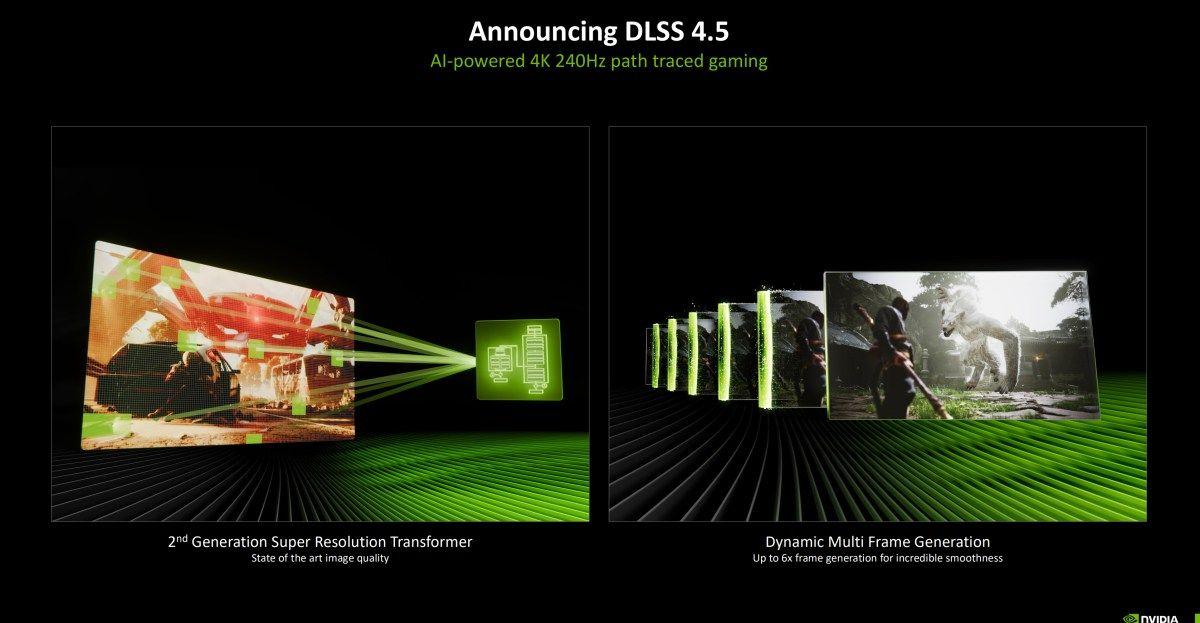
Source: The Verge
Enhanced Super Resolution Tackles Visual Artifacts
The updated Super Resolution model in DLSS 4.5 addresses several persistent challenges that have plagued upscaling technology. Nvidia has focused training efforts on eliminating distracting shimmering or flicker on static surfaces, reducing ghostly trails behind objects close to the player like weapons, and delivering better anti-aliasing performance in titles such as Indiana Jones and the Great Circle
3
. Hands-on demonstrations revealed that DLSS 4.5 makes certain lighting and particle effects appear richer and more natural3
. The model better understands game scenes by using game engine data to improve lighting, finer edges, and motion clarity2
. While the technology is more computationally intense than previous versions, support for accelerated FP8 processing in RTX 40-series and RTX 50-series cards helps offset the increased resource demand3
.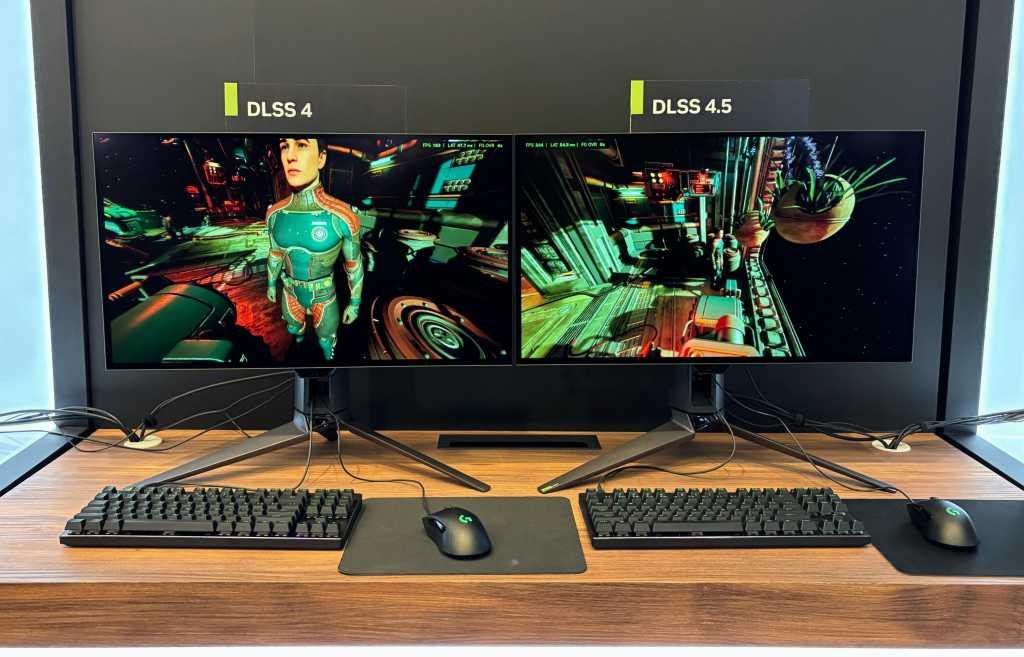
Source: PCWorld
Multi Frame Generation Reaches 6x Capability for RTX 50-Series GPUs
Nvidia is introducing a new 6x Multi Frame Generation mode for RTX 50-series GPUs, scheduled to launch in spring 2026
2
. This advancement generates five additional frames for every single rendered frame, up from the maximum of three additional frames in DLSS 41
. The technology is specifically targeted at 240Hz 4K gaming on ultra-high-refresh-rate monitors, enabling gamers to maximize their display capabilities2
. However, experts caution that Frame Generation works best when maintaining solid base frame rates between 50 and 60 fps to minimize latency and visual glitches4
. The improved image quality from DLSS 4.5's Super Resolution model provides better input data for the Multi Frame Generation system, theoretically resulting in higher quality across generated frames3
.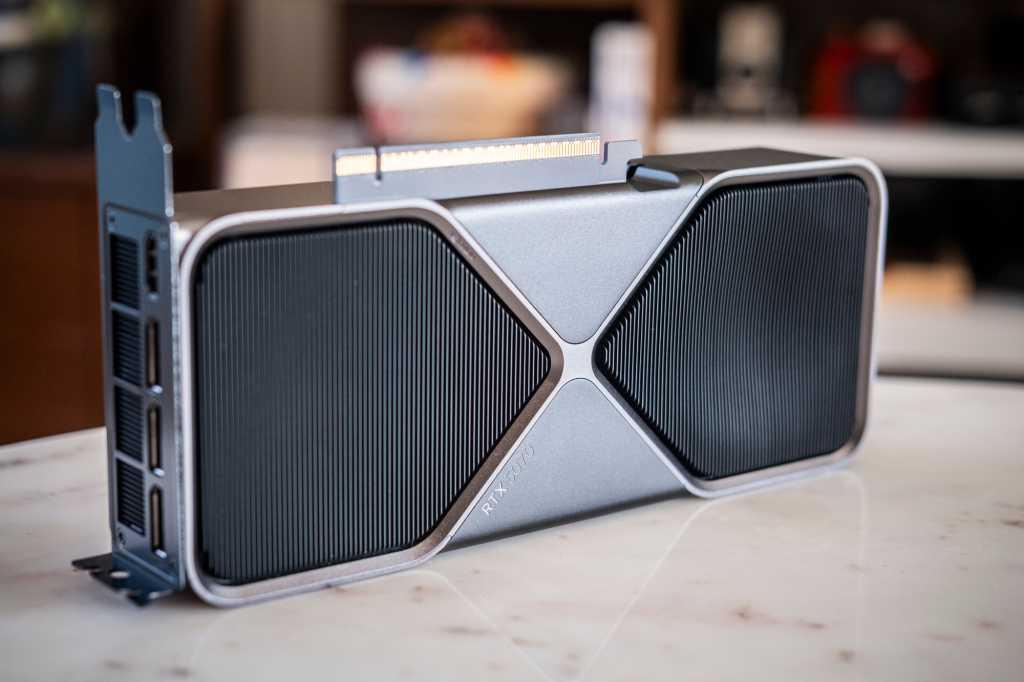
Source: PCWorld
Dynamic Multi Frame Generation Adapts to Monitor Refresh Rates
Alongside the 6x mode, Nvidia unveiled Dynamic Multi Frame Generation, which automatically adjusts the number of AI-generated frames based on real-time performance demands
2
. When graphics workloads intensify, the system increases Frame Generation multipliers to maintain smooth performance on high refresh rate displays, then seamlessly shifts down when the workload lightens2
. In testing, an RTX 5070 desktop connected to a 4K 240Hz display ran Dynamic MFG at 5x or 6x, while the same system attached to a 4K 165Hz display maintained a stable 3x multiplier5
. The technology dynamically targets monitor refresh rates to adjust the render-to-generated ratio on the fly, maintaining consistent speed and minimizing latency concerns1
. Critically, Dynamic MFG is intelligent enough to shut off AI frames completely during pre-generated cutscenes running at locked frame rates5
.Related Stories
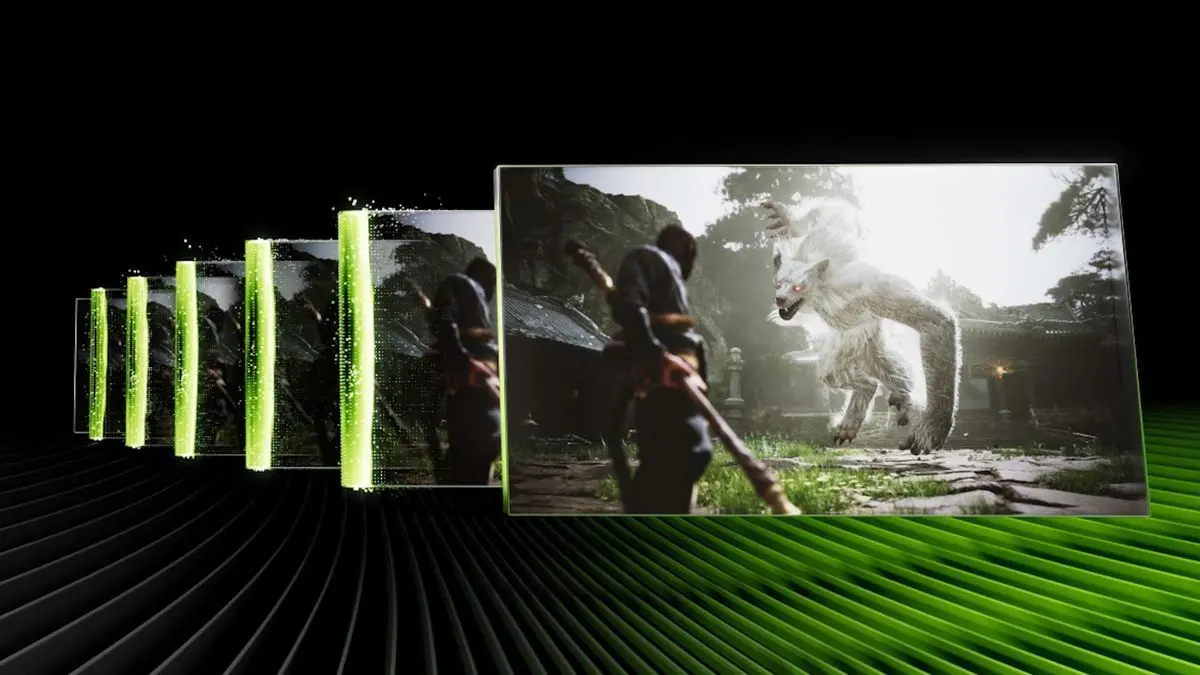
Broad Compatibility Across RTX GPU Generations
DLSS 4.5 is available immediately for all RTX GPUs, though it runs fastest on RTX 40-series and RTX 50-series cards
2
. Nvidia's introduction of Tensor Cores on RTX 20-series GPUs dating back to 2018 ensures that even older hardware can run the updated transformer model3
. However, RTX 20-series and 30-series cards lack FP8 processing acceleration, which may result in larger performance impacts compared to newer hardware3
. Gamers can force DLSS 4.5 activation in games that haven't been updated yet through the Nvidia app, which also allows users to select between different model versions to find the optimal balance of performance and image quality3
. The update arrives as AMD and Intel have narrowed the gap with their own upscaling technologies, with Intel's XeSS 3 and AMD's FSR Redstone both introducing 4X multi-frame generation4
.Additional Gaming Innovations and G-Sync Pulsar Availability
Beyond DLSS 4.5, Nvidia announced that G-Sync Pulsar monitors launched in September 2024 will soon be available for purchase
1
. These 1440p, 360Hz displays use technical approaches to virtually eliminate motion blur, keeping imagery crystal clear during camera panning5
. G-Sync-capable monitors also gain access to Ambient Adaptive Technology, which automatically adjusts color temperature and brightness based on environmental conditions, though it requires a light sensor rarely found on desktop monitors1
. Nvidia also introduced new capabilities for its RTX Remix modding platform, including Remix Logic, which enables games to make decisions about asset usage based on in-game events like specific weather or particle behavior1
.References
Summarized by

Navi
[3]
Related Stories
Nvidia releases DLSS 4.5 with enhanced AI upscaling as 6x frame generation waits until spring
14 Jan 2026•Technology
NVIDIA Unveils DLSS 4: A Leap in AI-Powered Gaming Performance
07 Jan 2025•Technology

DLSS 4: Nvidia's Game-Changing AI Upscaling Technology Revolutionizes Gaming Performance
31 Jan 2025•Technology

Recent Highlights
1
Google Maps unveils Ask Maps with Gemini AI and 3D Immersive Navigation in biggest update
Technology

2
AI chatbots help plan violent attacks as safety guardrails fail, new investigation reveals
Technology

3
OpenAI secures $110 billion funding round as questions swirl around AI bubble and profitability
Business and Economy

Recent Highlights
Today's Top Stories






Your Daily Dose of Curated AI News
Don’t drown in AI news. We cut through the noise - filtering, ranking and summarizing the most important AI news, breakthroughs and research daily. Spend less time searching for the latest in AI and get straight to action.

