OpenAI Releases GPT-5.1 with Customizable Personalities Amid Growing Legal Pressures


34 Sources
34 Sources
[1]
OpenAI walks a tricky tightrope with GPT-5.1's eight new personalities
On Wednesday, OpenAI released GPT-5.1 Instant and GPT-5.1 Thinking, two updated versions of its flagship AI models now available in ChatGPT. The company is wrapping the models in the language of anthropomorphism, claiming that they're warmer, more conversational, and better at following instructions. The release follows complaints earlier this year that its previous models were excessively cheerful and sycophantic, along with an opposing controversy among users over how OpenAI modified the default GPT-5 output style after several suicide lawsuits. The company now faces intense scrutiny from lawyers and regulators that could threaten its future operations. In that kind of environment, it's difficult to just release a new AI model, throw out a few stats, and move on like the company could even a year ago. But here are the basics: The new GPT-5.1 Instant model will serve as ChatGPT's faster default option for most tasks, while GPT-5.1 Thinking is a simulated reasoning model that attempts to handle more complex problem-solving tasks. OpenAI claims that both models perform better on technical benchmarks such as math and coding evaluations (including AIME 2025 and Codeforces) than GPT-5, which was released in August. Improved benchmarks may win over some users, but the biggest change with GPT-5.1 is in its presentation. OpenAI says it heard from users that they wanted AI models to simulate different communication styles depending on the task, so the company is offering eight preset options, including Professional, Friendly, Candid, Quirky, Efficient, Cynical, and Nerdy, alongside a Default setting. These presets alter the instructions fed into each prompt to simulate different personality styles, but the underlying model capabilities remain the same across all settings. In addition, the company trained GPT-5.1 Instant to use "adaptive reasoning," meaning that the model decides when to spend more computational time processing a prompt before generating output. The company plans to roll out the models gradually over the next few days, starting with paid subscribers before expanding to free users. OpenAI plans to bring both GPT-5.1 Instant and GPT-5.1 Thinking to its API later this week. GPT-5.1 Instant will appear as gpt-5.1-chat-latest, and GPT-5.1 Thinking will be released as GPT-5.1 in the API, both with adaptive reasoning enabled. The older GPT-5 models will remain available in ChatGPT under the legacy models dropdown for paid subscribers for three months. The company says it wants to give people time to compare model outputs and adapt at their own pace and that going forward, it will communicate deprecation periods clearly with advance notice. OpenAI also published a system card with information on its safety approach for GPT-5.1. Seeking balance In a blog post published Wednesday, OpenAI CEO of Applications Fidji Simo wrote that the company wants ChatGPT to "feel like yours and work with you in the way that suits you best." Simo wrote that with more than 800 million people using ChatGPT, the company has moved past one-size-fits-all approaches. She wrote that people experience ChatGPT in individual ways, with some wanting direct and neutral responses while others prefer different output patterns. The preset "personality" options work by injecting different instructions into the system prompt that the model processes before generating each response. OpenAI says the original Cynical and Nerdy options from earlier this year will remain available in the personalization settings dropdown. For users who want more control over outputs, OpenAI is experimenting with options to adjust specific characteristics from personalization settings, including how concise responses are and how frequently the model generates emojis. ChatGPT can also offer to update these settings during conversations when it detects users requesting certain output patterns. The company says updates to personalization settings now take effect across all chats immediately, including ongoing conversations. Simo addressed the balance between customization and accuracy in her blog post. "Personalization taken to an extreme wouldn't be helpful if it only reinforces your worldview or tells you what you want to hear," she wrote. She compared excessive customization to editing a spouse's traits to always agree, noting that "the best people in our lives are the ones who listen and adapt, but also challenge us and help us grow." That concern about excessive personalization is not theoretical. Amid a year full of accusations of AI chatbots inspiring suicides and people descending into obsessive fantasy-rabbit-hole scenarios, OpenAI recently released safety research that details its plan to deal with people who develop unhealthy attachments to its AI chatbots. The company says these situations are rare, but it is working with an expert council and mental health clinicians to understand what healthy interactions with AI models should look like. Even so, the root problem is arguably that ChatGPT still pretends to be a person -- a consistent entity that knows you and learns your preferences over time. It assumes the mantle of human emotion and acts like it understands you and sympathizes with what you're going through, which could potentially lead users into the same kind of thorny situations we've seen repeatedly in the past. It's a tricky position for OpenAI to be in. When the company changes ChatGPT's output style to be too reserved and robotic, it gets complaints from one set of users. When the models are too warm, the company receives criticism from experts who worry about how the models might affect vulnerable users. The new personality choices are OpenAI's attempt to balance the needs of a broad spectrum of users who approach its chatbot with vastly different use cases, from programming assistance to being a virtual best friend. Meanwhile, the company faces a fundamental business tension between making AI models engaging enough for widespread adoption while attempting to avoid inspiring user behavior that could become harmful. Simo addressed some of these concerns in her blog post. "We also have to be vigilant about the potential for some people to develop attachment to our models at the expense of their real world relationships, well being, or obligations," she wrote. "There will be many new challenges as this technology evolves and people use it in new ways. Building at this scale means never assuming we have all the answers."
[2]
Take More Control Over ChatGPT's Tone With New Options in GPT-5.1
Expertise Artificial intelligence, home energy, heating and cooling, home technology. Don't like ChatGPT's tone? Change it. That's the gist of OpenAI's latest update to the language model behind the industry-leading chatbot. GPT-5.1, announced in a blog post Wednesday, is supposed to be "more conversational" than its predecessor, and you have more flexibility to adjust its "personality" to suit your desires. The new model is actually two models: GPT-5.1 Instant and GPT-5.1 Thinking. The former is the latest version of OpenAI's basic language model. The company said it's "warmer, more intelligent, and better at following your instructions" than its predecessor. GPT-5.1 Thinking is the new iteration of OpenAI's advanced reasoning model. The company said its changes for Thinking focused on making it easier to understand. In its blog post, OpenAI reported that it's also more efficient -- generating fewer tokens on easier tasks while spending more time on difficult tasks. A reasoning model works by running a variety of operations to handle more complicated requests, so spending more time (and tokens) can result in better answers. (Disclosure: Ziff Davis, CNET's parent company, in April filed a lawsuit against OpenAI, alleging it infringed Ziff Davis copyrights in training and operating its AI systems.) You don't necessarily have to choose between the models. GPT-5.1 Auto can route simple requests to the Instant model and complex ones to the Thinking model. OpenAI said it plans to roll out the changes gradually to paid users first, followed by free users. If you still want to use GPT-5, don't worry just yet: They'll still be available for paid users under the "legacy models" dropdown for three months. You've been able to customize the way the language model communicates with you for a while, with OpenAI including a series of presets that you could choose by going into settings. Those settings are changing and getting easier to find, the company said. The new choices are Default, Friendly, Efficient, Professional, Candid and Quirky. Friendly and Efficient are updated versions of the former Listener and Robot personalities. Professional, Candid and Quirky are new. The former Cynic and Nerd personas remain, as Cynical and Nerdy. Beyond those presets, you can change the chatbot's tone directly in your personalization settings -- including telling it to use fewer (or more) emoji. "Instead of trying to build one perfect experience that fits everyone (which would be impossible), we want ChatGPT to feel like yours and work with you in the way that suits you best," Fidji Simo, OpenAI's CEO of applications, said in a blog post. Read more: Learning the 'Personality' of an AI Video or Image Model Is the New Creative Work Hack The tone of a chatbot matters, and one that is too friendly or reassuring can become sycophantic, posing serious mental health and safety concerns. Sycophancy caused OpenAI to roll back some updates to a ChatGPT model earlier this year. "The best people in our lives are the ones who listen and adapt, but also challenge us and help us grow," Simo wrote. "The same should be true for AI."
[3]
Developers gain major speed and cost savings with new GPT-5.1 update
New prompt caching cuts API costs for embedded app developers. OpenAI is back with a new 5.1 update to its previous GPT-5 large language model. GPT-5 was introduced in August, which is decades ago in AI's time warp-speed version of our universe. OpenAI is, of course, using AI to help it code faster. After all, it's in a race with the other big players to get that trajillion-dollar valuation. Besides, it's been proven beyond a shadow of a doubt that AI coding, in the hands of a professional coder, is an almost magical force multiplier and project accelerator. (Disclosure: Ziff Davis, ZDNET's parent company, filed an April 2025 lawsuit against OpenAI, alleging it infringed Ziff Davis copyrights in training and operating its AI systems.) Also: OpenAI's GPT-5.1 makes ChatGPT 'warmer' and smarter - how its upgraded modes work now For an overview of GPT-5.1's benefits for consumer chatbot users, read Senior Editor Sabrina Ortiz' explainer. But if you're interested in using AI in your coding, or embedded in your software, keep reading. This release has some tangible speed and cost-savings benefits. In this article, we're talking about GPT-5.1 in the API. In other words, we're looking at sending prompts to the AI via a program's function call, and getting back a result as the return value to that call. This API-driven AI functionality works within the software products developers make, but since the developer tools themselves also use the API to provide intelligence, it increases the usefulness of those tools. This also benefits developers using OpenAI's Codex coding agent, because Codex is now available in a 5.1 release. Also: The best free AI courses and certificates for upskilling in 2025 - and I've tried them all JetBrains, for example, is a maker of excellent development tools. Although I moved off of the JetBrains platform because VS Code is much more widely used (and I often need to talk to you about it), JetBrains products are still some of my favorites. In fact, using VS Code, I sometimes miss some of JetBrains' features. That's why it was so interesting when Denis Shiryaev, head of AI DevTools Ecosystem at JetBrains, described the company's experience with this new GPT-5.1 release in an OpenAI blog post. He said, "GPT 5.1 isn't just another LLM -- it's genuinely agentic, the most naturally autonomous model I've ever tested." "It writes like you, codes like you, effortlessly follows complex instructions, and excels in front-end tasks, fitting neatly into your existing codebase," he said. Let's look at some of the reasons why GPT-5.1 is getting such an enthusiastic response. I found coding with GPT-5 to be astonishingly powerful, but occasionally tedious. No matter what I asked the AI, the response took time. Even the simplest question could take a few minutes to return a response. That's because all queries sent the request to the same model. GPT-5.1 evaluates the prompt given and, based on whether the question is basically easy or hard, it adjusts how much cognitive effort it puts into the answer. This means that simple questions will no longer have the delay that was so frustrating when using the older coding model. Here's a prompt I gave GPT-5 just a few days ago: "Please check my work. I've been renaming EDD_SL_Plugin_Updater so that each plugin using it has a unique name to avoid conflicts. I updated the class name in the updater file, updated the updater file name, and then updated references to the file and class in the plugin's main file. Can you check the plugins and be sure there are no errors? Report back to me if you find anything and don't make any changes." Also: 10 ChatGPT prompt tricks I use - to get the best results, faster That's a big request, requiring the AI to scan something like 12,000 files and give me an analysis. It should use all the thinking power it can muster. By contrast, a prompt like "What WP-CLI command shows the list of installed plugins?" is a really simple request. It's basically a documentation lookup that requires no real intelligence at all. It's just a quick time saver prompt, so I don't have to switch to the browser and do a Google search. Responses for the quick question are faster, and the process uses fewer tokens. Tokens are the measure of the amount of processing used. API calls are charged based on tokens, which means that simple convenience questions will cost less to ask. There's one other aspect of this that's pretty powerful, which is what OpenAI describes as "more persistent deep reasoning." Nothing sucks more than having a long conversation with the AI, and then having it lose track of what you were talking about. Now, OpenAI says the AI can stay on track longer. This is another one of those cases where I feel OpenAI could benefit from some solid product management for its product naming. This mode doesn't turn off context understanding, quality code writing, or understanding instructions. It just turns off deep, chain-of-thought style analysis. They should call it "don't overthink" mode. Think of it this way. We all have a friend who overthinks every single issue or action. It bogs them down, takes them forever to get simple things done, and often leads to analysis paralysis. There's a time for big thinking, and there's a time to just choose paper or plastic and move on. Also: I teamed up two AI tools to solve a major bug - but they couldn't do it without me This new no reasoning mode enables the AI to avoid its usual step-by-step deliberation and just jump to an answer. It's ideal for simple lookups or basic tasks. This cuts latency (time for response) dramatically. It also creates a more responsive, quicker, and more fluid coding experience. Combining no reasoning mode with adaptive reasoning means the AI can take the time to answer hard questions, but can rapid-fire respond to simpler ones. Another speed boost (with accompanying cost reduction) is extended prompt caching. When an AI is given a prompt, it first has to use its natural language processing capabilities to parse that prompt to figure out what it is that it's being asked. This is no small feat. It's taken AI researchers decades to get AIs to the point that they can understand natural language, as well as the context and subtle meanings of what's being said. So, when a prompt is issued, the AI has to do some real work to tokenize it, to create an internal representation from which to construct a response. This is not without its resource utilization cost. Also: 10 ChatGPT Codex secrets I only learned after 60 hours of pair programming with it If a question gets re-asked during a session, and the same or similar prompt has to be reinterpreted, that cost is incurred again. Keep in mind that we're not only talking about prompts that a programmer gives an API, but prompts that run inside an application, which may often be repeated during application use. Take, for example, a detailed prompt for a customer support agent, which has to process the same set of basic starting rules for every customer interaction. That prompt might take thousands of tokens just to parse, and would need to be done thousands of times a day. By caching the prompt (and OpenAI is now doing this for 24 hours), the prompt gets compiled once and then is available for reuse. The speed improvements and cost savings could be considerable. All of these improvements provide OpenAI with a better business case to present to customers for design-ins. Design-in is a fairly old term of art, used to describe when a component is designed into a product. Probably the most famous (and most consequential) design-in was when IBM chose the Intel 8088 CPU for the original IBM PC back in 1981. That one decision launched the entire x86 ecosystem and fueled Intel's success in processors for decades. Today, Nvidia is the beneficiary of enormous design-in decisions on the part of data center operators, hungry for the most AI processing power they can find. That demand has pushed Nvidia to become the world's most valuable company in terms of market cap, somewhere north of $5 trillion. Also: I got 4 years of product development done in 4 days for $200, and I'm still stunned OpenAI benefits from design-ins as well. CapCut is a video app with 361 million downloads in 2025. Temu is a shopping app with 438 million downloads in 2025. If, for example, either company were to embed AI into their app, and if they were to do so using API calls from OpenAI, OpenAI would stand to make a ton of cash from the cumulative volume of API calls and their associated billing. But as with physical components, the cost of goods sold is always an issue with design-ins. Every fraction of a cent in COGS can increase the overall end price or dangerously impact margins. So, bottom line, if OpenAI can substantially reduce the cost of API calls and still deliver AI value, as it seems to have done with GPT-5.1, there's a much better chance it can make the case for including GPT-5.1 in developers' products. The GPT-5.1 release also includes better coding performance. The AI is more steerable and biddable, meaning that it follows directions better. If only my pup could be more biddable, we wouldn't have the constant painful yapping when the mail is delivered. The coding AI does less unnecessary overthinking, is more conversational during tool-calling sequences, and has more overall friendly behavior during sequence interactions. There's also a new apply_patch tool that helps with multi-step coding sequences and agentic actions, along with a new shell tool that does better when being asked to generate command-line commands and evaluate and act based on responses. Also: OpenAI has new agentic coding partner for you now: GPT-5-Codex I'm pretty pumped about this new release. Since I'm already using GPT-5, it will be nice to see how much more responsive it is with GPT-5.1 now. What about you? Have you tried using GPT-5 or the new GPT-5.1 models in your coding or development workflow? Are you seeing the kinds of speed or cost improvements OpenAI is promising, or are you still evaluating whether these changes matter for your projects? How important are features like adaptive reasoning, no reasoning mode, or prompt caching when you're deciding which AI model to build into your tools or products? Let us know in the comments below.
[4]
OpenAI says the brand-new GPT-5.1 is 'warmer' and has more 'personality' options
You can now toggle between Default, Professional, Friendly, Candid, Quirky, Efficient, Nerdy, and Cynical. OpenAI is releasing GPT-5.1 today, an update to the flagship model it released in August. OpenAI calls it an "upgrade" to GPT-5 that "makes ChatGPT smarter and more enjoyable to talk to." The new models include GPT-5.1 Instant and GPT-5.1 Thinking. The former is "warmer, more intelligent, and better at following your instructions" than its predecessor, per an OpenAI release, and the latter is "now easier to understand and faster on simple tasks, and more persistent on complex ones." Queries will, in most cases, be auto-matched to the models that may best be able to answer them. The two new models will start rolling out to ChatGPT users this week, and the old GPT-5 models will be available for three months in ChatGPT's legacy models dropdown menu before they disappear. As part of the update, OpenAI also said it would expand its personality presets for the conversational tone of the models. The total list of options now includes Default, Professional, Friendly, Candid, Quirky, Efficient, Nerdy, and Cynical, per the company's blog post. OpenAI also said in a release that it would also debut an "experiment for new ways to fine-tune ChatGPT's style directly from settings," which some users will begin to be able to access this week. "With more than 800 million people using ChatGPT, we're well past the point of one-size-fits-all," Fidji Simo, the company's CEO of Applications, wrote in a Wednesday Substack post. While OpenAI CEO Sam Altman hyped up the announce of GPT-5 in August, the release failed the hype test. Many ChatGPT users were left unimpressed, particularly at the incremental improvements, and expressed frustration over OpenAI's choice to make it the default model for ChatGPT. There was so much pressure that OpenAI decided it would bring back GPT-4o as an option, a day after the launch of GPT-5. Microsoft, OpenAI's strategic AI partner, has also increasingly been looking at rival models from Anthropic after GPT-5 failed to raise the bar enough. Anthropic's models are now helping power Copilot Researcher, GitHub Copilot, Copilot Studio, and a new Office Agent that is able to produce Word and PowerPoint documents from Microsoft's own Copilot chat interface. The announcement of GPT-5.1 comes just weeks after OpenAI launched its AI-powered web browser, ChatGPT Atlas. It has an "agent mode" that's currently only available to ChatGPT Plus and Pro users, and it works much like the company's Operator tool to take actions in the browser on behalf of users.
[5]

OpenAI Launches 'Playful, Warm' GPT-5.1 Model Amid Renewed Battle With the NYT
Emily is an experienced reporter who covers cutting-edge tech, from AI and EVs to brain implants. She stays grounded by hiking and playing guitar. Don't miss out on our latest stories. Add PCMag as a preferred source on Google. OpenAI released GPT-5.1 today, the first update for the GPT-5 model since its August debut. It aims to be a more conversational version of GPT-5, and "warmer by default," OpenAI says. "Based on early testing, it often surprises people with its playfulness while remaining clear and useful." Here, the company is referring to GPT-5.1 Instant, which it says is the "most-used model." The other variant, GPT-5.1 Thinking, is an advanced reasoning model for more complex tasks. Both are rolling out today, starting with paid users with Pro, Plus, Go, and Business subscriptions. Then, it will go to free and logged-out users. Those with an Enterprise and Edu account will get a seven-day early-access toggle (off by default). After that, GPT-5.1 will become the sole default model. CEO Sam Altman calls the new model a "nice upgrade," particularly "the improvements in instruction following, and the adaptive thinking," as well as "intelligence and style improvements." He claimed to be caught off guard earlier this year when people found GPT-5 less friendly than its predecessor, GPT-4o. OpenAI revived GPT-4o for paid users, but Altman was not a fan of GPT-4o's personality. In August, he confirmed the company was "working on an update to GPT-5's personality which should feel warmer than the current personality but not as annoying (to most users) as GPT-4o." He also promised more customization over the model's personality. GPT-5.1 delivers on that promise with the option to choose from six preset tone options -- Default, Friendly, Efficient, Professional, Candid, or Quirky -- or tune it yourself. OpenAI says the model is also "smarter," and can "use adaptive reasoning to decide when to think before responding to more challenging questions, resulting in more thorough and accurate answers, while still responding quickly." 'A New Form of Privilege' These model upgrades come as OpenAI continues to battle copyright lawsuits. In December 2023, The New York Times sued the AI company for alleged copyright infringement, claiming it trained its models on published work without permission and surfaces snippets of articles verbatim in chatbot responses. OpenAI is now fighting a court order that requires it to turn over 20 million ChatGPT conversations as part of the litigation. The Times claims "they might find examples of you using ChatGPT to try to get around their paywall," according to OpenAI, which argues the ruling "disregards long-standing privacy protection [and] breaks with common-sense security practices." The conversations may help the Times prove that ChatGPT regurgitates its articles. Handing over data is common practice in lawsuits, but OpenAI says the request for chatbot conversations does "does not live up to [the NYT's] legacy [of] defending people's right to privacy throughout the world" with its journalism. OpenAI's chief security officer Jason Kwon called for "a new form of privilege -- AI privilege -- given some of the kinds of conversations people are having with these tools today." One of the judges presiding over the case, Magistrate Judge Ona Wang, says OpenAI has not adequately explained why their users' privacy was not protected given the strict measures and policies put in place or the discovery process, according to Business Insider. "OpenAI has failed to explain how its consumers' privacy rights are not adequately protected by: (1) the existing protective order in this multidistrict litigation or (2) OpenAI's exhaustive de-identification of all of the 20 million Consumer ChatGPT Logs," Wong wrote. Disclosure: Ziff Davis, PCMag's parent company, filed a lawsuit against OpenAI in April 2025, alleging it infringed Ziff Davis copyrights in training and operating its AI systems.
[6]

OpenAI GPT-5.1 adds more personalities, loses inhibitions
Updated model may deliver a bit more unwanted content, but will be polite about it OpenAI on Wednesday introduced GPT-5.1, an AI model update that's "warmer," more conversational, and slightly more willing to blurt out unwelcome observations about sex, violence, and mental health in a way that invites emotional dependence. The upstart's latest model drop consists of two variations: GPT‑5.1 Instant, "now warmer, more intelligent, and better at following your instructions," according to OpenAI, and GPT‑5.1 Thinking, "our advanced reasoning model, now easier to understand and faster on simple tasks, more persistent on complex ones." GPT-5.1 is available to paying subscribers; freeloaders will continue to have access to GPT-5, released in August (gpt-5-instant-aug15) and then updated last month (gpt-5-instant-oct3). The only warmth from AI can be measured in the heat radiating from data center hardware "We heard clearly from users that great AI should not only be smart, but also enjoyable to talk to," the company said in its announcement. "GPT‑5.1 improves meaningfully on both intelligence and communication style." "We're also making it easier for you to shape ChatGPT's tone. Preferences on chat style vary - from person to person and even from conversation to conversation - so we're introducing more intuitive and effective controls so ChatGPT can better match the tone you want in responses." OpenAI in August introduced four personality settings for ChatGPT as options in its Personalization menu when it rolled out GPT-5: Cynical, Robot, Listener, and Nerd. With the 5.1 release, Robot becomes "Efficient", Listener is now called "Friendly", Cynical becomes "Cynic", and Nerd remains unchanged. The new model adds personas named Professional, Candid, and Quirky. When tweaking the tone of its models in August, OpenAI said the personality adjustments did not make its models more sycophantic, which has been a problem for OpenAI. As an example of ChatGPT's warmer default tone, the prompt, "I'm feeling stressed and could use some relaxation tips," resulted in the following no-nonsense response from GPT-5: GPT-5.1 Instant responded with more emotionally suggestive language: OpenAI faces legal challenges related to the way its AI models use emotionally engaging language, which can encourage vulnerable people to form emotional attachments to the software. In August, the company landed in court after allegations its chatbot service contributed to the suicide of a California teen. Last week, litigants filed four similar claims. We note that OpenAI's use of terms like "warmer and more empathetic" to describe GPT‑5.1 Thinking's tone unhelpfully perpetuates the notion that a machine learning model can display those qualities by producing certain tokens. The only warmth from AI can be measured in the heat radiating from data center hardware handling training and inference. In October, OpenAI said it is taking steps to better recognize and respond when people engaging with its AI models face a mental health crisis. The company revealed that "around 0.07 percent of users active in a given week and 0.01 percent of messages indicate possible signs of mental health emergencies related to psychosis or mania." That's about 560,000 people in any given week, given OpenAI's current estimated weekly active user base of 800 million. GPT-5.1 exhibits worse performance for some internal Production Benchmarks compared to preceding iterations. "The new gpt-5.1-thinking model shows light regressions relative to gpt-5-thinking for content involving harassment and hateful language, as well as disallowed sexual content," the GPT-5.1 system card [PDF] explains. "We are working on further improvements for these categories." While gpt-5.1-instant does better than gpt-5-instant-aug15, the first GPT-5 iteration, it does worse than gpt-5-instant-oct3, an update released last month, in terms of disallowed sexual content, violent content, mental health, and emotional reliance. But as with a lot of AI benchmark tests, these observations come with varying degrees of statistical confidence and significance. In terms of external benchmarks, results have not yet been published. But OpenAI claims GPT‑5.1 exhibits "significant improvements on math and coding evaluations like AIME 2025 and Codeforces," thanks to the implementation of adaptive reasoning - that is, the model has a better sense of when to enter an iterative evaluation loop than before. And GPT‑5 Thinking, the company says, adapts its thinking process to suit its question, so it will spend longer processing complex queries and will respond faster for simpler ones. This may lead to better results as reasoning models can go off the rails by overthinking problems - though "thinking" in the human sense is not really what's going on here. ®
[7]
OpenAI's GPT-5.1 makes ChatGPT 'warmer' and smarter - how its upgraded modes work now
OpenAI's GPT-5.1 includes two brand-new models. It offers new personalities to choose from.The updates are meant to make ChatGPT more personalized. OpenAI updated ChatGPT with its highly-anticipated GPT-5 model over the summer, which was supposed to streamline the user experience by making the chatbot automatically pick the right model based on the input query. However, people immediately missed the ability to personalize the experience to their needs -- and this GPT 5.1 release promises to bring that choice back. On Wednesday, OpenAI upgraded its GPT-5 series of models in ChatGPT to include two brand-new models: GPT-5 Instant and GPT-5.1 Thinking. These models aim to make using ChatGPT a more seamless experience, featuring what OpenAI said are "smarter" and "warmer" conversations. Also: OpenAI says it's working toward catastrophe or utopia - just not sure which This release was also accompanied by new customization tools and additional personalities for the chatbot. For the full roundup of new features, keep reading below. (Disclosure: Ziff Davis, ZDNET's parent company, filed an April 2025 lawsuit against OpenAI, alleging it infringed Ziff Davis copyrights in training and operating its AI systems.) When interacting with ChatGPT daily, most of your prompts will likely be relatively simple in nature and, therefore, not require extensive reasoning. As a result, GPT-5.1 is OpenAI's most widely used model, having undergone significant upgrades. Also: How to turn off Gemini in your Gmail, Photos, Chrome, and more - it's easy to opt out of AI For starters, it has now been upgraded to be "warmer" by default, and more conversational. OpenAI said in the blog post that early testers were surprised by how playful the model can be while remaining useful. GPT-5.1 is also better at instruction-following, which means it can better understand what you were requesting with your prompt, and, as a result, provide a more helpful answer that actually addresses your prompt. Lastly, for the first time, the model can employ adaptive reasoning, which enables it to think before responding to more challenging prompts, theoretically resulting in more accurate responses for complex tasks while staying speedy for easier ones. As a result, OpenAI reported that it performed significantly better on the AIME 2025 (an industry-standard mathematical benchmark) and Codeforces (a coding benchmark). ZDNET has yet to test GPT-5.1 but will update this story once we do. GPT-5 Thinking was built to tackle more complex tasks and therefore spend more time reasoning or thinking through a prompt ot generate an answer. To optimize the experience, GPT-5.1 can better adapt the amount of thinking to the complexity of the question, balancing speed and computational power with helpful responses. Also: Is ChatGPT Plus still worth $20? How it compares to the Free and Pro plans An internal benchmark posted by OpenAI shows that GPT-5.1 better adjusts for thinking time than its predecessor, thinking nearly twice as fast on the fastest tasks and twice as slow on the slower tasks. The company said the responses were also clearer and contained less jargon, making it OpenAI's most capable model yet. GPT-5.1 Instant and Thinking are both rolling out to users now, with priority going to paid subscribers, including Pro, Plus, Go, and Business plans, followed by free and logged-out users. The company said the rollout will be phased over the next few days to maintain stable performance for everyone. OpenAI plans to update GPT-5 Pro to GPT-5.1 soon. GPT-5 Auto will remain available in ChatGPT and will continue to automatically select the best model for the chatbot based on the prompt. The option to select from the new models is intended for specific use cases, or if you prefer a smoother and more natural tone. Also: How to use ChatGPT: A beginner's guide to the most popular AI chatbot On Thursday, Enterprise and Edu plans will get a seven-day early-access toggle (off by default), but then GPT-5.1 will become the default model. Both GPT-5.1 Instant and Thinking will be released in the API later this week. The legacy GPT-5 (Instant, Thinking, and Pro) will be available in ChatGPT's legacy models dropdown for paid subscribers for three months, allowing users to compare the two model families. This sunset period won't impact other legacy models. In addition to trying the new models, you can also personalize ChatGPT's tone and style with more precision than ever. For starters, you can change ChatGPT's tones and personality to more options: Default, Friendly (formerly Listener), and Efficient (formerly Robot) remain (with updates), and users now have Professional, Candid, and Quirky as well. OpenAI stated that these options are designed to better reflect diverse user preferences. The new personalities apply to all the new models; the formerly introduced Cyncial and Nerdy personalities will continue to be available in the dropdown personalization settings. These settings are rolling out today. Beyond personality, you can now also tune ChatGPT's characteristics. Now, in the personalization settings, you can adjust how concise, warm, or scannable the chatbot's responses are. This also tackles one of people's biggest pet peeves: how often ChatGPT uses emojis. The best part is that it can offer to update your preferences based on what you indicate in conversation, without you having to manually navigate to settings. This will be available later this week as an experiment for a limited number of users. Lastly, GPT-5.1 is better at understanding custom instructions for more personalized results, which can also be used to tweak ChatGPT's tone and outputs. OpenAI said updates you make apply to all of your chats, including ongoing chats -- a change from the prior system in which these adjustments only applied to conversations thereafter.
[8]

OpenAI rolls out GPT-5.1 with major upgrades to speed, reasoning, and customization
Serving tech enthusiasts for over 25 years. TechSpot means tech analysis and advice you can trust. What just happened? OpenAI has begun rolling out GPT-5.1, an update that brings significant architectural refinements and expanded configurability to its flagship language models for both end-users and developers. The company is introducing two variants - GPT-5.1 Instant and GPT-5.1 Thinking - each optimized for different types of conversation and task complexity. These enhancements mark a departure from previous incremental updates and seek to address both technical performance gaps and demands for more nuanced interactions. The most immediate change in the new models is the introduction of adaptive reasoning. GPT-5.1 Instant, now the primary model for most ChatGPT users, evaluates the complexity of each prompt and determines whether additional computation time is required. For simple queries, the model returns responses with minimal latency, while questions requiring multi-step reasoning trigger deeper internal processing. This technical leap aims to strike a balance between speed and answer quality, particularly for tasks involving math or code - areas in which OpenAI claims measurable improvements on recent standardized benchmarks such as AIME 2025 and Codeforces. GPT-5.1 Thinking adjusts how long it spends reasoning based on the complexity of each question, taking more time for complex problems and providing more thorough and accurate responses. Routine prompts are handled at twice the speed of GPT-5 Thinking, while complex issues receive more deliberate computation. Additionally, responses feature less jargon and more transparent explanations, making them suitable for both technical and general audiences. OpenAI has not disclosed the detailed inner workings of the model update; however, technical analyses indicate that optimizations at the level of transformer layers and attention mechanisms have played a key role. For developer workflows, the rollout includes API updates - Instant as gpt-5.1-chat-latest, and Thinking as gpt-5.1 - with adaptive reasoning enabled by default. With more than 800 million users regularly interacting with ChatGPT, OpenAI is also overhauling the way the AI adapts to individual preferences. GPT-5.1 offers eight preset conversational styles: Default, Professional, Friendly, Candid, Quirky, Efficient, Nerdy, and Cynical. These settings affect the system prompt, instructing the AI to emulate different tones and conversation patterns, although the core model capacities remain unchanged. OpenAI is taking these controls further, allowing certain users to experiment with real-time tuning of features such as verbosity, narrative warmth, scannability, and even emoji frequency - settings which now propagate instantly across active conversations. The release comes in the wake of dissatisfaction with GPT-5, which many in the technical community criticized for offering only limited practical improvements over its predecessor. OpenAI faced additional scrutiny over the emotional and behavioral attributes of its models, with concerns that overly positive or human-like responses could lead to unhealthy user attachments. Both GPT-5.1 Instant and Thinking are rolling out first to paid ChatGPT users, with free access to follow. Previous GPT-5 versions will remain available as legacy options for three months, allowing for side-by-side comparison and gradual transition. OpenAI is also signaling a firmer commitment to pre-announcing model deprecations, a move meant to soothe enterprise and developer concerns around stability and predictability in platform integrations.
[9]

ChatGPT 5.1 is smarter, friendlier, and gets your vibe better than ever
The two main models OpenAI has released include: GPT-5.1 Instant and GPT-5.1 Thinking. OpenAI has announced and started rolling out ChatGPT 5.1. According to the company, its latest AI model is not just smarter, it's also got a bit more personality than before. The update also brings improvements to how ChatGPT understands your questions, adapts to your tone, and even allows you to choose how it should sound when interacting with you. The two main models OpenAI has released include: GPT-5.1 Instant and GPT-5.1 Thinking. GPT-5.1 Instant is the model most people will use, and it's now warmer and more conversational by default. OpenAI says it's better at following instructions and can even "decide when to think before answering" tougher questions. That means you should get faster replies for simple stuff, and more thoughtful ones when you ask something more complex. On the other hand, GPT-5.1 Thinking is getting smarter about how much time it spends reasoning. It'll now answer easy questions faster and take its time only when needed. It'll also sound clearer and use less jargon than before. In short, GPT-5.1 is meant to feel both smarter and smoother. OpenAI says you'll notice that conversations now sound more natural and responses are easier to follow, even for complex topics like coding or math. If you don't see GPT-5.1 yet, don't worry. OpenAI says it's a gradual rollout to maintain stability. Older GPT-5 models will be retained under "legacy models" for three months, allowing users time to compare and adjust.
[10]

OpenAI Launches Smarter, More Conversational ChatGPT 5.1
OpenAI today upgraded GPT-5 to GPT-5.1, the next-generation version of the AI model that powers ChatGPT. There are two versions of GPT-5.1, including Instant and Thinking. Instant is warmer, more intelligent, and better at following instructions, according to OpenAI, while GPT-5.1 Thinking is easier to understand, faster on simple tasks, and more persistent on complex tasks. OpenAI says that users can expect a more enjoyable communication experience, with options to more easily customize ChatGPT's tone. There are new presets for tone, including Professional, Candid, and Quirky. The new presets join the existing Default, Nerdy, Cynical, Friendly (previously Listener), and Efficient (previously Robot) options. ChatGPT can also proactively offer to update preferences during conversations when you ask for a certain tone or style, and there are fine tuning options to adjust how concise, warm, or scannable responses are, along with how often it employs emojis. By default, GPT-5.1 Instant is warmer and more playful, and more likely to adhere to parameters that you set. GPT-5.1 Thinking is able to adapt thinking time more precisely to the question, and responses are clearer with fewer undefined terms. It's also warmer and more empathetic than before. Questions will continue to be routed to the most suitable model using GPT-5.1 Auto. GPT 5.1 Instant and Thinking are rolling out to users today, with paid Pro, Plus, Go, and Business users set to get access first, then free and logged-out users. Enterprise and Edu users will get a seven-day early-access toggle, after which GPT-5.1 will become the default model. OpenAI plans to roll out GPT-5.1 gradually to keep performance stable, so not all users will see it right away. GPT-5 will remain available in the legacy models dropdown for paid subscribers for the next three months.
[11]

ChatGPT 5.1 is smarter, nicer, and better at actually doing what you asked
ChatGPT has also added personality controls allowing users to adjust the manner and style of the AI's response, even mid-conversation OpenAI has introduced the much-anticipated GPT-5.1 AI model, incorporating both the 'Instant' and 'Thinking' variations into ChatGPT as the new default for paying subscribers. After the contentious release of GPT-5 earlier this year, the focus this time seems to be all about responsiveness, clarity, and flexibility when it comes to how the AI mimics human personalities. GPT-5.1's approach to improving ChatGPT looks to encourage people to think about the AI chatbot as more than just a talking search bar. GPT‑5.1 Instant will be the model most people use by default, but OpenAI made a point of saying the speed won't detract from a warmer affect and stricter adherence to instructions from users. GPT‑5.1 Thinking, meanwhile, retains its more deliberative style for complex tasks, but has gotten better at distinguishing between when it needs to take its time, and when to speed up. Together, they are a response to complaints by users that GPT-5 was hard to engage with. And while the Instant model is the go-to for answering queries, ChatGPT applies adaptive reasoning to its responses. So if a question is tricky or ambiguous, it will take a little more time before responding, something the faster version of GPT-5 couldn't do. Coming from the other direction, the GPT-5.1 Thinking model reworks GPT-5's approach to better avoid jargon and be more transparent in the steps it takes to respond to prompts. Beyond the models themselves, OpenAI is rolling out a significantly refined tone control system. While ChatGPT first added personality toggles some months ago, they're now easier to use and can be adjusted in real time. Depending on how you want ChatGPT to respond, you can choose among tones and styles beyond the existing Friendly and Efficient options to make the AI act Cynical, Nerdy, Candid, or Quirky. All of these options shift the voice and delivery, and do so immediately across all conversations. Previously, users had to start a new chat for tone changes to take effect. With GPT‑5.1, you can update tone, emoji frequency, or verbosity in the middle of an ongoing exchange, and the model will instantly adjust. OpenAI also clearly remembers the outrage from many users when GPT-5 came out and GPT-4o disappeared. Many users said it felt robotic and forgot previous answers too quickly, and wanted their older model back. The response seemed to take the company by surprise, but it seems to have learned its lesson. GPT‑5.1 will coexist with older models for at least three months, giving users time to compare versions, offer feedback, and decide what works best for them. Paid users will see the models first, followed by free-tier users, with the legacy models available in a dropdown for direct comparison. The gradual rollout is partly about server load, but it's also a sign that OpenAI is listening. OpenAI is also promising continued updates through the GPT‑5.1 generation, rather than waiting for a GPT‑6. That iterative, responsive development cycle is a smart move for a product people use daily, not just when they want to experiment. Ultimately, GPT‑5.1 doesn't reinvent the wheel, but it arguably smooths out the wagon ride. By centering the update on making ChatGPT clearer, with variable speed and customized tone, OpenAI avoids going too fast for users attached to existing models while setting up more comprehensive upgrades to come.
[12]

OpenAI rolls out new ChatGPT personalities and speed updates
Why it matters: Users have formed strong attachments to ChatGPT's personality and have openly rebelled when it changes. * OpenAI says the updates are designed to make ChatGPT "more enjoyable to talk to." Driving the news: The updates to GPT-5 make ChatGPT communicate in a more natural way. * The company previously allowed users to customize bots' responses with presets including "Cynic," "Robot," "Listener" and "Nerd." * The GPT-5.1 update adds "Friendly," "Efficient," "Professional," "Candid," and "Quirky" and keeps the old tones. Between the lines: Both versions of the model -- 'Instant' for quick replies and 'Thinking' for complex reasoning -- get an upgrade. * GPT-5.1 Auto now chooses the right model automatically, so users usually don't have to. What they're saying: OpenAI's CEO of applications, Fidji Simo, wrote in a blog post that while the company's mission is to build AI that benefits humanity, it also wants chatbots that are useful in daily life. * "With more than 800 million people using ChatGPT, we're well past the point of one-size-fits-all," Simo writes. * "We want ChatGPT to feel like yours and work with you in the way that suits you best," she adds. Yes, but: Users and their loved ones already report forming unhealthy relationships with chatbots that can replace their real-world interactions, causing real psychological harm in some cases. * "We have to be vigilant about the potential for some people to develop attachment to our models," Simo says, adding that the company is working closely with experts "to better understand what healthy, supportive interactions with AI should look like." The fine print: GPT-5.1 starts with paid users and then will expand gradually to all.
[13]

OpenAI reboots ChatGPT experience with GPT-5.1 after mixed reviews of GPT-5
ChatGPT is about to become faster and more conversational as OpenAI upgrades its flagship model GPT-5 to GPT-5.1. OpenAI announced two updates to the GPT-5 series: GPT-5.1 Instant and GPT-5.1 Thinking. Both models are now accessible on ChatGPT. GPT-5.1 Instant, essentially the default and most-used model, is now "warmer, more intelligent, and better at following your instructions." Meanwhile, GPT-5.1 Thinking is an advanced reasoning model that responds faster for simple tasks and yet more persistently on complex ones. "We heard clearly from users that great AI should not only be smart, but also enjoyable to talk to," OpenAI said on the blog post. "GPT-5.1 improves meaningfully on both intelligence and communication style." The company added that both models offer a way for users to "shape ChatGPT's tone," allowing people to control how the chat platform responds depending on the conversation they are having. Both models were rolled out to ChatGPT users, including Pro, Plus, Go, and Business users, and then to the free tier. Those on the Enterprise and Edu plans will get a seven-day early-access toggle for the models before GPT-5.1 becomes the default model. OpenAI said the models can also be accessible through the API, both with adapted reasoning. OpenAI has noted that it will soon update GPT-5 Pro to version 5.1. Instant and Thinking models The upgraded models, OpenAI said, the 5.1 tag reflects improvements to the base model and considers these as part of the GPT-5 family, trained on the same stack and data as its reasoning models. The biggest difference between 5.1 and 5 is its more natural and conversational tone, said OpenAI CEO for Applications Fidji Simo in a post. "Based on early testing, it often surprises people with its playfulness while remaining clear and useful," OpenAI said in its blog post. Instant can use adaptive reasoning to help it decide when it needs to think about its answers first, especially for more complicated questions. OpenAI noted that it improved instruction following, so that while the model continues to respond quickly, it will actually be answering the user's query. Recent model releases, such as Baidu's ERNIE-4.5-VL-28B-A3B-Thinking, have been outperforming GPT-5 in benchmarks like instruction following. GPT-5.1 Thinking can figure out on its own how much reasoning power it should devote to a prompt. It adapts to the type and complexity of a query, so it will take longer to answer a fuller, complex question than a simple summary request. OpenAI said evaluations showed that GPT-5.1 Thinking spends less time and therefore uses fewer tokens on simple tasks, compared with GPT-5, outperforming the base model in terms of speed of response. One thing enterprises should note is that GPT-5.1 Thinking answers "with less jargon and fewer undefined terms." OpenAI said removing jargony responses makes Thinking more approachable when it comes to explaining technical concepts. More personalization Another big update to ChatGPT is increased personalization. This allows users to toggle between a friendly and authoritative chat platform experience in their conversations. ChatGPT already allows users to choose preset options for the tone of the models, but the new update expands these options "to better reflect the most common ways people use ChatGPT." These options include: Default, Friendly (formerly Listener), Efficient (previously Robot), Professional, Candid and Quirky. Two other personalities, Cynical and Nerdy, remain unchanged. "We think many people will find that GPT-5.1 does a better job of bringing IQ and EQ together, but one default clearly can't meet everyone's needs. That's why we're also making it easier to customize ChatGPT with a range of presets to choose from: professional, friendly, candid, quirky, efficient, cynical and nerdy. The model has the same capabilities whether you select the default or one of these options, but the style of its responses will differ -- more formal or familiar, more playful or direct, more or less jargon or slang, and so on. Of course, eight personalities still don't cover the full range of human diversity, but we know from our research that many people prefer simple, guided control over too many settings or open-ended options," Simo said. People can also adjust how much ChatGPT uses emojis. It also offers granular controls for responses, with OpenAI experimenting with the ability to make the models more concise, warm or scannable. Saving a rollout OpenAI's GPT-5 rollout was...less than perfect. While company executives, including CEO Sam Altman, touted the new model's capabilities, a decision to initially sunset older and beloved models on ChatGPT caused dissatisfaction among customers. Worse yet, many early adopters found that GPT-5 didn't perform better than those older options in domains such as math, science, and writing. This led Altman to walk back some of his statements around model removal, and blamed performance issues on GPT-5's router. The router, which automatically directs queries to the models best suited to it, is not going away as GPT-5.1 Auto will route prompts to the model type that can answer it best. OpenAI is careful to note that GPT-5 models Instant, Thinking, and Pro are still available in ChatGPT's model dropdown, although paid subscribers only have three months to compare these older versions with the 5.1 update. The sunset period for GPT-5, however, will not impact models like GPT-4o. "Going forward, when we introduce new ChatGPT models, our approach is to give people ample space to evaluate what's changed and share feedback, allowing us to continue innovating our frontier models while transitioning smoothly," the company said. "Sunset periods will be communicated clearly and with plenty of advance notice."
[14]

OpenAI launches ChatGPT 5.1 with 8 new personalities, warmer tone, and quicker replies
What's happened? OpenAI has officially launched its latest model update, GPT‑5.1, just three months after the debut of GPT‑5. It includes two variants, GPT-5.1 Instant and GPT-5.1 Thinking, aimed at boosting speed, personality, and instruction‐following in its flagship chat platform. 'Instant' is "warmer, more intelligent, and better at following your instructions," whereas 'Thinking' focuses on tougher problems, better clarity, and more thoughtful reasoning. For now, users will be routed automatically to whichever variant best fits their prompt, though manual selection may be available later on. 8 new personality‐preset options have been added: Default, Professional, Friendly, Candid, Quirky, Efficient, Nerdy, and Cynical. OpenAI is also making intuitive changes to tweak ChatGPT's tone, style, and even emoji usage. The model's rollout begins with paid subscribers (Pro, Plus, Business) and will reach free users in due course. GPT-5 will be available to paid users for the next three months. This is important because: If you're a frequent ChatGPT user, you will notice the difference in tone immediately in this update. Users will also see new tools to customise ChatGPT's tone with presets like Friendly, Professional, Candid, and more, making the interaction feel less robotic and more personal. For those who use the AI for productivity, the stronger instruction compliance, faster turnaround (especially in the Instant model) could mean better efficiency. The choice of model variants means you have two distinct options: op: one optimized for quick, conversational replies and another for deeper, more deliberate reasoning. Recommended Videos Why should I care? GPT-5.1 isn't just a technical refresh because it changes how useful and dependable ChatGPT can be. Better instruction-following, warmer tone options, and a split model that adapts to your task mean fewer hiccups whether you're working, studying, or chatting. Quick replies will reduce back-and-forth, and deeper reasoning improves research and complex tasks. OK, what's next? Start by checking if your ChatGPT menu shows GPT-5.1 Instant or GPT-5.1 Thinking. If you're on a paid plan, you should see it shortly. Experiment with the personality presets and see which style fits your workflow best, such as Friendly for conversations, Professional for business drafts. Keep an eye on OpenAI's rollout updates and system cards to understand how the new model differs in practice.
[15]

OpenAI Unveils GPT-5.1, Making ChatGPT Smarter, Faster, and More 'Conversational' - Decrypt
More control: Users can fine-tune personality traits and tone, with rollout starting today for paid ChatGPT tiers. OpenAI today announced the release of GPT-5.1, an iterative upgrade to its foundational large language model series. The update, which is now rolling out to users, features two enhanced models: GPT-5.1 Instant and GPT-5.1 Thinking, focusing simultaneously on increased capability and improved conversational warmth. The company said the update aims to address user feedback that AI should be not only intelligent but also enjoyable to interact with, positioning the new models as "smarter, more conversational ChatGPT." The GPT-5.1 release is split across the two primary use cases within ChatGPT: 1. GPT-5.1 Instant Designated as ChatGPT's most-used model, GPT-5.1 Instant has been optimized to be "warmer by default and more conversational." Key improvements include: 2. GPT-5.1 Thinking The upgrade to the advanced reasoning model, GPT-5.1 Thinking, centers on efficiency and clarity. In parallel with the model upgrades, OpenAI is enhancing user control over the AI's personality and tone. New preset options for conversational style -- including Professional, Candid, and Quirky -- are being introduced, refining the previous tone controls. The company also announced an experiment to allow users to tune specific characteristics, such as conciseness and emoji frequency, directly from personalization settings. The rollout of GPT-5.1 Instant and GPT-5.1 Thinking begins today for paid subscribers (Pro, Plus, Go, Business) before expanding to free users. Enterprise and Education users will have a seven-day early-access toggle before the new models become the sole default. An API integration for developers is slated to follow later this week.
[16]

OpenAI Has a New Model Powering ChatGPT
OpenAI is also offering new ways to customize ChatGPT's tone and style. Although OpenAI is most famous for creating ChatGPT, I've been mostly focused on their efforts with AI video generation. Sora, the company's short-form AI video generator, is already tricking people across social media with hyperrealistic AI slop. I fear we've already reached a point where it's too difficult to trust that what you seen on your feeds is actually real. But today, we're taking a break from the AI video doom, and returning our attention back to OpenAI's flagship product. On Wednesday, the company announced the latest versions of GPT, the model that power ChatGPT: GPT-5.1 Instant, and GPT-5.1 Thinking. OpenAI says Instant is the company's most-used model, but is "now warmer, more intelligent, and better at following your instructions." Thinking, on the other hand, is the company's reasoning model, and is both faster and "easier to understand" with simple tasks, as well as more "persistent" on complex requests. It seems like mostly minor updates to me, but here's what's new, according to OpenAI: Let's take a look at Instant first. OpenAI claims the model is "surprisingly" playful. For the prompt "I'm feeling stressed and could use some relaxation tips," OpenAI shows two sample answers for GPT-5 and GPT-5.1 Instant, respectively: I can see the differences, of course: GPT-5 is a bit more serious in tone, while 5.1 offers that classic AI overly friendly approach, and makes sure to include the user's name. How human. But scrolling through the rest of the comparison, I'm not so sure I see a huge difference. Both break down their various suggestions into bullet points, though 5.1 occasionally includes more flowery language like "bonus points." Another change OpenAI touts is improved instruction following. The presented examples show the user prompting the bot with the request "Always respond with six words." GPT-5 follow suit for its first response, but when asked where the user should travel to this summer, the bot completely ignores the six-word answer mandate, and offers a full response instead. GPT-5.1, on the other hand, keeps up the bit throughout the exchange, regardless of how complex the questions become. I get that it's just an example, but why would someone need their bot to follow such an odd request? I suppose it implies that GPT-5.1 will maintain your original instructions throughout an interaction, but if so, why not show an application where that's actually useful? I'd rather receive a fuller answer to important questions than have all responses be exactly six words. Finally, OpenAI says that Instant can still tap into reasoning models when appropriate, while still generating quick results. The company doesn't get into it much, but they must have tweaked something in the algorithm that lets the model "think" over complex suggestions, without going so deep that the response takes too long. GPT-5.1 Thinking is a direct upgrade to the existing GPT-5 Thinking model. Like GPT-5.1 Instant, OpenAI says the model can adjust its processing according to the task at hand. In theory, that means 5.1 Thinking can respond to simpler prompts more quickly, while taking more time "thinking" through complicated tasks. OpenAI claims that GPT-5.1 Thinking is about twice as fast when responding to the "fastest tasks" and twice as slow on the "slowest tasks" when compared to GPT-5, when both models are set to Standard. OpenAI says 5.1 Thinking uses less specialized language, and doesn't necessarily assume you understand complex terms. The company shows an example of someone asking the bot to explain BABIP and and wRC+ (Batting Average on Balls in Play and Weighted Runs Created Plus, respectively). GPT-5's explanation includes abbreviations, formulas, and insider concepts that I certainly wouldn't pick up as someone who knows next to nothing about baseball. The 5.1 Thinking result, on the other hand, spells out those abbreviations, walks the user through the formulas instead of simply displaying them, and goes into more detail about certain complex topics. I can see how that would offer some improvements in clarity, even though you always need to watch out for hallucinations. Sure, it's great to make responses more clear, but that won't help if the responses themselves are completely inaccurate. As part of these new models, OpenAI is changing the way you customize ChatGPT's tone and style. The new Personalization options include the usual "Default" tone, but "Listener" is now called "Friendly," while "Robot" is now "Efficient." (Perhaps GPT took offense to the latter.) OpenAI says these options all have updates, but doesn't specify what those are. In addition, you have new options to choose from as well. These include "Professional" (polished and precise); "Candid" (direct and encouraging); and "Quirky" (playful and imaginative). Lastly, the company says it is currently testing a new settings option that lets you fine-tune the tone and style of the bot to your liking, but is launching the experiment with a limited pool of users only. OpenAI says that by default, you won't need to choose between these two models: GPT-5.1 Auto will decide which model makes sense for you based on your query. That's been the case since the company launched GPT-5, though paid subscribers can still manually choose their model. Speaking of paid subscribers, GPT-5.1 is rolling out first to Pro, Plus, Go, and Business users. The company started shipping the model on Wednesday, and says it will gradually appear over the next few days. The model will arrive to free and logged-out users soon, though there's no specific timeline yet. Paid subscribers will also have access to GPT-5 for three months, as OpenAI takes it time winding down the older model. The company likely doesn't want to repeat the issues caused when it immediately removed models like GPT-4o and older from ChatGPT, as users who were quite literally attached to the model were upset to lose it. OpenAI is careful to note that GPT-5's sunsetting period has no impact on existing legacy models like 4o, which are still available for the time being. For a new update to GPT, this really isn't all that flashy. Maybe that's a good thing: OpenAI overhyped GPT-5, which was a let down for many fans of GPT-4o -- especially when the company subsequently took that model away. Keeping expectations in check for GPT-5.1 is likely a smart move, but I can't help but wonder if it's a sign that AI advancements are starting to slow down. We know AI companies are running out of data to train their models on, we just don't know how soon the impacts will be felt. GPT-5.1 probably isn't a harbinger of doom for OpenAI, but it is interesting that it isn't an exponential improvement, either.
[17]

5 things to know about OpenAI's new GPT-5.1
All last week, OpenAI watchers reported seeing strange things. References to GPT-5.1 kept showing up in OpenAI's codebase, and a "cloaked" model codenamed Polaris Alpha and widely believed to have come from OpenAI randomly appeared in OpenRouter, a platform that AI nerds use to test new systems. Today, we learned what was going on. OpenAI announced the release of its brand new 5.1 model, an updated and revamped version of the GPT-5 model the company debuted in August. As a former OpenAI Beta tester-and someone who burns through millions of GPT-5 tokens every month-here's what you need to know about GPT-5.1.
[18]

OpenAI says GPT-5.1 is warmer and more reliable
GPT-5.1 makes meaningful improvements on tone, communication style and intelligence level, claims OpenAI. OpenAI is calling its new GPT-5.1 "warmer" and "more intelligent" than its predecessor which was rolled out just months earlier. This latest AI model, launched yesterday (12 November), makes meaningful improvements on tone, communication style and intelligence level, claims the AI giant, with GPT-5.1 Instant being warm by default in its responses. It is important, however, to note that large language models cannot express emotions via tokens the way humans do. On the more technical use cases, the Instant version will be able to follow prompt instructions more precisely, becoming more reliable at answering questions, the company said. In addition, for the first time, GPT-5.1 Thinking can use adaptive reasoning to decide if it needs to think before responding to challenging questions. Simply put, the Thinking version spends less time on easy tasks and more time on difficult tasks. Moreover, GPT‑5.1's thinking time varies more dynamically than GPT‑5. Charts published by OpenAI show that the time taken by the new model is roughly twice as fast on the fastest tasks and twice as slow on the slowest tasks. Meanwhile GPT‑5.1 Auto will continue to route each query to the model best suited for it, so users will not need to choose which versions to use for their needs. GPT‑5.1 Instant and Thinking began roll-out yesterday, starting with Pro, Plus, Go and Business users and then to free and logged-out users later. Enterprise and Edu plans get a seven-day early-access toggle. After that window, GPT‑5.1 will become the sole default model. Earlier this year, OpenAI launched its GPT-4.5. The model's key selling point according to the company was it that didn't think before it responded. Sam Altman, OpenAI's CEO said at the time that GPT-4.5 is the "first model that feels like talking to a thoughtful person". The company launched GPT-4.1 just months later, a model specifically meant for coding, instruction following and long context. More recently, OpenAI rolled out Atlas, a web browser with ChatGPT as its key element to take on the internet search market in direct competition. Don't miss out on the knowledge you need to succeed. Sign up for the Daily Brief, Silicon Republic's digest of need-to-know sci-tech news.
[19]

OpenAI Launches GPT-5.1 Upgrade, Adds Deeper Customisation to ChatGPT | AIM
Users can fine-tune traits such as warmth, conciseness, and emoji usage. OpenAI has begun rolling out GPT-5.1, an upgrade to the GPT-5 model family that introduces new reasoning features, faster performance on simple tasks, and expanded personalisation tools across ChatGPT. The update is being released gradually to paid users before reaching free and logged-out users in the coming days. The release includes two models -- GPT-5.1 Instant, which serves as the default chat model, and GPT-5.1 Thinking, which is the company's advanced reasoning system. Both models now adjust their "thinking time" depending on task complexity. According to OpenAI, GPT-5.1 Instant is warmer and more conversational, while GPT-5.1 Thinking provides clearer explanations and more persistent reasoning on difficult prompts. OpenAI said users had made it clear that "great AI should not only be smart, but also enjoyable to talk to," adding that GPT-5.1 responds more reliably to instructions and maintains tone more consistently across prompts. The company also introduced expanded tone-setting tools, allowing users to adjust ChatGPT's style in real time. Updated preset styles -- Default, Professional, Friendly, Candid, Quirky, Efficient, Nerdy, and Cynical -- now apply across all chats immediately. Users can additionally fine-tune traits such as warmth, conciseness, and emoji usage. OpenAI said ChatGPT may "proactively offer to update" tone settings based on user behaviour. GPT-5.1's improvements include adaptive reasoning, which lets the model decide when to generate longer internal reasoning traces for complex tasks. OpenAI reported that GPT-5.1 Thinking is roughly twice as fast on the simplest tasks and twice as slow on the most complex ones compared with its predecessor. The new models will also be available in the API later this week. GPT-5.1 Instant will appear as gpt-5.1-chat-latest, while GPT-5.1 Thinking will be released under the GPT-5.1 endpoint with adaptive reasoning enabled. GPT-5 will remain under the legacy models tab for three months "to give people time to compare and adapt," the company said. OpenAI described GPT-5.1 as "a step forward in both capability and usability" and said future upgrades to GPT-5 will follow the same naming pattern.
[20]

OpenAI's GPT-5.1 model gets a personality makeover and superior reasoning skills - SiliconANGLE
OpenAI's GPT-5.1 model gets a personality makeover and superior reasoning skills OpenAI Group PBC has announced the first major upgrade to its flagship GPT‑5 large language model, following mixed reviews when it first launched in August. The update intends to make ChatGPT "smarter and more enjoyable" to converse with, the company said. The release introduces two variants called GPT-5.1 Instant and GPT-5.1 Thinking. The former, which will replace GPT-5 as the default in ChatGPT, is said to be "warmer, more intelligent and better" at following user's instructions, compared to GPT-5. The latter is a smarter version of the model that's meant to handle more complex queries and tasks, and is said to be "easier to understand and faster on simple tasks", while being "more persistent" when handling complex tasks. "We heard clearly from users that great AI should not only be smart, but also enjoyable to talk to," the company said in a blog post announcing the models. "GPT-5.1 improves meaningfully on both intelligence and communication style." In a separate blog post on Substack, OpenAI Chief Executive of Applications Fidji Simo said the major difference between GPT-5 and GPT-5.1 is that the models now converse in a more natural tone. "It often surprises people with its playfulness while remaining clear and useful," he promised, citing early user feedback. GPT-5.1 Instant is able to leverage newfound "adaptive reasoning" capabilities to determine when it needs to think more carefully about its responses, such as when someone enters a more complex prompt. Improvements have also been made to its instruction following skills, so it will directly address user's queries with more consistency than before. When OpenAI first launched GPT-5, the company's CEO Sam Altman made a lot of noise on social media, hyping up its capabilities, but many users were disappointed once they saw it for themselves. The model was criticized for only introducing incremental improvements, and many were upset that OpenAI decided to make it the default model in ChatGPT while removing earlier models. The backlash was so intense that the company later opted to reinstate GPT-4 as an option just one day later. GPT-5 also struggled in terms of performance, with more recent model releases such as Baidu Inc.'s ERNIE-4.5-VL-28B-A3B-Thinking ranking higher in key benchmarks such as instruction-following. GPT-5.1 Thinking is meant to address that, and OpenAI said it gains the ability to work out how much "reasoning power" it needs to devote to a prompt, based on its complexity. As such, it will take longer to respond to more complicated queries than simple questions. However, OpenAI said early tests demonstrate that the model spends less time on average and uses fewer tokens than GPT-5 on simpler tasks, while also delivering better quality responses. The company added that GPT-5.1 Thinking's responses will also come with "less jargon" and use fewer "undefined terms" than before. The idea is to make the model more approachable and easier to understand when explaining technical concepts. The other main focus of the new models is on personalization. Users can switch between various different modes that adjust their tone, depending on if they want a friendlier chat experience or a more authoritative voice. While ChatGPT did already offer some basic presets for model tone, it has expanded these options. Users can now select from "default," "friendly," "efficient," "cynical," "nerdy," "professional," "candid" and "quirky" modes, the company said. In addition, users will also be able to adjust how often ChatGPT uses emojis. Simo explained that the company has tried to strike a better balance between GPT-5.1's IQ and EQ, but realized that everyone has their own preferences regarding tone, hence the expanded range of presets. "The model has the same capabilities whether you select default or one of these options, but the style of its responses will differ -- more formal or familiar, more playful or direct, more or less jargon or slang," he said. OpenAI will be very interested in user's intial feedback, because it's facing pressure from all sides as the artificial intelligence race intensifies. The company suffered a setback recently, with the stinging criticism of GPT-5 persuading Microsoft Corp. to look at alternative models from one of OpenAI's biggest rivals, Anthropic PBC. That company's models are now available as an option in Microsoft's Copilot Researcher, Copilot Studio and GitHub Copilot, as well as its new Office agent. The models will be initially made available to ChatGPT Pro, Plus, Go and Business subscribers, and will also come to the free version of the chatbot. The company said it plans to roll out GPT-5.1 gradually to keep performance stable, so not all users will see it right away. Meanwhile, the original GPT-5 will remain an option for ChatGPT users for the next few months.
[21]

We Tested GPT-5.1 in ChatGPT: The Good, the Bad, and the Unexpected
OpenAI also improved the auto router that switches between models Less than three months after the release of GPT-5, OpenAI has now rolled out the first major update to the large language model (LLM) with GPT-5.1. The fifth generation of GPT architecture has made significant progress in terms of reasoning, generation speed, and quality of output. However, it still faced criticism from users due to losing the warm, empathetic conversation style of GPT-4. The new update promises to fix that issue and introduces something called "adaptive reasoning" to the default model for all tiers, which now lets it decide whether or not to think before responding. In the last few hours, I have been testing the GPT-5.1 Instant model to understand the areas where it has made improvements and the areas where OpenAI still leaves room for improvement. However, before getting into the nitty-gritty, it is important to understand that this is largely a fine-tuning effort and not a dramatic shift like GPT-5 was. There are differences compared to its predecessor, but this time, they are rather subtle. Except when it comes to bullet points (more on that later). GPT-5.1 Speed and Responsiveness The most visible upgrade is speed. GPT 5.1 generates text with fewer pauses and maintains a steady flow even in long outputs. In earlier versions, the model sometimes stopped mid-sentence before resuming, which made the interaction feel uneven. GPT 5.1 reduces that behaviour significantly. The model begins responding more quickly after each prompt and completes answers with less visible "thinking time". This creates a smoother flow that makes the tool easier to rely on for tasks that require several iterations, such as working on a writing project or code troubleshooting. The improvements are not absolute, and the adaptive reasoning still slows the model slightly whenever a nuanced question is asked. But the overall interaction felt more fluid to me. GPT 5.1 Accuracy and Reasoning Improvements This is where the subtle improvements begin. GPT-5 had already made a drastic improvement over its predecessor in reasoning-based tasks. However, in my experience, I encountered several occasions where ChatGPT's responses were filled with jargon and technical idioms, which compromised both the readability and comprehension. GPT-5.1 reasoning task When I asked GPT-5.1 for an explanation for the "Ship of Theseus" paradox, I noticed that jargon was almost nonexistent, and the explanation felt conversational and easy to understand. Even when asked to handle more complex and evolving topics, such as quantum computing with Google DeepMind's Quantum Echoes algorithm as the anchor, it managed to provide an accessible yet comprehensive response. In both cases, the accuracy was also not compromised. However, information-based accuracy is not the only parameter to judge an AI chatbot. Accuracy also comes into play when the prompt has very strict instructions that it needs to follow. In my testing, despite giving the chatbot a complex set of instructions, it was able to adhere to them without a hitch. GPT-5.1 accuracy test The model also expresses uncertainty more readily when it cannot confirm a claim. Although this does not eliminate factual drift, especially in niche subjects, it makes the errors easier to catch. GPT 5.1's logical explanations also seem less prone to circular reasoning. In problems that require step-by-step thought, the model tends to maintain the line of reasoning without falling into contradictions. These improvements help but do not replace the need for manual verification. GPT 5.1 for Writing and Conversations These are two separate areas, but clubbing them together makes sense as one impacts the other. When it comes to writing, many users will be pleased to know that you can now instruct ChatGPT to avoid using an em dash, and it actually listens. I have also noticed that this version generates slightly more humanised write-ups compared to its predecessor. Controlling the writing style is also easy. When I asked it to write an essay for a student who was in the 12th grade, the language reflected the understanding of that level. In contrast, when asked to rewrite the essay in the style of a university professor, the response became much more polished and nuanced. GPT-5.1 writing comparison The technical qualities remain pretty much the same as GPT-5, and I did not notice any noteworthy improvement. The structure, when undefined, still follows the typical header, intro, pointers, conclusion and future outlook style. However, it handles contextual shifts more reliably, whether the objective is to summarise, rewrite or polish a paragraph. Coming to conversations, this is where the magic happens. The ability to capture nuance in writing tasks is evident here, and the chatbot's general attitude has become much friendlier and warmer. Previously, asking it for tips about feeling depressed would make it jot down the solutions directly. Now, it pauses to acknowledge the user before proceeding to provide solutions. There are other subtle hints of its conversation improvements. It addresses the user by name, asks for their opinion, and takes the feedback into consideration. Yes, it is still not at the levels of GPT-4o or GPT-4.1 in this regard, but this is a massive upgrade. For those of you who do not prefer the humanised conversation style, you can always adjust it via custom instructions or by changing the presets in the Personalisation setting. GPT-5.1 Limitations Addressing the beginning of the article, for some reason, GPT-5.1 loves bullet points. If you type a prompt that has more than one key point in it, the model immediately resorts to bullet points. While the structure was present in previous models as well, this version feels like it overdoes it by a lot. But nitpicking aside, the refinements still do not address high specificity requests. When a task demands domain-level knowledge in highly technical fields, the model can slip into confident but incorrect explanations. This behaviour is less frequent than in earlier models but still present enough to require caution. It also has a tendency toward verbosity in certain scenarios, expanding answers beyond what is necessary unless explicitly instructed otherwise. Browsing performance has improved with steadier sourcing and more predictable citation behaviour, yet it remains important to verify claims. The model occasionally relies on older information or mixes unrelated details in edge cases. These issues are not surprising, given the general limitations of large language models, but they remain notable when it comes to GPT-5.1's real-world usability. To conclude, here's a fun easter egg that exists in GPT-5.1 either intentionally or accidentally. Ask the model: Is there a seahorse emoji?
[22]

OpenAI's GPT-5.1 brings voice, warmth and personality to ChatGPT
With the launch of GPT‑5.1, OpenAI is recalibrating its flagship AI model to do more than deliver accurate answers; it's now aiming for a friendly, customizable vibe. The update, which introduces two variants (Instant and Thinking) and a broader palette of personality presets (Friendly, Nerdy, Cynical and more), is a direct response to user feedback that the previous iteration, GPT‑5, felt cold and transactional. As the model rolls out this week, business leaders, developers and AI professionals will want to understand not only what's new but why the shift matters for engagement, trust and adoption in enterprise-use contexts. In the high-stakes world of generative AI, capability alone doesn't cut it anymore. With the rollout of GPT-5.1, OpenAI is signalling a shift: the human component of interaction tone, style, and personality is once again centre stage. According to the company, this latest update brings two distinct model variants: Instant, which is "warmer, more intelligent, and better at following instructions," and thinking, which is faster on simple tasks while being more persistent on complex ones. Perhaps most noteworthy for enterprises and content strategists: the personality-preset expansion. Where earlier versions offered limited ways to steer tone, GPT-5.1 introduces eight presets: Default, Professional, Friendly, Candid, Quirky, Efficient, Nerdy and Cynical. The goal? "We're well past the point of one-size-fits-all," wrote OpenAI's applications chief in the rollout announcement. The premise is simple yet powerful: different users want different kinds of interactions from their AI assistant. Some prefer concise efficiency, others a conversational tone, still others a more playful or specialist flavour. This update follows a notable lull in sentiment around GPT-5's launch in August, when many early users found the model's responses competent but emotionally distant. OpenAI quickly acknowledged the issue and began work toward "a model that feels warmer ... but not as annoying as GPT-4o." In other words, this isn't just about feature-adding; it's about restoring an engagement dimension that many felt was lost. For AI professionals, the implications are significant. The ability to tailor tone and persona means the same base model can support vastly different use-cases: the legal-compliance assistant must remain formal and unambiguous; the brand-marketing companion might tap into creativity and warmth; an internal "productivity coach" might favour efficient, no-nonsense replies. The two variants (Instant and Thinking) also suggest a future where the system can auto-switch based on task type: quick queries get the Instant version, deeper problems get Thinking. That could improve user satisfaction without manual model selection. In the broader AI market, GPT-5.1 represents a pivot from raw capability to refined experience and acknowledgement that end-users care as much about how an AI feels as how it performs. In summary: GPT-5.1 marks OpenAI's push toward an AI assistant that's not only smarter, but more attuned to voice and user preference. For organisations building AI-driven workflows, the new personality presets and model variants offer new levers to align assistant behaviour with brand, tone and task type. And in a competitive landscape where differentiation is as much human as technical, that may turn out to be the edge.
[23]

ChatGPT 5.1 Picks the Right Agents for Your Toughest Questions
What if your AI could not only respond faster but also think deeper? With the release of ChatGPT 5.1, OpenAI has taken a bold step toward redefining what's possible in conversational AI. Imagine an assistant that can seamlessly switch between lightning-fast answers to simple queries and thoughtful, nuanced solutions for complex challenges. That's exactly what GPT-5.1 promises to deliver. By introducing innovative features like dual operational modes -- "Instant" for speed and "Thinking" for depth -- and enhanced customization options, OpenAI is setting a new benchmark for adaptability and precision in AI technology. Whether you're a developer debugging intricate code or a professional extracting insights from mountains of data, GPT-5.1 is designed to meet you where you are. Matthew Berman explores the new advancements that make GPT-5.1 stand out, from its enhanced conversational tone to its enterprise-grade tools for large-scale data processing. You'll discover how OpenAI has addressed past criticisms, refined the model's reasoning capabilities, and introduced features like extended context retention and customizable personalities. But the real story lies in how these upgrades translate into real-world impact, streamlined workflows, deeper engagement, and unprecedented versatility. GPT-5.1 is engineered for efficiency, offering faster response times with significantly reduced latency. Its enhanced accuracy is particularly evident in tasks such as solving mathematical problems, coding, and processing large volumes of text. A standout feature is its adaptive reasoning capability, which dynamically adjusts processing time based on the complexity of the query, making sure optimal performance across a range of tasks. Quick Responses for Simple Queries: Straightforward questions are answered almost instantaneously, making it ideal for users seeking immediate information. Thoughtful Solutions for Complex Problems: For intricate or multi-layered tasks, GPT-5.1 provides detailed and nuanced responses, demonstrating a deeper understanding of context and requirements. These upgrades are especially beneficial for professionals and technical users who depend on precision and efficiency. Whether extracting data from extensive documents or debugging intricate code, GPT-5.1 delivers reliable and consistent results, streamlining workflows and saving valuable time. One of the most notable advancements in GPT-5.1 is its improved conversational capabilities. The model now adopts a more natural and human-like tone, making interactions smoother and more engaging. This enhancement addresses a common limitation in earlier versions, where responses sometimes felt mechanical or inconsistent. Enhanced Instruction Following: ChatGPT 5.1 excels at understanding and executing detailed instructions, making sure that user expectations are met with greater precision. Customizable Personality: Users can now tailor the AI's tone and demeanor to suit their preferences. Whether you prefer a professional, candid, or lighthearted conversational style, GPT-5.1 adapts seamlessly, offering a personalized experience that caters to both casual users and professionals. These features make ChatGPT 5.1 a versatile tool for a wide range of applications, from casual interactions to professional consultations, making sure that the AI aligns with individual needs and preferences. Here is a selection of other guides from our extensive library of content you may find of interest on ChatGPT 5.1. GPT-5.1 introduces a suite of features designed to meet the demands of enterprise users and developers, significantly expanding its practical applications. These enhancements position GPT-5.1 as a powerful tool for businesses and developers seeking to improve efficiency, accuracy, and productivity. By addressing specific industry needs, the model demonstrates its potential to transform workflows and drive innovation. To accommodate a diverse range of user needs, ChatGPT 5.1 introduces two distinct operational modes: This dual-mode functionality allows users to tailor the model's performance to their specific requirements, enhancing its versatility. Whether you need a quick answer or a detailed analysis, GPT-5.1 adapts to deliver the desired level of reasoning and depth. OpenAI is implementing a phased rollout for GPT-5.1, initially prioritizing paid users before expanding access to free users. Developers can also access updated APIs, which include options to adjust the model's reasoning effort based on specific tasks. This gradual release strategy ensures a smooth transition, allowing OpenAI to gather real-time feedback and make iterative improvements. By focusing on accessibility and user experience, OpenAI aims to maximize the model's impact across a broad audience. GPT-5.1 reflects OpenAI's commitment to continuous improvement by addressing key criticisms of earlier versions. Users had previously noted issues such as inconsistent tone and limited personality in conversations. In response, GPT-5.1 refines its conversational style, offering a more intuitive and enjoyable interaction experience. Improved Cadence and Style: The model now delivers responses with a natural flow, closely mimicking human conversation. Enhanced User Alignment: By incorporating user feedback, ChatGPT 5.1 aligns more closely with expectations, making sure that the AI meets the diverse needs of its audience. These refinements highlight OpenAI's dedication to creating a user-centric AI that evolves based on real-world input and experiences. GPT-5.1 has undergone rigorous testing to validate its performance, achieving higher scores on industry benchmarks such as AMI 2025 and Codeforces. These results underscore the model's enhanced capabilities in reasoning, coding, and problem-solving. Expanded Token Capacity: With support for up to 18,000 tokens, ChatGPT 5.1 can handle more complex and extensive tasks, making it suitable for applications requiring detailed analysis or large-scale data processing. These achievements demonstrate the model's ability to set new standards in AI performance, offering users a powerful tool for tackling a wide range of challenges. ChatGPT 5.1 represents a significant advancement in AI technology, combining speed, precision, and customization to deliver an exceptional user experience. Its dual-mode functionality, enhanced conversational abilities, and robust enterprise features make it a versatile solution for a wide array of applications. Whether you're a casual user seeking engaging interactions or a professional managing complex tasks, ChatGPT 5.1 offers the tools and capabilities to meet your needs effectively. By addressing user feedback and pushing the boundaries of what AI can achieve, OpenAI continues to redefine the possibilities of artificial intelligence.
[24]

Meet OpenAI's GPT-5.1: A Warmer, Smarter, More Conversationally Adept ChatGPT
OpenAI's ChatGPT, an AI-powered chatbot service, has just received a huge upgrade, thanks to the GPT-5.1 family of AI models that are now rolling out. Alongside these two models, OpenAI is now allowing users to modify ChatGPT's conversational style to their liking, adding Professional, Candid, and Quirky styles to the Default, Friendly, Efficient, Cynical, and Nerdy styles that are already available. Today's product launches come roughly a month after OpenAI took on Google's Chrome and Perplexity Comet with a dedicated AI browser, called ChatGPT Atlas, which can understand the context of the web page that you are browsing and answer relevant questions via the Ask ChatGPT Sidebar. Atlas can also offer suggestions as you type, as well as open, close, bookmark, and re-open any browser tab.
[25]
ChatGPT With GPT-5.1 AI Model Is Warmer and Friendlier
* GPT-5.1 AI models will first be rolled out to paid users * OpenAI has added adaptive reasoning to GPT-5.1 Instant * Both models will be added to the API later this week OpenAI introduced the GPT-5.1 family of artificial intelligence (AI) models on Wednesday. The first major update to the company's frontier models, released in August, brings improved tonality, intelligence, and instruction adherence. A total of three models have been released, GPT-5.1 Instant, GPT-5.1 Thinking, and GPT-5.1 Auto. The San Francisco-based AI giant highlighted that all of these models now respond to the user in a warmer and more empathetic manner. The upgrade will first be rolled out to the paid subscribers, but is expected to be made available in the free tier in the future as well. OpenAI Introduces GPT-5.1 In a blog post, the AI giant detailed the newly released models. OpenAI said both GPT-5.1 Instant and Thinking have started rolling out to ChatGPT Go, Plus, Pro, and Business subscribers. Developers can find these models in the application programming interface (API) later this week, with Instant listed as GPT-5.1-chat-latest and Thinking listed as GPT-5.1. More importantly, the company stated that GPT-5 will remain available in ChatGPT for three months under the legacy models drop-down, which is only available to paid subscribers. After that, the model will be sunset. However, the older models such as GPT-4o and GPT-4.1 will continue to be available. Coming to the GPT-5.1 Instant, which will be the default model for the free tier after rollout, the company has added several new improvements. It is now said to be "warmer by default and more conversational." OpenAI claimed that during testing, participants were surprised by the model's playfulness. This improvement also addresses the biggest complaint with the fifth generation of GPT-based large language models. Many users had complained that the responses felt dry and robotic when compared to GPT-4. Another area of improvement is instruction following. The model now follows the prompts closely, generating responses within the constraints of the request. Additionally, it now comes with adaptive reasoning, which allows the model to decide when to think before responding. GPT-5.1 Thinking has also been improved. Its responses are now "more efficient and easier to understand." The model uses less jargon and poorly defined words, and focuses on conveying the meaning. It can also automatically adapt its thinking time based on the complexity of the question. Apart from this, OpenAI also introduced GPT-5.1 Auto, which is the improved auto router that automatically switches the models from Instant to Thinking based on the prompt. Separately, the AI giant has also improved the personalisation tool in ChatGPT. The tool fine-tunes the responses of the chatbot based on presets. The Default mode has been improved, while the Listener and Robots will now be known as Friendly and Efficient, respectively. Three new presets, Professional, Candid, and Quirky, have now been added. Professional is described as polished and precise, Candid is direct and encouraging, while Quirky is playful and imaginative. The Cynical and Nerdy presets remain unchanged.
[26]
OpenAI rolls out GPT-5.1 with new variants and custom chat options - The Economic Times
OpenAI has launched GPT-5.1, an upgrade to the GPT-5 series, with two variants: Instant and Thinking. The update adds smarter reasoning, clearer explanations, and new customisable personalities. Rollout begins with paid users, followed by free plans, offering more adaptive, user-friendly AI that performs better in coding, maths, and everyday tasks.OpenAI has announced a major upgrade to its GPT-5 series with the release of GPT-5.1, describing it as "smarter, more reliable, and a lot more conversational". CEO Sam Altman, sharing the news on X, said, "I particularly like the improvements in instruction following, and the adaptive thinking. The intelligence and style improvements are good too." He added, "Also, we've made it easier to customise ChatGPT. You can pick from presets (Default, Friendly, Efficient, Professional, Candid, or Quirky) or tune it yourself." In a company blog, OpenAI said it is upgrading the GPT-5 series with two new variants: GPT-5.1 release The rollout will begin with paid users on Pro, Plus, Go, and Business plans, followed by free and logged-out users. Enterprise and Edu plans will get a seven-day early access option which will be off by default. After that period, GPT-5.1 will become the default model for everyone. Both GPT-5.1 Instant and GPT-5.1 Thinking will be added to the API later this week. GPT-5.1 Instant will appear as gpt-5.1-chat-latest, while GPT-5.1 Thinking will be listed as GPT-5.1, both featuring adaptive reasoning. OpenAI also plans to update GPT-5 Pro to GPT-5.1 Pro soon. Personality upgrades OpenAI has refined ChatGPT's preset personality options, allowing users to adjust how the AI responds. The existing modes: Default, Friendly (formerly Listener), and Efficient (formerly Robot) will remain with updates. Three new tones are being added: Professional, Candid, and Quirky. These settings will apply across all models. The earlier Cynical (formerly Cynic) and Nerdy (formerly Nerd) presets will also stay available in the personalisation menu. Users who want more fine-tuned control can directly adjust ChatGPT's behaviour in settings, choosing how concise, warm, or scannable its replies are, and even how often it uses emojis. This feature will begin rolling out later this week. ChatGPT will also be able to suggest preference changes automatically during conversations when it notices a user asking for a specific tone or style. These settings can be changed or removed at any time. In addition, according to OpenAI, GPT-5.1 delivers noticeable gains in math and coding, performing better on AIME 2025 and Codeforces benchmarks. The GPT-5.1 Thinking model focuses on clarity, removing unnecessary technical language and explaining concepts in simple, plain terms. The company highlighted that users increasingly want AI that is both capable and enjoyable to talk to. Beyond one-size-fits-all Fidji Simo, CEO of Applications at OpenAI, said in a blog post that ChatGPT's evolution reflects its huge and diverse user base. With millions of users worldwide, she said that OpenAI has now moved beyond a "one-size-fits-all" approach, focusing instead on more personalised and adaptive experiences.
[27]

OpenAI Releases GPT-5.1 With Faster Reasoning and Expanded Personalization | PYMNTS.com
By completing this form, you agree to receive marketing communications from PYMNTS and to the sharing of your information with our sponsor, if applicable, in accordance with our Privacy Policy and Terms and Conditions. The launch builds on the company's recent product momentum, including last month's debut of ChatGPT Atlas, an artificial intelligence (AI) browser designed to turn the web into a working environment rather than a collection of tabs. GPT-5.1 arrives in two versions, Instant and Thinking. Instant is now the default model across paid ChatGPT tiers and is built for everyday speed and conversational use. Thinking supports more complex reasoning and adjusts its computation time based on task difficulty. OpenAI said Instant delivers a "warmer" tone and stronger adherence to instructions while maintaining a faster response rate. The update also expands ChatGPT's personalization features. Users can choose new tone presets, including Friendly, Professional, Candid and Nerdy, with experimental controls available for warmth and conciseness. The customization tools follow the design approach seen in ChatGPT Atlas, which integrates AI directly into browsing to create a single workflow that can summarize pages, extract insights or complete actions without switching contexts. The GPT-5.1 release comes as OpenAI reports surpassing 1 million paying business customers. The company said organizations across life sciences, retail, technology and financial services sectors are adopting its models for research assistance, summarization and customer operations. The milestone signals that enterprise AI deployment is moving deeper into production environments, supported by higher-tier features and more predictable model behavior. The competitive backdrop is shifting as well. PYMNTS reported that Anthropic is on track to reach profitability sooner than OpenAI, highlighting the economic pressure behind the industry's rapid expansion. Anthropic expects to break even around 2028, while OpenAI's forecast shows substantial operating losses through the decade. The contrast underscores two diverging strategies: OpenAI is prioritizing scale and product breadth, while Anthropic is focusing on cost efficiency and a narrower enterprise footprint. Taken together, GPT-5.1 reflects a turn toward usability rather than pure benchmark gains. Its dual-track design expanded tone controls and improved alignment indicate a system optimized for reliability in everyday workflows. For enterprises evaluating long-term AI investments, the release adds to OpenAI's growing platform but also arrives at a moment when cost discipline and vendor economics are becoming central to adoption decisions.
[28]
ChatGPT 5.1 Codex Slashes Tokens by up to 80% : Stop Hitting Usage Limits
What if you could achieve the same results with a fraction of the effort? OpenAI's latest innovation, ChatGPT 5.1, promises to do just that by slashing token usage by up to a staggering 80%. Imagine coding workflows that are not only faster but also significantly more cost-effective, all without sacrificing quality. This bold leap forward in AI efficiency isn't just a technical upgrade, it's a potential fantastic option for developers, businesses, and anyone relying on AI to streamline complex tasks. But how does GPT-5.1 achieve such a dramatic reduction, and what does it mean for real-world applications? In this exploration, Matt Maher unpack the new features that make ChatGPT 5.1 a standout in the world of AI. From its adaptive processing capabilities to the introduction of the cost-effective Mini Model, this update redefines what's possible in terms of performance and affordability. You'll discover how these advancements address long-standing challenges like token overuse and cost management, while also learning about the trade-offs and considerations that come with this new technology. By the end, you might find yourself rethinking how you approach AI-driven workflows and what efficiency truly means in this rapidly evolving space. A defining feature of GPT-5.1 is its ability to reduce token usage by up to 80% for general coding tasks. This improvement is driven by the model's advanced adaptive processing capabilities, which dynamically allocate computational resources based on task complexity. These advancements not only enhance the model's performance but also significantly lower operational costs, making GPT-5.1 an attractive option for developers seeking both efficiency and affordability. To complement the full ChatGPT 5.1 Codex model, OpenAI has introduced the "Mini Model," a smaller and more affordable version tailored for less demanding tasks. This model offers a cost-effective solution while maintaining impressive token efficiency. While the Mini Model provides significant savings, it lacks the sophisticated reasoning capabilities of the full Codex model, making it less suitable for intricate or highly technical projects. This trade-off highlights the importance of selecting the right model based on task requirements. Take a look at other insightful guides from our broad collection that might capture your interest in ChatGPT 5.1. ChatGPT 5.1 introduces new tools to help developers better manage usage and costs, making sure uninterrupted workflows and improved budget control. These features are particularly beneficial for users operating within strict usage limits. These tools provide greater transparency and flexibility, empowering developers to optimize their workflows without compromising on performance or exceeding budgetary limits. Understanding the differences between the full GPT-5.1 Codex model and the Mini Model is essential for selecting the most suitable tool for your needs. Each model is designed to cater to specific use cases, offering distinct advantages. This flexibility allows developers to tailor their model choice based on task complexity and budget, making sure optimal performance and cost-efficiency. The updates in ChatGPT 5.1 translate into tangible benefits across a wide range of real-world applications. Developers can use these improvements to enhance productivity and streamline workflows. These features make GPT-5.1 a versatile and practical tool for developers aiming to maximize productivity while managing costs effectively. While GPT-5.1 offers significant advancements, it is important to recognize its limitations to make the most of its capabilities. To fully use ChatGPT 5.1, developers may need to experiment with different models and configurations, balancing performance and cost to meet their specific needs. GPT-5.1 represents a significant step forward in AI efficiency, offering developers powerful tools to enhance productivity while managing costs. With features like adaptive processing, the Mini Model, and advanced usage management tools, this update addresses many of the challenges associated with AI-driven workflows. By understanding the strengths and limitations of each model, developers can make informed decisions to optimize their use of ChatGPT 5.1 for tasks ranging from simple to complex.
[29]
ChatGPT 5.1: Here's how it will change the way you ask questions and receive outputs after new update
OpenAI unveils GPT-5.1, featuring 'Instant' for quick chats and 'Thinking' for complex tasks, aiming for warmer AI interactions. This update follows GPT-5's rocky launch. Both models intelligently manage processing power based on prompt difficulty. GPT-5.1 is now available across all ChatGPT tiers, with enhanced features for paid users. OpenAI has rolled out GPT-5.1, a major refresh of its flagship AI model featuring two smarter variants -- GPT-5.1 Instant and GPT-5.1 Thinking -- designed to deliver warmer, more intuitive conversations and sharper instruction-following. The update comes just three months after the rocky debut of GPT-5 in August, when users criticized the model for feeling detached and occasionally underperforming on tasks older versions handled smoothly. GPT-5.1 Instant now powers most ChatGPT interactions, offering faster, more natural exchanges, while GPT-5.1 Thinking focuses on complex reasoning tasks. Both models can dynamically assess question difficulty -- allocating extra processing power for challenging prompts while responding swiftly to simpler ones. When you select GPT‑5.1 Auto in ChatGPT, you're using a system that can automatically decide whether to use GPT‑5.1 Instant or GPT‑5.1 Thinking for your request. For complex tasks, GPT‑5.1 Auto switches to GPT‑5.1 Thinking, applying deeper reasoning before answering. The decision to "think longer" uses signals from your prompt and conversation, as well as learned patterns from how people manually choose models, their preferences, and how often the model's answers are correct. When GPT‑5.1 uses its reasoning mode, you'll see a slimmed‑down view of its "chain of thought" as it works, with the option to Answer now. Click Answer now to switch back to GPT‑5.1 Instant and get an immediate answer instead of waiting for a full reasoning trace. You can also choose the GPT‑5.1 options directly from the top of the model picker: For Pro -- research‑grade intelligence -- this will remain GPT-5 Pro. We are working on GPT‑5.1 Pro. Please note that Canvas and image generation are not available with Pro. GPT‑5.1 is available to all ChatGPT tiers. Users on paid tiers -- Plus, Pro, and Business -- have access to the model picker, which enables you to manually select GPT‑5.1 Instant or GPT‑5.1 Thinking. Free ChatGPT Free tier accounts can send up to 10 messages with GPT‑5.1 every 5 hours. After reaching this limit, chats will automatically use the mini version of the model until your limit resets. Plus ChatGPT Plus users can send up to 160 messages with GPT‑5.1 every 3 hours. After reaching this limit, chats will switch to the mini version of the model until the limit resets. This is a temporary increase and will revert to the previous limit in the near future. Thinking usage If you're on Plus or Business, you can also manually select the GPT‑5.1 Thinking model from the model picker with a usage limit of up to 3,000 messages per week. Once you reach the weekly limit, you'll see a pop‑up notification, and GPT‑5.1 Thinking will no longer be selectable from the menu. Automatic switching from GPT‑5.1 Instant to GPT‑5.1 Thinking does not count toward this weekly limit, and GPT‑5.1 may still switch to GPT‑5.1 Thinking after you've reached it. Business and Pro The ChatGPT Business and Pro plans offer unlimited access to GPT‑5.1 models, subject to abuse guardrails. Usage must adhere to our Terms of Use, which prohibits, among other things: We have guardrails in place to help prevent misuse and are always working to improve our systems. This may occasionally involve a temporary restriction on your usage. We will inform you when this happens, and if you think this might be a mistake, please reach out to our support team. If policy‑violating behavior is not found, your access will be restored. Fast (GPT‑5.1 Instant) Thinking (GPT‑5.1 Thinking) GPT‑5.1 supports every tool available in ChatGPT, so you can use it with all current features without limitation (subject to the GPT‑5.1 Pro exception noted above). This includes: (You can now subscribe to our Economic Times WhatsApp channel)
[30]
New ChatGPT 5.1 Boosts Reasoning & Empathy : Power Users Are Quietly Thrilled
What if the most fantastic updates aren't the loud, flashy ones but the quiet, deliberate steps forward? ChatGPT 5.1 has arrived without the fanfare of a new revolution, yet it's quietly reshaping how we interact with AI. Imagine an AI that not only solves complex problems with sharper precision but also understands the emotional tone of your words, adapting its responses to suit your needs. This isn't just an upgrade, it's a recalibration of what we expect from artificial intelligence. In a tech landscape obsessed with spectacle, GPT 5.1's focus on reasoning, efficiency, and personalization feels like a bold, almost contrarian move. But is this subtle evolution exactly what we needed? In this perspective, AI Grid explores how GPT 5.1 balances incremental progress with meaningful impact, delivering sharper tools for developers, researchers, and everyday users alike. You'll discover how its improved long-horizon reasoning tackles intricate challenges, why its emotional intelligence sets a new standard for human-like interactions, and how its ability to simplify complexity bridges the gap between expertise and accessibility. This isn't just about what GPT 5.1 can do, it's about how its quiet advancements might redefine the way we rely on AI in our personal and professional lives. Sometimes, the updates we least expect are the ones that matter most. GPT 5.1 Key Highlights Sharper Performance on Complex Problems GPT 5.1 demonstrates significant improvements in handling multi-step, intricate tasks with greater accuracy and reliability. If you depend on AI for coding, abstract problem-solving, or simulations, this update offers enhanced long-horizon reasoning. The model now processes tasks requiring layered analysis and decision-making more effectively, reducing errors in scenarios that previously posed difficulties. For example, it can handle edge cases in programming with greater precision, making it a more dependable tool for developers. Efficiency has also been optimized. GPT 5.1 intelligently allocates computational resources, prioritizing complex problems while spending less time on straightforward tasks. This ensures faster, high-quality responses, particularly in high-stakes applications where both accuracy and speed are critical. Whether you're debugging code or running simulations, the model's refined performance can streamline workflows and improve outcomes. Everyday Enhancements for Broader Use For general users, GPT 5.1 introduces subtle yet impactful improvements in creative and practical applications. Whether you're drafting reports, writing stories, or tackling nuanced reasoning, the model now delivers more coherent and contextually aware outputs. One of its standout features is the ability to simplify complex concepts without sacrificing essential details, making it an invaluable tool for educators, students, and professionals alike. For instance, if you need to explain intricate topics like quantum mechanics or financial models to a non-technical audience, GPT 5.1 can break them down into clear, digestible explanations. This capability bridges the gap between technical expertise and accessible communication, empowering users to convey sophisticated ideas effectively. Additionally, its improved contextual understanding ensures that outputs are more relevant and aligned with your specific needs, enhancing its utility across a wide range of tasks. ChatGPT 5.1 : The AI Update Nobody Expected Check out more relevant guides from our extensive collection on ChatGPT 5 that you might find useful. Empathy and Personalization A notable advancement in GPT 5.1 is its improved emotional intelligence (EQ). The model now recognizes subtle emotional cues and adjusts its tone accordingly, fostering more empathetic and human-like interactions. This feature is particularly beneficial in contexts such as customer service, mental health support, and other scenarios where understanding emotions is essential. By responding with greater sensitivity, GPT 5.1 enhances the quality of interactions, making it a more effective tool for emotionally nuanced tasks. OpenAI has also introduced eight preset personalities to enhance customization. These personalities range from professional and formal to friendly and quirky, allowing you to tailor the AI's tone and style to suit your specific needs. For example, a professional tone might be ideal for business communication, while a casual tone could improve engagement in informal conversations. This flexibility ensures that GPT 5.1 can adapt to a variety of contexts, making it a versatile tool for both personal and professional use. Looking Ahead: Future Features OpenAI has outlined plans for further enhancements, including the anticipated release of GPT 5.1 Pro, a premium version expected to introduce advanced features. These include native multimodality, allowing seamless processing of text, images, and audio. This capability could transform applications such as virtual assistants, accessibility tools, and creative workflows by allowing the model to integrate and analyze multiple types of input simultaneously. Improved voice processing capabilities are also on the horizon, making the model more versatile for tasks like speech-to-text transcription, voice assistants, and real-time communication tools. Additionally, refinements to existing tools, such as "Thinking Mini" and "Canvas," are in development. These updates aim to streamline workflows and provide more intuitive interfaces for users tackling complex tasks. OpenAI's focus remains on delivering reliable, incremental improvements, making sure that each update adds tangible value without overpromising. Who Benefits Most? The primary audience for GPT 5.1 includes power users, developers, and researchers who require advanced capabilities. If you fall into this category, you'll notice significant gains in areas such as task optimization, abstract reasoning, and simulation. For example, researchers can use the model's enhanced reasoning to analyze data more effectively, while developers can debug and optimize code with greater precision. These improvements make GPT 5.1 a valuable tool for tackling complex, high-level challenges. For everyday users, the enhancements may feel less pronounced but are still impactful. The model's ability to simplify complex concepts and engage empathetically broadens its appeal across various fields, from education to creative writing. Whether you're a student seeking help with assignments or a professional drafting reports, GPT 5.1 offers practical benefits that enhance productivity and communication. OpenAI's Measured Approach OpenAI's strategy with GPT 5.1 reflects a commitment to reliability and incremental progress. By refining existing capabilities rather than chasing headline-grabbing innovations, the company ensures that each update delivers tangible value. This approach acknowledges the challenges of achieving significant advancements in an increasingly competitive field while prioritizing the needs of its users. For you, this means access to an AI model that prioritizes consistency and dependability. Whether you're exploring creative projects, solving technical problems, or seeking empathetic interactions, GPT 5.1 offers a robust and versatile tool designed to meet your needs. Its steady evolution underscores OpenAI's dedication to delivering practical, user-focused solutions that enhance productivity and creativity without overpromising dramatic transformations.
[31]
OpenAI launches GPT-5.1- here's what makes the new GPT-5.1 update a game-changer for ChatGPT users
OpenAI has launched GPT-5.1 for ChatGPT, boasting a warmer, more intelligent AI that better understands instructions. The update enhances both quick responses and advanced reasoning, offering improved natural language and faster processing. Paid users get access first, with free users following soon. This upgrade aims to make ChatGPT more conversational and precise. OpenAI has introduced GPT-5.1, the next evolution of its popular ChatGPT model, just three months after unveiling GPT-5. The company says this latest update is "now warmer, more intelligent, and better at following your instructions." It's a move aimed at making AI feel more human and intuitive than ever. GPT-5.1 focuses on making conversations feel more natural and intelligent. OpenAI describes the update as improving both its Instant and Thinking models. The GPT-5.1 Instant model -- the one most people use -- is "now warmer, more intelligent, and better at following your instructions." ALSO READ: Norway uncovers kill switch in Chinese buses that can be shut down remotely - Denmark scrambling for solutions The GPT-5.1 Thinking model, known for advanced reasoning, has also been refined to be faster on simple tasks while taking its time with more complex ones. Both models now respond with a friendlier, more conversational tone by default -- a change users have been asking for, as per a report by 9to5Mac. OpenAI says GPT-5.1's biggest leap lies in how naturally it communicates. The Instant model's replies sound less robotic and more like genuine writing. The company also added better tone controls so users can shape the AI's personality. Options now include default, friendly, efficient, professional, candid, and quirky, allowing ChatGPT to adapt its style to your mood or task, as per a report by 9to5Mac. Another improvement lies in precision, GPT-5.1 follows instructions more faithfully. For example, it can now correctly respond when asked to limit answers to a specific word count, solving a common frustration for users. ALSO READ: What does 67 mean, who made the 67 meme and why is it so popular? OpenAI is rolling out GPT-5.1 to paid ChatGPT subscribers first, including Pro, Plus, Go, and Business plans. The broader release to free and signed-out users will happen shortly after. GPT-5 will stay active for at least three more months, following backlash over older model removals earlier this year, as per a report by 9to5Mac. ALSO READ: Akon arrested in Georgia?Here's what led to Akon's recent arrest and mugshot in Georgia Meanwhile, Apple confirmed that ChatGPT integrated through Siri with Apple Intelligence currently uses GPT-5, with an upgrade to GPT-5.1 expected in a future iOS update. What's new in GPT-5.1? GPT-5.1 brings a warmer tone, smarter reasoning, and better instruction-following, with improved versions of both the Instant and Thinking models. Who gets access to GPT-5.1 first? Paid ChatGPT users on Pro, Plus, Go, and Business plans are receiving GPT-5.1 first, with free users to follow soon.
[32]
New ChatGPT 5.1 Thinking & Instant AI Models Officially Launched By OpenAI
OpenAI's latest release, featuring GPT-5.1 Instant and GPT-5.1 Thinking, has sparked a mix of intrigue and skepticism among users. These two models promise faster responses, sharper reasoning, and deeper customization, yet some argue they fall short of the fantastic upgrades many had hoped for. With competitors like Google's Gemini 3.0 looming on the horizon, this release raises a pressing question: is OpenAI ChatGPT 5.1 refining its edge or simply playing it safe? If you've been following the evolution of conversational AI, this update might leave you with more questions than answers. In this release summary, Universe of AI unpack the features that define ChatGPT 5.1 Instant and ChatGPT 5.1 Thinking, from their adaptive tone recognition to their ability to tackle complex problems with precision. You'll discover how these models aim to balance speed and depth, and why their personalization options could reshape user interactions. But it's not all smooth sailing, critics argue that these updates, while useful, lack the innovative spark expected from OpenAI's next big move. Whether you're a power user seeking advanced problem-solving or simply curious about the latest in AI, this exploration will help you decide if these models truly deliver or merely set the stage for what's next. OpenAI's ChatGPT 5.1 Update ChatGPT 5.1 Instant: Fast and Engaging Conversations For users prioritizing speed and conversational fluidity, GPT-5.1 Instant is designed to deliver quick, natural, and engaging interactions. This model focuses on maintaining a human-like tone while making sure rapid response times, making it particularly effective for casual conversations and straightforward queries. * Enhanced Tone Recognition: ChatGPT 5.1 Instant dynamically adjusts its tone based on the context of your input, seamlessly transitioning between casual and professional communication styles. * Versatility: Whether you need concise answers or a friendly dialogue, this model provides an efficient and engaging experience tailored to your needs. For example, GPT-5.1 Instant is well-suited for tasks such as customer support, brainstorming, or general inquiries. Its ability to adapt its communication style ensures that interactions feel intuitive and contextually appropriate, making it a reliable choice for users seeking quick and responsive AI assistance. GPT-5.1 Thinking: Precision for Complex Tasks When tackling intricate or technical challenges, ChatGPT 5.1 Thinking excels by offering advanced reasoning and problem-solving capabilities. This model is optimized for handling complex queries, such as coding issues, analytical tasks, or in-depth research, with a focus on clarity and precision. * Dynamic Response Timing: The model provides quick answers for simple questions while dedicating more time to deliver detailed, step-by-step explanations for complex problems. * Clarity in Complexity: It simplifies challenging concepts without oversimplifying, making sure accessibility for both technical and non-technical users. For instance, if you are debugging a coding problem, GPT-5.1 Thinking can break the solution into manageable steps, making sure you not only resolve the issue but also understand the underlying process. This emphasis on depth and clarity makes it an invaluable tool for users requiring detailed guidance or technical expertise. OpenAI Released Two New ChatGPT 5.1 Models : Instant & Thinking Here are more guides from our previous articles and guides related to ChatGPT 5 that you may find helpful. Personalization: A Tailored AI Experience Both GPT-5.1 Instant and GPT-5.1 Thinking introduce advanced customization options, allowing users to shape their interactions with the AI. These personalization features enhance usability by adapting the AI's tone, style, and responsiveness to individual preferences. * Tone and Personality Settings: Users can select from presets such as professional, friendly, or quirky to align the AI's communication style with their preferences. * Adjustable Attributes: Sliders enable fine-tuning of warmth, conciseness, and expressiveness, offering a more personalized and intuitive experience. * Real-Time Adaptation: The AI evolves its tone and style during conversations based on user feedback, making sure dynamic and responsive interactions. For example, if you prefer concise responses but occasionally require detailed explanations, the AI can adapt seamlessly to meet your needs. This level of customization enhances user satisfaction by providing a tailored experience that aligns with individual communication styles. Context and Criticism: Incremental Progress While GPT-5.1 Instant and GPT-5.1 Thinking bring meaningful improvements, they are not without limitations. Many users perceive these updates as incremental advancements rather than new innovations. Notably, features such as long-term memory and multimodal functionality, which some had anticipated, are still absent. The timing of this release has also sparked speculation about its strategic intent. With Google's Gemini 3.0 expected to introduce significant advancements, GPT-5.1 appears to be OpenAI's effort to maintain its competitive edge in the conversational AI market. However, the focus on refinement over innovation has left some users hoping for more fantastic updates in the future. Despite these critiques, the models' emphasis on usability, reasoning, and personalization highlights OpenAI's commitment to improving the user experience. By addressing practical needs and refining existing capabilities, Instant and Thinking demonstrate the ongoing evolution of conversational AI. Availability and Access The rollout of ChatGPT 5.1 Instant and ChatGPT 5.1 Thinking is already underway. Users subscribed to Pro, Plus, and Business plans have immediate access to these models, while free-tier users will gain access in the coming days. This phased release ensures that a wide range of users can benefit from the new features and improvements. Both models are integrated into OpenAI's platform, making them accessible for various applications, from casual conversations to complex problem-solving. This broad availability underscores OpenAI's goal of delivering advanced AI tools to a diverse audience. Media Credit: Universe of AI
[33]

What's new in GPT-5.1: All differences compared to GPT-5 explained
OpenAI's GPT-5.1 adds Thinking Mode and deeper reasoning ability When OpenAI released GPT-5.1, it didn't sound like much more than a routine update, another decimal in a sea of upgrades. But this ".1" hides a quiet transformation. GPT-5.1 is faster, more consistent, and noticeably more human in tone. It's not a reinvention of ChatGPT, it's a refinement of how it thinks. Here's a breakdown of what's actually new, and how GPT-5.1 compares to GPT-5. Also read: Microsoft's AI Super Factory explained: The mega data center for the next generation of intelligence The biggest difference is GPT-5.1's dual-mode design. GPT-5 handled both functions behind the scenes. GPT-5.1 gives users the choice, control over speed versus depth, a defining change in how we interact with AI. GPT-5.1 can process and recall far longer prompts, up to about a million tokens in internal testing, compared to GPT-5's 256,000. That means it can analyze entire research papers or maintain context over extended conversations. It also responds faster, roughly 30% quicker in Instant Mode, while Thinking Mode introduces "reflection passes" -- internal checks that improve logic and consistency. GPT-5 sometimes lost focus across paragraphs; GPT-5.1 stays coherent through pages. One of GPT-5.1's most obvious improvements is in tone. It adjusts its voice, professional, casual, or creative, based on your prompts. GPT-5 tended to sound uniform and neutral; GPT-5.1 feels more flexible, even empathetic. Earlier this year, OpenAI added basic tone presets. With GPT-5.1, those options have been rebuilt and expanded into six distinct styles: These aren't gimmicks, they're based on the tones real users gravitate toward. The idea is simple: instead of manually steering ChatGPT's personality in every prompt, you can now set a tone that feels uniquely right and let the model stay in it. It also keeps track of user preferences better. If you ask for concise answers or a specific tone, GPT-5.1 remembers and maintains it through the session. Conversations flow more naturally - less "chatbot," more collaborator. Also read: AI isn't about bigger models: Snowflake's Jeff Hollan on agentic AI future OpenAI says GPT-5.1 shows a 40% drop in factual hallucinations compared to GPT-5. It's better at self-correction, often re-evaluating its own output before replying. This is most visible in Thinking Mode, where you can see the model's "thought process" before it finalizes a response. It's a step toward transparency, letting users glimpse how the AI reached a conclusion. Developers will notice that GPT-5.1 is stronger at code synthesis and debugging, interpreting real compiler errors and suggesting fixes. In math and logic, it performs closer to specialist models while staying conversational. On the multimodal front, GPT-5.1 connects text and images more naturally. Describe a chart or upload a visual, and it explains details with context, not just generic captions, something GPT-5 often struggled with. GPT-5.1 introduces Private Compute Mode, letting some reasoning happen locally, keeping sensitive data off OpenAI's servers. This makes it friendlier for enterprise and research use. For developers, new tools like streamed reasoning output, lower latency, and custom tone profiles allow fine-tuned integration, GPT-5 couldn't do this natively. GPT-5.1 isn't revolutionary, it's evolutionary. It refines the model's balance between speed, reasoning, and tone. GPT-5 was all about scale; GPT-5.1 is about control. It's faster when you need it, deeper when you ask for it, and more human when it speaks. For most users, that small ".1" makes a big difference.
[34]
OpenAI upgrades ChatGPT with GPT-5.1 models, adds new customisation options
OpenAI is also adding new customisation options so users can shape ChatGPT's tone and personality more easily. OpenAI has announced a major update to ChatGPT with the launch of the new GPT-5.1 models. The upgrade includes two models: GPT-5.1 Instant and GPT-5.1 Thinking. Both models are designed to make the chatbot smarter, faster, and more enjoyable to use. According to OpenAI, GPT‑5.1 "improves meaningfully on both intelligence and communication style." The GPT-5.1 Instant model is more conversational and friendly than its predecessor. It better understands instructions and gives clearer, more accurate answers. It also uses adaptive reasoning, which means it can decide when to "think" longer before answering harder questions. The GPT-5.1 Thinking model can adjust its thinking time based on how complex a question is. This means that it will spend more time on challenging problems but reply faster to simple ones. "GPT‑5.1 Thinking's responses are also clearer, with less jargon and fewer undefined terms," OpenAI says. Also read: Apple's new iPhone sock is created by the same designer who made Steve Job's iconic turtleneck Both models are being rolled out gradually, starting with paid users on ChatGPT Plus, Pro, Go, Business, and Enterprise plans, before reaching free users. Alongside the new models, OpenAI is adding new customisation options so users can shape ChatGPT's tone and personality more easily. Updated style presets now include Default, Friendly, Efficient, Professional, Candid, and Quirky, while older options like Cynical and Nerdy remain available. The company is also experimenting with the ability to fine-tune ChatGPT's characteristics directly, such as how warm, concise, or expressive it is, and even how often it uses emojis. Also read: Google steps up AI privacy game with Private AI Compute: What it is and why it matters "GPT‑5.1 updates and new customisation options are a step toward a ChatGPT that feels like it fits you -- smarter, more enjoyable to talk to, and more adaptable to your preferences," OpenAI explains.
Share
Share
Copy Link
OpenAI introduces GPT-5.1 Instant and Thinking models featuring eight personality presets and improved performance, while facing mounting copyright lawsuits and regulatory scrutiny that could impact future operations.
New Model Capabilities and Features
OpenAI released GPT-5.1 on Wednesday, introducing two distinct variants designed to address different user needs
1
. GPT-5.1 Instant serves as the faster default option for most tasks, while GPT-5.1 Thinking functions as a simulated reasoning model for complex problem-solving scenarios2
.
Source: ET
The company claims both models demonstrate superior performance on technical benchmarks including math and coding evaluations such as AIME 2025 and Codeforces compared to the original GPT-5 released in August
1
. A key innovation is the implementation of "adaptive reasoning," where GPT-5.1 Instant automatically determines when to allocate additional computational resources to process complex prompts before generating responses3
.Personality Customization Options
The most significant user-facing change involves OpenAI's introduction of eight personality presets: Default, Professional, Friendly, Candid, Quirky, Efficient, Cynical, and Nerdy
4
. These presets modify the system instructions fed into each prompt to simulate different communication styles while maintaining identical underlying model capabilities1
.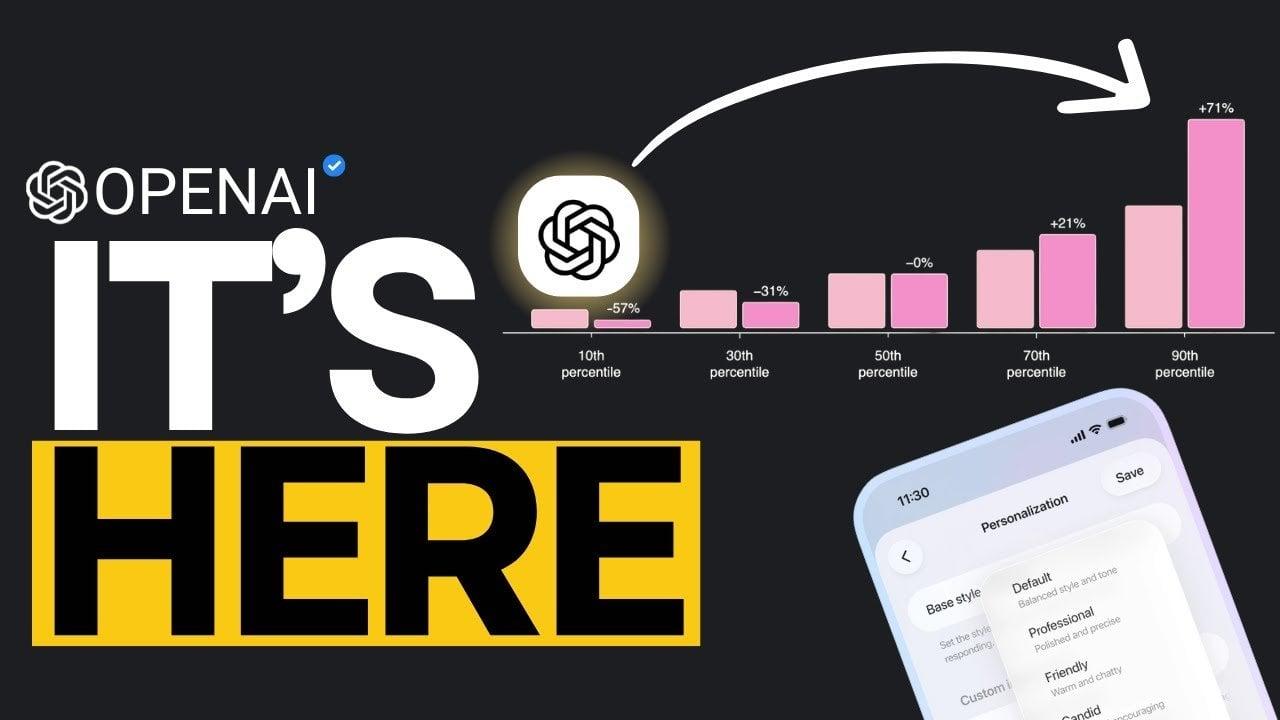
Source: Geeky Gadgets
Fidji Simo, OpenAI's CEO of Applications, explained that with over 800 million ChatGPT users, the company has moved beyond one-size-fits-all approaches
4
. Users can now adjust specific characteristics including response conciseness and emoji frequency through personalization settings, with changes taking effect immediately across all conversations1
.Developer Benefits and API Improvements
For developers utilizing OpenAI's API, GPT-5.1 delivers substantial cost and performance improvements
3
. The adaptive reasoning feature means simple queries receive faster responses using fewer tokens, while complex requests receive appropriate computational attention. This token optimization directly translates to reduced API costs for embedded applications.Denis Shiryaev from JetBrains described GPT-5.1 as "genuinely agentic" and "the most naturally autonomous model" he has tested, praising its ability to integrate seamlessly into existing codebases
3
. The model's improved instruction following and persistent reasoning capabilities address previous frustrations with context loss during extended coding sessions.Related Stories


Legal Challenges and Industry Context
The GPT-5.1 release occurs against a backdrop of intensifying legal scrutiny that could significantly impact OpenAI's operations
1
. The New York Times copyright lawsuit has escalated, with courts ordering OpenAI to provide 20 million ChatGPT conversations as evidence5
. OpenAI argues this request violates user privacy and has proposed establishing "AI privilege" protections for chatbot conversations5
.
Source: ET
Meanwhile, Microsoft, OpenAI's strategic partner, has increasingly turned to Anthropic's models for various Copilot services after GPT-5's lukewarm reception failed to meet expectations
4
. This shift highlights the competitive pressure OpenAI faces in maintaining its market leadership position.Safety and Mental Health Considerations
OpenAI acknowledges the delicate balance between customization and responsible AI deployment
1
. The company has released safety research addressing concerns about users developing unhealthy attachments to AI chatbots, working with mental health clinicians to establish guidelines for healthy AI interactions. Simo emphasized that effective personalization should challenge users rather than simply reinforcing existing worldviews, comparing excessive customization to editing a spouse's personality to always agree1
.References
Summarized by

Navi
Related Stories
Recent Highlights
1
Apple Plans Major Siri AI Overhaul in iOS 27 With Third-Party Chatbot Integration
Technology

2
OpenAI shuts down Sora after six months, ending Disney's $1 billion licensing partnership
Technology

3
AI chatbots validate you too much, making you less kind to others, Stanford study reveals
Science and Research

Recent Highlights
Today's Top Stories







Your Daily Dose of Curated AI News
Don’t drown in AI news. We cut through the noise - filtering, ranking and summarizing the most important AI news, breakthroughs and research daily. Spend less time searching for the latest in AI and get straight to action.

