OpenAI revamps ChatGPT shopping experience after Instant Checkout struggles with merchants


5 Sources
5 Sources
[1]
OpenAI revamps shopping experience in ChatGPT after struggling with Instant Checkout offering
OpenAI CEO Sam Altman attends an event to pitch AI for businesses in Tokyo, Feb. 3, 2025. OpenAI is rolling out a new shopping experience within ChatGPT to make it easier for users to find and compare products, after its Instant Checkout feature failed to take off. The company said on Tuesday that shoppers will be able to find products they're looking for by uploading images or describing items and including criteria like their budget, preferences and other constraints. ChatGPT will offer more visual results that people can use to compare different product offerings. "Under the hood, we've improved speed, relevance, and product coverage -- so results are more up-to-date and more useful," OpenAI said in a blog post. The update comes after OpenAI pivoted away from Instant Checkout, which allowed users to purchase select items from retailers like Etsy, Walmart and Shopify directly within ChatGPT. OpenAI announced that feature last year and initially billed it as the "next step" in AI-enabled commerce. Analysts previously told CNBC that OpenAI underestimated how difficult the enablement of transactions would be. It struggled to onboard merchants, show accurate data about products, and introduce multi-item carts or connect loyalty memberships. "We've found that the initial version of Instant Checkout did not offer the level of flexibility that we aspire to provide, so we're allowing merchants to use their own checkout experiences while we focus our efforts on product discovery," OpenAI said in the latest post. OpenAI said merchants can now share their product feeds and promotions with the company, which means their products are "fully represented" within ChatGPT. Retailers like Target, Sephora and Nordstrom already support OpenAI's new product discovery experience. Merchants interested in deeper integrations can also continue to develop custom apps within ChatGPT, OpenAI said. The company introduced that functionality at its annual developer conference in October and began adding dedicated retail apps from Instacart, Target and others last year. Triggering an app within the chatbot will help give those companies more control of the customer experience and the transaction process. Walmart introduced an in-app ChatGPT service on Tuesday that supports linking, loyalty and Walmart payments, OpenAI said. Alongside OpenAI's announcement, Shopify said Tuesday that it's "upgrading the shopping experience" in ChatGPT. It will allow Shopify merchants to connect their storefronts to its catalog, "then complete purchases via an in-app browser." Shopify is also rolling out a new service called Agentic Plan that lets merchants who don't have a storefront with the company surface their products via Shopify's own tools in ChatGPT, Google Gemini and elsewhere.
[2]
ChatGPT Revamps Shopping Features, Drops In-App Checkout
OpenAI is overhauling the shopping experience in its ChatGPT app by shifting the focus from in-app purchases to product discovery, after the company's Instant Checkout feature apparently failed to gain traction. Launched in September, Instant Checkout let users buy items from retailers like Etsy, Walmart, and Shopify directly within ChatGPT. In a new product post, OpenAI now says it is deprioritizing the feature as a standalone offering, because it "did not offer the level of flexibility that we aspire to provide." In place of it, ChatGPT is getting richer visual shopping tools, including side-by-side product comparisons, image-based search for finding similar items, and conversational result filtering. OpenAI says the updates are powered by an expansion of its Agentic Commerce Protocol, which lets merchants feed product catalogs and promotions directly into ChatGPT. Retailers including Target, Sephora, Nordstrom, Best Buy, and The Home Depot are already on board. Meanwhile, Walmart is launching a dedicated in-app ChatGPT experience that supports account linking, loyalty programs, and its own payment system. The updates are rolling out this week to all ChatGPT Free, Go, Plus, and Pro users. In related news, OpenAI yesterday said that it is ending support for its Sora AI video app just six months after it initially launched.
[3]
Shopping in ChatGPT is about to get a lot more interactive - users promised 'improved speed, relevance and product coverage'
* OpenAI is making it easier to discover new products and compare them in ChatGPT * Buyers weren't so fond of Instant Checkout, the company admits * Companies like Walmart are linking their own environment into ChatGPT OpenAI has announced a new shopping experience coming to ChatGPT designed to better help users discover new products and compare multiple options. The updates are all about a more visual interface - ChatGPT users can upload images as well as texts, setting out budget constraints and preferences, and the results are also now more visual with clearer side-by-side comparisons. Besides the customer-facing interface, OpenAI has also made under-the-hood changes to improve speed, relevant and product coverage. ChatGPT shopping is getting even better However, the company has also recognized that, while buyers are keen to learn more about potential purchases through AI, they're not so keen on buying through ChatGPT. As a result, Instant Checkout is being scaled back and ChatGPT will focus on more conventional merchant buying journeys. There are still opportunities for merchants to link in more closely to the chatbot interaction. For example, Walmart (a company that sat at the top for years before being dethroned by Amazon) will be supporting account linking, loyalty and Walmart payments within ChatGPT. "By partnering closely with OpenAI, we've been able to learn together as we move quickly to shape what agentic commerce can become," Walmart EVP Daniel Danker wrote. And while Anthropic has been praised for opening up the MCP, OpenAI wants to be known for ACP, the Agentic Commerce Protocol, which acts as a backend layer to connect merchants with users. The latest ACP improvements help product discovery. "As with other parts of ChatGPT, we're building iteratively," the company wrote, suggesting it may continue to change course as it has done with Instant Checkout. "We're learning from early launches, incorporating feedback from users and merchants, and continuing to improve the experience over time." The updated buying experience is rolling out for Free, Go, Plus and Pro users now. Follow TechRadar on Google News and add us as a preferred source to get our expert news, reviews, and opinion in your feeds. Make sure to click the Follow button! And of course you can also follow TechRadar on TikTok for news, reviews, unboxings in video form, and get regular updates from us on WhatsApp too.
[4]
OpenAI Enhances Product Discovery With Visual Shopping | PYMNTS.com
The updates include more visual shopping in ChatGPT and support for product discovery by the Agentic Commerce Protocol (ACP), which will bring additional information into ChatGPT, the company said in a Tuesday (March 24) blog post. OpenAI is rolling out these updates to all ChatGPT free, Go, Plus and Pro users this week, according to the post. With the enhancements to ChatGPT, users can browse products visually; upload images to find similar items; compare options side-by-side, including prices, reviews and features; get detailed, up-to-date information; and refine results conversationally, per the post. "For users, this turns shopping from a fragmented, time-consuming process into a single, seamless experience," OpenAI said in the post. "For merchants, it brings higher-intent shoppers who are closer to making a decision." ACP powers this shopping experience by enabling merchants to share product feeds and promotions, and by supporting multiple delivery paths so that merchants can participate with the systems they already use, including those from Salesforce and Stripe, according to the post. ACP was co-developed by OpenAI and Stripe and open-sourced from day one. OpenAI also said in the post that it is focusing on product discovery and is allowing merchants to use their own checkout experiences. Merchants can experiment with native experiences on ChatGPT while also developing ChatGPT apps. Walmart is introducing an in-ChatGPT app experience that takes users from discovery in ChatGPT to checkout in a tailored Walmart experience, per the post. This is now available in web browsers and will soon be added to apps. Daniel Danker, executive vice president, AI acceleration, product and design at Walmart, said in the post that the retailer and OpenAI have been learning about the potential of agentic commerce as they partner on this project. "Today's launch brings Walmart directly into the ChatGPT experience, combining leading conversational AI with the decades of retail expertise we've built serving consumers," Danker said in the post. OpenAI announced in October that it enabled ChatGPT users to chat with third-party apps while in conversation with the chatbot. The company did so by launching a feature called Apps in ChatGPT, together with an Apps SDK that allows developers to build these kinds of apps.
[5]
Walmart Shuts Down Agentic Commerce With OpenAI | PYMNTS.com
By completing this form, you agree to receive marketing communications from PYMNTS and to the sharing of your information with our sponsor, if applicable, in accordance with our Privacy Policy and Terms and Conditions. The shift marks an early stress test for the agentic shopping model that drew industry attention when the companies partnered in October. According to CNBC, OpenAI is now reworking Instant Checkout in favor of a more merchant-controlled architecture, reflecting growing concern among retailers about handing over the transaction layer to AI platforms. As reported by PYMNTS, Walmart joined Instant Checkout in October to let ChatGPT users purchase roughly 200,000 items without leaving the chat interface. OpenAI built the system with Stripe through what it described as the Agentic Commerce Protocol, aiming to pass order details, payment credentials and shipping preferences in a seamless handoff. The experience did not perform as expected. Daniel Danker, Walmart's executive vice president of AI acceleration, product and design, told Wired that conversion rates inside ChatGPT reached only about one-third of Walmart's native channels and called the experience "unsatisfying." CNBC reported that the feature offered a limited product selection months after launch and did not always display current item information. The design of the interface created additional friction. Walmart excluded high-consideration purchases such as televisions because the chat flow could not support bundling and accessory recommendations. The linear, single-query format did not match the multi-item basket behavior that drives order value on Walmart's own platforms. Shoppers also hesitated at checkout. Customers who typically complete purchases within Walmart's ecosystem encountered an unfamiliar payment flow inside a third-party interface. Gartner analyst Bob Hetu told CNBC that OpenAI "underestimated how difficult the enablement of transactions was going to be." Walmart is now replacing Instant Checkout with a model that keeps control inside its own systems. Walmart will soon deploy its in-house assistant, Sparky, inside ChatGPT. Danker said the company plans to extend a similar integration to Google's Gemini. Under this structure, users interact with Sparky inside ChatGPT but log directly into their Walmart accounts. Walmart keeps control of the underlying systems. The company synchronizes shopping carts across its website, mobile app and ChatGPT, allowing purchases to reflect ongoing shopping behavior rather than a single session. Walmart continues to run checkout entirely on its own infrastructure. The Information reported that this shift complicates OpenAI's enterprise strategy, which initially positioned the platform as owning the transaction layer. The revised model shifts that control back to merchants. OpenAI provides discovery and distribution, while retailers retain the cart, customer identity, loyalty data and transaction economics. Early internal data shows the new model performing better. Sparky inside ChatGPT is converting at roughly 70% of Walmart.com's rate, a significant improvement over Instant Checkout, though the figures remain preliminary. Danker told Wired that Walmart is bringing its store directly to the customer rather than routing customers through a disconnected checkout flow. Walmart's disclosure provides one of the first publicly reported performance benchmarks from a major retailer testing AI-driven commerce. The results are already influencing how the broader ecosystem approaches AI shopping. Shopify told CNBC it will no longer support native checkout inside ChatGPT and will instead route transactions back to merchant storefronts. Etsy confirmed to CNBC that the company is building a dedicated ChatGPT app to maintain control over its shopping experience. OpenAI said it is focusing on product discovery and search, where user engagement has been stronger than transaction completion. Amazon is taking a different path by keeping AI commerce tightly integrated within its own ecosystem. The company continues to expand tools such as its Rufus shopping assistant and "Buy for Me" agent, while also rolling out features like "Shop Direct," which allow customers to browse and purchase items beyond Amazon's core marketplace. Rather than relying on third-party AI interfaces, Amazon is embedding discovery, recommendation and transaction flows within its own platform, reinforcing control over the full shopping journey.
Share
Share
Copy Link
OpenAI is overhauling its ChatGPT shopping experience, shifting focus from in-app purchases to product discovery after its Instant Checkout feature failed to gain traction. Walmart reported conversion rates reached only one-third of its native channels, prompting the company to pivot toward a merchant-controlled model that keeps retailers in charge of transactions while ChatGPT handles discovery.
OpenAI Pivots ChatGPT Shopping Strategy After Instant Checkout Falls Short
OpenAI announced on Tuesday that it is rolling out a revamped shopping experience within ChatGPT, marking a significant shift away from its struggling Instant Checkout feature. The company is now focusing on product discovery rather than enabling transactions directly within the chatbot, after retailers reported disappointing performance and limited flexibility with the original approach
1
.
Source: PYMNTS
The pivot comes after Walmart disclosed that conversion rates inside ChatGPT reached only about one-third of its native channels, calling the customer experience "unsatisfying"
5
. OpenAI initially launched Instant Checkout in September, allowing users to purchase items from retailers like Etsy, Walmart, and Shopify directly within the chat interface. The feature was billed as the "next step" in AI-enabled commerce, but analysts told CNBC that OpenAI underestimated how difficult enabling transactions would be1
.Visual Shopping Tools Replace In-App Checkout
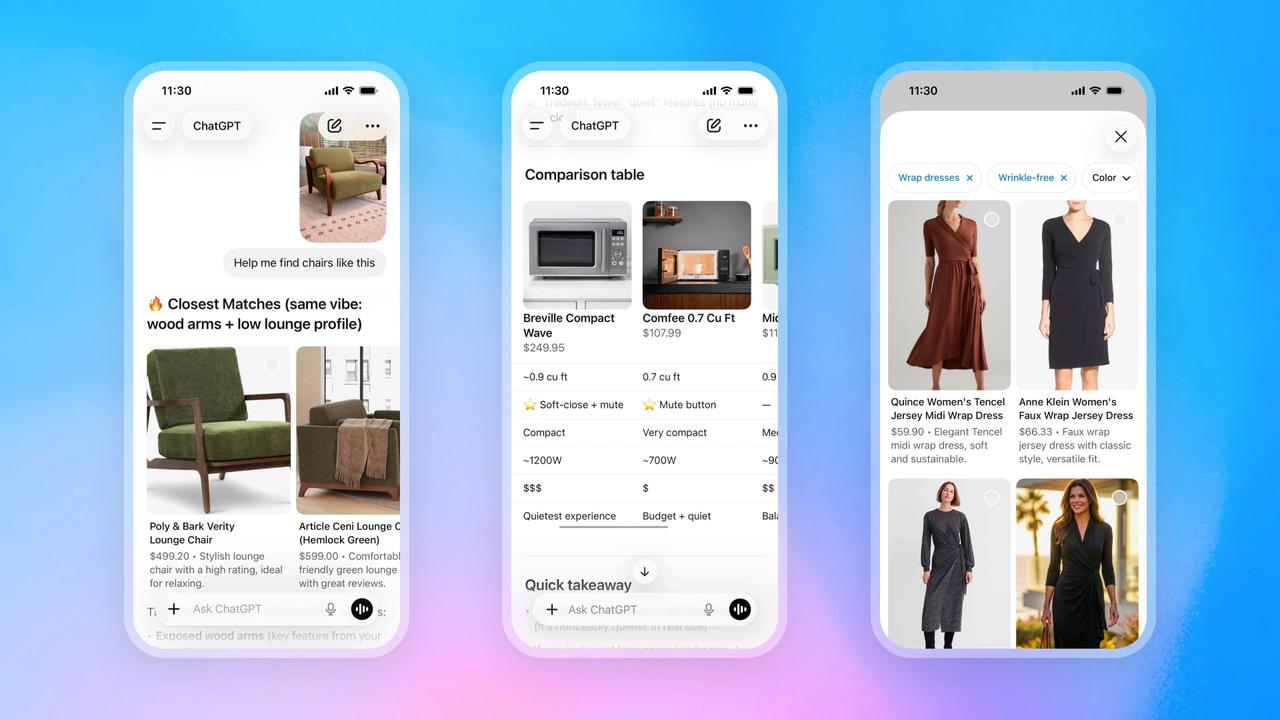
The updated shopping experience introduces more visual shopping capabilities that allow users to upload images or describe items while including criteria like budget, preferences and other constraints
1
. ChatGPT now offers richer visual results with side-by-side product comparisons, including prices, reviews and features, transforming what OpenAI describes as "a fragmented, time-consuming process into a single, seamless experience"4
.
Source: MacRumors
"Under the hood, we've improved speed, relevance, and product coverage -- so results are more up-to-date and more useful," OpenAI said in a blog post
1
. The updates are rolling out this week to all ChatGPT Free, Go, Plus and Pro users .Merchants Regain Control Through New Architecture
The shift represents a move toward a merchant-controlled model where retailers maintain control over the checkout process while OpenAI provides discovery and distribution. "We've found that the initial version of Instant Checkout did not offer the level of flexibility that we aspire to provide, so we're allowing merchants to use their own checkout experiences while we focus our efforts on product discovery," OpenAI stated
1
.Walmart is introducing an in-ChatGPT app experience that supports account linking, loyalty programs and Walmart payments, keeping the checkout process entirely within its own infrastructure
1
. Early internal data shows Walmart's new assistant, Sparky, converting at roughly 70% of Walmart.com's rate inside ChatGPT—a significant improvement over Instant Checkout, though still below native performance5
.
Source: PYMNTS
Daniel Danker, executive vice president of AI acceleration, product and design at Walmart, said the retailer is "bringing Walmart directly into the ChatGPT experience, combining leading conversational AI with the decades of retail expertise we've built serving consumers"
4
.Related Stories



Agentic Commerce Protocol Expands Merchant Participation
The new approach is powered by an expansion of the Agentic Commerce Protocol (ACP), which OpenAI co-developed with Stripe and open-sourced from day one
4
. The protocol enables merchants to share product feeds and promotions directly with ChatGPT, ensuring their products are "fully represented" within the platform1
.Retailers including Target, Sephora, Nordstrom, Best Buy and The Home Depot are already participating in the new product discovery experience . Shopify announced Tuesday that it is "upgrading the shopping experience" in ChatGPT by allowing merchants to connect their storefronts to its catalog, then complete purchases via an in-app browser
1
. The company is also rolling out a new Agentic Plan service that lets merchants surface their products via Shopify's tools in ChatGPT, Google Gemini and elsewhere1
.What the Pivot Means for AI Commerce
The challenges OpenAI faced with Instant Checkout highlight the complexity of AI-driven commerce. Gartner analyst Bob Hetu told CNBC that OpenAI "underestimated how difficult the enablement of transactions was going to be"
5
. The company struggled to onboard merchants, show accurate data about products, and introduce multi-item carts or connect loyalty memberships1
.Walmart excluded high-consideration purchases such as televisions because the chat flow could not support bundling and accessory recommendations, and the linear, single-query format did not match the multi-item basket behavior that drives order value
5
. Shoppers also hesitated at the unfamiliar payment flow inside a third-party interface5
."As with other parts of ChatGPT, we're building iteratively," OpenAI wrote, suggesting it may continue to adjust its approach based on user and merchant feedback
3
. The revised model positions OpenAI as a discovery platform while retailers retain control over customer identity, transaction economics and the full checkout process—a structure that may prove more sustainable as AI shopping continues to develop.References
Summarized by

Navi
[1]
Related Stories
Recent Highlights
1
OpenAI shuts down Sora video app after six months, ending Disney's $1 billion investment deal
Technology

2
AI-Generated Val Kilmer to Posthumously Appear in As Deep as the Grave After His Death
Entertainment and Society

3
Supermicro Co-Founder Indicted in $2.5 Billion Nvidia AI Chip Smuggling Scheme to China
Policy and Regulation

Recent Highlights
Today's Top Stories




Your Daily Dose of Curated AI News
Don’t drown in AI news. We cut through the noise - filtering, ranking and summarizing the most important AI news, breakthroughs and research daily. Spend less time searching for the latest in AI and get straight to action.

