Samsung Galaxy Z Fold 7 and Z Flip 7: A Leap Forward in Foldable Technology


2 Sources
2 Sources
[1]
I replaced my Galaxy S25 Ultra with the Samsung Z Fold 7 - and didn't regret it
But you'll dig the improved hardware, especially if you're familiar with foldable phones from the global market. The Galaxy Z Fold 7 is Samsung's biggest design overhaul since the Z Fold 2 in 2020, and it's back with a bang. Over the last three years, the Korean tech giant made slight refinements to each generation, resulting in a stale design. But the new Galaxy Z Fold 7 finally catches up to its Chinese rivals, even beating them in multiple ways. CNET survey: 64% of people say 'no thanks' to foldable smartphones I've been using the Samsung Galaxy Z Fold 7 for the past week and am happy to report that Samsung has made some damn near-perfect hardware. You get an easy-to-hold form factor, virtually no crease, a cover screen that's close to a regular phone in itself, a solid hinge, and the same main camera as the Galaxy S25 Ultra. These upgrades come with a cost, though. The Fold 7 will set you back at two grand, but if you have that money, this is the phone I recommend most. I spent 10 days with the Galaxy Z Fold 7, during which I had my SIM card in it for a week. I used the phone as I normally would, but with an emphasis on the new, most significant features. I also took more photos and videos than usual to see if there were any notable differences. Also: I changed 7 Samsung phone settings to instantly improve the battery life Testing also involved using the new Galaxy AI features in day-to-day life, like running Live Translate friends who speak multiple languages, removing unwanted objects in my photos with Generative Edit, and exploring other practical ways the new phones can improve our lives. Here's what works and what doesn't. The Galaxy Z Fold 7 measures just 4.2mm thin when unfolded and 8.9mm folded. For context, that's a few millimeters more than the 8.25mm iPhone 16 Pro Max and 8.5mm Pixel 9 Pro. Samsung's own Galaxy S25 Ultra measures 8.2mm, while the foldable Oppo Find N5 is 8.93mm thick. All in all, the Galaxy Z Fold 7 is just 0.1mm thicker than the thinnest book-style foldable, the Honor Magic V5. Paired with a body that's lighter than all of them at 215 grams, the Galaxy Z Fold 7 the lightest book-style foldable on the market right now. Also: Oppo's new foldable phone is one of the thinnest I've seen - and I hope OnePlus and Samsung follow suit This thin and light design makes it the most comfortable to hold Galaxy Z Fold phone yet -- if you hold it in the right hand. If you're left-handed, the hinge corners might dig into your palm, which was also an issue on the predecessor. That said, I'm a right-hander, and I find it more comfortable to use than the Galaxy S25 Ultra and iPhone 16 Pro Max. The Galaxy Z Fold 7 is also more durable than before. It features a stronger Gorilla Glass Victus Ceramic 2 on the cover screen, Gorilla Glass Victus 2 on the back and a Titanium plate layer instead of a carbon fiber sheet under the screen for added display durability. Plus, you get dust and water resistance with an IP48 rating. Also: I took a walk with Meta's new Oakley smart glasses - they beat my Ray-Bans in every way Samsung improved the cover screen, too. It's no longer fixated on the narrow form factor, enabling the 6.5-inch AMOLED screen with a 21:9 aspect ratio so apps interact better and play along well with the whole slab phone-like feel. It's bright enough to see outdoors and has the same 120Hz dynamic refresh rate and HDR10+ support as the inner display. Being able to text, scroll through social media, and browse the web on a Samsung cover screen feels refreshing. The Galaxy Z Fold 7 has a wider folding screen as compared to its predecessor. I've loved my experience on this sharp and vivid panel, but it isn't as immersive as before. Samsung stuck to an under-display camera (UDC) for years, which made the reading, browsing and gaming experience better than any other foldable. Utility-wise, its quality was worse than the new punch-hole 10MP camera -- and I'd prefer the new setup for video calls any day -- but I miss the under-display camera, too. I hope it returns in the future with better quality. Also: I used Huawei's $3,600 tri-foldable, and it made every phone I've ever tested feel outdated Once you accept that the camera isn't going anywhere, you can appreciate the Galaxy Z Fold 7's eight-inch LTPO AMOLED 2X panel with support for HDR10+ and a 120Hz dynamic refresh rate. I love its vivid colors and high-contrast look. But like before, the inner display attracts more smudges than the cover screen. Coming to the best part of the folding screen, there's virtually no crease. Samsung's new butterfly hinge mechanism has successfully negated it. In fact, Galaxy Z Fold 7 has the least amount of crease on any book-style folding phone that I've used. The Oppo Find N5 comes close, but the Vivo X Fold 5 and Honor Magic V3 both have slightly deeper creases running through the middle of the screen. Not that it matters when interacting with the big display, but less crease means a comfortable viewing experience in more lighting conditions and angles. The hinge, too, feels more premium than other foldables. If you're coming from one of the previous Z Folds, the Galaxy Z Fold 7 won't prop up at 150 degrees right out of the box, but it gets better as you use it. After a week of use, my unit no longer unfolds flat till up to roughly 135 degrees. I had a similar experience with the Honor Magic V3, which also has a butterfly hinge. If I had to choose between a subjectively more immersive Fold 6 screen with UDC and deep crease or Fold 7's punch-hole-clad screen with lesser crease, I'd pick the latter. I can't pinpoint why the Galaxy Z Fold 7 feels more premium than other foldables on the market but it is probably a combination of multiple factors: thinner and lighter design, least crease and flat sides that aren't unergonomic (in the right hand) to hold. It is slightly harder to unfold, but you'll get used to it within the first 48 hours. Samsung removed another feature on the Galaxy Z Fold 7: the S Pen, and I don't miss it. I never used it on my Fold 5 or Fold 6 and if it helps the phone make it thinner, I don't mind missing out on a stylus that has to be stored in an external case. Samsung's new Fold runs Android 16-based One UI 8, with Samsung's Galaxy AI having the most complete suite of artificial intelligence features. The phone runs smoothly, thanks to the Qualcomm Snapdragon 8 Elite SoC, paired with either 12GB or 16GB of RAM. I actually found some of the phone's AI features useful. For example, the AI Select feature lets you click anything on your screen to take actions. From transcribing interview recordings to removing unwanted objects in my photos, there are plenty of useful AI tools that actually work. Also: The Samsung Galaxy S25 Ultra was nearly unusable for me - until I downloaded this one app Coming from a OnePlus phone recently, I think Samsung could benefit from displaying similar pop-ups for on-call features like transcribe and translate. As of now, you need to swipe down and tap on the Live Translate tile from quick panel to use the feature, which isn't as easy to use. Samsung also finally gave its foldable the same primary camera as its flagship S-series phone. The Galaxy Z Fold 7 sports a 200MP main camera, borrowed straight from the Galaxy S25 Ultra. It is accompanied by a modest 3x 10MP telephoto camera and a 12MP ultrawide-angle lens. This camera system produces vibrant-looking shots in most scenarios. I recommend shooting most photos in 200MP mode, so you can crop them later and yet retain the details, as the 3x tele lens isn't the best. I wish Samsung let users switch between lenses in the 200MP mode. As of now, you get options for 1x, 4x, and 5x (you can zoom at any level from 1x to 5x) but to change to ultrawide, you need to switch to 12MP mode and then tap 0.6x. It's a slight inconvenience that I've faced regularly in the past week. Samsung has also improved the shutter speed, so moving subjects are captured better than before. The dynamic range remains great, while the Portrait mode still struggles with edge detection. Galaxy AI comes into play again and gives you the most polished photobomber-removal tool. Also: How earthquake alerts work on Android - and how to make sure they're enabled on your phone Another cool feature for videographers: Audio Eraser can now automatically detect what to tune out and has a designated button in your gallery. It made my voice a little robotic, but it did well to suppress background noise. Unfortunately, Samsung didn't upgrade the battery capacity on its new foldable. In fact, it hasn't increased the battery size in five generations; the Galaxy Z Fold 7 has the same battery as the Galaxy Z Fold 3. This means you get a 4,400mAh cell with support for a modest 25W wired charging and 15W wireless charging. When I first saw this number on paper, I was worried that an amazing hardware would be compromised by a questionable decision, especially when competing devices have 5,500mAh+ silicon-carbon batteries. Also: I replaced my Galaxy S25 Plus with the S25 Edge (and Samsung may do the same) As it turns out, the Galaxy Z Fold 7 is a full one-day device for moderate phone users (with about 5-6 hours of daily screen time). I'm not impressed by the charging speed, though. I usually average about nine hours on my phone daily and had to charge my Z Fold 7 every evening around 6 PM for my evening social media scrolling. If you're a heavy phone user, expect to plug in your Z Fold 7 after the work day, or earlier if your usage involves a lot of navigation on 5G. Samsung improved the weakest links of its book-style foldable with the Galaxy Z Fold 7 and the result is a near-perfect phone. I'd love for it to have a bigger battery and a better zoom camera -- the Vivo X Fold 5 has both -- but Samsung's foldable has U.S availability, longer software support, and a better user interface. In short, this is the most polished folding phone experience, in my opinion. However, it doesn't come cheap. After a $100 price bump, the Galaxy Z Fold 7 is Samsung's most expensive Fold yet, starting at $2,000. If you can spend that amount on a smartphone, you can't go wrong with this phone. It's a generational leap over its predecessor, and if you can find a good exchange offer, I recommend upgrading from last year's Z Fold 6, too. If you're a business professional or need a phone for productivity, the Galaxy Z Fold 7 should be on your radar.
[2]
I put the Galaxy Z Flip 7 vs Galaxy Z Flip 6 through a 7-round face-off -- here's the winner
Now that I've had plenty of time putting them to the test, I have a good idea of how this Galaxy Z Flip 7 vs Galaxy Z Flip 6 face-off will turn out. In my Galaxy Z Flip 7 review, I was delighted by the bigger upgrades that Samsung gave its latest flip-style phone. In fact, I'm so impressed by it that it has replaced the Motorola Razr Ultra (2025) as the best foldable phone you can buy right now. Just with any other year-over-year update, I still want to show how much of an improvement the Z Flip 7 makes over the Z Flip 6. One of the biggest areas I was concerned about was its performance and battery life, as Samsung opted to go with its own, in-house Exynos 2500 chipset instead of Qualcomm's. I'll definitely cover that and many other things in my 7-round Galaxy Z Flip 7 vs Galaxy Z Flip 6 comparison. Here's how the latest Samsung flip-style phone compares to last year's model. I'm happy to report that there isn't a price hike with the Galaxy Z Flip 7, making it the same $1,099 starting cost just like the Galaxy Z Flip 6 last year. Given the hardware upgrades, paired with some incredible Galaxy Z Flip 7 deals going on right now, I would give this one to the Z Flip 7. From what I've seen so far, most carriers and retailers haven't slashed the price of the Galaxy Z Flip 6 in a substantial way to clear out stock. Depending on where you look, you might actually snag one for free -- but that usually requires you to commit to a specific cell phone plan, just like what T-Mobile's offered last year. In fact, that's the same offer the carrier has right now for the Z Flip 7. Winner: Galaxy Z Flip 7 Although the overall design language doesn't differ between the two, there are a few noteworthy achievements that make the design of the Galaxy Z Flip 7 better. First of all, there's not a substantial change to its size and weight -- given how it features a larger battery and bigger screens. They both feature similar armor aluminum frames that make them incredibly durable, but the Z Flip 7 benefits from a new Armor Flex Hinge that makes it smoother to open and close. There's still a crease with the new hinge, but it doesn't appear to be as deep as the Z Flip 6. I will say, though, that I like the color options available to the Z Flip 6. You have a total of seven to choose from, versus the four with the Z Flip 7. However, I do anticipate Samsung coming out with more colors in the coming months. Winner: Galaxy Z Flip 7 Starting off with their main displays, the Z Flip 7 gets the nods for its larger 6.9-inch Dynamic AMOLED 2x display. In addition to that, it's also brighter according to our display benchmark test -- where it reached a peak brightness of 1,989 nits. That's a smidge brighter than the 1,835 nits recorded from the Z Flip 6's 6.7-inch Dynamic AMOLED 2x display. Even though the Z Flip 6 has a higher resolution, I can hardly notice this miniscule difference. What I think is more impressive though is how Samsung upgraded the Z Flip 7 with a larger 4.1-inch cover display. It's noticeably larger than the 3.4-inch one with the Z Flip 6, and as a result, it makes using apps and capturing content with the cameras much more satisfying. I can't tell you how much the extra room makes, especially when it comes to running full apps -- or typing with the keyboard. All of it is much easier with the larger cover screen of the Z Flip 7. Winner: Galaxy Z Flip 7 When Samsung showed off the Z Flip 7 during its Galaxy Unpacked event, I was a little surprised by the camera specs. On paper, it doesn't appear like any changes were made to its camera because it has the same 50MP main, 12MP ultrawide, and 10MP selfie cameras as the Galaxy Z Flip 6 -- including the same aperture values. However, Samsung did spend time explaining how its updated ProVisual Engine enhances the results. I've already detailed their differences in my Galaxy Z Flip 7 vs Galaxy Z Flip 6 photo shoot-out, which ultimately gave the performance to the Z Flip 7. I'll explain some of the biggest differences I noticed below. There are still new features and upgrades that make the Z Flip 7 the better camera phone. For starters, I can't stress enough the advantage of having a larger cover screen here because it makes selfies and vlogs easier to capture. Over on the video side, the Z Flip 7 also gains the same LOG video recording mode that debuted with the Galaxy S25 Ultra. As someone that edits video a lot, this flat picture profile gives me more flexibility in the editing room to tweak the colors to my liking. Despite having the same camera as the Z Flip 6, I can tell that the ProVisual Engine is working its magic ever so slightly with the Z Flip 7's shot above of the parking lot. That's because it's boosting the exposure of the trees in the background, which reveals details that are hidden there in the Z Flip 6. I thought their 10MP selfie cameras would produce the same results, but there's one key difference that gives a boost to the older Flip 6. Due to how the built-in screen protector of the Z Flip 7 goes over the selfie camera, it results in a slightly softer look. In contrast, the screen protector doesn't go over the selfie camera on the Z Flip 6 -- so it retains a sharper look overall. Again, the updated ProVisual Engine of the Z Flip 7 is working its magic in the portrait shots I captured of myself above. You might think the results are identical, but there are clues in the details that make the Z Flip 7's shot look more realistic. If you take a look at the strap on my shoulder, you'll notice that some parts of it blurred out -- whereas the Z Flip 6 keeps it all in focus. The reason why the Z Flip 7 does this is because it replicates the behavior of an actual camera whose focus is squared on the face. It's exactly the look I'd get from using my mirrorless camera. Zooming is done through their respective main cameras, as they lack the dedicated telephoto shooters that other phones offer. The difference boils down to the enhancements made by the ProVisual Engine of the Z Flip 7, which gives more definition to the sign in the middle of the shot and the chain link fence in the background. Low light is where the updated ProVisual Engine really flexes its muscles. While both shots are bright given that they were shot in near pitch dark conditions, the Z Flip 7 benefits from capturing more definition all around the tree. When I zoom to it, I can make out the finer details of the tree's bark and its textures. They look softer and muddy with the Z Flip 6. Winner: Galaxy Z Flip 7 Out of all the categories I'm judging, this is the one I'm most interested in because of Samsung's decision to ditch Qualcomm for the Z Flip 7. It's powered by an Exynos 2500 SoC and paired with 12GB of RAM, versus the Snapdragon 8 Gen 3 and 12GB of RAM in the Z Flip 6. While I don't see a huge difference in how they perform with my day-to-day tasks, like checking emails, surfing the web, gaming, and checking out my social feeds, their benchmark performance scores show something different. The Exynos 2500 barely beats out the Snapdragon 8 Gen 3 in GeekBench 6, but their graphics processing performances are almost identical. In a strange turn of events, the Z Flip 7 renders video slower with the Adobe Premiere Rush test. Really, I was hoping for a wider gap -- but this isn't the Snapdragon 8 Elite. The Galaxy Z Flip 7 gets a technical win here, but it really exposes how there's not a huge improvement. Winner: Galaxy Z Flip 7 There's a relationship between a phone's chipset and its battery life, so given the minor performance boost of the Z Flip 7, I wasn't expecting much in terms of its battery life. Thankfully I'm proven wrong because it seems as though Samsung invested more on making the Exynos 2500 power efficient, which could also be aided by the optimizations of One UI 8. Regardless, the Galaxy Z Flip 7 cruised to the finish line with its time of 12 hours and 24 minutes on our battery drain test. The Galaxy Z Flip 6 ran the same exact test, but falls a bit behind with its 11 hours and 1 minute clocked time. But to be fair, the Galaxy Z Flip 7 has a larger 4,300 mAh battery -- whereas the Z Flip 6 has a smaller 4,000 mAh. Over on the recharge side, the Z Flip 7 gets the same 25W wired and 15W wireless speeds as the Z Flip 6. Yet, it charges a smidge faster after 15 and 30 minutes in our testing. Winner: Galaxy Z Flip 7 On the surface, their interfaces may not look or feel all that different, but there are features that give the Z Flip 7 the more compelling software package. For starters, it benefits from having the latest One UI 8 software on top of Android 16. Visually it's not a huge departure, but new additions like the Now Bar and Now Brief are helpful. There's also the cross actions apps feature with the Z Flip 7, which makes it even more intuitive to perform complex actions all through voice commands. While it's only a matter of time before the Z Flip 6 gets the new One UI 8 software, which should bring the Now Bar and Now Brief, I'm not confident it'll get cross app actions. When it comes to AI features, the Z Flip 7 introduces a few new things. The most notable, of course, is the multimodal AI experience with Gemini Live. This allows me to tap into the Z Flip 7's cameras to allow Gemini see what I see, then ask it questions or make commands. I've actually used it to help me with a problem with my electrical breaker, which I know I couldn't do on my own. Secondly, there's the Audio Eraser feature that lets me remove unwanted noise in my videos. It's a handy tool that lets me tweak the audio on the device, rather than using software on my computer. And finally, Samsung finally brings DeX support to the series for the first time with the Galaxy Z Flip 7 -- and I couldn't be happier about this. That's because Samsung DeX means I can now connect the Z Flip 7 to a monitor and essentially have access to a desktop PC-like interface. In some ways, it can replace my laptop because of how well it multitasks apps. I'm not surprised by how this Galaxy Z Flip 7 vs Galaxy Z Flip 6 face-off turned out. The new Galaxy Z Flip 7 wins every category, with a few where there's a substantial improvement. Not only do I love the larger and brighter displays of the Z Flip 7, but I think its updated software also helps out. Both Samsung DeX support and multimodal AI Gemini Live are two big features you're not going to get with the Z Flip 6, which also helps when its price remains unchanged.
Share
Share
Copy Link
Samsung's latest foldable phones, the Galaxy Z Fold 7 and Z Flip 7, showcase significant improvements in design, durability, and performance, setting new standards in the foldable smartphone market.
Samsung's Foldable Evolution: Z Fold 7 and Z Flip 7
Samsung has made significant strides in the foldable smartphone market with the release of its latest devices, the Galaxy Z Fold 7 and Z Flip 7. These new models represent a substantial leap forward in design, functionality, and performance, addressing many of the concerns that have plagued earlier generations of foldable phones.
Galaxy Z Fold 7: A Design Overhaul
The Galaxy Z Fold 7 marks Samsung's most significant design update since the Z Fold 2 in 2020. At just 4.thin when unfolded and 8.folded, it's remarkably slim for a foldable device
1
. Weighing only 215 grams, it's now the lightest book-style foldable on the market, enhancing comfort and usability.
Source: ZDNet
Samsung has also improved the device's durability, incorporating Gorilla Glass Victus Ceramic 2 on the cover screen, Gorilla Glass Victus 2 on the back, and a Titanium plate layer under the screen. The Z Fold 7 boasts an IP48 rating for dust and water resistance, further solidifying its robustness
1
.Refined Displays and Hinge Mechanism
The Z Fold 7's cover screen has been upgraded to a 6.AMOLED display with a 21:9 aspect ratio, offering a more traditional smartphone experience when folded. The inner 8-inch LTPO AMOLED 2X panel supports HDR10+ and a 120Hz dynamic refresh rate, providing a vivid and smooth viewing experience
1
.Perhaps the most notable improvement is the virtually non-existent crease on the main display, thanks to Samsung's new butterfly hinge mechanism. This advancement puts the Z Fold 7 ahead of its competitors in terms of display seamlessness
1
.Galaxy Z Flip 7: Compact Power
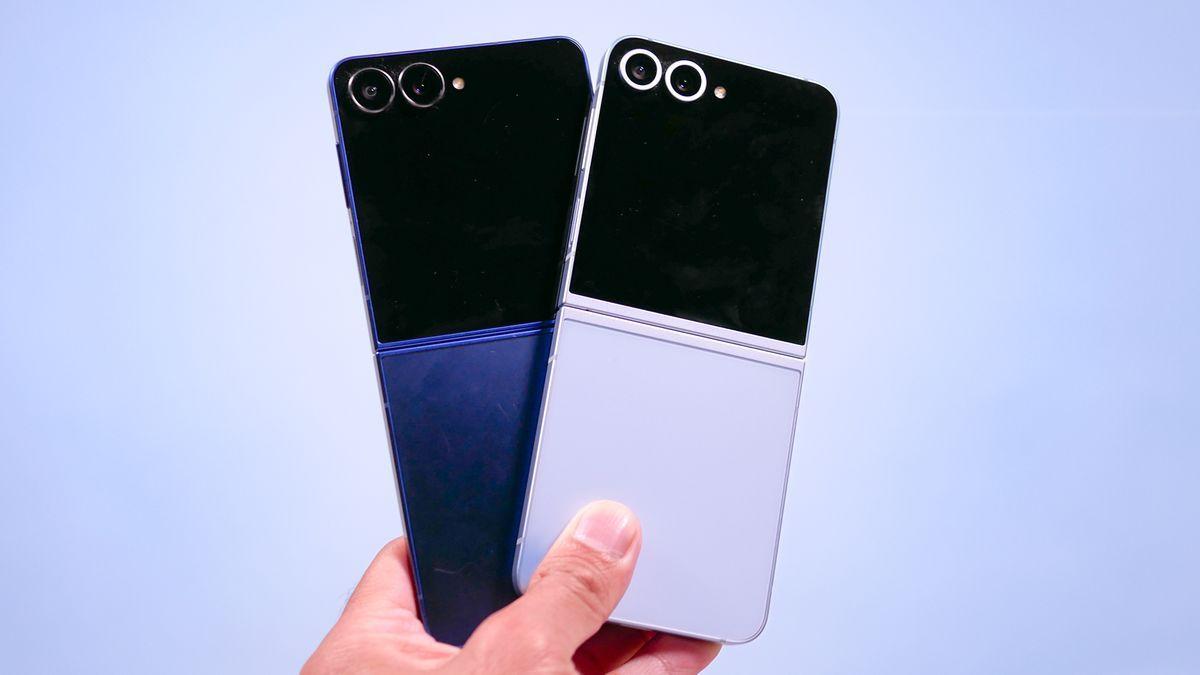
The Galaxy Z Flip 7 builds upon its predecessor's success with several key enhancements. The device now features a larger 4.cover display, significantly improving usability for apps and camera functions without unfolding the phone
2
.
Source: Tom's Guide
Despite maintaining the same starting price of $1,099 as the Z Flip 6, the Z Flip 7 offers substantial upgrades. The main display is slightly larger at 6.and brighter, reaching a peak brightness of 1,989 nits in tests
2
.Camera Improvements and Performance
While the Z Flip 7 retains the same 50MP main, 12MP ultrawide, and 10MP selfie cameras as its predecessor, Samsung has introduced a new ProVisual Engine to enhance image quality. The larger cover screen also facilitates easier selfie and vlog capture
2
.Both new models showcase Samsung's commitment to pushing the boundaries of foldable technology. The Z Fold 7's virtually creaseless display and the Z Flip 7's enlarged cover screen address key user concerns, while improvements in durability and performance make these devices more practical for everyday use.
Market Implications
These advancements position Samsung strongly in the competitive foldable smartphone market. With Chinese rivals making significant progress in this space, Samsung's latest offerings demonstrate the company's determination to maintain its leadership position in foldable technology
1
2
.As foldable phones continue to evolve, the Z Fold 7 and Z Flip 7 represent a significant step towards mainstream adoption of this form factor. Their refined designs and enhanced functionality may help overcome consumer hesitation and drive broader acceptance of foldable devices in the smartphone market.
References
Summarized by

Navi
Recent Highlights


Recent Highlights
Today's Top Stories








Your Daily Dose of Curated AI News
Don’t drown in AI news. We cut through the noise - filtering, ranking and summarizing the most important AI news, breakthroughs and research daily. Spend less time searching for the latest in AI and get straight to action.

