Pony AI and Uber partner with Verne to launch Europe's first commercial robotaxi service


4 Sources
4 Sources
[1]
Uber aims to launch Europe's first robotaxi service with Pony AI and Verne
Uber is joining forces with two companies, China's Pony AI and Croatia's Verne, to launch what it claims will be Europe's first commercially available robotaxi service. The vehicles are already being tested in Zagreb, Croatia, where Verne is headquartered, and will soon be available to customers on Uber's ridehail network. The announcement is the latest move by Uber to shield itself from the financial blowback of robotaxis potentially overtaking the traditional ridehail business. The company has allied itself with dozens of autonomous vehicle developers over the past year in an attempt to persuade investors that it can survive the impending robotaxi era. It's latest partners are Pony AI, which is currently operating autonomous vehicles in a number of Chinese cities, and Verne, which spun off of supercar maker Rimac. Under the terms of the deal, Uber will provide the ridehail network, along with the customers; Verne will manage the fleet; and Pony AI will develop the autonomous driving technology. The first service will be in Zagreb, with more European markets to follow. And the ultimate goal is to scale the fleet to "thousands of robotaxis" over the next few years. Currently, the companies are validating the technology on the streets of Zagreb using Pony AI's Arcfox Alpha T5 Robotaxi, equipped with the Chinese company's 7th generation technology stack. The vehicle was jointly developed and manufactured with state-owned Beijing Automotive Group Co (BAIC). Once the companies start charging fares, they anticipate it being Europe's first commercial robotaxi service. They will have some competition. Waymo has said it intends to launch a robotaxi service in London sometime in 2026. Uber is also testing self-driving cars with Momenta in Germany. And Volkswagen has said it will launch an autonomous ridesharing service under its subsidiary Moia, also in Germany. As for Verne, there haven't been many updates since it was first announced as a robotai side project to Rimac. Mate Rimac, the founder and CEO of Rimac Group, showed off a fleet of 60 prototype autonomous vehicles late last year. Whether those vehicles ever end up in Uber's fleet, though, is an open question.
[2]
Pony AI, Uber to Launch Robotaxis in Croatia in Europe Push
Uber plans to work with partners to bring robotaxis to more than 10 markets this year, including Munich and the UK, as part of its goal to be the biggest robotaxi platform. Chinese robotaxi company Pony AI Inc. and Uber Technologies Inc. have begun testing driverless cars in Zagreb, Croatia, expanding their partnership beyond the Middle East and into Europe. The companies are preparing for a launch "soon" with locally based startup Verne, which will own and operate a fleet of BAIC Motor Corp.-manufactured Arcfox Alpha T5 robotaxis, equipped with Pony AI's self-driving technology, according to a joint statement on Thursday. The vehicles will first be offered on Verne's app and eventually be available to book on Uber's service. Pony AI, founded nearly a decade ago, is working to expand its global footprint in a bid to boost sales and stem losses. For Uber, the move is part of a bigger bet to include robotaxis alongside its network of human-driven vehicles. The tech giant looks to offer driverless rides in more than 10 markets this year and eventually wants to be the biggest robotaxi platform. The two companies had planned a rollout in the Middle East last year, but that has been postponed. An Uber spokesperson didn't provide a reason for the delay, saying that the effort is still moving forward. Testing on public roads is already underway in the Croatian capital, according to the statement. The partners plan to expand the fleet to thousands over the next few years in additional European cities and other markets. Uber agreed to invest in Verne, which is 47%-owned by Bugatti owner Rimac Group, to support future growth. "Verne will lead the process of ensuring market readiness and obtaining European regulatory approval for these launches," according to the statement. Verne has announced its own ambitions to launch a two-seater robotaxi without a steering wheel in 2026. Such a vehicle would rival Tesla Inc.'s Cybercab, which is slated to go into production this year. Uber doesn't develop its own self-driving technology, having sold off an in-house research unit in 2020. But it has teamed up with more than 20 technology providers and car companies globally, including Alphabet Inc.'s Waymo in the US and China's WeRide Inc. in the United Arab Emirates. That lets it offer self-driving rides through its app -- the approach used in the Pony partnership. In other agreements, Uber will play a bigger role overseeing fleet operations and maintenance. As part of a goal to have driverless rides in more than 10 markets this year, Uber plans to work with partners to bring robotaxis to Munich and the UK.
[3]
Pony.ai Teams With Uber on Robotaxis as Revenues Surge 160% | PYMNTS.com
By completing this form, you agree to receive marketing communications from PYMNTS and to the sharing of your information with our sponsor, if applicable, in accordance with our Privacy Policy and Terms and Conditions. The project is slated to get underway soon in the Croatian capital of Zagreb soon, with initial development work already happening, Pony.ai announced Thursday (March 26). "The three companies plan to collaborate on the deployment of a commercial robotaxi service, combining Pony.ai's autonomous driving system, Uber's global mobility platform, and Verne's service ecosystem and operational framework," the announcement said. "Under this model, Pony.ai will provide its autonomous driving solution; Verne will act as fleet owner and service operator; and Uber will integrate the service into its global ride-hailing network, complementing Verne's own customer-facing platform," the announcement added. Also Thursday, Pony.ai announced its quarterly earnings, along with plans to deploy robotaxis in more than 20 cities around the world. The company's robotaxi fleet has now surpassed 1,400 vehicles, and has extended its operations into Croatia as well as the Chinese cities of Hangzhou and Changsha, the announcement said. The company said its robotaxi revenues rose by 160% year-over-year during the quarter, with fare-charging revenues jumping by more than 500%. "The robotaxi is the first true application of physical AI, with its core differentiator lying in driving capability, an area where our competitive edge remains unparalleled across the industry," said Dr. Tiancheng Lou, Pony.ai's chief technology officer. Physical AI, as covered here recently, refers to systems that go beyond generating content into operating in real environments: robots, autonomous machines and the foundational models that instruct them how to behave. "The category has been building momentum for years, but 2026 marks a credible inflection point," PYMNTS wrote. "At CES in January, Nvidia CEO Jensen Huang declared that the ChatGPT moment for robotics had arrived, suggesting the combination of AI models and computing infrastructure could soon unlock large-scale commercial adoption." The report also touched on the theory that machines that can perceive, reason and function in the physical world may be on a more direct path "than software running in a data center" to reaching AGI (artificial general intelligence) or a form of artificial intelligence (AI) that can perform at/above the level of humans. "If that thesis is right, the physical AI buildout now underway is not just a manufacturing story. It is the early infrastructure of something considerably larger," PYMNTS added.
[4]
Pony AI Partners With Uber, Verne to Deploy Robotaxis in Europe
China's Pony AI is partnering with Uber Technologies and autonomous driving startup Verne to deploy a robotaxi service in Europe, expanding its footprint overseas as it races toward profitability. Nasdaq-listed Pony AI--one of the "Big Three" of China's robotaxi industry--will launch the service with Uber and Verne in the Croatian capital of Zagreb. The move comes as Chinese robotaxi companies push to grow their fleets at home and overseas to reach the tipping point where they can start turning sustainable profits and win over consumers. Last year, Pony AI struck a tie-up with auto giant Stellantis to deploy robotaxis in Europe, starting with test drives in Luxembourg, where the Chinese company's European division is based. Its peers, WeRide and Baidu's Apollo Go, have also expanded into the European market. Guangzhou-based Pony AI said Thursday that it will work with Uber and Verne on scaling commercial robotaxi services in Zagreb and other European cities. The trio have already started road tests in the Croatian city and aim to have a fleet of thousands of robotaxis over the next few years, they said. "Croatia has a strong tourism profile and attracts large numbers of international visitors each year, which adds another dimension to long-term mobility demand," said James Peng, chief executive of Pony AI. Under the partnership, Pony AI will provide autonomous-driving technology while Verne will act as the fleet owner and service operator. Uber will integrate the driverless taxi service into its global ride-hailing network. Verne is a Croatian company backed by Tasaru Mobility Investments, which is fully owned by Saudi Arabia's Public Investment Fund. The announcement comes on the cusp of Pony AI's fourth-quarter earnings results, which investors will be watching for signs of progress in its profitability milestones. In the third quarter, the firm's net loss widened on a near-doubling of research-and-development expenses. Revenue rose 72% thanks to strong growth in robotaxi services, and licensing and application revenues. Pony AI also said it reached single-unit economics breakeven in Guangzhou and Shenzhen --two key markets in China--meaning it books a profit every time it adds a car to its local fleet.
Share
Share
Copy Link
Pony AI and Uber are teaming up with Croatian startup Verne to launch what they claim will be Europe's first commercial robotaxi service in Zagreb. The partnership combines Pony AI's autonomous driving technology, Uber's ride-hailing network, and Verne's fleet management, with plans to scale to thousands of vehicles across European cities. The move comes as Pony AI reports 160% year-over-year revenue growth.
Pony AI and Uber Join Forces to Deploy Robotaxis in Europe
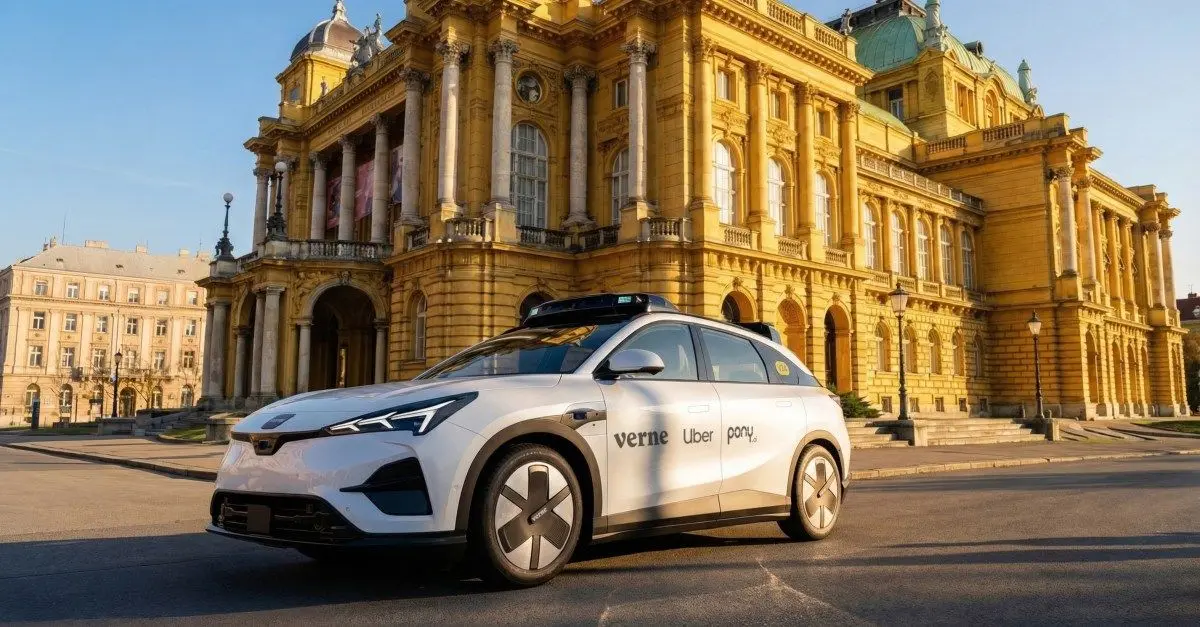
Pony AI, Uber, and Croatian startup Verne have announced a partnership to launch what they claim will be Europe's first commercial robotaxi service
1
. Testing is already underway on public roads in Zagreb, Croatia, where the service will debut soon, marking a significant expansion for both Pony AI and Uber into the European autonomous vehicle market2
. The partnership divides responsibilities strategically: Pony AI will provide its autonomous driving technology, Verne will act as fleet operator and service owner, and Uber will integrate the service into its global ride-hailing network3
.The companies are currently validating their technology using the Arcfox Alpha T5 Robotaxi, manufactured by state-owned Beijing Automotive Group Co (BAIC) and equipped with Pony AI's 7th generation self-driving technology providers stack
1
. The driverless vehicles will initially be available on Verne's app before expanding to Uber's platform, with ambitions to scale the fleet to thousands of robotaxis across multiple European cities over the next few years2
.
Source: The Verge
Strategic Positioning in the Robotaxi Race
For Uber, this partnership represents the latest effort to position itself as the dominant platform in the autonomous ride-sharing services era. The company aims to offer driverless rides in more than 10 markets this year, including Munich and the UK, as part of its goal to become the biggest robotaxi platform globally
2
. Uber has deliberately avoided developing its own autonomous technology after selling off its in-house research unit in 2020, instead partnering with more than 20 technology providers and car companies worldwide, including Alphabet Inc.'s Waymo in the US and WeRide Inc. in the United Arab Emirates2
.
Source: PYMNTS
This approach shields Uber from potential financial blowback as robotaxis threaten to overtake traditional ridehail business models
1
. By integrating autonomous fleets into its existing network, Uber maintains its position as the customer-facing platform while leaving the complex and capital-intensive work of developing autonomous technology to specialists like Pony AI.Pony AI's Global Expansion and Financial Momentum
For Pony AI, one of China's "Big Three" robotaxi companies, the European deployment represents a critical step in its global expansion strategy
4
. The company announced Thursday that its robotaxi fleet has surpassed 1,400 vehicles and has extended operations into Croatia as well as the Chinese cities of Hangzhou and Changsha3
. The company's financial performance shows strong momentum, with robotaxi revenues rising 160% year-over-year during the quarter, while fare-charging revenues jumped by more than 500%3
.Pony AI CEO James Peng highlighted Croatia's appeal, noting that "Croatia has a strong tourism profile and attracts large numbers of international visitors each year, which adds another dimension to long-term mobility demand"
4
. The company also achieved single-unit economics breakeven in Guangzhou and Shenzhen, meaning it books a profit every time it adds a car to its local fleet in these key Chinese markets4
. This profitability milestone signals that the company is moving closer to sustainable commercial operations.Related Stories

Competition Heats Up in European Markets
The Zagreb launch positions the partnership ahead of several competitors racing to deploy robotaxis in Europe. Waymo has announced plans to launch a robotaxi service in London sometime in 2026, while Uber is separately testing self-driving cars with Momenta in Germany
1
. Volkswagen has also committed to launching autonomous ride-sharing services under its subsidiary Moia in Germany1
. Pony AI's peers, including WeRide and Baidu's Apollo Go, have similarly expanded into European markets4
.Verne, the Croatian partner backed by Tasaru Mobility Investments (fully owned by Saudi Arabia's Public Investment Fund), spun off from supercar maker Rimac Group, which is 47% owned by Bugatti owner Rimac Group
2
. Mate Rimac, founder and CEO of Rimac Group, showcased a fleet of 60 prototype autonomous vehicles late last year, though whether those vehicles will eventually join Uber's fleet remains unclear1
. Verne has announced ambitions to launch a two-seater robotaxi without a steering wheel in 2026, which would rival Tesla Inc.'s Cybercab slated for production this year2
. Uber has agreed to invest in Verne to support future growth, with Verne leading the process of ensuring market readiness and obtaining European regulatory approval for these launches2
.Physical AI and the Path to Artificial General Intelligence
Dr. Tiancheng Lou, Pony AI's chief technology officer, positioned the company's work within the broader context of Physical AI development: "The robotaxi is the first true application of physical AI, with its core differentiator lying in driving capability, an area where our competitive edge remains unparalleled across the industry"
3
. Physical AI refers to systems that operate in real environments—robots, autonomous machines, and the foundational models that instruct them—going beyond content generation into physical world interaction3
.Some experts theorize that machines capable of perceiving, reasoning, and functioning in the physical world may be on a more direct path to reaching Artificial General Intelligence (AGI) than software running in data centers
3
. Nvidia CEO Jensen Huang declared at CES in January that the ChatGPT moment for robotics had arrived, suggesting the combination of AI models and computing infrastructure could soon unlock large-scale commercial adoption3
. This positions commercial robotaxi services not merely as a transportation innovation but as critical infrastructure for broader AI development.The partnership previously planned a rollout in the Middle East last year, though that has been postponed, with an Uber spokesperson declining to provide a reason for the delay while confirming the effort continues
2
. Pony AI has also struck a separate tie-up with auto giant Stellantis to deploy robotaxis in Europe, starting with test drives in Luxembourg, where the Chinese company's European division is based4
. As regulatory frameworks evolve and fleet management economics improve, the race to establish dominant positions in key European markets will determine which companies can translate technological capability into sustainable commercial success.References
Summarized by

Navi
[4]
Related Stories
Uber Expands Global Robotaxi Presence with Chinese Partnerships, Including Pony AI
07 May 2025•Technology

Pony AI swings to profit, plans robotaxi expansion to 20 cities with Uber partnership
Today•Technology

Uber Plans Strategic Investment in Autonomous Driving Firm Pony.ai's IPO
21 Nov 2024•Business and Economy

Recent Highlights
1
OpenAI shuts down Sora video app after six months, ending Disney's $1 billion investment deal
Technology

2
AI-Generated Val Kilmer to Posthumously Appear in As Deep as the Grave After His Death
Entertainment and Society

3
Supermicro Co-Founder Indicted in $2.5 Billion Nvidia AI Chip Smuggling Scheme to China
Policy and Regulation

Recent Highlights
Today's Top Stories







Your Daily Dose of Curated AI News
Don’t drown in AI news. We cut through the noise - filtering, ranking and summarizing the most important AI news, breakthroughs and research daily. Spend less time searching for the latest in AI and get straight to action.

