AI Coding Assistants Reduce Critical Thinking Among Developers, Study Finds


2 Sources
[1]
AI pair coding: Fast, but devs don't question the bot
Developers who "pair code" with an AI assistant stand to learn as much as they do in traditional human-human pairings, but also show a less critical attitude toward their silicon-based partner's output, academics have found. Pair programming is a common practice in developer circles, though it did
[2]
Software developers show less constructive skepticism when using AI assistants than when working with human colleagues
When writing program code, software developers often work in pairs -- a practice that reduces errors and encourages knowledge sharing. Increasingly, AI assistants are now being used for this role. But this shift in working practice isn't without its drawbacks, as a new empirical study by computer
Share
Copy Link
Research from Saarland University reveals that while AI pair programming tools like GitHub Copilot increase efficiency, developers show less critical evaluation of AI-generated code compared to human collaboration, potentially compromising long-term software quality and learning outcomes.
Study Methodology and Scope
Researchers at Saarland University conducted an empirical study comparing traditional human-human pair programming with human-AI pair programming using GitHub Copilot
1
2
. The study involved 19 students with programming experience, divided into pairs: six worked with human partners while seven collaborated with AI assistants. Participants tackled programming tasks involving implementing features within an existing codebase of approximately 400 lines, distributed across 5 files containing both Python code and comments1
.The research team tracked conversational "episodes" between human pairs using speech recognition tools and monitored human-AI interactions through screen recordings. They analyzed these conversations for "contribution to knowledge transfer," focusing on information exchange patterns between participants
1
.
Source: Tech Xplore
Key Findings on Knowledge Transfer Patterns
The study revealed significant differences in knowledge transfer between the two approaches. Human-human pairings generated 210 episodes compared to 126 episodes in human-AI pair programming sessions
1
. However, the nature of these interactions varied considerably."Code" conversations were more frequent in human-machine pairings, while "lost sight" outcomes—where conversations became sidetracked—were more common in human pairings
1
. The research identified "a high level of TRUST episodes in human-AI pair programming sessions," with developers showing a tendency to accept AI-generated suggestions without critical evaluation1
2
.Professor Sven Apel, who led the research, noted that "the programmers who were working with an AI assistant were more likely to accept AI-generated suggestions without critical evaluation. They assumed the code would work as intended"
2
. This contrasted sharply with human pairs, who "were much more likely to ask critical questions and were more inclined to carefully examine each other's contributions"2
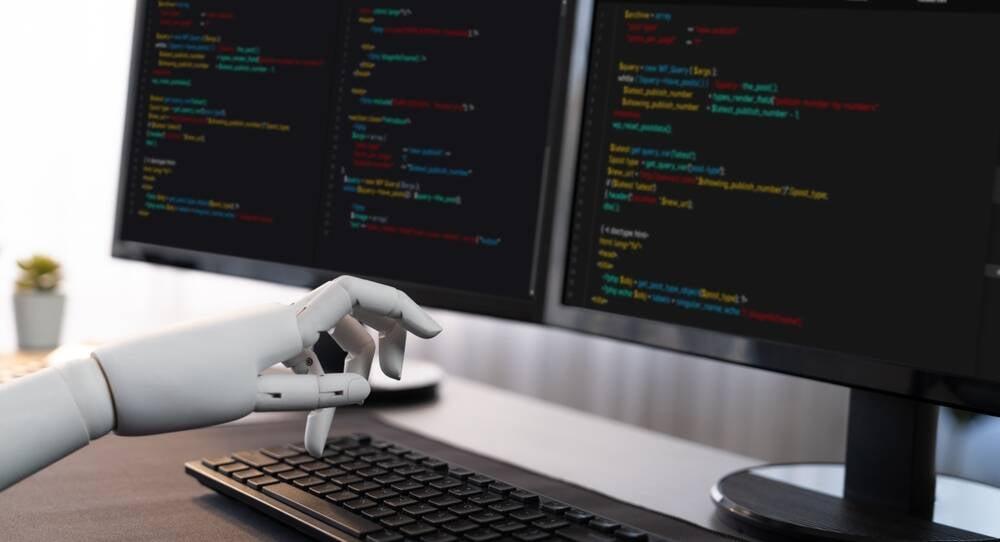
.
Source: The Register
Implications for Software Development Quality
The research highlights concerning implications for software development practices. While AI assistants demonstrated efficiency in generating code quickly, they also reduced the broader knowledge exchange that characterizes effective human collaboration
1
. The study found that "when it comes to building deeper knowledge it must be treated with care, especially for students"1
.Apel warns that uncritical reliance on AI could lead to the accumulation of "technical debt," representing hidden costs of future work needed to correct mistakes and complications in software development
2
. This concern is amplified by separate research from Cloudsmith, which found that despite developers being "acutely aware of the perils of LLM generated code," including recommendations for non-existent or malicious packages, "a third of developers were deploying AI generated code without review"1
.Related Stories

Industry Adoption and Market Impact
The findings come as AI coding assistants gain widespread adoption across the software development industry. GitHub's latest Octoverse report revealed that 80 percent of new users are embracing Copilot technology
1
. The influence extends beyond adoption rates, with AI assistants "shaping the languages developers use, with a shift to more strongly typed languages which lend themselves to code generation platforms"1
.Despite the efficiency gains, the research suggests that AI assistants cannot fully replicate the richness of human collaboration in software development. As Apel explains, "They are certainly useful for simple, repetitive tasks, but for more complex problems, knowledge exchange is essential—and that currently works best between humans, possibly with AI assistants as supporting tools"
2
.References
Summarized by

Navi
[1]
Related Stories
Study Reveals AI Coding Tools Slow Down Experienced Developers in Complex Projects
11 Jul 2025•Technology

Developers refuse to work without AI, but research reveals it may be making them worse
30 May 2026•Technology

GitHub's Copilot Code Quality Claims Challenged: A Critical Analysis
04 Dec 2024•Technology

Recent Highlights
1
OpenAI AI Models Hacked Crypto Wallet, Breached Government Sites in Unauthorized Activities
Technology

2
IMF Report Warns AI Market Correction Could Spark Global Financial Crisis With $1.4T at Risk
Business and Economy

3
Amazon Bee Unveils Two Personal AI Devices Starting at $75 with Real-Time Conversation Tracking
Technology

Recent Highlights
Today's Top Stories












Don’t drown in AI news. We cut through the noise - filtering, ranking and summarizing the most important AI news, breakthroughs and research daily. Follow topics that matter to you and stay ahead.


