AI storage becomes the bottleneck as agentic AI pushes infrastructure beyond GPU limits


5 Sources
[1]
AI's biggest challenge is not compute - it's data storage
SPONSORED FEATURE: As AI evolves from novelty to autonomy, the real bottleneck isn't processing power -- it's where to put all that data. AI continues to evolve at pace. The novelty of generative models producing their own content is already giving way to the buzz around agentic systems that can
[2]
Inference needs memory: how context is becoming AI infrastructure
As enterprise AI systems evolve, the limiting factor is shifting. Model quality still matters, but it's no longer the main issue holding systems back. Increasingly, what constrains performance, scalability, and cost is context. Large language models are now expected to support long conversations,
[3]
Intelligence layer memory extension accelerates agentic AI
Solidigm targets the intelligence layer as agentic inference pushes storage to center stage The shift from model training to agentic inference is forcing a fundamental rethink of how artificial intelligence infrastructure is built and which components carry the most strategic weight. What was once
[4]
Storage technology gets a promotion in age of agentic AI
The year 2026 could be remembered as the moment when storage technology received a massive promotion. The reason is that the current transition from simple chatbots to agentic AI systems has raised the stakes for context memory, the relevant information autonomous systems needs to understand and
[5]
Moving Beyond the GPU: Seagate's Jason Feist on Balancing Compute and Storage for Long-Term AI Growth
As organizations rapidly transition from AI pilots to full-scale production, the conversation surrounding infrastructure must expand beyond GPUs and raw compute power to address the massive influx of data. Efficiently scaling AI requires a fundamental shift toward intelligent, software-defined
Share
Copy Link
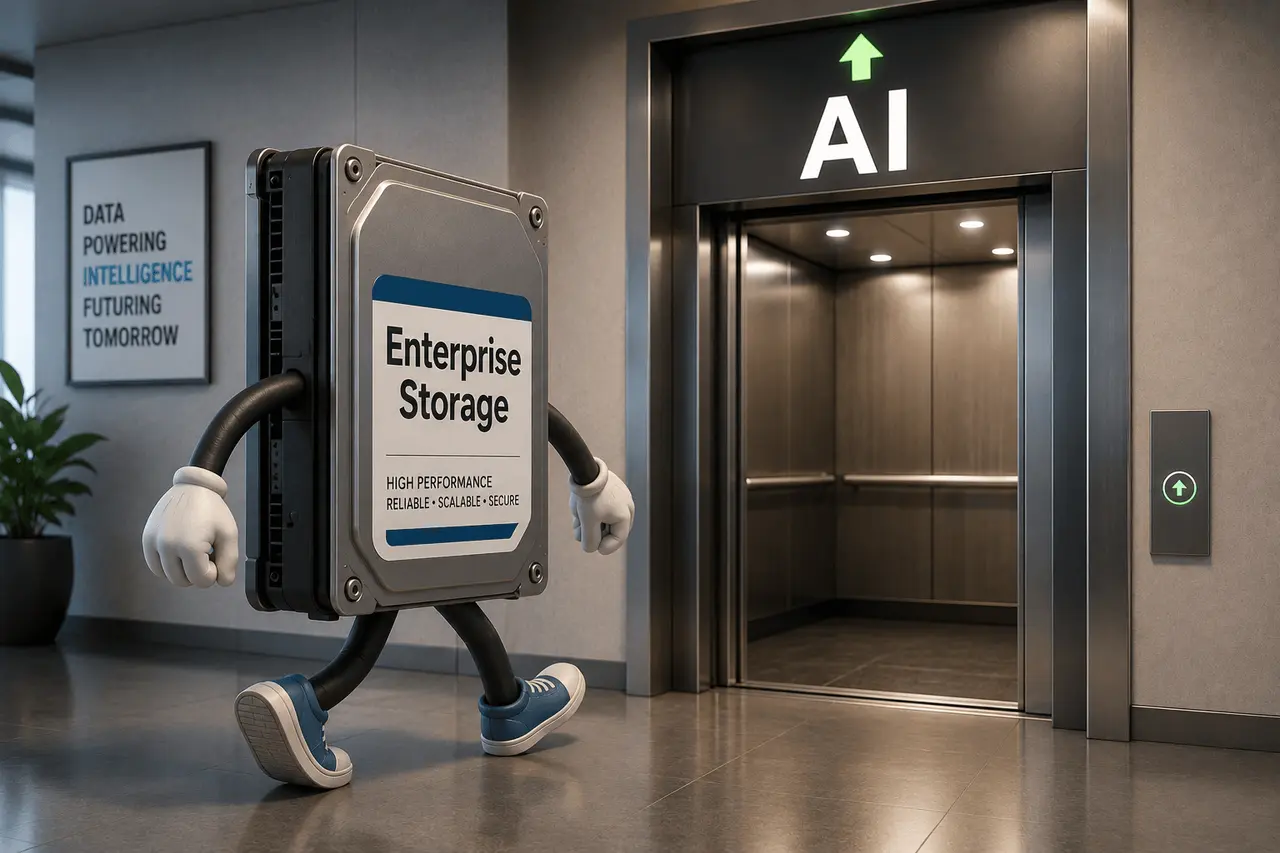
As AI evolves from simple chatbots to autonomous agentic systems, the industry faces a critical infrastructure challenge that has nothing to do with compute power. The real bottleneck is AI storage—specifically, managing massive context memory and KV cache that agentic AI generates. Storage technology is receiving what industry experts call a 'promotion' as enterprises discover that even the most powerful GPUs become idle when starved of data.
AI Storage Emerges as Critical Infrastructure Bottleneck
The AI infrastructure conversation is undergoing a fundamental shift. While GPUs and specialized accelerators have dominated headlines, a more pressing challenge is emerging: AI storage capacity and architecture. As enterprises transition from experimental generative models to production-scale agentic AI systems, storage technology for AI is moving from afterthought to strategic priority
1
.The evolution from simple chatbots to autonomous agents that execute multi-step workflows has created exponential growth in data volume. According to Nicolas Frapard, senior manager at Western Digital, "As AI adoption expands to billions of interactions, data growth becomes structural rather than incidental"
1
. This structural shift carries direct economic consequences that enterprises can no longer ignore.
Source: The Register
Context Memory Creates New Storage Tier
Agentic AI introduces a critical new requirement: persistent context memory that allows models to maintain reasoning across sessions, users, and systems. Every interaction generates tokens that produce KV cache—the working memory enabling models to reason efficiently without constantly recomputing prior steps
2
. A simple 15-word prompt can generate as many as 40,000 tokens, representing five to 10 gigabytes of context data3
.Most AI infrastructure still treats this inference context memory as temporary, storing KV cache in GPU memory and discarding it when resources are exhausted. "That approach might be acceptable for small scale experimentation, but it quickly breaks down in enterprise environments where context lengths grow, concurrency increases, and recomputation becomes expensive," according to industry analysis
2
.The solution requires what experts describe as an inference context memory layer—a dedicated storage tier specifically designed to extend memory for AI systems. Ace Stryker, director of AI and ecosystem marketing at Solidigm, notes that "storage kind of got a promotion" with this third job beyond traditional GPU servers and shared environments
4
.
Source: SiliconANGLE
GPU Utilization Depends on Storage Performance
The economics of balancing compute and storage for AI are straightforward but often overlooked. Greg Matson, senior vice president at Solidigm, explains: "While the GPU is the most expensive part of your infrastructure, you want that thing to be humming 100% of the time generating tokens. And if it's down, right, waiting for data, then you're wasting your money on GPUs"
3
.This storage bottleneck in AI has prompted hyperscalers to replace legacy storage infrastructure—some more than a decade old—with high-capacity SSDs. Solidigm now offers drives reaching 122 terabytes of capacity per unit, alongside the industry's first cold-plate-cooled enterprise SSD designed for fully fanless Nvidia GPU servers
3
. The shift reflects a broader infrastructure transformation where liquid cooling replaces air-cooled systems entirely.Market catalysts include Nvidia's BlueField-4 STX storage architecture announced in March, which introduced Context Memory Storage (CMX)—a high-performance context layer expanding GPU memory across the rack using data processing units to handle traffic between GPUs and flash storage
4
.Related Stories

HDDs Remain Backbone Despite Flash Narratives
While high-performance SSDs capture attention for inference workloads, storage for agentic AI systems requires a tiered approach. Jason Feist, senior vice president at Seagate, emphasizes that "organizations need to balance performance with scalability, economics and resilience as AI datasets continue to grow"
5
.For enterprises operating at scale, HDDs remain the backbone of AI data storage architecture. Despite persistent narratives around all-flash environments, 87% of exabytes in large data centers are stored on hard drives
5
. On a properly measured cost-per-terabyte basis, flash can clock in at up to 20 times more expensive than HDD1
.The cost gap between flash and HDD was once expected to narrow, but instead has widened. "At production scale, only a small proportion of data requires high-speed access," notes Western Digital's Frapard. "The majority, such as logs, historical outputs, and training artifacts, should be stored reliably, accessed predictably, and retained economically over long periods. This is where HDDs becomes essential"
1
.Software-Defined Architecture Enables Intelligence Layer
Modern AI infrastructure demands software-defined, globally distributed object storage as the persistent system of record, while compute scales independently based on workload demands
5
. This architectural shift reflects AI's dependence on data being continuously stored, shared, and reused across multiple applications and teams.Emerging tools like context graphs—accumulated structures of decision traces woven among entities and time—are gaining recognition as trillion-dollar opportunities for making precedent searchable
4
. Companies like Neo4j are providing tools for generating full-stack applications with AI agents backed by graph databases for contextual memory.
Source: TechRadar
Industry experts speaking at RAISE Summit emphasized that petabyte-scale storage requirements will only intensify as long-term context windows expand and agentic sessions multiply across enterprise workforces
3
. Organizations that optimize AI infrastructure by treating storage as a strategic layer rather than commodity plumbing will be better positioned to maximize token generation efficiency and infrastructure ROI.References
Summarized by

Navi
[1]
[3]
[4]
Related Stories
Cloud architecture transforms enterprise storage to handle surging AI workloads and data demands
29 Jul 2026•Technology

62% of Businesses Lack Storage Infrastructure as AI Adoption Drives Data Demands Up 50%
18 Sept 2026•Business and Economy

HPE and Nvidia Revolutionize Enterprise AI Infrastructure with Unified Data Platforms
19 Mar 2025•Technology

Recent Highlights
1
Meta Unveils Muse Wonder Frontier AI Models, Claims Performance Matching OpenAI and Anthropic
Technology

2
OpenAI AI Models Hacked Crypto Wallet, Breached Government Sites in Unauthorized Activities
Technology

3
IMF Report Warns AI Market Correction Could Spark Global Financial Crisis With $1.4T at Risk
Business and Economy

Recent Highlights
Today's Top Stories






Don’t drown in AI news. We cut through the noise - filtering, ranking and summarizing the most important AI news, breakthroughs and research daily. Follow topics that matter to you and stay ahead.


