Amazon's Vulcan: The Warehouse Robot with a 'Sense of Touch' Reshaping Automation


2 Sources
[1]
Amazon's new warehouse robot has a 'sense of touch' that could see it replace human workers
Amazon's Vulcan robot picks up items from storage trays. (Image credit: Amazon) Amazon has announced a new robot with a sense of touch, enabling it to pick up and stow around three-quarters of the items found in its warehouses. The new robot, called Vulcan, can accurately gauge the pressure
[2]
Amazon unveils warehouse robot with sense of touch, raising more...
What just happened? Amazon has unveiled a revolutionary new robot that has a sense of touch, which will allow it to handle around three quarters of all items in the company's warehouses at a speed comparable to humans. It's a worrying claim for the hundreds of thousands of people in Amazon's
Share
Copy Link
Amazon unveils Vulcan, a revolutionary warehouse robot with touch sensitivity, capable of handling 75% of warehouse items. While improving efficiency, it raises questions about the future of human workers in Amazon's facilities.
Amazon Introduces Groundbreaking Warehouse Robot with Touch Sensitivity
Amazon has unveiled Vulcan, a revolutionary warehouse robot equipped with a "sense of touch," marking a significant advancement in automation technology. This innovative robot can handle approximately 75% of the items found in Amazon's warehouses, operating at speeds comparable to human workers
1
2
.Vulcan's Technological Prowess
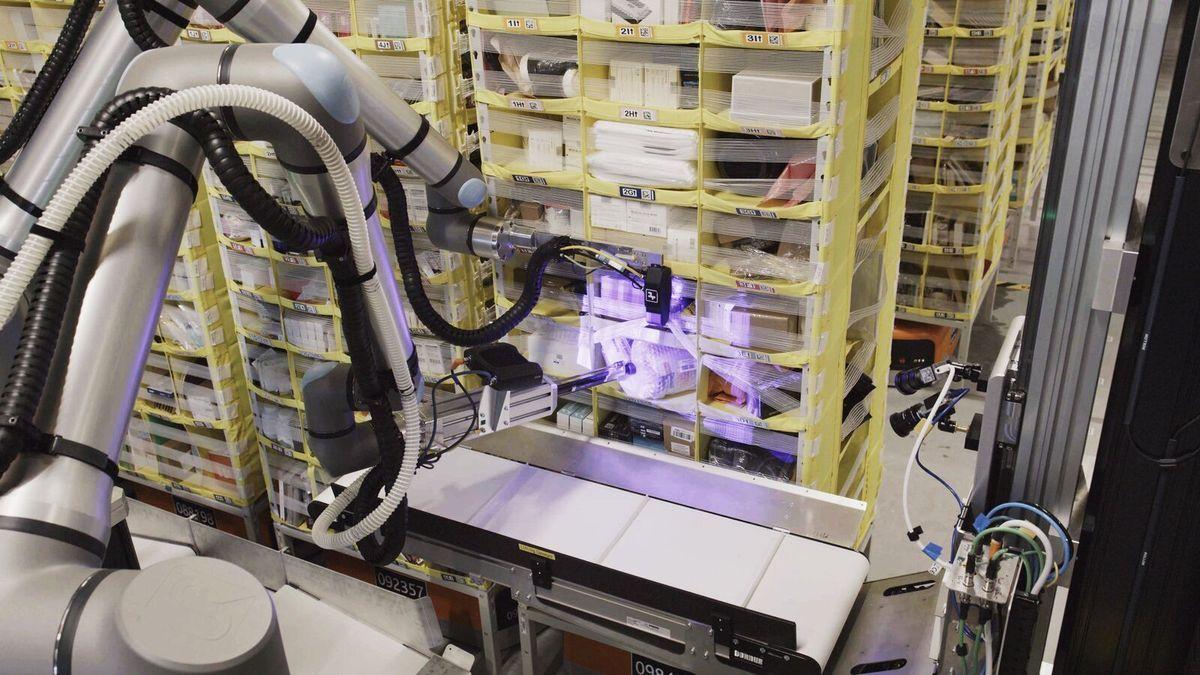
Source: Live Science
Vulcan represents a "fundamental leap forward in robotics," according to Aaron Parness, Amazon's director of applied science. The robot's key feature is its ability to accurately gauge the pressure required to grab and move warehouse items based on their size, dimensions, and density
1
.To achieve this human-like touch sensitivity, Vulcan employs a sophisticated system:
- A wand with an item-identifying camera and a suction cup
- A two-part robotic arm for gripping and pulling items
- An AI-powered sensor that determines the exact amount of pressure and torque needed to safely handle objects
1
2
This advanced system allows Vulcan to interact with a wide range of items, including delicate ones that previous robots struggled to manipulate.
Operational Capabilities and Deployment
Vulcan is currently operational in Amazon's fulfillment centers in Spokane, Washington, and Hamburg, Germany. The robot can handle items weighing up to 8 pounds and works behind a fence to reduce the risk of accidents involving human workers
1
2
.Key operational features include:
- Ability to work 20 hours per day
- Capability to reach items stored 8 feet high, eliminating the need for employees to use ladders
- Handling of items stored just above the floor, reducing ergonomic stress on human workers
1
2
Impact on Amazon's Workforce and Operations
Amazon's deployment of Vulcan and other robots has seen a significant increase, with the number of robots in its warehouses growing from 350,000 in 2021 to more than 750,000 today. This robotic workforce nearly matches Amazon's 1 million human employees
1
2
.The company claims that this robotic fleet will:
- Improve efficiency in warehouse operations
- Reduce ergonomic stress on human employees
- Create new job categories, such as robotic floor managers and quality control specialists
1
However, an internal document acquired by Business Insider revealed that Amazon's robots are "critical to flattening Amazon's hiring curve over the next ten years," potentially saving the company up to $10 billion annually by 2030
1
.Related Stories

Concerns and Reassurances
The introduction of Vulcan has raised concerns about the future of human workers in Amazon's facilities. However, Amazon maintains that the new robot will work alongside humans rather than replace them
2
.Aaron Parness, who leads the Amazon Robotics team that developed Vulcan, stated, "I don't believe in 100% automation. If we had to get Vulcan to do 100% of the stows and picks, it would never happen." He added that Amazon would never have a fully automated warehouse in the future
2
.To address potential job displacement concerns, Amazon claims to have spent $1.2 billion since 2019 on upskilling human workers, preparing them for new roles in robot maintenance, operation, installation, and construction
2
.Broader Industry Trends
Amazon is not alone in embracing advanced robotics. Other companies, such as GXO Logistics, a global contract logistics company, have been testing similar autonomous machines in their facilities
2
. This trend suggests a broader shift towards automation in the logistics and warehousing industry, potentially reshaping the future of work in these sectors.References
Summarized by

Navi
[1]
Related Stories
Amazon Unveils Vulcan: A Warehouse Robot with Human-Like Touch Sensing
07 May 2025•Technology

Amazon's Proteus robot now takes plain language orders as €10bn warehouse automation push begins
04 Jun 2026•Technology

Amazon's Warehouse Robots: Revolutionizing Efficiency, but Challenges Remain
20 Nov 2024•Technology

Recent Highlights



Recent Highlights
Today's Top Stories



Don’t drown in AI news. We cut through the noise - filtering, ranking and summarizing the most important AI news, breakthroughs and research daily. Follow topics that matter to you and stay ahead.


