Anthropic Launches Smart Reports to Help Enterprises Track AI Spending and ROI


3 Sources
[1]
Anthropic just launched tools to show companies what their AI spending is buying
The financials Anthropic shared with investors this week suggest that its AI coding tool, Claude Code, is every bit the business success the frontier lab wanted. The company recorded an operating profit in the second quarter, and 900% net revenue retention -- that is, spending from the same
[2]
These Claude Enterprise features let you track AI ROI - what's new - ZDNET
Is your pricey Claude Enterprise account worth it? Anthropic is trying to surface insights with three tools. * Many businesses still want more clarity on AI ROI. * Claude Enterprise features, now generally available, capture output metrics and centralize budget info. * Anthropic needs to sustain
[3]
Smart Reports: Anthropic's Way of Helping Users to Measure AI Spends and Value Thereof
This appears to be Anthropic's way to reduce the noise around AI payoffs to enterprises, if not shut it down completely For those of us with a sense of humour, the irony is not lost around what Anthropic's latest ploy. A full day after sharing their own financials with prospective investors via
Share
Copy Link
Anthropic introduced Smart Reports and new tracking features for Claude Enterprise customers to measure AI spends and value. The tools show team output, costs, and workflow breakdowns while offering optimization recommendations. This comes as the company reported 900% net revenue retention and filed for IPO.
Anthropic Introduces Tracking Tools to Address Enterprise AI Spending Concerns
Anthropic announced a suite of reporting tools designed to give enterprise customers granular visibility into their AI spending and ROI, addressing a critical concern as businesses struggle to justify their AI investments
1
. The timing is notable—these Claude Enterprise features became generally available just one day after Anthropic filed its IPO prospectus with the SEC, revealing 900% net revenue retention and an operating profit in Q22
3
. Customer spending grew nine times between Q3 2025 and Q3 2026, driven largely by the success of Claude Code, Anthropic's AI coding tool1
3
.Smart Reports and Pooled Budgets Transform Cost Management
Source: TechCrunch
The new tracking features—Smart Reports, pooled group budgets, and in-app surveys—were released in beta in September and are now available for all Claude Enterprise plans
2
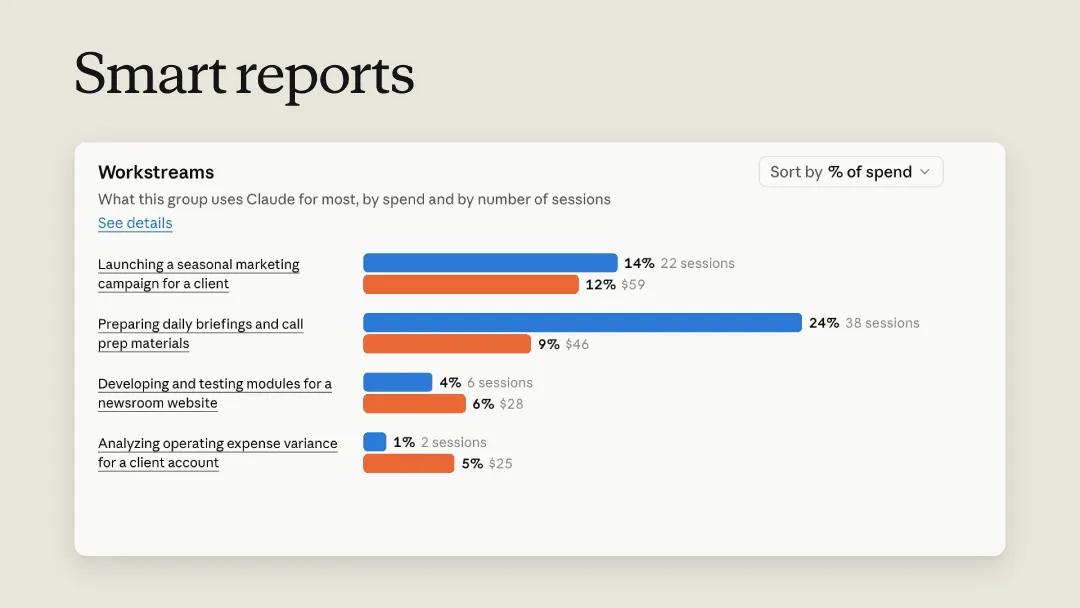
. Smart Reports use internal analytics and employee surveys to show managers what their teams produced over specific date ranges, how much it cost, and where workflow breakdowns occurred1
3
. The reports also identify opportunities to create routine workflows from consistently run tasks and provide recommendations for improving results. Anthropic emphasized that this data won't be used for model training by default and noted that Smart Reports "aren't designed and should not be used for evaluating individual performance or making employment decisions"2
.Pooled group budgets address a common pain point by setting monthly spend caps for entire teams in addition to individual seat limits
2
. This prevents highly active users from being constrained while others leave token spend unused. Admins can configure individual and group spend limits based on historical data, and users can belong to multiple budgets ordered by priority2
.AI Spending Optimization Becomes Critical as Costs Surge

Source: ZDNet
The need to measure AI spends and value has become urgent as companies grapple with unexpectedly rapid cost growth. Research from Jellyfish, which analyzed 276,000 software developers, found that spending on agentic coding tools has grown 10x since the beginning of the year, now equaling approximately 2% of total engineering cost
1
. "Even if you're saying 2% is still small, that 10x growth is growth that most CFOs didn't plan for," Nicholas Arcolano, chief scientist at Jellyfish, told TechCrunch1
. Claude Code and other Anthropic models remain the most widely used, responsible for nearly a third of all proposed code changes submitted for review1
3
.Yet many businesses remain skeptical about AI ROI. While venture-backed firms are driving token spend, most Fortune 500 companies aren't seeing major gains from AI deployment
1
3
. Apollo Global Management's chief economist Torsten Slok even claimed AI had delivered "zero financial payoffs"3
. These reporting tools appear designed to reduce noise around AI productivity and provide the proof points enterprise customers need.Related Stories

Enterprise Stickiness Gives Anthropic Competitive Edge

Source: CXOToday
Anthropic has maintained its lead among enterprise customers despite competition from OpenAI's Astra model, released this summer
1
. "Anthropic was just there with great enterprise motions, and they had an incumbent weight of their own—this stuff just worked and worked well, and a lot of people just put a lot of effort into standardizing workflows around it. And there's not a big enough reason to switch," Nikolas Albarran, AI product lead at Jellyfish, told TechCrunch1
.Switching costs are significant once a frontier lab has embedded itself within an organization. Investment in forward-deployed engineering (FDE) teams—AI consultants embedded inside customer organizations—creates additional friction
1
. These new reporting tools function as "FDE-lite," providing lighter-touch support that helps customers optimize their workflows without requiring dedicated consultants.High Stakes for Customer Retention Ahead of IPO
The focus on customer retention carries heightened importance as Anthropic pursues its IPO. Claude Enterprise, priced at $20 per seat per month plus API token rates, represents a significant investment compared to Claude Teams, which costs the same per seat but caps at 150 users and includes tokens
2
. Companies making enterprise-level AI investments need clear evidence of value to justify continued spending, especially as Ramp data shows Anthropic spend peaked in July and has declined slightly through October2
.Anthropic's IPO prospectus acknowledged this risk directly: "If the market for our models, platform, and applications develops more slowly than we expect or declines, our growth may slow or stall, and our business, financial condition, and results of operations could be adversely affected"
2
. In a potentially volatile market facing bubble concerns, sustaining high customer growth becomes essential. These AI tracking features represent both a response to customer demands for transparency and a strategic move to lock in enterprise customers by demonstrating measurable productivity gains and helping them optimize AI spending before competitors can offer similar capabilities.References
Summarized by

Navi
Related Stories
Anthropic Launches Smart Reports to Track How Employees Use Claude at Work
29 Oct 2026•Technology

Anthropic Launches Financial Analysis Solution and Analytics Dashboard for Claude Code
15 Jul 2025•Technology

Anthropic launches enterprise AI agents with plugins for finance, HR, and investment banking
24 Feb 2026•Technology

Recent Highlights


Recent Highlights
Today's Top Stories









Don’t drown in AI news. We cut through the noise - filtering, ranking and summarizing the most important AI news, breakthroughs and research daily. Follow topics that matter to you and stay ahead.


