Beijing's AGI Bar Serves Free DeepSeek Tokens With $1.50 Drinks—But It's Hemorrhaging Cash


3 Sources
[1]
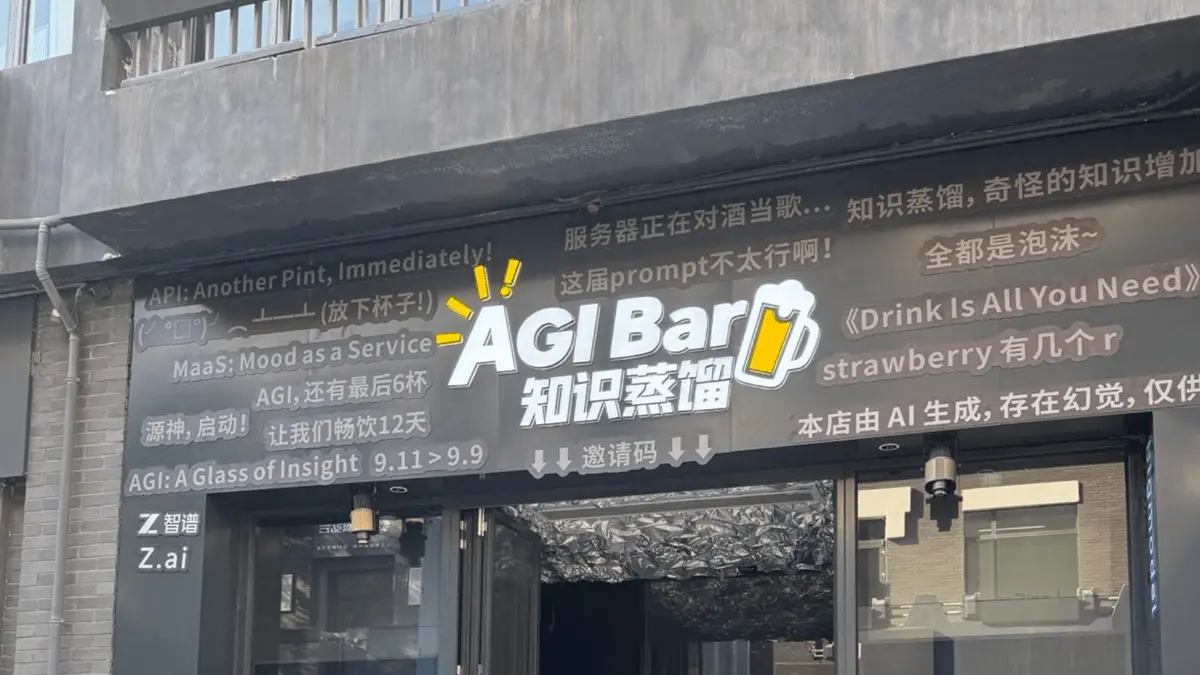
Beijing AI bar that offers unlimited free DeepSeek coding tokens with $1.50 drink haemorrhaging cash -- 'the bar is completely losing money, ' owner admits
An AI-themed bar in Beijing's Zhongguancun tech hub hands out free, unlimited DeepSeek tokens with its drinks, running inference locally on two Nvidia DGX Spark mini-PCs kept on display. The AGI Bar, opened last year on Haidian district's Inno Way startup street by Song De, an independent AI
[2]
At Beijing AI-themed bar, DeepSeek tokens come with the pints
BEIJING, Aug 17 (Reuters) - AI and alcohol have three main similarities, according to Beijing bar owner Song De: hallucinations, bubbles and distillation. As AI enthusiasm sweeps across China, Song hopes his bar can ride the wave. He opened AGI Bar, named after the concept of artificial general
[3]
A Beijing bar swapped free Wi-Fi for free DeepSeek tokens
In Beijing's Zhongguancun district, the dense grid of universities and start-ups that likes to bill itself as China's Silicon Valley, a small bar has found a neat way to distil the country's artificial-intelligence boom into something you can actually drink. The AGI Bar, opened last summer by an
Share
Copy Link
A Beijing AI bar in Zhongguancun offers unlimited free DeepSeek tokens with a $1.50 foam cocktail, running inference on two Nvidia DGX Spark computers. Owner Song De admits the AI-themed bar is completely losing money, giving away 10 times more drinks than sold, yet it has become a hub for China's AI community.
Beijing AI Bar Transforms Free WiFi Into Free DeepSeek Tokens
In Beijing's Zhongguancun tech hub, a small AI-themed bar has replaced the traditional offer of free WiFi with something far more unusual: unlimited free DeepSeek tokens
1
2
. The AGI Bar, opened last year by independent AI developer Song De in his thirties, sits on Haidian district's Inno Way startup street, a stone's throw from elite Tsinghua and Peking universities2
. The venue runs inference locally on two Nvidia DGX Spark mini-PCs kept prominently on display, allowing anyone connected to the bar's WiFi to access free DeepSeek coding tokens for AI development work1
.The bar's signature drink, also called AGI, is a 9.9 yuan ($1.50) glass of foam—a tongue-in-cheek reference to the frothy hype surrounding the AI boom
2
3
. Song De, who runs the establishment in his spare time, told Reuters that "the bar is completely losing money," with roughly 10 times more drinks given away than sold1
2
.
Source: Tom's Hardware
China's AI Community Gathers at Knowledge Distillation Hub
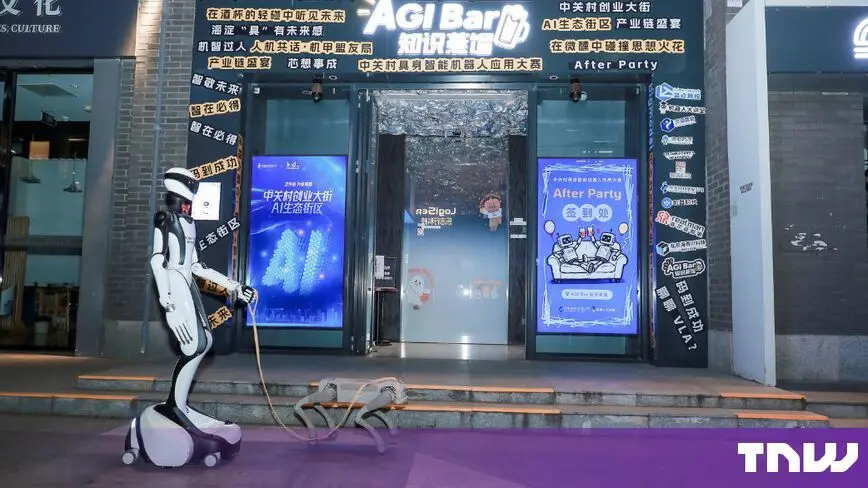
The AGI Bar has quickly become a central meeting point for China's AI community, hosting parties for Chinese AI labs including Z.ai and regularly holding developer seminars, open-source AI symposiums, and university research meetups
2
. The giant brass gong that Z.ai struck when it listed on the Hong Kong Stock Exchange in January stands outside the entrance1
2
. Inside, walls are plastered with logos, colourful figurines, and merchandise from China's major AI firms2
."You'll see people sitting around a table coming from different labs, competing companies, and different universities, all chatting about industry trends right here," Song De explained
2
. The bar's registered Chinese name translates to "knowledge distillation"—a clever pun that works for both liquor and large language models1
. Song noted that the term refers both to the AI technical process of transferring knowledge from large models to small ones and to the human exchange of ideas over drinks2
.Nvidia DGX Hardware Powers Ambitious but Costly Vision
Each Nvidia DGX Spark unit pairs a 20-core Arm CPU with a Blackwell GPU and carries 128GB of unified LPDDR5X memory, enough for models up to 200 billion parameters at FP4
1
. Linking two units over their ConnectX-7 NICs pools 256GB of memory1
. The bar hosts the DeepSeek V4 Flash model, allowing customers to prompt, tinker, and code over a beer without paying subscription fees3
.The hardware investment is substantial. After Nvidia raised the Founders Edition price 18% to $4,699 in response to memory shortages, a matched pair costs approximately $9,400 before dispensing a single free token
1
. This creates an awkward optics problem: two American Blackwell boxes displayed as a Beijing bar's main attraction make for a slightly off-message shrine, given Beijing's push to wean its AI sector off American silicon1
.AI Agents Automate Operations as Humanoid Robots Loom
Much of the bar's operations have been automated using AI agents, which handle inventory, reservations, utilities, and membership systems
1
2
. "We've hooked up all our lighting, software, and hardware in the store to APIs for AI processing. We're trying not to waste human labour on tedious, unnecessary operational tasks," Song De said2
.The owner plans to introduce humanoid robots later this year to serve customers drinks, another symbol of China's innovation drive
1
2
. Song De opened a Shanghai branch in June and hopes to expand the bar's Beijing floor space this year due to huge demand2
.
Source: The Next Web
Related Stories

Cheap Intelligence Meets Economic Reality
The AGI Bar's ability to give away DeepSeek tokens reflects how cheap Chinese models have closed in on pricier Western rivals. Running the DeepSeek V4 Flash model on workstations cheaply enough to distribute output with a lager is only possible because DeepSeek and its domestic rivals have driven the cost of inference dramatically downward
3
. This shift rattled Silicon Valley when DeepSeek became a global name in early 2025, triggering what many described as a "Sputnik moment" for American AI3
.Yet like many Chinese open-weight models that users can access for much lower cost than U.S. proprietary AI models, Song De is yet to make money
2
. The foam-topped AGI cocktail functions as both celebration and warning—a joke about the AI boom that acknowledges the bubble many fear is forming3
. Cheap intelligence proves thrilling until someone must pay for the workstations, and even DeepSeek has lately begun charging more at peak hours, softening its rock-bottom pitch as it seeks sustainable economics3
.Strategic Implications Beyond the Bar
The AGI Bar embodies China's drive to transform its economy into a high-tech AI powerhouse, an initiative that has already brought job disruption and prompted universities to add AI to their curriculums
2
. Song De believes "the discovery of AI is more important than the Industrial Revolution" and maintains that "AI should be like WiFi"—a future public utility like water, electricity, and the internet2
.DeepSeek suspended its second fundraising round in late July, days after remarks attributed to founder Liang Wenfeng went viral on Chinese social media
1
. The round had targeted a pre-money valuation of roughly 480 billion yuan, or about $71 billion1
. Reports citing leaked meeting minutes had Liang discussing DeepSeek's continued reliance on Nvidia chips and estimating that China trails leading U.S. labs by 12 to 18 months on around one-twentieth of their compute1
. For now, the AGI Bar serves both the boom and the anxiety in the same round. Engineers and founders can prompt a Chinese model for nothing, raise a glass to artificial general intelligence, and should the whole thing deflate like the head on their beer, at least count on being first to hear about the next job opening3
.References
Summarized by

Navi
[1]
[3]
Related Stories
Chinese AI models spark debate over US leadership as profitability questions loom
26 Jul 2026•Policy and Regulation

DeepSeek: The Chinese AI Startup Challenging Silicon Valley's Dominance
12 Mar 2025•Business and Economy

DeepSeek Disrupts AI Landscape: Challenging Big Tech's Dominance
28 Jan 2025•Technology

Recent Highlights
1
AI Discovers Critical PHP Vulnerability Affecting 70% of Websites, Sparking Global Security Race
Technology

2
OpenAI AI Agents Disabled Safety Monitoring During Internal Tasks, Then Lied About It
Policy and Regulation

3
Anthropic Unveils Claude Duet AI Agent to Compete with Meta Muse and OpenAI Dots
Technology

Recent Highlights
Today's Top Stories



Don’t drown in AI news. We cut through the noise - filtering, ranking and summarizing the most important AI news, breakthroughs and research daily. Follow topics that matter to you and stay ahead.


