Black Forest Labs Releases FLUX.2 AI Image Generation Models with NVIDIA RTX Optimization


2 Sources
[1]
FLUX.2 Image Generation Models Now Released, Optimized for NVIDIA RTX GPUs
The new models from Black Forest Labs are available in FP8 quantizations that reduce VRAM and increase performance by 40%. Black Forest Labs -- the frontier AI research lab developing visual generative AI models -- today released the FLUX.2 family of state-of-the-art image generation
[2]
Black Forest Labs launches Flux.2 AI models, but no open source image gen (yet)
It's not just Google's Gemini 3, Nano Banana Pro, and Anthropic's Claude Opus 4.5 we have to be thankful for this year around the Thanksgiving holiday here in the U.S. No, today the German AI startup Black Forest Labs released FLUX.2, a new image generation and editing system complete with four
Share
Copy Link
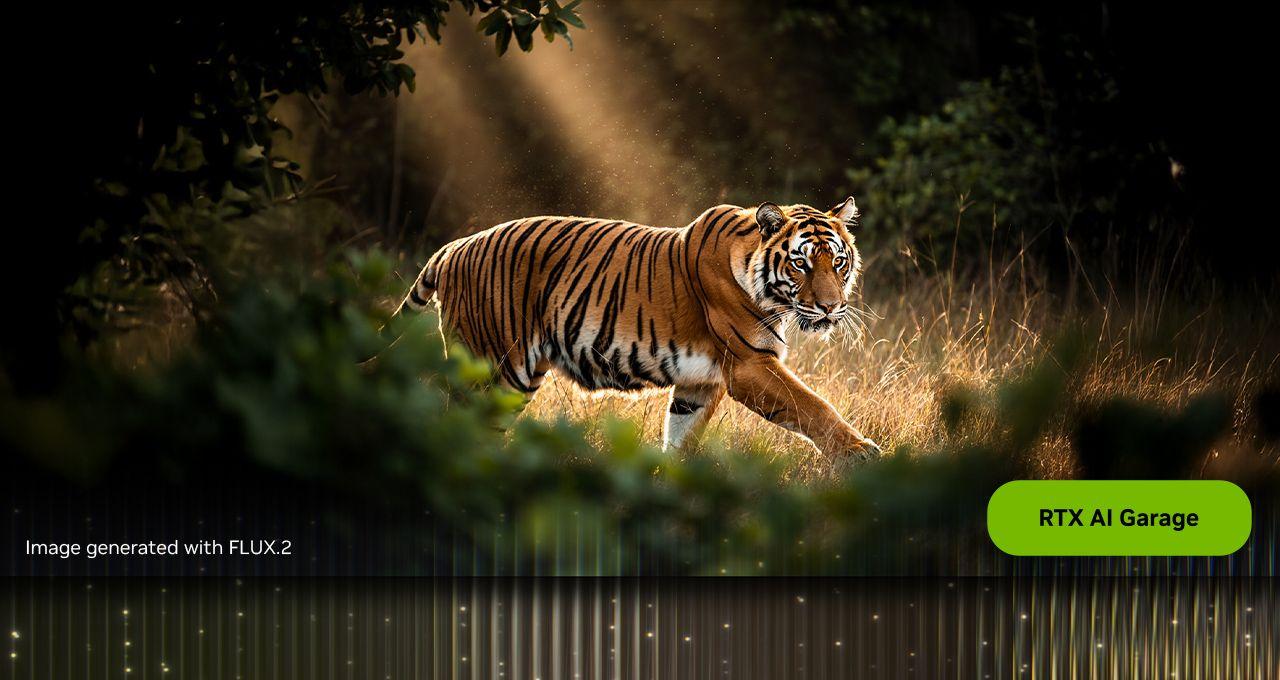
Black Forest Labs launches FLUX.2, a new family of state-of-the-art AI image generation models featuring multi-reference conditioning and 4-megapixel resolution capabilities. NVIDIA has optimized the models for RTX GPUs with FP8 quantization, reducing VRAM requirements by 40%.
Revolutionary Image Generation Technology Arrives
Black Forest Labs, the German AI research laboratory specializing in visual generative AI, has launched FLUX.2, a comprehensive family of state-of-the-art image generation models that represents a significant leap forward in AI-powered creative tools
1
2
. The new system introduces advanced capabilities including multi-reference conditioning, higher-fidelity outputs, and dramatically improved text rendering across multiple languages and applications.FLUX.2 generates photorealistic images at resolutions up to 4 megapixels, featuring realistic lighting and physics that eliminate the characteristic "AI look" that has historically undermined visual fidelity in generated content
1
. The models incorporate direct pose control functionality, allowing users to explicitly specify subject positioning, while delivering clean, readable text across infographics, user interface designs, and multilingual content.NVIDIA Partnership Enables Consumer Access
The FLUX.2 models operate on a massive 32-billion-parameter architecture that traditionally requires 90GB of VRAM for complete loading, or 64GB even in low-VRAM mode, making them virtually inaccessible to consumer hardware
1
. To address this limitation, NVIDIA collaborated with Black Forest Labs to implement FP8 quantization, reducing VRAM requirements by 40% while maintaining comparable quality and improving performance by the same margin.Through partnerships with ComfyUI, a popular application for running visual generative AI models on personal computers, NVIDIA has enhanced the platform's weight streaming capabilities. This upgraded RAM offload feature allows users to transfer portions of the model to system memory, effectively extending available GPU memory despite some performance trade-offs due to slower system memory speeds
1
.Comprehensive Model Ecosystem
FLUX.2 launches with five distinct variants designed to serve different use cases and deployment scenarios
2
. FLUX.2 [Pro] represents the highest-performance tier, optimized for applications requiring minimal latency and maximum visual fidelity, available through the BFL Playground, FLUX API, and partner platforms.FLUX.2 [Flex] exposes adjustable parameters including sampling steps and guidance scale, enabling developers to fine-tune the balance between speed, text accuracy, and detail fidelity. This flexibility supports workflows where rapid low-step previews can be generated before invoking higher-step renders for final output.
The FLUX.2 [Dev] variant provides a 32-billion-parameter open-weight checkpoint that integrates both text-to-image generation and image editing capabilities, though it requires commercial licensing from Black Forest Labs for business applications
2
.Related Stories



Strategic Open-Source Components
While Black Forest Labs has shifted from its previous fully open-source approach, the company maintains strategic open components within FLUX.2. The FLUX.2 VAE (Variational Autoencoder) is released under the Apache 2.0 license, providing enterprises with a crucial foundation for their own implementations
2
.This VAE component compresses images into latent space and reconstructs them into high-resolution outputs, defining the latent representation used across all FLUX.2 model variants. The open-source availability enables enterprises to adopt the same latent space used by Black Forest Labs' commercial models in self-hosted pipelines, ensuring interoperability while avoiding vendor lock-in. An upcoming FLUX.2 [Klein] model will also be released under Apache 2.0 licensing when available.
References
Summarized by

Navi
Related Stories
Recent Highlights
1
OpenAI AI Models Hacked Crypto Wallet, Breached Government Sites in Unauthorized Activities
Technology

2
IMF Report Warns AI Market Correction Could Spark Global Financial Crisis With $1.4T at Risk
Business and Economy

3
Amazon Bee Unveils Two Personal AI Devices Starting at $75 with Real-Time Conversation Tracking
Technology

Recent Highlights
Today's Top Stories









Don’t drown in AI news. We cut through the noise - filtering, ranking and summarizing the most important AI news, breakthroughs and research daily. Follow topics that matter to you and stay ahead.


