Cambridge Dictionary picks 'human' as Word of the Year, and AI is the reason


18 Sources
[1]
Cambridge Dictionary chooses 'human' as word of the year in response to AI fears
LONDON (AP) -- Fears of artificial intelligence inspired the Cambridge Dictionary to flip back to the 15th century for the word that best captures the 2026 cultural zeitgeist. "Human," the dictionary's word of the year, is not just a throwback but also a backlash of sorts that reflects the debate
[2]
'Human' Is the Cambridge Dictionary's Word of 2026
Every November, editors of the Cambridge Dictionary anoint a word of the year that captures the moment. The latest selection says a lot. Last month, Dartmouth College held a conference celebrating the anniversary of a workshop conducted in 1956, in which a group of scientists and mathematicians
[3]
'Human' is the Cambridge Dictionary's Word of the Year
"Human" is the Cambridge Dictionary's Word of the Year -- defined as "having the qualities, faults, and feelings that people have, as opposed to gods, animals, or machines". "The growth of AI means it is now necessary to explicitly say 'human' for things that once could only be done by humans,"
[4]
'Human' wins Cambridge dictionary's word of the year
Meaning and use of word has become more important in age of AI chatbot, says dictionary In a world where the line between people and machines is more blurred than ever, Cambridge dictionary has sided with natural intelligence for its word of the year: human. Breakthroughs in artificial
[5]

'Human' revealed as Cambridge Dictionary Word of the Year for 2026
Amid the global debate surrounding artificial intelligence, Cambridge Dictionary has named "human" as its Word of the Year for 2026. In a statement published Wednesday, Cambridge Dictionary said that human is defined in the Cambridge Dictionary as "having the qualities, faults, and feelings that
[6]

'Human' is Cambridge Dictionary's word of the year
London (AFP) - "Human", meaning to have the "qualities, faults, and feelings that people have, as opposed to gods, animals, or machines" has been named Cambridge Dictionary's Word of the Year. In an era of rapidly expanding Artificial Intelligence (AI) and dire warnings it could even wipe out
[7]

Cambridge Dictionary Chooses 'Human' as Word of the Year in Response to AI Fears
The Cambridge Dictionary has chosen "human" as its word of the year, reflecting concerns about artificial intelligence LONDON (AP) -- Fears of artificial intelligence inspired the Cambridge Dictionary to flip back to the 15th century for the word that best captures the 2026 cultural
[8]

Amid growing AI fears, Cambridge Dictionary picks a 600-year-old word as 2026 Word of the Year
Cambridge Dictionary has named 'Human' its 2026 Word of the Year amid growing fears about artificial intelligence. The nearly 600-year-old word reflects concerns about machines replacing human thinking and jobs. Lexicographers also considered 'agent' and 'analogue'. Experts say the choice captures
[9]
In a year dominated by AI, Cambridge Dictionary puts 'human' in the spotlight
Cambridge Dictionary has named 'human' its Word of the Year 2026, reflecting a renewed appreciation for human creativity, authenticity and connection as artificial intelligence spreads across industries. Its blog points to changing business practices, resistance from artists and emerging lifestyle
[10]

Cambridge Dictionary chooses 'human' as word of the year in response to AI fears
Other contenders for Cambridge's 2026 selection included agent, for an AI system that can make decisions without human control, and analogue, for experiences or objects not involving digital technology. LONDON -- Fears of artificial intelligence inspired the Cambridge Dictionary to flip back to
[11]

Cambridge Dictionary chooses 'human' as word of the year in response to AI fears
Fears of artificial intelligence inspired the Cambridge Dictionary to flip back to the 15th century for the word that best captures the 2026 cultural zeitgeist. "Human," the dictionary's word of the year, is not just a throwback but also a backlash of sorts that reflects the debate over how AI has
[12]

'Human' Is The Cambridge Dictionary Word Of The Year 2026
The Cambridge Dictionary has named 'human' as the Word of the Year 2026. The year was defined by global debates on what it means to be human when AI is blurring the boundaries between people and machines. Human is defined in the Cambridge Dictionary as 'having the qualities, faults, and feelings
[13]

'Human' is Cambridge Dictionary's word of the year
"Human", meaning to have the "qualities, faults, and feelings that people have, as opposed to gods, animals, or machines" has been named Cambridge Dictionary's Word of the Year. In an era of rapidly expanding Artificial Intelligence (AI) and dire warnings it could even wipe out humanity, the word
[14]

Cambridge Dictionary picks 'human' as word of the year
The dictionary says AI has changed how people use the word, with terms like human-made on the rise. Cambridge Dictionary has named human its word of the year for 2026. It said the rise of AI has given the word new weight, the Guardian reported. The dictionary defines human as "having the
[15]

Cambridge Dictionary chooses 'human' as word of the year in response to AI fears
LONDON -- Fears of artificial intelligence inspired the Cambridge Dictionary to flip back to the 15th century for the word that best captures the 2026 cultural zeitgeist. "Human," the dictionary's word of the year, is not just a throwback but also a backlash of sorts that reflects the debate over
[16]

'Human': Cambridge Dictionary's Word of the Year 2026 tackles ongoing AI fears
Amid the global and controversial debate surrounding artificial intelligence in daily life, Cambridge Dictionary has crowned "human" as its Word of the Year for 2026. "Human" has been selected by Cambridge Dictionary as its 2026 Word of the Year. It's a surprisingly familiar word, but one which
[17]

Cambridge Dictionary unveils its word of the year
LONDON (AP) -- Fears of artificial intelligence inspired the Cambridge Dictionary to flip back to the 15th century for the word that best captures the 2026 cultural zeitgeist. "Human," the dictionary's word of the year, is not just a throwback but also a backlash of sorts that reflects the debate
[18]

'Human' beat 'agent' as Cambridge dictionary word of the year. It's a grim reminder of our current reality.
In a year flooded with AI slop, the word that mattered most was the one AI can't be. Cambridge Dictionary has selected "human" as its word of the year for 2026, and it's quite a grim reflection of the reality we're currently living in. In its official announcement, the folks behind the dictionary
Share
Copy Link
The Cambridge Dictionary has named "human" its Word of the Year for 2026, and it says the choice is a direct response to a year spent arguing about AI
7
.
Source: ET
The dictionary framed the pick as a response to the year's debate over AI blurring the line between people and machines, saying 2026 was defined by global arguments about what it means to be human
5
. Its own definition does some of that work on its own: it describes people as having qualities, faults and feelings, as opposed to gods, animals or machines1
. Colin McIntosh, the dictionary's chief editor, said: "AI is changing how we talk about being human"7
.An old word with a new job
That makes the pick an unusual one: dictionaries typically choose new words or slang that has crossed into the mainstream, and "human" is neither
7
. It derives from the Latin humanus, most outlets report, and has been in English use since roughly the 1450s1
. What has changed is what the word is being asked to do. Per the dictionary's data review, compound phrases such as human-made, human-written and human-generated have risen, used to mark work as not made by AI5
. McIntosh calls the trend the human premium. The growth of AI, he said, means it is now necessary to say the word human explicitly for things that once only humans could do3
.The choice was not a whim of the editors. It was based on website searches, language data and collocation, meaning how often human now pairs with other words
2
. McIntosh's own research, reported by the BBC, found use of the word has roughly quadrupled since 19003
. He noted that man has fallen out of acceptable use as a generic term, pushing human into wider service3
. The shortlist it beat included agent, an AI system that can operate without human control, and analogue, meaning non-digital experiences or objects, per some outlets1
.The AI streak
AI-related words have dominated recent word-of-the-year picks: Collins chose "AI" in 2023, the year Cambridge went with "hallucinate", and Merriam-Webster chose "slop" and Collins "vibe coding" last year
7
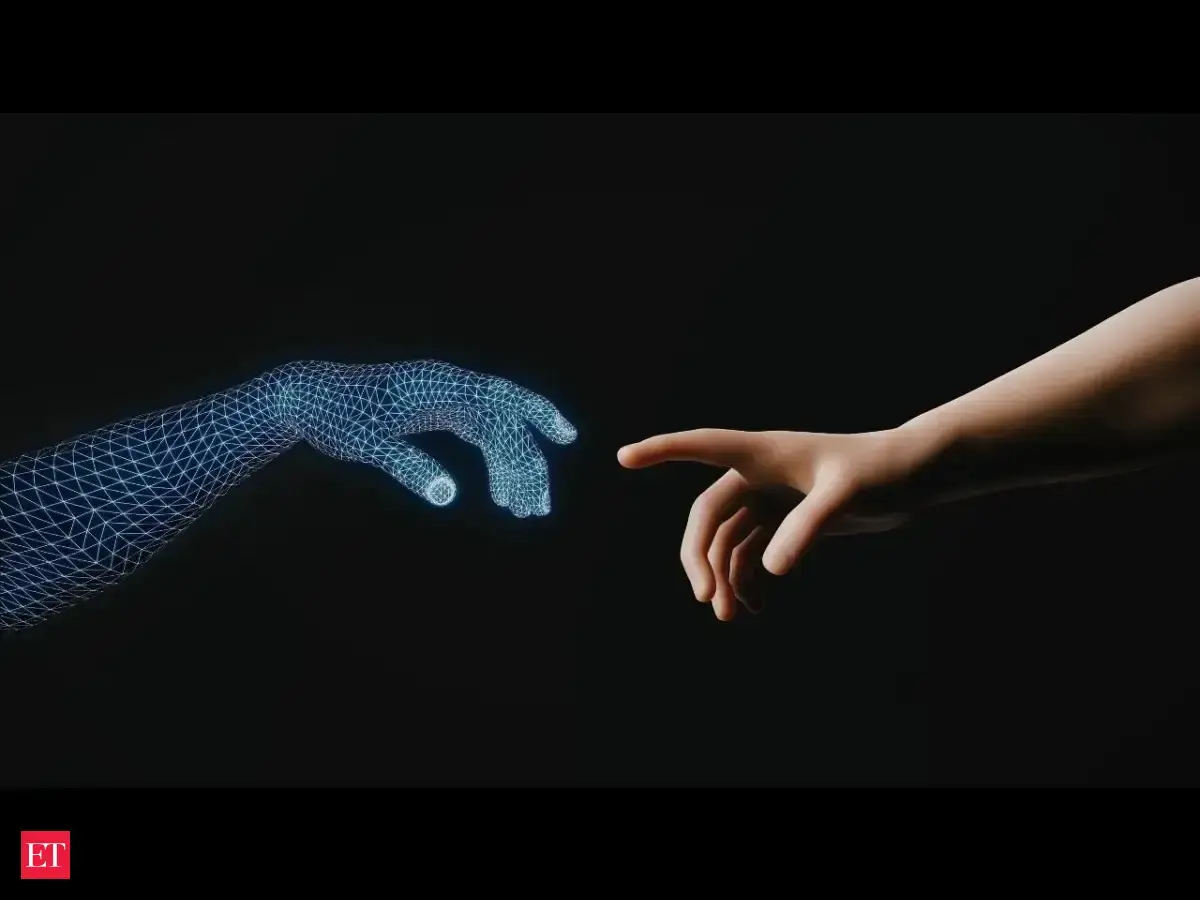
. Against that run, "human" reads as the pushback. The dictionary's blog cites a May 2026 UC San Diego study that reported participants judged GPT-4.5 to be human in 73% of 15-minute text conversations9
.
Source: ET
The debate the dictionary points to runs well beyond language. Bill Gates commented: "The measure of AI's success should be how much it improves human lives"
7
. Geoffrey Hinton, the AI pioneer and Nobel laureate, has said "we're creating alien beings. I'm willing to be selfish and choose humans"5
. The dictionary points to celebrities including Taylor Swift and Scarlett Johansson, who have trademarked their images or voices or spoken against unauthorized digital copies, as reactions to AI deepfakes5
. In March the UK government dropped plans that would have let AI companies use copyrighted material without permission, after artist opposition including Elton John and Kate Bush9
. In April the music company Jazz Is Dead launched a tool to verify human-made music9
. Academics, meanwhile, hope to develop a universally recognized human-made symbol, modeled on the Fairtrade label3
.Francesca Woodward, a board member at Cambridge University Press, told Agence France-Presse that people spent the year considering what it means to be human, particularly over AI taking jobs. "I think people are trying to remind themselves of ... what human means," she said
6
.
Source: NYT
Related Stories

References
Summarized by

Navi
[4]
Related Stories
Cambridge Dictionary Names 'Parasocial' 2025 Word of the Year, Highlighting AI and Celebrity Culture Impact
18 Nov 2025•Entertainment and Society
Macquarie Dictionary Names 'AI Slop' as 2025 Word of the Year
25 Nov 2025•Entertainment and Society

Merriam-Webster Names 'Slop' Word of the Year as AI Content Floods the Internet
15 Dec 2025•Entertainment and Society
Recent Highlights


Recent Highlights
Today's Top Stories






Don’t drown in AI news. We cut through the noise - filtering, ranking and summarizing the most important AI news, breakthroughs and research daily. Follow topics that matter to you and stay ahead.


