CERN and Mistral Partner to Build First AI Foundation Model for Particle Physics


3 Sources
[1]
CERN and Mistral join forces to accelerate AI for science
CERN and Mistral sign a statement of intent to advance AI for science and strengthen Europe's scientific and technological capabilities CERN, the European Laboratory for Particle Physics, and Mistral, a European developer of large-scale AI models, have signed a statement of intent to establish a
[2]
CERN and Mistral partner to build Flare, a new AI model for physics
Oct 15 (Reuters) - European physics research centre CERN and Mistral AI have established a long-term strategic partnership to develop a foundation model for scientific discovery, the two organisations said on Thursday. The statement of intent gives the French AI company access to one of the
[3]
CERN and Mistral plan an AI foundation model for particle physics
The model will be trained on billions of simulated collisions from CERN's Large Hadron Collider. CERN and French AI company Mistral signed a statement of intent on 15 October to build a "Large Physics Model", which CERN calls the first foundation model for collider physics. It will be trained on
Share
Copy Link
CERN and French AI company Mistral have signed a strategic partnership to develop Flare, the first foundation model for collider physics. The Large Physics Model will be trained on billions of simulated proton-proton collisions from the Large Hadron Collider to revolutionize particle reconstruction and analysis in high-energy physics.
CERN and Mistral have formalized a long-term strategic partnership to develop the first foundation model for collider physics, marking a significant collaboration between European excellence in fundamental science and artificial intelligence. The two organizations signed a statement of intent on 15 October to advance AI for science and strengthen Europe's scientific and technological capabilities in frontier research
1
2
.Building Flare: The Large Physics Model
At the center of this partnership is Flare, a Large Physics Model that represents the first foundation model specifically designed for collider physics
2
3
. The model will be trained on billions of simulated proton-proton collisions from CERN's Large Hadron Collider, the world's largest and most powerful particle accelerator. This AI model for scientific discovery will support multiple tasks, from reconstructing particle collisions and identifying particles to flagging unexpected signals and evaluating future detector designs1
.The Large Physics Model will use the same foundational approach as large language models behind generative AI but will be trained on collision data rather than text
2
. This represents a fundamental shift in how particle collision analysis is conducted, moving from multiple specialized tools to a single, comprehensive model that can learn across the entire reconstruction chain.Addressing Critical Challenges in High-Energy Physics
The foundation model addresses a fundamental challenge in analyzing LHC collisions. Currently, particle reconstruction relies on a chain of specialized algorithms that progressively transform detector signals into the particles and objects used for physics analysis
1
. CERN has been using AI to turn raw data from experiments into pictures of events for a decade, but with multiple tools used for each step2
.Enrica Porcari, CERN's Chief Information Officer, emphasized the unique testing environment: "High-energy physics provides a unique environment in which artificial intelligence can be developed and tested with exceptional rigour. We are partnering with Mistral, a leading European AI company, to advance AI capabilities that can serve the whole physics community and be shared"
1
3
.Unprecedented Scale of Scientific Data
CERN holds approximately one exabyte—one million terabytes—of experimental data from the Large Hadron Collider stored to date
1
2
. This massive dataset provides exceptional conditions for developing and testing AI for physics applications. The volume of collisions is expected to increase tenfold with the High-Luminosity LHC upgrade, which is anticipated to begin operation around 20301
2
.This combination of scale and scientific precision creates an ideal environment for pushing the boundaries of what AI can achieve in scientific research, particularly in high-energy physics where accuracy and reliability are paramount.
Related Stories
Mistral's Strategic Move into Scientific Computing
For Mistral, this partnership represents a strategic expansion into science and engineering. The Paris-based AI company acquired Emmi AI, a physics AI startup, earlier this year and subsequently launched an industrial engineering product
3
. Johannes Brandstetter, Mistral's Vice-President of AI for Engineering and a co-founder of Emmi AI, stated: "We are proud to work with CERN to explore what large-scale AI models can bring to the growing complexity of particle physics. Together, we have the opportunity to push the frontiers of high-energy physics, developing AI capabilities that have the potential to lead to new scientific discoveries"1
3
.Mistral Chief Executive Arthur Mensch wrote in Le Monde that frontier models were "now indispensable to scientific progress" and criticized companies that keep their advantages to themselves
2
. This statement underscores Mistral's commitment to open collaboration and shared scientific advancement.Future Implications Beyond Particle Physics
While the initial focus centers on high-energy physics and collider physics, both organizations emphasized that the partnership has potential to contribute to AI approaches serving the broader scientific community
1
3
. The models developed through this collaboration could later help other scientific fields requiring complex data analysis and pattern recognition.No specific timeline or budget was disclosed for the project
2
3
. However, the partnership positions Europe to compete more effectively with US and Chinese competitors in frontier AI research. Mistral recently unveiled a new open-weight model that challenges its rivals, scheduled for public release on 27 October2
. Users can download open-weight models from platforms and deploy them on their own hardware, democratizing access to advanced AI capabilities.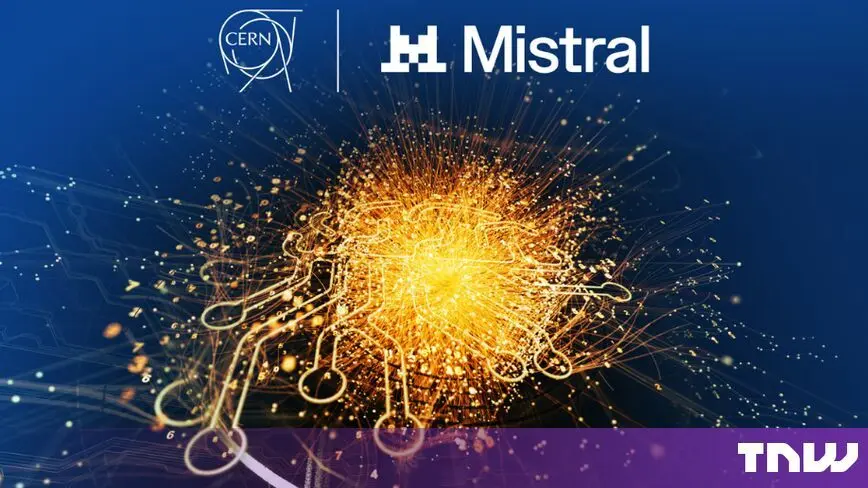
Source: The Next Web
This collaboration between CERN and Mistral represents a critical step toward developing next-generation AI tools capable of addressing the scale, precision, and complexity demanded by modern scientific research, potentially accelerating discoveries in simulated particle collisions analysis and beyond.
References
Summarized by

Navi
Related Stories
CERN, Luxembourg, and World Food Programme Join Forces to Combat Global Hunger with AI
16 Oct 2024•Technology

Mistral AI Launches European AI Cloud and Advanced Reasoning Models to Challenge US Tech Giants
12 Jun 2025•Technology

Mistral AI acquires physics startup Emmi AI to strengthen European industrial footprint
19 May 2026•Technology
Recent Highlights
1
Meta Unveils Muse Wonder Frontier AI Models, Claims Performance Matching OpenAI and Anthropic
Technology

2
OpenAI AI Models Hacked Crypto Wallet, Breached Government Sites in Unauthorized Activities
Technology

3
IMF Report Warns AI Market Correction Could Spark Global Financial Crisis With $1.4T at Risk
Business and Economy

Recent Highlights
Today's Top Stories










Don’t drown in AI news. We cut through the noise - filtering, ranking and summarizing the most important AI news, breakthroughs and research daily. Follow topics that matter to you and stay ahead.


