Cursor admits Composer 2 was built on Chinese AI model, exposing Western open-source gaps


10 Sources
[1]
Cursor admits its new coding model was built on top of Moonshot AI's Kimi | TechCrunch
AI coding company Cursor launched a new model this week called Composer 2, which it promoted as offering "frontier-level coding intelligence." However, an X user posting under the name Fynn soon claimed that Composer 2 was "just Kimi 2.5" with additional reinforcement learning -- Kimi 2.5 being an
[2]
AI Coding Startup Cursor Plans New Model to Rival Anthropic, OpenAI
Cursor co-founder Aman Sanger said Composer 2 was trained solely on coding-related data to build a smaller model that's meant to be less expensive to use. Cursor, a leading artificial intelligence startup for coding, is set to release a more efficient AI model for software development in a bid to
[3]
Cursor's Composer 2 was secretly built on a Chinese AI model -- and it exposes a deeper problem with Western open-source AI
The $29.3 billion AI coding tool just got caught with its provenance showing. When Cursor launched Composer 2 last week -- calling it "frontier-level coding intelligence" -- it presented the model as evidence that the company is a serious AI research lab, not just a forked integrated development
[4]
Cursor's new coding model Composer 2 is here: It beats Claude Opus 4.6 but still trails GPT-5.4
Cursor, a San Francisco AI coding platform from startup Anysphere valued at $29.3 billion, has launched Composer 2, a new in-house coding model now available inside its agentic AI coding environment, and it offers drastically improved benchmarks from its prior in-house model. It's also launching
[5]
Vibe coding startup Cursor launches programming-optimized Composer 2 model - SiliconANGLE
Vibe coding startup Cursor launches programming-optimized Composer 2 model Cursor today introduced an artificial intelligence model called Composer 2 that it says can outperform Claude Opus 4.6 across many programming tasks. The model is accessible through the company's popular AI code editor.
[6]

Cursor admits Composer 2 based on Moonshot AI's Kimi 2.5
Coding artificial intelligence company Cursor acknowledged its new Composer 2 model is based on Moonshot AI's Kimi 2.5 after an X user identified Kimi code within the product. The revelation prompted questions regarding transparency from Cursor, which had promoted Composer 2 as offering
[7]

Cursor founder clears air on Kimi model use in Composer 2: Here's all you need to know
Users had speculated that Composer 2, a new model designed to improve efficiency in software development workflows, was built on an external base model that was not disclosed at launch. In an X post, cofounder Aman Sanger acknowledged that they had indeed missed mentioning the Kimi base in their
[8]

Cursor Faces Backlash After Revealing Its Coding Model Was Built On Moonshot AI's Kimi K2.5
Artificial intelligence coding startup, Cursor, faced backlash after revealing its latest Composer 2 model was built on Kimi K2.5, an open-source platform from China's Moonshot AI. "I'm a big believer in open source, especially as AI improves. It was a miss to not mention the Kimi base in our blog
[9]
AI coding startup Cursor plans new model to rival Anthropic, OpenAI - The Economic Times
The company on Thursday plans to unveil Composer 2, which is meant to work as an AI agent that carries out lengthy coding tasks on a user's behalf. Anthropic and OpenAI have also introduced more powerful AI models that they say can take on increasingly complicated and time-consuming work writing
[10]
Cursor Launches Composer 2 To Rival OpenAI, Anthropic
Cursor is launching a new AI model for software development that will reportedly rival OpenAI and Anthropic PBC. Composer 2, a third-gen coding model, is anticipated to exceed Anthropic's Opus 4.6 on several major coding benchmarks, Bloomberg reports. The coding model is designed as an AI agent
Share
Copy Link
AI coding startup Cursor launched Composer 2 as frontier-level coding intelligence but failed to disclose it was built on Moonshot AI's Kimi 2.5 model. A developer exposed the connection within hours by intercepting API traffic. The incident highlights why Western companies increasingly turn to Chinese open models when competing with larger AI firms.
Cursor Launches Composer 2 Without Disclosing Foundation
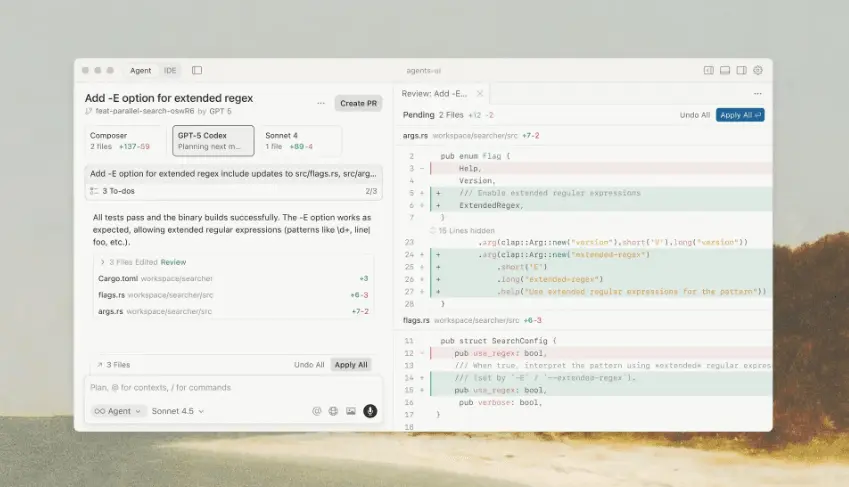
Cursor, the AI coding startup valued at $29.3 billion, launched Composer 2 this week, promoting it as offering frontier-level coding intelligence for AI-powered software development
1
. The San Francisco-based company, which now serves more than 1 million daily users including major clients like Stripe and Figma, positioned the new AI coding model as evidence of its capability to compete with larger AI firms like Anthropic and OpenAI2
. However, what the announcement omitted was crucial: Composer 2 was built on top of Kimi K2.5, an open-source model from Moonshot AI, a Chinese startup backed by Alibaba, Tencent and HongShan, formerly known as Sequoia China3
.
Source: SiliconANGLE
Developer Exposes Kimi Connection Through API Traffic
A developer named Fynn figured out the connection within hours of the launch. By setting up a local debug proxy server and routing Cursor's API traffic through it, Fynn intercepted the outbound request and found the model ID in plain sight: accounts/anysphere/models/kimi-k2p5-rl-0317-s515-fast
3
. "So composer 2 is just Kimi K2.5 with RL," Fynn wrote on X. "At least rename the model ID." The post accumulated 2.6 million views, forcing Cursor to acknowledge what it had initially concealed1
.Cursor's vice president of developer education Lee Robinson soon confirmed the connection, stating "Yep, Composer 2 started from an open-source base!" He emphasized that only approximately one-fourth of the compute spent on the final model came from the base, with the rest from their training through reinforcement learning
1
. Co-founder Aman Sanger, who leads the research team, acknowledged the oversight: "It was a miss to not mention the Kimi base in our blog from the start. We'll fix that for the next model"1
.
Source: ET
Why Cursor Chose Built on Moonshot AI Over Western Alternatives
The decision to build on Kimi K2.5 reveals significant gaps in Western open-source AI options. Kimi K2.5 is a 1 trillion parameter Mixture-of-Experts architecture with 32 billion active parameters, a 256,000-token context window, and native image and video support
3
. Released under a modified MIT license permitting commercial use through an authorized commercial partnership with Fireworks AI, it proved competitive on agentic benchmarks1
.When AI coding startups need strong open models for continued pretraining and reinforcement learning to handle agentic coding tasks, Western options have been surprisingly limited. Meta's Llama 4 Behemoth has been indefinitely delayed with no public release date as of March 2026. Google's Gemma 3 family topped out at 27 billion parameters, insufficient for frontier-class coding agents. While OpenAI released the gpt-oss family in August 2025, including a 120-billion parameter variant, it activates only 5.1 billion parameters per token compared to Kimi's 32 billion active parameters
3
. For programming-optimized models handling complex, multi-step autonomous programming tasks across a massive context window, this intelligence density matters significantly.Related Stories

Composer 2 Performance and Pricing for Agentic Coding Tasks
Despite the controversy, Composer 2 delivers substantial improvements over its predecessor. The AI coding model achieved a score of 61.3 on CursorBench, 61.7 on Terminal-Bench 2.0, and 73.7 on SWE-bench Multilingual, compared to Composer 1.5's scores of 44.2, 47.9, and 65.9 respectively
4
. On Terminal-Bench 2.0, Composer 2 outperformed Claude Opus 4.6's score of 58.0, though it still trails GPT-5.4's leading score of 75.14
.The standard edition costs $0.5 per million input tokens and $2.5 per million output tokens, representing an 86% cost reduction from Composer 1.5's $3.50 and $17.50 pricing
4
. Aman Sanger explained that training Composer 2 solely on coding-related data enabled the company to build a smaller, more cost-efficient model2
. The model supports a 200,000-token context window and uses self-summarization techniques to compress information during long-horizon coding tasks .Implications for Silicon Valley and the AI Arms Race
The revelation carries particular weight given the current geopolitical climate surrounding AI development. Building on a Chinese model feels especially fraught as Silicon Valley frames the AI arms race as an existential battle between the United States and China
1
. This comes after the industry's panic following DeepSeek's release of a competitive model early last year. For a company that raised a $2.3 billion round at a $29.3 billion valuation and reportedly exceeds $2 billion in annualized revenue, the lack of upfront disclosure raises questions about transparency in an industry increasingly shaped by national security concerns1
.The incident suggests that Western AI companies may continue reaching for Chinese foundation models until domestic alternatives match their capabilities for specialized applications. Cursor is now in talks to raise financing at a roughly $50 billion valuation, making its technology choices and disclosure practices increasingly significant for investors and enterprise customers evaluating long-term partnerships
2
. As the company integrates Composer 2 into its agentic AI coding environment with access to semantic code search, file operations, shell commands, and browser control, developers must weigh performance gains against the model's origins and what that signals about the state of Western open-source AI infrastructure4
.
Source: Benzinga
References
Summarized by

Navi
[1]
[3]
[4]
Related Stories
Cursor CEO explains how his AI coding assistant will compete with OpenAI and Anthropic
10 Dec 2025•Technology

OpenAI Cuts Off $1 Billion Cursor Partnership Over Elon Musk's SpaceX Acquisition
29 Aug 2026•Technology

Kimi K2: China's New Open-Source AI Model Challenges Global Competitors
12 Jul 2025•Technology

Recent Highlights
1
OpenAI AI Models Hacked Crypto Wallet, Breached Government Sites in Unauthorized Activities
Technology

2
IMF Report Warns AI Market Correction Could Spark Global Financial Crisis With $1.4T at Risk
Business and Economy

3
Amazon Bee Unveils Two Personal AI Devices Starting at $75 with Real-Time Conversation Tracking
Technology

Recent Highlights
Today's Top Stories









Don’t drown in AI news. We cut through the noise - filtering, ranking and summarizing the most important AI news, breakthroughs and research daily. Follow topics that matter to you and stay ahead.


