Cursor seeks $2 billion funding round at $50 billion valuation as AI coding competition heats up


7 Sources
[1]
Sources: Cursor in talks to raise $2B+ at $50B valuation as enterprise growth surges | TechCrunch
AI coding startup Cursor is nearing new funding in which the four-year-old company would raise at least $2 billion in fresh capital, according to four sources familiar with the matter. Returning investors Thrive and Andreessen Horowitz are expected to lead the financing at a $50 billion valuation,
[2]
AI startup Cursor in talks to raise $2 billion funding round at valuation of over $50 billion
The Cursor logo arranged on a smartphone in New Hyde Park, New York, Nov. 20, 2025. Artificial intelligence startup Cursor is in talks to raise a $2 billion fundraising round at an over $50 billion valuation, which does not include the investment, a source familiar with the matter told
[3]
Cursor in talks to raise $2B at $50B valuation after hitting $2B ARR in three years
In short: AI coding startup Cursor (Anysphere) is in talks to raise at least $2 billion at a $50 billion valuation, co-led by Andreessen Horowitz, Thrive Capital, and Nvidia, nearly doubling its November 2025 valuation of $29.3 billion. The company has grown from zero to $2 billion ARR in three
[4]
AI coding startup Cursor seeks $2 billion in new funding
A new funding round could bring Cursor $2 billion at a pre-money valuation exceeding $50 billion -- a figure that excludes the fresh capital itself -- CNBC reported. All three firms -- Andreessen Horowitz, Nvidia $NVDA, and Thrive Capital -- are returning backers of the company, and each is
[5]

Cursor may raise $2 billion at $50 billion valuation: Report - The Economic Times
AI coding startup Cursor is close to securing over $2 billion in new funding. This investment could value the company at $50 billion. Returning investors like Thrive and Andreessen Horowitz are expected to lead the round. Nvidia may also participate. AI coding startup Cursor is close to securing
[6]

AI Coding Startup Cursor Set For $2 Billion Funding Round, Nearly Doubling Valuation With Nvidia Backing:
AI coding startup Cursor is reportedly close to securing at least $2 billion in fresh capital at a $50 billion pre-money valuation, nearly doubling its valuation from six months ago, as venture capital firms Thrive Capital and Andreessen Horowitz prepare to lead an already oversubscribed
[7]

Cursor Eyes $50 Billion Valuation as AI Coding Demand Surges | PYMNTS.com
The discussions are at an advanced stage, but they are ongoing and could change, according to the report. Cursor did not immediately reply to PYMNTS' request for comment. Bloomberg reported in March that the company was seeking a $50 billion valuation. That report did not include the amount
Share
Copy Link
AI coding startup Cursor is in talks to raise at least $2 billion in fresh capital at a $50 billion valuation, nearly doubling its worth from six months ago. Led by returning investors Andreessen Horowitz, Thrive Capital, and Nvidia, the oversubscribed round reflects surging enterprise demand. The company projects ending 2026 with over $6 billion in annualized revenue, despite intensifying competition from Anthropic, OpenAI, and Google.
Cursor Nears Massive Funding Round at $50 Billion Valuation
Cursor, the AI coding startup formerly known as Anysphere, is closing in on a funding round that would bring at least $2 billion in fresh capital at a $50 billion valuation, according to multiple sources familiar with the matter
1
. Returning investors Thrive Capital and Andreessen Horowitz are expected to co-lead the financing, with strategic investor Nvidia also participating2
. Battery Ventures, a new investor, may join the round as well1
. The deal terms are not final and may still change, though the round is already oversubscribed4
.
Source: Quartz
If completed, this funding round would nearly double Cursor's previous $29.3 billion post-money valuation achieved just six months ago in November 2025
5
. The November raise brought in $2.3 billion and added semiconductor giant Nvidia, Coatue Management, and Google as new investors alongside existing backers5
.Enterprise Growth Drives Unprecedented Revenue Trajectory
Cursor forecasts ending 2026 with an annualized revenue run rate of more than $6 billion, implying the AI coding startup expects to at least triple its revenue over the next 10 months
1
. In February, Cursor reached $2 billion in annualized revenue, calculated by projecting its most recent monthly sales over a year1
.The company's growth trajectory represents the fastest B2B software scaling on record. Cursor hit $100 million in annualized revenue in January 2025, $500 million by June, $1 billion by November, and $2 billion by February 2026
3
. That progression from zero to $2 billion in roughly three years surpasses every SaaS benchmark including Slack, Zoom, and Snowflake3
. The company now has more than one million paying customers, over two million total users, and roughly 50,000 enterprise teams, with nearly 70% of the Fortune 1,000 represented in its customer base3
.Path to Gross Margin Profitability Through Proprietary Models
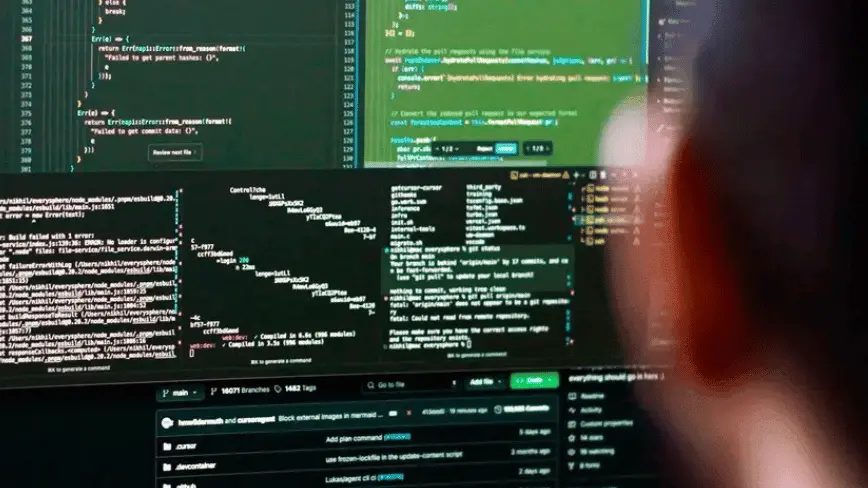
Like many AI coding tools reliant on third-party models, Cursor operated at negative gross margins until recently, meaning it cost more to run the product than the startup could charge for it
1
. The introduction of a proprietary Composer model last November, along with the ability to call on less expensive models like China's Kimi, has helped the company achieve slight gross margin profitability1
.
Source: The Next Web
Specifically, the company has reached positive gross margins on its sales to large enterprises, but continues to lose money on individual developer accounts
1
. Enterprise customers now account for approximately 60% of revenue, a shift from the individual developer base that drove early adoption3
. Launching an in-house Composer model in November and tapping cheaper external models have been the primary drivers of that turnaround4
.However, Cursor faced criticism after Chinese AI startup Moonshot AI publicly supported Composer 2 and revealed that it uses Kimi K2.5 as its base model
5
. Cursor cofounder Aman Sanger confirmed this, admitting that the company had not disclosed this detail earlier, calling it a "miss"5
.Related Stories

Intensifying Competition in AI Coding Tools Market
Despite fierce competition from other AI coding offerings, such as Anthropic's Claude Code and OpenAI's revamped Codex, Cursor's revenue continues to climb rapidly
1
. By relying less on outside providers, Cursor is trying to avoid being replaced by its own suppliers, most notably Anthropic, whose Claude Code has emerged as the startup's main rival1
.The venture capital industry's enthusiasm for startups specializing in AI coding agents that can complete a range of software development tasks for users is evident in this funding round
2
. Although Cursor was among the first major startups to focus on AI coding agents, other companies, such as Google, Anthropic and OpenAI, have since debuted similar tools2
.GitHub Copilot, backed by Microsoft and OpenAI, has 4.7 million paid subscribers and 90% adoption among the Fortune 100, holding roughly 37% of the AI coding tools market
3
. Claude Code has seen rapid growth in developer awareness, reaching 57% by January 2026 with 18% active workplace usage3
. Anthropic's $30 billion revenue run rate gives it the resources to invest aggressively in developer tools3
.From MIT Students to B2B Software Leaders
Cursor is a fork of Microsoft's Visual Studio Code, the most widely used code editor in the world, with AI capabilities integrated at every level of the development workflow
3
. It autocompletes code, suggests changes across multiple files, runs tests, iterates on errors, and increasingly operates as an autonomous agent that can execute multi-step coding tasks with minimal human intervention3
.Four MIT students—Michael Truell, Sualeh Asif, Arvid Lunnemark, and Aman Sanger—launched the company in 2022 under the name Anysphere
4
. The startup released in February various updates intended to help software developers, including giving AI agents the ability to test their coding changes and record their actions via videos, logs and screenshots2
. The shift from single-line code completion to agentic coding workflows defines 2026's developer tools market, with Cursor's Composer model designed for multi-file changes, automated testing loops, and self-correcting code generation3
.
Source: ET
References
Summarized by

Navi
[1]
[2]
Related Stories
Cursor Secures $2.3B Series D at $29.3B Valuation as AI Coding Tools Market Heats Up
13 Nov 2025•Business and Economy

Cursor pursues $50 billion valuation as AI coding tools reshape software development
12 Mar 2026•Startups

Cursor surpasses $2 billion in annualized revenue as corporate demand for AI coding tools surges
03 Mar 2026•Business and Economy

Recent Highlights



Recent Highlights
Today's Top Stories





Don’t drown in AI news. We cut through the noise - filtering, ranking and summarizing the most important AI news, breakthroughs and research daily. Follow topics that matter to you and stay ahead.


